Home Blog Page 699

Ripple CEO Says Ripple Never Offered $10-$20B to Acquire Circle: Report

0

Ripple CEO Brad Garlinghouse has clarified the swirling rumors about the company’s alleged bid to acquire USDC stablecoin issuer Circle.

In an X post yesterday, fintech policy expert Chris Brummer summarized key takeaways from his fireside chat with Garlinghouse during the XRP Las Vegas conference.

According to the summary, Garlinghouse and Brummer discussed Ripple’s future direction and addressed rumors surrounding a potential acquisition of Circle.

Rumors of Ripple’s interest in acquiring Circle have been circulating since April. Multiple reports suggested that Circle rejected an initial offer from Ripple in the range of $4 billion to $5 billion, deeming it insufficient. Notably, subsequent reports claimed that Ripple raised its offer to between $10 billion and $20 billion.

Ripple Never Offered $10-$20B for Circle 

However, according to Brummer, Garlinghouse refuted this claim at the XRP Las Vegas conference, denying that Ripple ever offered $10–$20 billion to acquire Circle.

While his statement implied that Ripple may have made an offer at some point, he did not disclose specific financial details. According to Brummer, Garlinghouse indicated that Ripple was not pursuing an outright takeover of Circle.

In the meantime, Circle has dismissed reports about potential plans to sell itself to Ripple. A spokesperson affiliated with the stablecoin issuer revealed that the company is currently focused on its long-term goals. 

Weeks after denying the acquisition rumors, Circle filed for an IPO on the NYSE, offering 24 million Common A shares at $24 to $26 each. 

Other Major Key Points From Garlinghouse

Meanwhile, Brummer also shared other key points Garlinghouse made at the conference. 

RLUSD’s Use in Hidden Road 

According to Brummer, Garlinghouse hinted that Ripple’s acquisition of Hidden Road signals deeper ambitions. The deal, which would see Hidden Road utilize RLUSD as a collateral asset for its prime brokerage services, signals Ripple’s intent to position RLUSD as an on-ledger collateral, not just another stablecoin.  

Brummer described this approach as “infrastructural thinking,” perhaps unexciting to some, but foundational for the industry.

XRPL’s Selection in Dubai Real Estate Tokenized Project 

Additionally, the Ripple CEO also commented on the selection of the XRP Ledger (XRPL) for Dubai’s real estate tokenization project. The Dubai Land Department, in collaboration with Ctrl Alt, the Dubai Future Foundation, and the Virtual Assets Regulatory Authority, would issue tokenized title deeds on XRPL. 

Reacting, Garlinghouse asserted that tokenization is transitioning into a practical experiment in some regions like Dubai. 

Unity in Crypto 

Furthermore, the Ripple CEO also advocated for unity across the broader crypto space as he weighed in on the company’s donation of the Skull of Satoshi to the Bitcoin community. 

In his view, the continuous conflict between crypto communities yields no positive results but harms the entire industry. Hence, he encouraged the industry to unite in achieving shared goals. 

Top Analyst Predicts $38 Price Target for XRP — Here’s the Main Reason Why

XRP could be on track to resume its bull run after retesting the neckline of a years-long double bottom structure.

Veteran analyst and Dutch market technician Gert van Lagen highlighted this situation in one of his previous analyses. However, despite weeks of price action, data suggests the analyst’s commentary is still relevant, as XRP has maintained this retest.

Specifically, Van Lagen previously spotlighted a double bottom XRP formed on the 2-week chart that has persisted for seven years. 

XRP Forms 7-Year Double Bottom

For the uninitiated, a double bottom is a pattern that signals a possible shift from a downward trend to an upward one. Notably, it resembles a “W” shape, forming when the price drops, recovers, dips again to nearly the same level, and then climbs.

In XRP’s case, the first bottom formed when the asset collapsed from the $3.8 all-time high in January 2018 to a floor price of $0.1140 by March 2020. XRP eventually recovered from this floor to a new high of $1.96 in April 2021 during the bull run at the time. This confirmed the first formation.

XRP Forms Double Bottom Gert Van Lagen
XRP Forms Double Bottom | Gert Van Lagen

Meanwhile, the second bottom formed when XRP slumped from the $1.96 high in April 2021 to another floor price of $0.2870 in June 2022. This materialized on the back of the Terra collapse in May 2022. However, XRP recovered to the $2 mark in December 2024, sealing the second formation.

With these two bottoms fully formed, the structure took shape, featuring a neckline at the $2 price level. In such patterns, a break above the neckline is often a signal of a bullish breakout. Nonetheless, the market typically expects a retest of the neckline support following that breakout before a price run.

Interestingly, XRP broke above the neckline in December 2024, soaring further to a high of $3.4 by January 2025. However, at $3.4, the asset faced resistance, eventually retracing to the $2 mark. XRP has struggled at $2 since February, and as it faces these struggles, the asset is essentially retesting the neckline.

Analyst Sets XRP Target at $38, but Insists It’s Conservative 

To maintain its bullish structure, XRP must defend the $2 mark, which represents the neckline. As long as this structure remains, the double bottom pattern is still intact, and a recovery could lead to the much-anticipated price explosion.

The analyst also identified an ascending triangle that began forming after the first bottom. Importantly, Van Lagen has set a target of $38, marking a 1,604% increase from the current XRP price of $2.23. Nonetheless, the analyst insists this target is conservative due to historical precedent. 

Specifically, when XRP witnessed a similar double bottom structure from December 2013 to April 2017, the post-breakout rally was more parabolic than what it would witness from here to $38. Despite this more parabolic run, the previous double bottom took less time to form, with just over three years.

Notably, several analysts have also predicted a possible run to the $30 range. For instance, market watcher EGRAG suggested in February that XRP could claim $34. Also, wealth mentor Linda Jones mentioned last November that XRP’s 4-year cycle could push the asset to $33.

Here is the Predicted Timeline for Shiba Inu to Reach $0.00024 or $0.0058

0

Amid Shiba Inu rebounding to the $0.00013 range, we consulted multiple sources to determine when SHIB might surge to ambitious targets such as $0.00024 or $0.0058.

Shiba Inu is gradually recovering from the recent downturn, which saw its price drop to the $0.000012 level last week. It has since rebounded and is currently trading at $0.00001309 as of the latest update.

Despite the brief recovery, Shiba Inu is still showing a 7-day decline of 9.84%. Conversely, its price has increased by 3.01% in the past 24 hours and 0.72% over the past week.

Shiba Inu Potential Surge to $0.00024 or $0.0058 

Shiba Inu’s modest rebound has reignited investor optimism, with many anticipating a rally toward higher targets like $0.00024 or $0.0058. Reaching these levels would require SHIB to eliminate up to two zeros from its current price.

To hit these targets, Shiba Inu would need to rise by approximately 1,733% to reach $0.00024, and 44,208% to hit $0.0058, based on its current price of $0.00001309.

Assuming the supply remains at 589.5 trillion tokens, a price of $0.00024 would imply a market cap of $141.48 billion, while $0.0058 would correspond to a staggering valuation of $3.41 trillion.

Several entities believe Shiba Inu could eventually clinch the $0.00024 and $0.0058 marks under favorable market conditions. As a result, we compiled the views of various experts regarding when these predictions could materialize. 

Predictions for Shiba Inu’s Surge to $0.00024 or $0.0058

Experts affiliated with the crypto trading platform Changelly predict that Shiba Inu will reach the $0.00024 target by February 2032, seven years from now. They expect SHIB to hit an all-time high of $0.000246 by then. 

However, the experts project that the $0.0058 prediction will materialize eight years later, specifically by May 2040.

Telegaon 

Leading crypto prediction platform Telegaon suggests that the $0.00024 forecast would come to fruition in three years, 2028. According to the prediction, Shiba Inu’s price is expected to hover between $0.000207 and $0.000312 by 2028. 

For the $0.0058 forecast, Telegaon expects it to become a reality between 2036 and 2039, which is 11 to 14 years from today. 

ChatGPT and Grok Potential Timelines 

Meanwhile, we also consulted two leading AI chatbots to gauge their timelines for SHIB’s rise to $0.00024 and $0.0058. 

ChatGPT 

According to ChatGPT, Shiba Inu will hit the $0.00024 price milestone between late 2025 and mid-2026, potentially driven by a strong bull market, SHIB token burn, and widespread adoption of Shibarium. 

However, the chatbot expects the $0.0058 forecast to play out by late 2031 or early 2032. ChatGPT suggests that achieving this feat would require reducing Shiba Inu’s supply by 50–75%, massively expanding SHIB’s utility, and riding two more bull cycles in 2028 and 2032. 

ChatGPT timeline for Shiba Inu surge to $000024 and $00058

Grok 

On the other hand, X’s Grok issued its prediction under two different scenarios: optimistic and conservative. For the optimistic scenario, Grok forecasted that SHIB will clinch the $0.00024 target this year. 

However, it set a conservative timeline of 2030, suggesting that SHIB could trade at $0.00024 within the next six years. Furthermore, Grok projects that Shiba Inu will not reach the $0.0058 target until 2040, 15 years from now. 

Grok timeline for Shiba Inu surge to $000024 or $00058

Santana Predicts When SHIB Could Hit $0.0002

Last year, prominent market analyst Alan Santana forecasted that Shiba Inu could soar near the $0.00024 target this year. In the analysis, Santana suggested that Shiba Inu was in an ‘accumulation phase,’ which could see the asset trade sideways and eventually reach a target price of $0.00023179 by the end of 2025. 

DAG Managing Director Explains How XRP ETF Could Impact XRP Price

XRP advocate Jake Claver, Managing Director of Digital Ascension Group, recently weighed in on how XRP’s price could react to the launch of spot ETFs.

In a recent disclosure, Claver expressed his anticipation that XRP spot ETFs could launch this year. Notably, the SEC has postponed decisions on filings from firms like Grayscale, Franklin, and WisdomTree as predicted.

However, the broader expectation is that these products will launch in the last quarter of 2025, specifically around October, when the SEC reaches a final decision deadline. With the products going live, Claver noted he expects price appreciation for XRP. He drew parallels to what happened with Bitcoin.

XRP Could Follow Bitcoin’s Path

Notably, Bitcoin spot ETFs launched in January 2024, when Bitcoin was trading around $45K. The initial hype led to a brief “sell the news” event, where Bitcoin dipped shortly after the launch.

However, a historic price rally followed, with Bitcoin peaking above $73K ahead of its April 2024 halving. This marked the first time BTC claimed a new ATH before the halving. Bitcoin went on to surpass the $100K level by the end of the year as Bitcoin ETFs accumulated over 1 million BTC tokens, with BlackRock leading the charge.

Claver believes a similar scenario could play out for XRP. He noted that a glimpse of this occurred in late 2024 when XRP’s price broke out massively to the upside for the first time in years. 

The price movement coincided with major developments, including repeated news of asset managers filing to list XRP ETFs. Bitwise and Canary Capital were among the first movers, followed shortly after by others like Grayscale and WisdomTree.

While a cooldown from the frenzy brought XRP’s price below $2 multiple times, the coin has largely remained stable around the $2 mark. Proponents believe that an official ETF approval announcement would bring fresh momentum for XRP.

Latest on XRP ETFs

The latest development from the SEC concerning XRP ETFs is that the regulator has initiated proceedings to decide whether to approve the WisdomTree XRP Fund. In a May 27 notice, the SEC stated it is evaluating whether the proposal complies with statutory laws. Accordingly, the agency has called on the public to provide input.

The public has 21 days from the date of publication in the Federal Register to submit comments, and 35 days for rebuttals.

While filings from major industry names are already present, BlackRock and Fidelity, which are leaders in Bitcoin spot ETFs, are notably absent. As a result, the XRP community is widely anticipating their filings. Their involvement could be a game-changer for XRP, similar to their impact on Bitcoin.

How High Could XRP Go?

Speculation around XRP’s potential price performance following the ultimate arrival of ETFs has been widespread.

One theory projects XRP’s potential based on attracting just a portion of Bitcoin ETF inflows, should U.S. approval occur.

Since January 2024, Bitcoin ETFs have seen about $40 billion in inflows. If XRP ETFs attract 15% of that ($6 billion), and a 100x inflow-to-valuation multiplier is applied, XRP’s market cap could rise by $600 billion to reach $715 billion. Specifically, this would push the price to $12, a 450% increase from its current $2.22.

Meanwhile, analyst Zach Rector predicts XRP could reach $15 if XRP ETFs attract strong inflows. Notably, he used a more aggressive market cap multiplier model.

Rector bases his forecast on JPMorgan’s estimate that XRP ETFs could see $4–$8 billion in inflows during their first year. Using the lower $4 billion figure and a 200x market cap multiplier, he estimates an $800 billion boost in XRP’s valuation. Adding this to XRP’s current $125 billion market cap brings it to $925 billion.

While these forecasts sound promising, they are based on hypothetical scenarios that may not materialize.

“Not Taking Risks Is a Risk”: CZ Reacts as 12 New Companies Add Bitcoin to Balance Sheets

0

Binance founder Changpeng Zhao (CZ) suggests that new Bitcoin treasury companies are making calculated, risk-based decisions like any other firm.

He made this assertion in response to data on the latest Bitcoin treasury companies.

12 New Bitcoin Treasury Companies Disclose BTC Holdings 

For context, last month ended on a high note for Bitcoin. Notably, several companies leveraged Strategy’s Bitcoin playbook by converting part of their cash reserves to BTC for the first time. 

Crypto commentator Berit shared data showing that 12 companies acquired Bitcoin last month, marking it as their first BTC purchase. According to the data, GameStop acquired 4,710 BTC, Zap Solutions 1,500 BTC, DDC Enterprise 100 BTC, Roxom Global 98.01 BTC, and ATAI 58 BTC. 

Other companies whose Bitcoin acquisition became public knowledge in May include KindlyMD/Nakamoto (21 BTC), Coinsilium Group Forza (10 BTC), Walnut Capital (10 BTC), Where Food Comes From (7 BTC), GreenMerc (6.2 BTC), Al Abraaj Restaurants (5 BTC), and H100 Group (4.39 BTC). 

Binance Founder: “Not Taking Risks to Buy Bitcoin Is a Risk”

In response, the Binance founder said these new Bitcoin treasury companies are making deliberate, risk-based decisions by purchasing BTC. He emphasized that every company takes risks, whether they’re buying Bitcoin or engaging in other activities.

According to him, risk is not a binary concept requiring an all-or-nothing approach. Instead, the amount of risk a company assumes should be based on a calculated position on a scale of 0–100%.

CZ, who previously stated that Bitcoin was going to the “moon,” asserted that with the right balance, a firm could achieve an optimal risk-to-ROI ratio.

Managing Risks 

Rather than criticizing or endorsing any specific strategy, CZ’s commentary framed Bitcoin acquisition by treasury companies as part of a broader discussion on corporate risk management. It suggests that companies must find a personalized, optimal balance of risk and return, whether that includes Bitcoin or not.

In response to his commentary, a follower asked CZ how much risk exposure he is taking, and he replied, “Too much.”

He said he holds more fiat than necessary, humorously describing it as riskier than holding Bitcoin. In parallel, Zhao noted he plans to reduce his risk exposure in fiat currencies.

However, he did not indicate whether he would convert some fiat currencies to cryptocurrencies, such as Bitcoin. 

Essentially, the Binance founder’s message is that firms face significant risks by refusing to take risks. This implies that companies that decide not to add Bitcoin to their balance sheets may be taking a greater risk, which could result in them missing out on potential returns. 

BlackRock Dumps $561 Million in Bitcoin to Buy Ethereum

The world’s largest asset manager, BlackRock, is again making headlines in the crypto space, and this time for selling Bitcoin to buy Ethereum.

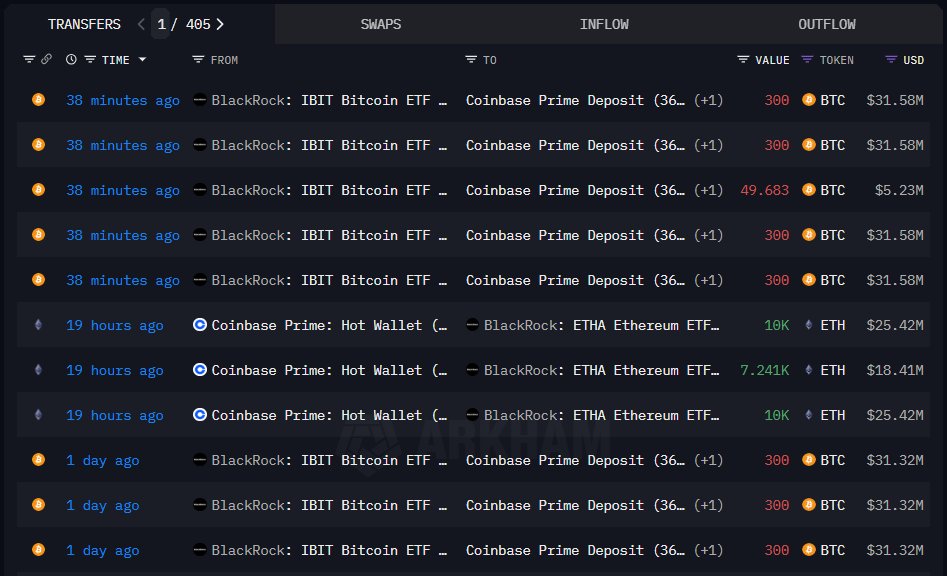
Over the past few days, on-chain data has shown BlackRock gradually liquidating portions of its Bitcoin holdings via the Coinbase Prime institutional platform.

The trend of BlackRock’s BTC sales picked up on June 2 at 10:56 UTC, when it moved 300 BTC worth $31.3 million to Coinbase. For context, prior to this transaction, the last outflow to Coinbase was three weeks ago.

BlackRock went on to offload a total of 5,362 BTC through a series of transactions: multiple 300 BTC batches, one transaction of 212 BTC, and another of 49 BTC. Altogether, the prominent asset manager dumped Bitcoin worth $561 million.

Interestingly, while offloading BTC on Coinbase, BlackRock was simultaneously acquiring Ethereum. During this period, the firm withdrew 27,241 ETH from Coinbase, valued at $69.25 million.

Image
Snapshot of BlackRock Bitcoin and Ethereum transactions

Why Is BlackRock Selling Bitcoin?

Notably, the amount of Bitcoin BlackRock sold aligns almost perfectly with the outflow figures recorded by its iShares Bitcoin Trust over the past two days. On Monday, BlackRock’s Bitcoin spot ETF posted a $130.4 million outflow. On Friday, May 30, it recorded a $430.8 million outflow, bringing the two-day total to $561 million.

During this same period, the overall U.S. Bitcoin spot ETF market experienced consecutive daily outflows starting last Thursday, totaling a $1.23 billion net drain.

These negative trends followed ten consecutive days of positive flows into U.S. Bitcoin ETFs. The shift coincided with Bitcoin reaching an all-time high of approximately $112,000 in May before undergoing a retracement.

Amid this retrace, investors grew cautious and began offloading their positions, as evidenced by outflows from BlackRock and other ETF managers. Notably, BTC’s price dipped to around $103,000 before rebounding slightly to $106,600 at press time, up 2.5% over the past 24 hours.

Despite BlackRock liquidating over half a billion dollars’ worth of Bitcoin in two days, its total Bitcoin spot ETF flows since inception remain strong at $48.439 billion. Meanwhile, its entire BTC holdings stand at 661,142 tokens, worth approximately $70 billion.

Ethereum ETFs Remain Positive

While the Bitcoin spot ETF market has recently seen heavy outflows, Ethereum ETFs have shown a different trend. Ethereum spot ETFs have now maintained 11 consecutive days of positive inflows, led entirely by BlackRock.

Yesterday, total Ethereum ETF inflows stood at $78.2 million, with BlackRock contributing $48.4 million and Fidelity adding $29.8 million. All other Ethereum issuers reported zero flows. 

Historically, inflows into Ethereum spot ETFs have largely come from BlackRock and Fidelity, with occasional contributions from Bitwise and Grayscale.

Davinici Jeremie: Not Buying Bitcoin Is Biggest Mistake You’ll Ever Make, Expects BTC Never Drop Below $80K Again

Davinci Jeremie, one of the early adopters of Bitcoin, has termed not holding the asset one of the biggest errors one would make in their existence.

Jeremie always knew something was special about Bitcoin, the first and most prominent cryptocurrency in existence. Recall that he was literally begging users to buy even a small portion of the digital asset years ago, when it traded around $1.

Now, he is making the call again above $100,000, insinuating it is still early to buy now. In a June 3 tweet, he called not owning Bitcoin the biggest mistake one could ever make in life.

Again, Jeremie Sounds the Clarion Call

Bitcoin surged to a new all-time high of nearly $112,000 in May, continuing its ascent to previously uncharted territory. Interestingly, people are already regretting not engaging the asset when it was barely anything.

Trevor Noah, for instance, a popular South African media personality and comedian, called not buying Bitcoin a few years back the biggest mistake in his entire life. While he has acquired considerable affluence, he said at the Web Summit Qatar 2024 that he still regrets the snub to date.

Other people, like Charles Schwab’s CEO Rick Wurster, have also expressed regret in missing out on Bitcoin. The latter said he felt “silly” for not buying Bitcoin, noting that some of his folks made a lot of money with the asset.

Nonetheless, many, including Jeremie, believe it is still early to own Bitcoin despite its millions of percent increase since its market debut. The Bitcoin OG suggested in today’s post that holding it can still make a significant difference in one’s financial life.

His Tuesday tweet emphasized the importance of diligence in accumulating Bitcoin, despite recent highs. Jeremie stressed that not taking the orange pill is a financial state that one needs not to be in. He did not mince words, explicitly suggesting it would be a life full of regrets for non-Bitcoiners.

Bitcoin Still Cheap

Meanwhile, Jeremie is not the first with such conviction that Bitcoin is a must-have and still worth buying at current prices. Considering the long-term trajectory of the asset, many top investors and wealth managers believe the asset will still benefit buyers extensively at this stage.

For instance, Michael Saylor has repeatedly urged Bitcoin exposure, stressing that those who have not bought will regret it while the underexposed will wish they had bought more. A top investment manager, Lawrence Lepard, also called Bitcoin an opportunity of a lifetime, urging users to buy the asset before it gets to $10 million per coin.

Even Eric Trump stated that just 0.1 BTC is enough to make a financial fortune. According to him, you don’t need to be a “wholecoiner” to benefit from Bitcoin’s massive upside potential.

Bitcoin Would Never Drop Below $80,000 Again: Jeremie

Meanwhile, Jeremie also suggested that Bitcoin may never fall to its 2021 peak price of $70,000 again. In a parallel tweet, he emphasized that the pioneering cryptocurrency may never again fall below $80,000.

While many have called for a steep decline in early 2026, Jeremie believes Bitcoin would not drop more than 24% from its current price of $105,664. While he did not provide further context, his post suggests the asset has more room for growth. As a result, it may not correct more than a certain percentage.

Nonetheless, Bitcoin has a history of retesting its previous cycle’s top during bear markets. For context, Bitcoin retested its 2013 top after hitting a new all-time high of $19,804 in 2017. It also retested 2017’s peak after its $70,000 all-time high in 2021, confirming the trend.

Notwithstanding, the asset’s growing maturity and institutional presence may make an exception for it during the bear market. Meanwhile, this remains highly speculative.

BlackRock Bitcoin ETF Is the Youngest Top ETF and May Surpass Satoshi in BTC Holdings, Bloomberg Analyst

0

The BlackRock Bitcoin ETF has emerged as the fastest-growing fund by assets, according to a recent disclosure by Bloomberg ETF analyst Eric Balchunas.

Just 1.4 years since its launch, the BlackRock iShares Bitcoin Trust (IBIT) has amassed $72.4 billion in assets under management, making it the youngest ETF in the top 25 by a margin of over a decade.

According to Balchunas, this development positions IBIT as the only fund under 10 years old on the list, and one that is nine times younger than the next-youngest ETF. 

Notably, IBIT’s rise signals historic investor demand for direct Bitcoin exposure through a regulated ETF wrapper.

Historic Asset Growth for a Newcomer

Among the top ETFs by asset size, longstanding funds such as Vanguard’s VOO, SPDR’s SPY, and iShares’ IVV each carry more than $580 billion in assets and have been active for at least 14 years.

In stark contrast, the BlackRock Bitcoin ETF ranks 23rd in size despite its short existence, with its 1.4-year age making it a significant statistical outlier. Other ETFs, such as VWO and IEMG, are over 12 years old, underscoring the unusual nature of IBIT’s ascent.

In his analysis, Bloomberg ETF analyst Eric Balchunas described IBIT’s position among the top ETFs as “like an infant hanging out with teenagers and twenty-somethings,” emphasizing the fund’s unusually young age relative to its peers. He added that this is possibly the most amazing stats pulled by IBIT. 

While older ETFs built scale over decades, the BlackRock Bitcoin ETF accumulated assets at an accelerated rate. He also pointed out the role of structural advantages—such as liquidity, cost efficiency, and the trust associated with traditional ETF frameworks—as key drivers behind IBIT’s success in attracting inflows.

BlackRock Bitcoin ETF Could Surpass Satoshi Nakamoto as Largest BTC Holder

Alongside its asset growth, IBIT has also emerged as a leading custodian of Bitcoin. According to Balchunas, IBIT currently holds 660,842 BTC, ranking it as the second-largest holder globally. 

Only the balance belonging to Bitcoin’s pseudonymous creator, Satoshi Nakamoto, exceeds IBIT’s holdings. Estimates suggest Satoshi’s wallets contain approximately 1,123,500 BTC, though some analysts, such as London-based Farside Investors, have questioned the certainty of that figure.

Meanwhile, Balchunas emphasized that even conservative estimates still place IBIT on track to become the largest holder of Bitcoin by late 2026. The BlackRock Bitcoin ETF has purchased around $50 billion worth of Bitcoin since its inception, surpassing major holders like Binance and Strategy, which hold 622,546 BTC and 580,955 BTC respectively.

Long-Term ETF Market Impact Discussed

In a separate development, Strategy Chairman Michael Saylor in April predicted that IBIT could eventually overtake Vanguard’s VOO to become the largest ETF globally. 

At a Bitwise-hosted Bitcoin conference, Saylor outlined a potential path over the next decade where Bitcoin ETFs reshape traditional fund rankings. Balchunas later echoed this possibility, noting that while such an outcome remains speculative, IBIT’s trajectory is significant within the broader ETF industry.

Donald Trump Jr Finally Reveals Why His Family Got Into Bitcoin

In a recent interview on CNBC’s Squawk Box, Donald Trump Jr. shared that his family turned to Bitcoin and crypto out of necessity.

Speaking with co-hosts Joe Kernen and Andrew Ross Sorkin, he presented why the Trumps got into crypto and what pushed them in that direction, insisting that it was not an attempt to chase the prevalent trend.

Kernen asked Trump Jr. about the headlines tying Bitcoin to the Trump brand and the broader MAGA movement. He questioned whether it was appropriate for President Donald Trump to have a meme coin tied to his name.

The Trump’s Entered Bitcoin and Crypto Out of Necessity

In response, Trump Jr. explained that their turn to crypto started after his family entered politics. Before that, banks in New York returned his calls and approved loans for real estate projects without hesitation. 

However, once his father became president, those same institutions stopped answering. The Trumps found themselves shut out of the banking scene. According to him, the financial system turned on them overnight, and they couldn’t get basic financing even with solid business records and assets.

He said that was when he and his brother realized something important: the system was not built to be fair. Before politics, they had access to everything because of their name and resources. 

Afterward, they experienced the kind of financial roadblocks that everyday Americans face all the time. This opened their eyes. Notably, they saw crypto as a way to work around a system that suddenly turned against them.

Blockchain Has Some Real Benefits

Speaking further, he added that blockchain technology also has real advantages. As a real estate developer, he questioned why basic processes like title insurance still cost so much and take so long. 

He saw clear ways crypto could make those transactions faster and cheaper. For him, the decision wasn’t about jumping on a trend, it was about survival and innovation. He described it as a necessary pivot after getting locked out of traditional finance.

Sorkin then asked whether the Trump-linked meme coin could let foreign or domestic actors secretly send money to those in power. 

Responding, Trump Jr. distanced himself from the coin, saying he wasn’t part of that project and instead focused on more serious areas like stablecoins and Bitcoin mining.

Trump Jr: TRUMP Meme Coin a “Proof of Concept”

Still, he defended the meme coin as a “proof of concept,” arguing it shows how the crypto world recognizes that traditional finance doesn’t treat everyone equally.

Interestingly, Kernen compared the meme coin controversy to past scandals involving Hunter Biden’s art and the Clinton Foundation. He suggested that, like those cases, the meme coin could open the door to influence buying. 

Trump Jr. acknowledged those concerns but pointed out the anonymous nature of crypto makes it hard to link transactions directly to political power. He said the coin proves how quickly the public is losing trust in traditional systems.

When asked about criticisms from crypto insiders, Trump Jr. insisted that no one he spoke to had voiced any concerns. Instead, many thanked him for helping bring attention and credibility to the space. 

He said crypto attracts a wide range of people, including libertarians, conservatives, and those simply looking for more financial freedom, and that the support hasn’t come from just one side of the political aisle.

To wrap up, Sorkin asked if crypto could one day threaten the U.S. dollar. Trump Jr. said he believes the opposite. He pointed out that stablecoins like USD1 actually support the dollar’s dominance. 

He explained that these coins now buy more Treasuries than many foreign governments do, helping maintain U.S. borrowing power. In his view, stablecoins might end up being the key to keeping the dollar strong in the long run.

The Trump Family’s Involvement in Crypto

Notably, the Trump family has made major moves in crypto. In Q4 2024, World Liberty Financial, a decentralized finance platform inspired by Trump Sr., launched, raising $550 million through token sales. 

In mid-January 2025, just before the inauguration, Donald Trump launched the TRUMP meme coin while Melania Trump launched MELANIA. Reports say Trump-affiliated groups hold 80% of both coins. 

At the end of March, Trump Jr. and Eric Trump revealed they had taken a minority stake in American Bitcoin, a mining company created with Hut 8. 

Also, WLFI introduced the USD1 stablecoin, backed by a $2 billion investment from an Abu Dhabi firm through Binance. Then last month, Trump Media and Technology Group announced a $2.5 billion plan to build a Bitcoin treasury.

Here’s How RLUSD Will Amplify XRP Role, Not Diminish It

Leading XRP community voices are pushing back against concerns that the Ripple stablecoin RLUSD will overshadow XRP’s utility.

Instead, they argue that RLUSD will strengthen XRP’s role within the XRP Ledger (XRPL) ecosystem.

XRP Still Dominates Pathfinding

According to analysis shared by the “All Things XRP” account, XRP remains central to transaction routing on the XRPL due to its status as the native bridge asset. The network’s pathfinding algorithm automatically defaults to XRP when identifying the most efficient route for cross-currency payments.

This gives XRP a unique advantage over any newly introduced asset, including RLUSD. XRP continues to offer faster execution, lower costs, and greater liquidity than most stablecoins can match.

RLUSD Complements, Not Competes

The RLUSD stablecoin seeks to bring price stability to the XRP Ledger, particularly for institutional settlements and treasury operations. Rather than competing with XRP, RLUSD expands the network’s functionality by addressing a need that XRP, as a volatile asset, is not designed to fulfill.

By introducing RLUSD, Ripple is not replacing XRP but rather broadening the ecosystem it supports. As institutions adopt RLUSD for specific use cases, their activity on the XRPL could grow and boost XRP liquidity and usage through increased transaction volumes.

Despite the buzz surrounding RLUSD’s adoption, “All Things XRP” emphasized that XRP still dominates in key areas: instant cross-border payments, On-Demand Liquidity (ODL) services, and as a bridge asset for multi-currency transactions.

The message is that RLUSD is a value-add, not a threat. Integrating a native stablecoin like RLUSD enhances the XRPL ecosystem and further reinforces XRP’s importance.

“All Things XRP” summed it up by stating that those betting against XRP in light of this development are, in effect, betting against the design of the entire ledger.

Ripple CTO on XRP and RLUSD Utility

Previously, Ripple CTO David Schwartz reassured the XRP community that XRP remains essential to the XRPL. 

While RLUSD may serve specific applications such as payment settlements, Schwartz confirmed that only XRP can pay XRPL transaction fees. While acknowledging that stablecoins might reduce XRP’s utility in specific contexts, Schwartz clarified that RLUSD will not replace XRP’s core functions.

He explained that volatile assets like XRP are crucial for some DeFi use cases. At the same time, stablecoins play an essential role in others, such as pricing, trading, and fund storage.

Essentially, RLUSD will expand use cases without diminishing XRP’s central function as a bridge asset.

Interestingly, community members have suggested raising XRPL fees to increase XRP scarcity. Schwartz opposed the idea of using artificial scarcity as a value strategy. He maintained that the XRPL should prioritize utility over speculation and noted that such decisions require broad consensus.

Ripple CEO’s View

Notably, Ripple CEO Brad Garlinghouse echoed this sentiment. He described RLUSD as a complementary tool that enhances liquidity and improves access, without undermining Ripple’s ongoing commitment to XRP’s growth.