Home Blog Page 708

From Holders to Governors: Shiba Inu Finally Launches ShibDAO

0

Shiba Inu becomes the latest chain to adopt a fully decentralized governance regime, returning power and ownership to the Shiba Army.

The highly anticipated ShibDAO went live yesterday on the Shiba Inu ecosystem, marking a new regime of governance. The ecosystem’s official X account confirmed the debut, as the project transitions from a mere meme coin to having one of the most advanced decentralized autonomous organization (DAO) structures in Web3.

The governance shift follows the launch of the Bury 2.0 staking model. For context, this governance-focused upgrade enables users to stake SHIB, LEASH, BONE, and TREAT for voting escrow (VE) power, which is used to participate in decision-making within the Shiba Inu ecosystem.

Fully Decentralized Shiba Inu

The ecosystem’s X account indicated that the ShibDAO marked the end of power centralization on Shiba Inu. Notably, this gives the community the right not just to contribute, but to propose, vote for, and decide the ecosystem’s roadmap.

Essentially, the Shiba Army can vote on practically any move within the ecosystem, including Shibarium upgrades, metaverse mechanisms, token utility changes, and major partnerships. Holders of any of the aforementioned SHIB native tokens can also leverage the charity and community council to drive social impact and community-driven innovations.

Voting and Voting Weight

At the moment, the Bury 2.0 upgrade does not have an active staking reward. The ecosystem’s developers plan to release staking tokenomics in the future, which will ensure holders earn passive rewards while participating in Shiba Inu’s growth.

Upon successfully staking SHIB, LEASH, or BONE on ShibaSwap using the Bury function, holders earn veSHIB, representing their voting power. The ecosystem clarified that the weight of one’s vote relies not only on how much one stakes but also on the lock-in period.

For context, the longer you stake your tokens, the more weight your VE carries. This does not in any way circumvent the importance of large stakes but aims to reward belief in the ecosystem. Remarkably, community members can also delegate their power to someone else to act on their behalf and can revoke it at will.

Customized DAOs for Community Factions

Meanwhile, the new governance system also allows the launch of sub-DAOs for specific community members. Users can claim a Shib Name (SNS) and launch their DAOs for select groups of artists, gamers, developers, and community-centric projects.

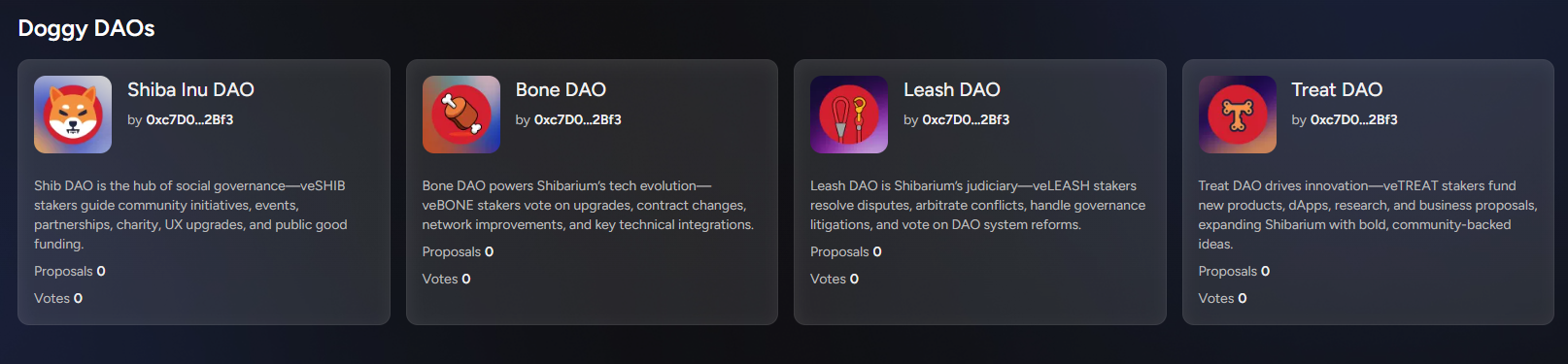
Furthermore, each token’s DAO has specific functions in the ecosystem. SHIB DAO manages community initiatives and activities, BONE DAO is responsible for voting on Shibarium enhancements and developer suggestions, LEASH DAO handles governance-related conflicts, and TREAT DAO supports innovation and the creation of decentralized applications.
DAOs and Jurisdictions

The ShibDAO launch is part of the Shiba Inu team’s efforts to establish the ecosystem as a household name in the Web3 space. Interestingly, the team has teased that bigger innovations are still in the pipeline.
US SEC Clarifies Certain Staking Activities on Proof of Stake Networks Are Not Securities

0

The U.S. Securities and Exchange Commission’s Division of Corporation Finance issued guidance clarifying that certain staking activities on proof-of-stake (PoS) networks do not fall under securities laws.

The Division stated on May 29 that participants engaging in specific protocol staking actions are exempt from registration requirements under the Securities Act. This announcement covers various staking models, including self-staking by node operators, self-custodial staking through third parties, and custodial staking where custodians act on behalf of asset owners.

Staking Rewards Considered Compensation for Network Services

The Division emphasized that staking rewards represent compensation paid to node operators for services provided to the network. These rewards do not equate to profits earned from entrepreneurial efforts or management roles. Consequently, such staking activities fall outside the scope of securities regulation.

Furthermore, the SEC clarified the role of custodians in these arrangements, noting that custodians act solely as agents. They do not influence decisions about when or how users’ funds are locked, reinforcing the view that custodial staking does not trigger securities law obligations.

Ancillary Services Classified as Administrative, Not Entrepreneurial

Beyond staking alone, the SEC also discussed associated services typically provided with staking, referring to them as administrative or ministerial tasks. These supplementary services involve protections against slashing, options for early withdrawal, varied reward timing, and pooling assets to satisfy minimum staking requirements.

The Division stated that these features do not alter the regulatory status of staking activities, as they do not constitute entrepreneurial efforts. This clarification follows a previous SEC position on proof-of-work mining, where certain mining activities were also deemed outside the purview of securities transactions.

Commissioner Crenshaw Disagrees with Guidance

Meanwhile, SEC Commissioner Caroline Crenshaw issued a dissenting statement. She criticized the guidance, arguing that exempting crypto staking activities from securities regulation conflicts with existing laws and court precedents.

Crenshaw referenced cases involving U.S. exchanges Kraken and Coinbase, as well as a dismissal related to Binance on the same day. According to her, the SEC’s approach generates uncertainty by blurring which laws the Commission intends to enforce in the crypto sector.

SEC’s Shifting Approach to Proof-of-Stake Assets

Notably, these developments reveal a significant shift in the SEC’s stance on crypto, particularly regarding Proof-of-Stake (PoS) assets, under the leadership of Chair Paul Atkins.

Historically, the SEC had taken a hardline position against centralized staking providers. A prominent example occurred in 2023 when the SEC’s scrutiny of Kraken’s staking services prompted many companies to cease operations within the United States due to the resulting legal uncertainties. The case against Kraken, along with ConsenSys and Cumberland, was, however, dismissed.

Notably, the former SEC Chair, Gary Gensler, adopted a broad and stringent interpretation of crypto assets. Gensler argued that a substantial majority of cryptocurrencies, especially those based on Proof-of-Stake mechanisms, should be classified as securities. His rationale centered on the Howey Test.

However, the recent approach marks a notable departure from previous regulatory actions.

Analyst Identifies Two Possible Paths for Shiba Inu Price: Which Will Prevail?

0

An analyst outlines two price scenarios for Shiba Inu but favors the ascending path, noting strong support from the SHIB community for a rebound.

Shiba Inu (SHIB) has experienced a steady decline in its price over the past week. Today, SHIB trades near $0.0000134, marking a 7.17% drop in the last 24 hours and a 14.04% decline over seven days. 

Despite occasional minor rebounds, the overall trend remains bearish, reflecting ongoing challenges for the meme crypto. Consequently, an analyst is charting two case scenarios for SHIB price action.

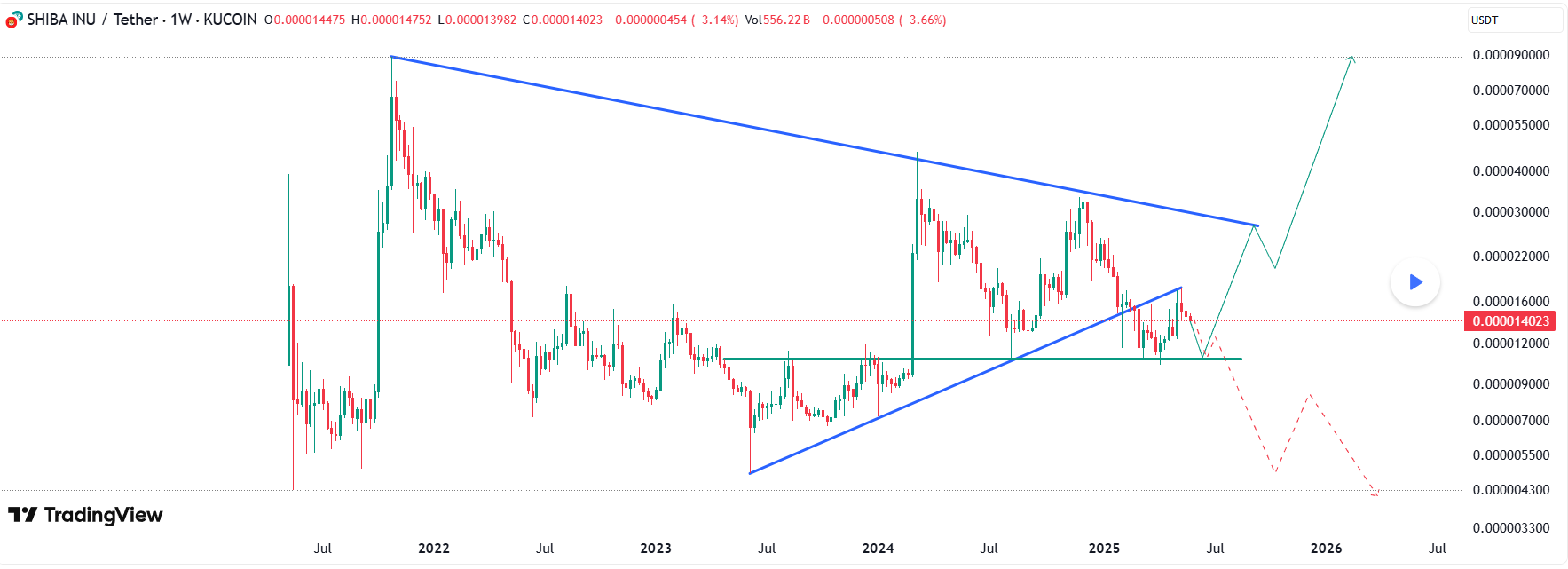
TradingView analyst Aram Salimi highlighted Shiba Inu’s weekly chart, which shows a sustained downtrend since its all-time high around $0.000088 in late 2021. The price has repeatedly encountered a descending resistance line, which has connected several lower levels since 2021. Notably, this line has acted as a formidable barrier to upward momentum.

Screenshot 2025 05 30T093221612
Shiba Inu Price Prediction

This resistance line initially triggered strong reversals at critical points from the 2021 peak, with SHIB hitting a bottom at $0.00000483 in June 2023. The line was tested again in March 2024, near $0.0000453, and in December 2024, near $0.0000335.

In both cases, the Shiba Inu price failed to break through and pulled back afterward. These repeated rejections confirm the trendline’s significance as a ceiling preventing gains.

Meanwhile, the ascending support line, which began forming mid-2023, traces higher levels and has provided several bounce points. The line emerged on June 5, 2023, when SHIB hit $0.00000483 following its all-time high decline.

The price respected this support between late 2023 and early 2024, when it dipped to test it at $0.0000071 on January 1, 2024, and surged back to the descending resistance. The support line was tested again on August 5, 2024, at $0.0000108.

However, in early to mid-2025, SHIB broke below this ascending support, settling near a demand zone around $0.0000108. This zone has previously capped bearish moves in August 2024 and April 2025. 

Potential Case Scenarios

The analyst outlines two potential future paths: a bullish scenario and a bearish scenario. The bullish projection assumes that SHIB will successfully hold the $0.0000108 support, rebound, and eventually break through the long-term descending resistance line.

After overcoming this resistance, the price could continue rising, possibly reaching its previous all-time highs around $0.000088. SHIB surging from the current $0.0000134 to $0.00009 represents approximately a 571.6% increase.

Conversely, the bearish scenario suggests that if the 0.0000108 support level fails to hold, SHIB may fall further, targeting the next significant levels around $0.000009 and then down to $0.000004300. If it drops from $0.0000134 to $0.0000043, SHIB would fall approximately 67.91%.

However, the analyst suggests that the ascending path appears more likely, citing strong support from the Shiba community.

Mixed Sentiment and Increased Activity

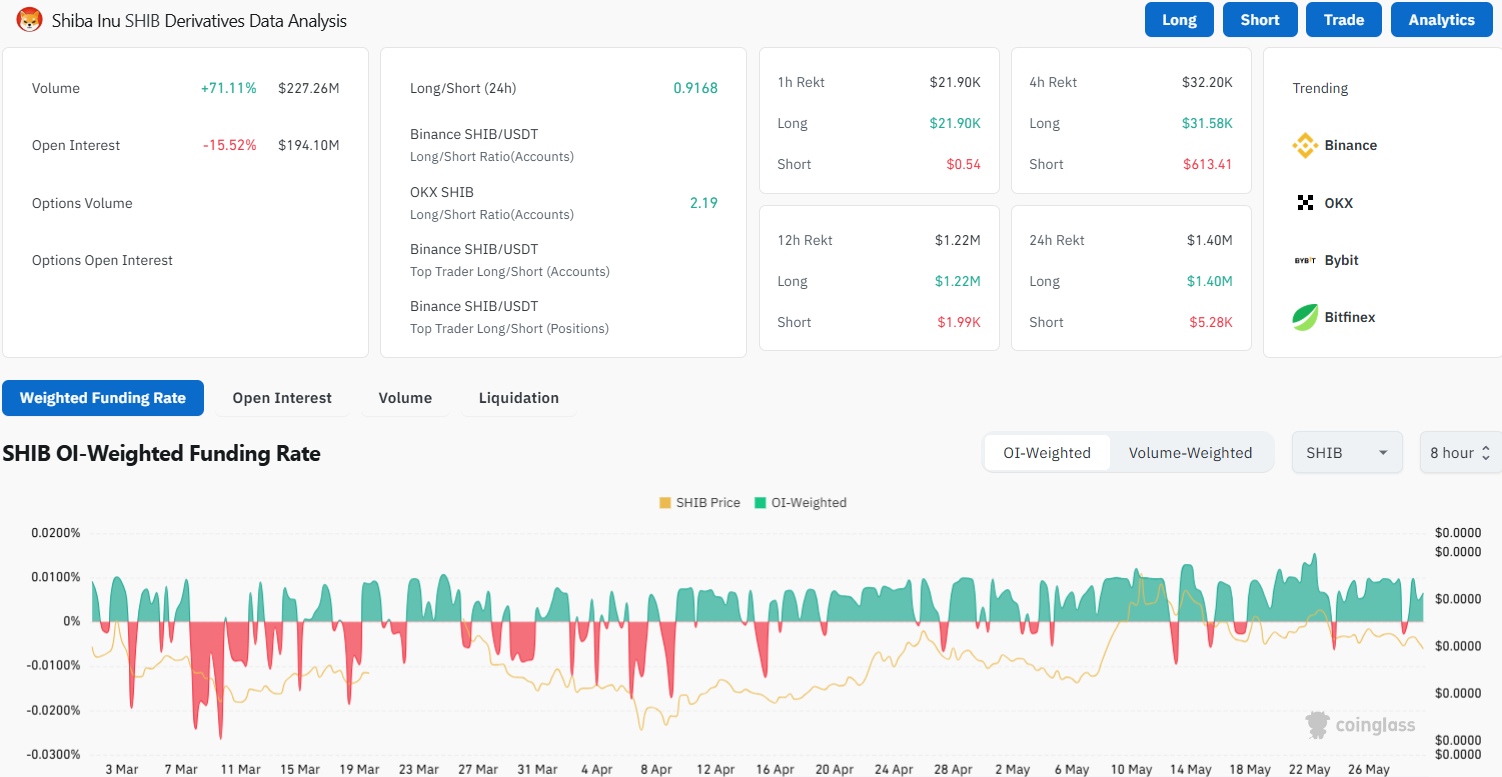
Shiba Inu’s derivatives data show notable activity changes amid the price action. Trading volume has surged by 71.11%, reaching $227.26 million, signaling growing market interest.

However, open interest declined by 15.52% to $194.10 million, suggesting traders might be closing contracts or rotating positions. This reduction could also indicate a preparation phase for new moves.

Screenshot 2025 05 30T102430155
Shiba Inu Derivatives Data

Long/short ratios provide contrasting views across exchanges. Binance’s SHIB/USDT pair shows a ratio of 0.9168, with slightly more shorts than longs by account count.

Conversely, OKX reports a ratio of 2.19, indicating that longs outnumber shorts significantly on that platform. This disparity reflects differing trader behavior in various markets.

Meanwhile, liquidation data shows long positions account for most losses, with $1.4 million in long liquidations over 24 hours, compared to just $5,280 in shorts. These liquidations, often from weaker hands, may pave the way for stronger buyers. A positive funding rate of 0.0065 further indicates a bullish bias, as more traders hold long positions despite SHIB’s price decline.

Ripple Says It’s Happening, XRP Army Reacts

Ripple has sparked fresh excitement in the XRP community with a post full of teasers, accompanied by the popular remark, “It’s happening.”

Taking to X, Ripple tweeted that if something is happening on-chain, then it is happening with Ripple. It urged its 3.1 million followers to discover why blockchain is transforming finance and everything else.

Ripple further emphasized these subtle hints with an accompanying clip highlighting “It’s happening,” featuring a ticking clock, an image of a charging bull, and a signpost pointing to three locations: Wall Street, the Marunouchi Line, and Broad Street.

XRP Army Reacts

This suggestive post got members of the XRP community wondering what Ripple was hinting at. “I saw what you did there,” said Xena, a prominent voice in the community. Meanwhile, others tried to piece the puzzle together, often relying on AI interpretations to make sense of the message.

Notably, the mention of the Marunouchi Line in the post prompted many to ask why. One commenter pointed out that the Marunouchi Line is a major subway route in Tokyo. Its highlight in the video, alongside other iconic locations like Wall Street and Broad Street, suggests Ripple’s aim to integrate blockchain solutions into diverse urban and financial ecosystems.

They also noted that the headquarters of SBI Holdings is located near the Tokyo Metro Marunouchi Line. For context, SBI Japan is a longstanding Ripple partner, using XRP to facilitate cross-border payments in some Asian countries.

While the details of what Ripple is hinting at remain scarce, the post emphasized the company’s focus on payments, custody, and stablecoins. These are areas where it has made significant recent efforts.

Where It’s Already Happening with Ripple

Regarding Ripple’s payment endeavors, the biggest buzz surrounds its acquisition of Hidden Road, with ongoing speculation about its significance. 

Recently, XRP community members discovered that Hidden Road became a member of the Government Securities Division of the Fixed Income Clearing Corporation (FICC) in March 2025, just before Ripple’s acquisition announcement.

This membership grants Hidden Road access to a clearing system that handles over $11 trillion in daily U.S. Treasury trades. It also enables participation in key Treasury clearing operations, including netting and repo transactions.

Ripple aims to streamline Hidden Road’s post-trade settlements using the XRP Ledger, offering faster, more transparent processing.

While some in the XRP community hoped XRP itself would be used for settlements, Ripple clarified that XRP won’t serve that role. Instead, Ripple’s stablecoin RLUSD will be collateral, with XRP supporting transaction fees.

Meanwhile, this week alone, Ripple’s RLUSD secured major listings on prominent exchanges, increasing the stablecoin’s accessibility and liquidity. New additions include Bitget and Bitmex. Other top exchanges where RLUSD trades include Kraken, Gemini, and Bitstamp.

Custody Services and Infrastructure

Regarding custody services, Ripple filed for the “Ripple Custody” trademark with the USPTO in February. The filing coincides with the U.S. Treasury engaging third-party custody firms like Anchorage Digital to explore secure management of the national Bitcoin reserve.

This move also follows Ripple’s acquisition of custody firm Metaco as it expands its institutional infrastructure offerings. Ripple’s Custody app, available on app stores, functions as an authenticator for institutional custody transactions rather than as a user wallet.

As New ‘Decisive Evidence’ Emerges, Expert Says Ripple and SEC Case Never Fails to Entertain

0

Renowned pro-XRP lawyer Bill Morgan weighs in on the unending twists and turns in the lawsuit between the SEC and Ripple. 

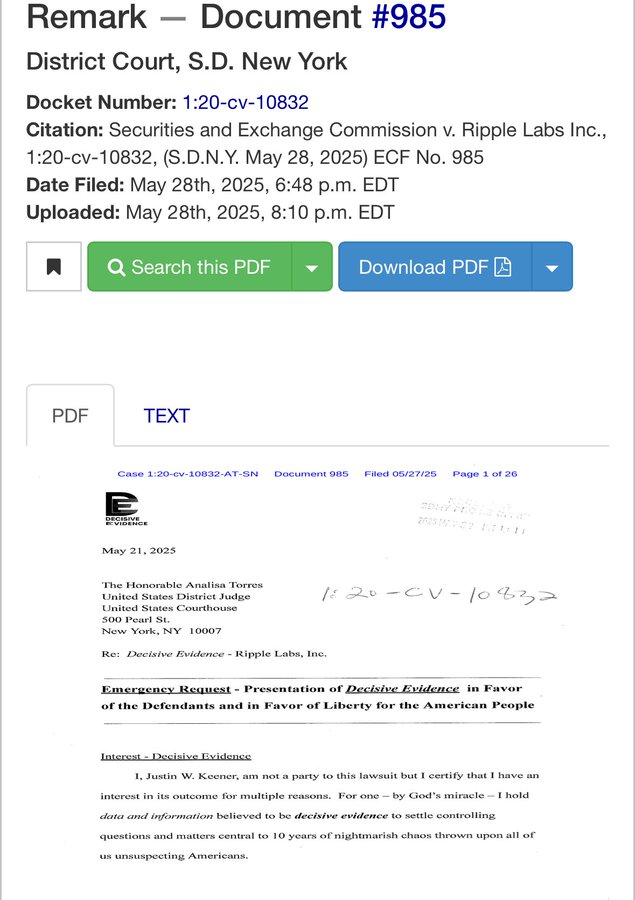
A nonparty, Justin W. Keener, filed a motion in the lawsuit on May 28, submitting a lengthy document tagged as ‘decisive evidence’ in favor of Ripple and Americans. 

Nonparty Submits Decisive Evidence 

This so-called evidence criticized the SEC’s overall enforcement approach and the Howey test, a long-standing securities test used to interpret what transactions constitute investment contracts. Recall that Keener first requested to present the decisive evidence in the Ripple lawsuit last month. 

At the time, the U.S. SEC requested that the court deny the request, emphasizing that the nonparty had filed the motion incorrectly. However, Keener continued with the submission, criticizing the Howey Test and the SEC’s enforcement approach. 

Nonparty submits new decisive evidence in Ripple lawsuit
Nonparty submits decisive evidence in Ripple lawsuit

It bears mentioning that the SEC recently sued Keener for operating as an unregistered dealer of penny stocks. As a result, a federal court ordered him to pay a fine of $10 million for violating federal securities law. 

Pro-XRP Lawyer Reacts

His recent filing sparked reactions from XRP community members, with Attorney Morgan highlighting the endless twists in the case. 

In an X post today, Attorney Morgan suggested that he has been looking forward to a new filing from the parties, especially after Judge Torres denied an earlier request for an indicative ruling on the proposed settlement agreement. 

His anticipation for a new filing grew due to the looming deadline of June 16, when the SEC is expected to submit a status report to the Second Circuit. 

Recall that the SEC and Ripple jointly requested a 60-day pause of their appeal in the Second Circuit. This request allows them to work on a potential resolution of the case following an initial settlement agreement. 

Notably, the parties agreed to withdraw their appeals under the condition that Ripple pay a fine of $50 million instead of $125 million. They also agreed to dismiss the injunction imposed on Ripple’s business. 

With the 60-day stay granted, the SEC and Ripple requested an indicative ruling on the agreement. However, Judge Torres denied the request two weeks ago, leaving many pondering the next line of action. 

Twists in the Ripple Case

Many assumed that the parties would either re-file their request for an indicative ruling in a New York federal court or issue a status report to the Second Circuit. However, a nonparty submitted a lengthy document tagged as decisive evidence in support of Ripple and Americans. 

Following the recent filing, Attorney Morgan noted that the Ripple lawsuit never fails to entertain, suggesting that the case is filed with drama stalling its resolution. 

For perspective, the lawsuit, which the SEC announced in December 2020, has continued to linger to date. Whenever there is an indication that the lawsuit is nearing an end, a new development emerges, extending its resolution. 

A case in point was the SEC’s appeal of Judge Torres’ decision two months after her final verdict in August 2024. As the parties work toward a resolution, Keener has now submitted a new filing that could delay the case’s conclusion. 

Saudi Aramco Not Involved in XRP Ledger Oil Tokenization Despite Viral Report: Details

Document suggesting Saudi Aramco is launching “White Rock Oil Tokenization on the XRPL” falls apart under scrutiny.

The XRP ecosystem has seen a strong wave of positive activity lately, with several major developments grabbing headlines. However, as excitement grows, so does the spread of misinformation. Notably, some individuals have taken advantage of the current momentum to push false reports.

A Fake Name and a Misappropriated Signature

One recent example is a fake document that has made the rounds online. It claims Saudi Aramco, Saudi Arabia’s state-owned oil giant, is working with White Network to tokenize oil using the XRP Ledger. The document also claims a Saudi official signed off on the project, making it seem like a major government-backed initiative.

Image

However, this claim quickly falls apart when you take a closer look. The name on the document, “Sheikh Abdullah bin Khalid Al-Falih,” does not match any known Saudi official. 

The closest match is Khalid bin Abdulaziz Al-Falih, who currently serves as Saudi Arabia’s Minister of Investment and was previously the Minister of Energy. However, even this similarity fails to lend credibility to the document.

What makes the forgery even more apparent is the fact that the signature on the document, purportedly linked to this fictional “Sheikh Abdullah bin Khalid Al-Falih,” has been identified as belonging to Mahtab Keramati, a well-known Iranian actress.

Mahtab Keramati Wikipedia
Mahtab Keramati | Wikipedia

Saudi Aramco and WhiteRock Have Failed to Confirm the Report

Moreover, Saudi Aramco has not made any disclosures or hinted at a project involving blockchain or tokenizing oil. The company continues to focus on its core areas, like bond sales and international energy deals.

Although Aramco did team up with Japan’s SBI Group, a prominent Ripple partner, in 2023 to explore digital asset investments, that partnership did not involve XRP or the XRP Ledger and had nothing to do with oil.

Further, while WhiteRock is involved in the XRPL, it has not released any statements around oil tokenization. For context, in March 2025, WhiteRock launched its platform on the XRP Ledger mainnet, allowing institutions to trade tokenized securities like stocks and bonds. 

Interestingly, the platform already manages over $71 million in assets, settling trades in just a few seconds. However, none of that has anything to do with oil or Saudi Aramco.

Bullish Developments Around the XRP Ecosystem 

The recent false reports come amid impressive progress around the XRP ecosystem. For one, the Dubai Land Department recently chose the XRP Ledger for a new real estate tokenization project. 

In addition, VivoPower, a Nasdaq-listed company, raised $121 million in a private deal to create an XRP reserve, with backing from a Saudi prince. Most recently, Chinese AI mobility company Webus also revealed plans to raise $300 million for a similar XRP reserve. 

However, despite all the momentum, XRP’s price hasn’t reacted much. The strong fundamentals and real-world use cases have not yet translated into gains in the market. Investors continue to wait for the price to catch up with the growing activity behind the scenes.

In 24 Hours Three Companies Announce Plans to Buy and Hold XRP as a Strategic Reserve Asset

0

XRP is capturing the attention of notable institutions, with three companies announcing plans to buy and hold it as a strategic treasury asset in a single day. 

Although the performance of the broader crypto market has been below expectations this week, XRP enthusiasts took comfort in the news that three companies have embraced XRP as a treasury asset. 

ACG Establishes XRP Reserve 

It started with a May 28 announcement from Ault Capital Group (ACG), a subsidiary of Hyperscale Data, which disclosed its intentions to add XRP to its balance sheet. According to the announcement, ACG aims to purchase $10 million worth of XRP by the end of this year to support its expansion into financial services. 

The acquired XRP will be classified as a cryptocurrency asset on ACG’s balance sheet and marked to its fair market value at the end of each reporting period. Changes in the value of ACG’s XRP holdings will be in the company’s operating expenses on the consolidated statement of operations. 

Shortly after, ACG announced plans to launch an XRP lending platform for NYSE-listed companies. The move would allow NYSE-listed companies to borrow a fixed amount of XRP as a loan. Scheduled to launch by Q3 2025, the lending initiative will be backed by ACG’s XRP reserve. 

VivoPower to Establish XRP Reserve 

Meanwhile, on May 28, Nasdaq-listed VivoPower International disclosed its transformation into the world’s first XRP-focused enterprise. This transformational journey saw the firm raise $121 million via a private placement led by Prince Abdulaziz bin Turki Abdulaziz Al Saud of Saudi Arabia. 

VivoPower will allocate a significant portion of the $121 million funding to purchase and hold XRP, thereby establishing an XRP-focused treasury. Some of the funds will be for investments in the XRPL DeFi ecosystem and related initiatives.

Webus International to Establish XRP Reserve to Support Global Payments 

While enthusiasts were celebrating these incredible milestones, AI-focused company Webus International announced plans for a non-equity financing of up to $300 million to create an XRP strategic reserve. The announcement came a few hours after VivoPower signaled its intention to acquire XRP as a treasury asset.

Webus will utilize the XRP reserve to facilitate global payments, leveraging the asset’s utility in cross-border settlements. In addition to establishing a strategic XRP reserve, it will use part of the funds to accelerate its global expansion and develop an effective blockchain infrastructure. 

On May 8, Wellgistics Health announced a $50 million credit facility to create a strategic XRP reserve.

These recent developments signal a growing interest in XRP among institutions, which consider the token a major corporate treasury asset. 

Michael Saylor: Companies Holding Bitcoin Have a 90% Success Rate in 5 Years, 99% Over 30–40 Years

0

Michael Saylor delivered another passionate speech on Bitcoin, this time emphasizing its extremely low chance of failure if held in one’s balance sheet.

The Strategy executive chairman and Bitcoin evangelist said one can never go wrong holding Bitcoin, the largest cryptocurrency by market cap. In a speech delivered at the 2025 Bitcoin Conference in Las Vegas, Saylor emphasized that investing in Bitcoin is unequivocally synonymous with creating life-changing wealth.

Saylor Highlights Two Paths to Wealth

He identified two paths to riches in 2025: one requiring competency and the other involving doing nothing for a long time. With the emergence and growing relevance of artificial intelligence, Saylor told the over 35,000 crypto enthusiasts present at the Las Vegas event that mastering the technology to build real skills is one path to acquiring wealth.

“If you have the humility to ask for help from the AI, don’t put your ego first; put your interest first. Your family will thank you in years to come,” Saylor said.

Meanwhile, the second route to riches is to buy Bitcoin and hold onto it simply. Saylor emphasized that changing the world operationally is tedious, and even the best ideas ultimately fail to succeed.

The Strategy co-founder noted that there is a 90% chance that a new product will fail in the next five years. However, that is not the case with Bitcoin, as keeping the asset on one’s balance sheet has a 90% success rate over the next half-decade.

The situation becomes even more interesting in a longer timeframe. Saylor highlighted that most operational ideas have a 99% failure rate in 30-40 years, a stark contrast to Bitcoin’s long-term proficiency.

“There’s a 99% chance every financial idea that rests upon a foundation of Bitcoin succeeds,” Saylor added.

Interestingly, Bitcoin’s past long-term price trajectory aligns with Saylor’s comments. CoinMarketCap shows that the pioneering cryptocurrency is up over 218 million percent from its lows of $0.048 nearly 15 years ago.

Leveraged Partnership to Create Wealth Faster With Bitcoin

Meanwhile, Saylor applauded solo Bitcoin holders for their efforts to take the orange pill. While he noted that they would become wealthy regardless, the executive chairman highlighted that “cutting others in” would not just increase capital but also returns.

Saylor buttressed his point using a dentist who earns $200,000 a year. He shared that the dentist would buy $1 million worth of Bitcoin if he invested it all in the premier asset.

However, if he incorporates the dental practice and gets his business valued at five times its cash flow, the dentist can sell 33% of his venture for $500,000 and buy Bitcoin. 

He can raise an additional $500,000 a year later, at a double market cap, to buy even more Bitcoin. With Bitcoin’s strong performance, his business can raise another $3 million the following year, thereby increasing the firm’s assets and profit by simply sharing the Bitcoin opportunity with others.

Saylor noted that this initiative is what Strategy (formerly MicroStrategy) and firms like Metaplanet and Semler Scientific have adopted. With this playbook, Strategy currently holds 580,250 BTC worth $61.2 billion. Meanwhile, Metaplanet holds 7,800 BTC worth $832.5 million, while Semler Scientific boasts 4,264 BTC valued at $450.3 million.

Meanwhile, the list continues to swell as Marathon Digital, GameStop, and soon Trump Media have mirrored the playbook.

Interestingly, the recently concluded 2025 Bitcoin Conference also featured key speeches on Bitcoin. Blockstream’s CEO, Adam Back, said Bitcoin will be worth $1 million in five years; Eric Trump insisted that 0.1 BTC is enough to create a fortune; and US Vice President JD Vance assured that Bitcoin is part of America’s mainstream economy.

“Crypto Is Still Here,” Says CZ as SEC Drops Binance Lawsuit With Prejudice

0

Changpeng Zhao (CZ), former CEO of Binance, has expressed his delight after the U.S. SEC moved to dismiss its lawsuit against both him and the company.

In a social media post, CZ shared an image of former SEC Chair Gary Gensler wearing a red clown nose, injecting a tone of irony into the situation. Alongside the image, CZ wrote, “Crypto is still here,” signaling renewed hope for the industry amid a shifting regulatory stance under the new SEC leadership.

In parallel, Binance expressed gratitude to SEC Chairman Paul Atkins and the Trump administration after the SEC dropped its lawsuit. The company thanked them for opposing regulation through enforcement actions.

SEC Ends Enforcement Action 

Importantly, the dismissal was filed with prejudice, preventing the SEC from reopening the case. A Binance spokesperson described the outcome as a landmark moment and credited former SEC Chair Paul Atkins and the Trump administration for a regulatory approach that supports innovation without excessive enforcement.

The SEC’s decision to drop the lawsuit comes after years of allegations that Binance and CZ offered unregistered securities and failed to block U.S. users from the exchange. The regulator also accused Binance of commingling customer funds through a “web of deceit.”

However, the SEC clarified the dismissal was a discretionary policy move and did not represent its position on other crypto-related cases.

Regulatory Shift Following Years of Legal Pressure

This lawsuit followed a period of intense scrutiny under SEC Chair Gary Gensler, who led aggressive enforcement actions against crypto firms. Gensler’s SEC alleged that Binance and other companies sold unregistered securities as digital tokens.

However, several high-profile cases have been dropped since Paul Atkins assumed the SEC chairmanship under the Trump administration. The SEC’s softened stance is also reflected in other recent dismissals, such as cases against Coinbase and inquiries into PayPal’s PYUSD stablecoin.

Separately, Binance pleaded guilty in 2023 to federal anti-money laundering and sanctions violations, resulting in a $4.32 billion penalty. CZ served a four-month prison sentence and was released in September 2024.

New SEC Leadership Calls for Regulatory Clarity

Notably, Paul Atkins, the new SEC Chair, has outlined a strategy to evolve the commission’s approach to crypto regulation. He advocates shifting focus from enforcement to clearer rulemaking tailored to decentralized blockchain assets. 

Atkins emphasized building regulatory frameworks compatible with crypto’s decentralized nature while protecting investors. The SEC is reviewing issuance guidelines, aiming to encourage compliance through clarity rather than enforcement. This marks a distinct change from the previous administration’s aggressive regulatory posture.

Here’s What Can Push XRP Price to $13 or $22

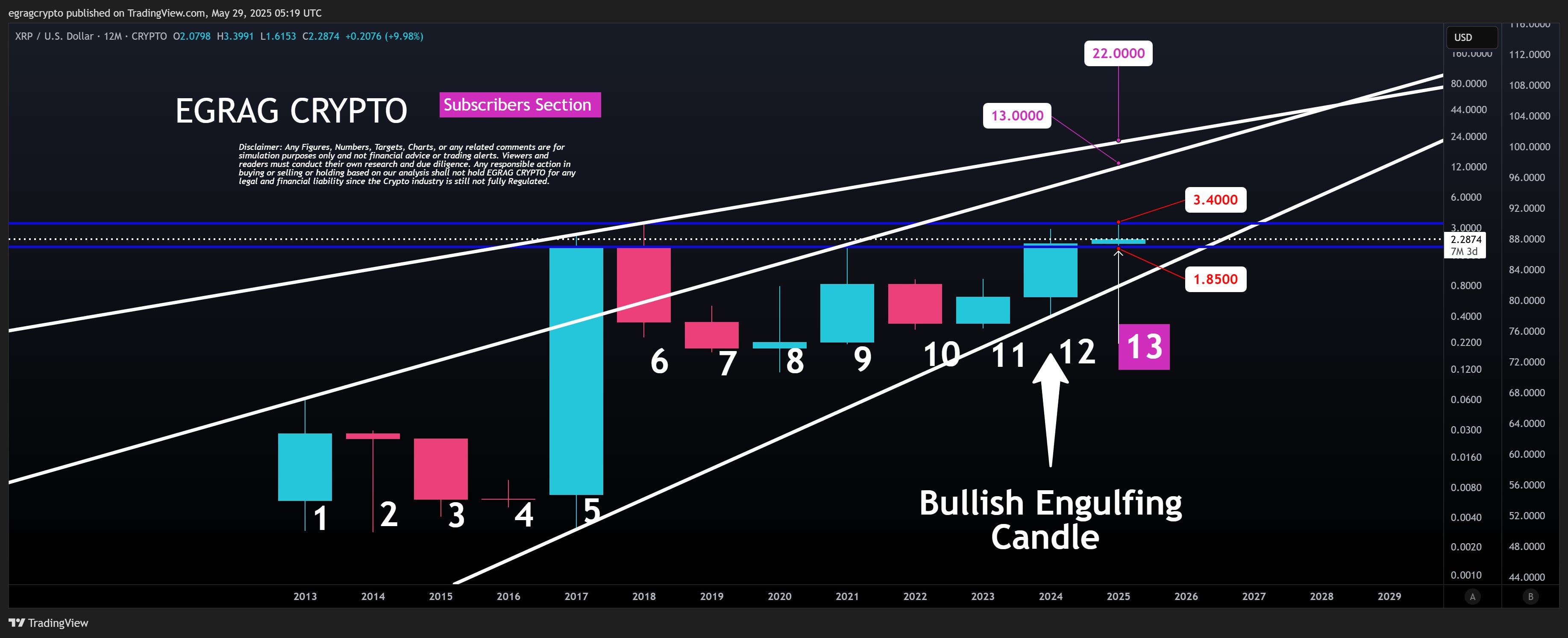
EGRAG Crypto, a prominent analyst, has identified a bullish engulfing candle pattern consistent on the yearly XRP chart, projecting an imminent rally.

His recent analysis comes on the back of what he believes is market “noise,” as XRP continues to consolidate around $2. For context, after reaching a peak of $2.65 on May 12, XRP has continued to observe losses, now stuck at the lower range of the $2 level.

Despite the bearish pressure, analysts like EGRAG believe the asset still has massive potential, calling attention to several bullish indicators on its chart across multiple timeframes. In the latest commentary, he leveraged the 12-month timeframe. 

XRP Bullish Engulfing Candles

According to EGRAG, XRP has been witnessing bullish engulfing candles since its fifth yearly candlestick in 2017. For the uninitiated, a bullish engulfing pattern contains two candlesticks: the first is a small red (bearish) candle, and the second is a larger green (bullish) candle that fully covers the body of the one before it. 

Notably, this formation often indicates that a downward trend may be shifting toward an upward move. EGRAG’s chart indicates that the first bullish engulfing pattern on the XRP yearly chart involved a small -0.68% red candle in 2016 and a subsequent large +33,066% green candle in 2017.

EGRAG says this pattern has continued throughout XRP’s history, playing out again for Candle 12 in 2024. The analyst indicated that the larger the timeframe for such a bullish signal, the greater the potential impact. As a result, an appearance on the yearly sign is “bullish as hell.”

XRP Bullish Engulfing Candles EGRAG Crypto
XRP Bullish Engulfing Candles | EGRAG Crypto

XRP to Observe 13th Candle Breakout

Interestingly, amid the persistence of this pattern across several yearly candles, EGRAG believes the 13th XRP yearly candle might lead to impressive gains following the recent engulfing candle. Specifically, this 13th candle pertains to the current bull year, 2025, which is already showing a 6.53% gain at press time. 

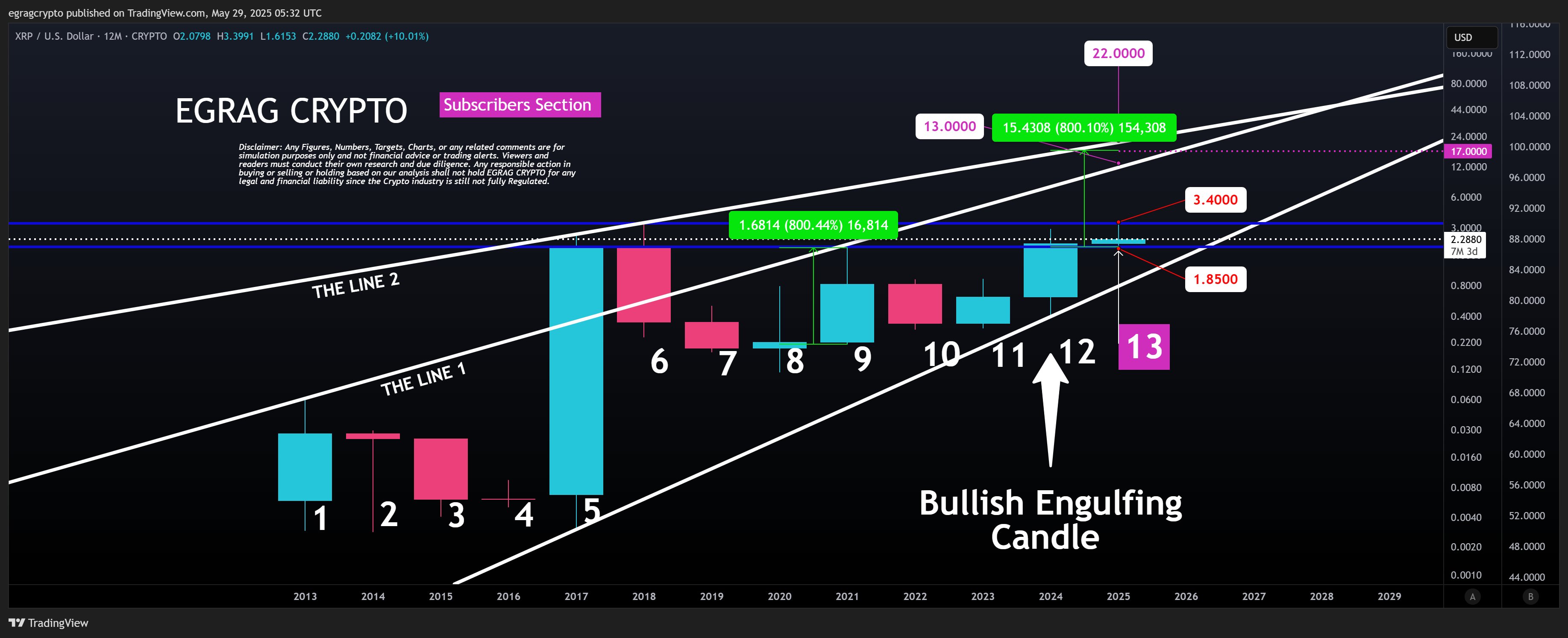
To present price targets for this projected growth, the market analyst turned to historical data. He cited the upsurge from Candle 9 in 2021, which led to an impressive 800% rise.

The analyst expects Candle 13 to replicate this rally. Interestingly, a repeat of the 800% increase would push the asset to a price of $17. 

XRP Price Target EGRAG Crypto
XRP Price Target | EGRAG Crypto

However, EGRAG’s chart also features three ascending lines that have dictated XRP’s price movements in terms of extreme price movements. Notably, one of these lines has served as support over the years, while two of them, specifically Lines 1 and 2, have acted as resistance. 

XRP Price Targets and Market Noise

Interestingly, the $17 target from the Candle 13 upsurge lies perfectly between Lines 1 and 2. According to EGRAG, Line 1 lies on the $13 price, while Line 2 syncs with the $22 price. As a result, the analyst expects Candle 13 to push prices to $13 or $22, aligning with the resistance on one of these lines.

Meanwhile, as traders await this run, EGRAG suggested that XRP trading between $1.85 and $3.4 is market noise. Currently, XRP changes hands at $2.21. According to him, if the asset closes below $1.85, the current bull run is over. However, if it closes above $3.4, its price is on the verge of reaching double digits.