Home Blog Page 754

Your XRP Is Programmed to Hit at Least $30 This Cycle, Top Analyst Says

While XRP hovers around the $2 mark without major price movements, analysts continue to project a promising future for holders in this cycle.

Crypto bulls, led by Bitcoin’s renewed attempt to reach $100K, are driving optimism in the market. However, XRP is still showing minimal price movement. The coin is up 2% today, trading at $2.17, a price that reflects a weekly loss of 1.03%.

Meanwhile, a bold new prediction from analyst Steph has caught the attention of XRP holders. In a tweet, he claimed that XRP is “programmed to hit at least $30 this cycle.”

Although XRP has stagnated around $2 for the past three months and has remained below its all-time high for over seven years, this analyst is projecting a potential 13X return for holders by the end of this cycle.

Notably, the forecast is supported by a technical chart using Elliott Wave Theory on a long-term timeframe.

XRP Chart Promising $30 Price for Holders

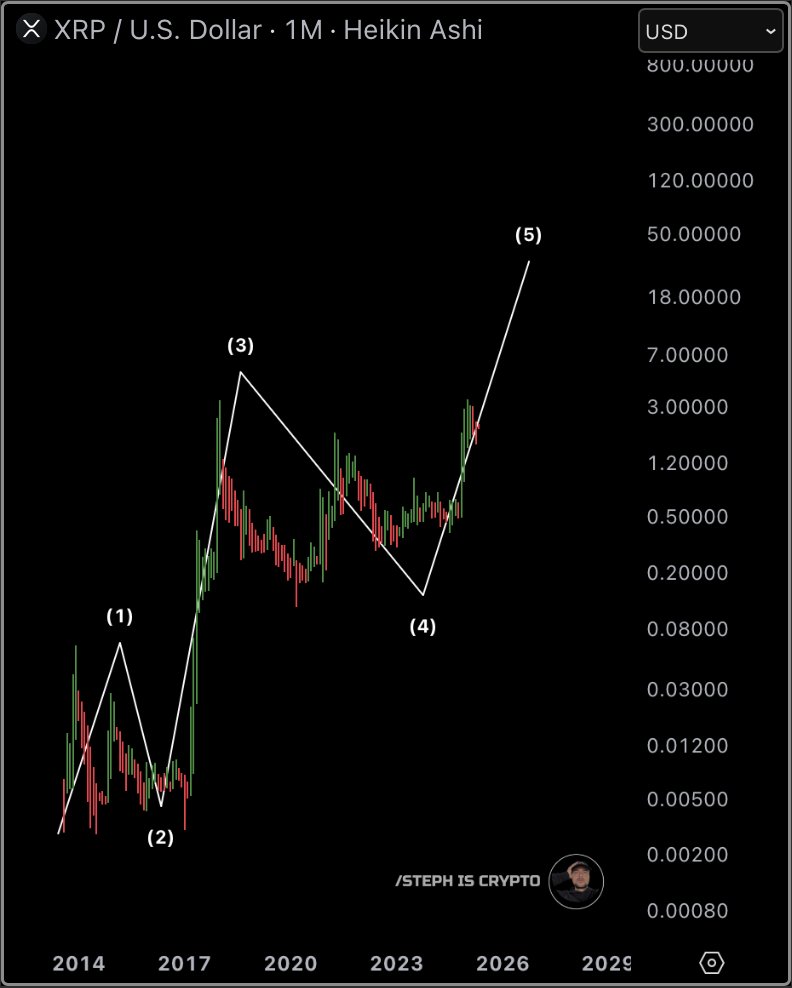
The chart uses a 1-month Heikin Ashi candlestick setup to smooth out price noise and highlight broader trends. Overlaid on the chart is an Elliott Wave structure suggesting XRP is approaching its fifth and final wave in a long-term bullish cycle.

Notably, the chart incorporates XRP’s monthly candlesticks dating back to 2014. It highlights that after the 2014 market bottom, XRP entered a bullish Wave 1, which concluded with a corrective Wave 2 in early 2017.

From there, Wave 3 began, pushing XRP from around $0.005 to over $3 by early 2018. This move marked the completion of Wave 3 and ushered in Wave 4, a long corrective phase.

Since then, XRP has struggled to reclaim previous highs, consolidating throughout Wave 4. However, the chart suggests this correction ended in early 2023, laying the foundation for the emergence of Wave 5, which is now forming.

During this ongoing fifth wave, XRP has again approached the $3 mark, hitting a local high of $3.34 before retracing. Despite short-term fluctuations, the broader trend remains bullish, according to the chart, with Wave 5 still unfolding.
Image
XRP long-term chart by Steph

Multiple Calls for $30 XRP Target by 2025 to 2026

Analyst Steph believes this final wave could ultimately propel XRP to $30 or higher before a major corrective phase begins.

The projection on the chart suggests this move will unfold gradually, with the final target to occur by 2026. While timelines remain speculative, other market commentators have shared similar projections for XRP, some without relying on technical analysis.

For instance, XRP analyst “J4b1” believes XRP could reach between $6.37 and $30 this year, arguing that buying at $2 remains a good entry point. He cited historical trends, Ripple’s strategic supply control, institutional demand, regulatory clarity, ETFs, and tokenization as key drivers for this surge.

Others, like Davinci Jeremie, believe $24 is possible this cycle, citing favorable government backing.
Ripple Gradually Reducing XRP Role to Just Transaction Fees: Pundit

Amid the rising prominence of RLUSD in the crypto market, concerns about the diminishing role of XRP have triggered discussions within the community. 

Community member Elena Schoen, who describes herself as a Chain Detective, recently raised concerns that Ripple may be slowly sidelining XRP, relegating it to a limited function. 

Is Ripple Replacing XRP with RLUSD?

Taking to X, she suggested that XRP is now primarily serving the function of transaction fees on the XRP Ledger, with RLUSD taking over broader utilities such as liquidity, cross-border transactions, retail and institutional settlements, and multi-fiat onboarding.

Schoen urged the community to examine Ripple’s website carefully and form opinions backed by facts. She argued that the only fundamental need for XRP is its role in covering fees. 

According to her, RLUSD is becoming the preferred asset for virtually all other functionalities on the XRPL, despite XRP being the default bridge asset. She further argued that with time, even that default status might lose its weight.

Notably, these concerns have surfaced as RLUSD continues to gain traction. Since its launch in December 2024, RLUSD has surged in popularity, recently earning a listing on Gemini, a leading U.S.-based trading platform. The stablecoin now ranks as the twelfth largest in the sector with a market cap of $316 million and a 24-hour volume of $59 million.

Others Disagree

However, not all community members share Schoen’s apprehension. One Alex Beesley argued that RLUSD is likely the first in a series of regional stablecoins, including potential versions like RLGBP, RLEUR, and RLJPY. He claimed that XRP will be important as the common thread that binds these currencies. 

Meanwhile, Dennis Piwi suggested that XRP’s value lies in its behind-the-scenes role as the “silent backbone” of tokenized finance, enabling frictionless swaps across stablecoins and CBDCs. To him, the real strength of XRP is in infrastructure rather than hype.

Also, last month, after Ripple announced the integration of RLUSD into Ripple Payments, concerns emerged within the XRP community. However, pundits like “All Things XRP” stressed that the two assets would complement each other, with RLUSD providing price stability and XRP offering speed and efficiency.

Previous Comments from Ripple Executives

Notably, in response to these growing concerns, Ripple executives have reiterated their commitment to utilizing XRP. For instance, during the 2024 XRP Ledger Apex summit, Ripple CTO David Schwartz explained that stablecoins like RLUSD are important for maintaining pricing consistency and minimizing volatility.

However, he indicated that XRP maintains an important role within the XRPL through advanced features like pathfinding and auto-bridging that favor its liquidity.

Schwartz also stressed in October 2024 that RLUSD could not replace XRP due to the latter’s unique properties, including its role in transaction fees, immunity to freezing, and independence from jurisdictional constraints.

Moreover, President Monica Long addressed the community last October following the announcement of RLUSD’s exchange partners. She reiterated that Ripple’s dual-token strategy is intentional, allowing clients to choose between XRP and RLUSD depending on their transaction needs.

In a January 2025 interview with Citizens Bank, Ripple CEO Brad Garlinghouse confirmed that RLUSD and XRP serve distinctly different purposes. He explained that RLUSD represents fiat on-chain, whereas XRP acts as a bridge asset essential for enabling liquidity between different currencies.

Analyst Says if XRP Could Spike 68,990% to $3.8 in 2018, It Can Rise 45,982% to $1,000

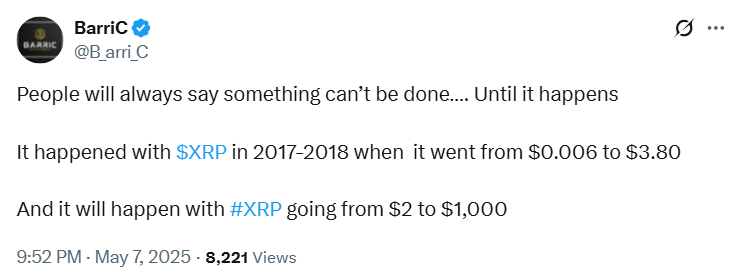
A market analyst has suggested that XRP can repeat its 2017/2018 historic run, insisting that people always doubt something is possible until it happens.

XRP has sustained its range-bound movements over the past three months. Notably, price upswings to highs like $3 in March have met intense resistance, while slumps to lows like $1.6 have triggered rebounds, with XRP largely maintaining a position around the lower ends of the $2 mark.

Despite this extensive consolidation, some proponents remain confident that XRP still has the potential to reach ambitious price levels, with the $1,000 mark often featured in these discussions. For instance, Matthew Brienen, the COO of CryptoGuard, suggested XRP could reach $100 to $1,000 over the next ten years.

XRP Rallied 68,990% to $3.8 in 2018

However, critics have argued that such price predictions are unfeasible, citing market cap constraints. Meanwhile, analysts like BarriC continue to champion them. In his most recent commentary, he insisted that such an upsurge is possible, considering XRP’s impressive historical performance.

BarriC XRP Commentary

For context, XRP demonstrated one of the best performances by any altcoin during the 2017/2018 bull run. BarriC suggested that the asset rallied from $0.006 to an all-time high of $3.8 during this run. However, the reality was actually more impressive.

Notably, XRP began in March 2017, the month in which the uptrend started, at $0.0055. That month alone, it surged 284%. The rally persisted until it hit a peak of $0.3988 in May 2017, after which, it faced resistance and consolidated for six months, until November 2017.

Following this extensive consolidation period, XRP resumed the uptrend, this time, soaring to the all-time high of $3.8 in January 2018. Remarkably, the run from $0.0055 to $3.8 represented a massive 68,990% increase in less than nine months.

Can XRP Surge 45,982% to $1,000?

At the time, most analysts believed such an uptrend was impossible for XRP, especially considering it started the bull run on a bearish note, dropping 42% from October 2016 to March 2017. Citing this historical precedent, BarriC argues that XRP can repeat this run, noting that people often insist something is impossible until it actually happens.

Notably, the pessimism around an explosive surge to $1,000 has been loud, and understandably so. For perspective, at $1,000, XRP would have a fully diluted market cap of $99.98 trillion, over four times the current market cap of gold. This seems highly improbable. Finance expert Rajat Soni argued that those who eye even a $100 price for XRP have a “mental disability.”

Nonetheless, BarriC is convinced that XRP to $1,000 will happen, albeit not soon. For context, at the current price of $2.17, XRP must surge by a massive 45,982% to reach this $1,000 mark. Despite the upsurge necessary for this price target, BarriC believes this “impossible situation” will happen, just like it did in 2017/2018.

Robinhood Markets to Expand US Securities Tokenization to European Users: Bloomberg

0

Robinhood Markets LLC has plans to expand its European presence by offering tokenized US securities to users in the region.

California-based crypto exchange Robinhood entered Europe in 2023, offering users access to buy and sell digital assets on its trading platform. Since then, it has made efforts to expand its reach in the region through recent strategic partnerships.

Still, Robinhood seems poised to bring more crypto-related actions to its European users. A recent Bloomberg report reveals that the exchange plans to bring asset tokenization to its users in the province.

Robinhood to Offer Tokenized US Assets

The report, citing people familiar with the development, confirmed that Robinhood is building a distributed ledger-based platform that brings US assets to European customers. The proposed protocol will allow retail users to trade tokenized US securities such as stocks and bonds.

Meanwhile, the plans are still in their earlier stages, with Robinhood yet to decide on a digital asset firm to partner with for the rollout.

Per the report, the exchange considers layer 2 platform Arbitrum and the Solana network probable destinations for its European tokenization push. Notably, discussions are ongoing, with neither party having confirmed the development.

Robinhood’s CEO, Vlad Tenev, first teased the idea in a March podcast with Bankless. He emphasized that it is easier to access short-lived, hype-based assets like meme coins but tedious to buy private companies like SpaceX and OpenAI, a narrative the exchange looks to change with its imminent asset tokenization venture.

Moreover, Robinhood plans to offer this product in Europe in a regulatory-compliant manner. It has done this with ongoing plans to acquire MiCA-compliant crypto exchange Bitstamp. The acquisition would see Robinhood operate freely in the region without regulatory hurdles.

The exchange also announced in April that it has secured a brokerage license from the Central Bank of Lithuania. Notably, the charter authorizes Robinhood to offer investment services to all 27 European Union (EU) countries.

Big Players Delving into Tokenization

Asset tokenization involves bringing real-world assets on-chain, integrating traditional finance with blockchain technology. Notably, a recent report from prominent financial technology firm Ripple tipped the sector to grow to $18 trillion by 2033.

Interestingly, major players already have a skin dip in the emerging sector. Prominent market participants like BlackRock and Franklin Templeton have launched RWA tokenization platforms on the Ethereum and Solana networks. Ripple is also making inroads in the promising technology, touted to save around $20 billion annually in global clearing and settlement costs.

Aside from Robinhood, firms like Goldman Sachs and Taurus are also looking to expand their offerings to include asset tokenization.

Hoskinson Says Starstream Could Be Central to Cardano Future

0

Charles Hoskinson, founder of Cardano, has officially joined the Starstream Working Group, describing the project as a potential core element of Cardano’s future. 

His involvement underscores a growing institutional focus on enhancing blockchain performance through new execution environments. 

The working group has recently experienced rapid growth, expanding by approximately 50% in just two weeks, according to Sebastien Guillemot, co-founder of Paima Studios and an early driver of the Starstream initiative. 

New Virtual Machine Targets UTXO Scalability

Starstream introduces a UTXO-based virtual machine that offers significantly higher capability and simpler integration than previous iterations. According to Guillemot, the design aligns with zero-knowledge (ZK) cryptography, a critical advancement for privacy-preserving computation. 

Notably, Cardano’s existing extended UTXO (eUTXO) model has faced implementation challenges with advanced cryptography. Starstream resolves this using a WebAssembly-based VM that generates a ZK proof for every smart contract interaction. 

This verifies computations without revealing underlying data, directly addressing previous limitations. The system enhances performance through near-free transaction batching, simplifying use cases including oracles, gaming, real-world assets, and stablecoins.

Other Recent Developments on Cardano 

Beyond the progress surrounding Starstream, the Cardano ecosystem has seen several notable advancements in infrastructure and cross-chain capabilities. 

A key initiative gaining traction is Midnight, a sidechain developed by Input Output Global (IOG) with a core focus on data protection and privacy.

According to recent remarks from Charles Hoskinson, Midnight could be a foundational platform for blockchain-based equity issuance. This came during a discussion held on May 1 with Midnight CEO Eran Barak. Hoskinson highlighted that privacy, programmability, and interoperability are critical to bringing traditional stock markets onto blockchain systems.

Meanwhile, Cardano’s native wallet Lace has reached an important technical milestone with the release of version 1.22. This update, rolled out to users in the beta program, introduces native support for Bitcoin. This marked the wallet’s first major move into multi-chain territory.

Users can now send, receive, and manage Bitcoin assets directly from the Lace interface, expanding the wallet’s utility beyond the Cardano ecosystem.

Shiba Inu Community Burn Portal Incinerates 1,003,331,701 SHIB

0

Shiba Inu community burn portal, Shib Torch, successfully removes over 1 billion SHIB tokens from circulation through incineration. 

Prominent Shiba Inu community figure Shibarium Updates (@shibizens) alerted the community about the milestone via a recent tweet.

Shibarium Updates disclosed that Shib Torch had burned 1,003,331,701 (1 billion) Shiba Inu tokens. At the current price of $0.00001330 per token, the dollar equivalent of these tokens is worth $13,334. 

The overall burn from Shib Torch represents a tiny fraction of Shiba Inu’s total supply of 589.5 trillion tokens. Nonetheless, its impact on Shiba Inu’s price is expected to be seen in the long term. As Shiba Inu’s supply declines, its price might experience a spike in the future.

How Much Shib Torch Burned in Previous Months 

The latest update on Shib Torch’s overall burn comes less than two months after The Crypto Basic reported the total burn to be around 713.12 million. 

At the time, the burn rate saw a 7-day increase of 10.02%. The latest update indicates that the automated burn portal has burned 290,203,437 (290.2 million) SHIB since March 18, 2025. 

According to Shibarium Updates, the amount of Shiba Inu tokens burned through Shib Torch represents a 4.97% surge from the figure recorded last week. This rising burn rate indicates growing community engagement on Shibarium. 

Shiba Inu Burn Process 

It is common knowledge that Shib Torch burns Shiba Inu tokens using a fraction of the fees obtained through Shibarium transactions. Notably, users are required to pay a base fee in BONE to facilitate transactions on Shibarium. 

However, those who want validators to prioritize their transactions, especially during network congestion, can do so by paying an extra cost, a priority fee, which is allocated to the validator. 

On the other hand, the base fee is split into two: 70% for burning SHIB and 30% as the platform’s fee. Prior to the launch of Shib Torch, the team manually burned the 70% base fee after accumulating a significant amount of BONE, which was later converted to Shiba Inu and sent to a dead wallet. This process led to the incineration of around 56 billion SHIB. 

However, following the launch of Shib Torch in August 2024, the process was automated. Here, the system holds the 70% base fee in a reserve until it hits a balance of 1,000 BONE tokens. Upon reaching this threshold, any user can initiate the burn, which automatically converts the BONE to SHIB and sends it to the dead wallet. 

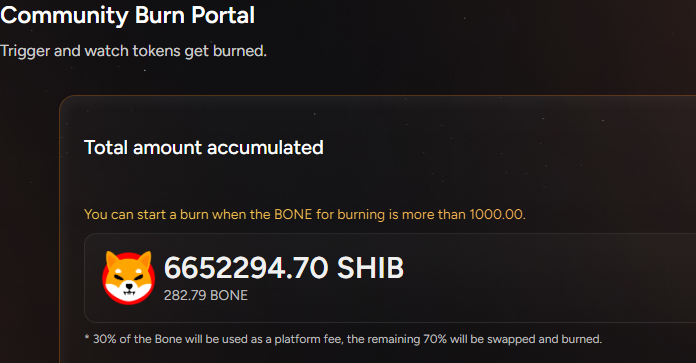
In the meantime, the burn contract has accumulated 282.79 BONE, currently equivalent to 6,652,294 (6.65 million) Shiba Inu tokens. 

BONE accumlated for incineration through Shib Torch
BONE accumulated for incineration through Shib Torch

Meanwhile, the broader Shiba Inu community has permanently removed 410.74 trillion SHIB from circulation, bringing the total supply down to 589.55 trillion tokens. Of the 410.74 trillion SHIB, 15.82 million SHIB tokens were incinerated in the past 24 hours in four transactions. This pushed the burn rate to 3,661%. 

Analyst Identifies Buying Opportunity For Dogecoin Before Rise to $0.3

0

Analyst Ali Martinez sees a buying opportunity for Dogecoin, suggesting it could rebound over 66% after testing a long-term support trendline that has held since October 2024.

Notably, after dipping toward $0.165 on May 6, Dogecoin reversed course, climbing near the $0.18 resistance by May 8. This movement reflects a short-term recovery as it posted a 4.76% gain over 24 hours and 3.01% across seven days. 

Although price action hints at renewed buying interest, analysts remain divided on the path ahead, citing both structural support patterns and momentum indicators to frame the ongoing market scenario.

Long-Term Trendline Signals Sustained Support

On the weekly timeframe, crypto analyst Ali Martinez highlights a consistent ascending trendline that has supported Dogecoin since October 2024.

This line, originating from October 2024 when DOGE traded below $0.06, has cushioned every major pullback since, including one near $0.09 after a breakout above $0.21. 

This year, the support trendline is being tested again as the price has been dropping towards it.

Notably, Martinez’s chart projects a hypothetical dip to $0.14, which would retest the support at the trendline. Such a move could act as a buying opportunity, as the analyst predicts a possible rebound with a price target of $0.30. From current levels, Dogecoin would need to rise 66% to reach this projection. 

Breakout from Falling Wedge Adds to Bullish Setup

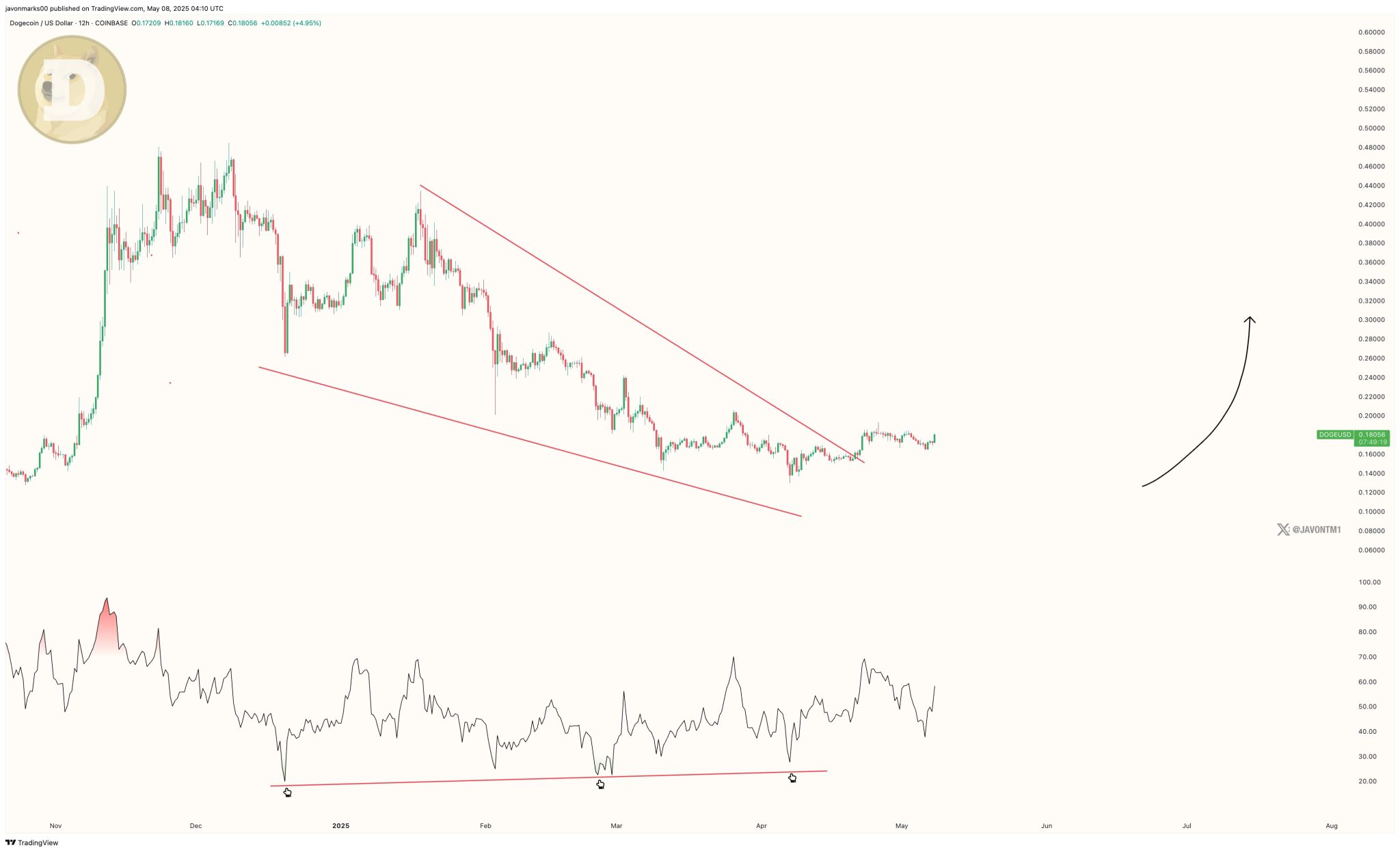
Adding to the broader narrative, another analyst Javon Marks has identified a falling wedge pattern stretching from the $0.50 peak in late 2024 to a narrowing base between $0.14 and $0.16. Dogecoin has recently broken above the wedge’s upper boundary, typically a bullish signal. 

GqZir0eWsAARsZd
Dogecoin Price Prediction

A curved arrow on the chart outlines a projected parabolic movement toward $0.30, with a longer-term technical target positioned at $0.65. This would imply a 261% increase from the current price level.

Supporting this breakout, the relative strength index (RSI) shows a bullish divergence. Between February and April 2025, while price action formed lower lows, the RSI made higher lows. This divergence often points to weakening downward momentum and aligns with the wedge breakout narrative, suggesting potential upward continuation.

Medium-Term Weakness Still Flags Caution

Meanwhile, analyst Farid Saremi presents a contrasting perspective based on a 3-hour DOGE/USDT chart.

He highlights equilibrium zones anchored at resistance levels from December 2024 and January 2025—when Dogecoin peaked just under $0.50 and later at $0.43. The current price has slipped below the $0.18–$0.21 consolidation range, which now serves as the main equilibrium band.

Following this breakdown, Saremi identifies intermediate support at $0.10894, linked to January 2025 consolidation, and a deeper target near $0.07478, based on price behavior from October–November 2024.

According to his analysis, the loss of balance in the consolidation zone suggests weakened buyer strength. He notes that while timing may vary due to external influences, the projected levels remain valid reference points for potential price movement.

Solana Rally Targets $200 as Binance Traders Fuel Momentum

Solana gains momentum post-FOMC as traders go long, with prices eyeing the $164–$200 range. Can the rally hold above $150?

The bullish trend in the crypto market continues following the FOMC meeting, which decided to keep federal rates steady. Amid this bullish turnaround, Solana, one of the top-ranking altcoins, has surpassed the $150 milestone.

Fueled by an intraday recovery of 2.11%, Solana now hints at a potential move toward the $164 level. Will this renewed rally in Solana sustain its dominance above the $150 psychological threshold?

Solana Price Analysis

Solana has bounced off the 23.60% Fibonacci level at $141.95. Overlapping this Fibonacci level is a crucial demand zone between $142 and $144.

As Solana maintains strength above the recently flipped resistance-turned-support zone, the recovery rally has reclaimed the $150 level. Moreover, the sideways movement over the past two weeks above $142 now suggests a potential double-bottom reversal.

This bullish pattern could extend the falling wedge breakout rally observed in mid-April.

Solana Price Chart

The daily RSI line remains above the midpoint and has crossed the 14-day SMA, supporting the upside potential. Additionally, the Chaikin Money Flow Index is positive at 0.06, highlighting favorable money flow. Thus, technical indicators bolster the likelihood of a prolonged bull run in Solana.

The 38.20% Fibonacci level projects immediate resistance at $164.77. However, based on the falling wedge breakout, the upswing will likely continue toward the pattern’s apex.

This apex coincides with the 61.80% Fibonacci level near the $200 psychological mark, suggesting a short-term upside potential of 35%.

On the flip side, a potential breakdown below the 23.60% Fibonacci level could drive the price down toward the $100 psychological support.

Binance Accounts Anticipate Massive Surge in Solana

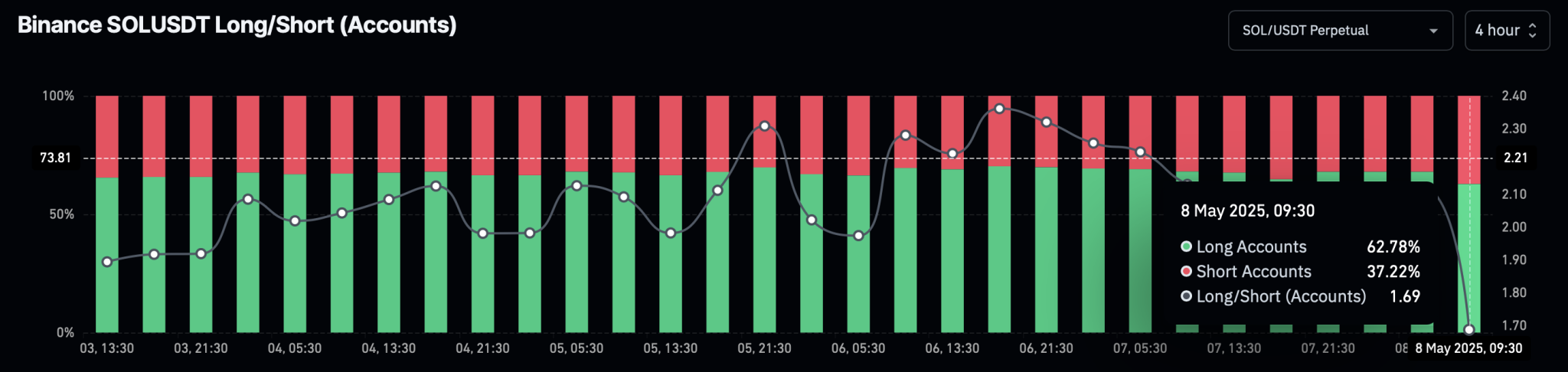
With Solana’s rising price, Binance traders remain highly optimistic about the altcoin. According to data from Coinglass, Solana derivative traders on Binance now hold a long-to-short account ratio of 1.69, indicating strong bullish sentiment.

Solana Long/Short Accounts (Binance)

Long positions have increased to 62.78%, dominating market sentiment. Additionally, Solana’s open interest has surged by 4%, reaching $5.65 billion.

Currently, the funding rate stands at 0.0053%, further underscoring the potential for a leverage-driven rally in Solana.

DeFi Development Corporation Announces 7-for-1 Stock Split

DeFi Development Corp., formerly Janover Inc., has approved a 7-for-1 forward stock split of its common shares, effective May 20, 2025. Shareholders of record as of May 19 will receive six additional shares for every one held.

The company, positioned as a leading public-market vehicle for Solana (SOL) accumulation, stated the split aims to enhance liquidity and broaden investor access as it continues executing its SOL-focused treasury strategy.

Coinbase Users Lost $45M to Social Engineering Scams in the Last Week: ZachXBT

0

A recent report from on-chain security analyst ZachXBT has identified a pattern of scams, particularly affecting Coinbase users.

The blockchain sleuth shared that Coinbase users are bleeding funds through social engineering scams, a fraudulent scheme that has persisted for months. Last week, users on Coinbase, America’s largest crypto exchange, lost $45 million to bad actors through such attacks.

For the uninitiated, a social engineering scam involves manipulating users to share sensitive information with a scammer. Notably, they achieve this through impersonation, sharing phishing links, or baiting.

Coinbase Users Losing $330M Annually to Fraud

Meanwhile, ZachXBT stressed that these attacks have been ongoing for weeks despite earlier notifications to Coinbase. Yesterday’s $45 million scam disclosure on his Telegram account follows a similar report a week ago, in which users lost another $46 million to social engineering frauds.

The prominent analyst estimates that these fraudulent activities have pushed funds stolen from Coinbase users into nine figures in the past few months. Furthermore, ZachXBT highlighted that these scams cost customers $330 million annually.

Remarkably, these social engineering scams are peculiar to Coinbase. The analysis, conducted with the assistance of on-chain investigator “Tanuki42,” highlighted that only Coinbase users have fallen victim to these attacks while identifying the root causes of this persistent issue.

Interestingly, Ripple CTO David Schwartz earlier warned users of a similar scam, specifically in January. He shared a screenshot of a phishing email he received from a fake Coinbase representative claiming he needed to update his account for a smoother experience using the exchange.

ZachXBT Proffers Solutions to Recurring Theft

While he expressed dissatisfaction with Coinbase’s handling of the growing issue, ZachXBT acknowledged the exchange’s remarkable wins for the industry. Some of them included the exchange’s legal wars with the US SEC for clear crypto regulatory frameworks and building its layer 2 network, Base.

Meanwhile, ZachXBT highlighted some of the probable causes why attackers find operating with Coinbase easier. For one, he stressed that Coinbase has a poor response time to customer complaints, especially outside US working hours. 

He also noted that the platform has had several unreported security issues. Further, ZachXBT highlighted a bug that allows Coinbase to send verification codes to emails not registered on its platform.

Nonetheless, ZachXBT recommended multiple solutions, including annulling compulsory phone number requirements for advanced users and adding authenticator and security key options. He further advised creating elderly or beginner accounts with withdrawal restrictions and a more proactive user engagement tool.

Notably, social engineering scams are spreading quickly in the crypto industry. A recent FBI report shows that US crypto users lost $9 billion to fraudulent activities in 2024, of which this scheme made up a considerable portion.

Coinbase FOIA Documents Reveal SEC Internal Communication About XRP and Ethereum

0

Leading U.S. exchange Coinbase has shared documents revealing the SEC’s internal discussions about XRP and Ethereum’s security status. 

Coinbase obtained this internal communication through Freedom of Information Act (FOIA) requests to several U.S. federal agencies, including the SEC. 

According to internal emails from 2021, SEC staffers questioned whether XRP exhibits certain security characteristics. Notably, the securities agency, at one point, internally discussed asking an expert what risks the XRP Ledger (XRPL) might suffer if Ripple seized operations and walked away. 

SEC Labeling XRP a Security 

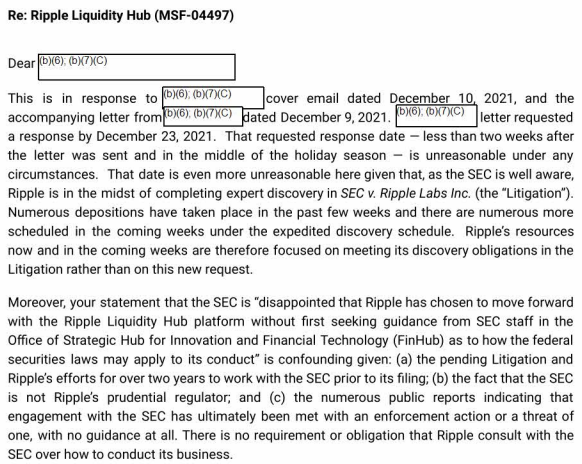
In a separate letter dated December 9, 2021, the SEC directly referred to XRP as a security. The regulator made this known when expressing disappointment regarding Ripple’s planned launch of its Liquidity Hub. 

Per the letter, the SEC expressed dissatisfaction that Ripple launched Liquidity Hub without first seeking the commission’s opinion on how federal securities law may apply to the platform’s operations. 

At the time, the SEC cited information indicating that Ripple directly or indirectly planned to offer XRP and other crypto assets deemed securities through its Liquidity Hub platform.  

Two weeks later, Ripple responded to the letter, describing the commission’s claim as ‘confounding.’ Explaining why it did not consult the SEC, Ripple emphasized that the commission is not its prudential regulator. It added that reports suggest that the SEC usually files enforcement actions against entities that engage with it. 

Ripple response to SEC 2021 letter
Ripple response to the SEC 2021 letter

It bears mentioning that these internal emails came when the SEC was embroiled in a heated legal battle with Ripple. This lawsuit, which was introduced in December 2020, centered around XRP’s regulatory status. The SEC initially labeled XRP a security, alleging that Ripple raised $1.3 billion through its sales. 

However, Ripple pushed back and refuted these claims, leading to a protracted legal battle. Interestingly, a New York federal court also sided with Ripple and emphasized that XRP is not a security in itself. 

New York Seeking SEC Support to Classify Ethereum as a Security 

In another email dated June 2023, Shimso Maswoswe, the head of the New York Attorney General’s Investor Protection Bureau, asked the SEC to file an amicus brief in its case against KuCoin to support its argument that Ethereum (ETH) is a security. 

Maswoswe’s email comes three months after the New York Attorney General’s office sued KuCoin for facilitating the trading of unregistered commodities and securities. In the lawsuit, New York labeled ETH as an unregistered security and sought the SEC’s support to back up the claim. 

According to the New York Attorney General’s office, the SEC’s amicus brief, which might prompt the court to label ETH a security, would benefit investor protection. Several months later, KuCoin settled with New York’s regulators, agreeing to shut down its operation in the state and pay a fine of about $28 million. 

Despite the settlement, the SEC still launched a probe to ascertain whether ETH was a security. This prompted Ethereum software company ConsenSys to sue the SEC. However, the case was later dropped after the SEC approved the launch of multiple Ethereum ETFs.