Home Blog Page 753

Pundit Says 99% Will Be Locked Out, While the 1% Holding XRP Will Be Rewarded: Here’s Why

A prominent voice in the XRP community has stirred discussion with a daring take on the future of money. 

According to community commentator Pumpius, a global financial reset is underway and will only reward the select few holding XRP. This vision suggests that the next financial system will not reward those holding fiat or speculative cryptocurrencies. Instead, utility-driven tokens like XRP will become the new standard of value.

In particular, Pumpius claimed 99% of the people “will be locked out” for holding “the wrong assets.” Meanwhile, he claimed the other 1% will be on the promising side for holding XRP.

Infrastructure, Not Speculation

Pumpius portrays XRP not as a mere trade or token, but as “citizenship paper in the post-reset financial empire.” He sees it as an essential utility, hardwired into what he describes as the “new banking brainstem.”

Essentially, this commentary distinguishes XRP holders from typical retail crypto participants. It draws a line between meme coin traders and those positioning themselves for a systemic overhaul. 

Pumpius argues that as CBDCs, tokenized debt, and permissioned blockchain rails take hold, XRP will act as a routing layer for every transaction, property, and loan in a digitized, global economy.

Institutions Already Testing XRP?

Backing his claims, Pumpius pointed to institutional traction. He claimed that XRP had been “tested” by the Bank for International Settlements (BIS) and “mapped” by the World Bank, while the International Monetary Fund (IMF) praised the project. He also noted RippleNet’s engagements with over 40 central banks. 

While these mentions are often nuanced or indirect, they remain a core pillar of XRP community narratives. Meanwhile, according to him, this is not speculation but “occupation.”

“The Flip” Will Be Silent, Not Televised

Pumpius concluded by warning that the transition to the new system won’t be announced with sirens or news flashes. According to him, it will happen quietly, through protocol upgrades and backend integrations. Those who miss the shift may find themselves permanently excluded from participating.

Ultimately, these bold claims seek to hype sentiment about XRP’s speculative future to give investors more reasons to be on board. Interestingly, many commentators in the XRP share this perspective. Some have even claimed that not holding XRP is an insane risk in one’s financial strategy.
Market Veteran Raoul Pal Reveals Bitcoin Dominance Has Topped Out: Here’s What Comes Next

Raoul Pal, an accomplished trader and founder of Real Vision, reveals that Bitcoin dominance has reached its cycle top amid a persistent uptrend.

The market veteran disclosed this in a commentary on X today, suggesting that technical signals, specifically DeMark tops, indicate there could be a potential turning point for Bitcoin’s market share, which has seen a steady climb since December 2024. 

DeMark Indicators Show Bitcoin Dominance Top

Notably, Pal cited DeMark Indicators, developed by industry legend Tom DeMark, as the tools indicating this market top. These tools identify reversals by pointing out overextended price trends. 

In this case, Pal noted that daily, weekly, and monthly DeMark tops have aligned for Bitcoin dominance, suggesting that its upward trajectory may be nearing exhaustion. While he failed to call out the specific DeMark indicators, popular ones such as the TD Sequential could have been useful for identifying this top.

He noted that despite the recent growth in Bitcoin dominance, the current peak falls short of the 2021 high of 73.63%, which itself was below the 2017 peak, indicating a long-term weakening trend in Bitcoin’s market grip.

Currently, Bitcoin dominance, which sits at 64.8% at press time, shows Bitcoin’s resilience amid a broader market lull. While Bitcoin has gained 6.6% year-to-date in 2025, currently trading at $99,458 as it approaches the $100,000 milestone, the altcoin market has struggled to catch up.

The TOTAL2 index, which tracks the crypto market excluding Bitcoin, has declined by 19.67% this year, dropping from $1.34 trillion to $1.07 trillion. This disparity has bolstered the steady climb for Bitcoin, now looking to mark a sixth consecutive month of gains in May 2025. 

What’s Next: The Banana Zone’s Second Phase

However, Pal’s prediction suggests that the tide may soon turn in favor of altcoins. Pal introduced the “Banana Zone” to describe what he believes comes next. 

This term, coined by Pal himself, refers to a phase in the crypto market cycle where prices generally explode, creating a parabolic, banana-shaped price curve on charts. He divides it into three phases, with the first phase representing the initial breakout for all assets, which occurred in November 2024.

Nonetheless, the second phase involves the “Banana Singularity” or altcoin season and involves a period when altcoins experience more uptrend after consolidating, outpacing Bitcoin as investors seek higher returns in riskier assets. This second phase typically follows a peak in Bitcoin dominance, as capital rotates into altcoins. 

Other Analysts See Bitcoin Dominance Dropping Soon

Besides Pal, other analysts believe Bitcoin dominance is on track for a correction. For instance, Merlijn the Trader suggested today that the altcoin season has observed a trigger. According to him, the dominance of the Bitcoin season is “cracking,” arguing that those who do not position themselves for this shift will become exit liquidity.

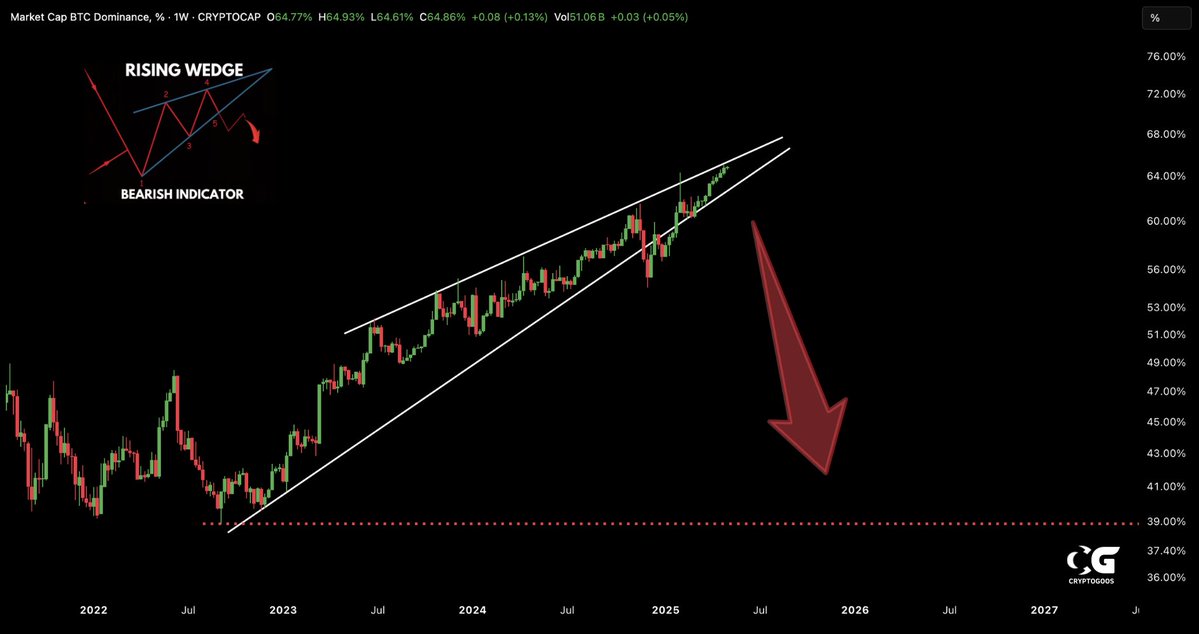
In addition, market analyst Crypto Goos noted that Bitcoin dominance might be breaking down soon, identifying a rising wedge structure that has persisted since 2023. Data suggests BTC.D has reached the peak of this wedge, and a breakdown is imminent.

Bitcoin Dominance in Rising Wedge Crypto Goos
Bitcoin Dominance in Rising Wedge | Crypto Goos

Wellgistics Health to Adopt XRP as Reserve Asset and for Healthcare Payments

Wellgistics Health has announced a $50 million credit facility to adopt XRP as reserve asset and back a new real-time payment infrastructure powered by the altcoin.

The healthcare distribution firm aims to be among the first publicly traded companies in the sector to integrate XRP as a treasury reserve asset and a core settlement mechanism for its nationwide network. 

XRP as a Treasury Asset and Settlement Mechanism in Healthcare

Through its newly secured Equity Line of Credit (ELOC), Wellgistics plans to deploy programmable liquidity and blockchain-based payment systems to remove traditional banking bottlenecks.

The company sees a healthcare infrastructure where manufacturers, suppliers, and pharmacies transact instantly, bypassing outdated intermediaries and high fees.

By leveraging the XRP Ledger, Wellgistics is working to transform one of the most rigid sectors of the U.S. economy.

“We’re betting on infrastructure… not inertia,” said CEO Brian Norton. He added that the company’s focus is on building faster rails, cleaner data, and more efficient platforms.

Why XRP?

Wellgistics outlined several key reasons for choosing XRP over traditional payment rails. Leading the list is its transaction speed. Specifically, XRP settles in about 5 seconds, compared to up to 3 days via ACH or wire transfers.

Each transaction costs less than $0.0002, dramatically lower than standard bank wire fees. The XRP Ledger also provides on-chain transparency, enabling real-time compliance and auditability.

These features enable smart rebate automation, pricing tools, and an immutable compliance layer integrated directly into the Wellgistics ecosystem.

XRP Integration Across the Pharma Chain

Use cases for XRP across the Wellgistics network include:

  • Swift settlement between pharmacies, manufacturers, and suppliers
  • Smart rebates based on prescription-level data
  • XRP-based credit lines for independent pharmacies
  • Global payments with low FX and transfer fees
  • Immutable audit trails for DSCSA compliance and pricing validation

Wellgistics Moves as XRP Gains Institutional Momentum

This announcement comes amid growing institutional adoption of XRP. CME Group plans to launch cash-settled XRP futures in May 2025. Meanwhile, Mastercard has named XRP as a top bridge asset for global payments in a 2025 report.

Likewise, Ripple’s $1.25 billion acquisition of Hidden Road expands its reach into prime brokerage services. Ripple has also secured regulatory licensing in Dubai while expanding live XRP-powered corridors in Brazil and Portugal.

Essentially, as the infrastructure around XRP matures, Wellgistics seeks to lead a new wave of blockchain adoption in U.S. healthcare. Notably, its decision to adopt XRP as a reserve asset comes amid a growing trend among institutions.

For instance, last December, Worksport announced plans to acquire XRP for its reserve. Moreover, the US government has decided to include XRP in its asset reserve, though with no plans yet to acquire the asset.

US Banks Can Offer Crypto Custody and Execution Services, OCC Confirms

0

The U.S. Office of the Comptroller of the Currency has clarified that national banks and federal savings associations are permitted to buy and sell crypto assets on behalf of their customers. 

This development came through an interpretive letter on Wednesday. It builds upon previous guidance and removes earlier supervisory hurdles. It also signals a broader acceptance of crypto asset activities within the traditional banking sector.

Banks May Offer Full Crypto Execution Services

According to the OCC’s updated interpretive letter, national banks can execute crypto transactions and provide related services such as asset settlement, exchange between fiat and cryptocurrencies, recordkeeping, valuation, and tax reporting. 

These services may be conducted either directly or via third-party service providers. The OCC emphasized that institutions must maintain robust internal controls and adhere to sound risk management practices, especially when working with sub-custodians.

The letter also confirms that banks can act based on the customer’s direction when buying or selling assets in custody. 

Third-Party Relationships Require Risk Oversight

The OCC’s latest letter further outlines banks’ responsibilities when outsourcing crypto custody or execution services. Institutions must implement due diligence procedures and ensure appropriate oversight mechanisms when engaging sub-custodians. 

These third-party relationships must also be governed by risk management frameworks that align with existing banking standards. Furthermore, sub-custodians’ involvement must ensure customer asset protection through adequate internal safeguards.

Regulatory Shift Under Trump Administration

This regulatory update aligns with broader changes under President Donald Trump’s administration. It has shown increased openness toward digital asset integration within the financial system. 

An OCC’s March 7 communication rescinded prior rules that required banks to obtain supervisory non-objection before engaging in crypto-related operations. The U.S. Federal Reserve also announced on April 24 that it is withdrawing its 2022 guidance that mandated advance notice for state member banks engaging in crypto activities.

Coinbase’s Chief Policy Officer, Faryar Shirzad, acknowledged the regulatory update and noted Acting Comptroller Rodney Hood’s role in delivering greater regulatory clarity.

Rich Dad Poor Dad Author Reaffirms Bitcoin as Defense in Global War Caused by Greed, Insanity, and Fear

0

Robert Kiyosaki, author of “Rich Dad Poor Dad,” has emphasized that Bitcoin remains a critical defensive asset in what he describes as a global war triggered by fear and greed.

His message follows a significant development in the automotive industry as major Japanese carmakers such as Toyota, Honda, and Nissan are reportedly halting vehicle sales in the United States. 

This decision, according to Kiyosaki, could result in mass unemployment and economic disruption in towns reliant on Japanese auto plants.

He added that while U.S. manufacturers like Ford, GM, and Stellantis might gain from this development, they must respond swiftly. He drew parallels to broader geopolitical tensions, warning that currency wars often escalate into trade wars, which may ultimately lead to military conflict.

Growing Threat of War

In his statement, Kiyosaki linked the economic risks facing the United States to broader geopolitical dynamics, citing his own military experience during the Vietnam War. 

He refrained from specifying which potential conflict he referred to but expressed concern over rising international tensions. He highlighted the growing threat of war and emphasized the need for preparation, both economically and personally. 

His remarks centered on the idea that assets like Bitcoin could serve as financial protection in an increasingly volatile global environment.

Can Bitcoin Be Defense in a Global War?

Notably, Bitcoin has demonstrated strong performance through 2025, gaining over 50% in the past year and now nearing the critical $100,000 level.

As of today, it is trading at $99,456, reflecting a 2.11% increase in the last 24 hours and a 3.52% rise over the past week. Despite brief volatility earlier in the year, the digital asset has shown resilience during recent market disruptions. 

Its recovery from a dip below $75,000 during tariff-related instability earlier this year supports Kiyosaki’s view, though no definitive link has been established between geopolitical risk and Bitcoin’s rally.

Other Pundits Seeing Bitcoin as Hedge Against Turbulence

Previously, analysts from Citigroup acknowledged Bitcoin’s stable behavior amid financial stress, particularly in comparison to traditional assets. In an April report, Citigroup noted that Bitcoin had outperformed macro-based price expectations since early March. 

This performance occurred as equities and bonds faced heavy volatility. Notably, during the March 2023 Silicon Valley Bank crisis, Bitcoin remained stable above $21,000 and closed that month above $28,000. Similarly, in September 2023, amid rising U.S. bond term premiums, it maintained value, opening near $25,000 and ending slightly higher.

Standard Chartered Says $120K Bitcoin Forecast For Q2 2025 Was Too Low, Envisions Stronger Surge

0

Standard Chartered analyst Geoffrey Kendrick apologizes for his Q2 2025 initial price forecast of $120,000 for Bitcoin, admitting that the target was too low. 

Kendrick, Standard Chartered’s head of digital assets, issued the apology today in an emailed note to clients, as seen and reported by CNBC. 

Initial $120K Price Call for Bitcoin By Q2 2025 

Notably, Kendrick has earned a reputation in crypto for supporting Bitcoin and setting bullish price targets for BTC. Last month, he predicted that Bitcoin would hit a new all-time high of $120,000 before the end of Q2 2025. 

In that prediction, the Standard Chartered expert asserted that Bitcoin’s potential surge to $120,000 would be driven by strong whale accumulation, the strategic shift from U.S.-based securities into assets like Bitcoin, and the rise in U.S. treasury term premium. 

While Kendrick expects Bitcoin’s price to hit $120,000 in Q2 2025, he projected that BTC would continue the rally toward $200,000 by the end of the year. 

Why $120K Currently Looks Low 

In his latest note to clients, Kendrick considers his Q2 2025 Bitcoin forecast of $120,000 too low. He emphasized that Bitcoin’s prevailing narrative has shifted in the past few weeks. 

Kendrick noted that Bitcoin’s narrative first hinged on its correlation with risk assets before it evolved into a vehicle for strategic reallocation away from U.S. assets. Notably, the narrative is now centered around capital flows coming from multiple channels.

He specifically referenced the significant inflows into U.S. spot-based exchange-traded funds (ETFs) tied to Bitcoin. According to him, these Bitcoin ETFs saw inflows of $5.3 billion over the past three weeks, indicating strong institutional demand. 

Another factor that changed Kendrick’s mind about his Q2 2025 Bitcoin target is the growing demand among corporate entities. In his view, this is reflected in Strategy doubling down on its Bitcoin accumulation spree, Abu Dhabi’s sovereign wealth fund Mubadala investing over $400 million into BlackRock’s Bitcoin ETF, and the Swiss National Bank gaining indirect exposure to Bitcoin through its acquisition of Strategy’s shares. 

Notably, Kendrick did not factor in the strong institutional and corporate demand for Bitcoin in his April 2025 BTC forecast. Given the recent development, Kendrick believes Bitcoin might surpass his initial Q2 2025 Bitcoin forecast of $120,000 before the quarter ends. 

Bitcoin Close to Revisiting $100K 

His bullish assertion comes on the heels of Bitcoin’s renewed rally toward the psychological price mark of $100,000. At press time, Bitcoin was up 2.95% over the past 24 hours to $99,535. 

The premier asset hit a daily high of $99,882 today, less than $200 shy of clinching the $100,000 mark. At $99,535, Bitcoin is currently down 8.77% from its previous ATH of $109,114, registered on January 20, 2025. 

Not Much New XRP Added as XRPL’s AMM Sees Minimal Growth and a Surge in Low-Value Tokens

0

Panos Mekras says the XRPL needs high-quality assets like stablecoins and RWAs to fix stagnant AMM liquidity despite rising pool count.

Notably, as of May 7, 2025, XRPL’s automated market maker (AMM) ecosystem has recorded a rapid increase in the number of liquidity pools, reaching 19,782. However, XRP liquidity across these pools has remained stagnant since early 2025, hovering around 13.39 million XRP. 

The disparity between pool creation and actual capital inflow has raised concerns within the XRPL community. Panos Mekras, co-founder of Anodos Finance, highlighted the issue on X, noting that while token and pool numbers have surged, meaningful growth in XRP-backed liquidity has failed to materialize.

Asset Quality Remains Central to Growth Challenges

According to Mekras, the expanding pool count is being driven primarily by tokens with limited utility. He observed that many newly issued tokens offer little to no value, yet continue to extract liquidity from the ecosystem. 

He argued that introducing higher quality assets—such as stablecoins from top issuers and real-world assets (RWAs)—is the way to go. Additionally, Mekras emphasized the need for platforms that can enhance onboarding and user interaction with XRPL. In his view, both builders and users must demand better standards from new projects in order to prevent further fragmentation of liquidity.

AMM Pool Composition Raises Usability Concerns

One user on X asked Mekras about pools involving two issued tokens—such as RLUSD paired with a memecoin or another fiat-pegged asset. The question focused on the accessibility of such pools and whether they offer meaningful utility. 

Mekras responded that their value depends on demand and liquidity. He warned that low-activity pools can divert resources away from top-performing pools. 

Despite acknowledging that stable-to-stable pools could be beneficial, he pointed out that user trust in existing stablecoins from GateHub and Bitstamp remains low.

Comparisons with Other Chains 

While activity on other blockchains continues to see growth in total value locked (TVL), XRPL’s liquidity has remained relatively unchanged. Mekras noted that competing chains have already attracted billions in TVL and are now seeing renewed momentum. 

In contrast, XRPL’s low liquidity persists. He stated that the ecosystem should already rank among the top chains by liquidity, yet lacks the presence of top-tier stablecoin issuers.

A technologist, Hussein Badakhchani, who first called attention to this growing concern, responded that while high-quality assets are important, improving the fee structure to better incentivize liquidity providers could also be effective. 

Proposal to Raise the AMM Fee Cap

Badakhchani’s suggestions include a proposal to raise the AMM fee cap from 1% to 2.5%, allowing liquidity providers to vote for higher returns. Another change involves replacing the existing single-fee model with a more granular, operation-specific structure covering XRP and token deposits and withdrawals separately. 

To support this, a revamped liquidity provider (LP) voting mechanism was proposed, designed to accommodate the multi-tiered fee model.

The suggestions also call for excluding blackhole wallets from LP vote calculations to prevent inactive addresses from impacting fee adjustments. To ensure continuity, he recommended a backward-compatible migration strategy for existing pools.

Ethereum Crosses $1,900, Sets Stage for $2,400 Breakout 

Ethereum breaks $1,900 with a 5% jump. On-chain data supports a smooth climb to $2,000 and above.

With Bitcoin’s price crossing above the $99,000 mark, Ethereum is gaining momentum. After topping the $1,900 mark, ETH registered a 24-hour high at $1,916. This marks a critical breakout, signaling a potential Ethereum bull run ahead. Will this surge of bullish momentum drive Ethereum to the $2,400 mark?

Ethereum Price Analysis Signals Massive Breakout Run

Ethereum has surged nearly 5% today, forming a bullish engulfing candle and trading close to the $1,900 level. With a massive boost in buying pressure, Ethereum has surpassed the 50-day EMA at $1,853, marking the breakout of a long-standing support zone near $1,850.

Ethereum Price Chart

The supply zone had kept bullish growth in check over the past couple of weeks. However, with the new bullish engulfing candle, the falling channel breakout rally in Ethereum, witnessed in late April, has finally begun.

Noting the upside potential, the MACD and signal lines remain in positive territory, showing a new wave of bullish histograms. This reflects an increase in trend momentum, signaling a smoother rally ahead.

The 23.60% Fibonacci level sets an immediate price target for Ethereum near the $2,000 psychological mark. However, the declining EMA lines suggest the next price targets are at $2,108 and $2,426.

If the broader market maintains its bullish momentum, the breakout at the 23.60% Fibonacci level will likely push Ethereum to the $2,400 level.

On the flip side, if buyers fail to hold the position, Ethereum could retrace to test the $1,600 mark.

On-Chain Signals Clear Path to $2,000

According to the global In/Out of the Money (GIOM) indicator by IntoTheBlock, Ethereum has shifted beyond the $1,858 zone. The newly formed in-the-money zone between $1,779 and $1,858 holds 7.65 million ETH owned by 7.35 million investors.

As Ethereum enters a new zone extending from $1,858 to $2,039, the uptrend will likely experience a smoother journey to $2,000. In the at-the-money zone, 8.14 million investors hold 5.76 million ETH at an average cost of $1,927.

IntotheBlock
IntotheBlock

While the path to $2,000 appears smooth, the next “out of the money” zone, up to $2,492, contains a massive supply of 69.61 million ETH owned by 12.72 million investors. As a result, a potential pullback could occur once Ethereum crosses above the $2,000 mark.

An “Epic Gravitational Fall” for XRP Targets 1,140% Surge: Here’s How

0

A prominent market watcher has recounted an earlier plausible technical analysis, highlighting a potential XRP price rally to uncharted territory.

Market expert Egrag Crypto reiterated XRP’s potential for new price discoveries in an X post on May 7. The analysis highlighted a potent “epic gravitational fall” for the fourth-largest cryptocurrency by market cap, with its target an over 11-fold rally from its current price.

The noteworthy analysis comes on the heels of XRP’s price resurgence amid broader market bullish momentum. The digital asset has been up 4% since the start of the day, spurred by Bitcoin’s run to nearly $100,000 after the Federal Reserve’s unchanged interest rate announcement.

XRP’s Rally Is a Natural Course

Egrag pointed users to a valid X analysis from December 2023, projecting a massive XRP price rally. The commentary highlighted the token’s price development within a giant cup in the stratosphere on the monthly timeframe while leveraging an inverted chart.

The chart shows that XRP entered the space after its January 2018 all-time high of $3.55. While it attempted to break down from the stratosphere with its April 2021 peak of $1.96, dwindling momentum and prevalent regulatory clouds around the XRP ecosystem prevented the outburst.

XRP Price Analysis/Egrag Crypto

However, Egrag noted that, as gravity stays constant, XRP will also obey natural laws. Eventually, the asset defied the stratospheric impediment by breaking below the 0.72 Fibonacci extension at $1.20. XRP’s meteoric upswing from 50 cents to nearly $2 in November ensured the breach.

With the indestructible law of gravity now in full swing, Egrag identified three targets upon breakdown. First, he predicted a rally of 525% from the break point and 240% from the current level to a new all-time high of $7.5.

Furthermore, he identified the second target at $13, a staggering 491% from today’s price. Ultimately, the market watcher asserted further gravity-enabled “free fall” to $27, marking a 1,140% upsurge from now and a 2,150% swell from the breakout Fibonacci level.

Analysis Confirms XRP to $27

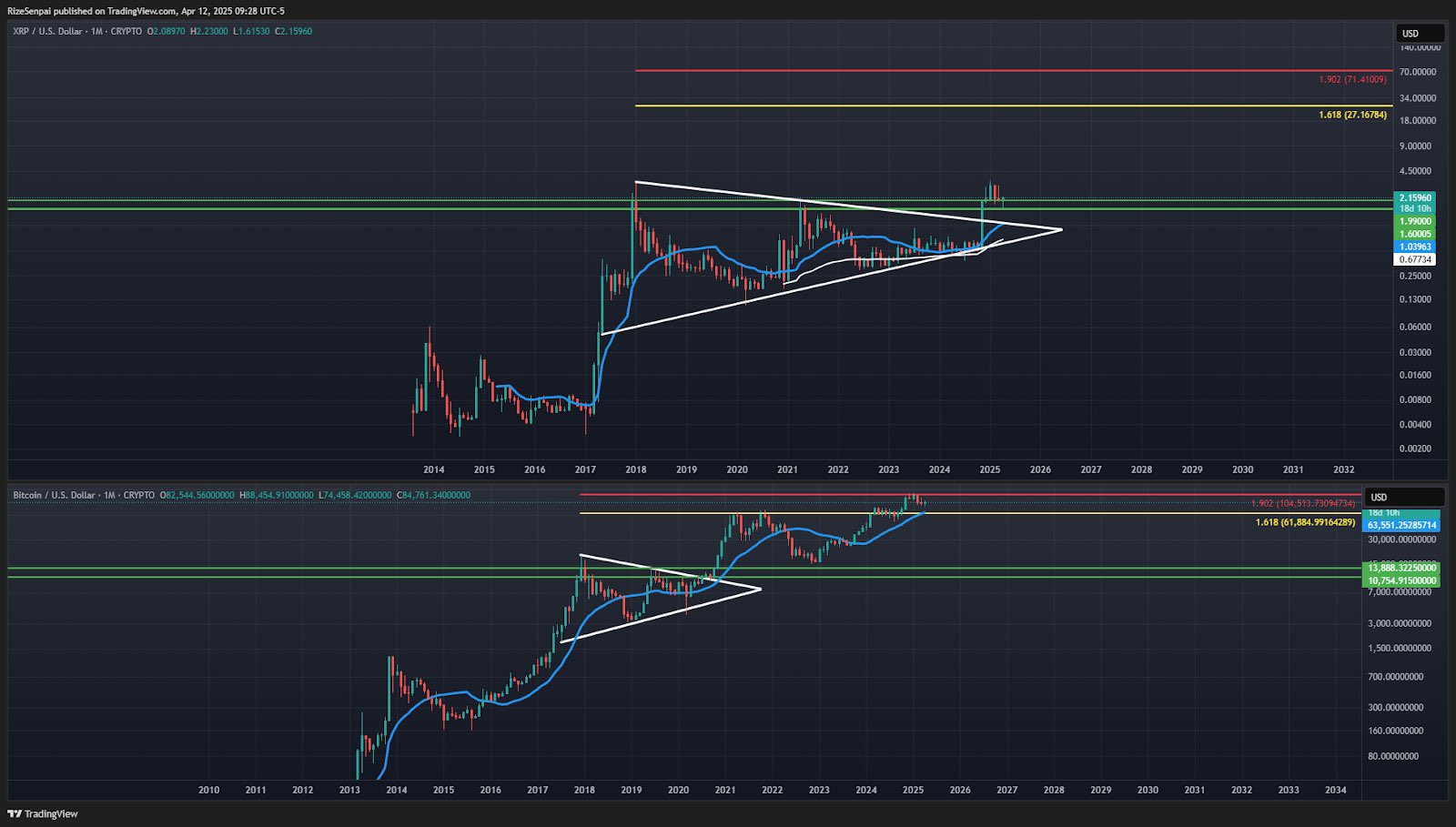
Meanwhile, analyst Amonyx also predicted a potential XRP rally to $27 in a Wednesday commentary. He identified a developing bullish XRP price action in an accompanying chart, drawing inspiration from its historical performance.

XRP Symmetrical Triangle Breakout/Amonyx

For perspective, XRP broke from a symmetrical triangle with its over 500% November expansion, with sustained bullish traction steering it to the levels around the tip of the structure’s origin at $3.55. The expert compared its recent price action to a similar breakout in 2021, which saw the token surge to the 1.618 and 1.902 Fibonacci extensions.

Amonyx expressed confidence that XRP would mirror the performance, predicting a similar surge to the extensions. Notably, the chart shows that the 1.618 and 1.902 Fibonacci levels lie at $27.16 and $71.4, respectively.

In the meantime, XRP currently trades at $2.20.

SUI Targets New All-Time High at $6 as Derivative Traders Turn Bullish

SUI price jumps 8.3% to $3.60 with a golden crossover. Can it reach the $6 ATH as network activity and trader interest surge?

With a bullish comeback for altcoins, SUI is among the fastest to gain momentum in the market. Currently, the SUI price is $3.60, reflecting an intraday gain of 8.3%.

As a golden crossover accompanies SUI’s bounce-back, bulls are anticipating a major rally. Could this lead to a new all-time high at the $6 mark?

SUI Price Analysis

Bouncing off the 23.60% Fibonacci level at $3.30, SUI has made a strong recovery. After a period of consolidation and indecisive price action in recent weeks, the broader market rebound has helped pump the SUI token.

SUI Price Chart
SUI Price Chart

With a new bullish engulfing candle, the SUI token shows signs of a positive reversal from the $3.30 level. Additionally, the recent golden cross between the 50-day and 200-day EMA lines continues to serve as a bullish signal.

The ongoing recovery now hints at a bullish crossover between the 50-day and 100-day EMA lines, potentially restoring full positive alignment. As the uptrend builds momentum, the Chaikin Money Flow Index stands at 0.21, indicating a strong capital inflow. With a previous high near 0.40, the indicator suggests more room for growth.

SUI Price Targets

According to trend-based Fibonacci levels, the continued upside in SUI faces immediate resistance at the 38.20% level, which is around $4.63. However, if the bullish trend persists, the retracement pattern also points to a potential new all-time high at $6.

On the downside, key support levels include the 200-day EMA at $2.84, followed by psychological support at $2.

SUI Network Expansion Continues

As the market price climbs, the SUI network continues to expand rapidly. According to SUIScan, the SUI network has surpassed 10 billion total transactions. Meanwhile, total value locked (TVL) has reached $1.729 billion, inching closer to a new all-time high near $2 billion.

The total number of accounts has exceeded the 180 million milestone, reflecting sustained network growth.

Derivative Traders Go Long on SUI

Amid the surge, trader interest in SUI’s derivatives market has spiked. Open interest has risen 6.12% to reach $1.60 billion. Over the past 24 hours, heavy seller liquidations have wiped out $4.41 million in short positions.

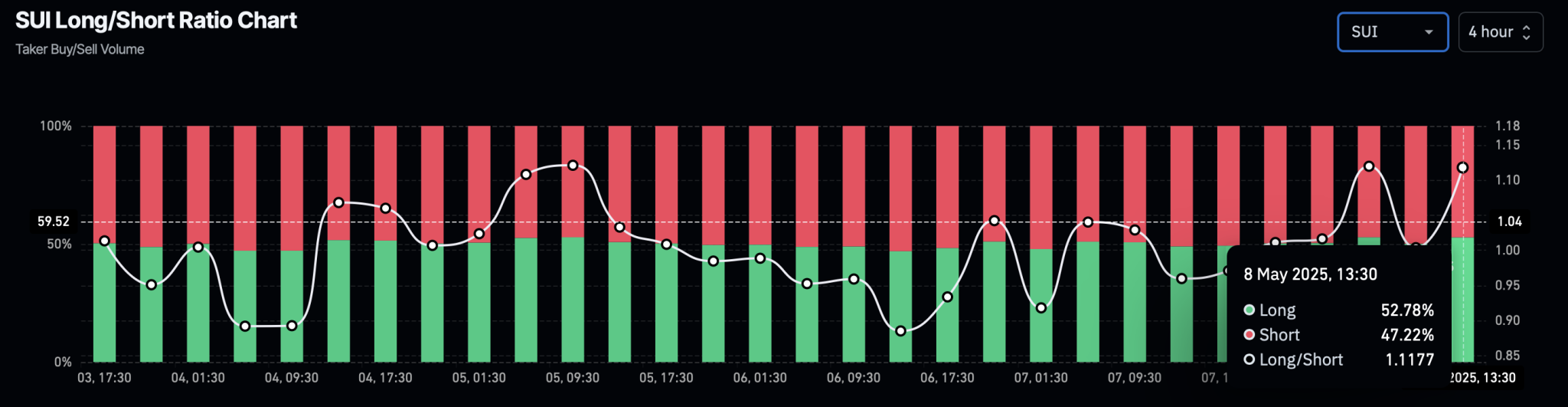
Fueling the likelihood of further short liquidations, long positions over the past 24 hours have climbed to 52.78%, pushing the long-to-short ratio to 1.1177. This reflects a shift toward bullish sentiment among derivative traders.

Coinglass
Coinglass