Home Blog Page 759

Tron Eyes $0.40 as Tether’s $1B USDT Mint Boosts Momentum

TRON price holds near $0.24 amid bullish momentum. With strong EMA support and Tether’s $1B mint, can TRX reach the $0.40 mark?

The crypto market remains relatively quiet following sharp weekend volatility, with Tron holding steady near $0.24. The altcoin remains in the top 10 by market capitalization, currently valued at $23.46 billion, and is resisting a minor pullback of 0.91% over the past 24 hours.

Currently, TRX’s resilience suggests the potential for a major breakout rally. Could this bullish momentum push Tron toward the $0.40 level?

Tron Price Analysis

On the daily chart, TRON price action reveals a consolidation range between $0.21 and an upper ceiling of $0.2551. Within this range, short-term TRX price action is supported by the 50-day EMA, indicating growing strength.

This increases the likelihood of a breakout as TRX approaches the upper boundary. Additionally, the 50-, 100-, and 200-day EMA lines remain in a bullish alignment.

Tron Price Chart
Tron Price Chart

Based on previous price movements, the current consolidation follows a sharp correction from $0.45 to $0.21. This range reflects the market’s absorption of the selling pressure that began in late 2024.

Since then, price momentum has been confined within the range, potentially setting the stage for a strong breakout. Supporting this outlook, the MACD and signal lines are trending closely together in the positive zone.

This suggests an increased chance of a bullish crossover, which could signal a trend reversal. Using trend-based Fibonacci retracement levels, a breakout could see TRX reaching the 23.6% level at $0.28.

Should momentum strengthen, the price may test the 50% Fibonacci level at $0.3988, highlighting a strong possibility for TRX to reclaim the $0.40 mark. Conversely, a breakdown below the 50-day EMA at $0.24 could lead to a retest of the 200-day EMA at $0.2243.

Tron Ecosystem Boosted by Additional 1B USDT Mint

Fueling bullish sentiment around the Tron ecosystem is Tether, which has minted an additional 1 billion USDT on the Tron network. Since April 28, Tether has minted 4 billion USDT across Ethereum and Tron.

According to a recent tweet by crypto analyst Ted Pillows, Tron’s network economic value stands at 24.56%, second only to Solana at 41.72%. With Tron’s chain revenue now surpassing Ethereum’s at 16.4%, demand for TRX tokens is expected to increase.
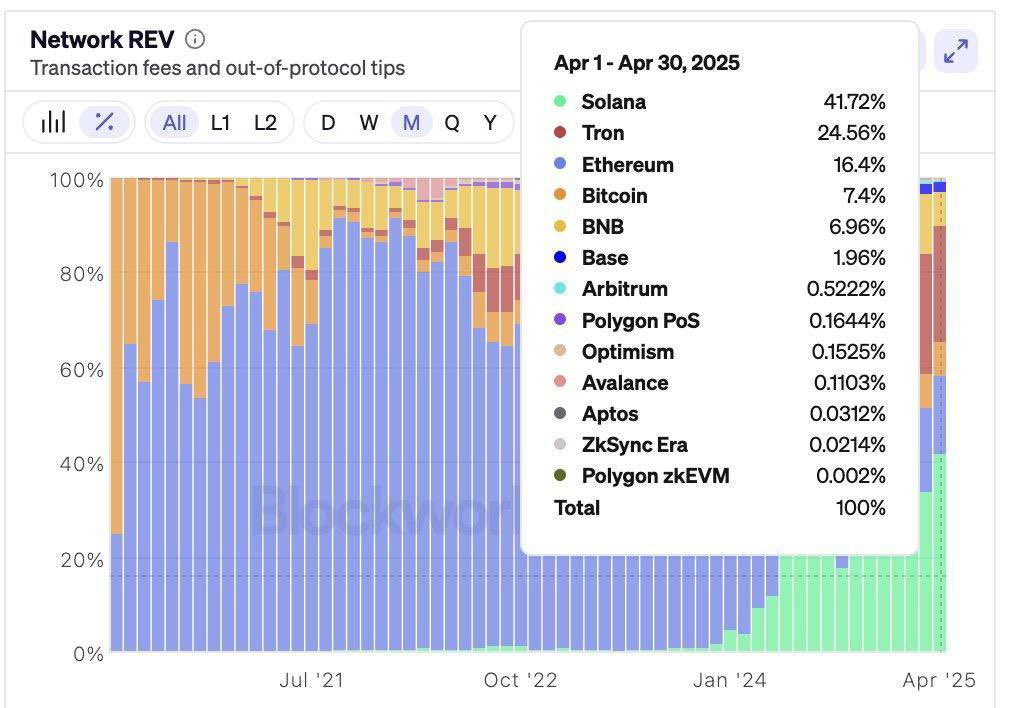
Image

According to TronScan, the total number of accounts on the Tron network has surpassed the 300 million mark. As of now, total accounts stand at 304.65 million, while the total value locked (TVL) has exceeded $20 billion, currently at $20.25 billion, indicating growing network strength.
Here Are Levels to Watch as Shiba Inu Ecosystem Token BONE Forms Possible Reversal to $16

0

Analyst Crypto Conqueror identifies levels to pay attention to for Bone ShibaSwap, a prominent Shiba Inu ecosystem token, eyeing a potential reversal.

Bone ShibaSwap (BONE) displayed brief volatility over the past week, fluctuating between $0.27 and $0.32. A sharp surge on May 4 temporarily pushed the price above $0.32, followed by a retracement that stabilized around $0.29 by May 6. 

While this movement signals short-term price fluctuations, an analyst is now tracking a potential reversal pattern forming near historically significant support levels.

Reversal Signals Align with Fibonacci Channel Levels

Technical analyst Crypto Conqueror highlighted a possible trend reversal based on the Fibonacci channel and price behavior around key zones.

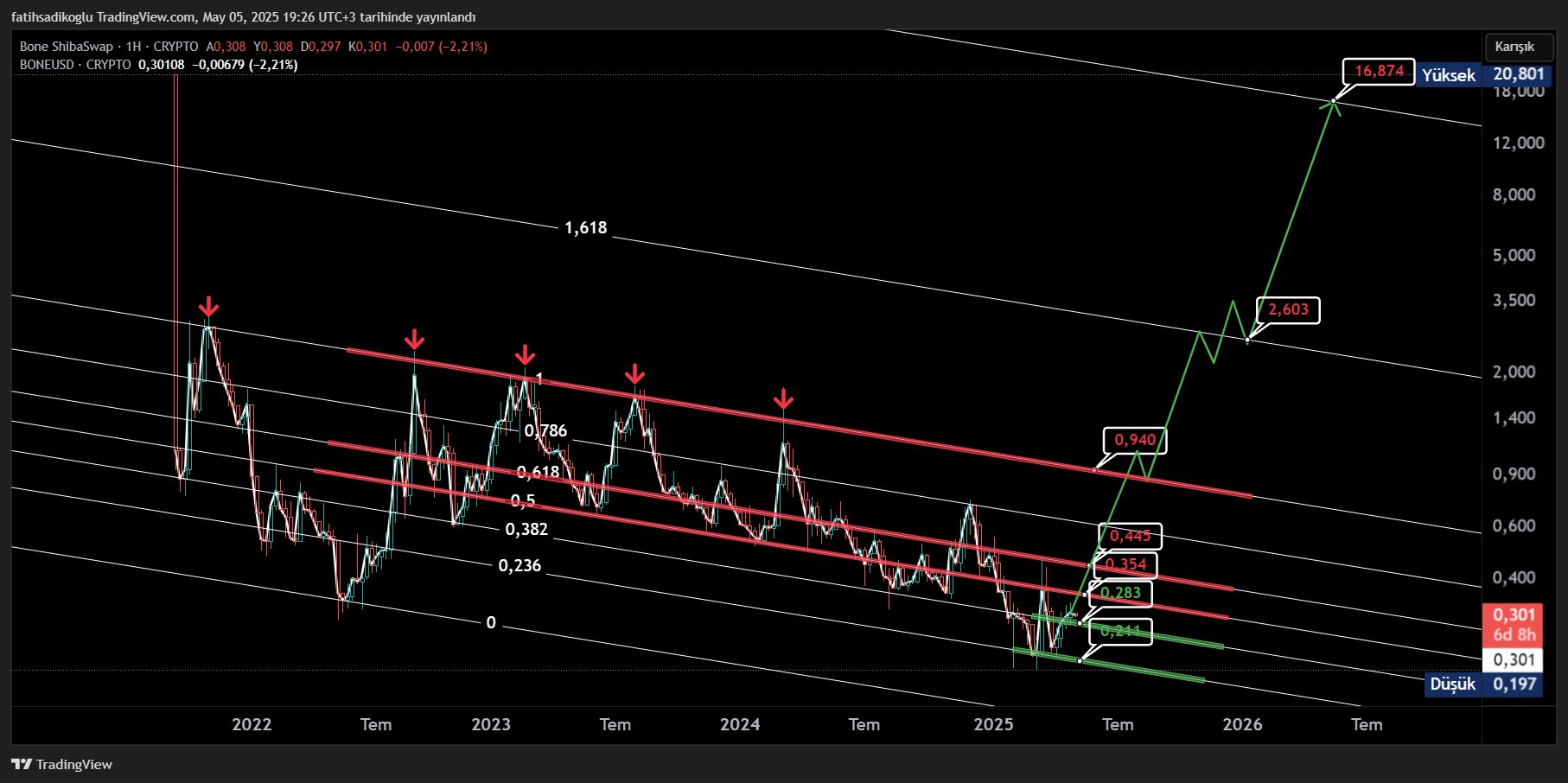
According to the analysis, BONE has found repeated support at $0.21, which corresponds with the 0.236 Fibonacci retracement level. This support level has historically triggered price rebounds, confirming its significance in the current market condition.

Bone ShibaSwap 1h Chart Crypto Conqueror
Bone ShibaSwap 1h Chart | Crypto Conqueror

The analyst suggested that the key Fibonacci channel zones at $0.35 and $0.44 have historically functioned as both support and resistance, with multiple price touches reinforcing their significance. He emphasized that these levels are likely to act as the initial indicators for upward movement. Sustained price closures above these bands would signal potential bullish momentum.

Furthermore, the analyst identified the Fibonacci 1 channel level at $0.94 as a critical breakout point. Although price wicks have extended to this level five times since BONE’s launch, there has yet to be a confirmed close above it on the line chart. 

As noted by Crypto Conqueror, a close beyond this threshold would represent BONE’s definitive trend reversal and open the path to higher Fibonacci targets. Specifically, the 1.618 Fibonacci channel target stands at $2.60, while the 2.618 level corresponds to $16.80.

On-Chain Activity Reflects Deflationary Pressure

Adding to this technical structure, recent on-chain events suggest potential supply-side pressure. The Sol Killer (DAMN) project, a meme coin operating on the Shiba Inu blockchain Shibarium, recently burned 10,197 BONE tokens. 

DAMN’s official X account disclosed the burn event, while Shibariumscan verified the removal alongside 189.47 million DAMN tokens. This burn activity reduces the circulating supply of BONE, contributing to its deflationary outlook and potentially reinforcing long-term price stability.

This development follows a broader effort across the Shiba Inu ecosystem to introduce deflationary measures. However, despite these actions, other metrics present a more cautious backdrop for short-term outlooks.

Large Holders Show Cautious Behavior 

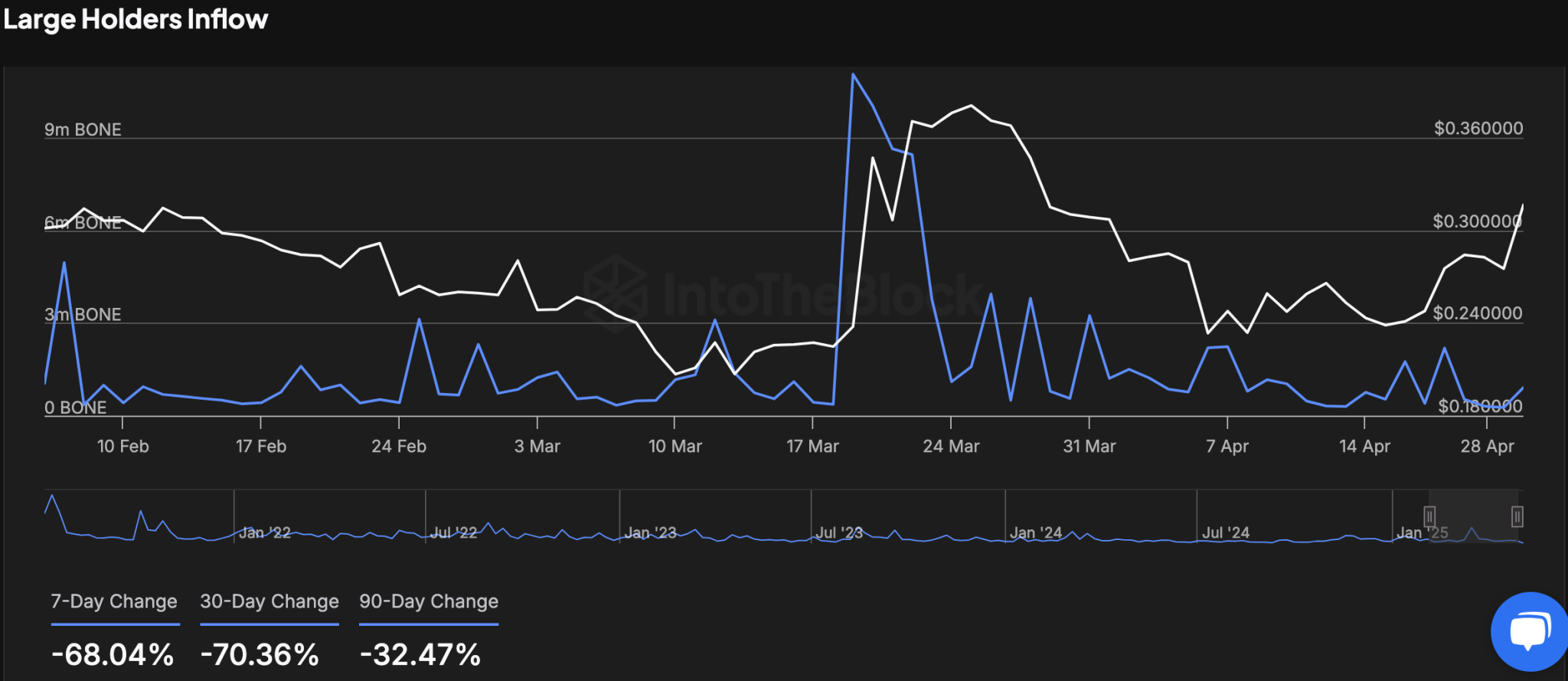
Whale activity over the last three months has reflected lower participation in accumulation. Data sourced from IntoTheBlock reveals a decline in large holder inflows from early February through April 2025. 

BONE Large Holders Inflow | IntoTheBlock

Percentage changes in 7-day, 30-day, and 90-day inflows show steep drops of -68.04%, -70.36%, and -32.47%, respectively. This trend suggests that while BONE has recovered from its March lows, larger investors remain hesitant to increase holdings at current levels.

Analyst Shares Why Buying XRP at $2.20 Is Still Smart, Not Too Late

An XRP analyst known as “J4b1” recently triggered renewed optimism about XRP’s future price trajectory, as the token continues to trade around $2.

In a recent analysis, the analyst explained why buying XRP at $2.20 isn’t too late to the party. In his view, it could be an early move before institutional demand triggers a major breakout.

Notably, the analysis relies on historical context, internal forecasts, and Ripple’s strategic price management. It explored XRP’s origins, noting that its story began in 2012, when it traded below a penny while Ripple pitched its payment solutions to banks.

From Under 1 Cent to Cross-Border Challenger

He claimed that as institutions began recognizing the benefits—faster settlement, reduced fees, and freed-up liquidity—XRP skyrocketed to $3.84 during the 2017 bull run. However, disruption came with resistance.

Ripple’s challenge to traditional finance drew regulatory fire. A 2015 fine from FinCEN and the 2020 SEC lawsuit plunged XRP into years of uncertainty. It stalled adoption and suppressed price performance. Still, Ripple never stopped building.

The company focused on infrastructure and partnerships, acquiring firms like Metaco and securing licenses globally.

Interestingly, J4b1 cited a supposed 2018 BlackRock report that estimated XRP’s price could reach between $6.37 and $30 in bullish scenarios. He claimed these projections, made before the SEC lawsuit, hinted at XRP’s institutional potential, one that may have already played out if regulatory headwinds hadn’t slowed momentum.

Why $2.20 May Be Intentional

Meanwhile, the analyst examined Ripple’s strategy for managing XRP’s liquidity to explain XRP’s price action. Each month, Ripple unlocks 1 billion XRP from escrow but only sells a fraction, often via OTC deals, to minimize market impact. The firm then re-locks the remaining tokens.

According to J4b1, this approach helps Ripple stabilize XRP within a range that supports operational needs. In his example, if Ripple needs to move $200 million using 100 million XRP, each token must be worth $2. If prices rise too quickly, Ripple sells; if they fall too low, Ripple buys.

J4b1 used this scenario to argue that XRP hasn’t broken out yet because Ripple may be deliberately maintaining a stable price for functional reasons. However, this perspective is largely speculative, as a higher XRP price could also benefit the company and its stakeholders.

What Could Trigger an XRP Breakout?

Regarding what could drive an XRP price breakout, J4b1 highlighted several key catalysts:

  • Institutional adoption
  • Regulatory clarity under a pro-crypto Trump administration
  • XRP spot ETFs
  • Real-world asset tokenization on XRPL

The analyst suggested that a supply shock could occur once institutional demand outweighs Ripple’s supposed price management strategy, potentially driving XRP significantly higher.

XRP: From $6.37 to $30?

According to the analyst’s models, XRP’s 2025 price could range from $6.37 on the conservative end to $30 in an optimistic, utility-driven scenario. He emphasized that these aren’t meme-level predictions but are based on fundamental analysis and early institutional modeling.

Ultimately, J4b1 used these points to argue that entering the XRP market at current prices still offers investors ample opportunity, a sentiment widely shared within the XRP community.

Bitcoin Price Could Reach as High as $450,000 This Cycle, According to Raoul Pal

0

Raoul Pal, CEO of Real Vision, suggests that the crypto market could be entering an extended bullish phase, and Bitcoin will go higher in Q1 2026. 

Speaking during the Sui Basecamp event, Pal explained that a confluence of macroeconomic and technical indicators now supports the case for a parabolic phase in digital assets. This period, which he calls “The Banana Zone,” may push Bitcoin and other cryptos significantly higher through the first quarter—or potentially even the second quarter of 2026. 

The expectation aligns with ongoing macro conditions, including a delayed rate-cutting cycle, and forward-looking liquidity models that continue to trend upward despite broader market uncertainty.

Bitcoin Could Reach $450,000

Pal highlighted that a tight correlation exists between liquidity levels and asset prices, noting that 90% of Bitcoin’s price movement and 97% of Nasdaq’s can be explained by liquidity flows. As such, he emphasized that tracking global liquidity remains key to understanding market direction. 

Although recent investor sentiment has turned cautious, Pal reported that macro indicators still support further gains. He pointed to improving business cycle data, particularly the ISM index, which he believes is bottoming out and could climb significantly. 

The ISM Index is a monthly economic indicator that measures U.S. business activity. Readings above 50 signal expansion, and below 50 indicate contraction.

According to Pal, if the ISM levels reach 57, currently below 50, his internal models project that Bitcoin could touch $450,000. Pal noted that this surge would also impact altcoins, ushering in the altcoin season.

Market Phase Echoes Previous Frenzy Cycles

In the video, Pal indicated that cryptocurrencies have now entered what he classifies as the third cycle phase, defined by intense speculation and rapid price movements. He drew parallels to earlier periods like 2009 and 2020, when liquidity spikes preceded institutional inflows. 

While prone to sharp corrections, this phase often sees extended upward trajectories. Pal cautioned that even 35% drawdowns may not signal an end to the cycle, though they could create confusion among investors. He warned against using leverage and urged holders to remain cautious during this volatile stage.

Bitcoin’s Path Compared to Amazon’s Long-Term Rise

Elsewhere in the crypto space, new analyses suggest that Bitcoin may be breaking away from its traditional four-year halving cycle. Financial researchers have begun comparing Bitcoin’s projected growth to Amazon’s historical performance between 2002 and 2025. 

Notably, Amazon’s stock rose from under $1 to over $230 over that period, despite repeated downturns and skepticism. This comparison implies that Bitcoin might follow a similar long-term trajectory if structural cycles become less influential. Analysts at Bitcoin Archive believe this evolving pattern could define the asset’s next 20 years.

XRPL Labs Founder and Ripple CTO Respond as User Points Out Massive 10,000 XRP Xaman Fee

The XRPL Labs founder and Ripple’s CTO have responded to a complaint regarding an unusually high 10,000 XRP fee from Xaman.

Notably, Clint Boerner, co-founder and CTO of Ark Institute, recently raised alarm over what appeared to be an exorbitant transaction fee from Xaman Wallet (formerly Xumm). According to Boerner, during an attempt to swap PLR tokens for XRP, his wallet encountered a service fee request of 10,000 XRP, roughly equivalent to $21,000. 

He expressed concerns publicly, pointing out the concerning nature of the issue although the transaction failed due to insufficient balance. Boerner argued that had the wallet contained the required amount, the system might have deducted the fee without warning.

Speaking further, he shared that a different transaction executed from another wallet, even with a Xaman Pro subscription, also incurred a small standard fee of 0.09 XRP, noting that he was still awaiting a response from Xaman’s support team on the matter.

XRPL Labs Founder and Ripple CTO Respond

Wietse Wind, the founder of XRPL Labs, the team behind Xaman, responded to Boerner’s concerns. Wind clarified that what appeared to be a 10,000 XRP fee was a safeguard mechanism that deliberately sets an impossible requirement to ensure the transaction does not proceed. 

According to Wind, the transaction in question originated from a payload signing event tied to an attempted exchange for a staggering 100 billion XRP. He explained that this extraordinary value triggered a hard cap within the backend of the system.

Wind assured the community that they had since updated the backend to prevent such extreme payloads from third-party developers. 

He confirmed that the transaction never completed and affirmed that had it gone through, the development team would have refunded the amount. In his statement, Wind confirmed that they had resolved the bug and fully addressed the issue.

Meanwhile, some community members brought the issue to Ripple’s Chief Technology Officer, David Schwartz. When asked for his opinion, Schwartz dismissed the incident as a edge case that had slipped past earlier iterations of the code. He noted that the XRPL Labs team had fixed issue.

Additional Context

Reacting directly to Boerner’s claim, Denis Angell, a software engineer at XRPL Labs, explained that the system calculates swap fees based on the amount of XRP involved in the transaction. According to him, in this peculiar instance, the request involved 100 million XRP, which resulted in the inflated fee estimate. 

Angell reassured users that all verified swap providers within Xaman use exchange rate-based calculations, which inherently safeguard users from encountering such edge cases when using the built-in Swap feature.

Meanwhile, Danella Draper, a Web3 consultant and blockchain educator, suggested users should be mindful when interpreting the situation. Draper suggested that Boerner may have inadvertently attempted to execute a transaction equivalent to the entire ledger in one go. 

She stressed it was important to consider the technical context fully before making public claims, warning that such misunderstandings could undermine the reputation of a platform like Xaman that has reliably served the XRP Ledger for years.

Binance Co-founder Changpeng Zhao Says Bitcoin Will Hit $500,000 or $1M This Bull Cycle

0

Binance co-founder and former CEO Changpeng Zhao has predicted that Bitcoin will hit new price milestones during this bull cycle, including a seven-figure value.

This bull cycle has seen its fair share of highs and lows, including Bitcoin’s surge to a six-figure valuation. The flagship cryptocurrency crossed $100,000 for the first time last December and hit a new high of $109,300 on January 20.

However, as the asset faces consolidation following a drop from the $109K peak, Binance co-founder and former CEO Changpeng “CZ” Zhao has dropped a bold Bitcoin price prediction. He suggested that the crypto firstborn will break new heights with a surge to between $500,000 and $1 million this bull cycle.

More Milestones for Bitcoin

CZ made the price prediction during the Myriad Markets prediction session in a RugRadio podcast with founder Farokh Sarmad. When quizzed on which price Bitcoin will trade at by the end of the bull cycle, he stated that the asset would rally, possibly to a seven-figure value at $1 million.

Interestingly, CZ had made a similar prediction in the past. In a tweet during the February market crash, he asserted that the crypto leader would hit $1 million before crashing to around $985,000. However, he did not place a timeline for its attainment until yesterday’s podcast.

Notably, this price target would see Bitcoin rally 959% from its current market price of $94,457. Also, its market cap will reach $19.8 trillion, nearing gold’s current valuation of over $22 trillion.

Meanwhile, the Binance co-founder expects the global cryptocurrency market to hit $5 trillion by the end of the year. Notably, his analogy suggests that this bull cycle will extend beyond 2025, which is supposedly the last year of the bullish season according to the historical cyclical calendar.

Interestingly, there are predictions that Bitcoin will hit $1 million, but none is as close as CZ’s recent outlook. The earliest is a January 2027 timeline by Dr. Murray Rudd and Dennis Porter of Satoshi Action Funds. Meanwhile, Cathie Wood and Swan Bitcoin projected a $1 million Bitcoin price in 2030.

No New Dogs for Now: CZ

Meanwhile, Zhao shared major highlights on his meme coin dabble earlier in the year. For perspective, he posted pictures of his dog Broccoli in February, sparking a meme mania among degens.

CZ noted that he was in the dark about how meme coins work and posted his dog’s picture based on popular demand. While he mentioned that he enjoyed the experience, he does not intend to buy another dog in the near term.

He also squashed rumors that he was willing to relinquish his shares at Binance.US for a presidential pardon deal, revealing he has not directly contacted pro-crypto US President Donald Trump. However, he confirmed that he recently applied for a presidential pardon but clarified that the end game was not to become Binance CEO again.

Shiba Inu: Top Shibarium Meme Coin Burns 10,179 BONE Tokens

0

Sol Killer (DAMN), a meme coin based on Shiba Inu blockchain Shibarium, announced that it has burned more than 10,000 Bone ShibaSwap (BONE) tokens. 

The official X account of DAMN shared the development yesterday, emphasizing that its burn mechanism has succeeded in permanently removing 10,197 BONE from circulation. 

Notably, data from Shibariumscan also confirms that the Sol Killer project has burned 10,197 BONEs alongside 189.47 million of its native token, DAMN. 

Here’s How Sol Killer Is Burning BONE 

In a follow-up blog post, Sol Killer explained how its mechanism reduces BONE’s supply. The project revealed that while it was not designed to burn BONE initially, the incineration of its liquidity pool (LP) last year unlocked a deflationary trick that reduces the supply of Bone ShibaSwap through burns. 

Last year, The Crypto Basic reported that Sol Killer burned its LP, leading to the incineration of 3,179 BONE and 35.5 million DAMN. With Sol Killer’s LP burned, tokens in the contract, which include BONE and DAMN, become inaccessible forever. 

Notably, WoofSwap, the team behind Sol Killer, splits swap fees between LP holders and its protocol, each receiving 70% and 30%, respectively. The fees for LP holders and WoofSwap protocols are stored in different PairFee contracts. 

However, since Sol Killer has burned its LP, the 70% fees cannot be claimed and are forever locked in the PairFee contract designed for LP holders. In this way, the tokens, including BONE and DAMN, are considered burned forever. 

With this mechanism, anytime someone initiates a transaction on WoofSwap involving Sol Killer, it contributes to the deflationary trend of both BONE and DAMN. This activity could reduce the tokens’ supply and boost their prices in the long term. So far, Sol Killer’s burn mechanism has torched 10,197 BONE. 

Why Sol Killer’s BONE Burn Not Reflecting on Etherscan 

It is worth mentioning that the burn does not reflect on Etherscan since it was carried out on Shibarium, an Ethereum-based L2 scaling solution. 

For context, tokens bridged from Ethereum to Shibarium are usually in wrapped versions, like Wrapped BONE (wBONE). When an ERC‑20 token like BONE is bridged to Shibarium, the original token stays locked in an Ethereum bridge contract, and a wrapped version equivalent is issued on the Shibarium L2 network.

With Sol Killer burning 10,179 wBONE through its unique burn mechanism, the actual BONE held in the Ethereum bridge contract would remain stuck forever. 

Meanwhile, BONE is currently trading at $0.3014 per token, with its price up 0.51% in the past 24 hours.  

Analysis Suggests Bitcoin May Mirror Amazon’s Long-Term Rise if Four-Year Cycles Are Over

0

A recent Bitcoin analysis suggests that if the 4-year cycles have ended, Bitcoin’s next 20 years may mirror Amazon’s long-term growth trajectory.

A historical chart tracking Amazon’s stock price from 2002 to 2025 has emerged in current financial discussions, presenting a new avenue through which Bitcoin’s future can be evaluated. Notably, the chart highlights Amazon’s consistent long-term growth amid early skepticism about its profitability.

The pattern now serves as a reference point as Bitcoin analysts reassess its evolution beyond the familiar four-year halving cycle. Market watchers are now comparing the two assets, particularly in light of changing macroeconomic forces influencing Bitcoin’s price behavior.

From Amazon’s Skepticism to Long-Term Wins

Over two decades, Amazon’s stock (AMZN) climbed from under $1 in the early 2000s to over $230 by 2025. During this period, it weathered multiple downturns and frequent concerns from analysts about its earnings. 

However, the stock demonstrated resilience, consistently rebounding and forming a long-term upward trajectory. 

This sustained growth pattern is now being viewed as a possible analogue for Bitcoin, particularly if traditional halving cycles become less dominant. Bitcoin Archive notes that if Bitcoin’s four-year cycles are truly over, its next 20 years could follow a pattern like Amazon’s long-term rise.

Community Reacts

Notably, analysts on X are weighing in on the idea that Bitcoin may be moving beyond its traditional four-year cycles. One user pointed to strong similarities between early skepticism around Amazon and current doubt about Bitcoin, likening missed opportunities in 1999 to ignoring long-term gains today.

Another market commentator stated that if the four-year cycle has ended, Bitcoin is no longer about chart patterns but instead about navigating liquidity-driven volatility. The user added that over the next 20 years, the focus could shift away from halving narratives and toward broader macroeconomic forces.

Institutional Demand Outpaces Bitcoin Supply

Meanwhile, further data show there is not enough Bitcoin, and that rising institutional interest in Bitcoin is pressuring the available supply. According to Bitwise CEO Hunter Horsley, only 165,000 BTC are projected to be mined in 2025. However, public companies alone acquired over 95,000 BTC in Q1 2025, signaling a potential supply-demand imbalance. 

Bitwise also reported that institutional Bitcoin holdings rose by 2.2% during the same quarter, reaching a total value of $56.7 billion. This rapid accumulation suggests that supply may fall short of institutional appetite.

Strategic Bitcoin Reserve Will Never Happen: Kevin O’Leary

0

Kevin O’Leary dismissed the Strategic Bitcoin Reserve proposal, stating it won’t pass despite strong advocacy from industry leaders like Michael Saylor.

This came in a public exchange between the Shark Tank judge and Anthony Scaramucci, founder of SkyBridge. The discussion touched on Senator Cynthia Lummis’s proposed Strategic Bitcoin Reserve Bill. 

During the debate, aired on Scaramucci’s official YouTube channel, both investors took opposing positions in response to a question from the audience. One question focused on whether the proposed Bitcoin legislation would benefit the U.S. economy.

For context, Senator Cynthia Lummis reintroduced the Strategic Bitcoin Reserve Bill this year with new co-sponsors. The bill aims to establish secure Bitcoin vaults under the U.S. Treasury. It proposes that the government purchase 1 million BTC to strengthen the dollar and reduce national debt. 

Meanwhile, during a separate Bitcoin forum, MicroStrategy Chairman Michael Saylor stated the U.S. could potentially earn $106 trillion by gradually acquiring Bitcoin.

O’Leary: Strategic Bitcoin Reserve Will Never Happen

Meanwhile, Kevin O’Leary firmly rejected the idea of a Strategic Bitcoin Reserve, stating the bill would not receive bipartisan support. He criticized Michael Saylor, claiming that his aggressive Bitcoin strategy was self-serving. “Michael Saylor is talking his own book,” O’Leary said.

Moreover, O’Leary highlighted that Strategy sells stock, preferred shares, and debt to buy Bitcoin, noting that its shares trade at twice the value of the company’s underlying Bitcoin holdings. He argued that such a model lacks long-term viability.

Instead, O’Leary highlighted stablecoin regulation as the likely legislative focus in the near term.

According to him, the U.S. is more likely to pass a stablecoin law that enables digital dollars to move globally at minimal cost. He disclosed ownership in USDC and emphasized that moving dollars with stablecoins would cost one basis point, compared to the 2% in fees traditional banks charge.

He added that stablecoins could reduce international dollar transfer fees and undercut banks’ revenue models. In his view, this scenario is more achievable than the establishment of a Bitcoin reserve by the government.

Scaramucci Supports Bill

On the other hand, Anthony Scaramucci, managing partner at SkyBridge, disagreed with O’Leary. He stated that the bill would benefit the economy. He referred to recent comments from David Sacks, President Trump’s crypto czar, who advised delaying executive action to avoid partisanship. 

Scaramucci stressed that unilateral action by a Republican administration might lead to reversal by a future Democratic government. He stressed that the next six months remain critical for establishing bipartisan support.

He pointed out that the United States already maintains 27 strategic reserves, including oil and gold. This reference was used to justify the potential addition of Bitcoin to the list. 

Strategy Expands Holdings 

Notably, the debate followed Strategy’s latest Bitcoin acquisition, which was signaled days earlier by Saylor.

Strategy’s recent $180.3 million acquisition brought its total Bitcoin holdings to 555,450 BTC. The firm’s average purchase price reached $68,550 per coin, indicating a cumulative investment of about $38.08 billion.

Saylor has also reiterated plans to continue accumulating Bitcoin, regardless of future price points. According to his recent public statements, acquisitions could even scale up to $1 billion per day.

Can an XRP Holder Earn Passive Income Natively on XRPL? Recent Test Shows Shocking Results

XRP staking might not exist in the traditional sense, but one community voice has demonstrated that there’s still a way to earn yield natively on the XRPL.

In a detailed case study posted on X, XRP community commentator “All Things XRP” documented an experiment to determine whether XRP holders can earn passive yield without leaving the XRP Ledger. The user aimed to answer the popular inquiry concerning staking and earning yield on idle XRP.

Since XRP doesn’t support native staking like Ethereum, the experiment focused on Doppler Finance. Notably, the platform offers DeFi yield strategies directly on the XRPL without the use of bridging or wrapped tokens. Intrigued by this possibility, “All Things XRP” decided to test it personally and share his results.

Setup and Strategy: CeDeFi on the XRP Ledger

Using the Xaman wallet, the analyst deposited 476 XRP into Doppler’s staking pool. The setup process took around 20 minutes, including wallet creation, funding, and connecting to the Doppler web app.

Doppler doesn’t offer traditional staking rewards. Instead, it generates yield through two CeDeFi strategies: The first is XRP-neutral arbitrage, which takes advantage of exchange price differences without altering XRP exposure.

Meanwhile, the second strategy includes spot–perpetual arbitrage, in which XRP is used as collateral to execute offsetting trades based on funding rate dynamics.

Notably, the platform measures rewards in Doppler Points (DP), issued at a rate of 0.01 DP per hour per $1 of deposited XRP. The long-term value of these points remains speculative. All Things XRP suggested they may serve governance purpose, access, or future token rewards.

Security and Custody

The user was initially cautious about the platform’s visibility but proceeded after reviewing Doppler’s documentation and security partners. Notably, Fireblocks and Ceffu (MirrorX) handle custody, managing user assets with institutional-grade protection.

Essentially, this setup eliminates the need to rely on smart contracts or risky bridges, one of the major concerns when experimenting with newer platforms.

Real Results: 0.3990 XRP Earned in 9 Days

After nine days, the experiment yielded 0.3990 XRP, approximately $0.88 at an XRP price of $2.21. This translates to an annualized return of about 3.41%, placing it within Doppler’s advertised APR range of 3% to 4.5%.

Withdrawals from Doppler take seven days to process due to a batch-based unstaking system.

Not Huge, But It’s Honest Work 

The community commentator described the yield as modest but legitimate, noting that the process was transparent, secure, and built entirely on XRPL infrastructure. The key takeaway is that it offers a way to earn passive yield on idle XRP without wrapping, bridging, or engaging in high-risk speculation.

However, this exercise still relies on a third-party platform, which typically carries extra risk and does not provide the same experience as the actual native staking mechanism on networks like Ethereum. As a result, market participants should be cautious. The XRP community is already exploring native staking on the XRPL, with contributions from Ripple and Flare.