Home Blog Page 758

How Could Bitcoin React as Billionaire Paul Tudor Warns of New Market Lows Even if Trump Cuts China Tariffs by 50%?

Billionaire hedge fund manager Paul Tudor Jones is sounding the alarm on U.S. equity markets, with potential implications for Bitcoin and the broader crypto sector.

In a recent CNBC interview, he warned that stock markets could fall to new lows even if President Trump reduces China tariffs by 50%. With traditional markets facing headwinds, many investors wonder if Bitcoin could benefit as a haven.

Paul Tudor Jones Sees Pain Ahead for Equities

Last month, global financial markets felt the impact of the U.S.–China trade war. The U.S. stock market reportedly lost $10 trillion just days after Trump’s announcement.

Meanwhile, global data on corporate market capitalization shows that overall valuations dropped to $100 trillion on April 7, down from $113 trillion two weeks earlier. The crypto market was not immune—Bitcoin fell to a five-month low of $74,000.

However, a relief announcement by Trump reversed the downturn, and markets have since rebounded significantly. Bitcoin has recovered to $97,000, while global corporate valuations have risen to $111 trillion.

Still, financial commentators like Jones believe the danger is far from over. During the interview, Jones pointed to two key market pressures: persistent tariffs on Chinese imports and a Federal Reserve reluctant to cut interest rates.

Even if Trump reduces China tariffs to 50% or 40%, Jones believes it won’t be enough to reverse market weakness.

“These tariffs are like a massive tax increase,” Jones said, estimating they could shave 2–3% off U.S. GDP growth. He further noted that unless the Fed becomes “really, really dovish,” markets are likely heading to new lows. Only then, he argues, will both the Fed and the White House reconsider shifting policy in a meaningful way.

Risk-Off Environment Could Favor Bitcoin

If equity markets plunge as Jones predicts, capital could flee to alternative assets such as Bitcoin, gold, and cash. Indeed, gold rallied during the April crisis, reaching new all-time highs.

Meanwhile, Bitcoin did not escape the sell-off. While its price crashed alongside U.S. stocks, it has since fully recovered and outperformed traditional assets as panic subsided.

Notably, Bitcoin’s initial correlation with equities sparked concerns. However, industry leaders explained that the situation was temporary and largely due to Bitcoin’s robust liquidity and 24/7 availability, unlike stocks. They noted that, over the long term, Bitcoin is not correlated with traditional markets.

Notably, Jones himself is a Bitcoin bull who has called it a strong hedge against inflation and monetary debasement. His current bearish outlook on stocks raises the possibility that investors like him could shift more capital into crypto if traditional assets continue to underperform.

Essentially, while the stock market appears poised for turbulence, Bitcoin may stand to benefit as a hedge.

UK Won’t Establish Bitcoin Reserve, Treasury Secretary Says It’s “Not Good for the Market”

0

Emma Reynolds MP, the Economic Secretary to the Treasury of the United Kingdom, has disclosed that the U.K. will not follow the U.S. in establishing a strategic Bitcoin reserve. 

Reynolds made the disclosure during a fireside chat at the Financial Times Digital Asset Summit hosted in London. During the event, Reynolds stressed that stockpiling cryptocurrencies like Bitcoin is unsuitable for the U.K. market. 

Since President Donald Trump announced plans to establish a crypto reserve in the U.S., there have been debates about whether other nations will adopt the strategy. 

As previously reported, Japan dismissed the idea of holding Bitcoin as a treasury asset, noting that cryptocurrencies are not foreign currency reserves. The U.K. has followed suit, as it does not consider stockpiling assets like Bitcoin an appropriate strategy for its market. 

Close Relationship with the US on Digital Assets Regulation 

Even though the U.K. will not mirror the U.S. Bitcoin reserve model, Reynolds stressed the need for collaboration between the countries on crypto regulation. 

She highlighted key progress regarding this transatlantic cooperation. This includes the creation of a senior-level working group on digital assets and the meeting between U.S. Treasury Secretary Scott Bessent and the U.K.’s Chancellor of the Exchequer, Rachel Reeves. 

According to Reynolds, the regulatory forum will meet next month to discuss cooperation on digital assets. Per Reynolds, this cooperation is imperative given the remarkable shift in the United States’ stance on digital assets under Trump. 

Plans to Leverage DLT to Issue Sovereign Debts 

Meanwhile, the Economic Secretary to the U.K.’s Treasury also revealed ongoing plans to use distributed ledger technologies (DLTs) to issue sovereign debt. 

According to her, the procurement process has already commenced, and the government hopes to appoint a supplier by the end of the summer of 2025. 

UK Won’t Copy EU’s MiCA Framework 

Further, she disclosed that the U.K. is not considering copying the EU’s MiCA framework for digital assets. Instead, it aims to ensure digital assets operate within the United Kingdom’s existing financial services regulation. 

Reynolds suggested that existing financial regulations should also apply to digital assets since they carry the same risks. 

Meanwhile, Reynolds conceded that some aspects of cryptos, particularly Bitcoin’s decentralized nature, are beyond governments’ regulatory ability. 

In her view, crypto’s decentralized nature poses a major regulatory challenge; hence, the government can only do so much. 

Billionaire Investor Says Real Estate is Bad Investment, Advises Investors to Go for Bitcoin Instead

0

One of the wealthiest men in Mexico and the world has recommended exposure to Bitcoin over real estate, calling the latter an expense.

Specifically, Ricardo Salinas Pliego, the fifth richest man in Mexico, gave first-hand expert investment advice on his X handle on Monday. In the post, he suggested that he finds buying Bitcoin, the largest cryptocurrency by market cap, a more astute venture over real estate.

Real Estate Is Bad Investment: Pliego

Owing to his affluence, the billionaire has had his fair share of investment ventures. Pliego founded Grupo Salinas, a conglomerate with its toes in media and telecommunications. He also runs the Grupo Elektra, a business he inherited from his family.

Yet with his wealth of investment experience, Pliego finds Bitcoin a more rewarding acquisition than real estate. Interestingly, he called owning a house “expensive,” stressing that, contrary to popular opinion, it is not an investment.

While the billionaire investor admires the concept of buying a property, he explicitly states that those who own them as investments are doing the wrong thing. He insisted that stacking Bitcoin was a more lucrative venture than real estate.

Meanwhile, Pliego’s portfolio is a testament to his staunch belief in the nascent digital asset. In a recent disclosure, he revealed that he holds a staggering 70% of his wealth in Bitcoin and Bitcoin-related vehicles. With his net worth exceeding $5.8 billion, his stash of the premier asset would surely amount to a lot.

Bitcoin vs. Real Estate Debate

Notably, the real estate market has its lure as the go-to sector for legacy investments. While it offers stable and modest returns, Bitcoin has outperformed it outright in the last few years.

For perspective, real estate returned 36.9% between 2017 and 2024, while Bitcoin appreciated nearly 2,000% in the same timeframe. 

Meanwhile, a recent report from JP Morgan highlighted that US housing prices could increase by a mere 3% in 2025. Furthermore, it highlighted a trend of dwindling demand as economic mishaps have driven interest from the market to more lucrative enterprises.

However, Bitcoin’s demand is off the charts lately, as institutional and retail investors turn to the asset. With growing adoption, market observers have tipped the pioneering cryptocurrency to continue its northward drive.

Moreover, Bitcoin’s low maintenance, minimal taxation, and digital features make it preferable to real estate, which is immobile and expensive to maintain.

Citi and SDX Partner to Tokenize Private Markets by Q3 2025

0

Citi has announced plans to tokenize traditional private markets through a partnership with the SIX Digital Exchange, as revealed at the Point Zero Forum in Switzerland. 

The initiative targets inefficiencies in private equity markets by presenting institutional and eligible investors digital access to equities of firms in their pre-IPO stage.

The firms seek to deliver a solution that simplifies asset servicing while expanding access to high-growth, venture-backed private companies through SDX’s blockchain-based infrastructure. The offering is expected to launch by Q3 2025.

New Asset Servicing Model 

Importantly, under the partnership, Citi will assume responsibilities for tokenizing, settling, and safeguarding assets on SDX’s digital Central Securities Depositary (CSD) platform.

Notably, by integrating with SDX’s regulated blockchain network, Citi intends to streamline the process for issuing and managing shares in mature private firms. This marks a change from current manual processes toward a digital servicing model for private market assets.

As part of the model, Citi plans to enable improved liquidity options for early investors and employees while maintaining compliance with existing cap table requirements. Meanwhile, SDX will provide the regulatory infrastructure required to support institutional-grade digital securities distribution.

Citi’s country officer for Switzerland, Monaco, and Liechtenstein, Marni McManus, said the Swiss regulatory environment and SDX’s platform allow the firm to address persistent challenges in private markets.

Tokenized Equities Global Expansion 

In parallel, global institutions Sygnum and SBI Digital Markets will help extend the reach of the tokenized equities. Sygnum will facilitate access to investors in Europe, while SBI Digital Markets will serve clients in Asia.

This expansion looks to create a more globally connected digital asset ecosystem centered on SDX’s regulated infrastructure. Citi’s digital assets team noted that client demand is driving the need for end-to-end servicing of tokenized instruments.

Ryan Marsh, Citi’s Head of Innovation and Strategic Partnerships, stated that the firm will act as both digital custodian and tokenization agent on the SDX platform. 

Institutional Demand Reinforces Tokenization

Interestingly, Citi’s recent activities follow a longer-term forecast on asset tokenization published in its March 2023 “Money, Tokens and Games” report.

In that document, the firm’s analysts projected that tokenized digital securities can hit a value of $4 trillion to $5 trillion by 2030. That estimate represents an approximately 80-fold increase over current levels of tokenized real-world assets.

Meanwhile, another financial behemoth, Goldman Sachs, is also expanding its presence in the digital asset sector. During TOKEN2049 in Dubai, Goldman’s Head of Digital Assets, Mathew McDermott, confirmed the firm is deepening efforts in crypto lending and tokenized products. These developments point to increasing institutional engagement in blockchain-based solutions that serve private markets.

Bitcoin Faces Two CME Gaps at $91K and $97K: Which is More Likely to Fill First?

Bitcoin currently faces two futures CME gaps on the lower timeframe, with both presenting bullish and bearish implications.

Pseudonymous crypto analyst and trader BitBull first called attention to this current market position in a recent analysis amid the current Bitcoin (BTC) pullback. For context, since soaring to a two-month peak above $98,000 on May 2, BTC has witnessed turbulence.

Bitcoin Faces Two CME Gaps

As the ongoing correction persists, BitBull confirmed that Bitcoin now has two CME gaps it has not yet fulfilled, and these gaps could provide some insight into where the crypto firstborn would head next. 

For the uninitiated, CME gaps occur because the CME futures market closes on weekends and holds breaks at specific times, while Bitcoin trades nonstop. If Bitcoin’s price gains or loses massively over the weekend or during the intraday break, a large price difference, or gap, can show up on the chart when CME trading resumes.

Particularly, of the latest duo, the first CME gap occurred on Tuesday, April 22, during which Bitcoin closed one 2-hour candle at $91,415 and opened a new one at $93,915, presenting an over $2,000 gap. 

Bitcoin Faces Two CME Gaps BitBull
Bitcoin Faces Two CME Gaps | BitBull

Meanwhile, the second CME gap occurred more recently. Notably, this gap materialized during the ongoing recovery push on Friday, May 2, when Bitcoin closed a 2-hour candlestick at $97,680 and opened a new one at $96,455.

Now, with Bitcoin changing hands around $94,775 in its quest to reclaim the $95,000 mark, the first CME gap between $91,415 and $93,915 rests below its current market position, while the second CME gap between $96,455 and $97,680 lies above the current position.

Which CME Gap Will Bitcoin Likely Fill First?

Notably, CME gaps can often affect Bitcoin price movement since many traders anticipate the price will return to fill the gap. This common belief typically drives market behavior, making it more likely for these gaps to fill, as traders position themselves for such moves.

Amid the formation of two gaps, it remains unclear which one BTC will fill first. According to BitBull, due to the current price correction, it is more likely that the market may attempt to push BTC toward filling the bearish gap. This indicates that if the pullback persists, BTC could drop to the $93,015 to $91,415 range.

However, she suggested that this price drop could help the bulls build the necessary strength for a reversal. According to her, such a strong reversal could lead to a rally above $100K. Investment analyst Tuna Kaya also believes $100K would mark Bitcoin’s next target especially if it recovers from a region he believes marks the lower band of an ascending channel.

Nonetheless, it is important to note that some CME gaps never get filled. As a result, BitBull’s forecast remains uncertain at press time. Meanwhile, another analyst, Paxton, suggests Bitcoin has formed a cup-and-handle pattern on the 1-week chart. Following the pullback to retest the handle breakout, he believes an upsurge is now likely.

Top YouTuber Says $10 Price ‘Definitely Possible’ for Cardano

0

The Modern Investor, a prominent YouTube personality, recently suggested that Cardano (ADA) reaching $10 is “definitely possible” during a strong altcoin season. 

Currently, Cardano is trading at $0.6578, down over 3% in the past 24 hours. The altcoin has also hit a weekly low, falling 7.9% over the past 7 days. To reach the projected $10 mark, ADA would need to surge approximately 1,420% from its current price.

A key factor influencing the YouTuber’s bold outlook on ADA is a series of fundamental developments working in Cardano’s favor. He notably referenced a recent statement by Cardano founder Charles Hoskinson, who subtly commented on ADA’s price potential.

Hoskinson mentioned that ADA could reach price targets of $3, $5, and possibly $10 as the ecosystem continues to mature.

This perspective aligns with internal developments, including strategic efforts to integrate Bitcoin staking and support Ripple’s stablecoin, RLUSD.

Strategic Developments with Ripple and the XRP Ledger

Cardano’s leadership has confirmed active discussions with Ripple regarding the potential integration of the RLUSD stablecoin. In January 2025, Hoskinson stated via X that calls had already taken place with Ripple’s team. 

Talks began after meetings between Cardano and Ripple executives, including CTO David Schwartz, in November 2024. The goal is to bring RLUSD into Cardano’s ecosystem, potentially through the Midnight privacy sidechain. 

Meanwhile, plans are also in motion to integrate the XRP Ledger with Cardano. These developments indicate an expanding effort to bridge ecosystems, positioning Cardano as a multi-chain platform. 

Lace Wallet Enhancements 

In parallel, Cardano’s native wallet, Lace, reached a significant milestone with the release of version 1.22. This update introduced Bitcoin support within its beta program, marking Lace’s initial move toward becoming a multi-chain wallet. 

Users can now send, store, and manage Bitcoin directly through the Lace interface. Hoskinson acknowledged this development on X, confirming the update’s alignment with Cardano’s broader cross-chain strategy. 

Other Analysts Projecting $10 ADA

Various analysts have weighed in on ADA’s future price potential elsewhere. Dan Gambardello, founder of Crypto Capital Venture, projected a price increase to $10 per token. 

Meanwhile, TradingView contributor CobraVanguard provided a more conservative technical analysis. He identified a bullish flag pattern on ADA’s 3-day chart. Following a steep rise from $0.30 to above $1.30 between November and December 2024, ADA entered a downward-sloping flag formation. Resistance has held at $1.30, $1.10, and $0.90, while support levels remain firm around $0.63 to $0.56.

However, the analyst noted that traders should wait for a breakout above the flag’s upper trendline. If that occurs, a move toward $1.3387 could materialize.

SUI Holds $3.30: Bulls Target New All-Time High as TVL Surpasses $1.74B

SUI gains bullish momentum following a wedge breakout. With a golden crossover forming and TVL rising, can it reach the $6 milestone?

With a strong attempt to break into the top 10 cryptocurrencies, SUI is currently trading at $3.34. The project boasts a market cap of $11.16 billion and has recorded a 0.64% gain in the past 24 hours.

SUI price remains above the $3.30 level, hinting at a potential bounce following a retest. Could the golden crossover between the 50- and 200-day EMAs ignite the next major rally toward $6?

SUI Price Analysis

SUI’s daily chart showcases a bullish breakout of a falling wedge pattern. This wedge breakout rally marked the end of the prevailing declining phase during Q1 2025. 

SUI Price Chart
SUI Price Chart

Between early January and April, the price declined nearly 65%. However, the recent rebound has pushed the price above both the 50- and 200-day EMAs, as well as the key psychological level at $3.

Currently, SUI is holding above $3.30 at the 23.60% trend-based Fibonacci retracement level. The surge in bullish momentum has brought the 50- and 200-day EMAs close to forming a golden crossover.

If this uptrend continues, the crossover could confirm a strong bullish signal. Supporting the bullish case, the Chaikin Money Flow Index remains positive, recently spiking to 0.18.

With continued positive money flow, the uptrend appears sustainable. If a post-retest recovery follows, Fibonacci levels point to a near-term target of $4.63 (38.20% retracement).

In a more optimistic scenario, the rally could extend to the 50% Fibonacci level, hitting the $6 mark. This would mark a new all-time high for SUI, driven by the ongoing bullish breakout.

On the downside, immediate support lies just below $3.30, at the 200-day EMA around $2.83.

SUI Ecosystem Strengthens as Stablecoin Market Cap Hits All-Time High

As SUI eyes a new all-time high, its ecosystem continues to gain strength. According to SUIScan, the total value locked (TVL) on the SUI network stands at $1.77 billion, with total accounts reaching 177 million.

SUI TVL
SUI TVL

Additionally, DeFiLlama data shows that the SUI stablecoin market cap has climbed to $918 million—a new all-time high. As of May 6, daily DEX volume on the SUI network has reached $487.99 million.

Solana Risks $45M Long Liquidation: Will SOL Crash to $134?

Solana is nearing a triangle breakout at $145, with $44.95 million in long liquidations looming below $143. Will SOL crash to $134?

With the broader market experiencing a slight pullback, Solana is trading at $144.48. After a nearly 2% surge on May 5, the price is undergoing an intraday decline of approximately 1.5%.

Amid short-term volatility, Solana’s price is approaching the apex of a triangle pattern, suggesting an imminent breakout. Will the SOL price avoid a breakdown below $143 and the potential liquidation of nearly $45 million in long positions?

Solana Price Nears Triangle Breakout

On the 4-hour chart, Solana’s price trend is forming a symmetrical triangle pattern, marked by two converging trend lines. This indicates a tightening of the SOL price range near the $145 level.

Solana Price Chart
Solana Price Chart

The recent pullback within the triangle has caused the price to breach both the 50- and 100-period simple moving averages. This raises the risk of a negative crossover between these averages, potentially triggering a sell signal.

However, as Solana nears the triangle’s apex, the MACD and signal lines are converging in negative territory, hinting at a possible shift in momentum.

SOL Price Targets

While Solana continues to trade within the triangle, it remains in a no-trade zone. A breakout from the pattern could test the immediate resistance at $155.

A successful breakout rally would significantly increase the probability of Solana reaching the $180 level. Conversely, a breakdown could lead to a retest of the 200-period simple moving average at $134, signaling a potential downside of nearly 7%.

Bearish Sentiments on the Rise in Solana Derivatives

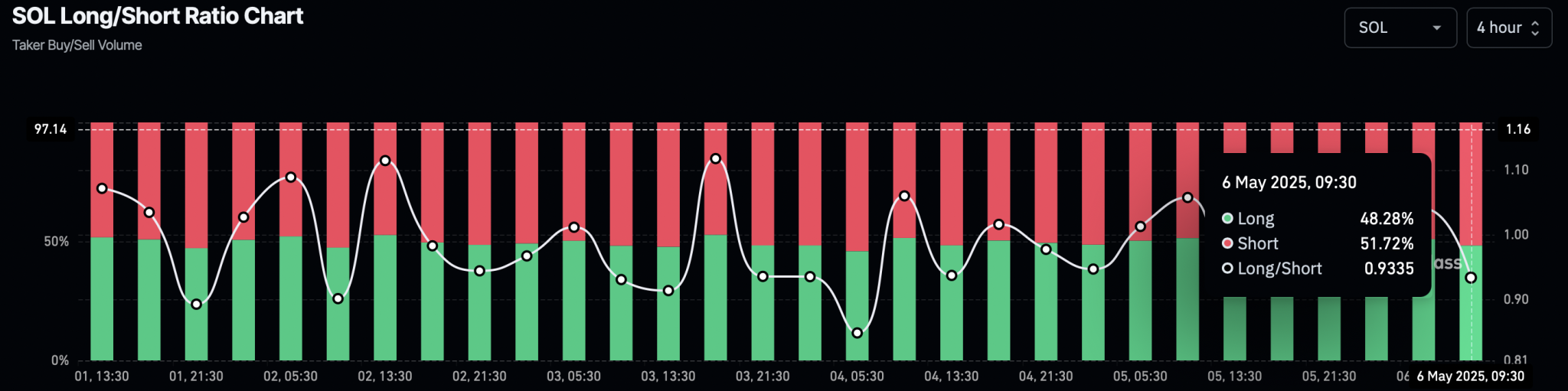
While Solana holds within the triangle pattern, the derivatives market shows a slight uptick in bearish sentiment. According to CoinGlass’s long-to-short ratio chart, short positions have increased to 51.72% over the past four hours.

This shift has brought the long-to-short ratio down to 0.9335, indicating a marginally bearish-dominated market.

Solana Long/Short Ratio Chart

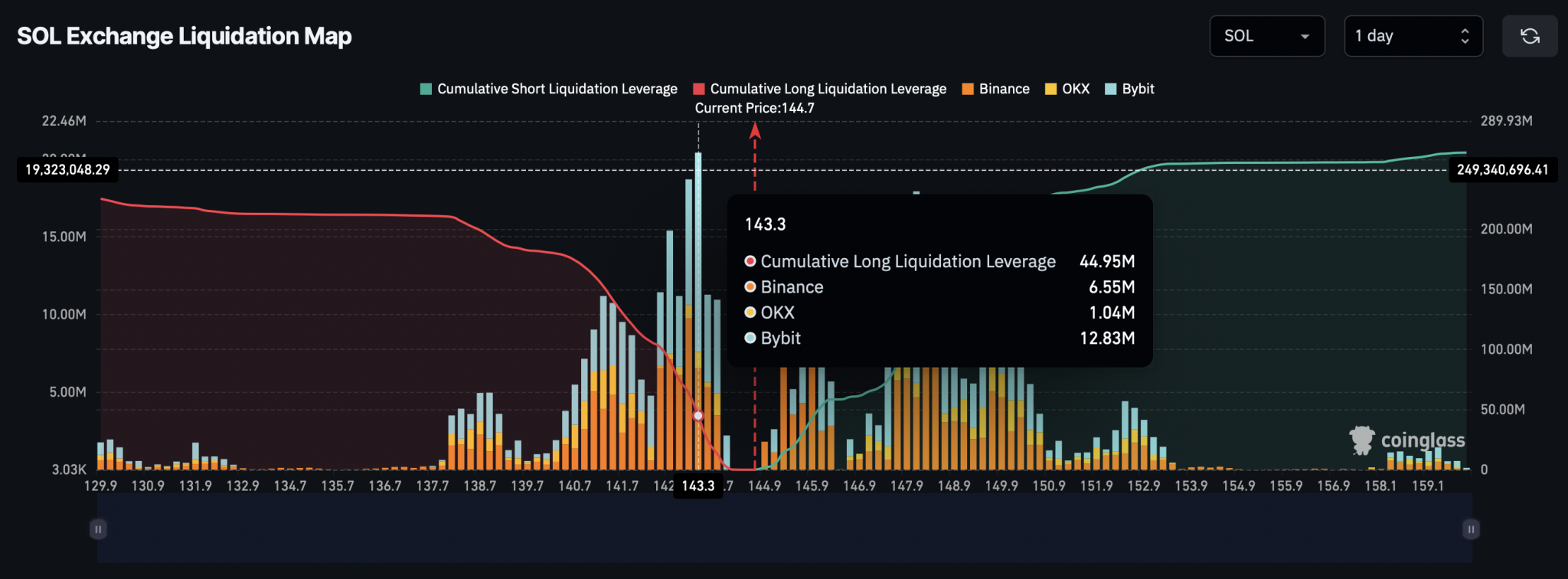
Additionally, the SOL exchange liquidation map signals a potential $44.95 million in long liquidations if Solana drops to $143.3. A sharp increase in long liquidations could trigger a more severe correction due to a domino effect.

Solana Liquidation Map

Here is How Much Shiba Inu Must Rise to Turn $1K into $10K, $50K, and $100K

0

Investors who take advantage of the latest market dip by investing $1,000 in Shiba Inu could see returns of $10,000, $50,000, or even $100,000 if SHIB rises significantly. 

Shiba Inu’s attempt to recover the gains it lost during the peak of the global tariff war has stalled amid the recent market downturn. 

The broader crypto market experienced a slight dip due to anticipation of the Federal Reserve’s interest rate decision. Reacting to the upcoming macroeconomic event, the total crypto market cap slumped 0.73% in the past day to $2.93 trillion. 

This downturn resulted in a bloodbath in crypto prices, with Shiba Inu plunging by 3.37% within the past day. At the time of this publication, Shiba Inu was trading at $0.00001258, translating to a market valuation of $7.41 billion. 

In the meantime, the slight retracement has not dampened investors’ hopes for a significant rebound this cycle. Therefore, they consider the dip a major opportunity to acquire SHIB at discounted prices, with some encouraging a minimum investment of $1,000 in Shiba Inu. 

How Much SHIB Must Rise for $1K to be Worth $10K, $50K, or $100K 

A $1,000 stake would have fetched 83 million SHIB tokens when the price reached a daily high of $0.00001373 on May 1. However, following the latest dip, investors can scoop 79.49 million SHIB tokens at the current price of $0.00001258. 

This portfolio of 79.49 million Shiba Inu tokens, valued at $1,000 today, could soar to $10,000, $50,000, or $100,000 depending on how high Shib’s price appreciates. 

For this $1,000 SHIB investment to be valued at $10,000, $50,000, or $100,000, Shiba Inu must hit target prices of $0.0001258, $0.000629, or $0.001258. 

While the $0.0001258 target demands a surge of 900% from the current price, the $0.000629 and $0.001258 projections represent gains of 4,900% and 9,900%, respectively. 

Clinching any of these targets would bolster the market valuation of Shiba Inu’s price. Assuming Shiba Inu’s circulating supply remains constant, its market cap would rise to $74.12 billion if the price hits $0.0001258. 

Further, if the price soars to $0.000629 and $0.001258, respectively, Shiba Inu would reach lofty valuations of $370.63 billion and $741.27 billion. 

When Can SHIB Reach $0.0001258, $0.000629, or $0.001258 

Last year, popular crypto expert Eunice Wong projected that the second wave of this season’s bull run could take Shiba Inu’s price to the $0.000125 mark. However, Changelly analysts think the $0.0001258 projection could become a reality by February 2030, five years from now. 

They also expect Shiba Inu to continue its uptrend and finally clinch the $0.000629 target four years later, precisely by July 2034. 

Finally, Changelly believes the ambitious target of $0.001258, which requires Shiba Inu to eliminate two zeros from its price, would materialize between 2035 and 2039.  

Notably, these projections are speculative and should not be considered financial advice. As with all cryptocurrencies, SHIB’s price is highly volatile, and there are no guarantees it will reach these targets within the predicted timeframes.

Bitcoin Miner Riot Platforms Sells 475 BTC in April, Deviating from Its 100% HODL Strategy

0

Leading crypto miner Riot Platforms has made its single-largest monthly Bitcoin sale since its inception, with a 475 BTC dump in April.

Riot Platform, the second-largest publicly traded crypto miner, announced selling Bitcoin in April. Per the Monday disclosure, it sold 475 BTC at an average price of $81,731, realizing net proceeds of $38.8 million.

The April Bitcoin sales marked Riot Platforms’ first major unload since January 2024, when it announced its 100% HODL strategy. Furthermore, it was also its largest single-month Bitcoin liquidation in its eight-year mining history.

Miner Adjusts to New Difficulty

Meanwhile, Riot announced mining 463 BTC in April, down by 70 BTC from March’s 533 BTC. However, it sold all mined bitcoins and an additional 12 BTC from its reserve. With the liquidation, the leading miner holds 19,211 BTC as of April 30, worth $1.8 trillion at the current market price.

Riot Platforms Operations Update for April
Riot Platforms Bitcoin Mining Operations Update for April

In a statement accompanying the disclosure, Riot’s CEO Jason Les noted that the 13% reduction in mined Bitcoin followed two successive difficulty adjustments. For perspective, mining difficulty changed twice in April, including an increase to a record-setting 123.23 trillion at block height 893,088 on April 19.

The adjustment saw mining difficulty grow an impressive 8% between March and April, further hampering profitability among miners. While the difficulty has declined slightly since the start of May, reduced miner output makes Bitcoin scarcer, a variable that impacts prices at a constant or increased demand.

Bitcoin Sales, a Business Decision: CEO

Furthermore, Les disclosed that the Bitcoin sales funded ongoing expansion and operation costs. He noted that Riot rounded off the $185 million acquisition of Rhodium Encore at its Rockdale Facility in April, assuming tangible assets such as the 125 MW power resource.

Hence, Bitcoin sales were Riot’s “best funding source,” as it opted to ensure a strong balance sheet without compromising stock strength. Meanwhile, the miner will continue to monitor the market and employ available tools to sustain its business operation alongside its Bitcoin strategy.

Interestingly, this strategy counteracts the schemes other publicly traded crypto miners like Marathon Digital (MARA) employ. For context, the leading crypto miner by Bitcoin balance recently announced it was raising $2 billion to buy more BTC and fund operations.

Recall that Riot reported total revenue of $161.4 million in Q1 2024, of which $71.5 million came from its mining activities.