Home Blog Page 768

Analyst Expects XRP to Hit $17 with Mega Monthly Candle, Then $55 After Macro Channel Breakout

A notable market commentator sees XRP breaking into the higher end of the three-digit territory, citing historical macro data.

XRP has not fared well over the past few months after surpassing $3.3 in mid-January. The asset collapsed from this seven-year peak amid the bearish pressure that engulfed the broader crypto market from February. XRP dropped 29% in February and an additional 2.58% in March.

However, while its April performance has been more encouraging, it has failed to observe any substantial uptick, consistently ranging around the $2 lows. Interestingly, market analyst EGRAG believes this consolidation will soon end, highlighting a long-term macro channel.

XRP Observes 6-Candle Pattern 

In his latest analysis, the market watcher noticed XRP’s behavior within this macro channel on the monthly chart. Notably, its historical data reveals a pattern the asset has followed within this channel, ultimately leading to an impressive price run.

This pattern involves the formation of six key monthly candles above the 21 EMA. For context, XRP witnessed this pattern in the second half of 2017 following its impressive 801% spike from March to May 2017. Notably, after this run, XRP observed a correction and subsequent consolidation that lasted for months.

XRP Macro Channel EGRAG Crypto
XRP Macro Channel | EGRAG Crypto

During this consolidation, the asset saw a massive red monthly candle in July 2017 as it dropped 34% that month. The second candle was a bullish one, leading to a 58% gain in August 2017. Meanwhile, the third candle, in September 2017, resulted in a 23% loss. 

The fourth candle saw large upswings but closed with a 0.92% loss, and the fifth one set the stage for the recovery push, with a 19% gain in November. Interestingly, XRP then witnessed a massive green candle in December 2017, spiking by an impressive 746% within that month as it completed the six-candle pattern.

XRP to $17 if History Repeats

EGRAG believes this structure is playing out again. Notably, after the initial 283% rise in November 2024, XRP has already witnessed five candles. These five candles led to a 6.43% gain in December 2024, a 46% increase in January 2025, a 30% loss in February 2025, a 2.56% drop in March 2025, and now, a 4.84% rise in April 2025.

The market analyst believes this close to the April candle sets the stage for a massive run during the sixth candle in May 2025. According to him, if history repeats, XRP will see another “mega monthly candle” in May 2025, with a price target of $17. Such a rally would mark a 672% increase from the current price of $2.2.

Another Potential Surge to $55

However, EGRAG expects XRP to see higher prices from here. It bears mentioning that these five candles have remained within the earlier identified macro channel. Nonetheless, with XRP’s surge to $17, the chart shows that the asset would breach the upper boundary of the channel.

According to EGRAG, this breach in itself could trigger another upside move. From the initial $17 target, EGRAG sees XRP soaring by another 223% to $55. Notably, analysts such as Cryptominder have also projected a possible XRP rally to the $50 region.

Here is XRP Price after ETF Approval if XRP ETFs Get 15% to 30% of Bitcoin ETF Inflows

XRP’s price could reach greater heights if XRP ETFs secure only a fraction of Bitcoin ETF inflows following their approval.

The potential approval of spot XRP Exchange-Traded Funds (ETFs) in the United States could lead to massive price implications for the asset. With XRP’s regulatory hurdles largely resolved and institutional appetite on the rise, the odds of approval have increased.

Interestingly, Polymarket sets an 80% chance of an XRP ETF approval this year, up from 68% just a week ago. As market participants anticipate these products, most expect a bullish impact on XRP price, especially if they record similar success to Bitcoin ETFs.

XRP ETF Aproval Odds Polymarket
XRP ETF Approval Odds | Polymarket

XRP Price if XRP ETFs Get 15-30% of Bitcoin ETF Inflows

For context, data from Sosovalue indicates that Bitcoin ETFs have accumulated approximately $39 billion in net inflows since their introduction in January 2024. If XRP ETFs capture just 15% to 30% of that figure, the price of XRP could skyrocket.

For instance, assuming XRP ETFs attract 15% of Bitcoin’s ETF inflows, this would equate to $5.85 billion entering XRP-focused funds. Applying a modest inflow-to-valuation multiplier of 100x, this $5.85 billion could boost XRP’s market cap by $585 billion. 

Notably, when added to the current market cap of around $130 billion, the new total valuation would reach $715 billion. Meanwhile, XRP’s circulating supply currently stands at 58.44 billion tokens. Factoring in this figure would place the price at about $12.23 per token. That represents a 450% surge from its current trading price of $2.22.

However, doubling that share to 30% of Bitcoin ETF inflows would have even more dramatic implications. This higher percentage would result in $11.7 billion in net capital moving into XRP ETFs. This would lead to a $1.17 trillion increase in XRP’s total valuation by applying the same 100x multiplier.

When combined with the existing $130 billion market cap, XRP’s valuation could climb to about $1.3 trillion. This new valuation yields an XRP price of $22.2, considering the supply of 58.44 billion tokens. Such an increase would mark a nearly 900% appreciation from today’s price.

XRP ETF Developments

While these projections rely on assumptions, the growing interest in XRP ETF products supports the idea that institutional investment could flood the market once approvals are granted. Bitwise CIO previously confirmed they are witnessing large demand for an XRP ETF.

Notably, the ETF scene for XRP has seen rapid developments throughout 2024 and 2025. Teucrium Investment Advisors led the way by launching the Teucrium 2x Long Daily XRP ETF on April 8, offering leveraged exposure to XRP’s daily price swings. 

Interestingly, ProShares also recently received the green light to launch a suite of futures-based ETFs, including leveraged and inverse offerings. However, these products rely on derivatives, not direct holdings of XRP.

Despite the momentum, no spot XRP ETF has been approved yet. Multiple firms, such as Bitwise, 21Shares, WisdomTree, and Franklin Templeton, have submitted applications. 

Among them, Franklin Templeton recently experienced a delay when the U.S. SEC announced on April 29 that it was extending the review period for the company’s spot XRP ETF proposal. 

Crucially, the potential conclusion of the Ripple vs. SEC case would bolster the chances of approval. Also, several firms, including Bitnomial, Coinbase, and CME Group have introduced CFTC-regulated XRP futures. This further helps the cause of an XRP ETF launch. 

Here’s Why XRP Is Down 30% Despite ‘Most Bullish Fundamentals in History’

A prominent voice in the XRP community is drawing attention to a growing disconnect between XRP fundamental progress and its market price.

According to crypto commentator Brett, the current market slump may be a calculated phase in a much larger game to shake out retail holders before XRP’s true value is realized.

Price Is Not the Truth, Just the Distraction

Brett argues that price action does not reflect the true value of an asset like XRP, asserting that it’s merely a distraction. Notably, XRP is down 2.5% today and has seen a more substantial 30% decline over the past three months, currently trading at $2.20.

The coin had a promising start in 2025, breaking price levels last seen seven years ago. However, bearish momentum soon took hold, and XRP has struggled to make further progress.

Still, Brett maintains that this price action doesn’t reflect what’s happening behind the scenes. Instead, he believes it’s meant to test patience and wear down early believers.

Quiet Progress Behind Red Candles

Despite the gloomy charts, Brett points to a steady stream of progress for XRP and Ripple behind the scenes. He cites new banking partnerships, regulatory advancements, expansion into cross-border payment corridors, and increasing institutional adoption.

Most notably, the SEC has halted the Ripple lawsuit, and settlement discussions are already underway. Amid this major development in the nearly five-year legal battle, Ripple announced the acquisition of a prime broker for $1.25 billion. 

This move will enhance the XRP Ledger’s utility in fund processing, bringing fresh institutional liquidity into the XRP ecosystem, something enthusiasts view as extremely bullish.

Yet, these announcements have failed to significantly move XRP’s price this month. Brett claims this is intentional. According to him, these developments are deliberately low-profile, quietly laying the foundation for what he calls “the next financial system.”

It’s a Game of Perception and Patience

While retail investors focus on daily price fluctuations, Brett believes the real story is playing out beneath the surface, and it’s not meant for public visibility.

Describing the current XRP market as a psychological game, Brett says the louder the fear, the greater the opportunity.

He argues that the narrative claiming XRP is “finished” is one of the biggest “lies” in the market. In his view, the token is being strategically integrated into a broader financial infrastructure to benefit institutions and insiders.

Brett added that many will never realize XRP’s true value because they’re too distracted by short-term price action. He contended that the shift won’t come with warning signs or hype but through silent integration, gradual infrastructure buildout, and a final phase in which only those who endure will be positioned to benefit.

His message to the community is to stop chasing updates, silence the noise, and prepare for the long game.

Notably, numerous other commentators share this perspective, urging investors to accumulate XRP while it remains “cheap.” Some like Edoardo Farina have even claimed that not holding XRP could be the biggest risk in today’s investment landscape.

Top Analyst Says XRP Is Going to Fall 30% to $1.55: Here’s Why

0

XRP could be up for a notable downward trend, as a prominent market analyst has predicted a steep price decline below $2.

The asset had a purple patch last week following an 8% rally from $2.07 to $2.30. Just when optimism started creeping in, XRP has seen all its earlier gains this week wiped out. For context, the token is down 3.9% from its opening price on Monday and 8% from its intra-week high of $2.36.

Meanwhile, XRP is not alone in this recession. The token has followed a broader market trend, which has seen Bitcoin struggle to hold $95,000 and Ethereum drop below $1,800.

Further Downsides Imminent?

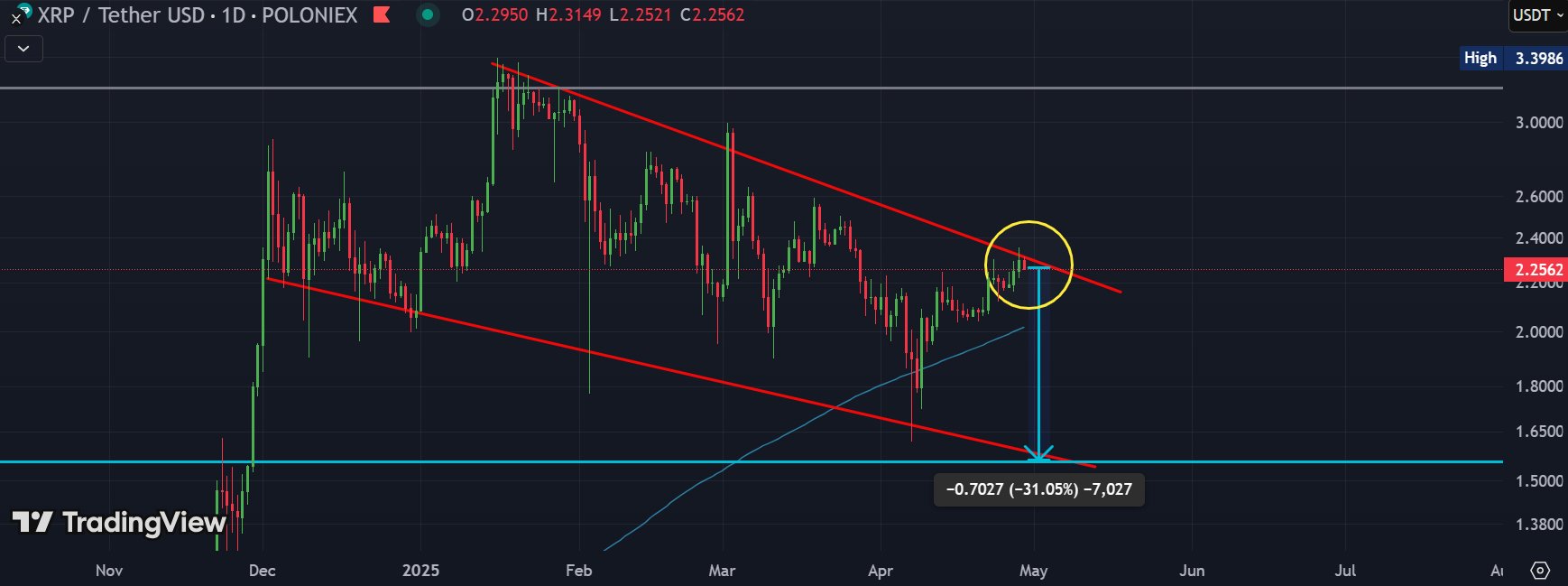
However, according to analyst BLOCK BULL, the worst may still be on the horizon for XRP. In his April 29 X post, he predicted further downsides, specifically targeting a drop below the crucial $2 support zone.

For context, the market analyst cited an XRP rejection from the tip of a bull flag pattern on the daily timeframe. The token could not overcome the resistance in the region, eventually receding by over 8% so far.

XRP Rejected from Bull flag

Following this downturn, the commentary predicts a steep price decline to $1.55, representing a 30% regression from the channel’s top and 28.6% from the current market price. Notably, the price mark aligns with the bottom of the flag pattern.

Meanwhile, BLOCK BULL insists that the possible capsize was only temporary and a perfect entry position. He urged investors to hold their bags, as whales capitalize on dumps of this nature for maximum profits.

Support Still Holding

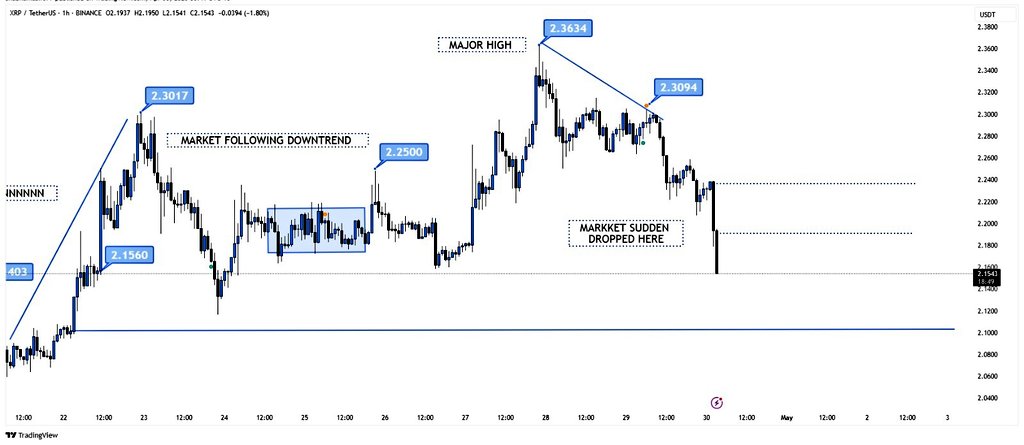
Nonetheless, analyst BitGuru highlighted in a parallel tweet that despite XRP’s downside, it still holds a crucial support area. The high-ranking asset has corrected over 6% in the past two days, slumping from $2.30 to $2.15, yet the analyst noted that it has held above a consolidation range on the 1-hour timeframe.

XRP Trends Above Lower Timeframe Range

Meanwhile, the market watcher noted that a trend above the range’s support at $2.15 could spark a rapid price rebound to around $2.25 and possibly even higher prices. Interestingly, another analysis suggests the coin could pump to as high as $5 next month, a new all-time high.

In the meantime, XRP trades at $2.17, down 3% since the start of the day.

Grayscale Launches Bitcoin Adopters ETF to Track Companies with BTC on Their Balance Sheets

Grayscale, one of the largest crypto-focused asset managers, has launched a new exchange-traded fund (ETF) called the Grayscale Bitcoin Adopters ETF.

The fund trades under the ticker symbol BCOR. It offers equity exposure to publicly traded companies incorporating Bitcoin into their corporate treasury strategies.

Targeting Companies That Hold Bitcoin on Their Balance Sheets

The BCOR ETF tracks the Indxx Bitcoin Adopters Index, a proprietary benchmark that includes companies worldwide that have adopted Bitcoin as a treasury reserve asset. These companies are referred to as “Bitcoin Adopters.” Notably, they represent a cross-section of sectors and industries, including technology, financial services, and consumer goods.

Notable examples likely to be featured in the fund include firms such as Strategy (formerly MicroStrategy), Metaplanet, Tesla, and Block. These firms have all made headlines for holding significant Bitcoin reserves.

No Direct Bitcoin Exposure, but a Strategic Proxy

Unlike Grayscale’s single-asset trust products, BCOR does not invest directly in Bitcoin or other crypto assets. It also does not utilize crypto derivatives or participate in initial coin offerings (ICOs). Instead, it provides indirect exposure through equity stakes in public companies that incorporate Bitcoin into their financial strategies.

This structure aims to offer investors a lower-risk, regulated avenue to benefit from Bitcoin’s adoption curve, without the complexities or volatility associated with holding BTC outright.

According to David LaValle, Global Head of ETFs at Grayscale, BCOR offers a forward-looking approach to capitalize on the growing corporate adoption of Bitcoin through traditional equity investments.

The ETF spans seven sectors and 15 industries, reflecting a diversified basket of equities tied together by a single unifying theme: corporate Bitcoin adoption. This makes BCOR a potentially attractive option for crypto-curious investors and those seeking to hedge against inflation.

Notably, the fund has a net asset value per share of $25.31 at press time and an asset under management of over $1 million.

Grayscale Expands Its ETF Footprint

The launch of BCOR adds to Grayscale’s growing suite of crypto asset-focused ETFs. The firm currently offers a Bitcoin spot ETF (GBTC), although it has not been as successful as its close competitor, BlackRock’s iShares Bitcoin Trust.

In particular, GBTC has seen massive outflows totaling $22.73 billion since inception. In contrast, BlackRock’s Bitcoin spot ETF has recorded an impressive $42.387 billion in inflows during the same period.

Nevertheless, the underperformance has not deterred Grayscale from launching additional ETFs centered on Bitcoin and other crypto assets. Notably, the firm is also pursuing ETFs for XRP, Cardano, Solana, Litecoin, and even Dogecoin. These applications are currently awaiting approval from the SEC.

Roswell Becomes First US City to Adopt Bitcoin as Reserve Asset

Roswell, New Mexico, has officially become the first U.S. city to establish a Bitcoin reserve. 

The city has received its first donation in the firstborn crypto, amounting to 3,050,323 satoshis, or about 0.0305 BTC. This donation is now the cornerstone of the “Roswell Strategic Bitcoin Reserve,” which will be managed by the city government.

Roswell’s Strategic Reserve

Notably, the city of Roswell received the first BTC donation on April 29, 2025. During this press, the 0.0305 BTC was worth roughly $2,845. The funds will serve as seed capital for the newly established Bitcoin reserve. 

According to the plan, the reserve will primarily focus on accumulating Bitcoin donations and sponsorships over the next decade. The goal is to grow the reserve to a point where it can be used as an emergency fund once it reaches the $1 million threshold.

The city’s Bitcoin reserve will be subject to city council oversight. Specifically, the council must unanimously approve any use of the reserve, with the possibility of allocating up to 21% of the reserve every five years for designated purposes. The initial focus will be to provide financial relief to local elderly residents, particularly through subsidizing their water bills, and to fund emergency disaster response.

Growing Interest in Bitcoin Reserves

Meanwhile, Roswell’s adoption is one among several jurisdictions aiming for a Bitcoin reserve. For instance, only a day ago, Arizona’s Legislature recently passed Senate Bills 1025 and 1373, which would allow the Arizona Treasury and retirement system to invest up to 10% of their funds in virtual currencies. These bills are now awaiting Governor Katie Hobbs’ signature to become law.

Notably, Alabama has also introduced a bill proposing that its State Treasurer invest up to 10% of state funds in Bitcoin. The legislation, known as House Bill 482, creates a framework that would permit investments only in digital assets with a market cap of at least $750 billion over the previous 12 months. 

Other jurisdictions like Texas, California, Florida, and New Hampshire have also proved the intentions to establish a Bitcoin stockpile.

Vitalik Buterin Shares His 2025 Vision for Ethereum’s Future

Ethereum founder Vitalik Buterin has presented his personal roadmap for 2025, highlighting the direction he believes the Ethereum ecosystem should head. 

Buterin disclosed this in a recent post on the decentralized social platform Warpcast. His focus covers concepts around deep infrastructure upgrades to ideas about how Ethereum can support open technology and societal resilience.

Ethereum L1 Long-Term Roadmap

One of Buterin’s top priorities is making Ethereum’s base layer-1 faster, leaner, and more secure. A major part of this is something called single-slot finality, which would reduce the time it takes for Ethereum transactions to become final from around 15 minutes to just a few seconds. 

The proposed method would rely on “supercommittees” of about 125,000 validators to improve the process. While this may sound ambitious, it comes with trade-offs that will need careful handling to avoid weakening the network’s security.

Ethereum Founder Buterin on Warpcast

Meanwhile, the Ethereum co-founder is also thinking long-term about the Ethereum Virtual Machine (EVM), the core engine that runs smart contracts. Buterin wants it to evolve to support newer cryptographic tools better and work more smoothly with scaling technologies like rollups.

Notably, the move toward a “stateless” Ethereum, where validators don’t need to store the entire history of the blockchain, could make running a node more accessible and encourage greater decentralization.

Full-Stack Security and Privacy

Also, Buterin has not forgotten Ethereum’s roots in decentralization and resilience, especially after past security setbacks like the 2016 DAO hack. He stressed that upgrades should always preserve the core values of security and openness, as the network scales and modernizes.

Security and privacy also feature in his 2025 focus, but not just at the protocol level. Buterin wants stronger protection all the way up the stack, from smart contracts to wallets to apps. 

He’s pushing for more robust open-source practices and tools that minimize the need for centralized intermediaries, which are often weak points in the system. 

In addition, privacy is getting more attention too, with technologies like zero-knowledge proofs, which are essential to keeping Ethereum users safe in an environment where governments and corporations are increasingly tracking online behavior.

Buterin also discussed what he calls “decentralized accelerationism,” or d/acc. For context, it is a response to today’s fast-moving tech landscape, which looks to keep power in the hands of users and communities, not corporations. 

Essentially, this means building decentralized communication tools, better governance systems, and more funding models for public goods. 

Other Important Areas

He’s also paying attention to areas like cryptography, open-source operating systems, and even bio-defense. These are fields where Ethereum and blockchain tech might help in making systems more secure and transparent. 

Meanwhile, he admitted to being less directly involved in some research areas, such as ongoing work in consensus design, peer-to-peer networking, and layer-2 hardware solutions. He also called attention to developments such as Danksharding and zkEVM, which are central to Ethereum’s scalability roadmap and could increase throughput by 2026.

Pro-Crypto Advocate Eric Trump Says Banks Risks Extinction If They Don’t Change Their Ways

0

Eric Trump, a prominent crypto stakeholder and Donald Trump’s second son, has issued a new warning to traditional financial institutions, particularly banks. 

Eric Slams Current Banking System 

During a recent interview with CNBC’s Dan Murphy in Dubai, Eric warned that banks might go extinct in the next 10 years if they do not change how they operate. He lambasted the traditional banking system, saying it is broken, slow, and expensive. 

Additionally, he took a swipe at SWIFT, the global messaging network for financial institutions, calling it an ‘absolute disaster.’ This vintage financial messaging system sometimes takes days and exorbitant fees to settle transactions across borders. 

In his view, transactions on the blockchain are much better than those conducted in the current traditional banking system. The second son of President Trump also referred to the current banking system as inefficient and slow while stressing that it is outdated. 

Notably, most crypto enthusiasts also share a similar sentiment, with some calling on banks to leverage blockchain to scale their operations. 

Further, Eric criticized the U.S. banking system, saying it favors only the ultra-rich. He added that some people weaponize the system against average income earners and those with different political views, particularly people wearing the ‘Make America Great Again’ hat. According to him, this malicious act forced him to venture into crypto. 

Banks’ Mixed Reactions to DeFi Rise  

Eric’s criticism of the current banking system comes as traditional financial institutions attempt to grapple with the rise of crypto, especially the decentralized finance (DeFi) sector. 

DeFi platforms are giving banks a run for their money by eliminating centralized intermediaries and allowing people to transact with each other directly on the blockchain at a negligible fee. Notably, 

Eric also shared some important features of DeFi in the interview. He stated that anyone can launch a DeFi app and send money instantly to another user’s wallet without variability or high fees. 

In response to the rise of cryptos and DeFi, several banks, such as Goldman Sachs and JPMorgan, have embraced the emerging asset class by setting up their crypto trading desks and blockchain-based payment systems.  

However, most banks have refused to embrace crypto. They believe crypto users face serious risks due to a lack of regulation and security vulnerabilities. 

Growing Support for Crypto 

Eric has been a strong advocate for crypto and has continued to support the emerging asset class. 

Last year, he predicted that Bitcoin would eventually hit $1 million, driven by the asset’s supply cap, resistance to censorship, and absence of intermediaries. 

His family also has a crypto empire, World Liberty Financial, which owns multiple cryptocurrencies, including stablecoins like USDT and USDC, SEI TRX, LINK, AVAX, and MOVE. It also owns a Bitcoin mining company, dubbed American Bitcoin, and a dollar-pegged stablecoin. 

Here’s How Much $1,000 in Shiba Inu Could Be Worth by 2030

0

Bullish predictions from top market watchers suggest that an investment of $1,000 in Shiba Inu today could generate remarkable gains for investors in the next five years. 

As crypto investors continue to seek high-return opportunities, many are turning their attention to assets like SHIB, which they believe have the potential to surge significantly during the next bull market.

This optimism in Shiba Inu remains despite SHIB’s price plunging by 27% in the last three months. The canine-themed token has suffered a more devastating 36.8% year-to-date.

Yet, some investors are unbothered by SHIB’s short-term price action. Interestingly, they anticipate a more impressive Shiba Inu price performance over the next five years, specifically by 2030. 

This timeline comes two years after the next Bitcoin halving event, slated for 2028. Like previous halving events, the next one could usher in strong gains for BTC and altcoins, including SHIB.  

Potential Shiba Inu Price By 2030 

With investors keeping an eye on 2030, this article presents some bullish Shiba Inu predictions for this timeline. Experts affiliated with crypto trading platform Changelly predict that Shiba Inu will eliminate a zero from its price and reach a maximum target of $0.000158 per token by 2030. This represents a jaw-dropping surge of 1,085% from where Shiba Inu currently trades at $0.00001333. 

On the other hand, the prediction platform Telegaon forecasts that SHIB will surpass the price level projected by Changelly for 2030. Telegaon expects the price of SHIB to rise to $0.000712 by 2030, marking an increase of 5,241% from the current price. 

Shiba Inu Price Prediction Telegaon

As previously reported, a group of 26 industry experts projected that Shiba Inu would trade at $0.0001971 by 2030. Hitting this target demands a massive spike of 1,378% from its current price. 

What a $1,000 Investment in SHIB Today Could Be Worth by 2030

Based on these projections, we can estimate the potential returns on a $1,000 investment in Shiba Inu today. At the current price of $0.00001333, $1,000 would buy approximately 75,018,754 SHIB tokens. Recent data from IntoTheBlock suggests that 82,600 on-chain addresses hold a minimum of $1,000 in Shiba Inu. 

If Changelly’s prediction of $0.000158 materializes by 2030, an investment of $1,000 in SHIB today would surge to $11,852, representing an ROI of nearly $11,000. 

Similarly, these investors would also see their $1,000 stake in Shiba Inu climb to roughly $14,786 if Finder’s price projection of $0.0001971 comes to fruition by 2030, yielding a return of $13,700. 

Lastly, should Telegaon’s prediction come to pass and SHIB clinches an ambitious target of $0.000712 by 2030, patient investors would see their $1,000 stake grow to $53,413, an audacious return of over $52,000. 

Dogecoin Price Forecast: Here’s What Dogecoin Could Be Worth at $100B, $500B, and $1T Market Cap

0

Dogecoin price could surge significantly in the future, with projections showing up to a 3,700% increase at a $1 trillion market cap.

Notably, the largest meme coin has entered another consolidation phase after a brief rally that saw its price briefly surpass $0.19. As of now, Dogecoin trades around $0.174, and despite recent bearish trends, longer-term market sentiment remains positive. 

Market watchers are specifically optimistic about the future, predicting potential price surges if Dogecoin’s market capitalization grows. At press time, Dogecoin’s market cap is around $26 billion.

Dogecoin Price Predictions Based on $100B, $500B, and $1T Market Cap

Notably, with a $100 billion market cap, DOGE could reach approximately $0.6709. This represents a 285.55% increase from its current price of $0.174. 

If Dogecoin were to achieve a $500 billion market cap, its price could climb to around $3.35, marking a significant 1,827.82% increase.

Additionally, if Dogecoin were to hit a $1 trillion market cap, it could rise as high as $6.71, reflecting an astronomical surge of about 3,755%. These projections, though ambitious, highlight the potential for substantial long-term growth, depending on how the market evolves.

It is worth mentioning that this analysis assumes Dogecoin’s current supply of 149 billion tokens remains the same.

When Can DOGE Hit These Prices?

Analysts at Changelly have provided additional insight into Dogecoin’s potential price trajectory over the next decade. According to the platform, DOGE could hit $0.6 by June 2029. 

Furthermore, Dogecoin might reach $3.2 by February 2034, with an average price of $3.40 and a maximum of $4. By November 2034, Changelly expects DOGE to surpass $5. 

Technical Analysis and Breakout Patterns

Amid the decade-long predictions, several technical analysts have pointed to key patterns that suggest how Dogecoin’s price may perform. MasterAnanda, for instance, noted that Dogecoin has recently completed an ABC correction, positioning the crypto for a potential bullish rally. 

The correction began from a high of $0.4846 on December 8, 2024, with the first wave seeing a 46% drop to $0.2626. The B-wave then saw a 66% rebound to $0.4350 in January, followed by a C-wave, which resulted in a 70% drop to local support at $0.1298.

While Dogecoin has rebounded from this support level to its current price, the analysis suggests the asset remains undervalued. MasterAnanda projects a possible rally to $0.703.

In addition, Trader Tardigrade examined Dogecoin’s price action using a three-day chart spanning from 2014 to the present. The chart reveals multiple symmetrical triangle formations, which have historically preceded significant breakouts. After the final breakout in late 2024, Trader Tardigrade now forecasts a potential surge to $2.9.