Home Blog Page 772

US Secretary of Commerce Reveals Vision for Bitcoin Mining, Wants BEA to Add BTC to its Account

0

US Secretary of Commerce Howard Lutnick reveals how the United States aims to support Bitcoin mining operations under President Donald Trump’s administration. 

During an interview with Bitcoin Magazine, Lutnick shared his vision for Bitcoin mining. He disclosed that the Commerce Department’s investment accelerator initiative will benefit Bitcoin mining companies and allow miners to set up shop in the U.S. 

Bitcoin Miners Will Benefit from Investment Accelerator Initiative

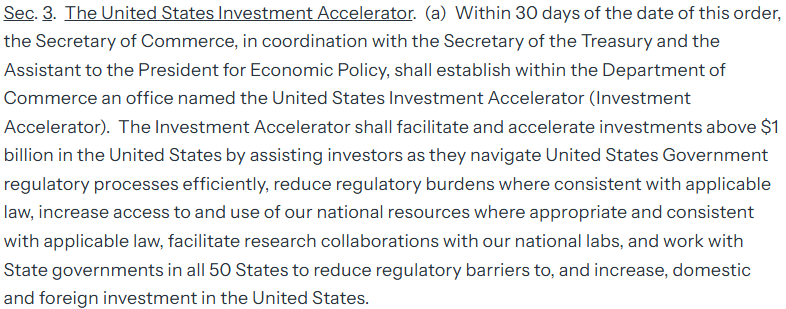
Last month, President Donald Trump ordered the Commerce Department to create an Investment Accelerator office to accelerate investments of $1 billion in the American economy. 
Trump investment accelerator executive order
Trump Investment Accelerator Executive Order

This initiative helps clear regulatory hurdles for businesses looking to invest in America and fast-tracks the process of obtaining the necessary operational licenses for these businesses. 

Interestingly, the Commerce Secretary emphasized that the investment accelerator would support crypto businesses, particularly Bitcoin mining companies. 

Other Bitcoin Mining Support 

Besides helping miners obtain the required operational licenses, Lutnick suggests that the Commerce Department would allow Bitcoin miners to build their own power plants right next to where they intend to site their mining data centers. 

This power plant, often powered by wasted gas, would allow miners to run their operations off-grid without relying on local utilities. 

“Bitcoin miners will be allowed to put their data centers on top of gas fields, with a power plant set up right next to them,” Lutnick remarked. “This way, miners won’t be drawing power [from the existing grid].” 

With this support, Lutnick expects the next generation of Bitcoin miners in America to ‘control their destinies’ and drastically reduce power costs. He speculates that the support would ‘turbocharge’ Bitcoin mining operations in the United States. 

Trump Wants Remaining Bitcoin Supply Minted on US Soil 

The Commerce Department’s push to scale Bitcoin mining operations in the U.S. aligns with Donald Trump’s vision for the industry. Last year, Trump promised to ensure that the United States dominates the Bitcoin mining sector. 

He wants the remaining Bitcoin supply to be mined on American soil. This move would enable the United States to dominate the energy sector, according to him. 

Bitcoin Is a Commodity, Not a Currency

Meanwhile, Lutnick added credence to Bitcoin’s status as a commodity. According to him, Bitcoin is a commodity and not a currency. He emphasized that Bitcoin should be treated like other commodities, including oil and gold. 

Interestingly, Lutnick floated the idea of having the Bureau of Economic Affairs (BEA) incorporate Bitcoin in its national account metrics. This approach is similar to how the BEA refines its account using gold while also recording the exports and imports of the precious metal under its International Transaction Accounts. 

Lutnick Welcomes Bitcoin to the US 

Further, Lutnick declared that Bitcoin is welcome in the U.S., noting that the current administration has several BTC proponents, including himself and the White House Crypto Czar David Sacks. 

The Commerce Secretary says he wants Bitcoin to thrive in the U.S., adding that the industry has to figure out how to win. He emphasized that the U.S. will never return to the era when crypto businesses were treated as if they had committed an offense.

Analyst Says Think Bigger Now, as Cardano Hit $90B Market Cap in 2021 Without Smart Contracts

0

Prominent YouTuber Lark Davies is pointing to major Cardano upside as network development accelerates, says think bigger.

Speaking to his audience of over 630,000 subscribers on April 24, Davies emphasized that Cardano achieved a $90 billion market cap in the previous cycle without smart contracts or widespread application usage.

Now, with smart contracts fully live and real-world use cases emerging, Davies suggested the blockchain’s users should think bigger than in the previous cycle.

The previous bull run saw Cardano move from below $1.2 to reach its highest price level at $3.09. At the same time, its market cap topped above $90 billion before plummeting and is now at around $25 billion today.

Cardano Exceeds 130,000 Smart Contracts

For context, according to TapTools data, Cardano has now exceeded 130,000 smart contracts deployed on its mainnet, indicating a sharp rise in development activity. 

Smart contracts could contribute to a surge in Cardano’s market capitalization by expanding the blockchain’s utility and application range. For context, smart contracts enable the development of decentralized applications (dApps) across sectors like decentralized finance (DeFi), non-fungible tokens (NFTs), gaming, and supply chain management.

As a result, increased activity typically correlates with higher on-chain volumes, greater total value locked (TVL) in DeFi, and expanding user bases — all of which can strengthen a blockchain’s economic value.

Other Factors That Could See Cardano Surging

In addition to the expanding smart contract ecosystem, network stability has become a defining feature for Cardano.

Frederik Gregaard, CEO of the Cardano Foundation, reported that the blockchain has gone seven years without experiencing a single failure. According to Gregaard, Cardano maintains the most code changes compared to other networks, without missing a block since its launch in 2017.

Moreover, speculation is intensifying around a potential spot ADA exchange-traded fund (ETF). Following the appointment of Paul Atkins as the new chair of the U.S. Securities and Exchange Commission (SEC), optimism surrounding crypto ETF approvals has grown.

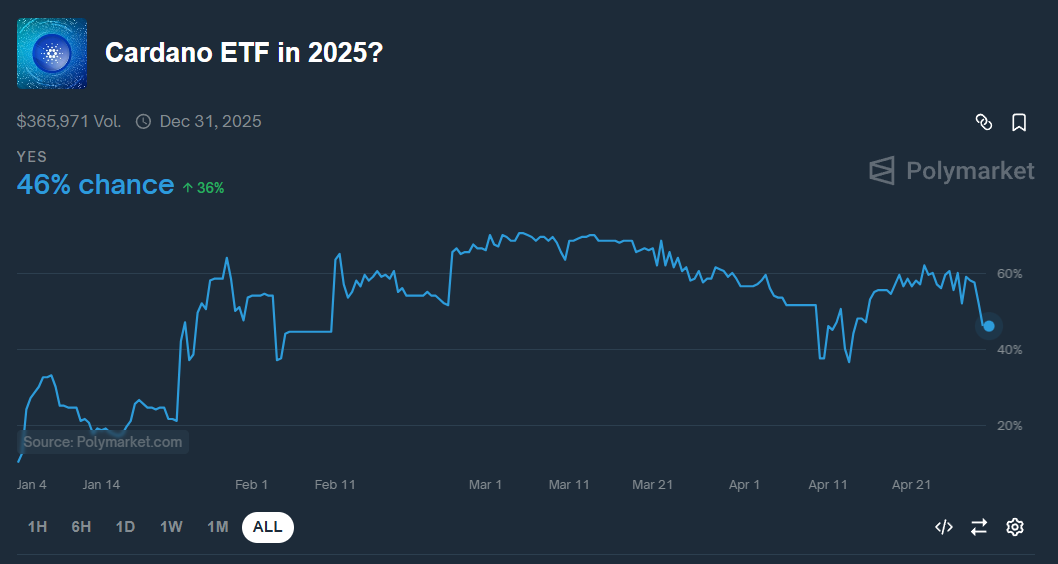
Supporting this trend, data from prediction market Polymarket shows the probability of an ADA ETF approval in 2025 has climbed to 46%, suggesting mounting anticipation in the community.

Cardano ETF Approval Prediction | Polymarket

Key Technical Levels Following Cardano Breakout

While these fundamental developments gather momentum, analysts are observing bullish signals for Cardano’s price. Justin Wu noted that ADA recently broke out of a descending wedge pattern that had formed since February 2025. This pattern, characterized by lower highs and lower lows, had kept downward pressure on prices until volatility tightened near its apex.

Notably, between April 11 and April 12, ADA gained over 8% as the breakout unfolded, often seen as a positive indicator for future price action. However, after the initial surge, Cardano entered a period of consolidation, holding steady above a critical support level of approximately $0.51.

Building on this movement, Wu identified two major resistance points to watch. The first sits at $1.2456, with a second resistance target at $1.4642 if bullish momentum continues.

Cardano Founder Backs Conversation on Enhancing Bitcoin Messaging Capabilities

0

Cardano founder and IOG CEO Charles Hoskinson recently joined the conversation around enhancing Bitcoin messaging capabilities via the OP_RETURN functionality.

The conversation emerged after a Cardano DRep, “Psiloblox,” raised concerns about the lack of OP_Return support in most Bitcoin wallets. It highlighted missed opportunities for users to attach messages to Bitcoin transactions. In response, Hoskinson described the critique as “interesting.” 

Notably, the context of the conversation is the Cardano native wallet, Lace, adding Bitcoin support. Given the significance, Cardano proponents like Psiloblox are lauding the move and highlighting weaknesses in other wallet services.

Growing Interest in OP_Return Applications

In the tweet, Psiloblox explained that most Bitcoin wallets do not utilize OP_Return, one of Bitcoin’s few non-financial features. He emphasized the feature’s potential by sharing a previous personal experience requesting a new function in the Bitkit wallet. 

Specifically, Psiloblox suggested allowing users to add a message field, automatically converting it into HEX format for easier use. He pointed to the Moonshine wallet as an example. 

As a result, Psiloblox argued that such an enhancement could set wallets apart from others lacking this support. He had also proposed integrating a QR code scanning feature for OP_Return fields to boost usability further.

Bitcoin Developers Push to Remove OP_Return Data Limits

Meanwhile, some Bitcoin developers are pursuing changes that could expand OP_Return’s capabilities even further. One example is developer Peter Todd, who acknowledged two years of attempts to curb data storage abuse.

This request proposes eliminating the 80-byte limit on OP_Return data, a measure initially intended to discourage spam.

Todd’s initiative draws on a formalization effort led by Chaincode Labs’ Antoine Poinsot. It encourages developers who view the current restriction as unnecessary to test and evaluate the proposed adjustments. They believe lifting the limit could open new possibilities for Bitcoin transactions while reflecting ongoing use trends.

However, despite earlier efforts to limit OP_Return data size, users have continued to find workarounds.

Opposing OP_Return Data Storage Proposals

Luke Dashjr, a vocal opponent of arbitrary data storage through Bitcoin’s OP_Return feature, criticized the recent proposals as “utter insanity,” gaining traction within parts of the developer community.

Defending Bitcoin’s limited blockspace for strictly financial transactions, Dashjr argued that the network has already suffered over two years of “attacks” by arbitrary data “spammers.” 

He emphasized that the continued hands-off approach is unsustainable, stating that the “damage” already inflicted should be sufficient proof. He also questioned whether he was “the only one left” who genuinely cares about Bitcoin’s long-term survival.

Dark Pools: DAG MD Reveals Only Reason XRP Has Failed to Surge

0

Digital Ascension Group’s Managing Director suggests that the XRP price remains stagnant due to an alternative accumulation venue by large institutions.

Despite a string of bullish headlines and progress within the Ripple and XRP ecosystems, the XRP price has failed to reflect the momentum many investors anticipated. Since February 2025, XRP has remained in a consolidation phase around the $2 mark, showing resilience but lacking a decisive breakout. 

XRP Price Remains Stagnant 

Interestingly, according to Jake Claver, Managing Director at Digital Ascension Group (DAG), the main reason behind XRP’s price stagnation is not due to market fundamentals or investor disinterest, but the growing influence of dark pools.

For context, XRP kicked off the year with a strong bullish push, rallying to a high of $3.3 in January. However, following this peak, the asset experienced a sharp correction and has since struggled to regain upward momentum. 

Although intermittent rallies have surfaced, such as a 34% surge to $3 on March 2, an 11% uptick on March 19, and a 14% gain on April 9, each movement has failed to establish a lasting breakout above major resistance zones. 

Most recently, after a brief run toward $2.36 on Monday, April 28, XRP slid back to $2.2. With this slight pullback, it has continued the pattern of tight range-bound trading between $2 and $2.5.

Possible Reason: Institutions Prioritizing Dark Pools

In a recent X thread, Claver said the answer is the private trading venues known as dark pools. He describes these platforms as discreet environments where large-scale transactions can take place without causing major price disruptions on public exchanges. 

For instance, if an institutional investor wants to purchase $500 million worth of XRP, executing that order publicly would create massive buying pressure and trigger price spikes, potentially leading to FOMO-driven retail buying. 

On the other hand, dark pools allow such transactions to occur quietly and efficiently, shielding them from market visibility until after execution.

Claver stressed that while this system benefits large players, it creates a misleading picture for everyday traders. The XRP price remains flat, despite heavy accumulation behind the scenes. 

XRP Price Could Explode from the Pressure

This hidden accumulation phase leads to tightening supply on public markets, a condition that could culminate in explosive price action once the institutions exhaust the available liquidity.

Speaking further, he explained that institutions, including hedge funds, family offices, and even countries, are increasingly turning to dark pools to build substantial positions without revealing their strategies. 

According to him, trading platforms like Coinbase and Kraken have already introduced dark pool services for high-volume clients. In addition, it appears decentralized alternatives are emerging rapidly.

Notably, Claver pointed out that retail investors often misinterpret the current market lull as a lack of demand. In reality, institutions are quietly removing supply from the market. In turn, this prepares the foundation for a potential dramatic repricing event. 

Essentially, when dark pool reserves dry up and buyers are forced to turn to public exchanges, the limited available supply could lead to sharp price gaps and rapid appreciation.

He likened the dark pool mechanism to a pressure cooker, which slowly builds up force until it eventually explodes. For XRP specifically, Claver suggested that a combination of regulatory clarity, institutional utility, and reduced supply could ignite a parabolic surge, potentially driving the XRP price 2x, 3x, or even 5x higher in a very short timeframe.

Positive XRP and Ripple Developments

Interestingly, these positive developments have dominated the scene in recent times. For one, Ripple’s $1.25 billion acquisition of prime brokerage firm Hidden Road indicated an important expansion into institutional finance. 

Meanwhile, legal clarity appears closer than ever, with Ripple and the SEC recently agreeing to drop their respective appeals, suggesting a near-term resolution to their long-standing litigation. 

Furthermore, institutional interest in XRP has gained steam, as evidenced by the launch of a spot XRP ETF in Brazil and a leveraged version in the U.S. Notably, despite these developments, XRP currently trades at $2.27, down 0.26% in the past 24 hours. 

Blockstream CEO Says Strategy and Bitcoin Treasury Firms Could Propel BTC to $200T Market Cap

0

Blockstream co-founder and CEO Adam Back suggests that firms with Bitcoin-focused treasuries like Strategy could push BTC to a $200 trillion market cap. 

Adam Back made the suggestion recently, emphasizing that Strategy (formerly MicroStrategy) and other Bitcoin treasury companies are arbitraging the gap between Bitcoin’s future value and today’s fiat world. 

This approach has seen Strategy and others emerge as early bettors on ‘hyperbitcoinization’. They put large portions of their cash reserves into BTC, expecting the cryptocurrency to appreciate significantly over time, unlike fiat currencies, which they believe will depreciate.

Driving Hyperbitcoinization

Back, along with many Bitcoin proponents, defines hyperbitcoinization as a theoretical tipping point where Bitcoin overtakes all fiat money to become the global reserve currency, store of value, and medium of exchange. 

In a follow-up comment, Back noted that the key driver of this transformation is Bitcoin’s ability to outperform both inflation and interest rates over four-year cycles consistently.

Notably, reaching the $200 trillion market cap demands a huge spike of 10,595% from Bitcoin’s current valuation of $1.87 trillion. At this valuation, 1 BTC will be worth $10 million, assuming 20 million BTC coins are in circulation. 

This $10 million target outpaces Back’s previous Bitcoin prediction of $1 million, which he projects will materialize this cycle. 

Strategy Leads Corporate Bitcoin Adoption 

Meanwhile, Strategy has continued to lead the charge in corporate Bitcoin adoption. Yesterday, it announced the purchase of 15,355 Bitcoin, bringing its total Bitcoin holdings to 553,555 BTC, worth around $52 billion.

So far, Strategy’s Bitcoin accumulation spree has been lucrative, with the company seeing an unrealized profit of $14 billion. 

Other firms around the globe are leveraging Strategy’s Bitcoin playbook to convert their cash holdings to BTC. For instance, Japanese investment firm Metaplanet has acquired 5,000 Bitcoin and plans to acquire another 21,000 BTC by 2026. 

Corporate Bitcoin Balance Grows By Nearly 100K BTC in 30 Days 

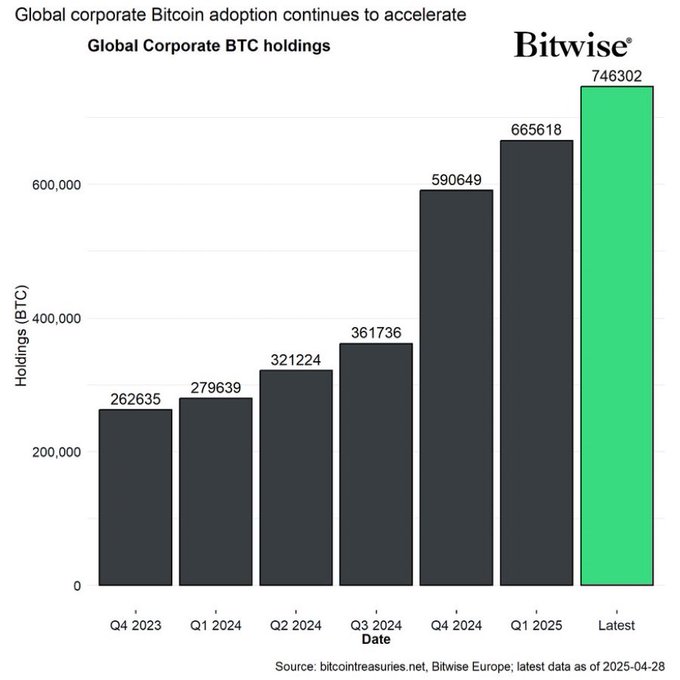
Meanwhile, fresh data from André Dragosch, Bitwise’s Head of European Research, shows widespread adoption of Bitcoin among corporate entities. According to the data, corporate Bitcoin balance has soared by nearly 100,000 BTC over the past month. 

The reported Bitcoin balance at the end of Q1 2025 stood at around 656,618 BTC. However, the balance has increased to 746,302 BTC in less than a month, marking a surge of 80,684 BTC from what was reported in Q1 2025. 

Corporate Bitcoin balance

It is worth noting that Dragosch shared the data before Strategy announced its acquisition of 15,355 BTC. This indicates that the corporate Bitcoin balance has increased by 95,000 in one month. 

FTX Estate Sues Unyielding Token Issuers in Latest Attempt to Repay Customers

0

The defunct crypto exchange FTX has taken legal action against specific issuers in its latest attempt to recover debts and repay customers.

FTX Trading and the FTX Recovery Trust have filed a lawsuit against certain token issuers who have failed to fulfill their agreements to remit the agreed-upon coins to the exchange. Specifically, the restructuring team sued NFT Stars Limited and Kurosemi Inc. on Monday over compliance issues.

FTX Takes Legal Action to Recover Tokens

FTX was once one of the most prominent cryptocurrency exchanges in the United States before its demise. It filed for bankruptcy in November 2022 after a experiencing a bank run upon reports that founder Sam Bankman-Fried had misappropriated $8 billion in customer funds through sister firm Alameda Research.

Following Bankman-Fried’s conviction and 25-year sentence, the defunct exchange has sought to recompense customers affected by the fallout. Notably, the repayment process is already underway, but the FTX estate has faced major hurdles with two firms, NFT Stars and Kurosemi, also known as Delysium.

The team claims in a complaint filed against both firms in Delaware’s bankruptcy court that they have failed to remit tokens due to Alameda Research’s venture arm, Alameda Ventures, as per the terms of an investment agreement. FTX revealed that it filed the lawsuit after several attempts to contact the token issuers failed.

Token Issuers Unyielding 

The lawsuit disclosed that marketplace NFT Stars has failed to fulfill its rights to FTX following an earlier investment. The bankrupt exchange paid $325,000 in November 2021 to the issuer for rights to 1.35 million SENATE tokens and 135 million SIDUS, an agreement that the NFT market has yet to fully honor.

Specifically, FTX claims that NFT Stars owes them 831,000 SENATE and 83 million SIDUS and seeks the court’s help in recovering these funds. Notably, the restructuring team claimed it had contacted the issuer 15 times between June 2023 and September 2024, with no success.

Furthermore, the complaint claimed that the AI gaming platform Delysium had not remitted the 75 million AGI tokens it owed FTX despite 13 attempts to recoup them. FTX paid $1 million for the coins in January 2022, which launched in April 2023.

However, following FTX’s bankruptcy, Delysium extended the initial 12-month vesting period agreed on to 48 months and has not remitted any tokens to the exchange. Also, the project stated in a public Discord statement that it would not allocate any AGI tokens to the collapsed trading platform.

FTX has asked the court to recoup these owed tokens and seeks compensation for damages. The estate has also threatened similar action against other firms that are unwilling to refund tokens owed to the exchange.

‘You Have Been Warned,’ Pundit Says XRP Will Not Remain at $2.2 Forever

0

Amid the range-bound movements observed by XRP, a notable market pundit has argued that the altcoin will not remain in the current region forever.

This commentary came from Edoardo Farina, Alpha Lions Academy Founder and Head of Social Adoption at XRPHealthcare, as he continues to highlight XRP’s resilience and potential to claim greater heights despite the current market uncertainties.

XRP Will Not Remain at $2.2 Forever

For context, over the past few weeks, XRP has continued to consolidate around the $2 mark, often surging beyond $2.2 during a rebound push, but facing resistance that brings it back to this level and subsequently below it. Most recently, XRP rose to $2.36 on April 28 but has now corrected to the $2.2 level, specifically trading at $2.28 at press time.

Amid this persistent market uncertainty, Farina believes the bearish pressure that often pushes XRP back to $2.2 and subsequently below this mark will not prevail forever. According to the market pundit, XRP will not stay at the $2.2 region forever.

Edoardo Farina on X
Edoardo Farina on X

Farina added an interesting comment to his disclosure, suggesting that this commentary was a warning. Specifically, the pundit might have directed the warning to investors who have remained on the sidelines due to the belief that XRP will not push beyond this level. It might’ve also been directed to traders who have chosen to short the asset.

Interestingly, these shorts have dominated the scene in recent times. Earlier this month, analyst Koroush AK suggested that this period was the best time to short XRP, predicting further downsides. Before that, another trader, Cole Garner, advised others to short XRP. More recently, Crashius Clay suggested XRP has been one of his most obvious shorts. 

XRP’s Previous Struggles at $0.5

Notably, Farina’s recent commentary comes on the back of these increasing short positions, which would suffer massive liquidations once XRP secures a recovery. The pundit’s comment is a result of his confidence in XRP’s potential, as similar bearish sentiments emerged during XRP’s range-bound movements last year.

Specifically, the asset persistently struggled around the $0.5 to $0.6 range in 2024, leading to some critics branding it a stablecoin. However, when the market exploded, XRP saw the highest upside for any top 10 asset, breaking above the $1 and $2 levels in one fell sweep.

Now, with XRP consolidating around $2 to $2.2, similar bearish sentiments from when it traded at the $0.5 to $0.6 range have emerged. Abdullah Nassif, Host of The Good Morning Crypto Show, noted earlier this month that $2 now felt like the $0.5 level from last year.

Meanwhile, pundits like Farina, who are increasingly confident that a rally beyond $2 will also emerge, believe investors should own at least 10,000 XRP to prepare for the projected uptrend. 

Expert Says That Holding Only XRP Is Enough to ‘Make It’

Widely followed crypto influencer “DustyBC” has shared the bold perspective that holding just XRP as an investment vehicle could be sufficient for one to “make it.”

His view suggests that XRP as one’s sole crypto investment strategy could be enough to secure a substantial fortune someday.

“XRP is Enough to Become Rich”

The dream of attaining financial freedom is the aspiration of many, and the crypto market’s potential for dramatic appreciation keeps many focused on the industry. However, with over 14 million crypto assets to choose from, investors are often confused about which asset could be the next breakthrough story.

XRP has frequently emerged as a favored coin among crypto influencers. They speculate that the asset could see price targets as high as $10,000, despite its already massive multi-billion-dollar valuation.

Established crypto tokens like XRP have experienced periods of explosive price performance, but this hysteria has since cooled, with the asset XRP in particular trading at a discount from its peak. Still, optimism remains high among market commentators regarding XRP’s prospects.

Many continue to argue that XRP could still make today’s investors millionaires. Some even warn market participants against betting against XRP’s future, saying it could lead to regret.

Daring claims like DustyBC’s only add to the ambitious forecasts about XRP. Notably, many in the community share his perspective that XRP alone could be sufficient for financial success in crypto. 

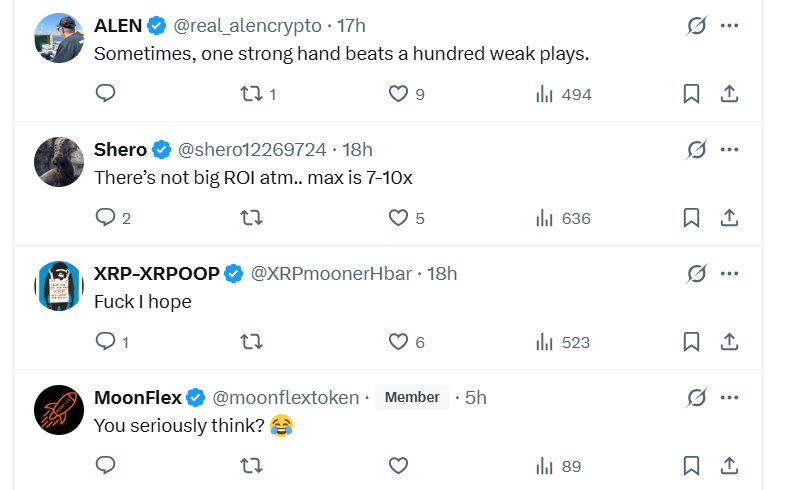
One user, Alen, remarked in reply that sometimes one strong hand beats a hundred weak plays. Some even say “less is more,” suggesting that investing in XRP may be more effective than overexposing oneself to other assets with less likelihood of success.

Diversification Still Important

Meanwhile, some who agree with this sentiment also emphasize the importance of diversification. One user, Crypto Degen, stressed that holding multiple promising assets is the best form of protection and risk management, rather than concentrating on just one coin.

Notably, one factor fueling the heated speculation about XRP’s potential is its native payment utility. Given that the market is valued in the multi-trillions, with projections suggesting it could reach $300 trillion by the end of this decade, proponents believe that XRP managing even just 1% of this market share would significantly impact its price.

Moreover, Ripple’s continued expansion, acquisitions, and partnerships keep XRP holders optimistic about the future. As a result, some ambitious market commentators warn that not holding at least 1,000 XRP tokens shows a lack of seriousness in one’s financial decisions.

“XRP Has Limited Potential”

Despite the prevalence of bullish forecasts for XRP, critical voices remain, offering a sobering perspective on the inflated expectations surrounding the asset.

For example, responding to DustyBC’s comment, X user Shero suggested that XRP’s near-term potential maxes out at a 7X to 10X surge, which he does not see as life-changing.

Critical voices like this often point to the fact that XRP’s valuation is already over $100 billion. As a result, the chances of a dramatic surge that could turn small holdings into life-changing fortunes are slim.

Community reaction to XRP potential
Community reaction to XRP’s potential

At the same time, a few leading industry commentators, like Davinci Jeremie, have stated that they do not recommend XRP as an investment. Particularly, Jeremie only recommends XRP for short-term speculation to make a quick buck.

The Fall of Siloes is a Prerequisite for True Web3 Adoption

0

While there is no shortage of specialized platforms in Web3, many of them still operate in silos, focusing on a single aspect – an exchange, banking, cards, decentralized trading, etc. – without integrating with the others. Independently operating decentralized exchanges like Uniswap, the Ethereum-based AMM (automated market maker); Curve Finance, a stablecoin-focused DEX; and dYdX, a layer-2 decentralized perpetual trading platform, are all effective in their own right. Platforms like Aave and Compound excel at offering services like interest, loans, and savings. Aave is an autonomous lending and borrowing protocol, and the equally well-known Compound offers interest-earning lending and borrowing. Wallets like MetaMask and Phantom are popular and focused on access, identity, and holding assets.

Then, there are crypto cards like Crypto.com and Binance Card. Crypto.com offers Visa cards, cashback in CRO, and staking features, and Binance allows users to spend crypto via a Visa card. Yet, these services remain siloed.

Fully integrated experiences are crucial to Web3 adoption

Albeit being a great deal more challenging to achieve, a fully integrated experience is critical for complete user satisfaction. Gleec was established in 2015 as a comprehensive blockchain ecosystem that aims to secure and simplify digital asset management, combining different services into a cohesive experience.

DeFi ecosystems make efforts to create bridges, and some of the dApps running on them try to cover everything, but many are still siloed. The evolution from DeFi version 1 (DeFi v1) to DeFi v2 holds promise for the Web3 landscape and users. The first version was typified by highly incentivized ecosystems, offering unsustainable yields that failed to maintain user interest due to rising security risks and dwindling returns. While innovative, the initial offerings often resulted in complicated, monolithic structures that were hard to navigate. Cross-chain bridges aim to overcome the inherent limitations of siloed networks, but they’re far from immune to vulnerabilities, such as unaudited smart contracts, unsecured private key management and upgradability processes, unproven validator sets, dependency on a single network, etc.

The multitude of layer-2 blockchains on Ethereum reflects efforts to overcome siloes. Many of them are EVM-compatible, so users can deploy contracts and assets across chains with minimal friction and no need to rebuild everything. L2s attempt to improve on Ethereum in terms of speed, privacy, cost, or scalability. However, the adjustments can paradoxically make the chain even more isolated, and it becomes harder for users to figure out how and where to get things done. It’s also challenging for developers to determine which chain to build on. If they do manage to build a faster and cheaper blockchain, it might be less secure with lower liquidity and fewer users.

Eliminating the need to seek one app after another

While many siloed applications are effective on their own, the user is left to seek another application for each additional demand. On Gleec, the user can take advantage of integrated blockchain infrastructure, crypto cards, centralized and decentralized exchanges, secure communication, banking solutions, and full regulatory compliance. Its secure, licensed infrastructure also powers Raphael Coin, a cryptocurrency that enables fractional ownership of a Renaissance artwork recently rediscovered by Dorotheum, a historic auction house founded in the 18th century.

The independent blockchain infrastructure features a Delayed Proof of Work (dPoW) consensus mechanism, which improves security by leveraging Bitcoin’s hashing power to notarize blocks, making attacks on Gleec much costlier. The ecosystem includes a crypto-friendly Visa card for crypto spending, an encrypted communication app), a DEX, a BTC exchange for digital asset trading, and Gleec Pay, which lets you create an IBAN directly within the exchange for fiat-to-crypto integration. The BTC exchange is a centralized trading platform offering a wide range of trading pairs, fiat integrations, and advanced trading features. The DEX (also a non-custodial wallet) enables peer-to-peer cryptocurrency trading, giving users full control over their assets.

Causes and effects of Web3 fragmentation

Siloed applications lead to liquidity fragmentation, where a user who holds tokens on different blockchains faces trouble if they want to use them all on one chain. They must first trade or bridge assets from Arbitrum or Base to Optimism (for example), pay high transaction fees, and invest significant effort to figure out complex procedures. This takes a lot of time, and concepts like pre-provisioning gas drive away non-technical users.

Inefficiencies in liquidity management discourage potential users from adopting dApps. What’s more, Web3 fragmentation is draining value and stunting the growth of a highly lucrative industry. Technological incompatibility is among the root causes of fragmentation. This direct tradeoff of decentralized ecosystems harms user experience and creates problems for developers, such as redundancies. Inefficiencies are driven by the need to build products and services like lending, DEXs, stablecoin minting, etc., across ecosystems in an environment that requires their replication at an exponential rate. Developers focus on replicating a few successful use cases across ecosystems rather than seeking integration and can’t afford to pay as much attention as needed to products that can make Web3 more appealing to mainstream users.

The activity would be higher if users didn’t need multiple accounts or gas tokens and to bridge funds for cross-chain operations manually. Additionally, projects suffer from unrealized innovation as they cannot build on a maximally decentralized and scalable base layer.

Web3 inefficiency in numbers

The total VC funding of the crypto industry peaked at $11 billion in Q1 of 2022 but plummeted thereafter and didn’t start increasing again until early 2024. In Q1 of 2025, it reached $4.8 billion but is still below the Q3/2022 level of $6.5 billion. While user numbers increase in line with rising investments, ecosystem growth is stagnant when you isolate different chains to look at their popularity. Only Solana and a few Ethereum L2s experienced growth in the first half of 2024, supporting the view that fragmentation has become more pronounced and that established ecosystems’ tactics mainly attract users from each other, further driving fragmentation. Solutions like Gleec will not single-handedly solve the Web3 fragmentation crisis, but their adoption is a step in the right direction.

What Does Real Thought Leadership Look Like In The Web3 Space?

0

By now, you’ve probably heard the term “thought leadership” being thrown around at conferences, on Twitter, and in many of a founder’s LinkedIn profile. In the Web3 space, in particular, it has become particularly buzzy to such an extent that everyone wants to be seen as a visionary and a trailblazer. 

But here’s the thing: actual thought leadership is rare.

After all, not everyone can excel at the top of the game and lead with innovation simultaneously. So, what exactly separates genuine Web3 thought leaders from the crowd of self-proclaimed experts and influencers? Let’s peel back the layers. 

Beyond the Hype Machine

The cryptocurrency space has an image problem, primarily due to its inherent association with hype and speculation. Four or five years ago, being a thought leader in the space was all about riding the hype trends and viewing it as a numbers game. But thought leadership in Web3 isn’t about having the most followers, speaking at every conference, or your ability to rile up followers with FOMO. 

It’s about consistently contributing valuable ideas that shift perspectives, form narratives, and push the entire industry forward.

Think about the voices you genuinely respect in the space (or in any other industry you participate in). They’re not just mimicking and repeating what everyone else is saying or creating content for the sake of it. They’re asking difficult questions, challenging assumptions, and sometimes taking unpopular or even controversial positions based on deeper analysis and their genuine convictions. 

When Vitalik Buterin writes about scaling solutions or governance challenges with Ethereum, people pay attention because he combines his technical expertise with philosophical clarity. That’s authentic thought leadership in action, offering insights that others can’t easily replicate.

Starting Your Thought Leadership Journey

If you run your own Web3 business, you might be reading this thinking, “That sounds great, but how do I actually become a thought leader in such a crowded space?” Good question.

First, the most crucial step is to find your specific angle. Despite its relative newness, the Web3 ecosystem is vast, encompassing DeFi, DAOs, NFTs, and layer-2 solutions. While you may have an opinion or even expertise in each of these areas, the truth is that you can’t be an authority on everything, nor should you try. Focus on a niche where you have genuine expertise, experience, and interest. 

For example, if you’ve built multiple DAOs, you might focus on governance innovations. If you’ve been deep in crypto security, your insights on protecting digital assets will carry more weight with those relevant audiences. 

Working With a Web3 PR Agency

Before you go it alone, it’s essential to realize that many of the emerging and established thought leaders you see finding success online are the ones who bring in expert help to amplify their voice and curate effective messaging. 

A web3 PR agency will not only help you create high-quality thought leadership campaigns, but it will also help position your authentic insights for maximum impact. 

The right partner will understand the technical nuances of your project and the insights you bring, while finding ways to leverage blockchain PR to enable you to interact and engage with diverse audiences. They’ll know which publications reach your desired audience and how to frame your ideas to resonate with them.

Just remember, this isn’t about creating hype and flashy one-time marketing campaigns. True crypto public relations is about strategically amplifying your genuine expertise (or the value of your crypto project), not creating a fake persona to buy some cheap followers. 

Consistency Trumps Virality

If you write one viral tweet and manage to catch a wave reaching millions of views, that alone doesn’t make you a thought leader. Consistent, thoughtful commentary over a long period is what does. 

To maximize the impact of your thought leadership efforts, establish a consistent schedule for sharing your ideas, whether through a newsletter, podcast, or thoughtful LinkedIn posts. In general, the medium you use matters less than the substance and regularity of your contributions.

Many successful thought leaders, both in Web3 and beyond, started small by sharing their learning journey openly. They documented their experiments, analyzed failures, and celebrated the breakthroughs they made. This authentic approach resonates much more than polished marketing.

Communicating Complex Ideas Clearly

The Web3 and blockchain space is technical. The best thought leaders are those who have a knack for translating complex concepts into language that their audience can easily access and understand. However, the challenge is finding ways to do that without oversimplifying to the point of inaccuracy.

This isn’t about simplifying things. It’s about finding the right metaphors, analogies, examples, and frameworks that make what could be an unfamiliar concept into an idea that clicks. When you can explain why zero-knowledge proofs matter to someone who isn’t a cryptographer (or has an active interest in the blockchain space), then you’ve demonstrated fundamental communication skills.

Effective blockchain PR and thought leadership hinges on this ability to communicate technical concepts clearly, and it’s a skill worth mastering if you really want to build a name for yourself. The most impactful crypto public relations strategies bridge the gap between technical innovation and mainstream understanding.

Final Word

Building recognition as a thought leader in Web3 is a marathon, not a sprint. The most respected voices in the space have been consistently contributing for years, weathering the various bear and bull market cycles and evolving their thinking as the technology matures.

In other words, you won’t become a thought leader overnight, and that’s okay. Start by sharing what you know and your areas of expertise. Be open about what you don’t know, and commit to continuous learning. To reach a point where your voice truly matters, you need to bring a fresh perspective backed by real experience.