Home Blog Page 784

XRP Pundit Says It’s Hard to Understand How Free You’ll Be if You’ve Amassed 10,000 XRP

0

A notable XRP community pundit has continued to champion an accumulation culture, identifying a threshold that could lead to financial freedom.

Edoardo Farina, who has continuously encouraged investors to accumulate more XRP tokens, believes the crypto asset will likely deliver massive gains for patient holders.

XRP Shows Resilience

For context, XRP’s price action has been suppressed over the past three months, as bearish pressure engulfs the broader crypto market. The asset lost 29.34% of its value in February 2025 alone, the largest single-month loss in over three years. Following this, XRP has shown resilience but continues to observe declines, albeit at a slower pace.

However, while XRP is down 1.47% year-to-date, the larger crypto market is suffering more significant losses. Notably, the global crypto market cap has dropped 17.59% within the same period, losing $561 billion. Specifically, Bitcoin (BTC) has slumped 9.65% year-to-date, and Ethereum (ETH) is down 52.6%.

XRP’s resilience is one of the factors contributing to the confidence among proponents, with one such proponent, Farina, optimistic that holding a portion of the XRP supply could lead to financial freedom. In one of his commentaries, Farina suggested holding at least 10,000 XRP tokens.

Holding 10,000 XRP Could Lead to Financial Freedom

According to the XRP community figure, investors might find it difficult to understand the scale of financial freedom they would attain by merely holding 10,000 XRP tokens. For context, procuring these 10,000 tokens today would cost around $20,150 at XRP’s current price of $2.15. 

Notably, these tokens were worth around $5,000 barely six months ago, in November 2024, when XRP traded for $0.5. Those who took the prerogative to accumulate XRP back then spent little for this stash. However, despite the price surge in the last few months, analysts like Farina believe another explosive run is on the horizon.

As a result, they suggest that the ongoing market turbulence presents a rare buy-the-dip opportunity. Interestingly, data from the behavior analytics platform Santiment confirms that only 299,547 XRP wallets, making up just 4.68% of the total 6.398 million addresses, hold at least 10,000 XRP tokens despite an increase in these high-value wallets.

XRP Addresses Holding at Least 10000 XRP Santiment
XRP Addresses Holding at Least 10000 XRP | Santiment

Notably, further data reveals that these wallets with at least 10,000 XRP as balances totaled 287,577 at the start of the year. The latest figure translates to an addition of 11,970 addresses to this tier year-to-date. Despite the increase, the lower figure indicates that investors might still be early into the market.

What Would Financial Freedom Entail?

Consequently, Farina believes those who seize the opportunity now could be financially free. However, this concept varies with each person. In most cases, returns amounting to $1 million could lead to financial freedom. Nonetheless, XRP would need to rise substantially to yield $1 million from a 10,000-token investment.

Specifically, for 10,000 XRP to present returns amounting to $1 million, XRP price must spike to $100. This represents a 4,801% increase from the current value. Notably, several analysts have insisted that this price is feasible. For one, Farina suggested last month that XRP ought to be above $100 under normal circumstances.

Also, in February, Armando Pantoja insisted that XRP has the potential to surpass $100, citing factors such as its role in cross-border settlements. However, critics like Rajat Soni believe this forecast is unreasonable, especially in the current market cycle. Also, wealth mentor Linda Jones does not see the $100 target materializing this year. 

Funding Fees Explained: How Perpetual Futures Keep the Crypto Market in Check

0

Perpetual futures are one of the most commonly traded products in crypto — especially among traders who want to use leverage. They’re flexible, don’t expire, and let you go long or short with ease. But there’s one part many traders don’t think about until it’s too late: funding fees.

These fees aren’t hidden, but they can catch you off guard if you don’t understand how they work. They’re charged every few hours, and depending on the market, you’ll either pay or receive a small amount — automatically. Over time, these small amounts add up.

The purpose of funding fees is pretty straightforward: they help keep the price of perpetual contracts aligned with the spot market. Without this system, the futures price could easily drift out of sync — especially during strong uptrends or panics.

In this article, I’ll walk through what funding fees are, why they exist, and how to manage them so they don’t quietly eat into your profits over time.

Key Takeaways

  • Funding fees are small payments exchanged between long and short traders every few hours on perpetual futures contracts.
  • They exist to keep the futures price aligned with the spot price, preventing major price distortions.
  • Positive funding means longs pay shorts; negative funding means shorts pay longs.
  • These fees can quietly eat into your profits over time, especially with high leverage or long holding periods.
  • Exchanges calculate funding rates differently, typically based on market imbalance and interest rate formulas.

What Is a funding fee?

In crypto trading, a funding fee is a small amount that gets paid between traders — usually every eight hours. It’s a core feature of perpetual futures contracts and how they work, helping to keep the futures price in line with the spot market.

Here’s the basic idea: when more people are going long (betting the price will go up), the funding rate tends to turn positive. In that case, long traders pay a fee to short traders. If the market flips and shorts outnumber longs, the rate goes negative, and now short traders are the ones paying.

You don’t have to do anything to send or collect it. The platform handles all of that automatically. It’s part of the contract, and the fee is settled straight from your account.

Most of the time, the fee is pretty small — maybe not even noticeable on a short trade. But if you’re holding a position for a few days or using high leverage, it can start to eat into your profits. So, it’s worth paying attention to, especially if you’re trading in a crowded market.

How is the funding rate calculated?

The funding rate is one of those things that catches new traders off guard. It’s not a flat fee, and it doesn’t work like trading fees or commissions. Instead, it’s a small amount of money paid between traders every few hours, and it’s based on how the market is behaving.

There are two main parts to the funding rate: the interest rate and the premium index. The interest rate is usually a fixed value set by the exchange, often around 0.01% every 8 hours. It doesn’t change much. The premium index is where things get interesting — this measures the difference between the price of the perpetual futures contract and the actual spot price of the coin.

If the futures price is higher than spot, it usually means most traders are going long. In that case, longs pay shorts. If it’s the other way around, and shorts dominate the market, then shorts pay longs. This keeps everything in balance.

Each exchange calculates this a bit differently. Binance, Bybit, and Phemex all use their own formulas, but the general idea stays the same: the more demand on one side of the market, the more likely you are to pay the fee — not receive it.

It’s not a huge fee on paper, but over time it adds up. Especially if you’re holding a position for a few days in a sideways market. 

Why do funding fees exist?

If you’ve spent more than a few minutes trading perpetual futures, you’ve probably come across something called a funding fee. It’s not exactly a flashy part of crypto trading, but it’s pretty important — and if you don’t understand it, you might end up wondering why your PnL keeps bleeding even when the price isn’t moving much.

In short, funding fees exist to keep the price of a perpetual contract aligned with the spot market. Because these contracts never expire, the platform needs a way to stop prices from drifting too far in either direction. That’s where funding steps in.

Here’s how it works: when the market is overly bullish, perpetual contracts often trade above spot price. In that case, longs pay shorts a small fee every few hours. The idea is to make going long a bit more expensive, which nudges things back toward balance. If the market flips and contracts trade below spot, then shorts pay longs instead.

It’s not about punishment — it’s just a mechanism to encourage fair pricing. Think of it like a gentle push to stop the market from getting lopsided.

In volatile environments, this small detail makes a big difference. Without funding fees, prices could spiral out of sync, creating risk for traders and the platform alike. So while they’re easy to overlook, funding fees are part of what keeps perpetual futures stable and functional.

How funding rates impact your day-to-day trading

If you’re trading perpetual futures, funding fees are something you’ll want to pay attention to. They’re often not huge on a per-hour basis, but they can quietly add up — especially if you’re holding a position for more than a day or two.

Let’s say you’re long on BTC during a bullish period. Odds are, the funding rate is positive, which means you’re paying a fee every 8 hours just to keep your position open. If you’re using higher leverage, that fee gets even bigger. Over time, these costs can really eat into your profits — or worse, turn a profitable trade into a loss. This is particularly risky for traders who take a more passive or long-term approach.

If your strategy involves holding for several days or weeks, it might make more sense to look for low-funding-rate pairs. Some traders even flip this around by shorting assets with consistently high positive funding. This way, you’re actually being paid to hold the trade — a tactic known as a carry trade. It doesn’t always work, but in sideways markets, it can help offset costs.

A good example of funding getting out of hand happened during the 2021 meme coin pumps. Coins like DOGE and SHIB saw funding rates skyrocket as hype exploded. At one point, traders were paying over 0.3% every 8 hours just to stay long — that’s more than 2% per day. And that’s before accounting for price movement.

In short, funding rates are an easy thing to ignore — until they aren’t. Whether you’re scalping or swing trading, it’s worth checking the rate before opening any leveraged position.

Pro tips for managing funding costs

Funding fees can quietly drain your balance, especially if you’re holding positions over long periods. Here’s how smart traders manage them:

  1. Trade near funding cutoffs. Funding is usually paid every 8 hours. By opening or closing a position shortly before the funding timestamp, you can avoid paying the fee—or collect it if the market leans in your favor.
  2. Hedge high-fee pairs. If you’re long on a pair with high positive funding, consider opening a short on a similar asset with negative funding. This can help neutralize the cost.
  3. Watch out in sideways markets. Many traders overlook funding in low-volatility conditions. But even without price movement, fees can chip away at your margin. If you’re not actively trading, it may be better to close your position and re-enter later.

Small adjustments like these can make a noticeable difference over time.

Final thoughts: Don’t let funding fees catch you off guard

Funding fees are one of the most overlooked costs in crypto leverage trading. While they might seem small on the surface, over time they can eat into profits or compound losses—especially if you’re holding positions through multiple funding intervals. Unlike trading fees, they’re not paid upfront, which makes them easy to ignore until they start draining your account.

Understanding how funding works gives you a real edge. It helps with smarter timing—knowing when to enter or exit a position—and more accurate position sizing, particularly for longer-term trades. If you’re trading during periods of high market imbalance, a poorly timed entry can result in paying funding every eight hours.

To stay ahead, monitor funding rates on your chosen exchange and use tracking tools or calculators to project costs. Don’t trade blind—make funding part of your strategy, not a surprise.


This Historical Support Could Trigger a 200% Surge for Shiba Inu: Analyst

0

A veteran trader predicts a potential 200% surge for Shiba Inu, based on a major historical daily support.

This analysis comes during a time when the price of Shiba Inu (SHIB) continues to fluctuate, with notable spikes and declines. Currently priced at $0.00001252, the coin has seen a 0.84% drop in the last 24 hours but a 4.39% increase over the past week.

Despite these short-term swings, a veteran analyst on TradingView, “MMB Trader,” has hinted at the possibility of a strong and significant pump phase for Shiba Inu.

Shiba Inu Price Could Reach $0.000037

In his commentary, MMB Trader shared a chart showing that historically, Shiba Inu has demonstrated substantial price increases, most notably in 2021. During this period, SHIB surged by an impressive 1,089%, rising from $0.000005 to $0.00008026 in weeks. However, the memecoin retraced to consolidate near $0.000005 by June 2022.

A more recent rally in 2024 also saw SHIB rise by 391.74%, moving from $0.00001 to $0.000045 in less than two weeks. Similar to the previous phase, Shiba Inu lost all the gains from this historic run. In particular, it crashed to just above $0.00001 this month, although it has rebounded to $0.000012.

Meanwhile, Shiba Inu’s dramatic price movements of 2021 and 2024 share a common factor: a key daily support zone. In the current cycle, SHIB bounced off the 2024 support level at $0.00001 earlier this month, signaling potential strength at this price level. Hence, the analyst points to the next resistance level at $0.00002562. 

The analyst anticipates the possibility of another bull run, with expectations of over 200% price increase for Shiba Inu. A further rise could occur if the red resistance zone on the chart breaks to the upside.

If SHIB experiences a 200% price increase from its current price of $0.00001252, it could reach $0.000037.

Shiba Inu Price Prediction | Source: TradingView

Further Bullish Stance on Shiba Inu

Separately, prominent crypto and forex trader Lars Kooistra shared a positive outlook on Shiba Inu. Kooistra revealed that he has taken a long position on SHIB, citing the high probability of a rally based on the TCT model 1 accumulation schematic observed on higher timeframes. This model suggests that SHIB is poised for an upward move.

Interestingly, Kooistra’s analysis also highlights a noticeable price correlation between Shiba Inu and XRP. Despite this, SHIB’s bullish momentum appears stronger, as its price continues to trend upwards compared to XRP.

Long-Term Holding Behavior

IntoTheBlock’s ownership data, particularly the ‘Addresses by Time Held’ data, further complements the bullish narrative. A chart shows an increase in long-term holders, those who have held SHIB for over a year. 

This group has grown by 2.07%, indicating a strong belief in SHIB’s long-term potential. Meanwhile, medium-term holders, or those who have held SHIB for 1 to 12 months, have decreased by 4.17%.

The decline in short-term traders, down by 16.78%, further underscores a shift in market behavior, with more investors opting to hold SHIB for extended periods.

Shiba Inu Addresses by Time Held Data

Analyst Says These XRP Price Indicators Still Support a Macro Breakout

0

Market watcher Casi analyzes XRP corrective phase with Elliott Wave theory, highlighting key support levels and potential for a breakout into Wave 3.

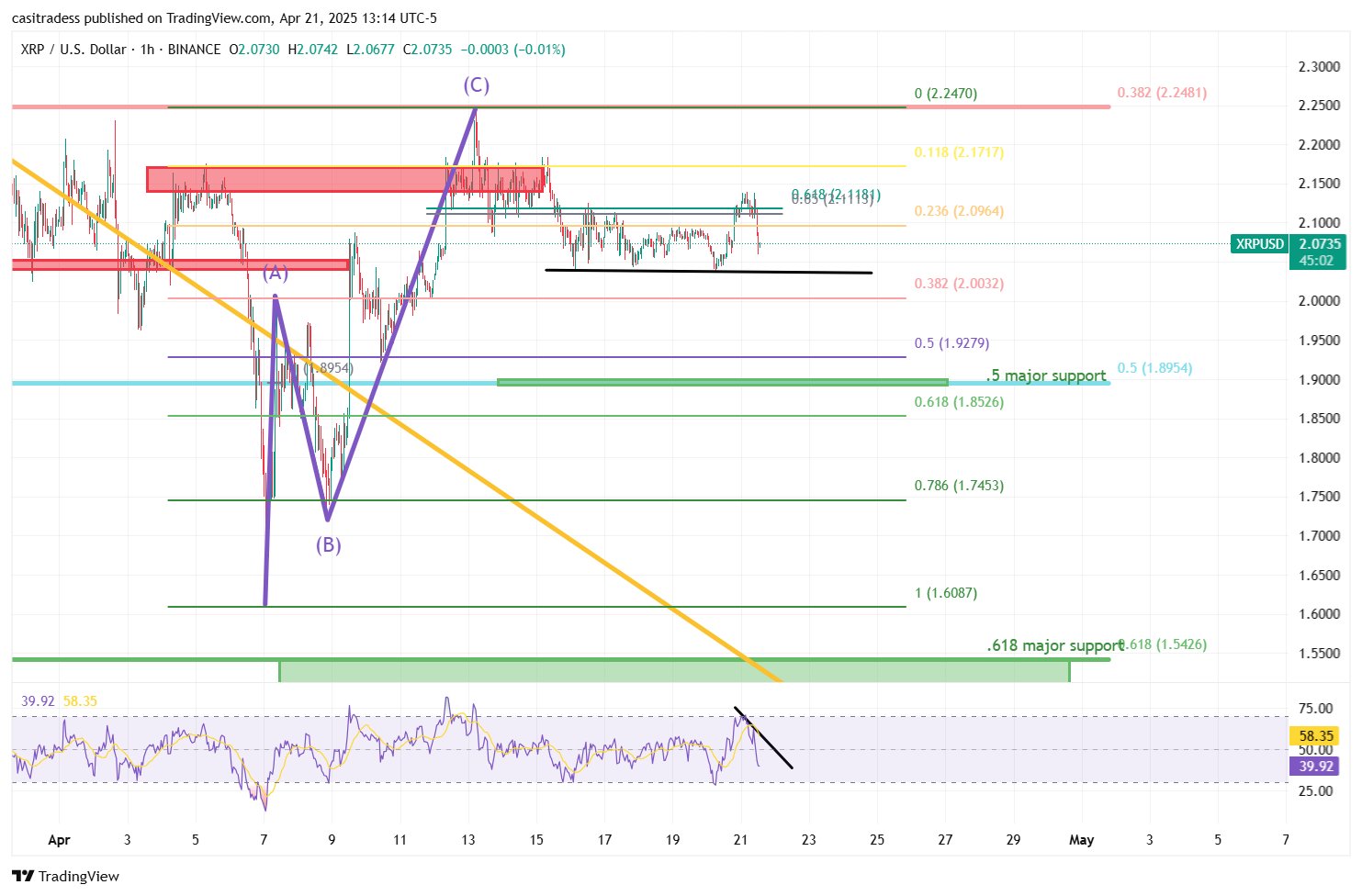
The analysis comes as XRP has been navigating through a narrow trading range between $2.04 and $2.18 from April 16 to 22. The price saw several fluctuations during this period, including a sharp surge on April 21, where the value briefly spiked to $2.14 before retreating to $2.07. 

Amid this performance, Casi Trades has called attention to key support levels and potential breakout signals for the crypto asset.

Analysts Watch XRP’s Corrective Phase

Casi Trades presents a view of XRP’s current price action. According to a previous April 17 analysis, XRP has been in a corrective phase, identified as Wave 2 in the Elliott Wave structure. This phase typically involves a pullback and comes after a significant upward move from the previous wave. 

Meanwhile, in the latest chart, Casi Trades shows how XRP attempted to break out alongside Bitcoin but faced resistance at the 0.618 Fibonacci retracement level, which is located just above $2.10. According to the analyst, this resistance point is often seen as a point of exhaustion for price movements, leading to a quick rejection.

In her analysis, Casi Trades also identified the ABC wave, which propelled XRP towards $2.25 in mid-April, and suggests that, similar to wave C, wave 3 is on the verge of unfolding.

XRP Elliot Wave Structure

Casi Trades highlights the $1.90 and $1.55 levels as key support zones that could prevent further decline. If XRP manages to hold above these levels, the likelihood of a breakout into Wave 3 increases. This wave, in Elliott Wave cycles, is known for being the most powerful upward phase. 

Extension targets for XRP, according to the April 17 analysis, suggested potential price levels of $6.50 at the 1.618 Fibonacci extension, $9.50 at the 2.618 extension, and possibly exceeding $12 at the 3.618 extension.

Indicator Point to Weakened Bullish Strength

In addition to Elliott Wave theory, Casi Trades incorporates momentum indicators further to assess XRP’s trajectory in the latest chart. The Relative Strength Index (RSI), which tracks price momentum, currently shows a neutral reading of 39.92. 

This indicates that XRP is neither overbought nor oversold at present. However, there is a noticeable bearish divergence on the RSI, as the indicator is trending downward while the price has been either moving sideways or slightly upward.

Notably, this suggests weakening momentum, confirming the notion that XRP may soon complete its corrective phase and break out if key support levels hold.

Further Optimism for Major Upsurge

Meanwhile, another analyst, Papa, has a more bullish outlook on XRP. He argues that XRP could be poised for a significant rally, drawing parallels with historical patterns observed during its 2017/2018 bull run.

Papa points to the formation of a symmetrical triangle pattern in late 2017, which marked the beginning of a massive rally. After an initial surge of 7,875% from $0.0055 to $0.3988 in 2017, XRP faced a pullback and consolidation, which then led to a breakout that saw the cryptocurrency soar 1,762% to its all-time high of $3.31 in January 2018.

Papa believes that XRP is now forming a similar consolidation pattern. Following a surge from $0.50 in November 2024 to a high of $3.39 in January 2025, XRP has encountered a pullback, dropping 39% from its peak.

However, instead of a symmetrical triangle, XRP is currently trading within a parallel channel. Papa suggests that if XRP breaks above the $3 resistance level, it could trigger a similar uptrend to the one seen in 2017. His projections suggest that XRP could reach as high as $14.

ECB and European Commission Divided on MiCA Amid Concerns Over US Stablecoin Expansion Under Trump

0

The European Central Bank (ECB) and European Commission are divided on how to strengthen Europe’s crypto regulations in response to U.S. efforts to expand its stablecoin industry.

At the heart of the disagreement is the regulation known as the Markets in Crypto Assets Regulation (MiCA). The ECB believes MiCA is insufficient to counter potential financial instability driven by U.S. policy changes under President Donald Trump. 

According to POLITICO, ECB concerns primarily center on the possibility that a booming U.S. stablecoin market could destabilize Europe’s economy. Meanwhile, the Commission insists that the current rules are robust enough to manage the risk.

ECB’s Alarm Over U.S. Stablecoin Growth

The ECB’s latest analysis warns that President Trump’s support for the U.S. crypto industry, especially stablecoins, could lead to financial contagion. The central bank highlighted that if dollar-backed stablecoins were to flood European markets, it could divert significant capital from the EU to the U.S., undermining efforts to make Europe’s financial system more independent.

Furthermore, the ECB argued that MiCA, introduced just months ago, needs an urgent revision to address these risks more effectively. Specifically, the ECB is concerned about the “multi-issuance” model, which allows European stablecoin issuers to collaborate with third-country firms, increasing exposure to potentially destabilizing external forces.

In response to these concerns, analysts from Standard Chartered have projected that dollar-backed stablecoins could grow dramatically, from $240 billion to $2 trillion by 2028. This projection has further fueled the ECB’s worries that such growth could spill over into Europe, creating risks of instability and a potential “run” on assets. 

ECB officials, including President Christine Lagarde and digital payments head Piero Cipollone, have repeatedly emphasized that MiCA might not be prepared to handle this new challenge.

European Commission Pushes Back 

On the other hand, the European Commission has sharply disagreed with the ECB’s assessment. According to the Commission, the existing MiCA framework is designed to manage risks associated with global stablecoins. 

The EU executive emphasized that it is too early to determine the exact impact of U.S. reforms on European markets. Moreover, the Commission pointed out that MiCA already requires crypto firms to meet stringent criteria, which has led some companies, including the popular Tether stablecoin, to delist from EU exchanges.

The Commission also defended MiCA by stating that the regulation allows for proactive measures against potential risks.

For example, the Commission highlighted that the law grants the ECB the authority to block stablecoin issuers if they threaten Europe’s payment systems, monetary policy, or sovereignty. This legal provision, the Commission argues, ensures that any major disruptions can be quickly mitigated.

ECB Chief on the Need for a Digital Euro

The European Central Bank (ECB) has been vocal about the need to neutralize the stablecoin threats. ECB Chief Economist Philip Lane reiterated this message in a keynote address at the University College Cork Economics Society Conference in Ireland, where he emphasized the critical importance of digital currencies in maintaining Europe’s monetary sovereignty. 

Lane raised alarms over the growing influence of foreign-controlled payment systems and stablecoins. He warned that these external forces could weaken the euro’s role in domestic and cross-border transactions.

He argued that the digital euro is essential for modernizing Europe’s financial system and ensuring the continent retains control over its monetary and financial future. Lane highlighted that Europe’s financial autonomy is increasingly under threat in today’s fragmented geopolitical landscape.

Senior Bloomberg Analyst Says Bitcoin Needs the Small Wins to Be True Alternative Asset

A senior analyst at Bloomberg says Bitcoin must secure small wins to be considered a true alternative asset amid outperformance.

For context, Bitcoin price has gained significant momentum this week, climbing from $84,000 on Monday to nearly $90,000. As of the latest update, Bitcoin stands at $90,790, up 2.85% over the last 24 hours. 

This rally has prompted Balchunas to draw comparisons with traditional financial assets like stocks, treasuries, and gold. Notably, Eric Balchunas, a Senior ETF Analyst at Bloomberg, highlighted Bitcoin’s recent performance and its divergence from broader markets in the past week.

A Diverging Path from TradFi

Balchunas pointed out that Bitcoin outperformed treasuries, which have been what he calls ‘unreliable’ once again. Balchunas also mentions gold, which is in a league of its own, having diverged by negative 0.983 as it posts massive gains amid the drop in equities.

Notably, gold recently surged to an all-time high of $3,500 per ounce, before retreating slightly to the $3,400 level.

Balchunas acknowledged that the time frame is small but emphasized that Bitcoin needs to secure these small wins if it aims to be considered a true alternative asset. Specifically, these small wins build up to place the asset ahead of global stocks, similar to what gold has observed over the years.

Bitcoin ETF Flows Surge

Other market watchers, including Matthew Sigel, head of research at VanEck, noted that Bitcoin’s rally from its April 7 low had allowed it to break free from its long-standing correlation with US tech stocks.

He noted that as Bitcoin approached its two-week high, Bitcoin Exchange-Traded Funds (ETFs) saw a surge in inflows, reaching their highest level since January 30.

Bitcoin vs. NASDAQ: Diverging Performance

Elsewhere, Ecoinometrics, a macro data provider, highlighted an interesting divergence between Bitcoin and the NASDAQ, with Bitcoin rising as the NASDAQ struggled. Historically, such divergences have not lasted long.

When the NASDAQ’s 200-day moving average trended downward, Bitcoin faced significant macroeconomic headwinds. Currently, Bitcoin is back at its 200-day moving average, but this time could be different. Ecoinometrics emphasized that the sustainability of this rally may depend on continued ETF inflows, as the rally could lose momentum without sustained investment.

Meanwhile, data from CoinShares revealed that sentiment in digital asset investment products is recovering. The majority of the inflows seen last week were directed toward Bitcoin, although mid-week retail data prompted $146 million in outflows.

New FEC filings Confirms Ripple’s XRP Donations Second Biggest to Trump’s Inauguration Fund

New FEC filings have confirmed that Ripple’s XRP donations made up the largest contributions from the crypto industry to President Donald Trump’s inauguration funds.

For context, the Trump transition team received a record $245 million in donations from hundreds of firms for Trump’s inauguration as the 47th president of the United States. Notably, the FEC report indicated that $6.23 million was refunded.

Among the prominent donors who contributed to the fund were Ripple, Meta, Amazon, JP Morgan, and Microsoft. Ripple contributed $4.9 million, the second-largest single sum among all donors. Meanwhile, the largest donor was Pilgrim, which gave $5 million to the president.

Remarkably, this fundraising effort for Trump’s second term was the largest in history. It was more than double the $107 million raised for his first term and nearly four times the $61 million raised by the Biden administration.

Ripple Makes the Second-Largest Donation

Of the massive $239 million fund, the crypto industry collectively donated $18 million to Trump’s celebratory event. Ripple led the pack by donating $4,889,345.

As reported earlier, Ripple made its donation in XRP tokens to Trump, which helped finance the President’s three-day inauguration celebration.

It is worth noting that, in addition to Ripple’s capital commitment to Trump’s inauguration, individual executives from the company also donated to influence the November 2024 elections.

For instance, Ripple’s chairman, Chris Larsen, donated at least $1 million in XRP to support Kamala Harris, although she did not win the election. On the other hand, Ripple’s Chief Legal Officer, Stuart Alderoty, donated over $500K in XRP to support Trump’s election.

Other Crypto Businesses That Contributed to Trump’s Celebration

Beyond Ripple, other prominent businesses in the crypto space also generously donated to Trump, both pre-election and post-election. The recent filing with the Federal Election Commission reveals that Robinhood donated $2 million to Trump’s inauguration. This made it the second-largest crypto industry donation after Ripple’s.

Meanwhile, Circle, the issuer of USDC stablecoin, Coinbase, Galaxy Digital, Ondo Finance, Solana Labs, and Paradigm each contributed $1 million to Trump’s inauguration.

Image

Notably, the crypto industry rallied massively to support Trump’s election and his celebration, as he had promised pro-crypto regulation. They sought relief from the hostile business environment the crypto industry experienced under the Biden-led administration.

Indeed, Trump is following through with his promises. He appointed a new SEC chair, Paul Atkins, who took office this week. 

Additionally, the SEC has dropped its litigation against various crypto firms, including Coinbase, Robinhood, and Gemini. Ripple’s case is also on hold as the agency and Ripple explore a potential settlement.

Trump Media Finalizes Deal to Launch Multiple ‘Made-in-America’ Crypto ETFs, Will XRP Be Included?

0

President Donald Trump’s media company finalizes its deal with Crypto.com and Yorkville America Digital to launch several crypto ETFs. 

The partners have decided to move from a non-binding agreement memorandum announced in March to a binding agreement for the launch of several ETFs under Trump Media’s fintech arm, Truth. Fi. 

Emphasis on Made-in-America Assets 

According to the press release, the ETFs will focus on ‘Made in America’ cryptos and securities across diverse sectors. Crypto.com’s broker-dealer arm, Foris Capital, will roll out these financial products later this year, pending regulatory approval. 

Once launched, the products will be made available across international trading platforms in the United States, Europe, and Asia. Per the announcement, leading American multinational law firm Davis Polk & Wardwell LLP will provide legal guidance to the partners. 

In addition to the ETFs, Truth Media will launch a series of Truth. Fi Separately Managed Accounts (SMAs). To support these financial products, Trum Media will invest up to $250 million of its cash reserves in the ETFs and SMAs. Notably, Charles Schwab will serve as the custodian. 

Partners’ Execs React 

Devin Nunes, Trump Media’s CEO and Chairman, said the partnership is a major step toward expanding the company’s operations into digital assets. He expressed excitement about the partnership and looked forward to launching the Truth. Fi ETFs for investors who believe in the American economy. 

Crypto.com CEO Kris Marszalek said the partnership underscores the exchange’s capabilities in bridging traditional finance and crypto. Marszalek claims the collaboration is a win for Trump Media, indicating that it will leverage Crypto.com’s platform to distribute its ETFs globally. 

Yorkville’s CEO, Troy Rillo, characterized the partnership as a significant step toward introducing new financial products that align with the company’s America-First vision. 

“This is an exciting moment, and we anticipate substantial interest in the ETFs upon their launch later this year,” Rillo remarked. 

Will XRP Be Featured in Trump Media ETF? 

Meanwhile, besides CRO, the announcement did not specify which other crypto will be featured in the Truth. Fi ETF basket.

Recall that in March, Crypto.com revealed that Trump Media will introduce three crypto ETFs under the Truth.Fi brand. 

They include an exclusive ETF tied to Bitcoin, a dual ETF linked to Bitcoin and Ethereum, and another basket ETF featuring multiple crypto assets like XRP, Solana, Ethereum, and the native token of its Cronos blockchain, CRO. 

At the time, Crypto.com deleted the post almost immediately and issued another announcement centered around CRO and Bitcoin. It remains to be seen whether the upcoming Truth. Fi ETFs will feature cryptos like XRP, other than CRO. 

In the meantime, the SEC has yet to approve an exclusive XRP ETF despite several asset managers vying to launch one. The regulator has a final deadline of October 2025 to approve or disapprove multiple XRP ETF applications. 

How Do Strategy’s Bitcoin Buys Impact BTC Price? VanEck’s Sigel Weighs In as BTC Reclaims $90K

VanEck’s Matthew Sigel has analyzed the impact of Strategy’s Bitcoin purchases amid an impressive recovery push by the crypto firstborn.

As Bitcoin surges past the $90,000 mark for the first time in over a month, market watchers again question the impact of Strategy’s relentless buying on BTC price action. However, fresh insights from VanEck’s Head of Digital Assets Research, Matthew Sigel, suggest that fears of market manipulation or artificial price inflation may be overstated.

How does Strategy’s Bitcoin Buys Impact Price?

According to Sigel, who cited data from investment bank TD Cowen, Strategy’s (formerly MicroStrategy) weekly Bitcoin purchases account for only a small fraction of overall market activity. 

On average, the company contributes around 8.4% of total weekly buy volume, although this number is skewed by a few exceptionally high-volume weeks. In most cases, its market share stays in the low single digits, around 3.3%, and there are multiple weeks when the firm does not buy any Bitcoin.

Weekly Bitcoin Trading Volume TD Cowen
Weekly Bitcoin Trading Volume | TD Cowen

Notably, statistical data support the idea that Strategy’s influence on price trends is minimal. Sigel found only a weak correlation, about 25%, between the company’s Bitcoin buying volume and BTC’s weekly closing price. 

In addition, the correlation with price changes over the course of a week is similarly low at 28%. These figures suggest that the firm’s activity does not have a meaningful or predictable effect on Bitcoin’s short-term price behavior.

Meanwhile, Sigel also addressed concerns about the new Bitcoin supply from miners. His research shows that Bitcoin’s secondary market trading volume massively outweighs mining outputs, making miners less influential in setting prices. 

Even when considering MicroStrategy’s purchases, secondary market activity remains roughly 17 times greater than total new supply, confirming the view that major institutional buys like MicroStrategy’s do not distort the overall market.

Bitcoin Reclaims $90K Shortly After Strategy’s Announcement

The timing of this analysis is especially relevant, coming just after Strategy’s latest acquisition. Yesterday, on April 21, the firm disclosed the purchase of 6,556 BTC between April 14 and April 20, at an average price of $84,785 per coin. 

The acquisition, totaling about $555.8 million, brings the company’s total holdings to 538,200 BTC. With this addition, Strategy now holds nearly 2.5% of all existing Bitcoin, procured at an average cost of $66,384 per coin.

Following this announcement, Bitcoin’s price experienced a significant uptick, reclaiming the $90,000 level and climbing to $90,718. Interestingly, the asset is up 3.78% today after a 3% rally yesterday. 

The surge has revived discussions around whether Strategy’s purchases had directly influenced the price bounce. Yet, as Sigel’s data-driven commentary suggests, broader market conditions and investor sentiment likely had a larger impact than a single firm’s actions.

For context, critics like economist and gold advocate Peter Schiff have championed this narrative. Schiff has long argued that Strategy’s aggressive Bitcoin accumulation artificially inflates prices. In particular, he suggested this in June 2021.

He accuses the firm of creating unsustainable price rallies and warns that its strategy, heavily funded through debt and equity dilution, could lead to financial disaster if Bitcoin’s value drops. Schiff has also labeled the company’s actions as bordering on market manipulation.

Bitwise Releases XRP Investment Guide ‘The Investment Case for XRP’ for Professionals

The recently released XRP investment guide by asset manager Bitwise continues to spark bullish sentiment among market commentators.

Bitwise’s XRP Investment Guide for Professionals

Notably, Bitwise titled the document “The Investment Case for XRP,” an informational guide for professional investors only. The authors include the firm’s Chief Investment Officer, Matt Hougan, and research analyst Ayush Tripathi.

In the 33-page document, Bitwise highlighted XRP as one of the oldest and most prominent cryptocurrencies. It launched in 2012 and has maintained strong interest from investors and developers through various market cycles.

Despite its longevity and scale, evidenced by over 2.8 billion transactions processed, XRP remains a polarizing asset. Advocates point to its efficient, low-cost blockchain and regulatory-friendly design.

However, detractors argue that despite multiple partnerships and a solid technological foundation, XRP has yet to achieve significant real-world adoption after more than a decade. Critics also raise concerns about its tokenomics, potential centralization, and lingering legal risks.

Meanwhile, the report explored XRP’s history, technology, use cases, and valuation, presenting bullish and bearish outlooks.

Notably, Bitwise notes that XRP’s progress faced roadblocks amid years of regulatory pressure, including the SEC lawsuit. However, it now sees a more favorable environment emerging after the 2024 U.S. election.

As a sign of this shift, the Trump administration recently announced plans to include XRP in a strategic crypto stockpile, potentially opening the door for XRP to compete on a level playing field.

Bitwise XRP Projections: Bullish and Ultra-Bullish Cases

To evaluate XRP’s prospective value, Bitwise employed the Capital Asset Pricing Model (CAPM), adjusting for risk factors such as regulatory shifts, macroeconomic uncertainty, and industry competition. The firm used this framework to estimate price targets for bearish, bullish, and super-bullish scenarios.

In its most optimistic projection, XRP could reach $4.48 by the end of 2025. From 2028 onwards, Bitwise forecasts XRP consistently trading in the double digits, starting at $13 and potentially hitting $20 by 2029. The model culminates in an ambitious $29 target by 2030.

Notably, this scenario assumes XRP becomes central to the booming tokenization and global payments space. With the tokenization market expected to top $11 trillion by the end of the decade, Bitwise suggests that even a modest 1–2% share could significantly enhance XRP’s value.

In a moderately bullish outlook, Bitwise anticipates XRP peaking at $3.90 in 2025 and gradually climbing to around $8 by 2028. By 2029, it may cross into double digits, reaching $10 before topping out at $13 by 2030.

This model implies an annual return of approximately 27%. It also relies on a more favorable regulatory environment and continued expansion of the XRP ecosystem.

Bear Case: Where XRP Fails to Gain Adoption

On the other end of the spectrum, Bitwise projects that XRP could fall to $1.82 this year. The decline could continue with XRP potentially dropping as low as $1.07 by 2026 and plummeting to just $0.13 by 2030. 

This forecast implies an annual return of -59%, driven by high volatility and a lack of traction in key growth areas such as stablecoins and institutional finance.

This outcome assumes XRP struggles to maintain relevance as competitors dominate major markets, leading to a steep decline in utility and overall value.

Despite the mix of bullish and bearish cases, Bitwise’s release of this document continues to spark discussions in the XRP community.