Home Blog Page 798

Here’s Projected XRP Price if It Captures 20% of Tokenization Market’s Estimated $18.9 Trillion Cap by 2033

0

XRP price could reach greater heights if the asset secures a large portion of the projected $18.9 trillion tokenization market cap.

A recent post by the community-driven X account All Things XRP has reintroduced discussion surrounding XRP’s possible utility in the tokenization of global assets. 

Tokenization Market Could Hit $18.9T

The analyst behind the account called attention to a recent joint report from Ripple and Boston Consulting Group (BCG), highlighting the massive growth expected in the tokenization space and XRP’s possible positioning to benefit from it.

For context, the report, titled “Approaching the Tokenization Tipping Point”, projects that tokenized assets could hit $16 trillion by 2033, representing roughly 10% of global GDP. However, broader market assessments push this figure even higher—potentially to $18.9 trillion. 

Image

Notably, in the commentary, the All Things XRP account emphasized how the XRP Ledger, with its established infrastructure and native token XRP, is in a good position to facilitate value movement in the growing tokenization market.

According to the post, tokenization – essentially putting real-world assets like real estate, equities, bonds, carbon credits, and art on the blockchain – introduces massive efficiency for trading and moving real-world assets.

Specifically, the benefits of tokenizing these assets include 24/7 trading, instant settlement, global accessibility, and lower transaction friction. 

Ripple and Other Firms Already Making Inroads 

Further, the concept isn’t merely hypothetical, as major financial institutions such as JPMorgan, HSBC, BlackRock, and Citi are already involved in early-stage tokenization initiatives. 

For instance, BlackRock has continued to expand its BUIDL tokenized fund, recently introducing it to the Solana blockchain. In addition, last December, ten global financial giants, including JPMorgan, Citi, MasterCard, and Visa, completed a tokenization trial using DLT for settlements.

Interestingly, as interest in tokenization grows, the XRP Ledger is in a position to support the market, All Things XRP stressed. Ripple CTO David Schwartz predicted that the XRPL could become the preferred platform for tokenization. With this, XRP could serve as a bridge currency.

Further, Ripple’s strategy includes building tokenization infrastructure, including liquidity hubs and interoperability tools, to become a major part of the market. Schwartz confirmed two years back that Ripple is already looking to pivot toward tokenization. Last November, Ripple and Archax launched a tokenized fund on the XRPL. 

XRP Price if It Captures 20% of Projected Tokenization Market

If this push is successful, and XRP secures a major share of the projected $18.9 trillion tokenization market, its valuation could surge. 

Assuming XRP captures just 20% of that market, this would translate into a $3.78 trillion market cap for XRP. This valuation would exceed the current market capitalization of Bitcoin at $1.7 trillion and the overall crypto market cap of $2.69 trillion.

At this $3.78 trillion valuation, XRP’s price per token depends heavily on the circulating supply. If all 99 billion tokens are in circulation, the price of one XRP would hit $37.8. This would mark a staggering 1,658% increase from XRP’s present trading price of $2.15.

However, should fewer tokens be in circulation at that time, say, 70 billion instead of the full supply, the price of each XRP token would rise to $54.

Interestingly, some analysts have already predicted a potential surge to the $37 to $38 range. Dutch-based technical analyst Gert van Lagen previously identified large-scale bullish chart patterns on XRP’s 2-week chart, including a double bottom and an ascending triangle, and set a $38 price target.

Once XRP Reaches $50, People Will Cry for $100, Says Expert

Edoardo Farina, founder of Alpha Lions Academy, recently reflected on the anxiety that often plagues the XRP community over its price performance.

As XRP sits at $2, many investors express concerns about stagnating prices. However, Farina argued that when the price of XRP eventually soars to $50, there would still be complaints. According to him, some people will likely be too focused on wishing it had gone even higher, perhaps to $100.

This commentary highlights a recurring sentiment: no matter how much progress or growth a coin makes, there’s always a feeling that it should have been more. This reflection comes at a time when XRP’s price has stagnated around the $2 mark with barely any progress over consecutive weeks.

How Far XRP Has Come

Over the last three months, XRP’s price has been in a ranging pattern, recording more dips than upward movement. After reaching $3.34 in late January, the price dipped to $1.64 but has since rebounded to the $2 range.

The asset has maintained this position longer than many enthusiasts expected, and frustration has started to set in. The lack of movement has become even more worrying for holders when considering major news from Ripple in recent months that has failed to significantly move XRP’s price.

Amid this anxiety about further progress, Farina’s tweet calls for a reflection on how far XRP has come. He urges enthusiasts to appreciate the progress the asset has made up until its current position.

Notably, just five months ago, XRP traded as low as $0.49. At the time, frustration about XRP’s movement was at its peak, as the coin lagged behind the broader bull market momentum.

However, in one fell swoop, XRP reversed its course and cleared nearly seven years of underperformance in a matter of weeks. Even though XRP has dipped by 33% in the last 12 weeks, it still maintains an impressive yearly gain of 327.81%.

In contrast, other top rivals like Solana and Ethereum have seen their yearly gains turn negative. In fact, at its current price of $1,583, Ethereum is trading at an astonishingly 48% below the price it traded at a year ago.

Anxiety About XRP Price to Continue Even Above $100

Given the holders’ tendency to forget past progress, Farina expressed that even if XRP were worth $50 per token, holders would still lament that the coin is underperforming and should be worth $100. Even at that point, the anxiety may not subside.

Meanwhile, the XRP community has witnessed contrasting opinions about its potential to reach $50. For instance, last August, analyst Amonyx argued that XRP could hit $50 and there is nothing anyone can do about it. However, with a $50 leading to a $5 trillion market cap, some critics have suggested the price mark might not be currently realistic.

However, Farina believes even if XRP claims it, anxiety about higher targets will set in. Interestingly, this aligns with earlier sentiments expressed by community figure BarriC. He suggested that in a few years, what could be considered “cheap” XRP would be in the $10 range and beyond.

According to this sentiment, by 2029, a “cheap” XRP price would be when the coin trades between $10 and $15. Looking further ahead to 2033, the anxiety about cheap prices would shift to levels ranging from $100 to $500.

Interestingly, this commentary came precisely a year ago when XRP was hovering around $0.50. Today, it is at $2, which somewhat lends credence to the idea that as the years progress, XRP will increase in value, and fresh anxiety about the price will set in again. In hindsight, this would be a lofty position.

VanEck Executive Reveals Plan for Bitcoin Bonds to Address $14 Trillion US Debt

0

Matthew Sigel, Head of Digital Asset Research at VanEck, has unveiled a Bitcoin concept to help the U.S. manage $14 trillion in debt. 

Sigel’s proposal, called “BitBonds,” is an investment product that combines the reliability of traditional U.S. Treasury bonds with the potential growth of Bitcoin. The goal is to protect investors from inflation and asset debasement while simultaneously assisting the U.S. government in financing its debt.

Structure of BitBonds

BitBonds would function as 10-year instruments, with 90% of investor capital allocated to low-risk Treasury securities, and the remaining 10% invested in Bitcoin.

Sigel’s design also involves the U.S. government purchasing Bitcoin with the funds raised from these bonds. Investors would receive all BTC gains until the maximum annual gain of 4.5%. From this point, the investor would split the gains equally with the government. According to Sigel, this arrangement is an aligned solution for mismatching incentives.

The investor perspective on BitBonds is centered on the opportunity for significant returns. Sigel noted that investors could expect a compound annual growth rate (CAGR) for Bitcoin between 8% and 17%, depending on the bond’s coupon rate. 

In a favorable scenario, where Bitcoin’s performance exceeds expectations, returns could soar with a CAGR of 30% to 50%. However, the structure also introduces risk.

While investors would share in Bitcoin’s upside, they would also be exposed to its downside. If Bitcoin fails to meet growth expectations, this could diminish the attractiveness of lower-coupon bonds.

Risk Mitigation for the U.S. Government

For the U.S. government, the risks associated with BitBonds are limited. Even in the worst-case scenario, where Bitcoin loses all its value, the government would still benefit from lower funding costs than traditional bond issuance. This would be the case as long as the coupon rate remains below the breakeven point. 

Sigel emphasized that, in such a scenario, the government would have secured inexpensive funding while retaining the potential upside from Bitcoin’s growth.

This hybrid structure, therefore, offers the government a way to address its fiscal challenges while keeping exposure to Bitcoin’s volatility at a manageable level.

Senator Lummis’ National Debt Cut Strategy

Sigel’s BitBonds proposal is in close alignment with Senator Cynthia Lummis’s vision. Lummis has advocated for the U.S. government to acquire Bitcoin as a strategy to manage national debt.

She proposed that the U.S. acquire 200,000 Bitcoin annually over the next five years, ultimately accumulating 1 million tokens. The senator believes this strategy could help reduce the national debt by up to 50% over the next two decades.

According to Lummis, Bitcoin’s long-term potential could serve as an asset for fiscal stability, particularly after the significant monetary expansion during the COVID-19 pandemic, which she argued led to the devaluation of the U.S. dollar.

CZ Says ‘Promise is Promise’ as BNB Foundation Burns 1.58 Million BNB Tokens Worth $916M

The BNB ecosystem has officially completed another quarterly burn of BNB tokens—this time incinerating tokens worth nearly $1 billion.

The disclosure came from the BNB Foundation, which confirmed the completion of the 31st burn in its ongoing quarterly series. Specifically, the team destroyed 1,579,207 BNB tokens worth approximately $916 million at the time of the transaction.

31st Quarterly Burn Summary

However, despite the large scale, this recent burn marks a decline from the previous quarter’s record. For context, in the 30th quarterly burn, the BNB Foundation eliminated 1.634 million BNB tokens, valued at approximately $1.16 billion.

The 30th burn comprised 1.524 million tokens destroyed through the Auto-Burn mechanism, along with around 110,000 BNB burned through the Pioneer Burn Program. However, in this latest burn event, the exercise destroyed no additional tokens under the Pioneer Burn Program.

Image

Total BNB Burned So Far

This latest effort brings the total number of BNB tokens burned to approximately 40.89 million. At the current BNB price of $581, this equates to around $23.75 billion in value removed from the BNB ecosystem.

BNB now has a circulating supply of approximately 139.311 million tokens, valued at around $81 billion. With this valuation, the token ranks as the fifth-largest cryptocurrency and the largest exchange token by market capitalization.

For context, the BNB ecosystem aims to reduce the total supply from its original issuance of 200 million tokens to 100 million tokens. So far, the project is nearly halfway toward this goal, with the current supply hovering around 139 million tokens.

With over 40 million tokens worth billions of dollars destroyed, some community members have expressed concerns that such large sums could fund better initiatives like marketing.

This concern was recently directed to Binance founder Changpeng Zhao. He responded that the decision does not lie with him. Instead, the burn mechanism was a commitment in the BNB whitepaper. “A promise is a promise,” he stated.

Overview of BNB

Notably, BNB is the native token of the BNB Chain ecosystem, powering transactions across BNB Smart Chain, opBNB, and BNB Greenfield. In addition to covering gas fees, it also serves as a governance token, a reserve asset, and a critical driver of ecosystem growth.

BNB employs two token burn mechanisms to manage supply:

  • A quarterly Auto-Burn, which adjusts based on BNB price and network activity
  • A real-time burn tied to gas fees, implemented through BEP95

All burned tokens go to a verifiable “black hole” address. Additionally, the Pioneer Burn Program assists users in recovering lost tokens through the burn process.

$10,000 in Shiba Inu, Dogecoin, or PEPE, Here’s What ChatGPT and Grok Say

Meme coins are in the spotlight, and investors seek promising investments in Shiba Inu, Dogecoin, and PEPE.

The global meme coin market is up 8% today, with major contributions from Dogecoin, Shiba Inu, and PEPE, the three market leaders. Now, retail and whale investors are flooding back into the market ahead of what many believe is the next major bull cycle.

Amid this, The Crypto Basic explores which meme coin one could allocate $10,000 to among SHIB, DOGE, and PEPE and which offers the best risk-reward profile in 2025.

Two AI giants, ChatGPT and Grok, have weighed in, offering different yet valuable perspectives on how to play the meme coin game.

ChatGPT: Shiba Inu Offers the Best Long-Term Mix

ChatGPT leans toward Shiba Inu as the strongest play for a $10,000 investment, calling it the “Ethereum of meme coins.”

According to the AI, SHIB offers community strength, ongoing token burns, and a growing utility ecosystem through platforms like Shibarium and the SHIB Metaverse. While acknowledging the high circulating supply and the need for continued utility-driven burns, ChatGPT suggests that SHIB has evolved beyond its meme roots.

Regarding allocation, ChatGPT recommends putting the full $10,000 into SHIB for those focused on long-term growth potential.

However, it proposes a split for investors seeking more balanced exposure: $5,000 into SHIB, $3,000 into DOGE, and $2,000 into PEPE.

The AI rates SHIB as “High reward, Medium–High risk” and sees it as a good fit for patient investors betting on infrastructure and community.

Grok: Dogecoin Is the Safer Bet

On the other hand, Grok takes a more conservative stance, favoring Dogecoin for its longevity, name recognition, and market cap dominance.

Grok points out that DOGE benefits from intermittent boosts tied to Elon Musk’s social media activity and remains one of the few meme coins with semi-mainstream appeal.

That said, Grok does not gloss over Dogecoin’s limitations. It notes that Dogecoin’s inflationary tokenomics make it harder for the coin to see rapid price appreciation.

However, for those looking to hold a meme coin without diving into the high-stakes world of hyper-volatility, Grok sees DOGE as the “least bad option” and potentially the most resilient if the market turns bearish.

PEPE

Meanwhile, ChatGPT and Grok agree that PEPE is the wild card. Known for its rapid, hype-driven pumps and dizzying volatility, PEPE has already shown its ability to deliver outsized gains in short windows, like its infamous 7,000% spike days after launching.

However, both AIs caution that PEPE lacks the utility or infrastructure of its peers, making it more suitable for short-term flips or speculative side bets.

ChatGPT describes PEPE as a “wild lottery ticket,” appealing to degens who thrive on thrill and timing. Grok echoes the sentiment but is more cautious. It emphasizes PEPE’s reliance on fleeting social media sentiment and notes its susceptibility to a rapid decline if momentum fades.

The Verdict

Ultimately, ChatGPT and Grok offer different philosophies. ChatGPT is optimistic about Shiba Inu’s evolution and utility-led future, making it the favored pick. However, Grok favors DOGE for its historical strength, broader recognition, and staying power in a volatile market. For those split between hype and fundamentals, the decision comes down to one’s risk profile.

Leading Crypto Asset Manager Says Dogecoin More Than an Internet Culture

0

Crypto asset manager 21Shares has reiterated its belief in Dogecoin, highlighting that the meme coin is more than just an internet culture. 

In a recent X post, 21Shares emphasized that Dogecoin is driven by a community committed to daily positive impact. The firm highlighted the coin’s practical utility, including its rapid transaction speed, minimal fees, and the ability to facilitate microtransactions and tipping.

Per a previous report, 21Shares noted that over the past ten years, Dogecoin (DOGE) has experienced an extraordinary increase of 130,000%, which equates to an annualized growth rate of 127%. According to the report, this performance has established Dogecoin as the top-performing asset among the top 25 cryptos by market capitalization.

Dogecoin’s Technological Advantages

According to 21Shares, Dogecoin’s architecture is specifically designed for efficient use, offering block confirmations every minute—10 times faster than Bitcoin. This speed ensures quick transactions, and coupled with its low fees, makes Dogecoin an ideal choice for small payments and everyday transactions.

Although Dogecoin has no cap on its supply, its mining system remains consistent and predictable, the firm noted. Every minute, the network mines 10,000 DOGE, contributing to an annual addition of about 5.25 billion tokens. Over the years, this fixed rate of issuance has led to a natural decrease in inflation, while maintaining network security and providing consistent rewards to miners.

Widespread Adoption and Payment Use

21Shares also noted how Dogecoin has gained recognition for its potential as a payment method, with major companies such as Tesla, AMC Theatres, and Newegg accepting it.

Thanks to its low transaction costs and quick processing, Dogecoin has proven to be an effective solution for routine payments. Crypto payment platforms like BitPay have further facilitated its use by enabling thousands of merchants worldwide to accept DOGE.

Recently, Dogecoin made headlines when The Open House Group, a leading Tokyo Stock Exchange-listed real estate company, added the meme coin to its list of supported payment methods. 

Institutional Exposure Through the Dogecoin ETP

Notably, 21Shares’ endorsement of Dogecoin goes beyond mere appraisals. The asset manager recently partnered with the House of Doge to launch the first Dogecoin ETP endorsed by the Dogecoin Foundation. 

This new financial product provides institutional investors a regulated way to gain exposure to Dogecoin. Also, barely a week ago, 21Shares joined the race to launch a Dogecoin ETF in the U.S., filing an S-1 registration with the SEC. Other firms like Bitwise and Grayscale are also looking to launch Dogecoin ETFs.

Panama City Residents Can Now Pay Taxes and Other Fees Using Bitcoin and Ethereum

0

Panama City Council approves using cryptocurrencies like Bitcoin and Ethereum to pay municipal taxes, permits, tickets, and fees. 

According to a report from Panama Banking News, the approval authorizes Panama’s Mayor Mayer Mizrachi to formalize a deal with Towertrust. Inc. and Towerbank International Inc. 

Under the partnership, Panama citizens can pay their municipal taxes, fees, tickets, and permits using various cryptocurrencies via an escrow-like system. Mizrachi confirmed the development in a statement yesterday, noting that the system will initially support four cryptocurrencies: ETH, BTC, USDT, and USDC. 

He suggested that the move positions Panama City Council as the first public government institution to accept crypto payments for taxes and fees. 

Innovative Approach 

Mizrachi recounted how the previous administration attempted to approve crypto’s use for tax payments via new legislation. However, his administration found a way to achieve the feat without submitting new legislation to the Senate. 

He emphasized that since public institutions are already structured to receive payments in U.S. dollars, the administration partnered with a bank to facilitate the conversion. Through this partnership, the bank will immediately convert received cryptocurrency payments into U.S. dollars.

Mizrachi expects the new initiative to maintain the free flow of cryptocurrencies throughout the Panama City economy. 

Features of Panama City’s Crypto Tax Payments 

It is worth mentioning that paying taxes with crypto is voluntary. Therefore, residents can decide whether to use crypto assets or traditional methods. 

In addition, Panama City’s support of crypto payments will not incur additional costs for the Mayor’s Office and will not alter existing tax regimes. Following the support of crypto payments, Panama’s citizens can meet their tax obligations from anywhere in the world. 

It is also expected to enhance the city’s transparency in financial processes while also contributing to the modernization of its payment system. Moreover, it could prompt other government institutions to accept crypto payments for taxes and fees. 

Growing Adoption of Crypto for Tax Payments 

The use of crypto to pay taxes and other fees is becoming popular. Several cities and states, particularly the United States, already accept crypto payments for these services. 

For instance, Colorado accepted crypto payments in 2022, allowing its residents to pay taxes using the emerging asset. However, the crypto payment system did not record much success in the early phase. 

Only six crypto tax payments were recorded from September to mid-December 2022, a negligible figure compared to the 1.37 million tax payment transactions recorded during the same period. 

Further, other states like Louisiana and Utah, as well as cities like South Dakota and Detroit, also accept cryptocurrencies for tax payments. 

Have China’s Local Governments Just Sold 15K Bitcoin Worth $1.35B? Here Are the Facts

Circulating reports suggesting local governments in China recently sold over $1 billion in Bitcoin might be misrepresenting facts.

Recent rumors across crypto media have stirred fears that Chinese local governments secretly offloaded 15,000 bitcoins worth $1.25 billion through offshore entities. 

These stories have spread, leading to concerns of greater selling pressure on Bitcoin as the market already faces headwinds from the ongoing U.S.–China tariff war and tightening macroeconomic conditions.

China Did Not Sell 15K Bitcoin: Here Are the Facts

However, a closer look shows that the reports misrepresented credible sources. The claims originated from misinterpretations of a recent Reuters report exploring China’s ongoing debate around the management of seized cryptocurrencies. 

Contrary to the speculative headlines, Reuters never confirmed any recent mass liquidation of 15,000 BTC. Instead, the report clearly stated that this was the amount the local governments held at the end of 2024, not a recent sale.

Specifically, the Reuters investigation showed how local governments in China have been battling with the complexities of liquidating seized digital assets, especially in the absence of consistent regulatory guidelines. 

Due to the national ban on crypto trading, local authorities often partner with private firms to sell confiscated assets overseas and convert the proceeds into yuan. According to Reuters, one of these firms is local technology company Jiafenxiang, which has sold crypto worth over 3 billion yuan since 2018.

Although these strategies are financially beneficial for local budgets facing strains from economic challenges, they exist in a legal grey area, leading to calls for reform.

Proposed Ways to Manage Crypto Wealth

Experts from the report stressed that inconsistent handling of crypto assets could result in corruption or further criminal activity. They insist that the growing volume of crypto involved in illicit transactions has raised the urgency for the government to recognize crypto as an asset and create a standard mechanism for selling them.

Further, some lawyers and academics also suggested that China’s central bank could help in managing seized tokens, potentially transforming them into a strategic reserve, similar to what the U.S. is doing.

For context, the United States has taken a friendly approach to Bitcoin. Notably, in March 2025, President Donald Trump signed an order to create a Strategic Bitcoin Reserve. 

The reserve is seeded with forfeited crypto assets from criminal cases, with the government promising to fund it in budget-neutral ways. Proposals to further grow the reserve include reallocating a portion of America’s vast gold holdings. Currently, the U.S. holds around 207,000 BTC, the largest sovereign holder of the asset.

In contrast, China’s approach remains unclear. Despite holding about 194,000 BTC, and being the second-largest sovereign holder, the country has yet to implement a centralized framework for managing its crypto wealth. 

Some officials and legal experts are now pushing for the creation of a sovereign crypto reserve, possibly based in Hong Kong where crypto trading is legal. 

Ru Haiyang, CEO of crypto exchange platform HashKey, says the Chinese government could follow in America’s footsteps by establishing a reserve. However, CryptoQuant CEO Ki Young Ju argued that China might have already sold the BTC seized from the PlusToken scam. Nonetheless, there are no official confirmations yet. 

Here is the Timeline for Shiba Inu to Rise 7,220%, According to Team of Top Experts

Despite a rocky start to 2025, a panel of crypto experts sees massive long-term upside for Shiba Inu, projecting that it could skyrocket by 7,220% over the next few years.

Notably, the boldest forecast pegs SHIB at $0.0008543, significantly surpassing its previous all-time high.

A Bumpy Start to 2025 for Shiba Inu

Shiba Inu hasn’t had the smoothest ride this year, with the token slipping over 45% year-to-date. Its price touched a low of $0.00001031 in early April before rebounding slightly above $0.000012, then retracing again. At press time, Shiba Inu is trading at $0.00001167, down 3% over the past day.

While this price action has been discouraging, analysts suggest the recent slump may be short-lived and could even present a golden entry point.

SHIB’s Potential Surge by End of 2025

According to a recent Finder report, industry insiders expect SHIB to regain traction this year. The average panel prediction places the token at $0.0000399 by the end of 2025. Notably, this would represent a substantial 242% upside from the current level of $0.00001167 but still lower than its 2021 ATH of $0.000088.

However, speaking specifically, some forecasts are even more ambitious. For instance, Gracy Chen, CEO of Bitget exchange, predicted that SHIB could peak at $0.0000600 in 2025. This also reflects a potential 414% gain from today’s price. Other notable 2025 forecasts include:

  • Ruadhan O (Founder, Seasonal Tokens): $0.0000500
  • Ronen Cojocaru (CEO, 8081 Inc): $0.0000743, representing a 537% rise from current levels

Notably, these Shiba Inu price forecasts for 2025 align closely with suggestions from analysts at Telegaon. They argue that SHIB would average $0.0000552 this year or reach a maximum price of $0.0000728.

However, not everyone is on board with the hype train. John Hawkins from the University of Canberra is among the skeptics, warning that SHIB could fall to $0.00001. He pointed to waning interest in meme coins and drew comparisons to the decline of NFTs.

SHIB 10-Year Outlook of 7,220% Moonshot

Looking ahead to 2030 and beyond, the panel’s consensus becomes even more bullish. On average, panelists predict a SHIB price of $0.0001971 by 2030. As for 2035, they project a price of $0.0008543.

If the 2035 forecast materializes, SHIB could shed another zero over the next decade. Cumulatively, this would represent a staggering 7,220% surge from today’s price.

Telegaon also believes Shiba Inu could reach this lofty height in ten years.

Experts attribute the potential gains to Shiba Inu’s loyal user base, which continues to drive engagement and adoption. They also believe that the launch of projects like the TREAT token could expand SHIB’s utility. Furthermore, if the broader crypto market heats up in 2025, SHIB could ride the wave.

Notably, supporters like Josh Fraser of Origin Protocol argue the meme coin space still has room to grow. Meanwhile, critics such as Jeremy Britton of BostonTrading.co believe SHIB’s tokenomics limit its long-term potential.

Is SHIB Fairly Priced?

The expert panel is split:

  • 48% believe SHIB is overpriced
  • 44% say it’s fairly valued
  • The rest remained undecided

Still, SHIB’s enormous circulating supply of over 589 trillion tokens remains a major concern. Many believe it could cap the token’s upside unless burn mechanisms significantly intensify.

Here’s the Next Move for Dogecoin as It Makes First False Break Since Dec 2024

Dogecoin has made its first false break since December 2024, as it witnesses a rebound above the support line, suggesting a potential bull run.

Dogecoin (DOGE) has faced notable struggles in recent days, with the price hovering around $0.1539 amid a 4.13% decline over the past 24 hours. Despite this short-term dip, analysts are presenting views on the future movements of the memecoin.

Insights into major technical patterns suggest that the downward momentum could soon reverse.

“False Break” on Dogecoin’s Price

One of the primary patterns gaining attention among analysts is the “False Break” observed in Dogecoin’s daily chart. According to Trader Tardigrade, the price has followed a consistent downtrend since December 2024. 

The downtrend is marked by a series of lower highs and lower lows, confirming the bearish market sentiment. Interestingly, throughout the year, Dogecoin has observed successful breakdowns to lower levels amid the downturn. The first breakdown occurred on Feb. 2, while the second materialized on Feb. 21. Further, DOGE saw a third breakdown on March 8.

However, the bears sought to trigger another breakdown on April 7 by pushing prices to $0.13 lows, but DOGE recovered quickly. This introduced a shift with a key “False Break.” This pattern occurs when the price temporarily falls below a critical support level but quickly rebounds, suggesting that the downward movement was not sustainable. 

Unlike previous breakdowns where the price continued to decline, the April decline failed to maintain its momentum. The analyst notes that Dogecoin has remained above the support line for several days, confirming the characteristics of a false break. According to him, this pattern could indicate the start of a new bull run for DOGE.

Per the analyst’s chart, this could signal the potential for a bullish reversal, eyeing the next target at $0.42, which marks a possible 172.90% increase from the current level.

Symmetrical Triangle Points to Potential Rebound

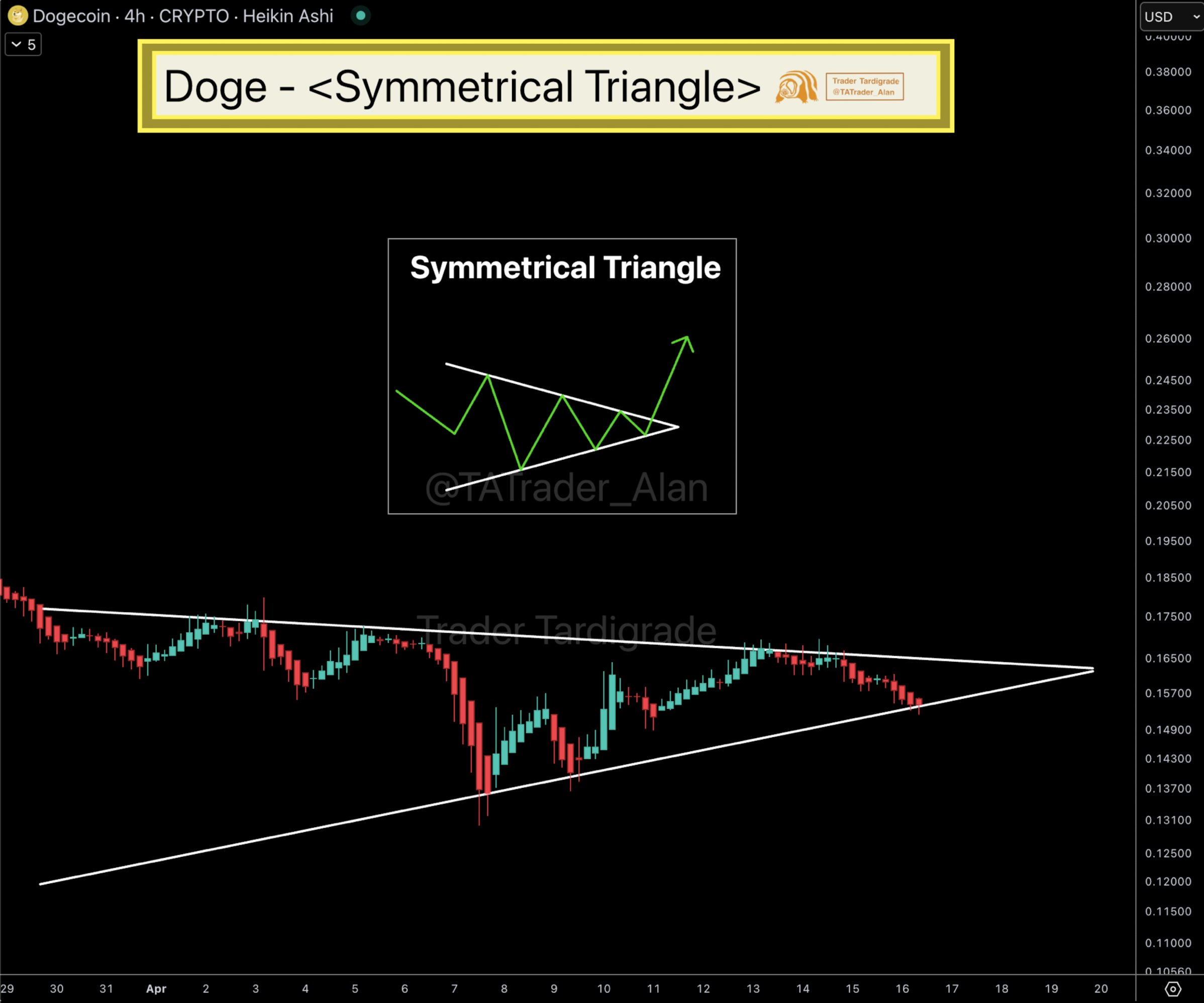
Another notable technical pattern is the Symmetrical Triangle, highlighted by Trader Tardigrade in a separate analysis. According to his chart, the price has been confined within the triangle, frequently bouncing between the upper resistance and lower support trendlines. Each time DOGE approaches the upper resistance, it faces rejection and retraces to the support. 

Dogecoin Symmetrical Triangle

Conversely, when it hits the support, buying interest pushes the price higher. In the most recent part of the chart, the price has hit the lower boundary of the triangle and is expected to rebound toward the resistance.

Although the analyst did not specify a target price in case of a breakout, he suggests that the longer the consolidation, the stronger the expected pump. 

Possible Return Near All-Time Highs

Meanwhile, an analysis by the TradingView account ‘FuaCompany’ presents a bullish outlook based on a rising channel. This pattern, identified on a monthly DOGE chart, shows that the price has been moving within parallel lines, forming higher highs and higher lows. 

According to FuaCompany, Dogecoin could continue to respect the rising channel, with potential bounces at the lower boundary leading to upward movements. Historical data suggests that when the price last hit the lower boundary around $0.05, it surged towards the upper limit. 

However, a bearish correction could also occur, causing the price to dip below the channel to around $0.08 before recovering. Despite the potential for short-term declines, the long-term target for Dogecoin remains around $0.70, near its 2021 all-time high.