Home Blog Page 825

Banking Giant BNY Introduces New Blockchain Accounting Platform, Taps BlackRock as First Client

0

BNY, America’s oldest running bank, has deepened its foot into blockchain, recently launching a new blockchain accounting tool, with BlackRock as first client.

According to a recent report by Fortune, Bank of New York Mellon Corporation (BNY) has introduced its latest blockchain-based accounting tool. 

BlackRock Becomes First Client

Interestingly, BlackRock, the world’s largest asset manager, became the first institution to adopt the new platform, which looks to modernize fund accounting by providing real-time insights into tokenized assets.

This newly launched tool directly records and updates a fund’s net asset value (NAV) on a blockchain, eliminating the reliance on third-party accounting services. By doing so, BNY is making fund management more transparent and efficient. 

Notably, the report confirmed that BlackRock will integrate this solution into its on-chain money market fund, BUIDL, allowing investors to access real-time financial data more seamlessly.

Caroline Butler, BNY’s head of digital assets, highlighted that this blockchain-powered product helps with visibility and accessibility within the financial ecosystem. She noted that the innovation builds on BNY’s expertise in digital assets, a sector that has gained increasing traction in recent years. 

The move comes as the broader industry trend turns toward tokenizing financial instruments to improve cost efficiency and operational effectiveness. 

Changing Regulatory Atmosphere 

Notably, BNY has steadily expanded its blockchain capabilities despite initial regulatory roadblocks. Under the previous U.S. administration, the Securities and Exchange Commission (SEC) introduced stringent balance-sheet requirements for banks holding crypto assets for clients. 

This created hurdles for financial institutions exploring digital asset custody. However, after obtaining regulatory exemptions in 2024, BNY resumed its crypto custody services, allowing the bank to hold Bitcoin and Ethereum for exchange-traded products. 

The regulatory landscape has since shifted further under the current administration, enabling more seamless blockchain adoption within traditional finance.

The launch of this accounting tool shows a change in how traditional financial institutions approach blockchain integration. 

While digital assets were once seen as volatile and risky, leading firms like BlackRock have actively embraced tokenization as a way to modernize fund management. Recall that BlackRock’s CEO Larry Fink recently suggested that every financial asset could be tokenized.

BNY’s Expanding Footprint in Blockchain and Crypto

BNY’s dabble with blockchain is not new. The bank has been actively developing digital asset services for several years. In 2022, the firm launched its Digital Asset Custody Platform, allowing select clients to store and transfer Bitcoin and Ethereum. 

A year earlier, the bank established its Digital Assets Unit, a dedicated division focusing on blockchain-based financial solutions. The unit has since worked on integrating blockchain technology into various financial services, including trade finance. 

In 2021, BNY joined the Marco Polo Network, leveraging distributed ledger technology to streamline global trade operations. Additionally, BNY Investment Management launched a Blockchain Innovation Fund in Singapore, providing investors exposure to companies adopting blockchain technology.

Cardano Foundation Debuts Open-source Identity Wallet and Platform

0

Cardano Foundation has introduced Veridian, an open-source digital identity platform to enhance the security and control of personal and organizational data. 

According to the official release, the platform aims to address growing concerns over data breaches, which have become increasingly frequent across various industries.

With the first product, Veridian Wallet, Cardano intends to empower users to manage their digital presence by providing verifiable credentials and robust data protection.

Challenges in Traditional Verification and Solution

The blog notes that 1.7 billion records were compromised in the U.S. last year alone. The problem is compounded by the centralized nature of existing solutions, where third parties often control sensitive information and credentials. 

Veridian aims to address these challenges with a decentralized identity management system. Unlike traditional platforms, Veridian gives users control over their own credentials and information. It incorporates advanced protocols, including Authentic Chained Data Container (ACDC) credentials and Key Event Receipt Infrastructure (KERI) decentralized identifiers.

Additionally, the optional integration of the Cardano blockchain adds a trust layer to enhance security and identity verification further.

The Role of Cardano Veridian Wallet

To complement the Veridian platform, Cardano has launched the Veridian Wallet, a tool for managing private keys, credentials, and identifiers. The wallet ensures users can securely access and control their data from any location. 

With this solution, Cardano aims to simplify the management of digital identities, making it easier for individuals and organizations to protect their sensitive information without relying on centralized systems.

Cardano’s Bitcoin DeFi Integration Plans

This news comes only days after Cardano founder Charles Hoskinson reiterated plans to integrate Bitcoin into the decentralized finance (DeFi) ecosystem. Hoskinson envisions a future where large institutions will turn to Bitcoin-based DeFi solutions within the next three years.

The integration will be facilitated by Cardano’s infrastructure, including the Hydra scaling solution and a partnership with Maestro, an infrastructure provider specializing in Bitcoin integration. 

Hoskinson believes this integration could help Bitcoin surpass the DeFi ecosystems of Ethereum and Solana. Hoskinson further emphasized that Cardano’s Aiken programming language will enable developers to create scripts for both Bitcoin and Cardano, ensuring seamless compatibility.

Bloodbath: Over $1.65T Lost in Hours as Crypto and Stock Markets Crash, Bitcoin Dips to $81K

The crypto and stock markets are reeling from extraordinary losses, with several trillion dollars wiped out in just a few hours.

Data from Coinglass shows that 196,538 crypto traders have faced liquidation, losing $561 million in the last 24 hours. Interestingly, one single trader lost $12 million. During this time, Bitcoin’s price plummeted by 7.6%, falling from $88,466 to $81,600 at press time.

The bearish sentiment in Bitcoin has spilled over into the broader crypto market, with XRP losing the $2 mark and Ethereum crashing to the $1,700 range. Overall, the global crypto market is now down by 4.4%, totaling $2.62 trillion, with $115 billion lost in the last 24 hours.

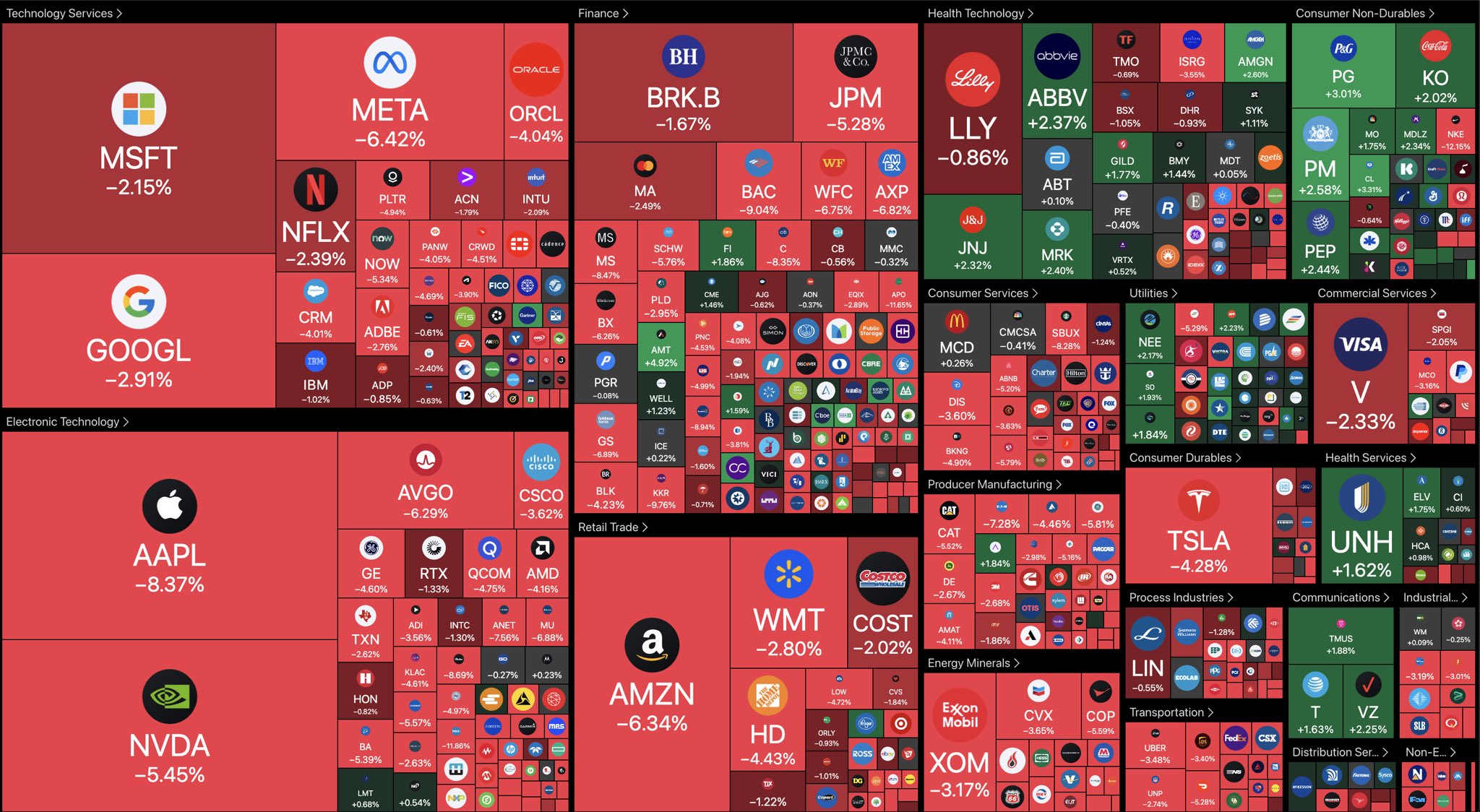
Meanwhile, in the stock market, the situation is much worse. Reports suggest that over $1.65 trillion has evaporated just hours after the U.S. stock market opened today. The biggest losers include Apple, Amazon, Nvidia, Meta, Tesla, and JPMorgan.

Image
Bloodbath in U.S. stock market

What Has Sent the Financial Markets Tanking?

Notably, the tanking markets come amid new economic policies from the President Donald Trump administration.

On Wednesday, April 2, President Trump announced a new, sweeping tariff plan, escalating global trade tensions. The plan includes a universal 10% tariff on all imports, aiming to charge foreign nations for access to the U.S. market.

Additionally, it includes reciprocal tariffs on countries that impose tariffs on U.S. goods, set at half the rate of their tariffs. For instance, China will face a 34% tariff combined with a previous 20% tariff, totaling 54%. The U.S. has also imposed a 20% tariff on the EU and 24% on Japan.

Meanwhile, Mexico and Canada are exempt due to the USMCA. Certain goods like steel, aluminum, pharmaceuticals, and semiconductors are also excluded.

Notably, the 10% tariff begins on April 5, and the reciprocal tariffs will take effect on April 9. Trump argues that the move will counteract trade imbalances and ensure fair treatment for U.S. consumers. Meanwhile, economists expect the policy to raise prices for consumers.

Essentially, the immediate effects of these policies are visible in the crashing values of both the crypto and U.S. stock markets.

What’s Next for Bitcoin?

Meanwhile, market commentators have expressed diverging views on the market’s reaction to Trump’s tariffs. Macro investor James Lavish criticized traders selling Bitcoin in response to U.S. tariffs, claiming they “have no idea what they own.”

On the other hand, analysts argue that Bitcoin’s drop to $81K is temporary, with some projecting a rebound to $90K soon.

Bitwise Unveils 3 New ETFs to Help Investors Profit from Crypto Volatility

0

Leading asset manager Bitwise has launched three option income strategy ETFs to help investors capitalize on the volatility in the crypto market. 

The ETFs are Bitwise MARA Option Income Strategy ETF (IMRA), Bitwise COIN Option Income Strategy ETF (ICOI), and Bitwise MSTR Option Income Strategy ETF (IMST). 

Notably, Bitwise designed the ETFs to give investors exposure to stocks of three crypto-related companies: Coinbase (COIN), Strategy (MSTR), and Mara Holdings (MARA). 

Funds Features 

The funds will generate income by selling out-of-the-money call options on COIN, MSTR, and MARA while maintaining a long position in the underlying stocks. Bitwise will distribute the income to investors monthly upon selling the call options. 

Foreside Fund Services, LLC, will distribute the newly launched ETFs. It is noteworthy that Foreside is not affiliated with Bitwise or any of the company’s associates. 

Active Management 

A portfolio management team from Bitwise, led by Jeff Park, the company’s head of Alpha Strategies, will manage the funds daily. 

Furthermore, the team, which consists of four members, will actively monitor developments within the crypto market. This includes industry capital flows, market sentiment, option pricing, regulatory updates, and other crypto-related developments. 

The active management of these funds is crucial in ensuring that investors remain exposed to the underlying stocks’ performance and participate in the income generated from the options. 

Caveat 

Meanwhile, Bitwise urged potential investors to consider the investment objectives, risks, expenses, and charges before investing in the ETFs. It clarified that investing in ETFs does not give investors direct ownership of the underlying stocks. 

Furthermore, Bitwise highlighted a covered call risk whereby income generated from the options sale may be insufficient to offset losses if the underlying stock’s price crashes. 

Notably, Bitwise remains one of the largest crypto index fund managers. It boasts over $5 billion in assets under management (AUM) across its investment products, including its dual Bitcoin and Ethereum ETF. 

The company seeks to introduce more investment products, particularly spot crypto ETFs, in the United States. It has filed with the U.S. SEC to launch separate ETFs for XRP, Dogecoin, Aptos, and Solana.

The SEC has acknowledged these filings, with sources speculating that some of the funds, especially those tied to XRP and Solana, might launch this year. 

Rich Dad Poor Dad Author Finds This Asset More Valuable Than Bitcoin and Gold

0

Robert Kiyosaki, the author of Rich Dad Poor Dad, has been a vocal proponent of silver, now stating that it holds more value than both gold and Bitcoin.

According to Kiyosaki, silver’s demand is rising due to its extensive use in various industries. He pointed out that while gold and Bitcoin supplies remain relatively stable, the supply of silver is decreasing, which could lead to a significant price surge.

According to Kiyosaki, Silver’s role in modern industries continues to expand, driving its demand higher. He highlighted areas where silver is essential, such as in solar panels, electric vehicles, and electronics.

These industries rely heavily on the previous metal for its unique properties, especially its high conductivity. Additionally, silver is crucial in sectors like medicine, water purification, and even military technology. 

Silver’s Price Suppression and Future Predictions

Notably, Kiyosaki believes silver’s price has been artificially suppressed for decades to maintain affordability for industrial use. Despite the rising demand, price has not reflected its true potential, as it remains significantly lower than gold. 

For instance, while gold has reached all-time highs, silver’s price is still about 60% lower than its peak. Kiyosaki anticipates that silver’s price will break through these barriers, potentially reaching $70 an ounce in 2025, with the possibility of hitting $200 in the next couple of years.

The Debate Between Silver, Gold, and Bitcoin

While Kiyosaki emphasizes silver, other market experts take different views. Peter Schiff, a well-known economist and gold advocate, continues to recommend gold as the ultimate safe haven asset. 

Schiff pointed out that while risk assets are faltering, gold is experiencing significant price increases. Recently, gold has reached new record highs, with some experts predicting it could hit $3,500 per ounce soon. 

Bitcoin Maxis Are Still Optimistic

Meanwhile, an analyst on X, Jelle, noted that Bitcoin is holding for a higher low following the announcement of tariffs by Trump. 

Jelle mentioned that if the market was bearish, he would have expected the price to sweep past previous highs, but this did not happen. He expects the higher low to hold and Bitcoin’s price to reclaim $84,000, with an initial target of $90,000. 

Meanwhile, Michaël van de Poppe observed that Bitcoin has returned to its range after an attempted breakout during a recent event. 

He pointed out that such breakouts are often not genuine and that $87,000 remains the key level to break. Van de Poppe added that as long as Bitcoin stays above $80,000, there is a strong likelihood of a rally.

Michael Saylor Says No Tariffs on Bitcoin as Donald Trump Brandishes Reciprocal Tax

0

Michael Saylor has again reiterated the decentralized and advantageous nature of Bitcoin in response to Donald Trump’s tariff slap.

Market participants have been fidgeting over Donald Trump’s Liberation Day impact on the crypto market. However, the much-discussed April 2 reciprocal tariff update has quickly flown by with minimal impact on Bitcoin and altcoins compared to some observers’ anticipations.

As nations react to Trump’s tariff hike, Strategy’s executive chairman, Michael Saylor, took to X (formerly Twitter) to emphasize Bitcoin’s uniqueness amongst other commodities.

“There are no tariffs on Bitcoin,” Saylor stated.

No Tariff on Bitcoin

While tariffs negatively threaten a nation’s broader economy, tangible commodities suffer the most impact. Trump’s tariffs are on all physically imported goods, which he justified were reciprocal to charges from other countries.

Meanwhile, compared to other commodities, Bitcoin’s digital properties have exempted it from the tariff parade. Saylor highlighted the pioneering cryptocurrency’s unique advantage in a tweet today, bluntly reminding his over 4.2 million followers of its enviable properties.

Nonetheless, the development has adversely impacted Bitcoin’s price since its inception, creating a divide among prominent market participants over the premier asset’s position as a store of value. Moreover, market participants argue that higher tariffs would impact the income of retailers and businesses, reducing appetite to invest in Bitcoin and other financial vehicles.

Trump Sets Tariff Baseline at 10%

The pro-Bitcoin president released details of his reciprocal tariff on Wednesday, noting that they would take effect on April 5. He highlighted those of a few countries in a dashboard he carried along while announcing the new importation levy.

Asian countries like China, Japan, Taiwan, and Vietnam, among others, received reciprocal taxes of 34%, 24%, 32%, and 46%, respectively. America did not spare its allies either, brandishing a 10%, 17%, 20%, and 26% tariff on the UK, Israel, the European Union, and India.

Trump’s Dashboard Showing Tariff

Meanwhile, some nations have responded, with China threatening a counter-tariff hike if Trump does not retract his latest importation tax increase. With new developments unfolding, Bitcoin has continued to hold above $80,000.

At the time of writing, the asset trades at $82,089, down barely 1% in the past 24 hours.

Analyst Says XRP Might Be the Best Short in Case of a Bull Trap: Here’s Why

0

A notable market commentator points to a potential XRP bull trap, advising that the crypto asset might be the best option to short if it plays out.

XRP has experienced a noticeable price drop from late March to early April, with its value recently dipping to $2.03, a level last observed on March 11. The trend points to a steady decline, reinforcing the downtrend that has affected XRP over the past few weeks. 

Currently trading for $2.05, XRP has seen a 1.65% decrease in the past 24 hours and a 13.08% drop over the last seven days. Despite this consistent downward momentum, some analysts suggest a possible reversal, warning traders to stay alert for any potential market shifts.

Analyst Insights: XRP Shorting Opportunity

Amid the market uncertainty, Astekz, a noted analyst, has flagged the recent market conditions as potentially leading to a possible “trap” for XRP traders. 

He suggests that although the cryptocurrency has approached a resistance area, it has failed to break through, signaling a potential decline. According to him, this could set the stage for a short-selling opportunity if the price fails to break higher. 

Astekz especially expects the downward push to materialize if XRP undergoes a bull trap. Such a bearish price movement occurs when an asset records a fake breakout to the upside during a downtrend, capturing the attention of bullish traders, and then suddenly crashes, “trapping” these bullish positions.

Influence of Bitcoin Whales on XRP

Meanwhile, another analyst, Vincent Van Code, has identified an intriguing pattern involving Bitcoin (BTC) whales that could be contributing to cases of such bull trap.

According to Van Code, large BTC holders have been responsible for significant price fluctuations in the XRP/BTC pair. He claimed that these whales are engaging in massive buy and sell actions, which has created a cascading effect across markets. 

In turn, arbitrage bots seem to balance out the XRP/USDT pair, leading to compressed price movements. This observation raises the question of whether these BTC whales are intentionally manipulating XRP’s price or simply engaging in swing trading to capitalize on short-term fluctuations.

Derivatives Data Points to Bearish Momentum

Elsewhere, recent data from Coinglass offers further evidence supporting the bearish outlook for XRP. Notably, the open interest has decreased slightly by 0.34%, signaling reduced participation from long traders. 

XRP Futures Data Coinglass
XRP Futures Data | Coinglass

Moreover, options volume has dropped significantly by 51.56%, indicating that speculative interest in XRP is waning. These declines, coupled with the negative funding rate, suggest that the market sentiment remains predominantly bearish.

Expert Says Dogecoin at a Make-or-Break Level, as It Could Surge to $0.57 or Slump to $0.06

0

Dogecoin is at a make-or-break level, according to an expert analyst who believes it could drop to multi-month lows or recover previous highs. 

The crypto market has resumed its bearish momentum, with Dogecoin being one of the assets affected. Between January and April 2024, the price of Dogecoin saw a significant drop from over $0.40 to around $0.16.

Key Support and Resistance Levels for Dogecoin

Recently, the price has decreased by 3.6% over the past 24 hours. Despite this short-term fall, analyst Ali Martinez’s recent chart proves that Dogecoin’s overall price movement from 2018 to 2025 has generally followed an upward trajectory.

According to Martinez, at present, Dogecoin is at a make-or-break level, a critical level that must hold for any potential uptrend to continue. If the price stays above this point, Martinez suggests Dogecoin could rally towards the resistance at $0.57, representing a 256.25% increase. 

However, if the support at $0.16 fails to hold, a significant drop to $0.06 is possible, signaling a 62.5% decrease in value. Martinez is however not the only analyst watching Dogecoin price future moves.

Bullish Divergence and Market Sentiment

Notably, another analyst, deeppatidar14, is observing a bullish divergence on Dogecoin’s 3-month chart. This pattern indicates that while the price has been making higher lows, the RSI (Relative Strength Index), a momentum indicator, has been seeing lower lows.

This discrepancy often signals a potential reversal or rally. The analyst advises traders to focus on the numbers and avoid being swayed by the news.

Inverse Head and Shoulders Pattern Identified

Meanwhile, a separate analyst, Trader Tardigrade, has pointed out a short-term bullish pattern forming on Dogecoin’s chart. Trader Tardigrade suggests that Dogecoin has formed an inverse head and shoulders pattern, typically indicative of a trend reversal. 

This pattern formed on the 4-hour chart, with the left shoulder forming when Dogecoin dropped to $0.1658 on March 29, followed by a dip to $0.1601 on March 31. The right shoulder then developed after a recent decline to $0.1677. 

The neckline of this pattern is positioned at $0.1760, and a breakout above this level could confirm a potential reversal to the upside.

In addition to the technical analysis, significant growth in address activity has been noted. Over the past seven days, new addresses have increased by 102.40%, while active addresses have risen by 111.32%.

Analysts Discuss XRP Price Predictions for 2025 Following Bitwise Report

0

Market commentators discuss XRP price predictions for 2025 following a recent report from asset manager Bitwise for its clients.

Notably, the crypto market has continued to generate talks about future price movements, especially for assets like XRP. An episode of The Good Morning Crypto show featured a discussion on the latest XRP price forecast published by Bitwise.

Bitwise XRP Price Prediction for 2025 and Beyond

Host Abdullah “Abs” Nassif opened the discussion, revealing the figures presented in the Bitwise report. According to the analysis, XRP could trade within a range of $1.82 to $4.48 in 2025, depending on market conditions. 

The report outlined three possible scenarios: a bear case where the price would be $1.82, a median bull case predicting $3.90, and a maximum bullish scenario setting XRP at $4.48. 

Meanwhile, beyond their XRP price predictions for 2025, Bitwise estimates that XRP could reach $6.50 in 2026, $9.50 in 2027, $14 in 2028, $20 in 2029, and $30 by 2030. The top target for 2030 represents a 1,370% increase from the current XRP price at $2.04.

In his commentary, Nassif noted that these figures are not speculative hype. However, he suggested that the asset manager designed them for professional investors, including asset managers, private banks, and pension funds. Recall that Bitwise already filed for an XRP ETF. 

“They’re not selling hopium. This isn’t for people like ourselves to get excited about the future of XRP. They’re trying to give realistic price projections for their clients,” he said.

3T Warrior Analyst Reacts

Meanwhile, in response, co-host Gonzo, a member of the 3T Warrior crypto team, noted that he has always been skeptical about price predictions in general. He questioned whether the Bitwise report accounted for potential downturns in the market. 

“You know me, I hate price predictions. What’s funny about that one is that it doesn’t account for any type of bear market. So I’d be curious to think like, what are they handling their clients that we’re just going to go up only in the next few years?” he said.

Speaking further, Gonzo analyzed major support and resistance levels for XRP, noting that the $1.95 to $2 price range is an important support zone. 

He suggested that in a worst-case scenario, if Bitcoin has already peaked and begins a downward cycle, XRP could fall to $1.60. However, he pointed out that XRP’s price structure indicates a solid base forming above $2. 

“So far, $2 has held. We don’t have a lot of trading range going up from that $0.50 level when we broke out, going up to $2. I believe that we’re building a pretty solid base,” he explained.

He noted that it’s possible for XRP to go lower, but suggested it’s already new its bottom. Despite the uncertainty surrounding short-term XRP price predictions for 2025, Gonzo found the long-term projections more meaningful. 

US Macro Factors Influencing XRP Price

The analyst linked potential price movements to macroeconomic factors, including the Federal Reserve‘s policies and upcoming political events. He noted that ongoing quantitative tightening could introduce more volatility into the crypto market. 

“With the U.S. still being in a quantitative tightening environment and what the Fed’s going to do, and the whole thing that’s going on with Trump playing chicken with the Fed, that’s a lot of uncertainty,” he added.

Meanwhile, Nassif confirmed that regulatory developments and institutional adoption of XRP tech would help determine future price action. He stressed that the Bitwise report was a conservative estimate, which left room for even higher prices amid greater adoption.

Expert Predicts XRP Price If Ethereum Hits $9,000 and BNB Claims $1,000

Nishant Bhardwaj, a financial investor with a decade of experience, has issued ambitious price targets for various crypto assets, including XRP, Ethereum, and BNB.

While a growing number of market participants believe the bull market is over, Bhardwaj expressed strong conviction in a continued bullish market. In a tweet, he highlighted bold outlooks for 14 crypto assets, including prominent ones like XRP and some mid-cap tokens.

Ethereum to $9,000 After 63% Dip

According to Bhardwaj, Ethereum could reach as high as $9,000 in this cycle. Notably, Ethereum is trading at $1,810, down by 47% this year, as it ranks among the worst-performing crypto assets in 2025. Ethereum has also dropped 63% from its all-time high of $4,892, with some losing faith in its ability to recover before the cycle ends.

However, Bhardwaj is optimistic. He believes Ethereum could still stage a phenomenal 397% run to reach an all-time high of $9,000. Meanwhile, for BNB, he proposed a cycle peak at $1,000.

Unlike Ethereum, BNB has already broken its last cycle peak, reaching an all-time high near $800. While the token has since dipped by 25% to $600, commentators like Bhardwaj expect Binance Coin to progress further to the $1,000 level.

XRP Price After Ethereum Hits $9,000 and BNB Hits $1,000

Meanwhile, Bhardwaj argues that in a market where Ethereum reaches $9,000 and BNB hits $1,000, XRP could break into the double-digit price range. Specifically, he proposed $12 as his peak point for XRP.

Notably, XRP is trading at $2.05, having dropped by 14% over the last seven days. Unlike BNB and Ethereum, XRP last shattered its all-time high back in 2018, two market cycles ago. 

However, sentiment around XRP has since improved. Many anticipate it will not only break its previous peak but go on to make a mark in the double-digit price range.

Reaching $12, as Bhardwaj suggested, would require XRP to grow by 485%. Notably, XRP has seen a 250% gain in its one-year performance.

Up-and-Coming Gems in the Spotlight

Bhardwaj is also targeting smaller, emerging projects with strong potential. Topping the list is Solana’s meme coin WIF, which has tanked by 80% this year. However, he believes it could rally to $5.

Other picks include Celestia (TIA), with a target of $150+ due to its leadership in modular blockchains. He also forecasted that Injective Protocol (INJ) will reach $300+ thanks to its strong fundamentals and revenue generation.

Bhardwaj also believes Jupiter (JUP) could explode to $10, while RNDR could hit $80+ as the AI boom impacts crypto.