Home Blog Page 852

Ripple Writes to SEC, Proposes 3 Solutions to Resolve Crypto Regulatory Confusion

0

Leading blockchain payments company Ripple has written to the SEC emphasizing its stance on providing regulatory clarity for crypto. 

Last month, Hester Peirce, the head of the SEC’s Crypto Task Force, requested public input on establishing clearer crypto taxonomy rules. Her request, titled “There must be some way out of here” suggests a desire to end the regulatory confusion created by the past SEC leadership. 

Ripple Responds 

In its response, Ripple criticized the past SEC leadership, particularly the one headed by Gary Gensler. The company emphasized that the SEC’s previous crypto guidance was overly confusing, long, and not backed by the law. 

Notably, it echoed that the past SEC thrived on creating confusion for market participants to cover its failure to faithfully follow the law. 

Ripple Proposes 3 Solutions 

Interestingly, Ripple made three proposals to help the U.S. SEC resolve the confusion created by the previous administration. 

Return to the First Principle 

To resolve this confusion, Ripple recommended that the SEC should return to its first principle by regulating only what constitutes securities as defined by federal securities laws.  

The company suggested that many digital assets, particularly those that do not generate yield or confer rights to profits, should not be classified as securities. 

Stay Within Statutory Bounds 

In addition, Ripple urged the SEC to follow the current law instead of establishing new ones that might create further confusion. 

The company pointed out that only the United States Congress has the ultimate power to create laws. Hence, the SEC should leave the creation of new rules to the U.S. Congress.  

Need for Clarity 

Furthermore, Ripple emphasized that the SEC should bring relief by providing regulatory clarity for the crypto market. In this view, the company praised the SEC Corporation Finance Division for clarifying that meme coins are not securities. This clearly suggests that meme-based cryptocurrencies are not subject to U.S. federal securities laws. 

Notably, Ripple recommended that the SEC should strive for this concise approach, which it believes will end the regulatory confusion in the crypto market. 

Meanwhile, several crypto entities, including Ripple, have been victims of this confusion. This saw the company endure a protracted legal tussle against the SEC. The good news is that the lawsuit is close to its end following the SEC’s decision to drop its appeal against Ripple. 

One major issue left is Ripple’s own cross-appeal. Nonetheless, many legal experts expect the company to drop the case once it reaches a favorable agreement with the SEC. 

Researcher Labels XRP “Biggest Financial Scam” Over $44K DEX Volume, Ripple CTO Responds

0

The Ripple CTO recently responded to a researcher’s claim that XRP is the “biggest financial scam” the world has ever seen over low DEX volume.

A discussion has emerged within crypto circles after analyst Aylo criticized XRP, calling it the largest financial scam in history. His criticism centered on the claim that XRP had produced little value despite reaching a massive $140 billion market capitalization.

Ripple CTO Responds to Low DEX Volume Claims

Aylo, who conducts research for blockchain resource Alpha Please, pointed to data suggesting that the XRP Ledger (XRPL) had only $44,000 in decentralized exchange (DEX) volume over a 24-hour period. 

Particularly, he shared a snapshot from DeFiLlama to support his argument, emphasizing that such a low volume was uncharacteristic for an asset with XRP’s market size.

He further noted that the XRPL’s total value locked (TVL) stood at just $80.63 million, significantly lower than that of leading blockchain networks with established decentralized finance (DeFi) ecosystems. His comments triggered discussions about the actual utility of XRP and its network.

Amid the discussion, Ripple’s Chief Technology Officer, David Schwartz, responded to Aylo’s assertion. He clarified that the specific data referenced likely only accounted for Automated Market Makers (AMMs) on the XRPL. 

Since AMMs represent just a fraction of the network’s usage, he suggested that the quoted volume did not reflect the full scope of XRP’s utility.

For context, XRP integrated AMM functionality recently, specifically last March. Despite being a decade-old network, XRPL had only recently pivoted toward DeFi, incorporating NFTs, AMMs, and stablecoins. This relatively new adoption has resulted in a DeFi ecosystem that remains underdeveloped compared to competitors.

dUNL Validator Counters with Higher Volume Figures

Vet, a dUNL validator, dispelled Aylo’s claim by presenting alternative volume figures. According to Vet, the actual 24-hour DEX volume on XRPL was around $9 million, not $44,000. 

Interestingly, he claimed that this lower volume compared to other blockchains presents an opportunity for market participants to leverage the XRPL’s growing DeFi ecosystem, which has hosted over 6 million wallets with minimal competition.

Responding directly to Schwartz, Vet stressed that DeFiLlama’s data might not accurately reflect XRPL’s full trading activity. He mentioned that he and Orchestra Finance had collaborated with DeFiLlama’s team on integration efforts. 

Vet explained that the actual 24-hour trading volume, when combining the Central Limit Order Book (CLOB) and AMM figures, was approximately $9 million.

Why is XRPL DEX Volume Low?

While XRPL’s $9 million DEX volume remains significantly lower than those of competitors, such as Ethereum ($1.44 billion), Solana ($1.087 billion), and Binance Smart Chain ($2.61 billion), this gap is largely due to XRPL’s historical focus outside of DeFi. 

The network has only recently begun expanding into decentralized financial services, making it understandable that its on-chain trading activity lags behind other blockchains that have prioritized DeFi development for years.

Further context highlights that DEX volume alone does not determine a blockchain’s legitimacy. Bitcoin, for instance, has an enormous market cap exceeding $1 trillion, yet its DeFiLlama data shows a mere $238,740 in DEX volume. This suggests that using DEX trading figures as the sole measure of a blockchain’s utility or legitimacy can be misleading.

Aylo’s argument also led to confusion, with certain individuals mistakenly assuming he was referring to XRP’s total 24-hour trading volume rather than its DEX volume. In reality, CoinMarketCap data indicates that XRP’s global trading volume stands at $3.14 billion within the same period, an appropriate figure for an asset of its size.

There’s No Hidden Agenda to Suppress XRP, Pundit Shares Why Price Has Not Pumped

0

A market pundit believes there’s no hidden agenda to suppress the price of XRP, shares the reason behind recent stunted growth.

For context, XRP only saw a surge from $2.28 to $2.6 following Ripple CEO Garlinghouse’s disclosure days back that the U.S. SEC had dropped its appeal in the long-running lawsuit against the company. 

Some had widely believed that the legal battle, spanning four years, was a major factor suppressing XRP’s price. However, despite the lawsuit nearing its end, XRP failed to break the $3 mark, leading to questions about the reasons behind its stalled momentum.

Notably, market analyst and software engineer Vincent Van Code addressed these concerns on X, explaining why XRP’s price had not reacted as many expected. 

He argued that the primary factor limiting XRP’s growth was not a hidden institutional agenda but rather market mechanics, including high-frequency trading, arbitrage, and price manipulation by large traders.

Market Manipulation and Low Volume

Van Code stressed that in low-volume environments, it becomes easier to manipulate price action. He noted the presence of multiple small orders, some below 6 XRP, which he attributed to “trade dusting.” This practice artificially inflates trading volume and creates an illusion of liquidity. 

“Make no mistake, price is being manipulated,” he stated, explaining that the system was balancing XRP’s movements against Bitcoin and Ethereum, both of which were experiencing heavy sell-offs.

Despite these, Van Code reassured his audience that he was not selling, dismissing the situation as temporary market noise.

No Hidden Agenda, Just Market Mechanics

One concerned investor questioned the motive behind the manipulation, asking whether institutions were intentionally suppressing XRP’s price to buy more time before entering the market. Van Code dismissed this theory. “Oh god no. It’s purely to make money,” he replied.

He claimed that high-frequency trading bots, operated by Binance VIP customers, had an unfair advantage due to their access to millisecond-level trading data. 

These traders, leveraging arbitrage across multiple tokens, could see and react to orders before retail investors. Van Code alleged that this allowed them to manipulate price movements, either pumping or dumping assets at will.

“The majority of exchanges source liquidity off Binance,” Van Code claimed, asserting that while Binance might not directly engage in manipulation, it creates an environment where such practices thrive. He alleged that Binance profits massively from spreads, fees, and liquidity-related payments, while retail investors are left at a disadvantage.

For years, some XRP investors have speculated that institutions deliberately kept the asset’s price low to accumulate at cheaper levels before making a big move. Van Code dismissed this theory, asserting that the price movements were simply the result of typical market mechanics.

“There is no hidden plan to suppress XRP price,” he said. “Just good old-fashioned shorts, longs, dumps, pumps, trade dusting, arbitrage.” 

Further, he reiterated that Binance itself was not necessarily engaging in manipulation but claims it was complicit in allowing its VIP traders to access data and features that enabled these practices.

Long-Term Holding is the Best Strategy

According to Van Code, the best way for retail investors to counteract these manipulations is not by attempting to out-trade the high-frequency bots but by adopting a long-term holding strategy. 

Specifically, he stated that when trading volumes are low, market makers receive hefty fees to provide liquidity, making high-frequency bots less effective.

“Retail are sitting ducks,” he noted. “You can’t beat them in trading. You can just buy and hold, that will cripple them.” He admitted that he had given up trying to time the market, instead focusing on long-term accumulation.

Odds of US Buying Bitcoin in 2025 Only 30%, Says Bloomberg Analyst

0

A Bloomberg analyst has urged investors to lower their expectations of the Trump administration buying Bitcoin in 2025.

Beyond further legitimizing the asset, one of the main reasons Bitcoin proponents have been pushing for a U.S. reserve is the hope that the world power will actively participate in the market, with the significant demand boosting prices.

While President Donald Trump has established a Bitcoin reserve through an executive order, whether the government will buy any fresh assets remains unclear.

For context, the order establishes a reserve out of the government’s holdings from seizures while directing the Secretary of Treasury and Secretary of Commerce to pursue “budget neutral strategies” to add to the stash. But what these strategies will entail remains anyone’s guess.

Amid these lingering questions, a Bloomberg analyst has urged investors to lower their expectations.

“Little Chance”

“30%.”

That’s how much chance there is of the U.S. government adding to its Bitcoin reserve in 2025, according to a March 21 note from a Bloomberg legal analyst shared by Matt Sigel, Head of Digital Assets Research at VanEck.

The analyst stressed that “there is little chance” the government would purchase Bitcoin or any other crypto asset for its reserve in 2025. If President Trump had wanted to, he could have done so through mechanisms like the Exchange Stabilization Fund.

This $39 billion fund is available to the Secretary of the Treasury and can be used for a variety of purposes, including stabilizing the dollar or offering foreign aid.

The analyst also argued that going through Congress was unlikely to yield any result until at least the mid-term elections in 2026. They stressed that any present bills to codify Trump’s executive order “are mostly symbolic and unlikely to become law.”

This stance is likely based on the Republican party’s slim majority in Congress and expected opposition from Democrats. In a March 13 letter, a group of House Democrats urged the Secretary of the Treasury, Scott Bessent, to cease all efforts to establish Trump’s Bitcoin strategic reserve, criticizing it as an attempt to benefit donors.

However, not all analysts share the pessimism of the Bloomberg legal analyst.

VanEck Puts Bitcoin Odds Higher

“I think we are closer to 50-60%,” VanEck’s Matt Sigel asserted in response to a question about where he placed the odds of the U.S. government adding to the Trump-established Bitcoin reserve in 2025.

The recent debate comes even as Bo Hines, the executive director of the president’s crypto working group, continues to offer hope to Bitcoin proponents. In a recent interview with Crypto In America host Eleanor Terrett, Hines asserted that there have already been “countless ideas” for the government to add to its Bitcoin reserve, noting that “the best ideas” will be implemented.

Bitcoin Fractal Suggests One Final Wave Down Before Major Rally 

The price action of Bitcoin appears to be mirroring a previous cycle with striking precision, according to fractal analysis from Chartered Market Technician Tony Severino. 

If history repeats, BTC may be on the verge of a final corrective move before launching into a strong rally.

Notably, it’s been nearly three months of dipping prices in the crypto market. Bitcoin is currently trading 23% below its January all-time high. While many hope for a reversal soon, Severino believes the pump may not come just yet.

Another Likely Correction Before the Next Leg Up

In his analysis, Severino compared Bitcoin’s current market structure from 2024 to date with its 2018-2021 cycle. This revealed identical uptrends and correction phases.

Both periods feature a double top formation (marked as “3” and “B” in the analysis) before a significant decline. Notably, the ongoing correction aligns with the historical pattern. It suggests BTC could see one more leg down to finalize Wave 4 before a re-accumulation phase begins.

Severino’s chart highlights that Bitcoin’s past cycle bottomed around the 0.5 Fibonacci retracement level before launching into its Wave 5 bull run. The current price structure suggests a similar setup, with BTC potentially dipping to around $75,200 before reversing upward.

Image
Bitcoin char by Tony Severino

Notably, Bitcoin has dipped to $76,600 this month and has since rebounded above $80K. With Bitcoin trading at $84K at press time, revisiting $75K would imply an additional 12% drop.

Final Wave 5 Surge to Follow

If the fractal remains intact, Bitcoin could be setting up for a prolonged uptrend akin to its 2020 breakout. The previous cycle saw BTC rally from around $15,000 to over $60,000. A similar trajectory could place BTC well beyond its current all-time high of $110,000 in the coming months.

Caution for Market Participants

While this analysis highlights a promising outlook after another correction, some believe Bitcoin could even fall deeper, as some technical indicators are already flashing bear market signals.

In a post, Ali Martinez pointed out that if Bitcoin drops below $76K, the next major support is at $58K. This suggests a dip to $75K could have stronger implications, with bears potentially driving prices much lower.

However, Martinez noted that should Bitcoin reclaim $94K, it would likely continue to $112K.

Bitcoin Volatility Shows Investors Scrabbling for Options Downside Protection

0

Bitcoin options traders are seeking market downside protection amid the asset’s price uncertainty, evident in the spike in implied volatility premium for puts.

Uncertainties have engulfed Bitcoin and the broader crypto market as investors quiver at the asset’s unclear price action. The pioneering cryptocurrency surged past $87,000 on Thursday only to correct to $83,800 today.

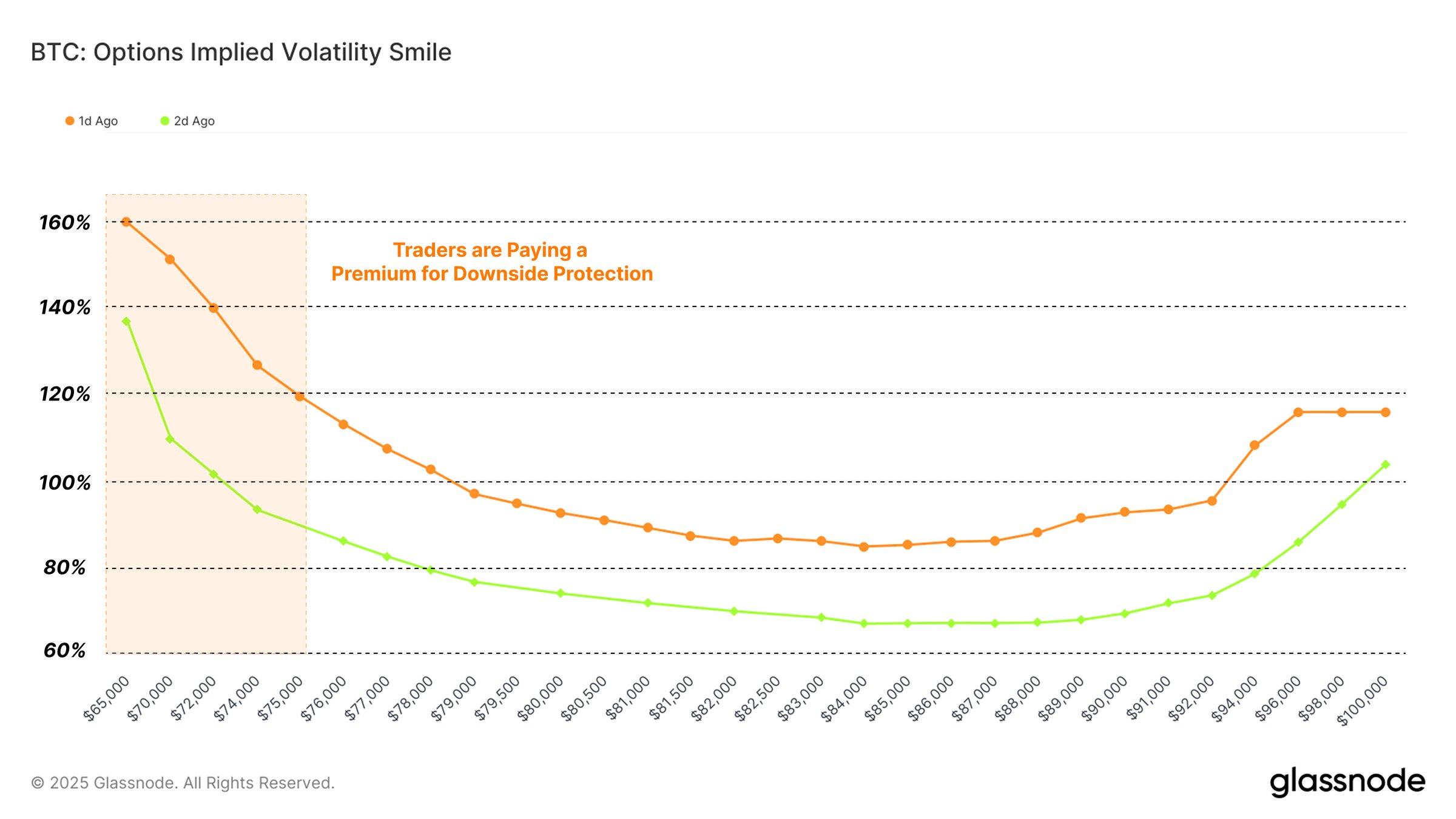
Meanwhile, this skeptical disposition also spilled over into the options market, reflected in the premium of different options contracts. Market resource Glassnode highlighted the growing demand for downside protection from Bitcoin options traders, which has impacted the implied volatility premium for puts.

Traders Take Risk-Averse Measures

In a tweet, Glassnode highlighted a substantial premium disparity between put and call options. For the uninitiated, the former is a bearish bet that allows traders to sell Bitcoin at a predetermined price, and the latter a bullish disposition, giving market users buying options at a strike price.

The market analytical firm tracked this growing caution using the Volatility Smile, a metric that measures the correlation between an options contract’s implied volatility and its strike price. The indicator identified the premium paid for different puts and calls at a strike price.

Bitcoin Options Volatility Smile

Interestingly, the metric shows that put contracts are more expensive than their call counterparts at the same order price. This results from a higher implied volatility premium for market users betting on lower prices as institutions and retail traders hedge against further Bitcoin price decline.

Moreover, the Options Delta 25 Skew parameter further exposes this disparity. The indicator, which displays the difference in implied volatility for puts and calls bearing the same delta, highlights the deviation in skew for 1-week and 1-month put and call contracts.

Bitcoin Options 25 Delta Skew

The delta skew has been on a downtrend lately, suggesting that put premiums have increased extensively in comparison to equivalent calls. Market makers and investors have adopted this risk-averse behavior to cushion the escalating Bitcoin volatility.

Long-Term Holders Unperturbed Despite Uncertainty

Meanwhile, Bitcoin’s recent price action has raised fears among short-term holders, who have sold their stash considerably to lock in both profits and losses. The over 23% decline from its all-time high has slowed capital inflow and futures activities across exchanges.

However, the spending rate among long-term holders remains interestingly low. These unique addresses, those who have held Bitcoin for at least 155 days, have remained relatively calm, resorting to keeping their stash rather than dumping them despite being at significant gains.

This might reflect growing confidence in the asset’s ability to rebound from recent lows or their patience in observing market trends before taking clear action. Notably, these wallets have a reputation for selling during the bull market and accumulating in the bear season. Bitcoin currently trades for $84,068, down 2% over the past 24 hours.

Trump’s Crypto Director Says Gains from Reassessing Gold Certificates Can be a “Budget-Neutral” Way to Buy Bitcoin

0

President Trump’s crypto director confirms that reassessing gold certificates could be a budget-neutral way to buy Bitcoin.

Robert “Bo” Hines, Executive Director of the Presidential Council of Advisers on Digital Assets, discussed this during the inaugural episode of the Crypto In America podcast. 

Recall that President Donald Trump recently signed an executive order establishing the Strategic Bitcoin Reserve (SBR) and a separate Digital Assets National Stockpile for altcoins. 

The order officially placed the U.S. government’s existing Bitcoin holdings, currently 198,109 BTC worth about $17 billion, according to Arkham Intelligence, into the SBR. 

However, the order also stated that the government will make any future Bitcoin acquisitions through “budget-neutral” means, a term that has left many wondering what strategies the administration might use to increase its holdings.

Selling Gold Certificates for Bitcoin

During the recent Crypto In America episode, journalist Eleanor Terrett asked Hines for a specific example of a budget-neutral approach. In response, he pointed to Senator Cynthia Lummis’s BITCOIN Act of 2025. 

Hines explained that the government could re-evaluate the true value of certain gold certificates, currently worth about $172 per ounce. If the government adjusted this valuation and recognized its gains, it could use the additional funds to acquire more Bitcoin.

“We could realize the gains on that, and that would be a budget-neutral way to acquire more Bitcoin,” Hines noted. He added that they are exploring multiple strategies, with high-level officials like Treasury Secretary Scott Bessent and Commerce Secretary Howard Ludnick involved in the discussions.

The Idea of Selling Fort Knox Gold for Bitcoin

Terrett followed up by asking whether the government could sell some of the gold in Fort Knox to purchase Bitcoin. Hines responded by saying that if such a move remained budget-neutral and did not burden taxpayers, it could be considered. 

He stressed that the administration is open to creative solutions and that an interagency working group is exploring various options. Recall that Hines previously mentioned that the government is looking to procure as much BTC as it can get.

“I don’t want to box us in yet to what that actually looks like because I want to be able to hear from everybody,” he stated in his latest remarks. Hines described the current administration as open to new ideas and innovative approaches to digital assets.

Expanding Beyond Bitcoin

The conversation moved to other crypto assets, with co-host Jacquelyn Melinek asking whether the government was considering other assets like Ethereum, XRP, Solana, and Cardano. 

In response, Hines explained that Bitcoin received a special status because of its undisputed classification as a commodity rather than a security.

“Bitcoin is different. It’s unique. It has intrinsic stored value and is widely accepted,” he said, referring to its so-called “immaculate conception,” which means it has no central issuer. 

This distinction led to the creation of two separate reserves: the Strategic Bitcoin Reserve (SBR) and the Digital Assets National Stockpile, which includes other cryptocurrencies.

Melinek also asked why they considered those particular five assets: Ethereum, XRP, Solana, Cardano, and Bitcoin. Hines clarified that they were selected based on market capitalization but added that the administration supports broader innovation in the crypto space.

“We still want to welcome and encourage innovation across many ecosystems,” he stated, acknowledging Bitcoin’s foundational role and also stressing the importance of technological growth in digital assets.

Strategy to Raise Over $710M to Buy Bitcoin; Here’s How Much BTC It Can Purchase

0

Strategy, the largest corporate Bitcoin holder, seeks to raise over $710 million through the issuance of high-yield preferred stock to expand its BTC holdings. 

In a press release today, Strategy (formerly MicroStrategy) unveiled the pricing for its Strife Perpetual Preferred Stock ($STRF) offering. According to the announcement, the firm will offer 8.5 million of its 10% Series A STRF later this month, each sold at $85. 

Notably, Strategy scheduled the sale of these shares for March 25, 2025, subject to standard closing conditions. Before this announcement, the initial target proceeds were $500 million. However, it has made some adjustments, raising the target to $722.5 million.  

Following tax and other expense deductions, the company is expected to net about $711.2 million. Per the announcement, Strategy will utilize the proceeds for general corporate purposes, including expanding its Bitcoin portfolio. 

If Strategy decides to buy Bitcoin using the entire net proceeds, it will acquire 8,467 BTC at the current exchange rate of $83,990 per BTC. 

STRF Dividends 

Meanwhile, holders of the STRF stock will receive cumulative dividends at an annual fixed rate of 10%, calculated based on $100 per share, according to the press release. 

The company intends to pay dividends by the end of each quarter, starting June 30, 2025, so long as the board declares them. However, if dividends are unpaid as scheduled, it will generate additional proceeds with a per annum increase of 1%, up to a maximum of 18%. 

Furthermore, the announcement identified financial institutions such as Citigroup, Morgan Stanley, SG Americas Securities, and Barclays Capital as joint-book running managers of the offering.

Financial institutions like Bancroft Capital, AmeriVet Securities, The Benchmark Company, and BTIG will also serve as co-managers of the offering.

Strategy Bitcoin Accumulation Efforts 

Strategy offers different debt instruments to raise funds to finance its Bitcoin purchase. The company has been utilizing this strategy to grow its Bitcoin holdings since initiating its first BTC purchase in August 2020. At the moment, it has a portfolio containing 499,226 BTC, valued at approximately $41.93 billion.

Notably, the latest offer aligns with its efforts to raise $42 billion over the next three years under a ‘21/21 plan’ to fund future Bitcoin purchases. 

The plan, introduced last year, aims to generate the $42 billion through the sales of $21 billion in equity and fixed-income instruments worth $21 billion. As of early January, Strategy had already raised $7.5 billion through the initiative. 

Cardano Founder To Moderate Panel Featuring Donald Trump Jr and WLFI Founders at DC Blockchain Summit

0

Cardano founder Charles Hoskinson is set to moderate a panel featuring Donald Trump Jr. and the founders of the Trump family-backed decentralized finance project, World Liberty Financial—Zach Witkoff, Zach Folkman, and Chase Herro—at the DC Blockchain Summit 2025.

On Wednesday, March 26, Hoskinson will moderate a panel on “Digital Liberty: Expanding Global Access to Digital Assets and DeFi,” featuring Trump Jr., Witkoff, Folkman, and Herro, according to the conference website.

The development has sparked excitement among the Cardano faithful, as many anticipate meaningful questions about the Trump administration’s plans for decentralized finance. At the same time, it may also feel like redemption for some who felt slighted by Hoskinson’s exclusion from the White House crypto summit held on March 7.

Interestingly, Hoskinson had expressed dissatisfaction after watching the White House summit, asserting that it was “time for crypto to change strategies and use the old ways,” a statement many took to mean a refocus on decentralization.

Input Output, the firm led by Hoskinson and the primary developers of the Cardano network, is among the biggest sponsors of the DC Blockchain Summit 2025. The summit intends to bring together government and industry leaders to address issues facing the crypto space and how the U.S. can bolster its competitiveness.

Crypto summits are likely to gain increased interest going forward, as one never knows when the president will make a cameo. On Thursday, March 20, he addressed attendees at Blockworks’ Digital Asset Summit via a recording, reasserting his commitment to making the U.S. a leader in crypto.


Expert Says There’s No Way XRP Won’t See Higher Prices in 2025

Crypto founder Edoardo Farina maintains that XRP will see higher prices in 2025, driven by several bullish factors.

Despite bullish news surrounding it, XRP has continued to show lackluster price performance in the market. XRP is trading at $2.40 at press time, down 4% over the past day. At this price, those who bought XRP in the last two months are nursing a significant loss of 25%.

Meanwhile, at the start of 2025, XRP was one of the best-performing coins among leading crypto assets. Even despite the market downturn, XRP still boasts an impressive 15% year-to-date gain, while Bitcoin is down 10% and Ethereum is down 40% year-to-date.

“No Way XRP Won’t See a New Peak This Year”

As bearish momentum largely dominates the crypto market, some are speculating that the bull market may be over and assets like XRP may not see fresh highs. However, Edoardo Farina, Head of Social Adoption at XRPHealthcare, disagrees with this sentiment.

According to him, there is no way XRP won’t see higher prices this year. In a follow-up tweet, he mentioned several key catalysts that could drive the price higher in 2025.

Factors to Push XRP in 2025

Leading the pack is the potential launch of XRP ETFs. Over 15 XRP ETF applications are currently under review by the SEC. These products could help make XRP more accessible to institutional investors and the broader public. They also have the potential to drive up demand and price, as was seen with Bitcoin in 2024.

Secondly, Farina cited the upcoming stablecoin regulation. Although XRP is not a stablecoin itself, many community pundits argue that XRP could benefit from stablecoin regulation.

XRP community researcher SMQKE argues that upcoming U.S. stablecoin regulations could boost XRP adoption and value by enhancing Ripple’s RLUSD with regulatory clarity and credibility.

The point is that as RLUSD usage grows, demand for XRP will rise due to transaction fees paid in XRP. These fees are burned, reducing supply and potentially increasing its value.

Notably, Farina even speculated that Ripple’s RLUSD could become the go-to standard for payment transactions.

Other Key Factors Driving XRP to an ATH

Meanwhile, Farina cited that XRP could also benefit from the U.S. backing of crypto firms. Notably, President Donald Trump has said his administration would prioritize U.S.-based crypto firms like Ripple.

Essentially, more institutional support means greater acceptance and mainstream adoption of XRP, which could drive its value up.

Furthermore, Farina discussed what he called institutional FOMO in XRP. He expects a time when institutional investors flood into the XRP market, helping its price soar due to large-scale buying.

Moreover, he also pointed to the potential for a “supply shock” on XRP. This suggests that a decrease in the available supply of XRP due to increased demand could lead to higher prices. Farina expects this hypothetical scenario to drive XRP to a new all-time high (ATH) this year.

Farina bullish on XRP