Home Blog Page 866

Here’s Dogecoin Price if Bitcoin Market Cap Hits $10T

Proportional growth analysis has hinted at Dogecoin price in the scenario where Bitcoin attains a $10 trillion market cap.

Bitcoin, Dogecoin, and the broader crypto market are recovering after several episodes of a market downturn this week. Bitcoin is up 2.55% at press time, trading at $84,100. At the same time, Dogecoin has gained 2.68%, trading at $0.1726.

Dogecoin continues to mirror Bitcoin’s price movements during both bullish runs and bearish downturns. Data from the market intelligence platform IntoTheBlock shows that Dogecoin has a 96% correlation with Bitcoin.

This close correlation suggests that the meme coin has a good chance of following Bitcoin’s path to higher levels. Analysts have high projections for Bitcoin, with industry pundits like Michael Saylor arguing for a multi-trillion-dollar market cap for Bitcoin in the near future.

In light of this, The Crypto Basic explores the potential price of Dogecoin in a scenario where Bitcoin’s market cap reaches $10 trillion.

Bitcoin Reaching a $10T Market Cap

At press time, Bitcoin’s market cap stands at $1.66 trillion. For Bitcoin to attain a $10 trillion cap, its current valuation must increase by 5X, or 503%. For context, a $10 trillion market cap would imply a unit price of $504,286 for Bitcoin.

Numerous industry commentators have suggested that Bitcoin could eventually reach a $500K valuation. Among them is financial author Robert Kiyosaki, who often bases his bold predictions on economic and political factors.

Likewise, Bitwise CIO Matt Hougan has expressed a similar sentiment. According to him, until Bitcoin hits $500K, it’s not too late to get involved.

Dogecoin Price If Bitcoin Reaches a $10T Market Cap

With this promising outlook, the global crypto market could exceed a $20 trillion valuation as Bitcoin typically comprises more than half of that market. Notably, the current global crypto market cap is $2.74 trillion.

So, what could the valuation of Dogecoin in a $10 trillion altcoin market be?

Estimating Dogecoin’s price when Bitcoin reaches $10 trillion is challenging. However, given their close correlation, one can rely on proportional growth analysis to estimate DOGE’s price.

In other words, since Bitcoin would need a 503% surge to reach a $10 trillion market cap, assuming Dogecoin grows at a similar rate, a 5X growth from its current level of $0.176 would send DOGE to $1.06. This would imply a market cap of $157 billion for Dogecoin, compared to its current market cap of $25 billion.

Meanwhile, popular projections within the crypto industry suggest that Dogecoin could reach $1 this year. On the other hand, industry experts expect Bitcoin to take a few more years to approach the $500K mark.

This suggests that many expect Dogecoin to reach $1 much sooner than Bitcoin reaching $500K. Essentially, Dogecoin’s price could exceed $1 when Bitcoin hits $500K with a $10 trillion market cap.

Historically, Dogecoin tends to outperform Bitcoin during bull runs. Given that Dogecoin’s market cap is in the billions, it has more room for faster growth than Bitcoin, which is already in the trillion-dollar threshold.

Telegraph analysts expect Bitcoin to reach $500K by 2029. During this same period, they predict DOGE will be priced at $13.


Bollinger Bands Founder Praises XRP for Exceptional Resilience, Says XRP Could Be the New Market Leader

John Bollinger, the inventor of Bollinger Bands, has praised XRP for its exceptional resilience during the recent significant downturn in the crypto market.

Notably, this week has been turbulent for crypto, with major assets tanking to historic lows. Meanwhile, XRP has demonstrated resilience, outperforming other major cryptocurrencies.

Bollinger highlighted this strength in a recent tweet, noting that XRP resisted the market’s downward pull better than its peers. He showered praise on the third-largest crypto with the following statement:

“Of all the major crypto assets, XRP resisted the recent singing of the Siren’s song best.”

How XRP Held Up Better Than Bitcoin, Ethereum, and Solana

This observation aligns with XRP’s recent price performance, where it held key support levels while Bitcoin and other top assets faced sharp corrections.

Notably, Bitcoin dipped to $76,600 this week shortly after trading above $86,000. This represented Bitcoin’s greatest decline of the year, taking it back to levels seen in November 2024.

In Ethereum’s case, it lost the $2,000 level completely and dropped to as low as $1,760. The last time Ethereum traded at this level was in November 2023. Currently, Ethereum is trading with a massive yearly loss of 54%.

A similar breakdown occurred in Solana this week, as its price dropped to $113, a low point not seen since August 2024.

Meanwhile, XRP withstood the selling pressure better. It only dipped to $1.916 this week, which is not even its lowest price of 2025, unlike Bitcoin, Ethereum, and Solana, which plummeted to historic lows.

XRP to Become the New Market Leader?

XRP’s remarkable resilience in weathering this storm has attracted widespread admiration from market watchers and critics. Veteran trader John Bollinger is the latest to highlight XRP’s outstanding performance.

In his commentary, he raised the possibility that XRP could become the new market leader. This suggests that XRP might continue to outperform other major crypto assets as the bull season progresses.

Already, XRP is leading the recovery in the market among the most prominent assets. Today, XRP is up 6.1%, trading at $2.43. This uptrend has erased its losses over the past 30 days. Now, XRP boasts an impressive year-to-date gain of 16%.

Meanwhile, Bitcoin is up 3% today, trading at $84,200. However, its 30-day performance still shows a 13% loss. Likewise, Bitcoin has lost all the gains it accrued since January, as its YTD performance now shows a 10% loss.

Ethereum is far from fully recovering. While it is up 2% today, trading at $1,930, it remains down by 40% on the 30-day scale. Its year-to-date performance shows a more staggering loss of 43%.

Binance Launches New Crypto Derivative Trading Products for Kazakhstan Users

0

The Kazakhstan arm of Binance has announced the launch of new crypto derivative trading products for users in the country. 

As part of its efforts to enhance users’ trading experience, Binance Kazakhstan has launched multiple crypto derivative products. The exchange made this known in a recent announcement where it unveiled the derivative products and tools.  

New Derivative Products Launched for Kazakhstan Users 

The products include Binance Options, Futures Copy Trading, Easy Futures, and BFUSD. These trading tools went live on Binance Kazakhstan on March 13 at 15:00 (UTC+5).  

These trading products are already available in most jurisdictions where Binance operates. However, the world’s largest crypto exchange has now expanded the offering to its Kazakhstan arm to enhance users’ trading experience in the country. 

The Binance Options represent financial contracts that give users the right to buy and sell an underlying asset at a given price before a specific date. This tool is equipped with a downside risk to help traders to limit potential losses. 

The copy futures trading tool allows eligible users to copy the trading strategies of experienced traders in real-time automatically. Notably, the easy future mode provides Binance users with a one-click placement mode for trading futures. 

Lastly, BFUSD is a reward-bearing margin asset Binance designed for futures traders. It functions as collateral for trades and also offers holders rewards in USDT. Additional rewards are distributed to users who actively trade USDⓈ-M Futures using BFUSD as collateral. 

Eligible users can access these derivative products and tools directly on the Binance Kazakhstan platform. 

Binance Licensed in Kazakhstan 

It is noteworthy that Kazakhstan is one of the countries where Binance is licensed to operate. Last year, it secured a complete Digital Asset Trading Facility (DATF) license from the country’s Astana Financial Services Authority (AFSA). 

This license allows Binance to operate a trading platform, provide custody services, and act as a broker-dealer for crypto assets within Kazakhstan. 

ETF Store President Predicts the Forthcoming Texas Stock Exchange Will Be “Highly” Bitcoin and Crypto-Friendly

0

Nate Geraci, the president of the ETF Store, has asserted a close collaboration between the crypto industry and the forthcoming Texas Stock Exchange.

The Texas Stock Exchange (TXSE) filed paperwork with the US Securities and Exchange Commission (SEC) in January and plans a market debut in 2026. The stock exchange looks to disrupt the duopoly between the two New York-based platforms, the NYSE and Nasdaq.

Interestingly, Geraci stated in a tweet today that the TXSE would leverage the emerging crypto industry in its quest to gain instant relevance upon its debut. As a result, he anticipates a “highly” crypto-friendly stance from the Dallas, Texas-based exchange.

A Crypto-Friendlier Stock Exchange

While the Nasdaq and the NYSE have grown to support the crypto industry, their regulatory capture remains a significant factor influencing their disposition towards the sector. Meanwhile, with the shifting regulatory climate in the United States, Geraci expects the soon-to-be-launched Texas Stock Exchange to fully embrace digital assets.

Moreover, the TXSE has raised over $160 million from Wall Street heavyweights like BlackRock, Citadel, and Schwab, who are core crypto supporters. The ETF Store president highlighted that the backing from these pro-Bitcoin firms would heavily dope their value proposition to favor crypto innovations.

Furthermore, BlackRock’s involvement might mean the Dallas-based exchange could be big on securities tokenization. The largest asset manager in the world by assets under management (AUM) has not been shy about showing interest in stocks and bonds tokenization. Geraci predicted it could leverage the TXSE’s upstart features to full effect.

The TXSE Eyes ETFs

Meanwhile, the TXSE’s latest endeavor seems to focus on the $11 trillion US exchange-traded fund (ETF) market. The exchange has poached senior ETF executives from the Chicago Board Options Exchange (CBOE) and Nasdaq.

It announced the hiring of Robert Marrocco as the global head of ETPs from CBOE and Alison Hennessy as the managing director of ETPs from Nasdaq. The hiring highlights the TXSE’s interest in the investment vehicle and its readiness to match toe-to-toe with these exchange heavyweights.

Expert Shares Evidence XRP Might Have Reached Its Bottom, Eyes $30 Target

0

A notable market watcher has shared what he believes is evidence that XRP might have already reached its bottom.

The analysis comes on the back of the ongoing XRP price decline that has persisted since February 2025. This downturn has been as a result of a broader market crash on the back of macroeconomic uncertainties and a bloodbath in the U.S. stock market. 

Now, amid the pullback, analyst Steph (@Steph_iscrypto) has identified what he believes is evidence that XRP might not see lower prices again.

XRP Sees Bullish Divergence

Particularly, the analyst called attention to a bullish divergence on the daily XRP chart, which occurred between Feb. 28 and March 11. 

For the uninitiated, a bullish divergence occurs when an asset sees lower lows while a momentum indicator, like the RSI, observes higher lows. This phenomenon suggests that the selling pressure is now weakening and a reversal could pop up soon.

Data from Steph’s chart confirms that XRP dropped to a low of $1.94 on Feb. 28. The asset recovered days later on the back of President Donald Trump’s strategic reserve announcement but corrected again to form a lower low of $1.89 on March 11.

XRP Bullish Divergence

Interestingly, during this period, the Relative Strength Index (RSI) saw a diverging performance. For context, when XRP dropped to $1.94 on Feb. 28, the RSI slumped to 32.72. However, during the collapse to $1.89 on March 11, the indicator saw a higher low of 43.34. 

Has XRP Bottomed?

According to Steph, the bullish divergence could indicate that XRP has already bottomed in the ongoing correction. Notably, while this might not translate to an imminent explosive run in the short-term, it could confirm that the asset may not go lower than the $1.89 floor from March 11.

Steph highlighted XRP’s historical performance as a guide. He pointed out that during the 2022 bear market, XRP observed a similar pattern. Notably, market data confirms that XRP saw a similar bullish divergence in June 2022, hitting a lower low of $0.28, while the RSI saw higher lows. 

While it took XRP months before it witnessed an explosive surge due to the bear market at the time, its price never went lower than the $0.28 bottom during the market rout. Steph predicts a similar trend for the $1.89 low in the ongoing correction.

A Lofty $30 Target

Meanwhile, leveraging a separate chart, Steph also noted that XRP could actually be on track to reach a lofty $30 price. He identified a double bottom formation on the monthly chart, which indicates the likelihood of an imminent XRP upward push.

For context, the first bottom formed when XRP dropped to a low of $0.1140 in March 2020, while the second bottom formed at $0.2870 in June 2022. Meanwhile, the neckline of the structure rests at the April 2021 high of $1.96 (around $2). 

XRP Double Bottom
XRP Double Bottom

XRP broke above the neckline in December 2024 and maintained the breakthrough in January 2025. However, the ongoing correction has triggered a retest of the breakout. The asset needs to hold above the neckline at $2 to sustain the breakout. If it maintains this, Steph insists the $30 target could come into play.

White House Confirms Crypto Czar David Sacks Sold Over $200M in Crypto: Details  

0

David Sacks and his company, Craft Ventures, sold over $200 million worth of crypto assets and related stocks before he took on his role as White House AI and Crypto Czar. 

The White House confirmed Sacks’ crypto divestment in a recent memorandum. It confirmed the move was part of efforts to avoid potential conflicts of interest during his tenure as Crypto Czar. 

Notably, part of this role includes helping the U.S. government develop a crypto regulatory framework at the federal level. 

Sacks’ Direct Crypto Divestment Details 

To ensure he would not benefit personally from this effort, he liquidated his direct crypto holdings and those managed by Craft Ventures worth over $200 million. Out of the total divestments, the statement acknowledged $85 million to be his personal stake.  

He completed most of the crypto sales before Donald Trump’s inauguration on January 20 and others a few days later. 

For instance, before Trump’s inauguration, he sold his direct crypto holdings, such as Bitcoin, Solana, and Ethereum. The memorandum confirmed that he liquidated his Bitwise 10 Crypto Index Fund (BITW) investment on January 22. 

Notably, the BITW fund invests in top crypto assets, including the five digital assets the U.S. plans to hold as reserve assets: Bitcoin, XRP, Cardano, Solana, and Ethereum. 

Other Crypto-Related Divestments 

To avoid conflicts of interest, Sacks offloaded his shares in crypto-related companies, particularly Coinbase and Robinhood. Additionally, he sold his financial stake–as a limited partner–in crypto investment funds, including Blockchain Capital and Multicoin Capital. 

Interestingly, Craft made a similar move, liquidating its position in Bitwise and Multicoin. Furthermore, he has also initiated the sale of his financial stakes in 90 other crypto-related VC funds, like Sequoia Funds. 

Current Crypto Holdings 

Despite these divestments, Sacks confirmed Craft still holds a financial interest in other crypto-focused funds, such as Lightning Labs and BitGo. His other crypto-related holdings include interests in AL Ventures and Beldore Capital Fund. 

Notably, Sacks signed the White House memorandum detailing his crypto interest a day before Senator Elizabeth Warren urged him to confirm his divestment from crypto. 

Recall that Senator Warren expressed concerns about Sacks’ exposure to crypto on March 6 following the creation of a Strategic Bitcoin Reserve (SBR) and digital asset stockpile. 

Here’s Why XRP Can Still Skyrocket to $15

0

A well-known analyst has insisted that XRP still has the potential to reach a two-digit price this cycle, citing its extensive symmetrical triangle formation.

This view, which came from market veteran Ali Martinez, aimed to counteract the prevalent bearish sentiments amid XRP’s downward trend. Notably, as the broader market faces a turbulent phase, XRP has been a victim of this rout, down nearly 29% from the $3.4 peak in mid-January.

The asset staged a recovery effort earlier this month but witnessed resistance that led to an 18.83% intraday decline on March 3, the highest since the Terra collapse in May 2022. Interestingly, despite the turbulence, Martinez believes an earlier projection to $15 remains intact.

The Years-Long Symmetrical Triangle

He discussed this in his latest commentary, calling attention to a seven-year symmetrical triangle formed by XRP from January 2018, when it collapsed from the $3.8 all-time high. For context, even before XRP’s recent breakthrough, multiple analysts had identified this triangle, stressing that a breakout could lead to substantial gains.

In his recent analysis, Martinez confirmed that as XRP formed lower highs from January 2018, this extended the descending trendline at the top. Meanwhile, as the altcoin observed higher lows within this period, it extended the ascending trendline at the bottom. This essentially formed the symmetrical triangle.

XRP Symmetrical Triangle Breakout Ali Martinez
XRP Symmetrical Triangle Breakout | Ali Martinez

Notably, XRP eventually broke out of this symmetrical triangle structure when it skyrocketed by a massive 283% in November 2024 on the back of President Donald Trump’s victory. This marked XRP’s largest monthly gain in seven years, setting the stage for a sustainable uptrend.

XRP Retesting Triangle Breakout

However, after two more months of upside, XRP now appears to be seeing a pullback amid the broader market’s downturn. Data from Martinez’s chart shows that this is likely a natural retest of the triangle breakout. Interestingly, even if XRP drops below $2, it would still maintain the breakout as long as it holds above $1.

Retests like this are expected in the market and typically confirms the strength of the breakout before any other explosive surge. As a result, Martinez maintains that XRP’s earlier target of $15 remains intact. The asset would likely aim for this level once it recovers from the ongoing correction.

The analyst likely reached this target by measuring the height of the widest point of the symmetrical triangle and then adding this distance to the breakout point. Currently, XRP changes hands at $2.43, already up 13.7% this month. To reach the $15 mark, the asset would need to rise by an additional 517% from the current level.

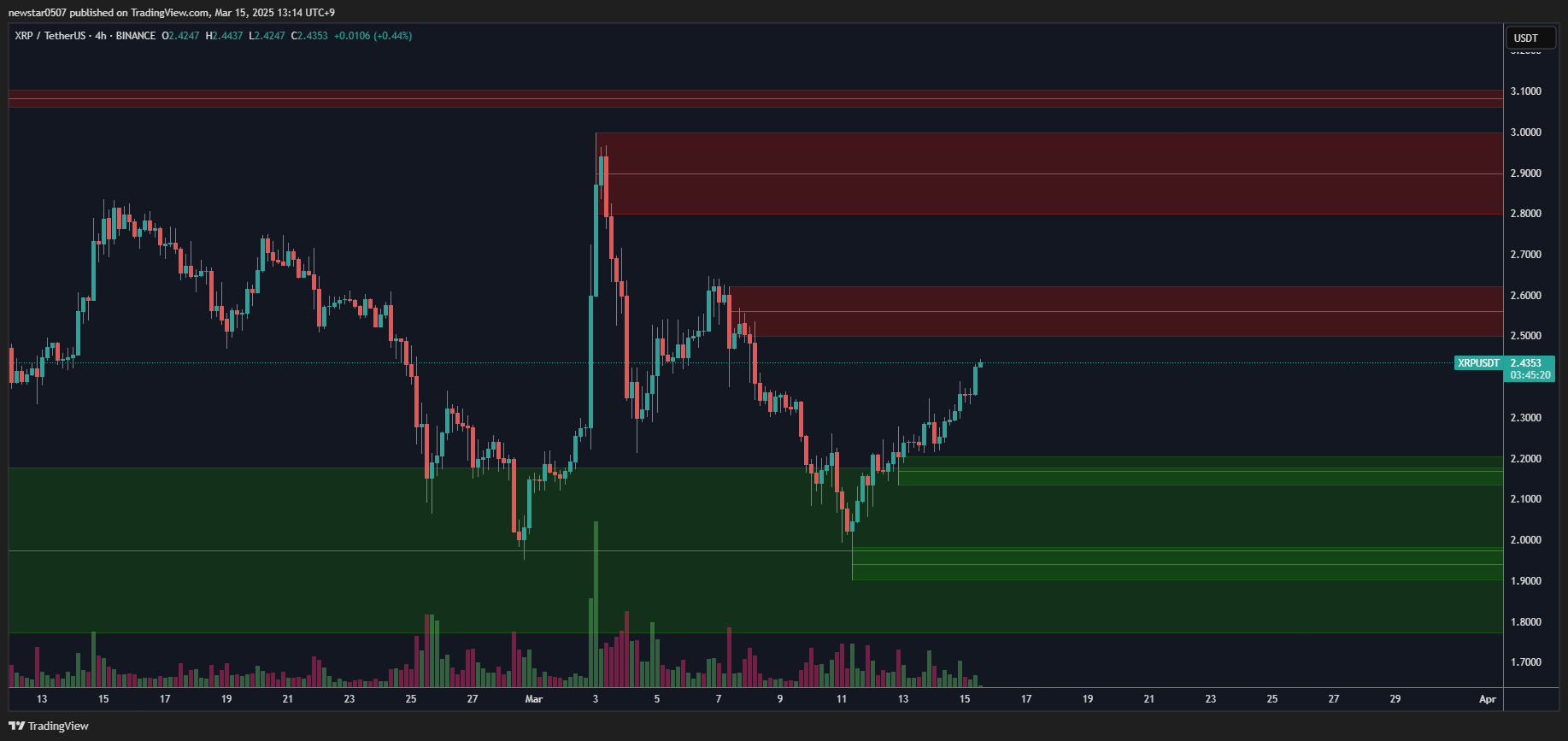
Notably, as XRP looks to break free from the bearish pressure in the short term, analyst CW recently highlighted a sell wall between $2.5 and $2.62 that could present resistance. According to him, however, if XRP decisively breaks this wall, it would witness a smooth sail to the $2.8 mark.

XRP 4h Chart CW
XRP 4h Chart | CW

Bitcoin Price Risks Crash to $10K, Says Bloomberg Analyst

0

Bitcoin price may be on the cusp of a devastating collapse, according to Bloomberg Intelligence Senior Commodity Strategist Mike McGlone.

In two separate X posts on Friday, March 14, McGlone argued that Bitcoin could crash to $10,000.

For context, a crash to $10,000 will represent a 91% decline from Bitcoin’s January 2025 all-time high of $109,000 and an 88% decline from its current price of about $83,000.

The last time Bitcoin saw such a deep correction was in 2011 when it crashed as much as 92% from its highs.

McGlone highlighted that Bitcoin was born when the stock market bottomed from the 2008 financial crisis and has led “one of the greatest risk-asset rallies in history,” but suggested that this rally may now be at an end.

In a separate post, the Bloomberg analyst called attention to the record Bitcoin exchange-traded fund launch and President Donald Trump’s pro-crypto shift and argued that the digital asset was at the peak of a dot-com-style bubble.

Meanwhile, the analyst suggests that the crash to $10,000 may have already begun. The sign? Risk markets are showing evidence of overheating while gold rises.

“Gold is up about the same amount in 2025 to March 13 — about 15% — that Bitcoin is down. But with Bitcoin at about $80,000, what stops those trajectories?” McGlone wrote.

Unsurprisingly, McGlone’s analysis has triggered a wave of pushback from Bitcoin and crypto proponents.

A Flawed Perspective?

Responding to McGlone, prominent market analyst David Weisberger argued that the basis of the Bloomberg strategist’s analysis was flawed.

“When one considers an option as an asset, THIS is what happens to one’s analysis,” he wrote.

“IF there was ZERO increase in Bitcoin adoption and IF those who invested thinking Bitcoin will demonetize gold change their minds and IF the stock market correction turns into a rout, and IF ‘BETA’ was stable, THEN this scenario could play out,” Weisberger added.

According to him, however, none of this will happen with the likelihood of a stock market crash. A stock market crash will likely trigger an injection of liquidity to support the market, which will still benefit Bitcoin.

Meanwhile, a Bitcoin maximalist, Joe Buchner, argued that if Bitcoin crashed to $10,000, the world would likely have bigger problems to worry about.

“If BTC dropped to 10k I think we’d be in a larger global issue than worrying about that. WWIII maybe would be in play and even then I think BTC would get flooded with $ for safety,” he wrote.

Russia Adopts Bitcoin for Oil Trade with China and India

0

Russia has started using crypto assets like Bitcoin in oil trade with China and India to navigate Western sanctions. 

While Russia previously supported crypto usage for international trade, its role in oil transactions had not been reported. The shift follows challenges in converting Chinese yuan and Indian rupees into Russian roubles, making digital assets a convenient alternative.

Russia’s Oil Trade Adopts Crypto Transactions

Per Reuters, some Russian oil firms have incorporated Bitcoin, Ethereum, and stablecoins like Tether (USDT) into their transactions. These digital assets help convert foreign currencies into roubles, easing trade settlements.

While crypto transactions still represent a small share of Russia’s $192 billion oil trade, the trend is gaining traction, according to the International Energy Agency.

According to Reuters, crypto has already played a role in circumventing U.S. sanctions in countries like Iran and Venezuela. Similarly, Russia’s adoption of digital assets in oil trade aligns with global precedents. Venezuela recently expanded its reliance on crypto for crude and fuel exports after renewed U.S. sanctions. 

Russia Implements Alternative Payment Systems

Russia has developed multiple payment frameworks to bypass traditional financial restrictions. USDT is one of the tools employed, but not the only one.

A researcher tracking crypto transactions for sanctions evasion confirmed this, highlighting Russia’s diversified approach. However, details about the extent of these systems remain undisclosed due to confidentiality agreements.

The Russian central bank previously acknowledged that sanctions had caused delays in cross-border payments, affecting the economy. This challenge has prompted businesses to explore alternative financial instruments, including cryptocurrencies. By leveraging digital currencies, Russia aims to maintain trade flows despite economic barriers.

Other Regulatory Developments in Russia

This report comes after Russia’s apex bank had proposed legalizing crypto asset trading for a select group of investors. 

Notably, the proposal aligns with President Vladimir Putin’s directive to establish regulatory frameworks for digital investments. The Bank of Russia confirmed the plan in a submission to the government.

White House Insider Says Trump Administration Aims to Buy “as Much Bitcoin as Possible”

A White House official revealed that the Donald Trump administration is eager to acquire as much Bitcoin as possible.

During a closed-door roundtable session this week, Bo Hines, the Presidential Working Group on Crypto Assets director, confirmed that the administration is focused on building its Bitcoin reserves. However, Hines emphasized that any acquisitions would be “budget neutral” and not burden taxpayers.

One of the key topics at the roundtable was the Bitcoin Act, recently reintroduced by Senator Cynthia Lummis. The bill proposes that the U.S. government purchase up to one million BTC and formally establish a Strategic Bitcoin Reserve.

According to Hines, the White House supports such a move and plans to apply pressure to ensure the legislation passes Congress. This is to ensure the status of the Bitcoin reserve endures beyond Trump’s administration.

Debate Surrounding the Funding of Bitcoin Purchases

The proposed funding mechanism for Bitcoin purchases has raised questions about its practicality. The Bitcoin Act would rely on revaluing U.S. gold certificates, which have not been updated since the U.S. abandoned the gold standard in 1971.

The certificates, which have appreciated dramatically in value due to the rise in gold prices, could fund the purchase of Bitcoin. However, critics have raised concerns about whether this approach can truly be considered “budget neutral” given the size of the proposed purchase.

Notably, acquiring 1 million Bitcoin would cost the government around $83 billion at the current price of 1 BTC.

As of now, the U.S. government holds a portfolio of around 200,000 BTC. However, analysts have noted that only 43% of this holding (about 86,000 BTC) could make it to the proposed reserve, as the other half, while seized, may not have been officially forfeited.

Progress on Bitcoin Reserve

This week, the U.S. government also explored strategies for custodial solutions for the proposed Bitcoin reserve, considering third-party or self-custody options.

The Treasury Department consulted with three industry giants in custody solutions. However, no official decisions yet on how to approach the custody of Bitcoin and other altcoins. Inside sources suggest the government could opt for third-party services in the interim, pending its readiness for self-custody.