Home Blog Page 869

Proposal for XRP as a U.S. Strategic Reserve Asset Appears on Official SEC Website—Here Are Facts

0

The U.S. SEC recently received a proposal on how the U.S. government could benefit from leveraging XRP as a strategic financial asset, but there’s a catch.

A newly surfaced document proposes that the U.S. government leverage XRP as a strategic financial asset, arguing that this could free up massive financial liquidity, reduce transaction costs, and solidify the nation’s position in the evolving digital economy. 

Submitted to the SEC by Maximilian Staudinger, the proposal outlines a multi-phase plan to integrate XRP into the U.S. financial system, eliminate regulatory roadblocks, and even establish a national Bitcoin reserve.

However, the document also contains impractical suggestions, such as purchasing more Bitcoin than actually exists. This has added to the questions around its feasibility. Further, the document does not appear to be affiliated with the SEC.

XRP National Adoption

For context, Staudinger’s proposal centers around integrating XRP into the U.S. banking system, stressing that the asset has the potential to unlock capital currently tied up in global Nostro accounts. 

According to the document, an estimated $27 trillion is stored in Nostro accounts worldwide, with the U.S. holding around $5 trillion. The proposal claims that by replacing traditional liquidity mechanisms with XRP, $1.5 trillion could be released, providing economic flexibility.

Proposal to SEC on Leveraging XRP as US Strategic Financial Asset

Additionally, the proposal suggests that shifting financial transactions to XRP could lead to an estimated $7.5 billion in annual transaction savings. It also argues that XRP could be used for government payments, including IRS tax refunds and Social Security distributions.

A Regulatory Overhaul to Clear XRP Path

To fully integrate XRP, Staudinger’s proposal calls for legal and regulatory changes. It recommends that the SEC officially classify XRP as a payment asset rather than a security and reach a settlement with Ripple. 

Additionally, it urges the Department of Justice (DOJ) to remove restrictions preventing banks from utilizing XRP-based solutions. The document suggests that a presidential executive order could accelerate this process by overriding regulatory roadblocks.

While the document outlines a standard two-year implementation timeline, it also proposes an accelerated six- to twelve-month plan. 

Notably, this would require immediate regulatory approvals through executive orders, fast-tracked government XRP trials, and mandates forcing banks to integrate XRP for liquidity solutions. 

Interestingly, the proposal boldly suggests that the Federal Reserve and the Office of the Comptroller of the Currency (OCC) enforce XRP adoption, presenting it as a national financial tool.

A Highly Ambitious and Unrealistic Bitcoin Reserve Plan

One of the claims in the document is a plan for the U.S. to establish a Bitcoin reserve by acquiring 25 million BTC. However, this is factually impossible, as Bitcoin’s total supply is capped at 21 million. 

Even if the U.S. government attempted to acquire all Bitcoin in circulation, that would be practically impossible amid market limitations. 

The proposal assumes that $1.5 trillion in freed capital could be directly reinvested into Bitcoin, but this level of acquisition would be unfeasible without severely disrupting the crypto market.

Not an Official SEC Document

While the proposal has gained attention after being published on the SEC’s website, it is important to clarify that this does not indicate any official SEC endorsement. XRPL dUNL validator Vet also stressed this in a post on X.

For context, the SEC allows individuals to submit proposals and public comments, which are then archived online. This particular document does not reflect an official agency position or an active discussion within the SEC regarding an XRP strategic reserve.

Staudinger or someone else likely submitted it through a public SEC portal, such as the EDGAR system or a comment form. The SEC does not fact-check or endorse such submissions; they remain publicly accessible as part of regulatory transparency. 

Meanwhile, little is known about Maximilian Staudinger. His name appears on the official website of Deutsche Vermögensberatung Aktiengesellschaft (DVAG), a German financial services firm, identifying him as a financial advisor from Monheim. 

DVAG, headquartered in Frankfurt, specializes in financial planning services across Germany, Austria, and Switzerland.

Staudinger has previously advocated for XRP’s potential as a strategic asset. In a discussion on X, he attempted to explain XRP’s advantages to gold advocate Peter Schiff. This exchange occurred after President Donald Trump mentioned XRP as part of a potential national crypto reserve earlier this month.

Top Analyst Says XRP Final Countdown Has Started, Issues Timeline for Price Reversal Back to the Upside

In a recent update on X, market watcher Steph provided a detailed analysis for XRP holders, stating that the final countdown for a potential price reversal has begun.

According to Steph, there are strong signals indicating when XRP could break back to the upside. His analysis focused on XRP’s current position in relation to the exponential moving average (EMA) ribbons.

Traders widely use the EMA ribbons to gauge bullish or bearish market conditions. When the price of XRP is below the ribbons, it signals bearish momentum, which is the case at the moment.

Steph stated that XRP has been trading below the EMA ribbons for 37 days since the beginning of February. He pointed out that the last time XRP traded below the ribbons was in October 2024.

According to him, XRP spent 35 days in this bearish territory before breaking above the ribbons and sparking a monumental price rally. During this time, XRP jumped from approximately $0.50 to over $3 before the current correction began.

Historical Patterns Pointing to XRP Reversal

Furthermore, Steph highlighted historical patterns, comparing the current market conditions to other instances when XRP dipped below the EMA ribbons. One such example was in April 2024.

He noted that XRP spent 90 days below the ribbons before experiencing a 43% price rally. Another notable instance was in August 2023, when the token spent 64 days below the ribbons, only to rise by 47% after breaking through.

Accordingly, Steph suggests that the current market scenario is no different, with XRP possibly on the verge of a similar breakout. He argued that the worst-case scenario for XRP is to spend 90 days below the EMA ribbons.

Meanwhile, he stated that the moderate case is 64 days. With few occasions where XRP traded below the ribbons for 36 days, and now that it has already spent 37 days, Steph sparked optimism that XRP could be about to see a huge reversal.

XRP Now 37 days below EMA ribbons
XRP is now 37 days below EMA ribbons, says Steph

Key Price Levels to Watch

The analyst pinpointed a key level for XRP to break through in order to confirm the potential price reversal. According to Steph, if XRP breaks above $2.35 with a daily close, it could trigger a massive rally.

He estimated that the minimum rally would be around 40% based on previous movements. Yet, he hinted that the price could rise even more.

The Short Squeeze Potential

Another critical point Steph raised is the current funding rates for XRP. He noted that funding rates are extremely negative, and many traders are shorting XRP.

“This creates a lot of liquidity above us with very little below. Price typically targets the highest liquidity, so a massive short squeeze is likely to occur soon,” he said.

Steph believes a short squeeze could accelerate the price surge, fueling the anticipated rally.

CZ Denies Binance Deal Talks with Trump Family, Calls WSJ Report Misleading

Binance founder Changpeng Zhao (CZ) has refuted the Wall Street Journal’s (WSJ) claims regarding talks between the Trump family and Binance for a potential business deal.

The report suggested that Binance had been negotiating with Trump’s representatives to secure a pardon for Zhao in exchange for business interests. However, CZ has denied having any such conversations.

“The WSJ article got the facts wrong,” he stated.

CZ Disputes Pardon Deal Allegations

In his tweet, Zhao strongly rejected the notion that he had discussed a deal with the Trump family or anyone else about acquiring a stake in Binance.US.

He highlighted that the WSJ and other media outlets had approached more than 20 people to verify the details of such a deal. However, none could confirm it.

He noted that for 20 individuals to have informed him about WSJ’s inquiry, it suggests the media must have contacted hundreds of people. Zhao expressed frustration with what he described as an attempt by the media to “make a story” from unsubstantiated claims. 

“I have had no discussions of a Binance US deal with… well, anyone,” Zhao confirmed.

Speaking on his reported desire to be pardoned by President Trump, the former Binance CEO stressed that no felon would mind a pardon, especially since he’s the only person in U.S. history to be sentenced to prison for a single BSA charge.

Zhao Suggests Anti-Crypto Bias Behind the Article

While Zhao denied any discussions of a pardon, he suggested that the WSJ article was part of a broader attack on President Donald Trump and the crypto industry. 

He implied that the article reflected the lingering forces of the “war on crypto” from the former U.S. administration led by Joe Biden still at work.

Notably, Binance pleaded guilty in 2023 to violating anti-money laundering laws. In settling the charges, CZ stepped down from his CEO position, and the exchange paid a historic $4.3 billion fine.

The WSJ article suggested that Zhao’s conviction complicated Binance’s ability to operate in the U.S. and that a pardon would facilitate the company’s potential return to the American market. 

It speculated that such a deal could open the door for Trump’s family to become more involved in the U.S. crypto market through their existing venture, World Liberty Financial.

However, Zhao’s outright denial casts doubt on whether any serious discussions took place between Binance and Trump’s representatives.

Cardano Struggles at $0.72: Can It Avoid a $0.62 Retest?

Cardano at $0.72 signals a potential pullback to a crucial support level. Will buyers fail to extend the recovery beyond the 200-day EMA?

With an intraday pullback of 2.09%, Cardano is trading at $0.72. Struggling to surpass the 200-day EMA, the ADA price trend hints at a pullback, forming an evening star pattern.

Will this pullback lead to a retest of the crucial $0.62 support? Let’s find out.

Cardano Analysis Suggests Potential $0.62 Retest

In the daily chart, ADA’s price trend shows an early bullish bounce back before reaching the 50% Fibonacci level at $0.6272. With a tweezer bottom formation, Cardano ended a five-day bearish streak with a 7.93% surge on Tuesday.

Cardano Price Chart
Cardano Price Chart

This led to a 1.66% bullish continuation, marking the second consecutive green candle. However, the failure to close above the 61.80% Fibonacci level at $0.7351 signals a bearish reversal.

With the intraday bearish candle, Cardano is signaling a potential evening star pattern as it retests the broken 200-day EMA. Furthermore, due to the increased volatility and bearish pressure, the 50-day and 100-day EMA lines are on the verge of crossing negatively.

Meanwhile, the MACD and signal lines remain negatively aligned below the zero line, with bearish histograms resurfacing. As a result, the technical indicators suggest a bearish outlook for Cardano.

Bearish Sentiments On The Rise?

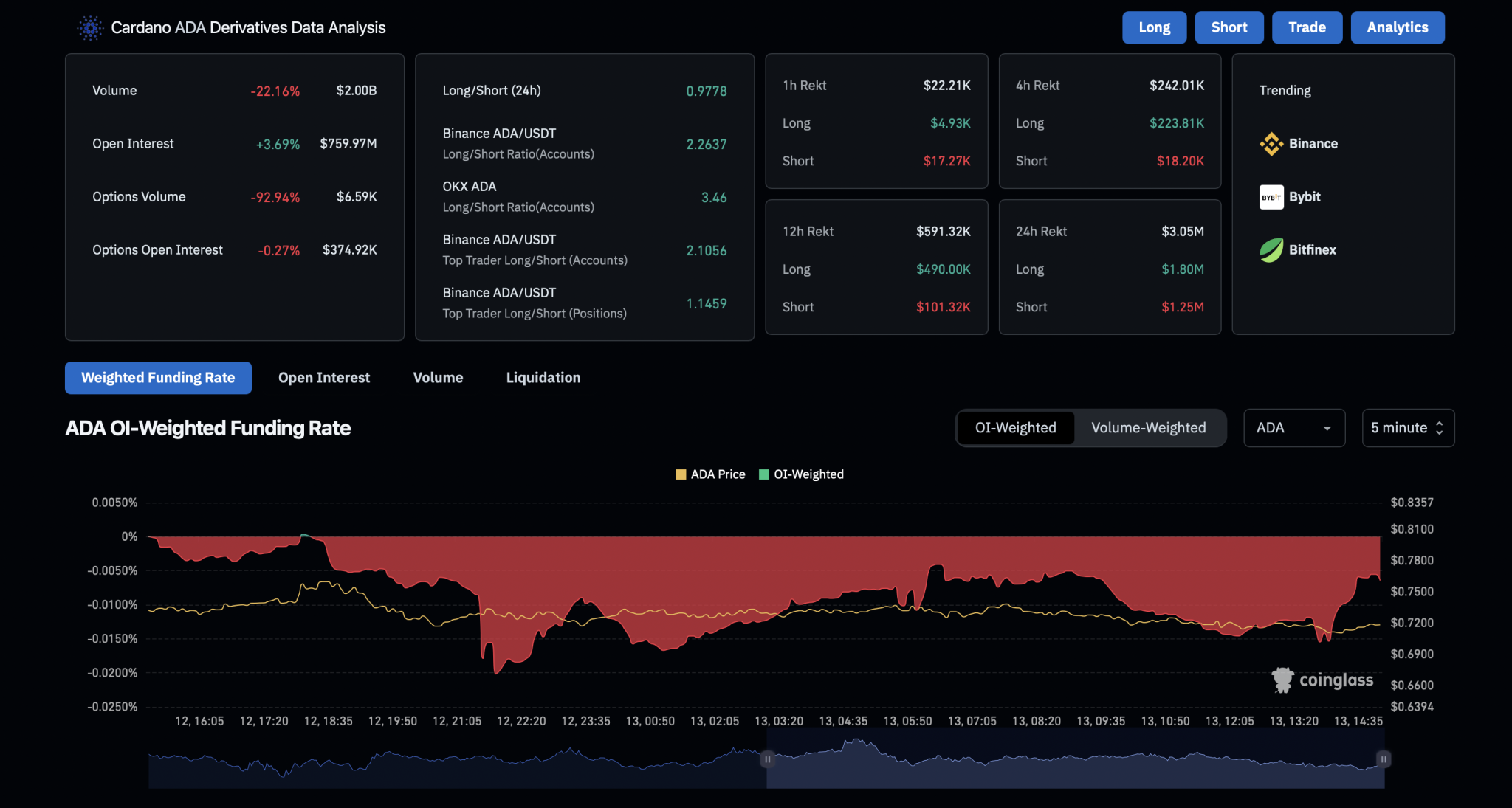
As Cardano struggles at a crucial crossroads, trader participation in Cardano futures contracts has seen a significant increase. The open interest for Cardano has risen by 3.69% to reach $759.97 million.

Cardano Derivatives
Cardano Derivatives

However, the long-to-short ratio remains slightly bearish at 0.9778. Additionally, the funding rate stands at -0.0064%.

The slightly bearish long-to-short ratio and funding rate signals a gradual rise in bearish sentiment surrounding Cardano.

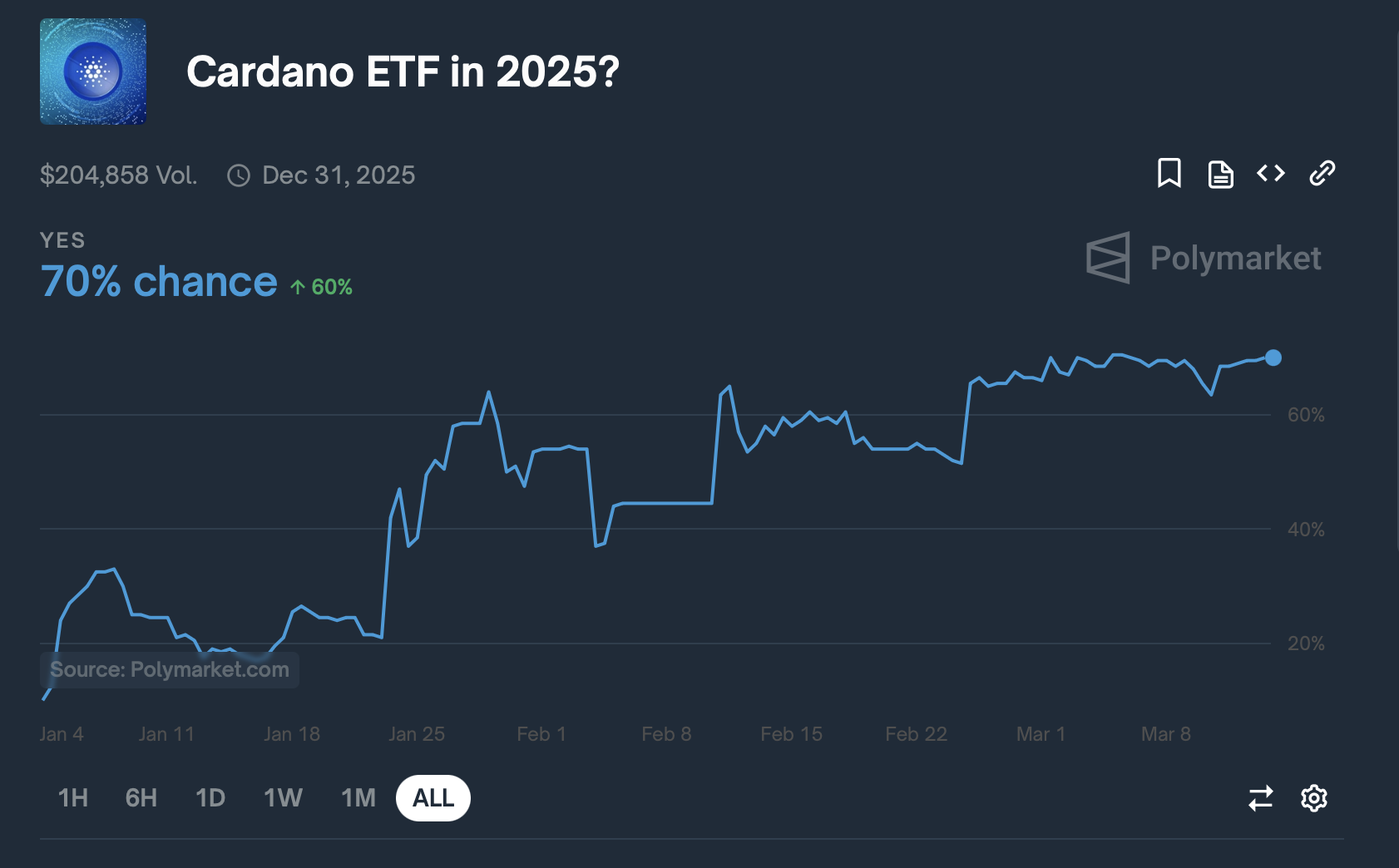
Despite the short-term rise in bearish sentiment, Polymarket users are anticipating a major approval for Cardano. According to recent data, users believe there is a 70% chance of Cardano’s ETF being approved in 2025.

Polymarket
Polymarket

Will Cardano Cross The 200-day EMA?

Based on Fibonacci levels, the short-term pullback points to the formation of an evening star pattern. This could likely retest the 50% Fibonacci level at $0.6272. However, as the broader market stabilizes, altcoins will likely bounce back.

In the event of a bullish extension, the Fibonacci levels suggest a price target of $0.9216 at the 78.60% level. Meanwhile, the dynamic average lines signal an intermediate price target near the 50-day EMA at $0.81.

Stablecoin Supply Spikes by $20B+ in Q1 2025: Here’s What This Could Mean for Bitcoin Recovery

0

Stablecoins are witnessing a massive surge in supply, and this trend could be beneficial for Bitcoin and the crypto market in the long term.

Blockchain analytics firm Glassnode reports that since the beginning of the year, the total stablecoin supply has grown by 10.9% or $20.17 billion.

This comes after a contraction in supply during the final weeks of 2024 when the total stablecoin supply dropped from $187 billion in December to $185 billion by January 2025. Notably, the contraction was likely due to investors capitalizing on the market uptrend.

Stablecoins Market Cap Percentage Change Glassnode
Stablecoins Market Cap Percentage Change | Glassnode

However, as the market drops, over the past 30 days, the stablecoin supply expanded by $3.33 billion, reflecting a 1.65% increase. This growth rate is comparable to levels observed in September 2024, when stablecoin inflows reached $2.37 billion. 

On a quarterly basis, stablecoin supply rose by $23.86 billion in Q4 2024, a 14.7% increase, while Q1 2025 has already recorded a $20.17 billion rise, reflecting a 10.9% expansion. The increase across the last two quarters outpaced the combined supply rise in Q2 and Q3 2024, which amounted to $18.6 billion, or 10.2%.

Stablecoin Market Cap Surges to $232.5 Billion

Data from CoinMarketCap reveals that the global stablecoin market capitalization has reached $232.5 billion, fueled by the recent supply expansion. 

Tether (USDT) remains dominant in the market, holding a commanding 61.5% share with a market cap of $143 billion. Despite facing regulatory scrutiny under the EU’s Markets in Crypto-Assets (MiCA) framework, USDT continues to lead stablecoin transactions globally.

Meanwhile, USD Coin (USDC) follows as the second-largest stablecoin, with a market cap of $58.4 billion. This continued growth in stablecoin valuations shows an increasing preference for stable assets, particularly during periods of market volatility.

A look at recent on-chain activities suggests that the surge in stablecoin supply is being driven by fresh mints from major issuers like Tether and Circle. Blockchain monitoring platform Whale Alert has tracked multiple large-scale stablecoin issuances over the past few days.

Circle, the issuer of USDC, has minted an additional 300 million USDC today alone, having issued $250 million an hour ago. Over the past week, Circle has minted $1.4 billion worth of USDC through multiple transactions.

Tether has also ramped up its stablecoin issuance. On March 2, the company minted a staggering $1 billion worth of USDT in a single transaction. 

Since then, Tether has been actively transferring millions of USDT from its treasury to Bitfinex, a crypto exchange owned by iFinex—the parent company of Tether. This follows another major issuance of $1 billion USDT on Feb. 28.

Can Stablecoin Growth Fuel Bitcoin Recovery?

Amid these fresh mints, Bitcoin is currently navigating a critical price zone near the $80,000 mark as the market turbulence persists. The rise stablecoin supply could play a major role in determining Bitcoin’s next move.

A surge in stablecoin supply typically shows an increase in sidelined buying power within the crypto market. Traders and institutional investors often hold stablecoins in anticipation of favorable market conditions before deploying funds into assets like Bitcoin and Ethereum. 

If confidence in Bitcoin strengthens, the newly injected liquidity from stablecoin mints could drive renewed buying pressure. Historically, a rise in stablecoin supply has correlated with increased demand for Bitcoin, as traders use stablecoins to enter long positions.

Analyst Predicts Another 20% Shiba Inu Dip to $0.0000090

0

An analyst projects an additional 20% decline for Shiba Inu, arguing that it remains in a descending channel with no breakout signals.

Shiba Inu (SHIB) continues to experience market volatility, reflecting a fluctuating price trend over the past day. SHIB is trading around $0.0000122, with a marginal 24-hour decline of 0.1%.

The token has struggled to gain momentum recently. It declined 9.2% in the past seven days, 16.8% over 14 days, and 25.4% in the last 30 days. This sustained downward trajectory highlights continued selling pressure. While some are anticipating a rebound, an analyst is predicting further decline.

Shiba Inu Could Dip Another 20%

A 12-hour SHIB/USDT chart from TradingView presents a downward trend, reinforced by technical indicators. The chart shows that Shiba Inu is within a descending channel characterized by lower highs and lower lows.

SHIB/USDT 12-hour Price Chart
Shiba Inu 12-hour Price Chart

According to the analyst, market signals do not suggest a breakout, leaving SHIB vulnerable to further declines. The analyst observes a lack of momentum and expects a continued downturn unless strong reversal signals emerge.

A key target in this downtrend is $0.0000090, a critical monthly support level that could determine SHIB’s near-term price direction. This represents a 20% fall from the time of the analysis.

Meanwhile, network data and on-chain activity reinforce the bearish outlook. Fewer investors are engaging with SHIB, further reducing demand and liquidity.

Declining Network Activity and Whale Inflows

On-chain metrics from IntoTheBlock reveal a decline in ecosystem engagement. The 7-day new addresses (NA) dropped by 8.23%, indicating fewer new investors entering the SHIB market. Additionally, the 7-day active addresses (AA) fell by 11.95%, suggesting reduced transactional activity.

Shiba Inu Daily Active Addresses

The 7-day Zero Balance Addresses (ZBA) Change showed a significant 25.34% drop, indicating more wallets are becoming inactive or being drained. This suggests declining investor interest and weaker overall market participation.

The Large Holders Inflow chart further reflects a reduced presence of institutional and whale investors. The 7-day whale inflow dropped 64.05%, while the 30-day inflow saw an 88.65% decline. 

Shiba Inu Large Holders Inflow

The 90-day inflow decrease of 87.12% further indicates an extended period of large-scale investor exits, contributing to SHIB’s ongoing bearish trend.

User Swaps 442,000 USDC on UniSwap and Received Just 11,000 USDT: Here’s What Happened

0

A user lost $431,000 in three transactions as he intended to swap his 442,000 USDC on the decentralized exchange Uniswap for Tether’s stablecoin.

Swapping tokens on decentralized exchanges (DEX) can be tricky, primarily due to issues like slippage, low liquidity, and MEV bot attacks. Yesterday, a user lost $431,000 over three different transactions while simply trying to swap between two prominent stablecoins, USDC and USDT.

Blockchain securities firm Peck Shield alerted users to this error on Wednesday, which looks similar to a sandwich attack. Notably, such exploits have frequently occurred on the Ethereum network due to its complex smart contract usage and open mempool.

Here’s What Happened

Three addresses, “0x5D14,” “0x999b,” and “0x5A89,” placed an order to swap 91,000 USDC, 131,000 USDC, and 220,800 USDC on DEX UniSwap V3. Notably, data from Etherscan indicates that these transactions had just four minutes between them.

However, the wallet addresses received a combined 11,000 USDT from the transaction, which was supposed to be a 1:1 swap. This represented a loss of $431,000 for the wallet owners.

User Swaps 220k USDC for 5k USDT

While the transaction came from three different addresses, data shows they might be from the same owner. A look at the transaction history shows they have one thing in common: the stablecoins came from Aave’s $1.2 billion USDC pool a few hours before the transaction.

Possible MEV Attack

Meanwhile, all pointers show that the wallets may have been sandwiched by a maximum extractable volume (MEV) bot. As typical of such attacks, these bots front-run the targeted transaction, manipulating the prices of assets in the liquidity pool.

The higher rates then affect the victims’ swap rates, which the bots benefit from by back-running the transaction. In this case, data shows that the MEV bot front-ran the transaction by swapping 18 million USDC, driving the rates for USDC to USDC in the liquidity pool by a factor of 44.

As the user’s swap order processed at that factor, the MEV bot back-ran the transaction, claiming over $200,000 in profits. Meanwhile, further analysis shows that the amountOutMinimum, a setting on UniSwap V3 that prevents such attacks, was set at zero, allowing the bot to pull the pool manipulation successfully.

amountOutMinimum Value

The Crypto Basic earlier reported that the Ethereum Foundation once fell victim to this MEV bot manipulation. The non-profit organization lost $9,000 from its 1,700 ETH sell-off in 2023.

Bitcoin Fails to React as US PPI Comes in Lower Than Expected

0

Bitcoin trades flat while other majors are mixed despite low PPI numbers.

After weeks of uncertainty, macroeconomic headwinds facing Bitcoin and the broader crypto market may now be easing.

Following the Wednesday, March 7, Consumer Price Index (CPI) data release for February 2025, recently released Producer Price Index (PPI) data suggests that wholesale prices also rose less than economists anticipated in February 2025. However, Bitcoin and the broader crypto market have failed to react to the news.

Bitcoin and Other Crypto Majors Mixed 

At the time of writing, Bitcoin is trading flat while other majors are mixed. Bitcoin, for one, is trading around the $82,400 price point, representing a mild 1.3% decline in the past 24 hours. At the same time, Ethereum is down nearly 1%, Solana is up nearly 2%, BNB has increased 6%, and Cardano is down over 3%.

The mixed market outlook comes despite recent cooler-than-expected PPI numbers, strengthening the case for a near-interest rate cut from the Federal Reserve. 

Specifically, on Thursday, March 13, the Bureau of Labor Statistics showed that wholesale prices rose 3.2% year-on-year (YoY), less than the 3.5% seen in January 2025, and the 3.3% projected by economists. On a monthly basis, prices were unchanged compared to the 0.6% increase in January 2025.

Similarly, core PPI, which excludes typically volatile food and energy prices, rose 3.4% YoY, below January’s 3.6% and economists’ expectations of 3.5%. Month-on-month (MoM), these prices increased only 0.1%, far less than January’s 0.5% and the anticipated 0.3%.

The lack of a market reaction to the PPI contrasts with the Wednesday market rise on February’s CPI that sent Bitcoin briefly above $84,000.

Ripple Moves 200,000,000 XRP Worth $457M: What’s Happening

0

Ripple recently sparked significant attention after transferring 200 million XRP, valued at approximately $457.6 million, to an unidentified wallet.


The timing of this transaction has raised questions within the crypto community, especially with the SEC vs. Ripple case nearing its resolution. This move coincides with growing speculation about the outcome of the ongoing legal battle, leaving many to question the intentions behind such a large transfer.

The Transfer and Its Speculated Purpose

The transfer was flagged by Whale Alert a few hours ago on X. Notably, Ripple frequently conducts significant XRP transfers, including its monthly releases of 1 billion XRP from escrow to manage the coin’s market supply.

While these routine transactions typically do not stir much attention, this specific transfer raised eyebrows, given its scale and timing.


An AI copilot for crypto on X, Alva, speculated that the transfer could be part of a liquidity play or preparation for a major move. It also suggests that it might be linked to a deposit for an exchange or a strategic action to influence market sentiment. 

Alva claims these high-volume transfers often have the potential to cause price fluctuations, making the market closely watch the movements of XRP.

Legal Developments in the SEC vs. Ripple Case

Amid these developments, sources have revealed that the SEC vs. Ripple case is nearing its conclusion. Reports from reliable sources indicate that the resolution delay stems from Ripple’s legal staff negotiating more favorable terms. 

One point of contention revolves around the August district court ruling, which imposed a $125 million fine on Ripple and prevented the company from selling XRP to institutional investors.

Ripple is attempting to address the broader implications of the ruling, especially as the SEC’s current leadership is reevaluating its approach to crypto enforcement. 

XRP Market Outlook

Amid these legal challenges, XRP’s market performance remains a focal point for investors. According to an analyst, XRP has recently completed its correction on the four-hour time frame.

Projections suggest that XRP could initially target $2.42 before gaining significant momentum. The real momentum is expected to emerge once XRP moves above the Ichimoku clouds.

With support at $2.22 and $2.04, XRP’s price may experience volatility in the short term. However, if the market sentiment shifts positively following the resolution of the SEC case, XRP’s price could reach targets as high as $4.29 and potentially even $5.86 in the longer term.

Chicago Board of Options Exchange (CBOE) Files to List Franklin Templeton XRP ETF 

0

Top U.S. equities market operator, Chicago Board of Options Exchange (CBOE), has submitted a 19b-4 filing with the SEC to list and trade shares of Franklin Templeton’s XRP ETF on its BZX Exchange. 

The application follows Franklin Templeton’s S-1 filing seeking to launch an ETF tracking the price performance of XRP. According to Cboe’s filing, Franklin’s prospective XRP ETF will be listed under BZX Rule 14.11(e)(4), governing the Commodity-Based Trust Shares. 

It indicated that Franklin would serve as the sponsor, Coinbase would be the custodian of the XRP, and Delaware Trust Company would be the sole trustee. 

Next Actions 

Cboe’s filing represents a major step toward the potential launch of Franklin Templeton’s XRP ETF. Following the filing, the U.S. SEC has about two weeks to acknowledge the exchange’s application relating to Franklin’s spot-based XRP ETF.  

Once acknowledged, the SEC will have a duration of 240 days from the date of the acknowledgment to communicate whether to approve or deny the ETF’s launch. 

The regulator will publish Cboe’s 19b-4 application in the Federal Register for public comments during this period.  

Rising Institutional Interest in XRP 

The development comes amid growing institutional interest in XRP. Several asset managers, including Canary and Grayscale, have filed to launch XRP ETFs in the United States. 

Since October 2024, the SEC has received at least 15 XRP ETF filings from top asset managers. This makes XRP the top crypto asset with the most ETF filing–surpassing Bitcoin’s 11 and Ethereum’s eight. 

Cboe to List and Trade Most XRP ETFs

Interestingly, most of these funds will likely debut on the Cboe BZX Exchange. Last month, the exchange filed a similar application to list and trade WisdomTree, 21Shares, and Canary Capital’s spot XRP ETFs. 

The SEC has acknowledged these filings, kicking off the 240-day approval deadline. On March 11, it postponed its decision on selected XRP ETF exchange filings, including one submitted by Cboe on behalf of 21Shares. Following the postponement, the SEC set May 22 as the new date for its decision on 21Shares spot XRP ETF.