Home Blog Page 868

Here is How High Dogecoin May rise After ETF Approval if DOGE Gets 25% to 40% of BTC ETF Inflows

0

Dogecoin price could reach new all-time highs if DOGE captures between 25% to 40% of Bitcoin ETF inflows following its ETF approval.

The crypto market is currently witnessing a period of sustained downtrend, and Dogecoin (DOGE), the original meme coin, has not been spared in the bloodbath. DOGE is already down 20% this month following a 38% collapse in February.

Dogecoin ETF Progress Sustains Long-Term Bullishness 

Despite the downward trend, with Dogecoin now trading at a pre-Trump presidency low of $0.16, long-term sentiments remain bullish. One of the motivations behind this sustained bullishness is the potential approval of Dogecoin ETF products, especially amid progress with the recent change in SEC leadership.

For instance, the securities regulatory agency acknowledged Grayscale’s filing for a Dogecoin ETF last month. While this acknowledgement did not translate to an outright approval, it set things in motion for the investment product. In addition, last week, the NYSE Arca submitted a 19b-4 filing for the Bitwise Dogecoin ETF. 

As asset managers continue to make progress in their Dogecoin ETF filings, the potential impact on Dogecoin price if these products secure approval would depend largely on how they perform. Notably, Ethereum’s price did not react favorably to the launch of ETH ETFs due to low capital inflows. 

However, this was not the case with Bitcoin, as the launch of Bitcoin ETFs last year triggered an impressive price run for the firstborn crypto, leading to a new all-time high before the next halving for the first time in the asset’s history. For context, data from Sosovalue confirms that BTC ETFs have commanded up to $35.4 billion in inflows at press time.

Dogecoin Price if DOGE ETFs Secure up to 40% of Bitcoin ETF Inflows

Accordingly, if the Dogecoin products secure approval and replicate even a fraction of Bitcoin’s performance, the impact on Dogecoin price could be massive. For this assessment, The Crypto Basic considers just 25% to 40% performance.

Notably, if Dogecoin ETFs get 25% of Bitcoin ETF inflows after a year in the market, they would command positive netflows worth around $8.85 billion. Applying the Bank of America inflow-to-valuation multiplier of 118x would yield a market cap increase of $1.044 trillion for Dogecoin.

An increase of $1.044 trillion to the meme coin’s already existing market cap leads to a new valuation of $1.067 trillion. With Dogecoin’s circulating supply currently sitting at 148.39 billion tokens, this new market cap translates to a Dogecoin price of $7.1.

Meanwhile, if Dogecoin secures 40% of Bitcoin ETF inflows, it would boast netflows worth $14.16 billion. This inflow would lead to a massive $1.67 trillion increase in market cap when applying the BoA multiplier. Currently, DOGE has a market cap of $23 billion. An additional $1.67 trillion valuation leads to a new market cap of $1.69 trillion.

Now, considering the current circulating supply of 148.39 billion tokens, this new market cap translates to a Dogecoin price of $11.41. Nonetheless, these assessments remain speculative, as there is no guarantee Dogecoin ETFs could secure this much capital inflow.

Interestingly, while these projections remain ambitious, market analyst Ali Martinez predicts a more audacious Dogecoin price of $15 after ETF approval. At press time, Dogecoin currently changes hands at $0.1617, down 19% over the past week.

Bitcoin Whales and Sharks Dump 57,687 BTC Worth $4.5B

0

Santiment data shows whales and sharks sold over 57,000 BTC in a week, signaling profit-taking and increased selling pressure on Bitcoin.

Bitcoin has experienced a consistent decline, with recent data showing a notable downtrend in price and a reduction in holdings by key stakeholders. 

Notably, Bitcoin’s 30-day performance stands at negative 14.7%. The 7-day and 24-hour performances also show dips of 7.3% and 1.6%, respectively, suggesting continued bearish momentum.

This decline aligns with a decrease in shareholder activity, particularly among whales and sharks, as recent Santiment data shows.

Large Holders Reduce Bitcoin Holdings

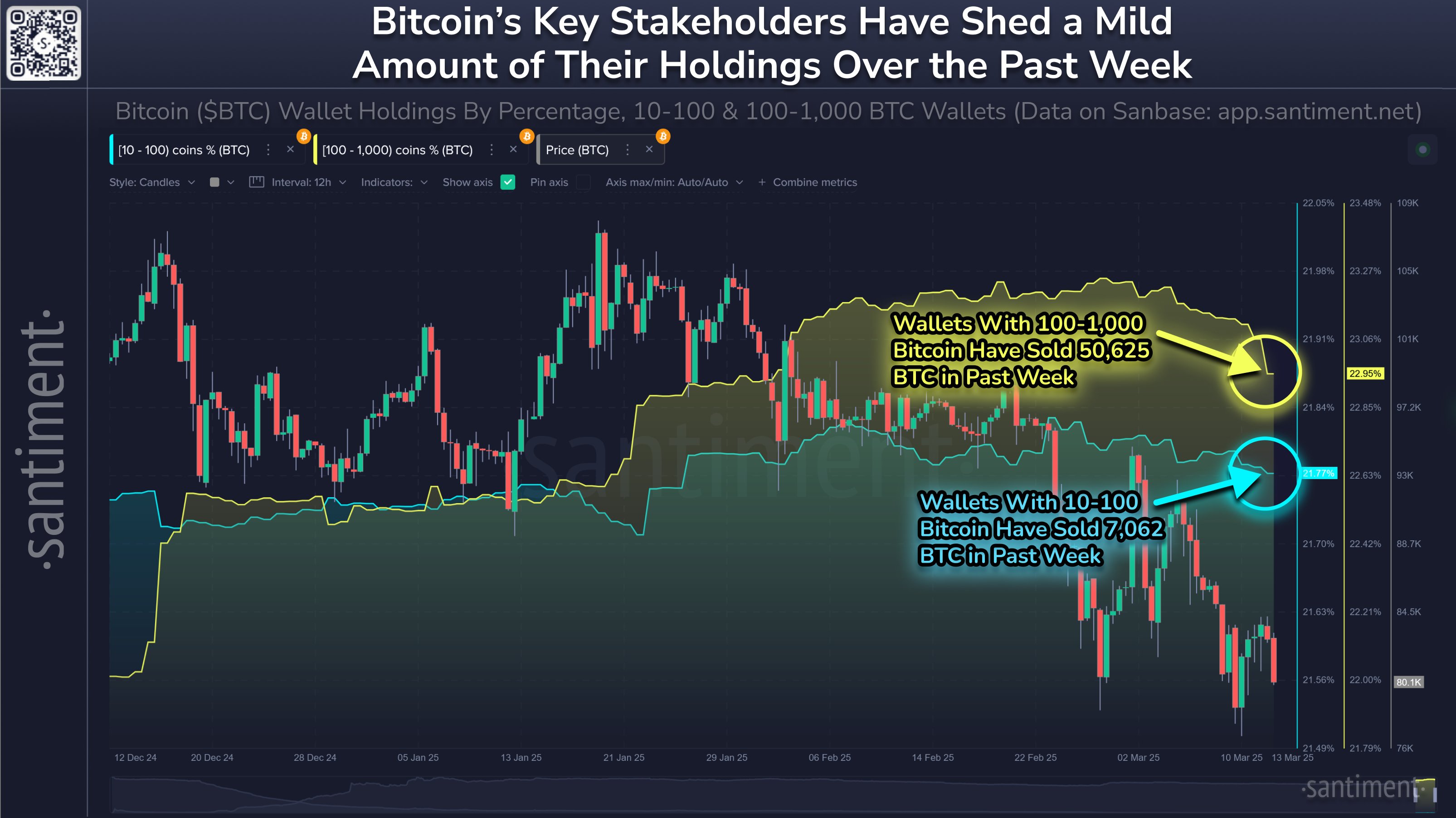
The analysis highlights significant Bitcoin sell-offs among two major wallet categories: whales and sharks. Whales, holding between 100 and 1,000 BTC, collectively sold 50,625 BTC in the past week.

This amount equates to roughly $4.07 billion at current market prices. As of March 13, these holders accounted for approximately 22.95% of Bitcoin’s total supply. 

Shark wallets, which hold between 10 and 100 BTC, also showed a decrease in Bitcoin holdings. Over the same period, this group sold 7,062 BTC, translating to about $567.1 million. Presently, sharks hold around 21.77% of the Bitcoin supply.

Notably, this massive sale of over $4.56 billion in Bitcoin by whales and sharks coincided with the asset’s consistent dip this month. This week, Bitcoin touched $76K amid these sell-offs.

According to Santiment, over the longer term, markets typically fluctuate with a mid-sized positive alignment with these wallet tiers. Essentially, the behavior of these large Bitcoin holders tends to have a moderate, positive impact on Bitcoin’s market movements.

Image

Bitcoin Network Activity Declines

Adding to the bearish narrative, data from IntoTheBlock provides further insights into Bitcoin’s network activity. It highlighted a decline in transaction volumes and user engagement. The 7-day Network Activity Change dropped by 3.58%, indicating lower transaction levels. 

Bitcoin Daily Active Addresses

Additionally, the 7-day Active Addresses Change decreased by 6.68%, signaling reduced user participation. Meanwhile, the 7-day Zero-Balance Addresses Change fell by 4.02%, suggesting an increase in emptied wallets.

Furthermore, IntoTheBlock’s Ownership Chart shows shifts in large holder netflows, a key indicator of whale and institutional activity. Over the past seven days, large holder netflows spiked by 1,213.40%, suggesting temporary whale accumulation or redistribution. 

Bitcoin Large Holders Netflow

However, the 30-day netflow dropped by 3,814.02%, indicating a continued exit by large holders. The 90-day netflow recorded a 1,172.76% decline, confirming an extended period of Bitcoin outflows from whale wallets.

State of Vermont Dismisses Staking Case Against Coinbase

0

The financial regulatory department of the State of Vermont has dropped its legal proceeding against Coinbase, citing a shift in the regulatory climate.

Following the US Securities and Exchange Commission’s (SEC) path, the State of Vermont has tossed its Show Cause Order against Coinbase, the largest crypto exchange in the United States. In a statement yesterday, the state’s Department of Financial Regulation dismissed the case without prejudice.

The State of Vermont cited a shifting regulatory tone in the United States as the cause for the case rescission. The American state noted that it followed the SEC’s decision to dismiss its case against Coinbase amid ongoing reforms on crypto regulation.

Another Coinbase Win

For context, on June 6, 2023, Vermont sued Coinbase for offering staking services to its residents, deemed unregistered securities, without due licensing. The Show Cause Order sought to halt the exchange’s crypto-staking offering, citing a violation of the federal securities laws.

The Vermont Department of Financial Regulation brought this case against Coinbase the same day the US SEC sued the exchange for allegedly selling unregistered securities to US investors. Notably, other states, including Kentucky, California, Washington, New Jersey, and Alabama, brought a similar legal action against the crypto exchange.

However, the US SEC officially dropped its case against Coinbase on February 28 as part of its efforts to create regulatory clarity in the US. The ripple effect forced Vermont to announce yesterday that it has followed in the path of the Wall Street top regulator.

“In light of the dismissal of the Federal Action and likelihood of new federal regulatory guidance, the Division believes it would be most effective and in the best interest of justice to rescind the pending Show Cause Order, without prejudice,” the Thursday order disclosed.

Moreover, the US SEC has recently dropped legal actions against multiple crypto firms. Robinhood, OpenSea, and Kraken, among others, have seen their cases and investigations tossed by the regulator.

The Work Is Not Over Yet: Coinbase

Paul Grewal, Coinbase’s chief legal officer (CLO), confirmed this development, applauding Vermont’s effort to comply with ongoing regulatory reform. In a tweet, he urged other states with staking actions against the exchange to follow the Northeastern state’s playbook.

Meanwhile, Grewal insisted that staking services are not securities. Furthermore, the CLO stated that the work to bring regulatory clarity to America remains, and nudged Congress to seize the bipartisan crypto-friendly environment in the House and Senate to establish a digital asset legal framework.

Notably, Coinbase has been at the forefront of this clarity push in the US, suing the SEC at one time for failing to respond to its request to create a legal framework for the industry. Also, its recent letter to the Office of the Comptroller of the Currency (OCC) and other federal banking regulators catalyzed a correspondence clearing banks to meddle with digital assets.

ETFStore President Reveals Bold Timeline For BlackRock To File XRP ETF

Nate Geraci, the President of ETFStore, has issued a bold prediction for XRP, expressing confidence that multi-trillion-dollar asset manager BlackRock will file for an XRP ETF.

Geraci shared this perspective in a tweet today, logging his “formal prediction” for the XRP investment space. Specifically, he expressed conviction that BlackRock will submit applications for both Solana and XRP ETFs.

Push for BlackRock to File XRP ETF

Notably, BlackRock’s XRP ETF filing is one of the most anticipated applications in the XRP community, given the prominence of the asset manager, which oversees $11.6 trillion in assets.

For context, BlackRock’s involvement in the Bitcoin ETF space changed the narrative last year. It attracted historic inflows, even breaking into the global leadership ranking of 2024 following inflows of over $30 billion within a year. The effect of these inflows was evident in Bitcoin’s price, which soared from $48K to over $100K by the end of 2024.

XRP enthusiasts are hoping for a similar event, eagerly awaiting BlackRock’s XRP ETF. Now, industry pundits like Geraci have formally projected that the BlackRock XRP ETF is on the way.

Notably, as of now, filings for 15 XRP ETFs have been made, with some being leveraged products, the largest number for a single asset yet. Big names in the mix include Grayscale, Franklin Templeton, WisdomTree, and Bitwise. Despite the surge of XRP ETF filings, BlackRock has yet to join the race.

Why BlackRock Will Seek an XRP ETF and the Timeline

In his bold prediction, Geraci provided reasons why BlackRock would pursue an XRP ETF. He also outlined a potential timeline for its development.

First, Geraci pointed out that BlackRock currently leads the crypto ETF markets for Bitcoin and Ethereum with the largest inflows. Geraci stressed that he does not see BlackRock allowing competitors to launch ETFs for top crypto assets like XRP and Solana without a fight.

For context, BlackRock’s Bitcoin ETF has seen $39.33 billion in inflows, while the Ethereum product has observed $4.18 billion in inflows. Its closest competitor, Fidelity, has seen only $11 billion in inflows for its Bitcoin ETF and $1.4 billion for its Ethereum ETF. Many others have struggled to even reach $1 billion in inflows.

With BlackRock leading by such a landslide margin, Geraci believes the asset manager would not allow rivals to close the gap by launching promising crypto ETFs for tokens like XRP and Solana.

Notably, he argued that BlackRock would submit an application for a Solana ETF any day now. Meanwhile, as for the XRP ETF, he believes it will come after the SEC drops its lawsuit against Ripple.

The most recent update on the SEC-Ripple lawsuit suggests both parties are in a negotiation phase, and a settlement could surface anytime soon.

Shiba Inu Team Says Kusama Doing Exactly What He Announced He Would

0

The marketing lead of the Shiba Inu ecosystem, Lucie, defends Shytoshi Kusama’s latest absence from social media platforms. 

Shytoshi Kusama, the pseudonymous leader of the Shiba Inu project, has been inactive on social media over the past week. 

Shiba Inu Kusama’s Latest Low Activity on Social Media  

Kusama’s X profile has been relatively quiet compared to his vibrant engagement earlier this year. He made his last post on February 21, where he announced the introduction of enhanced liquidity pools on ShibaSwap. 

He has been quiet ever since and has only retweeted different Shiba Inu-related posts. His last retweet relates to a March 7 post from Shiba Inu’s partner, Astra Nova. Since then, he has maintained a low profile on the platform and has not retweeted any X posts. 

Kusama’s inactivity on social media has triggered concerns among Shiba Inu proponents, who have questioned his whereabouts. Critics have also seized the opportunity to make malicious claims about the Shiba Inu lead developer. 

Lucie Defends Kusama 

Amid this development, Lucie suggested that Kusama’s recent absence from social media is part of a deliberate effort, which the Shiba Inu leader previously outlined. 

Following a decline in Kusama’s online presence, Lucie emphasized that he is working hard to give Shiba Inu global awareness. 

This indicates that as Kusama’s online presence declines, he is likely engaging in offline activities like meetings to potentially attract more attention to the Shiba Inu ecosystem. 

Meanwhile, she expressed confidence that the Shiba Inu leader would share more insights about his offline activities when he eventually returns to social media. 

Not New 

Kusama’s recent absence from social media is not a new development. The community has observed him take lengthy breaks from social media for other offline endeavors. 

Following his low social media presence in May 2024, Kusama revealed he traveled to the Middle East, where he met with his cousins. 

Although Kusama might be inactive on social media sometimes, he has portrayed himself as a workaholic. While many took breaks to spend the last Yuletide season with their families, Kusama revealed he was active during this period. 

According to him, in some weeks, he sometimes works 20 hours daily developing the Shiba Inu project to give the cryptocurrency the attention it deserves. Last year, he depicted what his work environment sometimes looks like while he tries to give SHIB utility and elevate the token into the top 5. 

By 2030 Investors Will Wish They Had Bought XRP Today: Key Opinion Leader Explains Why

0

A notable market commentator has asserted that a lot of people will regret not buying XRP today in the next half a decade.

This assertion came from John Squire, a media personality and self-acclaimed key opinion Leader (KOL). His commentary comes at a time when XRP is struggling to maintain its footing amid the persistent bearish price action that has dominated the crypto market.

For context, the global crypto market cap has lost over $1 trillion since Jan. 20 due to this turbulent phase, as Bitcoin battles the bears at $80,000. XRP has also been a victim of the bloodbath, with its valuation dropping from the peak of $195 billion in mid-January to the current figure of $133 billion, representing a loss of $62 billion.

Amid the market drawdown, XRP price now struggles at the $2.3 mark. Despite this, market commentators like Squire believe XRP is still on track for a massive uptrend in the future. This increasing bullish sentiment likely comes from expanding regulatory clarity and its impressive performance from Q4 2024.

“Everyone Will Wish They Had Bought XRP”

According to Squire, over the next five years, essentially by 2030, everyone will wish they had bought XRP today. Notably, most analysts have argued that the ongoing correction represents an opportunity for market participants to procure XRP at a discount price before an eventual price explosion.

John Squire on X
John Squire on X

To put things into perspective, XRP experienced a similar discount period during the COVID-influenced crash in 2020. For context, the asset collapsed to a local bottom of $0.1140 in March 2020, presenting a massive opportunity for investors to get into the market with minimal capital.

Notably, individuals who committed $50,000 into XRP at the time amassed about 438,596 tokens at the price of $0.1140 per token. Today, these tokens are worth a whopping $1,008,771 despite the ongoing market downturn.

Squire believes the current downtrend presents a similar opportunity to what the market observed in March 2020. However, for this to prove true, XRP needs to appreciate by a large margin from the current position. For context, at the current price of $2.3, XRP is up 1,917% from the $0.1140 low from March 2020.

XRP Uptrend Projections

A similar appreciation from here would lead to a price of $46 for the altcoin. However, most price projections eye less ambitious targets. For one, market analyst EGRAG has consistently predicted that XRP could soar to a $27 price, although he has failed to present a definite timeframe for this projection.

While Squire chose not to make any price predictions for what he believes XRP could trade for by 2030, analysts at crypto exchange platform Changelly have shared some insights. Notably, these analysts predict that XRP could trade at a minimum price of $13.86 at the start of 2030 and a maximum price of $23.10 by the end of the year.

XRP Price Predictions for 2030 Changelly
XRP Price Predictions for 2030 | Changelly

Wallet in Telegram to Integrate XRP and Dogecoin Trading, Launch Yield Program

0

Wallet in Telegram, a self-custody crypto wallet, would add support for trading over 50 new assets, including XRP, and roll out yield programs for users.

Starting as a TON-focused wallet extension, Wallet in Telegram seeks to deepen its venture into crypto trading and custody. On March 13, The Open Platform (TOP) announced plans to expand the capabilities of the mini-app wallet on Telegram to include over 50 new tokens.

TOP is the third-party developer of the Wallet, building on the messaging app’s ties with The Open Network (TON). The platform previously allowed the trading of a few crypto assets like TON, Bitcoin, and USDT, but it plans to expand its offerings.

TOP to Expand Wallet Features

The upgrade would take effect within two months and offer over 100 million Telegram users access to a wide range of cryptocurrencies. The protocol would now allow the trading of Ethereum, XRP, and meme coins like Dogecoin and Pepe directly on the self-custody wallet with simple steps.

Meanwhile, the wallet would also roll out an earn program for specific assets held in the wallet. The yield-bearing offering provides extra incentives for depositing and saving crypto on the decentralized wallet.

TOP would offer flexible yields of depositing up to 0.1 Toncoin (TON) and a yet-disclosed amount of USDT on the Wallet in Telegram protocol. Notably, the protocol would generate this incentive from staking these assets on behalf of users.

Wallet to Operate as a Full-Fledged Crypto Protocol

TOP CEO Andrew Rogozov noted that the new upgrade would allow Wallet to operate as a full-fledged crypto self-custody platform. While focused on revolutionizing the TON ecosystem, the new rollups meet growing client demands to access non-TON assets through the protocol.

Moreover, the initial upgrade would allow over 100 million Telegram users to buy and sell XRP and Dogecoin on the protocol without on-chain deposits and withdrawals. This trade-only mode means that TOP only allows in-app trading and custody of these assets but would not allow users to move non-TON native assets outside the custodian wallets.

Furthermore, the announcement confirmed that TOP has yet to fully form the list of the new altcoins that will be available on the protocol. The platform will gradually roll out the first 50 coins within the next two months. It bears mentioning that though the Wallet feature is embedded in Telegram, it has no affiliation with Telegram itself.

Trump’s World Liberty Financial Concludes Token Sale, Raising $550 Million

0

World Liberty Financial (WLFI), a project associated with President Donald Trump’s family, has successfully completed its fundraising efforts.

The project accumulated $550 million, according to an update from the project’s official website.

WLFI’s Initial Fundraising Goal Missed

The public sale of WLFI’s governance token commenced in October 2024, with an initial fundraising target of $300 million. The project offered 20 billion tokens at $0.015 each, but only whitelisted investors could participate.

Despite expectations, the sale generated only $11 million through distributing 766 million tokens. In response to the lower-than-expected demand, the team adjusted its funding goal downward to $30 million to align with market interest.

Surge in Demand Prompts Additional Token Offering

The first phase of WLFI’s token sale ended on January 20, with 20% of the total token supply successfully distributed. Justin Sun was reportedly one of the largest investors.

Due to rising interest, an additional 5 billion WLFI tokens were made available on January 20, priced at $0.05 per token. By March 13, approximately 99% of these tokens had been sold, reflecting a sharp increase in demand.

WLFI presale completed

Token Lock-up Period and Utility

It is important to note that all purchased WLFI tokens remain locked for 12 months following the sale, restricting any immediate trading activity.

WLFI serves exclusively as a governance token within the World Liberty Financial (WLF) Protocol. It grants holders the ability to submit and vote on proposals but does not confer ownership, financial returns, or economic benefits.

Additionally, the token is neither a security nor a digital currency and cannot be used for transactions or services. Its value remains independent of WLFI’s operational success.

To participate in the sale, investors were required to use an ERC-compatible wallet and complete Know Your Customer (KYC) and Anti-Money Laundering (AML) verifications.

Purchased tokens were set to be distributed to the designated wallets at the end of the sale period. According to the project’s terms, buyers assume full responsibility for any associated risks, including potential financial losses.

Market Volatility Leads to Losses

Also note that as of March 10, total losses linked to the Trump-backed WLFI initiative had reached $110 million.

Initially, the project allocated $336 million to acquire nine different cryptocurrency assets. However, market downturns reduced the portfolio’s value to $226 million. Ethereum (ETH) represented 65% of the holdings and recorded the largest decline.

WLFI purchased ETH at an average price of $3,240 per token, but with the current price hovering around $1,896, the portfolio suffered significant devaluation. Other digital assets within the WLFI portfolio also incurred losses, contributing to the overall financial setback.

SEC Seeks to Classify XRP As a Commodity like Ethereum, Ripple CTO Says There Was No ICO For XRP Like ETH

0

XRP community members are challenging FOX Business Senior Correspondent Charles Gasparino’s claims regarding the potential resolution of the Ripple lawsuit.

Gasparino shed light on the ongoing negotiations between the SEC and Ripple for the early dismissal of their case. He referenced a previous report from his colleague, Eleanor Terrett, who indicated the lawsuit was nearing its conclusion. 

Citing two sources familiar with the case, Terrett revealed why the SEC has yet to drop the Ripple case, as in other crypto-related enforcement actions. 

In the report, Terrett suggested that Ripple was negotiating to dismiss the August 2024 ruling. As reported earlier, the verdict comprises a $125 million fine and a permanent injunction. 

Gasparino’s Claim About Ripple Case 

In an updated report, Gasparino claimed he learned that the SEC is focused on whether XRP continues to trade and possesses a utility that would align it more as a commodity rather than a security. 

Additionally, he mentioned Ethereum as a benchmark, noting that although its team initially issued ETH via an ICO—similar to XRP—ETH has evolved over the years and now trades as a pure commodity.

However, Gasparino noted that the commission is attempting to make a similar case for XRP by ascertaining whether the coin has evolved into a commodity like ETH. 

He highlighted this comparison as the main discussion at the SEC regarding the potential dismissal of the Ripple case. 

XRP Enthusiasts React 

As expected, his report did not go down well with several XRP enthusiasts. Many users corrected what they saw as misconceptions in his report, while others accused him of bias. 

Reacting, Ripple’s CTO David Schwartz clarified that, unlike XRP, Ethereum issuers privately sold ETH before the development of its blockchain.


Top legal expert Bill Morgan also reacted to Gasparino’s report. He contended that there has never been a scenario in which a judge found that a token is a security in itself but can still morph into a commodity. 

Attorney Morgan mentioned Judge Torres’ finding about XRP, which held that XRP is not a security in itself. He argued that the SEC is not contesting the decision on appeal. 

The lawyer characterized Gasparino’s claim about the ETH and XRP comparison as highly unlikely. He added that this position conflicts with the SEC reasoning that led to the dismissal of other crypto-related lawsuits. 

Furthermore, popular community figure Ashley Prosper slammed Gasparino for being biased against XRP and Ripple. Prosper accused the journalist of ‘lacking a comprehensive understanding of the legal intricacies’ involved in the lawsuit. 

Meanwhile, John Deaton, a pro-XRP lawyer and former candidate for the U.S. Senate, recommended three articles to aid the SEC’s understanding of XRP’s non-security status. They include analysis conducted by top regulators, including SEC officials, who held that XRP is not a security. 

Notably, the SEC has yet to communicate its decision on the Ripple lawsuit, as the community anticipates an imminent resolution. 

Proposal for XRP as a U.S. Strategic Reserve Asset Appears on Official SEC Website—Here Are Facts

0

The U.S. SEC recently received a proposal on how the U.S. government could benefit from leveraging XRP as a strategic financial asset, but there’s a catch.

A newly surfaced document proposes that the U.S. government leverage XRP as a strategic financial asset, arguing that this could free up massive financial liquidity, reduce transaction costs, and solidify the nation’s position in the evolving digital economy. 

Submitted to the SEC by Maximilian Staudinger, the proposal outlines a multi-phase plan to integrate XRP into the U.S. financial system, eliminate regulatory roadblocks, and even establish a national Bitcoin reserve.

However, the document also contains impractical suggestions, such as purchasing more Bitcoin than actually exists. This has added to the questions around its feasibility. Further, the document does not appear to be affiliated with the SEC.

XRP National Adoption

For context, Staudinger’s proposal centers around integrating XRP into the U.S. banking system, stressing that the asset has the potential to unlock capital currently tied up in global Nostro accounts. 

According to the document, an estimated $27 trillion is stored in Nostro accounts worldwide, with the U.S. holding around $5 trillion. The proposal claims that by replacing traditional liquidity mechanisms with XRP, $1.5 trillion could be released, providing economic flexibility.

Proposal to SEC on Leveraging XRP as US Strategic Financial Asset

Additionally, the proposal suggests that shifting financial transactions to XRP could lead to an estimated $7.5 billion in annual transaction savings. It also argues that XRP could be used for government payments, including IRS tax refunds and Social Security distributions.

A Regulatory Overhaul to Clear XRP Path

To fully integrate XRP, Staudinger’s proposal calls for legal and regulatory changes. It recommends that the SEC officially classify XRP as a payment asset rather than a security and reach a settlement with Ripple. 

Additionally, it urges the Department of Justice (DOJ) to remove restrictions preventing banks from utilizing XRP-based solutions. The document suggests that a presidential executive order could accelerate this process by overriding regulatory roadblocks.

While the document outlines a standard two-year implementation timeline, it also proposes an accelerated six- to twelve-month plan. 

Notably, this would require immediate regulatory approvals through executive orders, fast-tracked government XRP trials, and mandates forcing banks to integrate XRP for liquidity solutions. 

Interestingly, the proposal boldly suggests that the Federal Reserve and the Office of the Comptroller of the Currency (OCC) enforce XRP adoption, presenting it as a national financial tool.

A Highly Ambitious and Unrealistic Bitcoin Reserve Plan

One of the claims in the document is a plan for the U.S. to establish a Bitcoin reserve by acquiring 25 million BTC. However, this is factually impossible, as Bitcoin’s total supply is capped at 21 million. 

Even if the U.S. government attempted to acquire all Bitcoin in circulation, that would be practically impossible amid market limitations. 

The proposal assumes that $1.5 trillion in freed capital could be directly reinvested into Bitcoin, but this level of acquisition would be unfeasible without severely disrupting the crypto market.

Not an Official SEC Document

While the proposal has gained attention after being published on the SEC’s website, it is important to clarify that this does not indicate any official SEC endorsement. XRPL dUNL validator Vet also stressed this in a post on X.

For context, the SEC allows individuals to submit proposals and public comments, which are then archived online. This particular document does not reflect an official agency position or an active discussion within the SEC regarding an XRP strategic reserve.

Staudinger or someone else likely submitted it through a public SEC portal, such as the EDGAR system or a comment form. The SEC does not fact-check or endorse such submissions; they remain publicly accessible as part of regulatory transparency. 

Meanwhile, little is known about Maximilian Staudinger. His name appears on the official website of Deutsche Vermögensberatung Aktiengesellschaft (DVAG), a German financial services firm, identifying him as a financial advisor from Monheim. 

DVAG, headquartered in Frankfurt, specializes in financial planning services across Germany, Austria, and Switzerland.

Staudinger has previously advocated for XRP’s potential as a strategic asset. In a discussion on X, he attempted to explain XRP’s advantages to gold advocate Peter Schiff. This exchange occurred after President Donald Trump mentioned XRP as part of a potential national crypto reserve earlier this month.