Home Blog Page 874

Exclusion from Airdrops Cost US Residents Potential Revenue of $2.64B in Four Years

0

Crypto-exposed residents of the United States have lost billions in revenue since 2020 due to geopolitical zone blocking from airdrop participation.

Cryptocurrency projects and enthusiasts view airdrops as a means of rewarding fervent users who have interacted with a protocol. Through pre-determined metrics, new and already existing projects incentivize user engagement with their ecosystems.

While these have changed over time due to the farming trick—a ploy employed by users to pose artificial interaction and earn more rewards—airdrops remain a widely recognized means projects boost community engagement. Meanwhile, US residents have missed major drops since 2020 amid regulatory impediments.

A recent Dragonfly report highlights this disposition and the estimated financial impact on both US residents and the government.

US Residents Lose $1.84B-$2.64B in Airdrop Reward

The report, published on Tuesday, shows that US residents have missed substantial rewards due to their inability to participate in airdrops. For perspective, the US Securities and Exchange Commission clamped down on crypto projects since former chair Gary Gensler took office in 2021, with projects geoblocking US users from airdrop participation in a cautious move.

Meanwhile, the United States has between 18.4 and 52.3 million cryptocurrency users. Interestingly, the geoblocking affected 920,000 and 5.2 million of these monthly active market participants in 2024.

Notably, the Dragonfly report highlighted 11 major airdrops between 2020 and 2024, which dropped a staggering $7.16 billion to over 1.9 million claimants. Some of these projects include 1inch, Uniswap, and EigenLayer, and the average median claim is $4,562 per eligible address.

As a result of the airdrop exclusion, US residents have missed between $1.84 billion and $2.64 billion in potential revenue. Moreover, these figures get larger with CoinGecko’s sample of 21 airdrops, with between $3.49 billion and $5.02 billion in revenue lost.
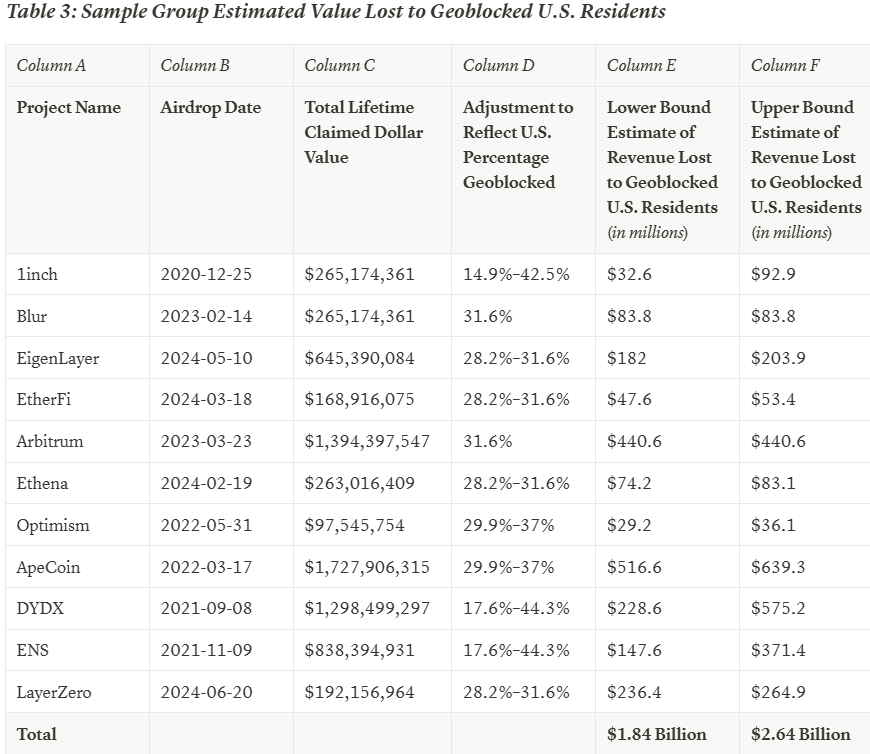
Estinated Revenue Miss from US Residents
Estimated Revenue Miss from US Residents

US Government Not Left Out

The report further indicated that the US government has also lost staggering amounts of revenue. With the $1.84 billion lower band and CoinGecko’s $5.02 billion upper band, an individual tax of $418 million and $1.1 billion and a state tax of $107 million and $284 million would have flowed into the state’s purse had the geoblocking not affected residents.

In total, the US government has lost between $525 million and $1.38 billion in taxes on US residents’ airdrop geoblocking. This adds to the growing number of funds the country has missed out on due to its mismanagement of the opportunities the crypto industry brings.

David Sacks, the White House AI and crypto czar, recently pointed out that the United States missed over $17 billion from the nation’s miscalculated Bitcoin sales.

Finance Expert Patrick Bet-David Explains How XRP Could Reach $1,000 Per Coin

In a recent episode of the PBD Podcast, Patrick Bet-David, host of Valuetainment, discussed the potential for XRP to reach an ambitious four-digit figure.

According to Bet-David, if XRP were to replace traditional financial systems like SWIFT and FedNow, the demand for XRP could skyrocket, leading to a massive increase in its price.

XRP to $1,000: Breakdown of the Numbers

In his commentary, the market commentator explained that the XRP Ledger (XRPL) can process transactions in just 3 to 5 seconds. This speed comes at near-zero cost, contrasting the much slower and more expensive SWIFT system.

He pointed out that currently, SWIFT handles $5 trillion daily, or 1.25 quadrillion annually. If XRP captured just 10% of this volume, it could see a market worth $125 trillion annually.

Bet-David cited statements from analysts who have predicted that such a massive volume would lead to a $10 trillion market cap for XRP. Accordingly, the unit price of XRP could rise to $100.

Meanwhile, Bet-David also mentioned that these analysts anticipate that with the full replacement of traditional systems, the value of XRP could soar to $1,000.

However, the media personality noted that these analysts may have vested interests in Ripple and XRP. As a result, he cautioned that while the scenario is plausible, it is not guaranteed.

Nonetheless, Bet-David emphasized that this analysis presents a bold vision of the future for XRP. It suggests that if these developments come to pass, it could be a game-changer for the coin.

Major Factor Influencing Bold XRP Prediction at This Time

Notably, these analyses come as Bet-David weighs in on the significance of U.S. President Donald Trump mentioning XRP among the tokens the U.S. could officially hold for the long term. On Truth Social, Trump shared a post about XRP and included comments about Bitcoin and Ethereum.

Bet-David speculated that this move could indicate growing support for XRP behind closed doors, potentially from influential figures advising the president. He emphasized that such endorsements could signal something significant on the horizon for XRP.

Accordingly, he urged listeners to keep an eye on the next 3, 6, and 12 months for potential developments. He also cautioned those who might not have the time or resources to conduct their own research, advising diversification as a safer strategy.

Ultimately, Bet-David believes the coming months hold important news that could drastically impact the future of XRP and other cryptocurrencies.

Here’s MicroStrategy Profit if It Had Invested $33B in XRP Instead of Bitcoin as Its Gains Drop to $7B Amid BTC Slump

0

Strategy (formerly MicroStrategy) would have secured a much larger profit if committed to investing in XRP rather than Bitcoin.

The latest market crash brought Bitcoin’s (BTC) price to new yearly lows below the pivotal $80,000 mark. Despite an immediate recovery above $80,000, Bitcoin remains in a critical position, currently changing hands at $81,800 with a 5.89% decline over the past seven days. 

MicroStrategy’s Bitcoin Strategy

Amid this market downturn, the performance of Strategy’s Bitcoin investment has been low of recent despite maintaining impressive gains. For context, the firm holds 499,096 BTC, which it procured for about $33.1 billion. 

Notably, at Bitcoin’s all-time high of $109,000, this holding would be worth $54.4 billion, yielding an unrealized profit of up to $21.3 billion for the Bitcoin strategy firm. However, currently, this profit has reduced to about $7.7 billion, as the worth of Strategy’s total Bitcoin holdings slump to $40.8 billion.

While the current profit still represents impressive gains, some XRP community figures have asserted how the software development company would have secured much greater profit had it turned its focus on XRP instead of Bitcoin.

Interestingly, The Crypto Basic recently evaluated these claims and found an element of truth. For context, MicroStrategy began its Bitcoin purchase campaign in August 2020 with a purchase of $250 million worth of BTC. Since then, it has committed $33.1 billion in the firstborn crypto asset, buying at an average price of $66,375.

MicroStrategy Profit if It Bought XRP Instead

Notably, if MicroStrategy had poured its $33.1 billion into XRP, especially during the period it amassed Bitcoin, its holdings would be worth more than the current value even with XRP’s 29% collapse last month.

For the sake of this assessment, we considered XRP’s average price since August 2020. Within this timeframe, the altcoin has traded at an average value of $0.7, with most of its time spent within the $0.5 to $0.55 region during the 2022 bear market.

Nonetheless, supposing Strategy purchased XRP at an average price of $0.7, the $33.1 billion would have procured 47.285 billion XRP tokens. Interestingly, according to the Q4 2024 markets report, Ripple held 42.4 billion XRP as of December 2024. Strategy’s 47.285 billion XRP holding would have made it the largest XRP holder, surpassing Ripple.

Meanwhile, these 47.285 billion XRP tokens are currently worth $101 billion amid XRP’s current price of $2.15. This translates to a yield of $67.9 billion, over $60 billion more profit than what Bitcoin currently boasts. Notably, at XRP’s mid-January peak price of $3.4, these holdings would be worth $160.769 billion.

However, while this assessment confirms that an XRP strategy would have benefited MicroStrategy more, it still does not accurately evaluate the potential profit due to the DCA factor. Also, a decision from MicroStrategy to invest in XRP since 2020 would have pushed XRP to a different position today, possibly higher.

Ripple CEO Reacts as $1.5T Asset Manager Franklin Templeton Joins XRP ETF Race

0

Franklin Templeton, an asset manager with over $1.5 trillion in assets, has joined the race to launch an XRP ETF in the U.S. 

Notably, The Crypto Basic initially reported the development on its official X handle. 

The leading asset manager officially submitted an S-1 registration with the U.S. SEC yesterday, March 11. This follows the asset manager’s earlier registration of an XRP Trust in Delaware. 

Key Details of Franklin XRP Trust 

Like previous filings from other asset managers, the Franklin XRP Trust will track XRP’s price performance, giving investors indirect exposure to the underlying asset. 

According to the filing, Franklin Templeton structured the fund as a Delaware Statutory Trust and selected Coinbase Custody as the custodian of the fund’s XRP assets. 

While CSC Delaware Trust Company will serve as the fund’s sole trustee, an unnamed custodian will manage the XRP Trust’s cash holdings. This unnamed entity will also serve as the transfer agent and administrator of the fund. 

Furthermore, Franklin sponsors the XRP Trust, and the company will serve as its marketing agent. 

Interestingly, the asset manager disclosed that shares of its XRP Trust will be listed and traded on the Cboe BZX exchange. Other prospective issuers, such as WisdomTree, Canary Capital, and 21Shares, also selected Cboe BZX as the platform for trading shares of their XRP ETFs. 

Ripple CEO Reacts 

Interestingly, Franklin’s XRP ETF filing prompted reactions from top crypto stakeholders, including Ripple CEO Brad Garlinghouse.

The Ripple CEO posted an eye emoji in reaction to the development, expressing delight and drawing the XRP community’s attention to the news. 

In addition, Nate Geraci, the President of The ETF Store, also reacted to the development, characterizing Franklin Templeton as a ‘big name.’ 

Next Step 

Following Franklin’s XRP ETF S-1 application, Cboe must submit a 19b-4 filing with the SEC, signaling its interest in listing shares of the fund. Like other prospective XRP ETF issuers, Franklin will wait for the SEC to acknowledge the exchange application of its XRP ETF. 

Once this happens, the SEC must decide whether to approve or deny the launch of the Franklin XRP Trust within a 240-day window,

Meanwhile, several industry experts believe the SEC will acknowledge the filing, as it did with other related filings.

Notably, filings for XRP ETFs continue to surface despite the ongoing SEC v. Ripple lawsuit. That case still lingers in the Court of Appeals for the Second Circuit. While the current SEC leadership has been pausing and dismissing other crypto-related lawsuits, it has not issued an official decision regarding the Ripple case. 

According to some legal experts, the delay is due to Garlinghouse’s negotiation to overturn the trial court’s decision that its XRP institutional sales constitute investment contracts. 

Recall that this finding prompted the judge to impose a $125 million fine against the company and an injunction against its future XRP sales to institutional clients. Overturning this decision would allow Ripple to continue selling XRP to institutional clients and potentially end the regulatory uncertainty surrounding the coin. 

TRIBLU Founder Speculates Possible Reason Behind Jack’s XRP Portrayal of Michael Saylor

0

The founder of TRIBLU LLC, an IT services firm, triggers fresh speculations around the possible reason behind Jack Dorsey’s XRP portrayal of Michael Saylor.

These new discussions have emerged within the XRP community following the first-ever White House Crypto Summit on March 7. The event, attended by key figures in the crypto industry, including MicroStrategy’s Michael Saylor, has led to speculations around Dorsey’s previous Primal clip.

Dorsey’s AI Clip

Recall that in early February, Jack Dorsey, the former Twitter CEO, shared a short AI-generated video on Primal, a decentralized social platform. The clip initially depicted Saylor, a well-known Bitcoin advocate, surrounded by Bitcoin visuals. 

However, as the video progressed, Saylor transformed into an XRP coin. Confusion emerged within crypto circles, with many wondering if Dorsey was hinting at a potential shift in allegiance for Saylor or simply jesting.

TRIBLU Founder Reignites Speculation

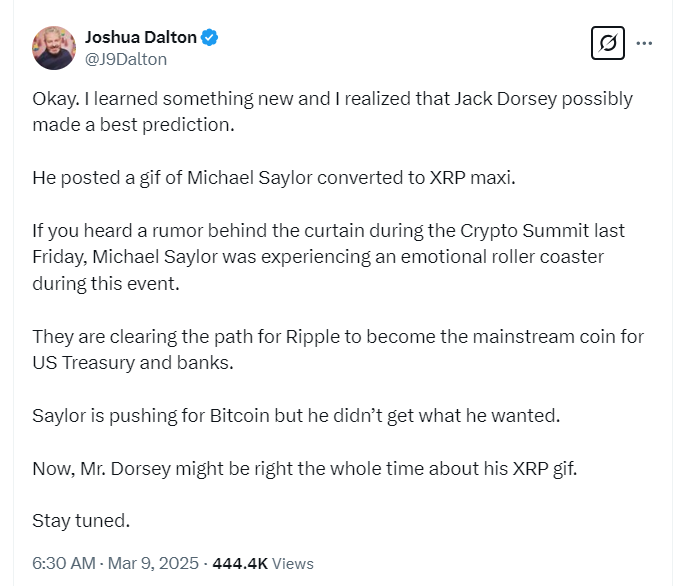
Most recently, following the White House Crypto Summit, Joshua Dalton, the founder of TRIBLU, voiced his observations, drawing a connection between Dorsey’s AI clip and what he claimed to have heard from insiders at the event.

Joshua Dalton the founder of TRIBLU
Image Source: https://x.com/J9Dalton/status/1898547019364606122

According to Dalton, Saylor reportedly experienced a mix of emotions during the summit, potentially indicating that discussions did not favor Bitcoin as he had hoped. 

He speculated that policymakers might be preparing the groundwork for Ripple to gain a more prominent role in U.S. financial systems, including the Treasury and major banks.

Dalton further suggested that Saylor may have been advocating for Bitcoin’s dominance but did not receive the response he had anticipated. 

In light of these, he proposed that Dorsey’s post might have been a more accurate prediction than initially believed. However, these interpretations remain speculative.

Reactions From the XRP Community

Despite their speculative nature, Dalton’s comments gained attention, with responses from other influential voices in the XRP community. 

Wealth mentor Linda P. Jones spotlighted a particular part of the claim, highlighting the notion that XRP could become a preferred digital asset within government financial systems. 

Moreover, Vandell Aljarrah, co-founder of The Black Swan Capitalist, put forward a theory that Saylor may secretly own XRP while simultaneously serving as a strategic figure promoting Bitcoin to the public.

According to Aljarrah, Saylor’s frequent appearances on mainstream financial news networks could be part of a plan to direct attention toward Bitcoin while diverting focus from other assets like XRP. He suggested that this level of influence and exposure was not coincidental.

Theories Remain Speculative 

Recall that at the time the clip initially surfaced, some XRP proponents interpreted it as a representation of Saylor’s potential change in allegiance toward XRP. The speculation gained traction amid growing tensions between Bitcoin maximalists and the XRP community. 

Despite the excitement surrounding these theories, they remain largely speculative and might not materialize as expected. While Dorsey’s AI clip fuels theories, its original intent remains unclear. It could have been a simple joke or just a reflection of his own views.

Here’s How High 1 Dogecoin May Reach if DOGE Market Cap Hits Elon Musk’s Net Worth

0

Dogecoin could set a new high above the $2 mark if its market cap matches the net worth of the world’s richest man, Elon Musk. 

Dogecoin has gained widespread popularity since its inception in 2013. While several factors have driven DOGE’s popularity over the years, investors cannot ignore Elon Musk’s influence on the firstborn memecoin.

Musk’s Effect on Dogecoin 

Tesla’s CEO remains one of the top advocates who brought significant attention to DOGE during the 2020/2021 market cycle. 

The American businessman has continued to draw significant attention to DOGE by characterizing the token as the “people’s crypto.” Three months after this comment, the price of DOGE spiked to an all-time high of $0.7376 per token on May 8, 20221. 

Although DOGE has plunged significantly from its peak, many believe that the influence of public figures like Musk, alongside strong institutional adoption, could propel Dogecoin’s price to new heights. 

Amid this optimism, some imagine a scenario where DOGE’s market cap might match Musk’s net worth. 

Overview of DOGE Market Cap vs Elon Musk’s Net Worth 

Musk is currently the world’s richest man, boasting an estimated net worth of $342.4 billion as of March 8, 2024. He is the CEO of several multi-billion dollar companies, including Tesla, SpaceX, and X (formerly Twitter). 

Elon Musks Net Worth
Elon Musk Net Worth

On the other hand, DOGE stands as the eighth-biggest cryptocurrency globally, with a market cap of $28.94 billion. At this valuation, DOGE is trading at $0.1951, marking a 24-hour decrease of 5.37%. 

DOGE Price If It Equals Musk Net Worth 

For DOGE to match Musk’s net worth of $342.4 billion, its market cap must grow more than tenfold from its current value. 

Specifically, DOGE’s market cap must soar astronomically by 1,083% from its current valuation of $28.94 billion to equal Musk’s $342.4 billion net worth. 

If this hypothetical scenario happens, Dogecoin will be worth $2.3 per token, assuming its circulating supply of 148.34 billion DOGE remains relatively stable. 

To demonstrate the significance of this rally, a portfolio of 100,000 DOGE, currently valued at $19,510, will be worth $230,000 if DOGE hits the $2.3 projected target. 

DOGE to $2.3 Prediction 

Interestingly, several crypto experts, including Dogecoin’s co-founder Billy Markus, have predicted DOGE’s potential surge to the $2 mark. 

In January, Markus called for an upsurge of 500% that could potentially take DOGE’s price to $2.3. At the time, he envisioned the possibility of the token being supported as a tipping currency on X. 

A few weeks later, renowned crypto analyst Javon Marks referenced DOGE’s historical price pattern to predict the meme coin’s future rally to around the $2.3 mark. 

Meanwhile, Changelly experts set a timeline on when DOGE might hit the $2.3 target. According to the experts, the $2.3 price projection could become a reality for DOGE by July 2032, more than seven years from now. 

However, the popular prediction platform Telegaon suggests that DOGE might reach the $2.3 target early next year. It remains to be seen whether DOGE will reach this target or what the exact timeline is for this to happen. 

In the meantime, investors must exercise caution and seek professional advice before investing in cryptocurrencies like DOGE. 

Analyst Warns: XRP Set for Potential Free fall, Here’s Why

XRP has been struggling recently, experiencing consistently declining prices. 

Currently, XRP is in a “freefall” phase, according to analyst Steph. He recently shared a crucial update on X, warning investors about a potentially dangerous pattern forming in the price action. The pattern in question is a Head and Shoulders formation, a known bearish signal.

Steph emphasized that the pattern was not well-formed in his previous update. However, the current market conditions have led to a clearer setup, with the left shoulder, head, and right shoulder becoming more apparent.

At the time of his analysis, the price of XRP was nearing a critical level, with the $2 mark under threat.

Support Level XRP Must Maintain to Remain Bullish

At the moment, XRP is trading at the $2 level, which serves as a support and neckline for this potential Head and Shoulders breakdown. According to Steph, this level is key in determining whether the pattern will play out and lead to further downside movement.

Steph noted that if XRP loses the $2 support level, it could signal a further decline. However, he also pointed out that, before taking a definitive stance, a daily—and ideally a weekly—candle close below the $2 mark is necessary to confirm the bearish outlook.

Notably, XRP touched $1.92 today before swiftly rebounding to $2.14 at press time, avoiding a close below $2. Still, the danger is not over yet.

Potential Price Dip to $1.20 and $1.17

Should the breakdown confirm with a close below $2, Steph provided a technical price target for XRP to watch next. Specifically, he forecasts a drop to the range of $1.20 to $1.17. This range is based on the length of the head in the Head and Shoulders pattern, projected down from the neckline.

Steph also pointed out that significant volume was traded in this price area back in November 2024. This suggests that a retest of this level could occur if the bearish scenario unfolds.

However, he cautioned that this outcome would only be valid if the market sees a confirmed breakdown below $2, with support from trading volume.

XRP head and sholders pattern by Steph
XRP head and shoulders pattern by Steph

Notably, analyst Ali Martinez has also warned that XRP could crash to $1, citing the head-and-shoulders pattern.

Martinez also noted that XRP recently formed the right shoulder of this pattern, warning of a major downfall with a sustained dip below $2. Essentially, although bullish sentiment about XRP persists, warnings of bearish levels are growing, even among optimistic analysts.

Research Platform Reveals Insiders Dumped TRUMP Token Before Crash

0

10x Research argues that insiders received the TRUMP token at the pre-inaugural Washington crypto ball before it became available for public trading.

The research firm suggests that these early investors capitalized on the opportunity before major exchanges rushed to list the coin as its value surged past $60, briefly touching $70. 

However, the price soon collapsed to $10, leaving retail traders with billions in losses. This pattern mirrors previous speculative cycles, including the 2021 NFT boom and bust, where early participants benefited while later investors faced heavy losses.

The TRUMP coin saw its value drop by 50% within a week. On-chain data revealed that early buyers quickly liquidated their holdings, using retail traders as exit liquidity.

Image

This sell-off significantly impacted the Solana meme coin sector, which had been driving substantial market activity. As a result, the downturn reinforced broader concerns about the volatility of speculative digital assets and the risks associated with hype-driven trading.

Solana Ecosystem Tokens Face Heavy Selling Pressure

The broader market downturn has also impacted key tokens within the Solana ecosystem. Raydium’s RAY token, a major automated market maker, has seen a 70% price decline in just 30 days.

Meanwhile, Jupiter’s JUP token, which operates as a decentralized exchange on Solana, has dropped by 42%. Likewise, Solana’s SOL token has lost 41% over the same period. The rapid declines suggest a waning interest in speculative tokens linked to recent market trends.

Pump.fun, a leading meme coin launch platform, has also seen a dramatic shift. Over the past year, it has facilitated 8.4 million meme coin launches, with activity peaking around President Donald Trump’s inauguration. 

During the Christmas to inauguration period, 1.7 million meme coins were launched. However, daily launches have now dropped from 62,000 to 24,000. Despite lower meme coin creation costs due to Solana’s price drop, participation has declined significantly.

Pump.fun Slumps Back to Hundreds

Adding to the woes, Pump.fun’s revenue stream has suffered, with daily earnings plummeting to their lowest in seven months by March 8. Previously, Pump.fun maintained daily fees above $1 million. However, current data shows 24-hour fees and revenue at $108,124.

Pump Fun Fees Vs Revenue

Trump’s Bitcoin Reserve Order Raises Questions

President Donald Trump’s involvement in the crypto sector has continued to raise questions. Edward Farina, founder of Alpha Lions Academy, pointed out liquidity challenges, attributing part of the instability to Trump’s engagement with the sector.

Meanwhile, Trump has shifted focus toward Bitcoin, signing an executive order on March 6 to establish a strategic Bitcoin reserve for the United States.

The order directs the Secretary of the Treasury and the Secretary of Commerce to develop budget-neutral strategies for acquiring Bitcoin. This condition aims to facilitate government Bitcoin purchases without incurring costs for U.S. citizens, potentially reducing public opposition.

In the days following the announcement, Bitcoin’s price experienced volatility, briefly falling below $77,000 before recovering. As of the latest data, Bitcoin is trading at $81,440, reflecting a 1.09% decline in the last 24 hours and a 3.04% decline over the past week.

Senator Lummis Reintroduces Bitcoin Act to Secure US Future as Michael Saylor Projects $106T Earnings from BTC

Wyoming Senator Cynthia Lummis has disclosed her plans to reintroduce the “BITCOIN Act” to secure America’s financial future.

Lummis confirmed this development at an ongoing invitation-only forum by the Bitcoin Policy Institute, themed “Bitcoin for America.”

During her speech, Senator Lummis expressed excitement, noting that she would reintroduce the Bitcoin bill today. She disclosed that the refreshed bill now has several additional co-sponsors compared to before, amid growing interest in the proposal.

Details of the Bitcoin Act

Notably, the original bill, introduced in July 2024, proposed the creation of a U.S. strategic Bitcoin reserve to strengthen the dollar and reduce the national debt. The legislation aims to establish secure Bitcoin vaults under the Treasury Department, with top-tier cybersecurity.

It proposed implementing a 1-million Bitcoin purchase program to acquire about 5% of the total Bitcoin supply. The bill also sought to fund the program through existing Federal Reserve and Treasury resources, such as gold.

Moreover, the bill aims to protect individual Bitcoin holders’ self-custody rights and financial freedoms.

For context, U.S. President Donald Trump has already signed an executive order to establish a Bitcoin reserve. Trump’s order focused on creating a reserve with existing BTC tokens the U.S. already holds, prohibiting periodic sales. It also hinted at further acquisitions but failed to present a definite strategy for this.

Meanwhile, some industry pundits have suggested that Trump’s Bitcoin reserve order would only stand for as long as he remains president since the establishment was not via the legislature. In other words, the effort risks being unwound by a new president.

However, they propose that the move could become permanent should Senator Lummis’s Bitcoin Act pass before the end of Trump’s tenure.

How America Could Earn $106 Trillion From Bitcoin

During the Bitcoin forum, MicroStrategy Chairman Michael Saylor commented on how the U.S. government could benefit from the proposed Strategic Bitcoin Reserve. He cited potential earnings of $106 trillion if the country consistently acquired Bitcoin over time.

Saylor pointed out that the U.S. could start by following the guidelines laid out in the Bitcoin Act, which suggests acquiring 1 million Bitcoin over a five-year period in a disciplined and transparent manner.

He emphasized that even holding 200,000 Bitcoin for the next 20 years could result in a value of $3 trillion, with no active trading involved.

According to Saylor, doing nothing—by avoiding poor decisions like selling or trading Bitcoin—could prove to be a profitable strategy. Meanwhile, he argued that the 1 million BTC the senator proposed could be worth $16 trillion.

Furthermore, he explained that if the U.S. were to adopt a more aggressive strategy, such as the “triple max” plan, it could acquire up to 4 million Bitcoin. He projected it would result in a $73 trillion benefit.

Saylor also urged the U.S. to be a superpower in acquiring Bitcoin, consistently acquiring Bitcoin daily until 2035, when 99% of the supply would be mined. In this strategy, it could accumulate 5.5 million BTC tokens, which he projected would be worth $106 trillion.

Saylor stressed that, in the long term, this strategy could neutralize the national debt and establish a significant global superpower position for the U.S.

Saylor Propsotion
Saylor proposition for US

Deutsche Boerse to Launch Bitcoin and Ethereum Custody Services for Institutional Clients

0

Leading German exchange group Deutsche Boerse announces plans to launch regulated crypto custody and settlement services for its institutional clients. 

According to a Bloomberg report, Deutsche Boerse will launch the new services this year through its trading unit, Clearstream. 

Features of the Offering 

Notably, Clearstream will offer the services to its 2,500 institutional clients by next month, April 2025. The firm will initially support the two biggest cryptocurrencies by market cap–Bitcoin and Ethereum. 

However, the Bloomberg report hinted that plans are underway to support other notable cryptocurrencies in the future. Clearstream will also expand its crypto-related services beyond settlement and custody to include staking, brokerage, and lending. 

According to the announcement, Deutsche Boerse will offer custody and settlement services through Crypto Finance AG, a subsidiary of Deutsche Boerse. Recall that in 2021, the German exchange group acquired a majority stake in Crypto Finance. 

Clearstream and Crypto Finance Execs React 

Jens Hachmeister, Clearstream’s head of new digital markets, highlighted the significance of the new services in a statement to Bloomberg. According to him, the initiative aligns with the company’s commitment to creating a comprehensive brokerage, custody, and settlement platform. 

Reacting, Stijn Vander Straeten, CEO of Crypto Finance, suggested that the initiative was driven by the growing demand for crypto-related services among institutional banking clients. 

In response to this demand, he stated that firms commit as much as €5 million to develop in-house crypto services.   

MiCA’s Impact on European Businesses 

The move comes as European businesses push to offer regulated crypto services to institutional clients following the implementation of the Markets in Crypto-Assets Regulation (MiCA). 

This regulatory framework, implemented on December 30, 2024, aims to provide institutional clients with clarity and safety within the crypto space. 

While many see MiCA as a positive step in global crypto regulation, particularly for institutional clients, some are concerned that its strict rules might negatively impact retail customers. Others suggested that the ‘strict regulation’ could potentially push smaller crypto businesses out of Europe. 

However, some entities have ignored these concerns and obtained a license under the MiCA framework. In January, Boerse Stuttgart Digital Custody made history by becoming the first German-based crypto asset service provider to obtain a full license under this framework. 

Meanwhile, Deutsche Boerse has continued to expand its footprint into the crypto market. After initially launching spot crypto trading for institutional clients earlier this month, these customers will now gain access to custody and settlement services through its official trading unit, Clearstream.