Home Blog Page 873

Whales Scoop 65K BTC as Bitcoin Holds $81K: Is $84K Next?

Bitcoin hovers above $81K in an overnight recovery, and whale activity hints at another potential price surge.

As Bitcoin maintains its dominance above the $81,000 mark, it has seen a notable comeback. After a 5.48% surge yesterday, an intraday pullback of 1.62% has dropped the market price to $81,524.

With Bitcoin fluctuating near the 61.80% Fibonacci level, the chances of a post-retest reversal are high. Could this drop Bitcoin back to the $75,000 mark?

Is Bitcoin in for Another Post-Retest Reversal?

On the daily chart, the BTC price trend shows a bullish engulfing candle, reclaiming the 61.80% Fibonacci level. This critical horizontal level is at $81,855.

Bitcoin Price Chart
Bitcoin Price Chart

Despite a 24-hour high of $83,733, the intraday pullback signals a possible post-retest reversal for Bitcoin. This is due to the recently broken support-to-resistance trendline of a symmetrical triangle pattern.

With a higher price rejection, the bearish intraday candle suggests a continuation of the bearish trend. Currently, the daily RSI line is fluctuating near the oversold boundary level, reflecting a weakening bullish momentum. Due to the lack of buying pressure, the possibility of a significant correction in Bitcoin remains high.

Whales Acquire 65K BTC Amid Volatile Market Conditions  

Notably, the recent swing low in Bitcoin has triggered a new wave of whale accumulation. As per CryptoQuant, the whales purchased over 65,000 BTC in the recent crash.

Furthermore, in a separate tweet, the on-chain data provider highlighted that Bitcoin corrections during a bull market are normal. According to the platform, Bitcoin’s 22% drawdown is not unusual for a bull market.

However, the valuation matrix signals a deeper correction than usual. During the 2016-17 bull market, similar drops didn’t trigger such a bearish sentiment. Therefore, the platform warns of a potential steeper correction for Bitcoin.

US Bitcoin ETFs Record $1.54 Billion in Outflow Since March 3

Despite Bitcoin’s surge on March 11, U.S. Bitcoin Spot ETFs recorded a net outflow of $371 million. With another day of outflows, Bitcoin ETFs have registered their 7th consecutive day of outflows in the U.S. market.
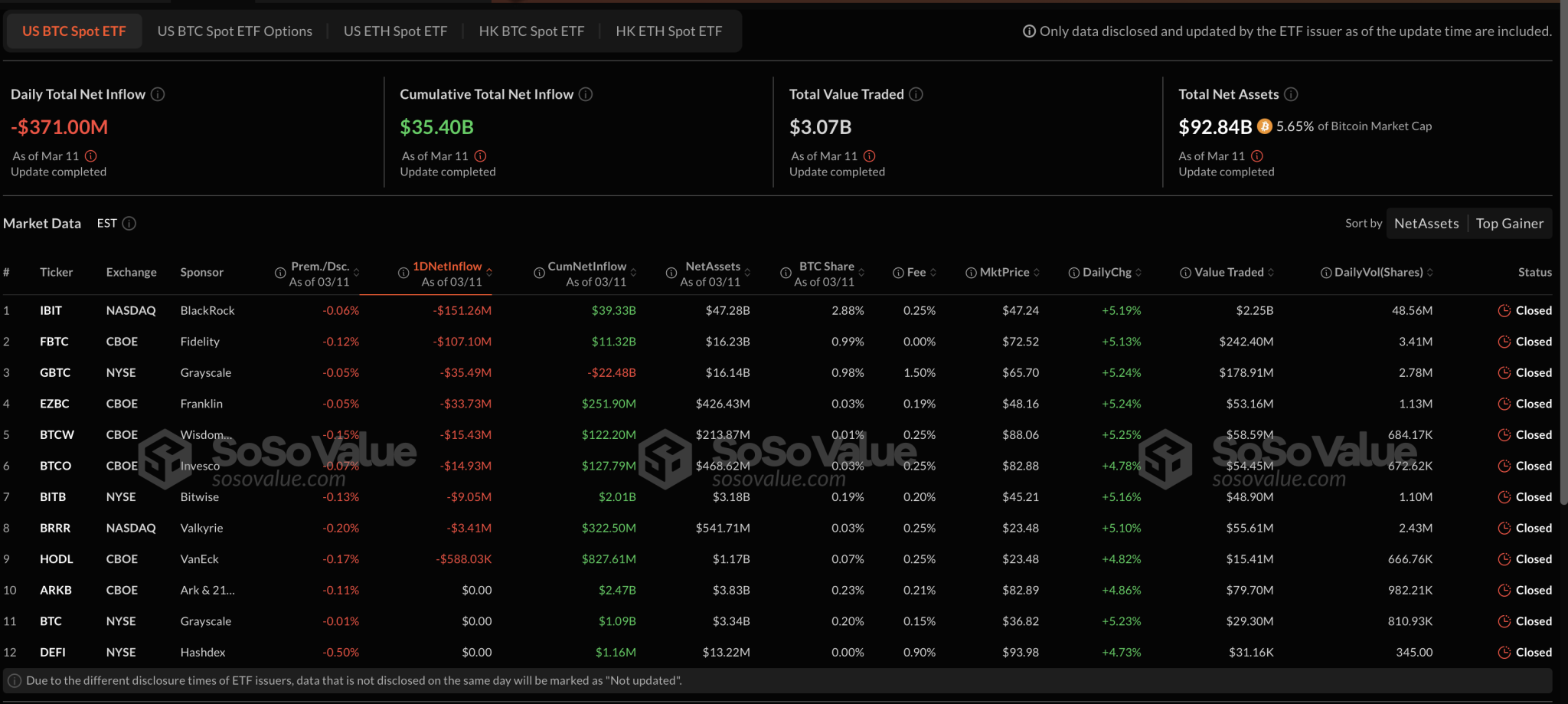
Bitcoin Spot ETFs
Bitcoin Spot ETFs

Driving the outflows, BlackRock and Fidelity offloaded $151 million and $107 million, respectively, while three ETFs saw zero outflows. Over the last seven trading days, Bitcoin ETFs have experienced a total outflow of $1.54 billion.

Analyst Highlights Key On-Chain Price Levels

Analyst Ali Martinez suggests that the short-term ongoing pullback in Bitcoin could encounter strong support levels at $79,270 and $69,450, based on on-chain data from IntoTheBlock.

The key support near $79,000 holds a total volume of 301.41K BTC in 368.55K addresses. Meanwhile, the short-term recovery leading to a bullish engulfing candle could face immediate resistance at $84,296, extending to $86,753, which holds a supply of 287.2K BTC in 556K addresses.


Lummis Tips BITCOIN Act as Solution To National Debt, Crypto Czar Says “Bitcoin is Special” as Strategic Reserve Gains Momentum

0

Senator Cynthia Lummis joins the chorus of voices tipping a strategic Bitcoin reserve to help the U.S. tackle debt concerns.

Following President Donald Trump’s executive order on Thursday, March 6, establishing a reserve from Bitcoin seized by federal law enforcement agencies, everyone from asset managers to key industry voices has tipped the move to help the U.S. tackle debt concerns.

The latest to join this chorus is pro-Bitcoin Senator Cynthia Lummis, who recently reintroduced her Bitcoin reserve bill, the BITCOIN Act, which promises to enshrine the strategic reserve in U.S. law, ensuring it survives even after Trump leaves office.

“The BITCOIN Act is the solution to our national debt, and the future of American prosperity,” Lummis asserted in an X post on March 11 on the reintroduction of her bill to codify the establishment of a U.S. strategic Bitcoin reserve.

The bill, first introduced in July 2024, would see the U.S. buy 1 million BTC, nearly 5% of the total 21 million BTC supply, over five years “by diversifying existing funds within the Federal Reserve System and Treasury Department.”

With the U.S. deficit increasing at a concerning rate, the national debt, which currently stands at $36 trillion, has become a battering ram for Bitcoin proponents goading the government to establish a strategic reserve of the digital asset.

The argument is premised on the belief that Bitcoin has exponential growth potential as a scarce asset. Simply put, proponents like Lummis believe that one day the asset will be so valuable that the U.S. will be able to leverage a reserve of it to clear its debt.

“Bitcoin is Special”

Surmising the view of these Bitcoin proponents, White House crypto czar David Sacks recently asserted that the digital asset was “special.”

“We do think Bitcoin is special,” Sacks declared in a Saturday, March 8 episode of the All-In podcast.

Amongst other things, the famed startup investor hailed the network’s enduring security over the past 15 years and the potential for its price to grow with more acceptance. 

“I mean, I remember back in 2011 I think it’s the first time I bought a Bitcoin. I think it was at $120. Now it’s at $90,000,” he stressed.

Ethereum Analysis: Is Breakout Rally to $2,500 Possible?

Will Ethereum make a bullish reversal to $2,500 as ETH price action signals a potential wedge breakout rally ahead?

Ethereum fluctuates near the $1,900 level as Bitcoin holds above $81,000. Notably, Ethereum has recorded a 13% drop in the past seven days.

However, a reversal pattern is emerging on the 4-hour chart, hinting at a potential bounce-back. Could this lead to a new wave of bullish momentum for Ethereum?

Ethereum Price Eyes Wedge Breakout For New Recovery Wave

On the 4-hour price chart, Ethereum is showing a declining trend but gaining momentum. The price drop has breached the 78.60% Fibonacci level, testing a local support trendline.

Ethereum price chart

The support trendline forms a falling wedge pattern on the 4-hour chart, with an overhead resistance trendline. Currently, the bullish reversal from the trendline, accompanied by lower price rejection, struggles to maintain dominance at the 78.60% Fibonacci level.

This crucial Fibonacci level is at $1,897. At present, Ethereum is trading at $1,907, reflecting a 2.04% price surge in the past four hours.

Technical indicators support the chances of a bullish reversal. The MACD and signal lines are on the verge of a positive crossover. Furthermore, the 4-hour RSI line has bounced off from the oversold region.

With a fresh wave of bullish momentum, Ethereum is likely to challenge the overhead trendline, which is close to the $2,000 psychological mark.

Analyst Signals Potential Recovery

With the short-term bounce-back in Ethereum from local support, network activity spiked. According to analyst Ali Martinez, the number of active ETH addresses has jumped 17% in the past 24 hours.

This marks a significant rise from 429,000 to 503,000 active addresses on the Ethereum network. As the number of active ETH addresses grows, this rising activity could lead to additional demand.


However, the analyst also highlights a surge in ETH supply on exchanges. Based on data from Santiment, more than 100,000 ETH has been moved to exchanges in the past 48 hours. This has led to a significant supply surge on exchanges, reaching 9.23 million ETH.

Moreover, the analyst points out crucial resistance for Ethereum between $2,248 and $2,610, based on the Global In/Out of the Money indicator from IntoTheBlock.

This resistance zone holds 65.24 million ETH across 12.28 million addresses. Therefore, the short-term recovery in Ethereum will need to surpass this critical level for a sustained recovery.


Ethereum ETFs Record Fifth Consecutive Day of Outflow

As Ethereum’s price remains volatile, U.S. Ethereum spot ETFs recorded a net daily outflow of $21.57 million on March 11. This includes an outflow of $11.82 million from BlackRock and $9.75 million from Fidelity.

The remaining seven ETFs showed no outflow. Since March 5, Ethereum ETFs have experienced five consecutive days of outflows, totaling $181.41 million.

Key ETH Price Targets

While the short-term increase in network activity hints at a potential bounce-back, critical resistances for Ethereum remain. However, the falling wedge breakout rally could trigger a new wave of bullish momentum.

Based on the Fibonacci levels, a breakout from the pattern would likely challenge the 50% Fibonacci level near $2,500. This price level aligns with the key on-chain resistance zone mentioned by Ali Martinez.

On the flip side, a failure to maintain the bullish momentum would likely lead to a retest of the $1,757 support level, close to the local support trendline.

Millionaire Pundit Alex Becker Says Cardano Could Easily 5x from Here

0

Prominent market pundit Alex Becker has suggested that Cardano could easily record a four to fivefold upside from the current market dip.

He shared this bullish sentiment in a Tuesday YouTube podcast. According to him, Cardano could deliver a 4x to 5x gain to smart buyers who leverage the recent dip to stack the layer-1 digital asset.

The eighth-largest cryptocurrency had a mixed price reaction earlier this month but has generally been bearish. The asset has been on a downward spiral since an over 53% increase in a single day to reclaim $1 on March 2 following Donald Trump’s inclusion in the US crypto reserve.

Nonetheless, Becker, who has often criticized Cardano, has suggested that the asset’s price is ridiculously low. He insisted that market enthusiasts who acquire ADA and most other high-caliber digital currencies at this point could easily post staggering gains.

Pundit Urges to Buy the Dip

Becker stressed that the latest downside has presented a massive buy opportunity for Cardano and other assets. He likened it to the over 25% Bitcoin crash from its all-time high to the discount the market saw during the FTX and Covid-19 pandemic crash.

Meanwhile, he noted that each of the downsides has usually proved rewarding for diamond hands, and this would not be an exception. As a result, he urged crypto enthusiasts to look past the current dip and buy assets that have long-term viability.

He mentioned a few assets “that are going nowhere,” including Cardano. According to him, the asset could easily grow fourfold or fivefold when the market rebounds and targets multiple all-time highs in the long term.

The pundit also mentioned Solana, Near, and Bittensor as blue-chip cryptos that would continue uptrends. Although he suggested that the multiple-fold surge may not happen this cycle, he insisted it would happen “within years.”

Cardano Set for a Quick Rebound?

Meanwhile, the AI-focused Hyros founder’s analysis correlates with recently emerging dispositions around ADA’s prices. Recent commentary suggests that Cardano has flashed a reversal signal amid a whale reawakening and could be set for a rebound to $0.92.

Furthermore, analyst Dan Gambardello’s speculations suggest that Cardano’s super trend to $10 remains intact despite the dip. Hence, he insinuated that the layer-1 coin could rebound extensively from the intense correction to unprecedented prices.

In the meantime, Cardano trades at $0.735, up 2% today after an impressive 8% surge yesterday.

Cardano 12X Surge Coming Soon, Top Analyst Predicts: Here’s Why

0

A chart analysis reveals a Cup and Handle pattern for Cardano (ADA), projecting an incoming 12X price surge.

Cardano has exhibited notable price fluctuations over the past 24 hours, ranging between $0.70 and $0.74. In that time, ADA gained 1.7% in the last hour and 1.8% over the past day.

However, the weekly trend shows a 21.6% decline, indicating a recent correction. Despite this, the token has posted an 8.1% gain over the past 14 days and a 5.9% increase over the past month, showing resilience in the broader trend.

Chart Analysis Suggesting Potential Breakout

Following this recovery, analysts are weighing in on the next moves for Cardano. A chart shared by CryptoElites highlights a “Cup and Handle” pattern in ADA’s price movement, forecasting a potential 12-fold price breakout once resistance is breached.

The “Cup” forms as the price declines, consolidates at the bottom, and begins to recover. The “Handle” appears as a smaller pullback before an expected surge. A breakout from this pattern typically signals strong upward momentum.

The analyst suggests that ADA’s key breakout resistance lies at $3.23. If the price surpasses this level, the next target would be around $6.45, based on the 1.272 Fibonacci extension. The ultimate price projection, should bullish momentum persist, is $9.33, in line with the 1.414 Fibonacci extension. In total, the analyst expects Cardano to see a 12X price surge.

Image
Cardano chart by CryptoElites

Could Cardano Reach $10?

Meanwhile, another analyst pointed to further bullish patterns. Dan Gambardello presented a chart featuring a curved dotted line, suggesting a possible parabolic trend. If ADA follows this path, it could result in a significant breakout to $10. The chart also included a moving average, which often signals bullish momentum when prices rise above it. 

At the time of the analysis, the Relative Strength Index (RSI) showed values between 50 and 60, reflecting increasing buying momentum. An upward trend in RSI suggests growing strength in the market, which could push ADA toward overbought levels.

On-Chain Metrics and Whale Accumulation

Elsewhere, crypto analyst Ali Martinez reported on March 11 that whales had accumulated 180 million ADA tokens in the previous week. This increased their total holdings to 6 billion tokens for wallets containing 1 million to 10 million ADA. Continued accumulation by large investors strengthens the case for a potential price recovery.

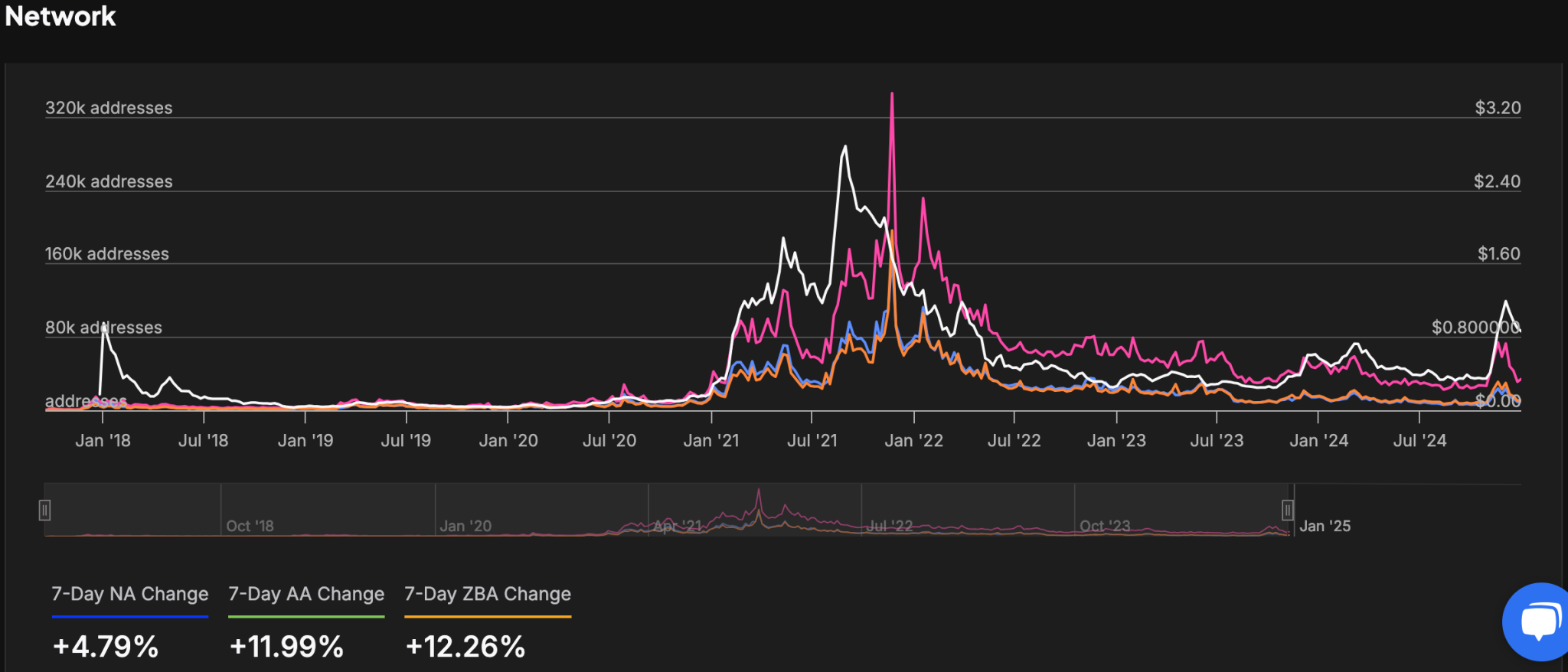
Additionally, Cardano network activity has shown a resurgence. On-chain data reveals a 4.79% increase in new addresses over seven days. 

Cardano Daily Active Addresses

Active addresses have risen by 11.99%, while zero-balance addresses have grown by 12.26%. These metrics indicate heightened user engagement, which often correlates with upward price momentum.

SEC Delays XRP ETF Decision Extending Review Period

0

The U.S. SEC has postponed decisions on several altcoin exchange-traded fund (ETF) applications, including two linked to XRP.

The regulator announced the delay on March 11, extending its review period for multiple proposed ETFs. The decision affects applications from various firms, including Grayscale, VanEck, 21Shares, and Canary. The SEC cited the need for additional time to evaluate the proposals and related issues before reaching a final decision.

SEC Extends Review Period for XRP ETF Applications

The SEC’s delay includes multiple XRP ETF applications, affecting filings from Grayscale and Canary. According to the official statements, the proposed rule change allowing an XRP ETF underwent amendments before publication in the Federal Register on February 20, 2025. The initial 45-day review period was set to expire on April 6, 2025. 

However, the commission has now extended the deadline, setting May 21, 2025, as the new decision date. This extension provides regulators with additional time to assess the filings.

Among the postponed applications, Canary’s request for a spot XRP ETF will now be considered on May 22, 2025. Meanwhile, Grayscale’s application for an XRP ETF also faces the same delay. The SEC’s decision aligns with similar extensions granted for other crypto ETFs.

Additional Delays for Other Altcoin ETF Filings

Apart from XRP-related ETFs, the SEC also postponed its decision on various altcoin investment products. The commission delayed rulings on Solana (SOL) ETF applications from VanEck, 21Shares, and Canary. 

Similarly, a Canary Spot Litecoin ETF application will remain under review until May 13, 2025. The Grayscale Spot Dogecoin ETF is now scheduled for a decision on May 21, 2025, while the Canary Spot ADA ETF is expected to be reviewed on May 29, 2025. These delays reflect the regulator’s cautious approach toward approving crypto investment products.

Meanwhile, the SEC extended its review of proposals related to in-kind creations and redemptions for Fidelity’s FBTC and FETH. BlackRock’s IBIT application also remains under consideration. Additionally, 21Shares’ request to integrate staking into its Ethereum (ETH) ETF remains unresolved.

SEC Acknowledges Grayscale Hedera Trust Proposal

In a separate development, the SEC recognized a proposed rule change that would allow Nasdaq to list and trade shares of the Grayscale Hedera Trust. The regulator opened a 21-day public comment period for the proposal before making a final decision.

Under the proposal, the trust’s shares would trade under commodity-based trust share rules. Grayscale would serve as sponsors, and CSC Delaware Trust Company would act as trustee. Coinbase Custody Trust Company would provide custodial services.

Dogecoin Reacts as All In Podcast Host Argues for “Better Bitcoin”

0

Is Dogecoin “a better Bitcoin”? 

While the Bitcoin corporate treasury wave sparked by Michael Saylor, Chairman of Strategy (formerly MicroStrategy), has sparked excitement about growing adoption in some circles, others are concerned, particularly about his company’s Bitcoin accumulation and the techniques driving this accumulation.

Among the latter is All In Podcast host Jason Calacanis. He has recently argued that Saylor’s actions paved the way for the introduction of “a better Bitcoin,” eliciting a cheeky reaction from the Dogecoin team.

In an X post on Tuesday, March 11, responding to Saylor’s speech at the Blockchain Policy Institute declaring Bitcoin a “superpower,” Calacanis asserted that the Strategy chair’s Bitcoin evangelism and accumulation techniques were bad for the digital asset’s ecosystem and brand.

“Too much centralization, too much hyperbole and too many conflicts. He’s actually setting up the perfect opportunity for someone to launch ‘a better bitcoin.’ I don’t know what that would look like, but he’s set the stage perfectly,” he added.

The All in Podcast host’s statements have unsurprisingly sparked a flurry of reactions, some less antagonistic than others.

The Dogecoin community, for one, has not so subtly suggested that the “better Bitcoin” is already here: DOGE. 

Reacting to Calacanis’ post, the Official Dogecoin X account shared a Willy Wonka GIF with a sarcastic “Really?” caption.

The sentiment comes as Dogecoin is a fork of the Bitcoin code with minor tweaks, especially in tokenomics, that make it more practical for payments. At the same time, it can be argued that DOGE remains more retail-driven than Bitcoin.

But the idea of “a better Bitcoin” is nothing new. It was the motivation behind the launch of many early altcoins. Still, none have been able to take away the original cryptocurrency’s appeal as a digital scarcity.

Shiba Inu Social Mentions Spikes By Over 4K Amid Price Recovery

0

Shiba Inu popularity on social media platforms continues to spike as SHIB moves to recover from the recent market downturn. 

Popular social intelligence platform LunarCrush reported a significant uptick in social media activity around meme-based tokens.   

Shiba Inu Ranks Among Top Meme Coins With Most Social Mentions 

According to LunarCrush, the development marks the first massive surge in social mentions that meme coins have experienced in a long time. 

Notably, Shiba Inu emerged among the top assets with the most social mentions. Per the data, it ranked as the fourth meme-based cryptocurrency with the most social media mentions. 

Its social mentions soared by 4,110, reaching a total of 9,820 over the past 24 hours. Despite the significant feat, Shiba Inu still ranked behind other top tokens, such as TRUMP, PEPE, and DOGE, whose social mentions rose to 11,580, 14,590, and 22,770 in the same time frame, respectively. 

In contrast, Shiba Inu outperformed other assets such as PWEASE (6,650), BONK (5,490), GIGA (4,210), and FARTCOIN (3,980). 

Significance of High Social Mentions 

For context, the rise in social mentions indicates a growing interest in the particular asset among investors and enthusiasts. As these individuals comment on the asset, their opinions could influence its price action. 

Positive commentary tends to boost investors’ confidence in the asset, attracting new users and potentially driving its price higher. However, negative remarks involving the asset could trigger sell pressure, leading to a price crash. 

Mixed Reactions Trail SHIB Recent Performance 

Shiba Inu community members have been expressing mixed reactions regarding SHIB’s performance. 

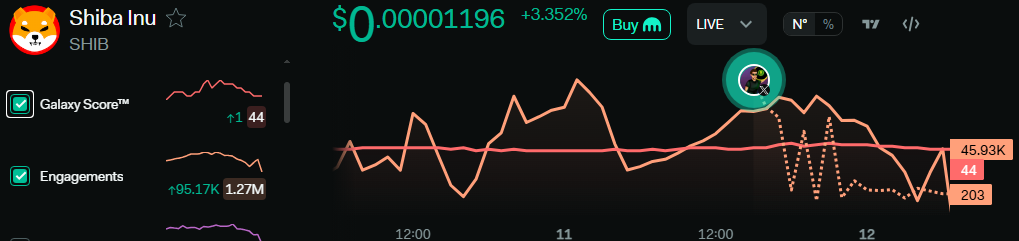
Yesterday, Shiba Inu crashed below $0.000011 for the first time in a year amid Bitcoin’s dip to $76K. After falling to a 1-year low of $0.00001097, SHIB rebounded nicely above the $0.000011 price mark. At press time, the asset is trading at $0.00001193. 

Expectedly, some investors took to social media to comment negatively about SHIB, given its recent dip. In contrast, most are convinced the asset will stage a major rally to lofty targets like $0.0001 before the end of the current market cycle. 

Meanwhile, Shiba Inu’s social sentiment across other key metrics like engagement has also soared. According to data from LunarCrush, SHIB’s social engagement has increased by 95,170, bringing its daily total to 1.27 million. The token also rose to a Galaxy Score of 44, with an Alt rank of 57 out of 5,878 assets. 

Shiba Inu social sentiment

Here’s Why the Bitcoin 22% Drawdown is Different from Other Cycles

0

Recent analytical insight highlights the contrast between the recent Bitcoin double-digit crash this bull season and similar price actions in previous cycles.

Bitcoin crashed to $76,600 yesterday after closing below $80,000 the previous day for the first time since November. While the asset recovered to close at almost $83,000 yesterday, it has corrected over 22% from its January 20 all-time high of $109,000.

Amid the uncertainties, market analytical provider CryptoQuant has highlighted that this magnitude of corrections is not new during the bull market run. Nonetheless, it cited developments that inferred that this cycle’s 22% capsize might differ from previous scenarios.

Bitcoin At Bearish Territory

In a March 11 report, an analysis from CryptoQuant concluded that Bitcoin’s short-lived dump below $80,000 has now placed it in bearish territory. Notably, other indicators support this disposition, as highlighted by the Bull-Bear Market Cycle (BBMC) indicator and the Market Value to Realized Value (MVRV) ratio.

The analysis highlighted that the BBMC indicator has reached the most bearish levels ever seen in this cycle, although Bitcoin has experienced a steeper correction than this since 2023. For perspective, the pioneering cryptocurrency corrected a staggering 32% from its March 2024 peak of around $73,000 to below $50,000 in August 2024.

Bitcoin’s Dip in the Last Two Cycles

Furthermore, the MVRV ratio Z-score has dropped below its 365-day moving average, signaling a complete loss of bullish momentum. CryptoQuant noted that such valuation metrics drift usually suggests a massive decline or the start of a bear market.

To add to the bearish developments, investors have extensively pulled funds from the US spot exchange-traded funds (ETFs) recently. With a net outflow of $371 million yesterday, the investment vehicles have recorded their seventh consecutive negative flow day and the 15th in the last 16 days.

Possible Bitcoin Correction to $63k

With the predominant bearishness and the valuation metrics flashing negative signs, the analysis suggested that Bitcoin appears to be in a deeper correctional phase than typical in a bull market. Furthermore, it highlighted the levels Bitcoin could capitulate to if the current price zone fails to hold.

CryptoQuant noted that Bitcoin could crash 23% from its current valuation to $63,000 if the levels between $78,000 and $75,000 fail to hold. Notably, this zone lies slightly below the trader’s on-chain realized price lower band, an area that has historically served as a cushion for lower prices during intense bull market corrections.

Meanwhile, the analysis follows BitMEX co-founder Arthur Hayes’ insistence that a crash to $70,000 is normal in the bull cycle and the market could still recover from such a dip. Bitcoin trades at $82,519, down slightly in the past 24 hours.

US to Implement BTC Reserve in Weeks: Bitcoin Magazine CEO

0

Bitcoin Magazine CEO David Bailey has stated that the U.S. government is implementing the proposed Bitcoin reserve faster than anticipated.

President Donald Trump’s executive order, signed on March 6, outlines a national crypto asset reserve for Bitcoin. Meanwhile, industry pundits believe the administration is detailing its approach within days or weeks instead of a gradual rollout.

US Government Implementing Bitcoin Reserve in Weeks

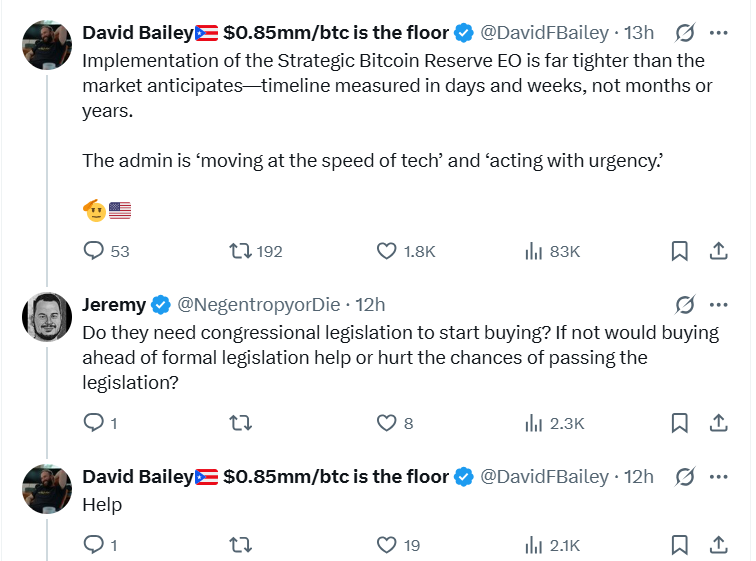
In a tweet, Bailey suggested that officials are executing Trump’s instruction “at the speed of tech,” prioritizing immediate action.

“Implementation of the US Bitcoin Reserve executive order in days and weeks, not months or years,” Bailey wrote.

The rapid approach has raised questions about whether congressional legislation is required for Bitcoin acquisitions. When asked on X if purchasing Bitcoin ahead of formal legislation would impact its chances of approval, Bailey responded that it would help.

Industry commentary on Bitcoin reserve timeline
Industry commentaries on Bitcoin reserve timeline

Broader Benefits of US BTC Reserve

Meanwhile, discussions have emerged regarding the broader implications of the executive order. Matt Hougan, chief investment officer at Bitwise, highlighted that the move significantly reduces the probability of a future Bitcoin ban in the U.S. 

Additionally, it increases the likelihood of other nations establishing similar reserves. The order also pressures foreign governments to act swiftly, as a short-term window now exists for nations to accumulate Bitcoin before further U.S. acquisitions.

Notably, the executive order eliminates long-standing regulatory uncertainty surrounding cryptocurrencies. According to Solana founder Anatoly Yakovenko, the order does not serve as a bailout but instead provides clearer guidelines for digital assets. 

He stressed the need for a stablecoin bill and banking access for cryptocurrency deposits. He also called for structured rules on token issuance and DeFi under SEC and CFTC oversight.

Moreover, institutions will find it increasingly difficult to argue that Bitcoin is an unsuitable asset. Hougan pointed out that national advisory platforms and global entities such as the International Monetary Fund (IMF) may need to reconsider their stance on Bitcoin’s viability.

Essentially, the formal recognition of Bitcoin by the U.S. government adds weight to its legitimacy in financial and institutional sectors.

US Bitcoin Holdings and Unresolved Questions

Elsewhere, Galaxy Digital’s head of research, Alex Thorn, distinguished between the U.S. government’s Bitcoin holdings and those designated for strategic reserves. The government currently possesses approximately 200,000 Bitcoin, but only 88,000 are allocated for the reserve. 

A separate 112,000 Bitcoin, seized from illicit activities, is set to be returned to Bitfinex. However, it remains uncertain whether these funds will ultimately be released as planned.