Home Blog Page 880

Strategy Chairman Saylor Says $16-$81T in Wealth by 2045 at Stake If the US Fails to Add Bitcoin to New Reserve

0

Michael Saylor proposed a strategy that could yield $16 to $81 trillion in 20 years for the United States if it starts buying Bitcoin now.

On Friday, the widely dubbed Bitcoin evangelist delivered another masterclass speech at the maiden White House crypto summit. He expounded on the pioneering cryptocurrency’s high-return prowess and how the United States’ immediate full adoption could yield jaw-dropping retributions.

The Strategy executive chairman presented from his carefully crafted 34-page report to US President Donald Trump and other industry leaders. Saylor published this document for the public’s view in a tweet on March 7.

A Staggering $16-$81T At Stake

The staunch Bitcoin advocate projected that the United States could gain $16 to $81 trillion in wealth by simply buying and holding the crypto firstborn. He stated that the newly established US Strategic Bitcoin Reserve (SBR) has the potential to deliver these staggering figures if the nation starts to stack the premier asset right away.

To hit the wealth target, Saylor suggested that the US acquire between 5% and 25% of Bitcoin’s total cap before 2035, when miners will mint 99% of them. When the nation has stacked that much, he stated that the simple demand-supply economics would do the rest.

Notably, this forecast aligns with the Strategy chairman’s earlier $13 million prediction. For perspective, if the US adds 1,050,000 BTC (5% of total supply) to its existing 198,109 BTC and the asset surges to $13 million, the stash would be worth $16.23 trillion.

He charged President Trump to quickly swing into action to avert losing an early adopter edge. The evangelist stressed that China and Russia are already demonstrating interest in the nascent industry, and America is at risk of passing this generational goldmine over to them.

US to Hit $60-$100T if It Adopts Complete Crypto Framework

Meanwhile, Saylor distributed the crypto industry into four sectors, each providing unique opportunities for adoption. He shared the sector into digital tokens, securities, currencies, and commodities.

Furthermore, he classified Bitcoin under commodities, stablecoins under currencies, and assets like XRP under tokens. Saylor believes tokenized bonds and ETFs would escalate, so he classifies them under securities.

If the US builds its economy around these narratives, the chairman believes it could add $60 trillion to $100 trillion to the US economy. His revenue partition is as follows: commodities, $20 trillion; securities, $20 trillion; and tokens and currencies yielding $10 trillion each.

Moreover, Trump reassured US crypto investors of his ploy to make America the “Bitcoin superpower of the world.” He made this claim at the Friday crypto summit, reiterating that he wants the nation to be ahead on all fronts.

Expert Says XRP Reaching $20 Will Just Be the Beginning

Edo Farina, the founder of Alpha Lions Academy, has shared an optimistic outlook on the future of XRP. 

He suggested that a price of $20 could be just the beginning for even higher price levels. Farina shared this perspective in a tweet on Friday. He backed his optimistic outlook for XRP by referencing Bitcoin’s historical growth.

Specifically, Farina highlighted how early Bitcoin investors who sold at $500 a decade ago would likely regret their decisions now, especially as BTC’s price has surpassed $100K. Applying the same logic to XRP, he stated that selling too soon could be a mistake at its current price of $2.36.

“If you knew 10 years ago that BTC would reach $100K, would you be selling at $500 for fiat?” he asked, adding, “Of course not.”

$20 XRP is Just the Beginning

Meanwhile, Farina revealed that he would buy even more when XRP reached $20 in the future. Farina’s statement implies that $20 could be a conservative estimate in the grand scheme. 

Drawing a comparison to Bitcoin, he suggested that selling XRP at $20 might be akin to selling Bitcoin at $500—when it could be worth far more in the future. 

Notably, at approximately $2.36, XRP has a long way to go before reaching the $20 milestone. Specifically, reaching $20 from current levels would require a growth of 750%.

Still, Farina believes that instead of seeing $20 as a top price for profit-taking, he would buy more, just as Bitcoin holders are profiting from the asset’s six-figure price. “I know what’s coming,” he said.

Critics Disagree

Meanwhile, other XRP market commentators, including technical analyst JD, have challenged Farina’s perspective. JD expressed disapproval with buying more XRP at $20, seeing it as a peak point for taking profits before a major correction. 

He believes buying at this level would expose investors to more risk of financial loss than gain.

Farina’s Perspective on How High XRP Could Go

However, Farina envisions a future for XRP far beyond double digits. He has repeatedly suggested that XRP could reach thousands of dollars per unit. 

In one of his more audacious statements, he even argued that an XRP price of $10,000 per token is inevitable. He bases this optimism on XRP’s growing utility in the payment market.

“He Just Mentioned the Top Five,” David Sacks on Trump’s Mention of XRP, ADA and SOL as Reserve Assets

0

The White House crypto and AI czar David Sacks has shed more light on Donald Trump’s mention of XRP, Solana, and Cardano as US reserve assets.

President Donald Trump signed an executive order on Thursday evening to create a US strategic reserve for Bitcoin and a digital asset stockpile for other assets. Initially perceived as bullish, the bill sparked widespread speculation in the crypto community, mainly due to certain disclosures.

The order disclosed it would not buy to add to the altcoins in the crypto stockpile. Notably, the president earlier mentioned Ethereum, XRP, Solana, and Cardano as part of the stockpile.

Amid the uproar, crypto czar David Sacks has attempted to clear the air. In an interview with Bloomberg TV, the head of the newly formed White House crypto working committee suggested that the community has overbought the inclusion of the earlier-mentioned altcoins in the national reserve.

Trump Just Mentioned the Top Five

Sacks stated that people are reading a lot of meaning in Trump’s addition of XRP, SOL, and ADA to the crypto reserve. He clarified that the pro-Bitcoin president merely mentioned the top five cryptocurrencies by market cap.

“Well, the president just mentioned the top five cryptocurrencies by market cap, so I think people are reading into this a little too much,” Sacks told Bloomberg when asked why Trump mentioned these altcoins.

Furthermore, Sacks mentioned that the United States does not know which digital asset it owns now; hence, the order requested a full audit of the nation’s portfolios. After the audits, the czar stated that it remains in the office of the Treasury secretary to either keep or sell discovered altcoins in the state’s best interest.

However, this does not apply to Bitcoin, the largest cryptocurrency by market cap. Sacks noted that America would store the asset and pursue budget-neutral funding for more purchases.

US to Explore Crypto Staking or Lending

Moreover, the crypto czar highlighted that the US might explore crypto lending, rebalancing, or staking after discovering all the assets in this purse. Howbeit, he stressed that the executive order’s main objective is to create a proper digital asset management system.

Once the tasked authorities complete the audit, the digital asset team will move the coins to a new wallet for safekeeping. Afterward, the office of the treasury secretary will employ proper portfolio management and stewardship.

Meanwhile, XRP, SOL, and ADA have not fared well following the recent disclosure. The high-caliber assets are down 6%, 4%, and 5.86%, respectively, in the past 24 hours.

US Federal Banking Regulator Clears Banks to Engage in Bitcoin and Crypto Activities

0

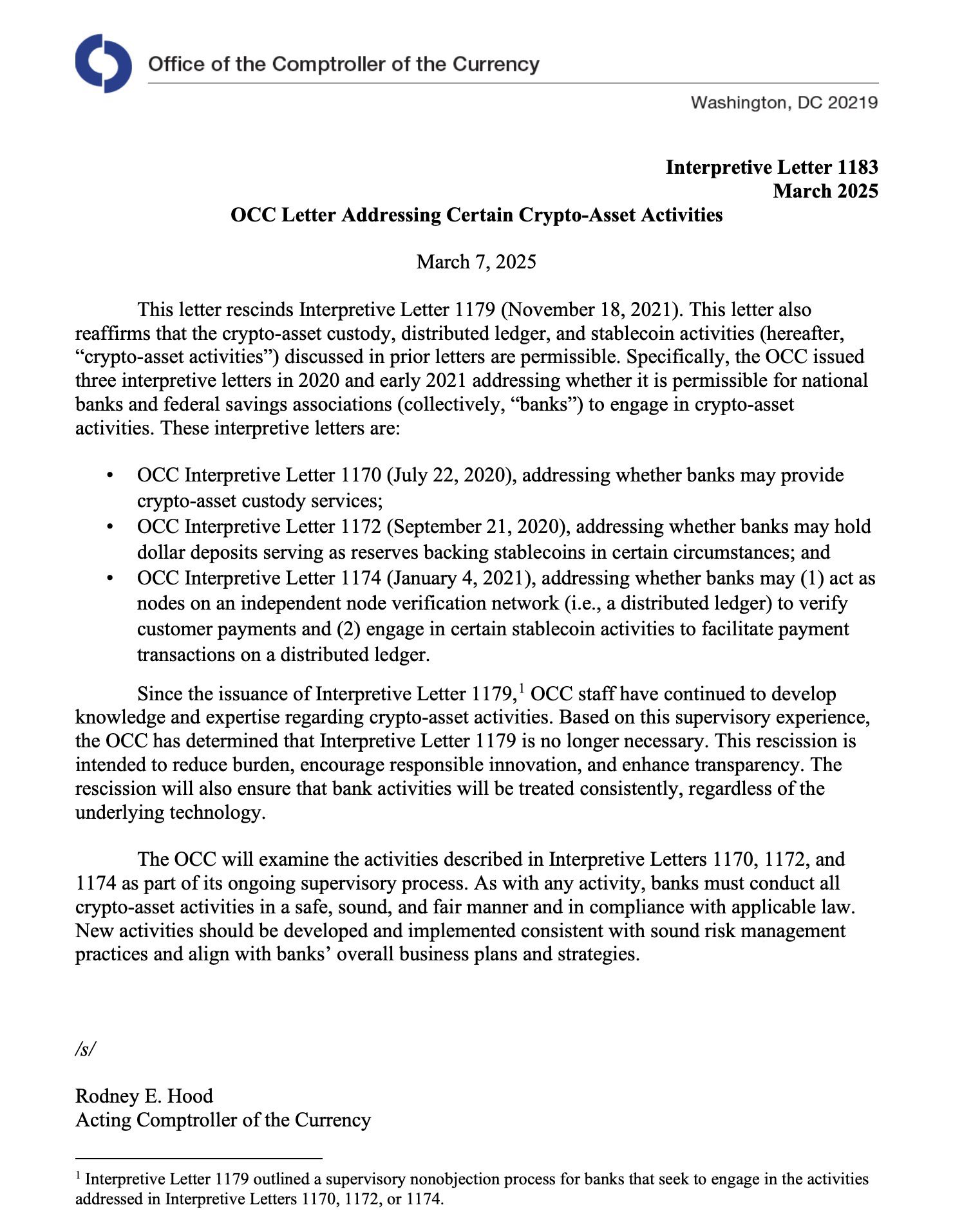
The Office of the Comptroller of the Currency (OCC) has clarified that federal banks can meddle with the cryptocurrency industry, lifting earlier impediments.

Following the United States’ adoption of Bitcoin and certain altcoins as reserve assets, a federal regulator has moved to encourage interaction with cryptocurrencies. Specifically, the OCC lifted an earlier clause discouraging financial institutions from servicing the digital asset industry.

In a Friday release, the Office of the Comptroller of the Currency clarified that federal banks could participate in certain endeavors regarding virtual assets. Notably, this new wave of regulatory clarity aligns with the clamoring of the nascent industry and financial institutions.

Banks Can Now Service Crypto Firms

The published Interpretive Letter 1183 explicitly clarified that banks can engage in crypto custody, certain stablecoin enterprises, and distributed ledger verifications. Furthermore, the OCC revoked earlier guidelines that national banks and federal savings associations should request regulatory permission before meddling with the digital asset industry.

Press release from OCC

Meanwhile, the new policy disrupts the guidelines established by the former Biden administration. This aligns with Trump’s pledge to reverse what he calls the tyranny of the Democratic president’s four-year governance over cryptocurrencies.

Rodney E. Hood, the acting comptroller of the currency, stated that the clarity addresses federal banks’ skepticism about offering services to the crypto sector. Nonetheless, he expects financial institutions to put the right risk management procedures in play, as they do with traditional assets.

Much-Needed Clarity

Moreover, the OCC announced withdrawal participation in an earlier joint circular discouraging banks from meddling with cryptocurrency, citing its risk and market vulnerability. While the 2023 statement did not outright ban national banks from crypto-related services, it bred cautiousness and skepticism.

Notably, Coinbase tried to lobby the OCC to release this statement last month. In February, the leading exchange sent a letter to federal regulators seeking a public stance to mitigate the friction between the digital industry and banks.

Market watchers have branded the latest development bullish, especially for assets like XRP. Analyst Amonyx shared this sentiment, particularly as the ecosystem’s newly launched stablecoin RLUSD could gain mainstream adoption.

Can Ripple Donate Part of Monthly XRP Escrow to US Stockpile? Expert Suggests Bold Idea

XRP community figure Crypto Eri has proposed that Ripple contribute a percentage of its monthly XRP escrow release to the U.S. government.

Eri humorously made this suggestion in a tweet amid ongoing discussions about how the U.S. government might start holding XRP.

Recall that last week, U.S. President Donald Trump disclosed that the country would hold XRP and other tokens like Solana and Cardano. The statement gained further weight when Trump signed an executive order for the government to hold a stockpile of altcoins.

While the government does not currently own XRP and does not plan to buy it, community members are speculating on ways through which the U.S. government could become an XRP holder.

Ripple Allocating a Portion of Escrow to the U.S. Government?

In this context, Eri suggested that if she were on Ripple’s strategy team, she would propose allocating a portion of the company’s monthly XRP release to the U.S. stockpile.

According to her, this approach would serve a dual purpose. It would not only provide the government with XRP, but also demonstrate the capabilities of the XRP Ledger—specifically its ability to handle secure, traceable, tamper-resistant, and irreversible distributions via the escrow feature.

Meanwhile, community members pointed out that this process would essentially mean giving away free XRP. Eri affirmed that the XRP release would indeed be a gift to the government.

On the other hand, community member “MoneyGcc” raised a legal concern. He noted that there is no existing mechanism for the U.S. government to legally accept gifts in crypto. MoneyGcc emphasized that the government is only authorized to accept USD.

In response, Eri jokingly remarked, “There’s a new sheriff in town.” This statement suggests the Trump administration could make new provisions to allow crypto gifts.

Ripple Paying Fine in XRP

Some have also proposed that Ripple could pay its $125 million regulatory fine in XRP to the U.S. government. XRP community member Yassin Mobarak championed this idea in a tweet.

Legal experts, including attorney Jeremy Hogan, confirmed that a payment in XRP could be legally viable based on past legal precedents.

Government Taking Over Ripple Escrow

Beyond giving a portion of Ripple’s XRP escrow to the government, some have suggested even bolder ideas, such as the government taking full control of Ripple’s XRP escrow without waiting for the typical unlock process.

According to XRPL Validator Vet, Ripple could transfer ownership of the escrowed XRP to the U.S. government through a simple transaction by changing the regular key of the escrow accounts to the government’s account.

This transfer would require Ripple to give up XRP tokens worth over $104 billion as the method doesn’t allow partial transfers.

While some speculate that this could happen, others dismiss the possibility. Some view it as an unlikely, “historic philanthropic gesture.”

Here is Why Shiba Inu Will Remain a Meme Coin Despite Its Many Achievements

0

This article examines why Shiba Inu will remain a meme coin despite the numerous projects launched in its ecosystem.  

Shiba Inu has been turning heads with its significant developments that have led to the growth of its ecosystem. The rationale behind these moves is to transition SHIB from a meme coin into a utility project. 

Shiba Inu Achievements 

For context, Shiba Inu launched in August 2020, initially focusing on becoming the biggest meme coin in the market, a title Dogecoin has held for several years. 

However, everything changed a few months later, as the ecosystem team, led by its pseudonymous founder, Ryoshi, outlined a strategic vision that will potentially transition SHIB from a meme coin to a utility token. 

Ever since, Shiba Inu has grown from just a token into an ecosystem, with significant projects like an L2 blockchain (Shibarium), a decentralized exchange (ShibaSwap), and games (Shiba Eternity, Agent Shiboshi, Shiboshi Rush, Lap Dog, and Shibridge). 

Other Shiba Inu ecosystem-related projects include SHIB: The Metaverse and non-fungible tokens (Shiboshi and SHEboshi). 

Only Factor Keeping SHIB As a Meme Coin  

Despite these notable achievements, one factor has kept SHIB in the realm of meme coins: its hefty supply. 

Unlike most established utility cryptocurrencies like BTC, ETH, XRP, BNB, and SOL, Shiba Inu boasts a hefty circulating supply. This enormous supply is a characteristic common to only meme coins.  

Notably, the circulating supply of Bitcoin, Ethereum, XRP, BNB, and Solana currently stands at 19.83 million, 120.59 million, 58.04 billion, 142.47 million, and 508.9 million, respectively. 

The limited supply of these established cryptocurrencies makes them attractive to investors, potentially driving up their value. This is evident in the price surge of these assets over the past few weeks. 

In contrast, Shiba Inu currently has a circulating supply of 589.25 trillion tokens, akin to most meme coins, which also have astronomical supplies. 

This enormous supply of Shiba Inu dilutes the value of each SHIB, potentially making it difficult for the token to witness significant price spikes observed in other limited-supply assets like BTC, ETH, XRP, BNB, and SOL. 

Therefore, for Shiba Inu to leave the realm of meme coins, the community must collectively burn a huge chunk of its supply. 

Although 410.74 trillion SHIB has been incinerated so far, there is still a need for more burns due to the token’s 589.25 trillion astronomical supply. 

Shiba Inu: Top Expert Outlines Strategic Vision to Drive ‘SHIB to the Moon’

0

Popular crypto educator Davinci Jeremie weighs Shiba Inu’s potential in the current market cycle and outlines a strategy that could take SHIB to the moon. 

Recent Shiba Inu Bearish Performance 

Shiba Inu has continued to trade in bearish territory in recent weeks, thanks to the unending downturn across the broader crypto market. 

At the current price of $0.00001306, SHIB is down 1.34% in the past 24 hours, 7.3% in the past week, and 17.84% over the past 30 days. Shiba Inu has also lost 59.37% of its value over the past three months, leading to its collapse to the $0.000013 mark. 

Despite Shiba Inu’s devastating plunge, several enthusiasts like Jeremie are optimistic about the token’s potential, with the expert projecting that SHIB could ‘go to the moon’ this cycle. 

SHIB Is Set for a Strong Cycle, But There’s a Catch 

Interestingly, the renowned crypto educator predicts that SHIB will perform strongly in this cycle. However, he cautions that the token might not deliver the dramatic rallies some investors expect this cycle.

Explaining the rationale behind this reasoning, Jeremie acknowledged that Shiba Inu has a strong utility following the introduction of Shibarium. According to him, Shibarium provides users with low-cost transactions and boasts the ability to run different types of applications. 

Despite Shibarium’s technical capabilities, Jeremie notes that “nobody is using it.” He emphasized that there are no real-world applications on Shibarium that drive SHIB’s adoption. 

“If they get that solved, Shiba Inu will go to the moon,” Jeremie asserted. 

This suggests that if the ecosystem team can attract real-world applications to Shibarium that utilize SHIB for transactions, the token’s price will skyrocket significantly this cycle. 

Meanwhile, the ecosystem team has embarked on various initiatives to drive Shibarium’s adoption, including partnering with top crypto projects like Chainlink and K9 Finance DAO. 

For instance, its partnership with Chainlink allows Shibarium to integrate the protocol’s Cross-Chain Interoperability Protocol (CCIP), granting more accessibility to Shiba Inu ecosystem tokens, including SHIB, BONE, LEASH, and TREAT. 

As the team rolls out more initiatives to drive Shibarium’s adoption—especially attracting more decentralized applications that leverage SHIB—Jeremie expects the token to experience a significant price surge. 

Expert Says Buying XRP Before SEC Settlement News to Catch a Pump is Gambling

As anticipation builds around the U.S. SEC dropping the Ripple lawsuit, many investors are eyeing XRP in hopes of capitalizing on potential price movements. 

However, software engineer Vincent Van Code has issued a word of caution to those considering jumping into the market.

In a recent tweet, Van Code compared purchasing XRP just before the SEC meeting to gambling. He warned that the volatility and uncertainty surrounding the event make it a risky strategy.

SEC Meeting and Ripple Settlement Outlook

Notably, the meeting in question was the closed-door session the SEC held yesterday. The agency has routinely held closed-door meetings on Thursdays. However, XRP community members have always interpreted the meetings as discussions surrounding an impending settlement in the Ripple case.

The argument for the most recent session gains weight as the SEC has been dropping cases against other crypto businesses over the past few weeks, with many eagerly awaiting Ripple’s turn.

In his commentary, Van Code highlighted the possibility that the case could be dismissed but suggested that it was more likely that the legal proceedings would continue.

He pointed out that the situation is less about the SEC’s choice and more about the legal processes surrounding the Ripple case.

Experts have explained that the U.S. SEC is taking longer to resolve its case against Ripple due to its procedural complexity. Unlike Coinbase, which had no final court ruling, Ripple is facing a $125 million penalty, and Judge Torres retains jurisdiction over the case until August 2025.

The SEC must address this penalty before dismissing the case, and any negotiations or settlements require court approval, adding legal hurdles. Notably, legal experts suggest the case could wrap up by May, though unexpected events may influence the timeline.

Don’t Gamble with XRP News

For XRP investors hoping to profit from any “pump” in XRP’s value ahead of the SEC announcement, Van Code stressed that it is important to approach the situation with caution.

Rather than viewing the potential outcome as an investment opportunity, he advised against treating it as a gamble.

“Buying XRP just before the supposed SEC meeting to catch it pumping is GAMBLING,” he said. “Don’t gamble.”

Meanwhile, X user Bodhi Karma presented a different perspective. Karma suggested that if investors are buying XRP to hold it long-term, it’s not a bad move to take advantage of the current price window.

He added that while short-term traders looking to “pump and dump” are indeed gambling, holding onto XRP for the long haul isn’t risky.

Could the US Government Accept Ripple’s $125 Million Fine Payment in XRP? Experts Weigh In

Recent discussions have emerged within the XRP community about the possibility of the U.S. government accepting Ripple’s $125 million fine payment in XRP tokens instead of U.S. dollars.

This speculation comes amid the U.S. government’s announcement to create a crypto asset stockpile for altcoins. Additionally, President Trump’s earlier remarks highlighted the government’s potential to hold XRP.

Amid these developments, community members now suggest that Ripple’s fine payment could mark the government’s first acquisition of XRP.

To recap, in August 2024, a federal court ordered Ripple Labs to pay a $125 million penalty to the U.S. SEC for violations of securities laws related to XRP sales to institutional investors.

At the time, Ripple proposed depositing the funds into an escrow account, which the SEC accepted under a court-approved arrangement. However, whether the escrowed funds were held in U.S. dollars or XRP tokens remains unclear.

Now, with recent developments surrounding the creation of a U.S. government digital asset stockpile, the idea of Ripple’s penalty being settled in XRP rather than USD has gained renewed attention.

Could the U.S. Accept XRP as Payment?

Prominent XRP community member Yassin Mobarak has pointed out the possibility of the U.S. government accepting XRP as a payment for the fine. His argument is based on the new digital asset stockpile, which will hold high-quality digital assets with deep liquidity, such as XRP.

Mobarak suggests that Ripple could settle its fine in XRP instead of USD, potentially leading to a historic first: the U.S. government holding XRP.

If this happens, Mobarak believes the government’s interest in XRP’s price appreciation could align with that of XRP holders, which could, in turn, foster regulatory clarity and wider adoption of the cryptocurrency in the U.S. market.

Legal Precedents and Expert Opinions

Attorney Jeremy Hogan has weighed in on the matter, referencing the 1869 Supreme Court case Willard v. Tayloe. This case established that payments in commodities, as opposed to dollars, could be legally enforced if both parties agreed to the arrangement.

Hogan suggests that, applying this precedent, a mutually agreed-upon payment in XRP between the SEC and Ripple could be legally viable.

However, a significant obstacle remains: penalties are typically paid to the U.S. Treasury. While the Treasury would oversee the digital asset stockpile, there is no official confirmation that it would accept XRP as payment instead of USD.

Meanwhile, Hogan also noted the potential financial impact. Had Ripple escrowed the penalty in XRP rather than USD, the Treasury could have gained nearly half a billion dollars due to XRP’s price appreciation. 

At the time of the penalty’s set value in 2024, XRP was around $0.50. However, today, its value is at over $2.540.

Analyst Reveals How Cardano Could Trigger a Bull Rally to $2

0

Analyst Ali Martinez identified a bullish breakout pattern in ADA, highlighting that the performing altcoin could continue its race toward the $2 mark.

Cardano price has faced a sharp pullback amid increased volatility in the crypto market, briefly falling below $0.83 before rebounding to approximately $0.88. The price drop represented a 5.8% decline over 24 hours. 

However, ADA maintained a 47.1% gain in the past week and remained 21% higher year-over-year, reflecting strong long-term momentum. As Bitcoin (BTC) and Ethereum (ETH) also experienced fluctuations, market participants closely monitor key indicators to determine ADA’s next potential move.

Cardano Price Poised for Rally to $2

For instance, Ali Martinez, an expert crypto analyst on X, highlighted a possible bullish breakout for ADA, citing a right-angled descending broadening wedge pattern in a recent analysis. According to Martinez, this pattern typically signals an impending breakout rally.

The overhead resistance for this formation stood at $1.14, and surpassing this level could trigger a high-momentum surge toward the $2 mark. 

Can Cardano Price Reach $12?

Meanwhile, another technical analysis from CryptoElites pointed to a cup and handle pattern, suggesting a continuation of ADA’s upward trend. The price had successfully broken out of a descending trendline, marking the end of a prolonged downtrend. 

A successful retest of the breakout zone signaled continued bullish momentum. The analyst outlined multiple price targets, including $2.50, $3, and $6, with a broader bull market target of $12. 

Increased Whale Transactions 

Recall that Cardano’s market activity showed a significant increase in large transactions. Blockchain analytics firm Santiment reported that whale transactions exceeding $100,000 reached a three-month high this week. The development coincided with ADA’s temporary surge to $1.13.

This increase in high-value transactions indicated renewed interest from large holders. The data further revealed that whale accumulation had been increasing over recent weeks, contributing to the asset’s resilience.

Additionally, the average age of ADA tokens in wallets declined as more tokens returned to circulation. Historically, a decrease in token age has signaled increased trading activity, often associated with heightened market volatility.

Notably, the rise in whale transactions aligned with shifting market sentiment, as on-chain data suggested increased engagement from long-term holders.