Home Blog Page 882

XRP Open Interest’s 5.6% Surge Fueling Price Rally: Analyst Shares Opportunity

0

A recent analysis suggests that increasing leveraged appetite among XRP traders has been a major catalyst to XRP’s recent price rally.

XRP has recorded three consecutive daily price appreciations after the Monday reality check. For context, the asset recorded its largest daily price correction since the Terra crash in 2022 on Monday, following a 34% surge the previous day.

Meanwhile, XRP has recovered since then, rallying 9% in the past three days. Recent analysis from CryptoQuant has suggested that growing derivative interest in the XRP Ledger native token has fueled this comeback.

Leverage-Driven XRP Pump

In a tweet, the market analytics provider shared that open interest (IO)—a metric measuring the value of derivative contracts that are unsettled on an underlying asset at a given time—has surged considerably in the past day.

Specifically, CryptoQuant mentioned that IO on XRP rallied 5.63% on Thursday, indicating growing leveraged activities on the asset. With the surge coinciding with a price uptick, the analysis suggested that derivative traders were responsible for XRP’s recent northward push.

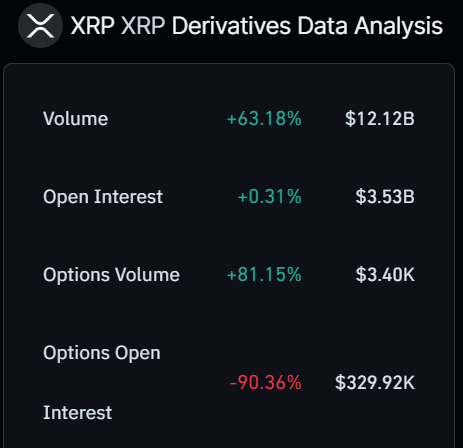
Notably, data from Coinglass confirms this open interest shift as margin-focused positions increased from $3.29 billion the previous day to $3.36 billion on Thursday. Moreover, this appetite has continued to accelerate, with XRP’s IO growing further to $3.53 billion today.

Furthermore, derivatives and options volume has surged alongside the open interest as traders increasingly pile on to profit from short-term XRP price shifts. Derivatives volume has increased by 63% and options volume by 81% in the past 24 hours.
XRP Derivative Data
XRP Derivative Data

Analyst Shares XRP Short Opportunity

Maarten Regterschot, a verified CryptoQuant analyst, has shared his thoughts on the leveraged-driven XRP price pump. He suggested that the pump may present a good XRP shorting opportunity for market traders.
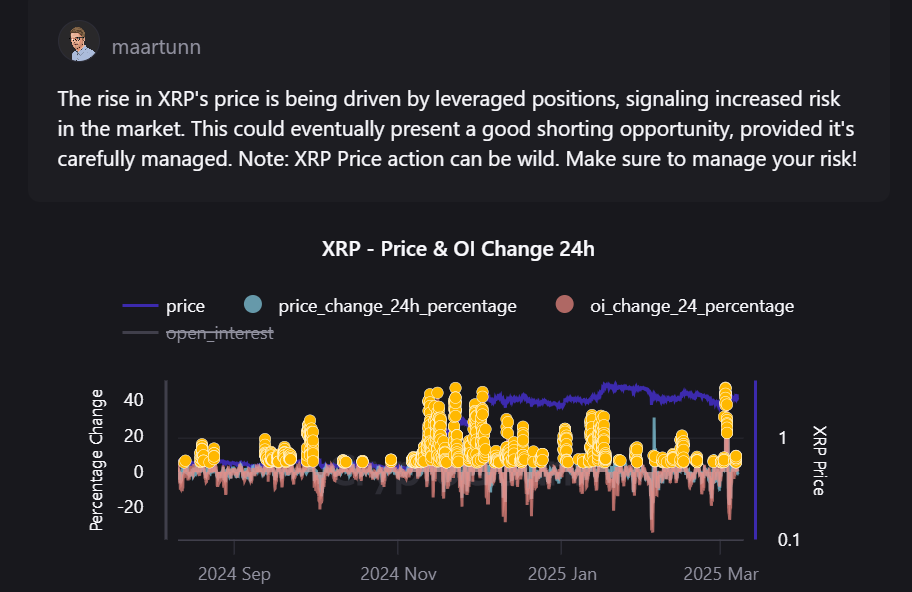
Maartunns XRP Analysis
Maartunn’s XRP Analysis

The analyst insinuated that as long/short positions indicate higher bets on more upsides for XRP, a drift in momentum could push prices lower. However, he urged caution, stating that XRP’s price actions “can be wild.”

In the meantime, XRP continues to regain momentum after an earlier flush today. The asset and other cryptocurrencies went south after Donald Trump’s executive order failed to meet the expected hype.

XRP trades at $2.533 at press time, up 3% in the past 8 hours.

Cardano Price Teases Wedge Breakout Rally: Will It Top $2?

Cardano price struggles for a bullish comeback while analysts picture a potential rally to $2 if ADA price exceeds $1.14.

As the crypto market remains highly volatile, with Bitcoin fluctuating near the $88,000 mark, Cardano is witnessing a quick pullback. The ADA price dropped by 7% last night and continues a bearish trend with an intraday pullback of 4.08%. 

Currently, Cardano trades at a market price of $0.8694 and warns of a potential return to $0.73. Will a lower price rejection candle signal a reversal for Cardano? Let’s find out.

Cardano Price Struggles at $0.86

On the daily price chart, Cardano is fluctuating sharply between the 50% Fibonacci level at $0.62 and the $1.20 supply zone. After a bullish engulfing candle formed over the weekend, with a 72% surge, Cardano has since shifted to a lateral movement.

Cardano Price Chart
Cardano Price Chart

The bullish recovery failed to overcome the supply pressure at the overhead zone, resulting in sharp fluctuations near the 78.6% Fibonacci level, which is at $0.9216.

Currently, Cardano has reached this critical level and formed a second consecutive bearish candle. As Cardano navigates this volatile path, the MACD and signal lines indicate a potential bearish crossover.

The average lines have entered positive territory, but the declining histograms suggest a trend reversal is possible. Additionally, the daily RSI line is nearing the halfway mark, reflecting a slight decline in bullish momentum. Hence, the technical indicators point to the possibility of a pullback.

Will Cardano Price Bounce Back To $2?

According to Fibonacci levels, the current short-term volatility suggests a potential pullback to the 61.8% Fibonacci level at $0.735. However, similar to the lower price rejection on Tuesday, the ADA price trend is likely to regain bullish momentum as the broader market stabilizes.

Furthermore, Ali Martinez, a crypto analyst, highlights the potential for a bull run in Cardano to the $2 milestone. In the analyst’s latest X post, he notes that Cardano’s price trend is forming a right-angled descending broadening wedge pattern.

This pattern is typically considered bullish and often leads to a breakout rally. Currently, the overhead resistance of the pattern stands at the $1.14 horizontal level. According to the analyst, a bullish breakout above this resistance could trigger a high-momentum rally in ADA toward the $2 mark.

Solana Price Volatility Increases Amid SIMD-228 Debate: Can SOL Reach $180?

Solana remains volatile as network validators debate the SIMD-228 proposal. Will the SOL price surge to $180 with a new tokenomics model?

As the crypto market faces a wave of sharp volatility, Solana is fluctuating around the $140 mark. Currently, the SOL token trades at $144, with a lower price rejection from the 24-hour low of $135.

The intraday bullish comeback suggests a potential rise to $150 as Solana validators discuss the SIMD-228 proposal. Will this new Solana improvement proposal spark a bull cycle?

Solana Price Fluctuates Near $140

On the daily chart, the SOL price action shows multiple candles rejecting lower prices over the past week. Currently, Solana trades at $144 with another lower price rejection candle. This follows a 2.06% pullback yesterday.

Solana Price Chart
Solana Price Chart

Solana is facing resistance at the 23.6% Fibonacci level, around $148.86. With overhead resistance and the psychological barrier at $150, Solana is struggling to overcome immediate selling pressure.

Due to the increased volatility, the MACD and signal lines are merging in a lateral trend, reflecting uncertainty in trend momentum. Furthermore, the daily RSI line is fluctuating between the oversold region and the halfway mark.

Thus, the technical indicators suggest Solana is struggling to gain momentum amid current market conditions.

Solana Network Debates a Shift to a Dynamic Inflation Model

As Solana’s price continues to fluctuate, network validators are discussing the SIMD-228 proposal, which relates to network inflation. The Solana Improvement Document (SID) 0228 outlines plans for a new, dynamic, market-driven emission model for Solana tokens.

This would change the way Solana tokens go into circulation. Currently, the network has a fixed issuance rate of 4.66% annually, which will gradually decrease to 1.5% over time.

However, developers plan to implement a dynamic emission model with the new proposal. Notably, market conditions will also dictate this model.

If more Solana tokens are staked, it will help reduce unnecessary rewards. On the flip side, if Solana staking falls below 33%, inflation will increase to incentivize more staking.

While small validators may earn less if staking rewards decrease, long-term Solana holders are likely to see their holdings become more valuable due to potentially lower inflation.

In conclusion, if the improvement plan is approved, with 65% of tokens staked at current levels, inflation could drop below 1% per year. However, if staking falls below 33%, inflation will be adjusted to encourage higher staking participation.

Will SOL Price Rise Back to $180? 

With a dynamic inflation rate, Solana’s market price will likely experience sharper volatility. However, at current levels, the network may see a decrease in token issuance.

As a result, with a reduced token supply, the market price could experience an artificial surge in demand, potentially leading to a bullish spike. Based on Fibonacci levels, the key resistance beyond the $150 mark is the 50% retracement level, around $180.

On the other hand, crucial support remains in the demand zone between $135 and $125.

How Cardano is Set to Transform Brazil’s Public Sector

0

Cardano looks set to transform the Brazilian public sector.

On Thursday, March 6, the Cardano Foundation, a non-profit tasked with driving the network’s adoption, disclosed that it had inked a deal with Brazil’s Serviço Federal de Processamento de Dados (SERPRO), which literally translates to the Federal Data Processing Service.

It is the world’s largest state-owned information technology company established to bring transparency to government revenue and spending.

SERPRO’s collaboration with the Cardano Foundation has two focus areas.

First, it will focus on blockchain education. Specifically, the Cardano Foundation said it will open its Cardano Academy program to SERPRO’s 8,000 employees. It will also host masterclasses and other educational events.

Secondly, SERPRO will integrate the Cardano network with its services. This will enhance SERPRO’s transparency and service delivery, Cardano Foundation CEO Frederik Gregaard said.

SERPRO’s planned integration of the Cardano network could offer one of the biggest instances highlighting blockchain’s potential beyond finance and speculation.

The state-owned firm powers more than 750 digital solutions, processes over 33 billion transactions annually and manages over 30.4 petabytes of data.

Meanwhile, the SERPRO collaboration is not the Cardano Foundation’s first carimbo in Brazil. In December 2023, the non-profit announced a partnership with Petrobras, Brazil’s multinational petroleum corporation, to educate its staff on blockchain technology.

Despite the recent news, Cardano’s native token ADA is trading at $0.88, representing a 7% decline over the past 24 hours. 

The decline comes as market participants digest the implications of President Donald Trump’s executive order to stockpile digital assets, which dispelled hopes that the government would buy the assets to hold in reserve.

Bitcoin Dips After US Reserve News: Can Bulls Hold $88K?

Bitcoin experiences a quick pullback following Donald Trump’s signing of the U.S. Bitcoin Reserve Order. Will BTC’s price survive the sudden rise in volatility?

The fluctuation in the crypto market continues as the broader market sees a 24-hour liquidation exceeding $500 million, with $400 million accounted for by long liquidations. Bitcoin has experienced a swift downswing as a result.

Additionally, Bitcoin’s price saw an intraday pullback of 1.98%. Currently, BTC trades at $88,095, showing a lower price rejection from the 24-hour low of $84,713.

As the swift recovery signals bullish support at lower levels, can this lead to a triangle breakout rally? Let’s explore.

Bitcoin Falls as Donald Trump Signs Bitcoin Reserve Order

The recent pullback in Bitcoin came despite Donald Trump, the U.S. President, signing an executive order to establish a strategic Bitcoin reserve. The announcement led to a swift drop in Bitcoin, falling from a 24-hour high of nearly $91,000 to just under $85,000.

Bitcoin Price Chart
Bitcoin Price Chart

Since then, Bitcoin has recovered, approaching the $88,000 mark. At present, BTC is consolidating between the 78.6% and 61.8% Fibonacci retracement levels.

The price trend is nearing the bottleneck of a symmetrical triangle pattern, signaling a potential breakout rally. Supporting this bullish outlook, the MACD and signal lines have given a positive crossover.

Additionally, the daily RSI remains slightly below the 50 level, reflecting mild bullish momentum. These technical indicators suggest optimism for Bitcoin’s price movement.

Is This a $17B Reduction in Bitcoin Supply?

In an X post, David Sacks, the White House’s AI and crypto czar, disclosed that the Bitcoin reserve aims to deviate from the U.S. government’s historical Bitcoin sales. In the last ten years, it has lost over $17 billion.

Meanwhile, the U.S. government currently holds 198,109 bitcoins, worth $17.41 billion. With the implementation of the Bitcoin reserve, the market is spared from selling pressure totaling approximately $17 billion.

BlackRock Witnesses $50M Outflow, Daily Total Outflow Hits $134M

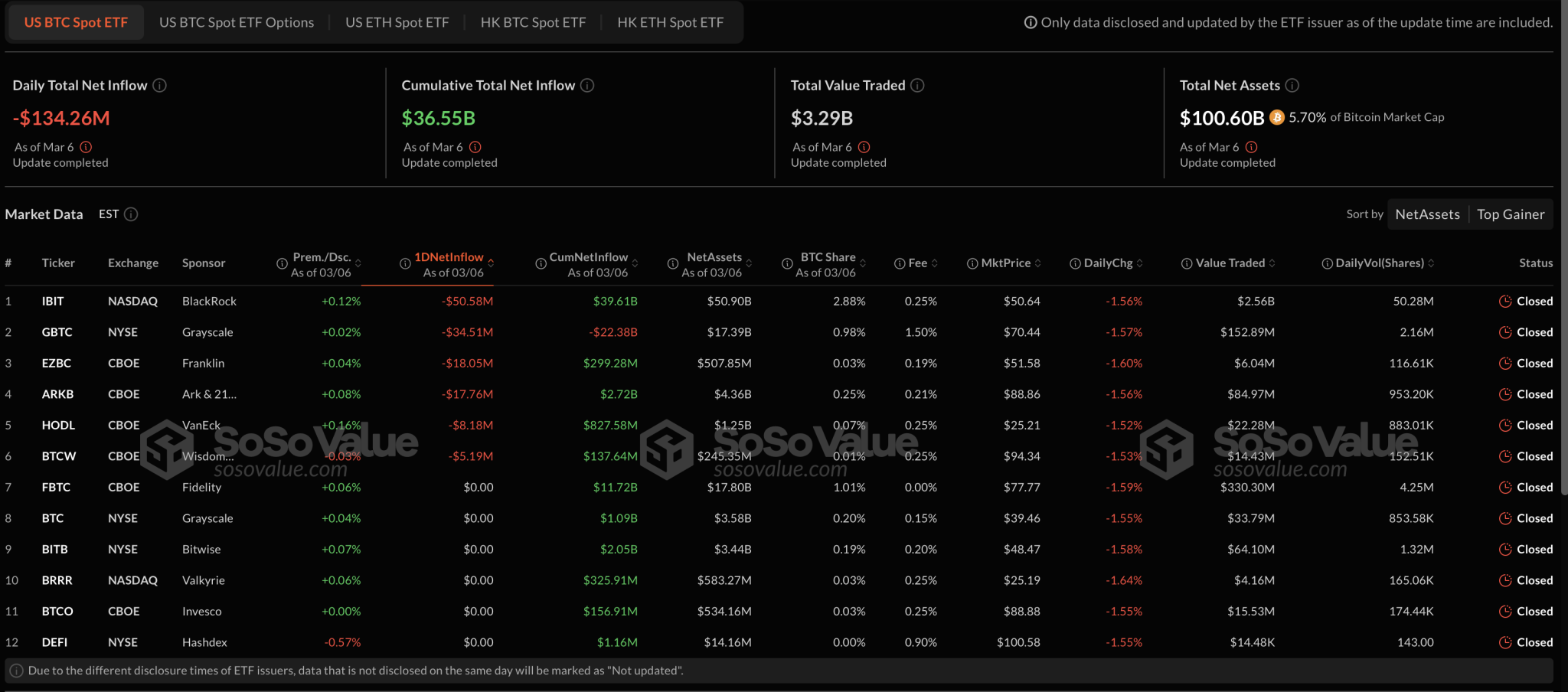
Amid declining Bitcoin prices, U.S. Bitcoin spot ETFs saw massive outflows on March 6, totaling $134.26 million. Of the 12 Bitcoin ETFs, the outflows were equally split between ETFs experiencing outflows and those with net zero flows.

BlackRock offloaded $50.5 million worth of BTC into the market, followed by Grayscale with $34.51 million and Franklin with $18.05 million. ARK and 21Shares saw outflows of $17.76 million, while VanEck and WisdomTree experienced outflows of $8.18 million and $5.19 million, respectively.

Bitcoin ETFs
Bitcoin ETFs

Will BTC Price Cross $100k?

Short-term market movements are experiencing high volatility, similar to a “buy-the-rumor, sell-the-news” phase. The current consolidation within the triangle pattern leaves Bitcoin’s price at a crossroads.

Based on Fibonacci levels, a breakout above the overhead trendline could challenge the $106,000 supply zone. On the other hand, the crucial support remains near $81,855.

Coinbase CEO Expects Most G20 Nations to Follow US to Create Bitcoin Reserve

0

Coinbase CEO Brian Armstrong praises Donald Trump’s administration for launching a Strategic Bitcoin Reserve in the U.S., highlighting its significance.  

The launch of digital asset reserve and stockpile in the U.S. has continued to elicit reactions from top crypto stakeholders, with the Coinbase CEO commenting on the development. 

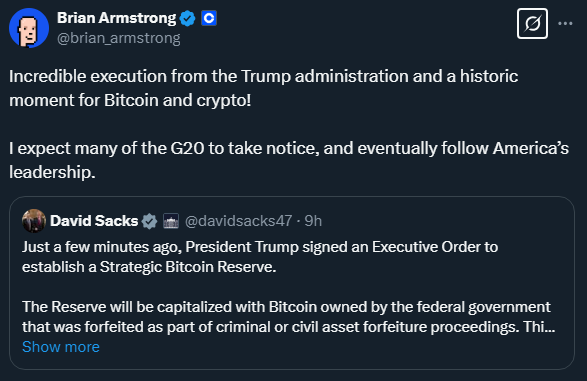
In an X post today, Armstrong praised the Trump administration for establishing the digital asset reserve. He characterized the feat as a “historic moment for Bitcoin and crypto.” 

Interestingly, he suggested that the U.S. crypto reserve initiative will capture the interest of most G20 nations, potentially inspiring them to follow America’s lead and create their own digital asset reserve. 

Coinbase CEO comments on US crypto reserve

Potential Implications for Bitcoin and Crypto 

For context, the G20 is an intergovernmental forum that comprises 19 countries, such as the U.S., the U.K., India, Japan, Italy, Brazil, Russia, South Africa, Germany, France, Canada, China, Saudi Arabia, Korea, Indonesia, Türkiye, Australia, Argentina, and Mexico. The European Union and the African Union are also members of the G20.  

The group is focused on addressing issues relating to the global economy, particularly international financial stability and climate change. 

The potential creation of crypto reserves across G20 territories would drive the widespread adoption of crypto, potentially validating the asset’s credibility and legitimacy. 

It is worth noting that some of these countries have had discussions relating to the digital asset reserve. Previously, Japan refrained from following the Bitcoin reserve initiative, emphasizing that crypto cannot serve as foreign exchange. However, with the latest development from the U.S., the country may review its stance.

US Crypto Reserve and Digital Asset Stockpile Initiative 

Notably, Trump’s executive order created a Bitcoin-only reserve and established a digital asset stockpile for altcoins. 

The order aims to hold Bitcoin and altcoins like Ethereum, Solana, XRP, and Cardano, which were obtained through civil and criminal forfeiture, as a long-term store of value assets. Meanwhile, this strategy ensures that the U.S. taxpayers’ money will not fund the crypto reserve.

Furthermore, the government will actively seek ways to grow its Bitcoin reserve using a budget-neutral strategy. However, it will not raise additional funds to buy more altcoins beyond those already obtained through civil or criminal forfeiture.

Here’s How US Government Could Trigger XRP to $10,000 with TBILL Purchases

0

An XRP community pundit has shared how the U.S. government could trigger a surge in XRP price to five digits using TBILL purchases.

This theory was disclosed by market commentator Vincent Van Code, who cited an analysis from AI chatbot ChatGPT to suggest that the U.S. government could catapult XRP to $10,000 per token by purchasing Ripple’s escrow stash using Treasury Bills (T-Bills). 

US Government Procuring XRP for $10,000

Leveraging ChatGPT’s analysis, Van Code highlighted a scenario where the U.S. Treasury or a financial titan like the Federal Reserve negotiates directly with Ripple to acquire its escrowed XRP at a fixed price of $10,000 per token. For context, Ripple currently has 38.1 billion XRP in escrow.

Rather than shelling out cash, the United States would issue T-Bills—essentially IOUs backed by the government. Ripple could then hold these T-Bills as reserves, use them as collateral, or sell them for liquidity. 

Van Code argued that once the U.S. locks in this price, it will set a global benchmark. Essentially, other nations and institutions would need to align with this valuation or risk exclusion from an XRP-dominated financial scene, especially if heavyweights like the IMF or Federal Reserve endorse it as a reserve asset.

Why would the U.S. pursue such a move? Van Code suggests three motives. First, it counters potential market manipulation by nations like China. Notably, with XRP pegged at $10,000, even a massive dump couldn’t tank its value below that threshold, safeguarding the system from financial warfare. 

Second, it bolsters the U.S. dollar’s influence during a transition to a post-dollar era. Particularly, by controlling XRP’s valuation, the U.S. maintains leverage over global settlements while T-Bills retain value in a USD-linked ecosystem. 

Third, it sets the groundwork for a blockchain-driven economy, with XRP enabling instant settlements and tokenized assets at a staggering $1 quadrillion market cap—based on its 100 billion token supply.

Could This Happen?

Could this happen? Van Code believes it’s plausible if the U.S. wishes to dominate blockchain finance. According to him, a coordinated push from the IMF and Federal Reserve could force global adoption, leaving other countries little choice but to jump on board. 

Notably, this could turn XRP holders to multimillionaires overnight. However, governments might impose regulations, pushing retail investors toward central bank digital currencies (CBDCs), while banks and corporations race to secure their own XRP reserves. 

If executed, Van Code sees this as the most monumental financial shift in history, with XRP potentially supplanting the U.S. dollar as the world’s reserve asset.

In a follow-up statement, Van Code reiterated the theory, asserting that the odds of XRP hitting $10,000 have soared in just days. He argued that a simple T-Bill swap for Ripple’s escrow could instantly establish this price, bypassing market-driven growth. 

The XRP to $10,000 Dream

Interestingly, it is important to note that other XRP community voices have also echoed this $10,000 dream, but doubts abound. 

For instance, community pundit Ripple Queen claimed last month that this price isn’t far-fetched but a realistic target. She urged investors to position themselves now for what she calls a historic opportunity. 

Similarly, Zach Rector, reacting to the U.S. government’s recent announcement of XRP’s inclusion in the U.S. Crypto Stockpile reserve, playfully rekindles the $10,000 conversation, hinting at its growing plausibility. 

Yet, not everyone buys in. Critics argue this valuation stretches beyond reason, predicting it won’t materialize without decades of organic growth—or at all, given the economic upheaval it could unleash. Also, Van Code’s TBILL idea might not see the light of day. 

Analyst Predicts Fifth Elliott Wave to Push XRP to $28 and Bitcoin to $150,000

0

A well-known market analyst presents ambitious price predictions for XRP and Bitcoin once an elongated Elliott Wave pattern completes.

These predictions came from market commentator CrediBULL, who has maintained his bullish outlook for both crypto assets despite the ongoing bearish price action. Notably, Bitcoin is down 13.2% since February, while XRP has collapsed by about 13.22% within the same timeframe.

Bitcoin Follows Elliott Wave Pattern

Looking at a broader perspective, CrediBULL’s chart confirms that these declines have been very minor compared to larger price swings. He shared separate XRP and BTC charts, which show that both assets are following a similar price trajectory amid an extensive Elliott Wave structure.

Interestingly, Bitcoin began this pattern in March 2023. For context, Wave 1 triggered a rally to $31K in April 2023, while Wave 2 produced a pullback that led to a low of $25.5K. Riding on the third Wave 3, BTC rose to $73.8K in March 2024, and then Wave 4 triggered a correction to $52.5K in September 2024.

Now, Bitcoin has staged a recovery as Wave 5 began in September 2024, with the latest Donald Trump-led Q4 2024 upsurge being part of the Wave 5 rally. However, CrediBULL’s chart suggests the Wave 5 rally is still not over. He believes the correction would persist for some time, and then a rebound would push BTC to $150K, completing Wave 5.

XRP Follows Similar Elliott Wave Pattern

Meanwhile, for XRP, the Elliott Wave structure began much later, specifically in Q4 2024. Data from CrediBULL’s chart indicates that Wave 1 began in November 2024, pushing XRP to the $2.8 high by December 2024. However, Wave 2 started shortly after, and is now influencing the ongoing correction.

XRP and Bitcoin Daily Charts CrediBULL
XRP and Bitcoin Daily Charts | CrediBULL

CrediBULL suggests the correction might linger for some time before XRP eventually begins the third impulsive Wave, expected to trigger a massive upsurge. The analyst expects this Wave 3 to take XRP to $16, representing a 545% increase from current levels and marking a new all-time high for the asset.

However, he believes the corrective Wave 4 could lead to a drop toward $12 over the next few months. After Wave 4 completes, CrediBULL expects XRP to begin the fifth wave shortly, predicting that the completion of this Wave 5 will lead XRP to a price of $28. This would mark a 1,029% rise from the current price.

XRP Chart “Looking Great” for Next Rally

Notably, XRP currently changes hands at $2.48, down 0.6% over the past 24 hours but up 25% in the last week. Meanwhile, BTC trades for $88,171, with a 4% decline in the last 24 hours and an 11% rise over the past week. CrediBULL suggests both assets are moving in the same direction, as they align with the Elliott Wave structure.

Interestingly, another analyst, Mikkybull, recently argued that XRP’s chart is “looking great” for a subsequent bullish push whether investors hate or love it. He shared that despite the recent drop, XRP has formed an ascending channel against the dollar and a symmetrical triangle against BTC on the 3-day timeframe.

Notably, both patterns typically lead to bullish upward moves if the asset breaks above the upper trendline. Currently, XRP is retesting the lower trendline on both structures, and a rebound from the bulls could trigger a rally above the upper one.

Bitwise CIO Explains How US Strategic Bitcoin Reserve Could Transform Global Financial Landscape

Matt Hougan, Chief Investment Officer at Bitwise, shared his insights on the potential impacts of the U.S. Strategic Bitcoin Reserve.

One of Hougan’s primary points was that establishing this reserve dramatically lowers the likelihood of the U.S. government ever banning Bitcoin.

Hougan believes that by creating a strategic reserve, the U.S. is signaling a commitment to the digital asset, making a ban increasingly improbable. Essentially, this move establishes Bitcoin as a recognized asset class in the U.S. financial system.

Other Nations May Follow Suit

Another major impact Hougan mentioned is the increased probability that other nations will establish their own strategic Bitcoin reserves. The U.S. move sets a precedent that could inspire other governments to consider Bitcoin as a long-term store of value.

Hougan suggested that this initiative could create a “race” of sorts, with countries rushing to secure their own reserves. This could accelerate the global adoption of Bitcoin, with national governments leading the charge.

Nations May Rush to Front-Run U.S. Moves

Furthermore, the U.S. Crypto Reserve’s creation might push other countries to act more quickly than originally planned.

Hougan argued that the announcement opens a “short-term window” for nations to front-run potential U.S. buying. Governments may want to secure Bitcoin at current prices before the U.S. accelerates its reserve purchases, increasing demand and possibly driving up prices.

Changing Institutional Perceptions of Bitcoin

Lastly, Hougan pointed out that the formation of the U.S. Bitcoin reserve makes it much harder for financial institutions — from national advisory platforms to organizations like the IMF — to label Bitcoin as an unsuitable or dangerous asset.

For instance, European Central Bank President Christine Lagarde previously ruled out the inclusion of Bitcoin in EU central bank reserves, citing its lack of liquidity, security, and reliability. However, with the U.S.’s official stance on Bitcoin, the EU regulatory approach could soften.

The End Game Was Never U.S. Buying All of the World’s Bitcoin

Meanwhile, in his remarks, Ryan Rasmussen, Head of Research at Bitwise, also expressed a similar optimistic sentiment as Hougan. He stressed that the “end game” was never for the U.S. government to buy all of the world’s Bitcoin. Instead, it was to prompt other countries to purchase Bitcoin.

For context, the U.S. already holds Bitcoin worth over $17 billion. The latest effort gives official recognition to it as a store of value. Accordingly, other countries without Bitcoin holdings will now have a need to hold it as a store of value, much like gold.

Furthermore, Rasmussen noted that this action removes excuses not to invest in Bitcoin for wealth managers, financial institutions, pensions, and endowments. It also eliminates fears of the U.S. selling its $17 billion BTC holdings.

Rasmussen also highlighted that the likelihood of U.S. states buying Bitcoin has increased. As he put it, “This changes everything.”

Trump Wants US to Buy BTC for Its Bitcoin Reserve Using “Budget Neutral Strategies”: What Does That Mean?

0

The strategic Bitcoin reserve executive order from President Donald Trump raises fresh questions amid plans to buy BTC using “budget neutral strategies.”

In a landmark move for crypto, on Thursday, March 6, President Donald Trump signed an executive order establishing a strategic Bitcoin reserve and a digital asset stockpile for the U.S. While the order clarifies the planned treatment of Bitcoin and other digital assets, it poses some fresh questions and perhaps some old ones.

One of the fresh ones is what does the Trump administration mean by “budget neutral strategies”?

For context, the executive order instructs the Secretary of the Treasury and the Secretary of Commerce to develop “budget neutral strategies” to acquire more Bitcoin for the planned reserve.

The condition appears to be a compromise between opening the door for U.S. government Bitcoin purchases—something Bitcoiners continue to pine for to see price boosts—and ensuring that it comes at no cost to U.S. citizens to reduce chances of resistance.

But what does it mean in practice?

Experts Weigh In

According to one research outlet, the answer could lie in a re-evaluation of another U.S. reserve.

“The ‘budget-neutral strategy’ comment strengthens the possibility that the Treasury pursue revaluation of its gold holdings, especially given Bessent’s recent remark, ‘We are going to monetize the asset side of the balance sheet’,” Presto Research asserted.

In simpler terms, the U.S. could sell some of its gold to buy Bitcoin. However, this could be a tough sell as it would likely attract significant resistance from gold proponents.

Meanwhile, Muse Labs Researcher Jinze has suggested that mining is not off the table.

“The U.S. government can use existing underutilized computing resources or energy (such as federal data centers) to mine Bitcoin and increase reserves,” he wrote.

The Kingdom of Bhutan has successfully employed this strategy since 2019. Whether the U.S. government can replicate this without significant resistance remains to be seen, as Bitcoin mining remains a polarizing topic in the country.

Another option highlighted by JAN3 CEO Samson Mow and likely hinted at by Strategy Chairman Michael Saylor is bonds. Saylor has used this strategy to accumulate over 2% of the Bitcoin supply at his business intelligence company turned Bitcoin treasury company.

The approach could be a strong contender, considering that Saylor is scheduled to attend the White House crypto summit on Friday, March 7.

Despite the recent executive order, legislative action may still be needed to make the Bitcoin reserve and any budget-neutral acquisition strategies operational.

At the time of writing, the U.S. government controls roughly 200,000 BTC worth nearly $17 billion. It has previously sold about 223,000 BTC for roughly $3 billion, which would have been worth over $19 billion today. 

Trump’s crypto czar, David Sacks, lamented these previous sales as a loss to the American taxpayers.