Home Blog Page 883

Bitwise CIO Explains How US Strategic Bitcoin Reserve Could Transform Global Financial Landscape

Matt Hougan, Chief Investment Officer at Bitwise, shared his insights on the potential impacts of the U.S. Strategic Bitcoin Reserve.

One of Hougan’s primary points was that establishing this reserve dramatically lowers the likelihood of the U.S. government ever banning Bitcoin.

Hougan believes that by creating a strategic reserve, the U.S. is signaling a commitment to the digital asset, making a ban increasingly improbable. Essentially, this move establishes Bitcoin as a recognized asset class in the U.S. financial system.

Other Nations May Follow Suit

Another major impact Hougan mentioned is the increased probability that other nations will establish their own strategic Bitcoin reserves. The U.S. move sets a precedent that could inspire other governments to consider Bitcoin as a long-term store of value.

Hougan suggested that this initiative could create a “race” of sorts, with countries rushing to secure their own reserves. This could accelerate the global adoption of Bitcoin, with national governments leading the charge.

Nations May Rush to Front-Run U.S. Moves

Furthermore, the U.S. Crypto Reserve’s creation might push other countries to act more quickly than originally planned.

Hougan argued that the announcement opens a “short-term window” for nations to front-run potential U.S. buying. Governments may want to secure Bitcoin at current prices before the U.S. accelerates its reserve purchases, increasing demand and possibly driving up prices.

Changing Institutional Perceptions of Bitcoin

Lastly, Hougan pointed out that the formation of the U.S. Bitcoin reserve makes it much harder for financial institutions — from national advisory platforms to organizations like the IMF — to label Bitcoin as an unsuitable or dangerous asset.

For instance, European Central Bank President Christine Lagarde previously ruled out the inclusion of Bitcoin in EU central bank reserves, citing its lack of liquidity, security, and reliability. However, with the U.S.’s official stance on Bitcoin, the EU regulatory approach could soften.

The End Game Was Never U.S. Buying All of the World’s Bitcoin

Meanwhile, in his remarks, Ryan Rasmussen, Head of Research at Bitwise, also expressed a similar optimistic sentiment as Hougan. He stressed that the “end game” was never for the U.S. government to buy all of the world’s Bitcoin. Instead, it was to prompt other countries to purchase Bitcoin.

For context, the U.S. already holds Bitcoin worth over $17 billion. The latest effort gives official recognition to it as a store of value. Accordingly, other countries without Bitcoin holdings will now have a need to hold it as a store of value, much like gold.

Furthermore, Rasmussen noted that this action removes excuses not to invest in Bitcoin for wealth managers, financial institutions, pensions, and endowments. It also eliminates fears of the U.S. selling its $17 billion BTC holdings.

Rasmussen also highlighted that the likelihood of U.S. states buying Bitcoin has increased. As he put it, “This changes everything.”


Trump Wants US to Buy BTC for Its Bitcoin Reserve Using “Budget Neutral Strategies”: What Does That Mean?

0

The strategic Bitcoin reserve executive order from President Donald Trump raises fresh questions amid plans to buy BTC using “budget neutral strategies.”

In a landmark move for crypto, on Thursday, March 6, President Donald Trump signed an executive order establishing a strategic Bitcoin reserve and a digital asset stockpile for the U.S. While the order clarifies the planned treatment of Bitcoin and other digital assets, it poses some fresh questions and perhaps some old ones.

One of the fresh ones is what does the Trump administration mean by “budget neutral strategies”?

For context, the executive order instructs the Secretary of the Treasury and the Secretary of Commerce to develop “budget neutral strategies” to acquire more Bitcoin for the planned reserve.

The condition appears to be a compromise between opening the door for U.S. government Bitcoin purchases—something Bitcoiners continue to pine for to see price boosts—and ensuring that it comes at no cost to U.S. citizens to reduce chances of resistance.

But what does it mean in practice?

Experts Weigh In

According to one research outlet, the answer could lie in a re-evaluation of another U.S. reserve.

“The ‘budget-neutral strategy’ comment strengthens the possibility that the Treasury pursue revaluation of its gold holdings, especially given Bessent’s recent remark, ‘We are going to monetize the asset side of the balance sheet’,” Presto Research asserted.

In simpler terms, the U.S. could sell some of its gold to buy Bitcoin. However, this could be a tough sell as it would likely attract significant resistance from gold proponents.

Meanwhile, Muse Labs Researcher Jinze has suggested that mining is not off the table.

“The U.S. government can use existing underutilized computing resources or energy (such as federal data centers) to mine Bitcoin and increase reserves,” he wrote.

The Kingdom of Bhutan has successfully employed this strategy since 2019. Whether the U.S. government can replicate this without significant resistance remains to be seen, as Bitcoin mining remains a polarizing topic in the country.

Another option highlighted by JAN3 CEO Samson Mow and likely hinted at by Strategy Chairman Michael Saylor is bonds. Saylor has used this strategy to accumulate over 2% of the Bitcoin supply at his business intelligence company turned Bitcoin treasury company.

The approach could be a strong contender, considering that Saylor is scheduled to attend the White House crypto summit on Friday, March 7.

Despite the recent executive order, legislative action may still be needed to make the Bitcoin reserve and any budget-neutral acquisition strategies operational.

At the time of writing, the U.S. government controls roughly 200,000 BTC worth nearly $17 billion. It has previously sold about 223,000 BTC for roughly $3 billion, which would have been worth over $19 billion today. 

Trump’s crypto czar, David Sacks, lamented these previous sales as a loss to the American taxpayers.

SBF Reveals Donations to Republican Party, Hints at Suicide, Accuses FTX Bankruptcy Planners in New Interview

0

Sam Bankman-Fried (SBF), founder of defunct crypto exchange FTX, sheds light on his donations to U.S. politicians. 

In a startling development, SBF featured in former FOX News host Tucker Carlson’s podcast from federal prison, where he is serving a 25-year jail term. 

During the interview, the former crypto billionaire disclosed his prison ordeal, perspective on U.S. crypto regulation, and political donations. 

SBF Political Donations 

Recall that SBF was found guilty of misappropriating customers’ funds, leading to the collapse of the FTX crypto exchange. Federal prosecutors claimed he spent over $100 million of the misappropriated funds on political campaign contributions during the 2022 U.S. midterm elections.  

Notably, the Democratic Party was the major beneficiary of SBF’s political donations, with SBF revealing that he secretly funded the Republican Party. 

Reason Behind Funding Republicans 

In his latest interview, the FTX founder revealed that he started donating heavily to the Republican Party by late 2022. According to him, he contributed equally to both political parties, with his donations to the Republican Party becoming public knowledge around the same time FTX collapsed. 

He revealed that his donations to Republicans were driven by certain things he experienced under the Biden administration. During the 42-minute interview, he expressed shock at the way the Biden administration handled crypto, describing Gary Gensler’s approach to crypto regulation as a “nightmare.” 

However, he expressed optimism about Trump’s approach, hoping that the president will deliver on his promises for the industry. 

In the meantime, SBF’s parents are seeking a presidential pardon from Trump since he could not get one under the Biden administration despite his hefty donations to the Democratic Party. Notably, SBF ranked as the second-largest individual donor of Biden’s presidential campaign. 

Is SBF Contemplating Suicide? 

SBF is currently serving a 25-year jail term for the role he played that led to the collapse of FTX. Commenting on his ordeal so far, SBF revealed that the prison officials have been friendly, adding that he is not in physical danger.

However, he expressed uncertainty about his ability to complete his jail term, hinting at a potential suicide. According to him, the suicide rate in prison is three times higher than what is typically expected, implying that the environment could have a psychological effect on inmates. 

SBF Accuses FTX Bankruptcy Planners of Fraud  

Meanwhile, he claimed that FTX would have amassed a considerable fortune if it had not filed for bankruptcy. Specifically, he asserted that the exchange would have had a strong balance sheet, with $93 billion in assets as against $15 billion in liabilities. 

He accused the bankruptcy estate of significantly depleting the company’s assets, siphoning tens of billions of dollars through the proceedings. 

While his parents seek a presidential pardon, SBF lawyers are pursuing an appeal to reduce his prison sentence. In a motion filed in the Second Circuit last year, his lawyers accused the trial judge of preventing their client from completely telling his own part of the story about FTX’s collapse. 

El Salvador Bitcoin Advisor Max Keiser Predicts BTC to $100,000 in a Few Hours and $120,000 This Month

0

Max Keiser, a popular maximalist and Bitcoin advisor to El Salvador’s president, has predicted an immediate BTC surge to $100,000.

In a tweet earlier today, Keiser projected that Bitcoin would reclaim six figures amid US President Donald Trump’s executive order. Specifically, he predicted that the pioneering cryptocurrency would surge to $100,000 in a few hours.

On Thursday, Trump signed an executive order to create a strategic Bitcoin reserve and a US crypto stockpile. While the market has not particularly reacted positively to the news, Keiser believes it could catalyze a surge to $100,000 in a matter of hours.

New All-Time High Before Month End

Meanwhile, Keiser, who serves as President Nayib Bukele’s advisor on Bitcoin-related matters, predicted the impending bullish run would spur the crypto firstborn to a new all-time high in March. He speculated an over 36% surge from the asset’s current price to $120,000 before the month’s end.

If Bitcoin is to resume this uptrend, it would have to defy the growing skepticism emanating from the reserve announcement. For perspective, Bitcoin slumped to $84,000 earlier today as Trump’s executive order failed to include fine details such as the reserve’s Bitcoin accumulation target and how it plans to attain it.

Nonetheless, Keiser is popular for his Bitcoin bullishness and predictions. Recall that he reviewed his Bitcoin prediction from $220,000 to $2.2 million per coin in December, citing a proposition from Strategy’s Michael Saylor to dump gold and buy Bitcoin.

Kieser Recommends Budget-Neutral Means to Buy More Bitcoin

Meanwhile, while the details of the reserve have spurred controversy, the former American filmmaker has suggested new means of funding more Bitcoin purchases. Notably, the Thursday order said the US Treasury and Commercial Secretaries could find “budget-neutral strategies” to increase the US Bitcoin reserve.

In a tweet, Keiser recommended selling the US strategic cheese reserve to buy Bitcoin. The Missouri-based stockpile holds over 1.4 billion pounds of cheese, estimated to be worth around $4 billion.

Moreover, the Bitcoin maxi made other outlandish suggestions, including selling US states like Maine, Vermont, and Massachusetts to fund Bitcoin’s purchase. Furthermore, he urged venture capitalist Tim Draper to return the 29,655 BTC he bought at an online auction from the US government.

An accompanying Reuters report shows that Draper won nearly 30,000 BTC in an auction held by the US Marshal Services in July. He acquired the bitcoins for roughly $18 million then. However, the stash has surged to a $2.7 billion valuation today.

Expert Tells What To Do If You Hold Less Than 1,000 XRP

Edoardo Farina, the founder of Alpha Lions Academy, recently took to X to offer strategic advice to XRP investors.

He emphasized the importance of building wealth and increasing holdings in XRP. Specifically, Farina mentioned that for those holding fewer than 1,000 XRP, now is the time to act and buy more tokens, suggesting that investors should “lock in now.”

His statement advocates for further acquisition of XRP tokens at the current price of around $2.49. He anticipates that the price will rise and become more expensive going forward.

Meanwhile, Farina urged those unable to invest more capital into XRP to focus on building multiple streams of income to grow their XRP holdings.

1,000 XRP Is Enough for Financial Success, but More Is Better

According to Farina, holding 1,000 XRP is “enough” for many investors to position themselves for potential financial success. 

For instance, while 1,000 XRP is worth $2,490 today, at a price of $10 per token, the value of those tokens would increase to $10,000. As the price continues to rise, portfolio growth becomes even more impressive.

While Farina believes that 1,000 tokens are sufficient, he acknowledged that accumulating more could provide greater flexibility in realizing one’s financial goals. Specifically, with more XRP, investors can take profits earlier as the market grows further.

For perspective, at $10 per XRP, a portfolio of 10,000 tokens would be worth $100,000—a substantial sum that could set some investors on the path to financial freedom.

Other Calls for Consolidating XRP Holdings Ahead of Price Boom

Essentially, Farina is advising market participants to take advantage of the “low” XRP price before it rises far beyond the current level. Wealth mentor Linda Jones has also recently shared similar advice. She urged investors to seize the opportunity presented by XRP’s price dip as a buying chance.

At the time, XRP fell 26%, dropping from $2.99 to $2.20 amid a broader market correction. Some analysts warned of further declines, with Ali Martinez predicting a potential drop to $1.

However, Jones and other pro-XRP commentators believe the dip is temporary and expect a strong rebound. While XRP has recovered from the early dip, the price is again dipping today.

Notably, these ongoing calls to load up on XRP come as many anticipate significant shifts in the crypto space, particularly for XRP. On Thursday, the U.S. government signed an executive order to create a crypto reserve. 

While the reserve will hold only Bitcoin, the order also establishes a national crypto asset stockpile that could potentially hold XRP, as the president had earlier hinted.

Many see this as a highly bullish catalyst for XRP’s price movement. While the order has been signed, the crypto market has yet to benefit from its impact, as XRP, Bitcoin, and the broader market are all down again today.

White House Calls Bitcoin Digital Gold as US Now Has World’s Largest Strategic Bitcoin Reserve

0

Donald Trump signs an executive order to create a strategic Bitcoin reserve and a US digital asset stockpile, with the White House dubbing BTC digital gold.

After much ado, Donald Trump has signed an executive order for a Bitcoin strategic reserve. The pro-crypto president officially consented to create the stockpile on Thursday, with the nation’s existing stash as a building block.

Trump also signed an executive order to create a US digital asset stockpile. The reserve would hold assets other than Bitcoin obtained through seizures and forfeiture. From an earlier disclosure, the national wallet will hold assets like Ethereum, XRP, Solana, and Cardano.

World Largest Bitcoin Strategic Reserve

The order mandated agencies like the Department of Treasury to fully account for all bitcoins obtained from seizures and forfeitures and transfer them to the newly created reserve. At the time of writing, a public wallet tied to the US holds 198,109 BTC ($17.51 billion).

Furthermore, the executive order specified that America would not sell the Bitcoin held in the reserve. Instead, it could pursue cost-effective means to buy more of the asset in a manner that is non-detrimental to US taxpayers.

Meanwhile, the White House called Bitcoin “digital gold,” citing its scarce features. The presidential disclosure also insisted that the asset would provide strategic advantages to America.

Reacting to the announcement, Strategy’s executive chairman, Michael Saylor, disclosed that the United States now has the world’s largest strategic Bitcoin reserve. His claims stem from America’s place as the biggest government holder of the asset.

The US Loses $16.14B to Selling Bitcoin Early

Following the executive order, market intelligence firm Lookonchain shared an intriguing fact on the US government’s previous sales of its Bitcon stash. It noted that while the nation has pledged not to sell the pioneering cryptocurrency again, it has already lost $16.14 billion to premature sales.

For perspective, Lookonchain highlighted that the US public wallet has sold 222,684 BTC realized from seizures and criminal cases over the years. While it sold at $3.38 billion—a substantial gain considering it spent nothing to acquire the tokens—the bitcoins have appreciated to a market value of $19.42 billion.

Due to the premature Bitcoin sales, the country has lost $16.14 billion in today’s market.

Market Reactions After Executive Order

Meanwhile, the crypto market, which has always reacted positively to developments around the US strategic reserve, failed to respond bullishly. Instead, the market corrected considerably.

For context, Bitcoin fell to an intraday low of $84,718 early Friday before rebounding to its current price of $88,158. Other assets like Ethereum and XRP are also down 6% and 1% in the past 24 hours.

Market watchers attribute the converse reaction to the bullish development to a lack of clarity on future Bitcoin purchases for the reserve. For perspective, the executive order failed to reveal how many BTC the US would add to the reserve and stated that the country would not acquire additional assets for the crypto stockpile.

Texas Becomes First US State to Establish Bitcoin Reserve

0

The Texas Senate has passed Senate Bill 21 (SB 21), allowing the state to allocate public funds to digital assets such as Bitcoin. 

The bill, backed by bipartisan support, positions Texas as the first U.S. state to create a Bitcoin reserve. The move comes amid concerns over national economic challenges, including inflation and deficits, prompting lawmakers to view Bitcoin as a viable reserve asset.

Texas Senate Approves Bitcoin Reserve Bill

Texas lawmakers have advanced SB 21, enabling the state to invest public funds into Bitcoin and other digital assets.

The bill, sponsored by Senator Charles Schwertner, establishes the Texas BTC Reserve under the management of the Texas Comptroller. It will hold Bitcoin and other cryptos with a market capitalization of at least $500 billion.

The legislation also provides a mechanism for funding the reserve through state appropriations. Supporters of SB 21 emphasize Bitcoin’s resilience through multiple market cycles.

Texas Lieutenant Governor Dan Patrick reaffirmed his commitment to making the state a leader in digital asset adoption. He stated that Texas aims to position itself at the forefront of the digital economy, aligning with President Donald Trump’s stance on crypto innovation. Patrick adds;

“Some have called Bitcoin “digital gold,” and I believe its limited supply and decentralized nature make it a critical asset for Texas’ future.”

Strategic Bitcoin Reserve Advisory Committee Introduced

To ensure oversight, SB 21 creates the Strategic Bitcoin Reserve Advisory Committee. This body will provide recommendations on the reserve’s management and release a biennial report detailing its holdings. Lawmakers structured the legislation to allow adjustments based on economic conditions and market performance.

Meanwhile, other states have explored similar initiatives, but none have reached the legislative stage of Texas. At least a dozen states have made efforts to pass bills permitting digital asset investments, though several encountered opposition or legislative setbacks.

New Hampshire Advances a Similar Proposal

On Wednesday, New Hampshire lawmakers progressed with House Bill 302, a measure permitting the state to allocate up to 5% of public funds into Bitcoin and precious metals. The bill passed a state house committee by a 16-1 vote, advancing it toward further legislative review.

While Texas has taken the lead, multiple states continue to evaluate digital asset investments. Some proposals have moved forward, while others faced rejection or delays.

Trump Confirms US Will Not Buy XRP for Strategic Reserve

0

President Donald Trump has finally signed an executive order for a crypto strategic reserve, but the order confirms the US will not buy XRP or other altcoins.

Recall that on March 2, the president announced plans to create a digital asset reserve that would include Bitcoin, Ethereum, XRP, Cardano, and Solana. However, this statement was only shared on Truth Social, with no official directive at the time. 

Crypto communities waited for an executive order, and four days later, on March 6, Trump signed it. Nonetheless, the order separated Bitcoin from other digital assets and confirmed the government’s decision not to purchase additional altcoins like XRP.

David Sacks, the White House official overseeing crypto and AI policy, first disclosed portions of the order on X. He confirmed that the US government holds around 200,000 Bitcoin. Notably, the government had continued to sell off most of its holdings, seized from criminals in the past.

According to Sacks, these Bitcoin sales had cost US taxpayers an estimated $17 billion in lost value, as confirmed yesterday by The Crypto Basic. The new policy aims to maximize the government’s holdings by securing Bitcoin as a strategic asset, similar to gold. 

Executive Order Details

Particularly, details of the executive order officially confirmed the establishment of the Strategic Bitcoin Reserve and the United States Digital Asset Stockpile. The Treasury Department is responsible for managing these assets, with specific policies for their oversight.

Notably, Bitcoin held by the government, primarily obtained through asset forfeitures, will be transferred to the Strategic Bitcoin Reserve. Unlike previous practices, the order prohibits the sale of Bitcoin from this reserve, confirming its position as a protected financial resource. 

Pee the order, the Treasury and Commerce Departments will develop strategies for acquiring more Bitcoin, as long as they are budget-neutral and do not add costs to taxpayers. This might contrast Senator Cynthia Lummis’ proposal of purchasing 1 million BTC.

Meanwhile, altcoins, including XRP, Ethereum, Cardano, and Solana, will fall under the United States Digital Asset Stockpile. However, the order explicitly states that the government will not purchase more of these assets beyond what it acquires through legal forfeitures. 

The Treasury will manage them under a separate framework and may dispose of them based on legal or regulatory considerations.

The executive order also requires federal agencies to conduct an audit of all government-owned digital assets within 30 days. This report will determine the full extent of crypto holdings and facilitate the transfer of assets into the designated reserves.

XRP Community Reactions

Following the release of the executive order, market analyst Blockchain Backer questioned Sacks about previous reports suggesting a strategic crypto reserve that included XRP, Solana, and Cardano. He pointed out that the government does not currently own these assets in significant amounts.

Notably, some crypto proponents speculate that the government might soon acquire XRP through the ongoing legal case between Ripple and the SEC. The lawsuit could result in Ripple paying a $125 million settlement in XRP, potentially increasing the government’s holdings. However, this remains speculative and unconfirmed.

Another analyst, Moon Lambo, suggested that the government might already own small amounts of XRP, Cardano, and Solana through lesser-known forfeiture cases. Despite this, he stressed that these holdings may not be large enough.

Trump’s Executive Order Confirms XRP as Part of US Stockpile and Bitcoin as Only Reserve Asset

0

President Donald Trump signs a new executive order establishing a digital asset reserve for only Bitcoin and a national stockpile for XRP and other altcoins. 

The order, signed yesterday, outlined the model for creating the highly anticipated U.S. Crypto Reserve. Notably, the order mandated the creation of a strategic Bitcoin-only reserve and a digital asset stockpile featuring altcoins–presumably cryptos like XRP, ADA, SOL, and ETH. 

Bitcoin-only Reserve 

According to the order, the strategic digital asset reserve will only hold Bitcoin, the world’s largest cryptocurrency by market cap. David Sacks, White House AI & Crypto Czar, disclosed that the creation of this reserve will not cost taxpayers a dime. 

He noted that the government would fund the reserve using the nearly 200,000 Bitcoins obtained through criminal and civil forfeiture. The U.S. government currently holds 198,109 BTC worth $17.33 billion and 750.22 wBTC valued at $65.52 million. 

Previously, investors had expected the government to auction its BTC holdings, as it had done in the past. According to Sacks, the premature sale of the government’s Bitcoin holdings resulted in a loss of $17 billion, prompting Trump to develop a strategy to maximize the value of the remaining BTC. Therefore, he ordered that the nearly 200,000 BTC be deposited in a reserve and held as a store of value. 

Furthermore, the United States aims to grow the Bitcoin held in the reserve by acquiring more BTC through budget-neutral ways. As a result, Trump ordered Treasury Secretary Scott Bessent and Commerce Secretary Howard Lutnick to explore how the country can fund additional Bitcoin purchases without costing taxpayers a dime. 

Digital Asset Stockpile 

In addition, Trump’s recently signed executive order mandates the creation of a digital asset stockpile featuring only altcoins. 

Sacks confirmed FOX Business Journalist Eleanor Terrett’s statement that this stockpile will presumably contain altcoins Trump highlighted over the weekend, which include XRP, Solana, Ethereum, and Cardano. 

Like the Bitcoin-only reserve, the U.S. government will create the stockpile using assets “forfeited in criminal or civil proceedings.” 

Of the four altcoins Trump named as part of the reserve initiative over the weekend, the U.S. government only holds Ethereum, totaling 56,035 ETH ($120.96 million). Despite not exclusively holding XRP, Solana, or Cardano, it currently possesses other altcoins and stablecoins. In particular, the U.S. government holds over $120 million in stablecoins and altcoins worth over $200 million. 

With the government interested in holding XRP, Solana, and Cardano, it could convert some of its altcoin holdings into these assets and deposit them in the stockpile. It remains to be seen whether the government might follow this approach. 

Nonetheless, the executive order explicitly stated that the government would not explore ways to buy additional assets for the stockpile beyond what it has already obtained via criminal or civil forfeiture. 

Analyst Shares Base Case for XRP, Identifies Where to Take Long Positions

0

CryptoInsightUK, a prominent market analyst, has shared what his base case for XRP is in the short term, identifying where he’ll be taking a long position.

His latest disclosure comes on the back of the ongoing market turbulence triggered by concerns around potential trade wars and other macroeconomic fears. Notably, XRP has continued to face challenges, especially after the 34% spike on March 2 following President Donald Trump’s Strategic Reserve announcement.

XRP Retracing 34% Upsurge

After that spike, XRP collapsed by a massive 18.79% on Monday, March 3, giving up most of the gains picked up the previous day. The asset is struggling to recover some of the lost values, but the bears have not made this rebound easy. 

Notably, as XRP began its crash later in the day on March 2, CryptoInsightUK called attention to the 4-hour chart that day, suggesting that the bearish price action might continue for some time. At the time, XRP still held above the $2.6 price level. However, the analyst suggested that further drops below this level would ensue.

He pointed to the massive uptrend from earlier in the day, which led to the formation of three large 4-hour green candles. According to him, the market typically drops after such large green candles and in some cases, the asset will fully retrace the gains from such upsurge. As a result, he expected further declines for XRP.

XRP 4h Chart CryptoInsightUK
XRP 4h Chart | CryptoInsightUK

CryptoInsightUK predicted that XRP would pull back to the $2.3 region, after which he plans to take a long position at this price level. However, he noted that after this drop, XRP could witness another impressive rebound to greater heights.

XRP Following Bitcoin Price Action 

His idea that this decline would materialize came from an observation of a similar price action from Bitcoin (BTC) last year.

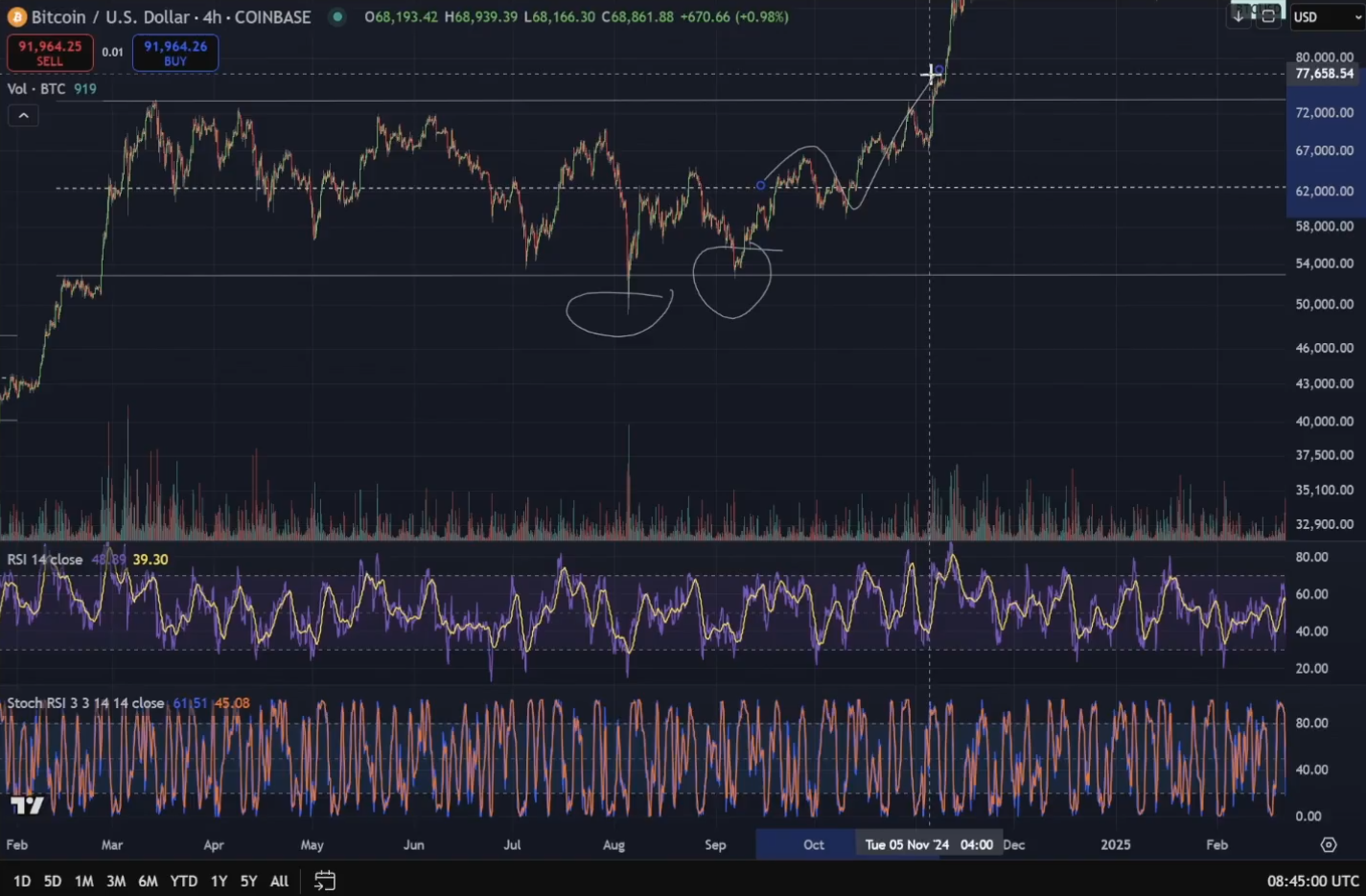
Notably, at the time, BTC first dropped to a low of $49,647 on Aug. 5, 2024, and then recovered. However, this recovery led to another pullback, leading to a higher low of $52,546 on Sept. 4, 2024, within the range of the previous low. After this higher low, BTC rose, pulled back a bit and then skyrocketed.

Bitcoin 4h Chart CryptoInsightUK
Bitcoin 4h Chart | CryptoInsightUK

Interestingly, XRP appears to be following this price pattern. For context, XRP observed its first low when it dropped to $1.7 on Feb. 3 amid a broader market downturn. After the recovery that followed, the asset witnessed a higher low when it declined to $1.95 on Feb. 28. 

Now, CryptoInsightUK believes the March 2 uptrend is the initial upsurge, after which a pullback would occur, like in the case of Bitcoin, before XRP eventually explodes. This pullback has just materialized as predicted, with XRP dropping to $2.2 on March 4. 

If XRP continues to follow the analyst’s prediction, then a recovery from this pullback could lead to an explosive price surge. So far, XRP has recovered but this price surge is yet to materialize. CryptoInsightUK’s projection, while unspecified, suggests a run to the $4 range could be possible. According to him, this is his base case.