Home Blog Page 889

Besides Bitcoin, ETH, XRP, ADA, SOL, Here are Projects Likely to Benefit from Trump’s Crypto Policy

0

Trump has backed Bitcoin, Ethereum, XRP, Cardano, and Solana for inclusion in a proposed strategic crypto reserve, but these may not be the only big winners of the U.S.’s emerging crypto policy.

President Donald Trump’s November 2024 election victory sparked a wave of excitement across the entire crypto space as his pro-crypto stance promised to provide an unprecedented supportive environment for the industry.

While the tide promises to lift all boats, Trump’s policy statements suggest it would likely lift some more than others. Trump himself appears to have his list of favorites, which he recently backed for inclusion in a proposed strategic crypto reserve. These include Bitcoin (BTC), Ethereum (ETH), XRP, Cardano (ADA), and Solana (SOL).

But these may not be the only big winners.

The Select Few?

On Tuesday, March 4, crypto research and analytics platform CryptoRank shared a Venn diagram highlighting some of the likely big winners of the U.S.’s emerging crypto policy, citing factors like whether they are “made in the U.S.,” have exchange-traded funds or pending applications, have been mentioned by Trump, or have affiliations with individuals who at one point have been invited to the White House.

Besides BTC, ETH, XRP, ADA, and SOL, the standout project appears to be Avalanche (AVAX). It was built by Cornell University researchers, has a pending ETF application, and had representatives participate in a February 2025 meeting with Bo Hines, the executive director of Trump’s digital asset advisory council, at the White House.
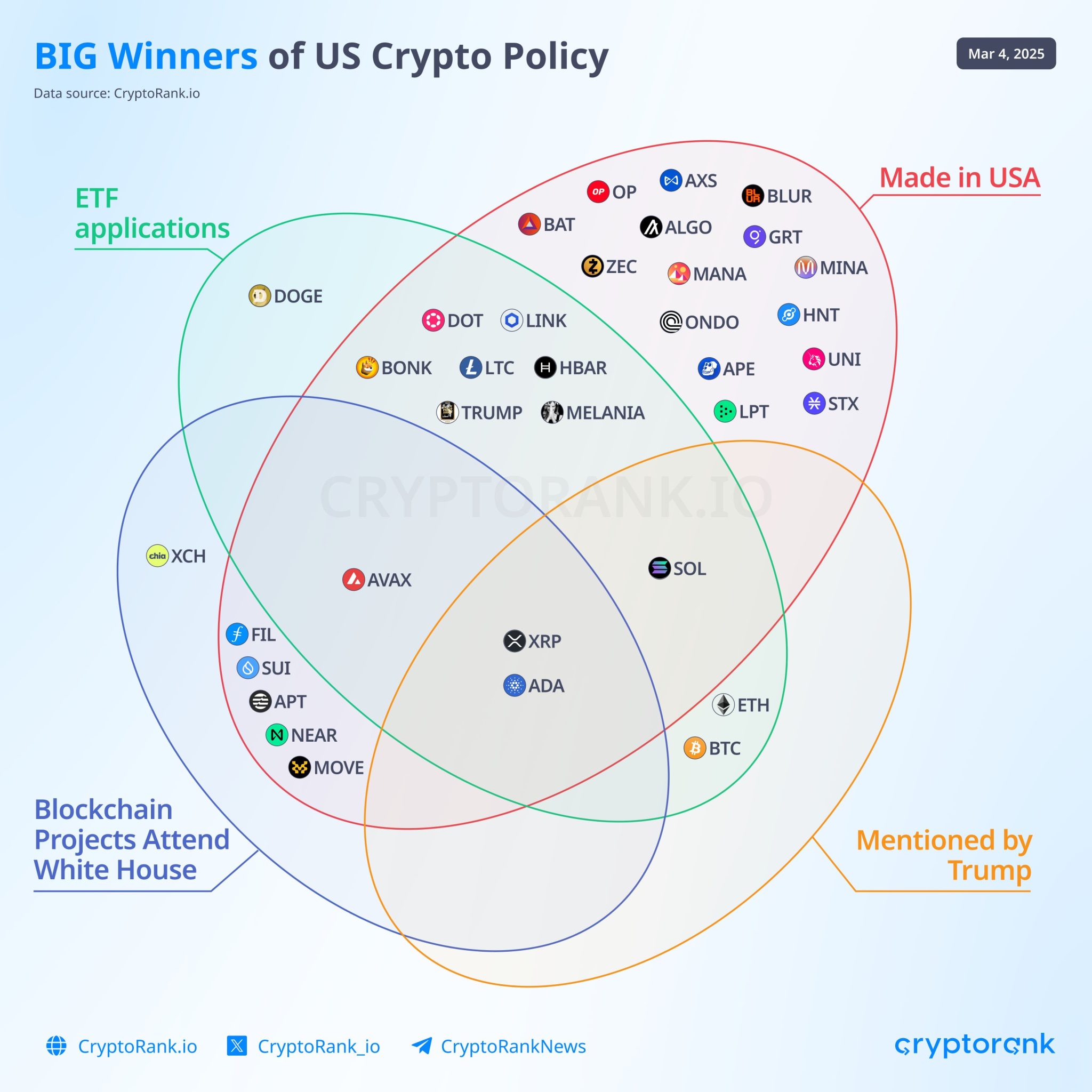
Likely winners of Trump crypto policy
Likely winners of Trump crypto policy. Source: CryptoRank

Beyond AVAX, Sui, Filecoin (FIL), Aptos (APT), NEAR, and Movement (MOVE) are among projects with U.S. roots that have also received White House recognition in the form of the meeting with Hines.

Aptos co-founder Avery Ching recently alluded to working with Cardano founder Charles Hoskinson on U.S. blockchain policy, perhaps referring to this White House roundtable.

At the same time, MOVE was recently linked to the Elon Musk-run Department of Government Efficiency. Specifically, reports suggested that Musk was considering leveraging the blockchain to bolster government transparency.

Other honorable mentions with U.S. roots include Polkadot (DOT), Chainlink (LINK), Litecoin (LTC), and Hedera (HBAR). These all have pending ETF applications.

Trump Pump Stonewalled?

Following Trump’s election victory, the total crypto market cap surged 68% from about $2.22 trillion to highs of $3.73 trillion in just over a month. Bitcoin rallied to record highs above the $100,000 price point, and popular altcoins inked triple-digit percentage gains.
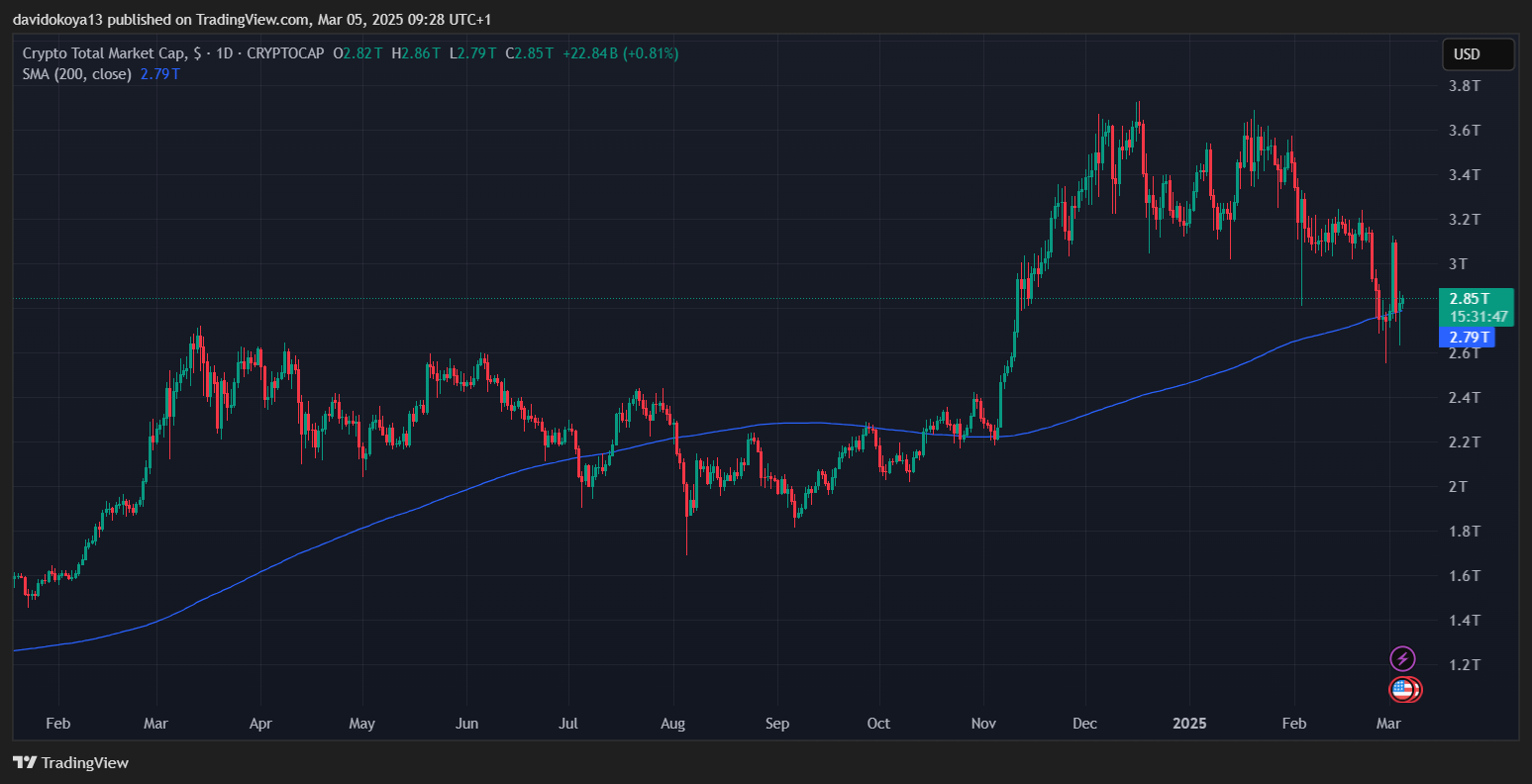
TOTAL 2025 03 05 09 28 12
Total crypto market cap chart: TradingView

Many had expected this show of strength to continue well into Q1, but that has not been the case. 

Persisting inflation and trade war fears sparked by Trump’s tariff policies have ensured that risk markets, including crypto, have been subdued recently, with sentiment quickly leaning towards pessimism.

“Until we get some certainty on tariffs/Ukraine/tax cuts/Doge cuts it is difficult to call a bottom for risk,” Standard Chartered Head of Digital Assets Research Geoffrey Kendrick wrote in a note on Tuesday.

Amid the uncertainty, Kendrick has warned that Bitcoin faces significant downside risk with a drop to the $69,000 to $76,500 range in the cards.
Pundit Shares New Theory for Why the SEC Has Not Yet Dismissed the Ripple Lawsuit

0

A market pundit has proposed a new theory for why the new SEC leadership has not yet dismissed the Ripple lawsuit despite it being the oldest crypto case on their desk.

Notably, the U.S. Securities and Exchange Commission’s (SEC) sustenance of the Ripple lawsuit has left many confused, especially as the new pro-crypto leadership terminates legal actions against other prominent firms. 

As a result, several theories on the possible reason behind this decision have surfaced. In the most recent instance, market commentator Vincent Van Code shared an idea surrounding the injunction barring certain sales of XRP tokens by Ripple.

Ripple Looking to Lift Court Injunction?

Van Code suggested in an X post that Ripple is likely engaged in negotiations with the Second Circuit Court of Appeals to overturn a pivotal ruling from July 13, 2023. In that decision, U.S. District Judge Analisa Torres determined that Ripple’s direct sales of XRP to institutional investors constituted securities transactions. 

Van Code believes Ripple seeks to reverse this finding to enable it to easily distribute XRP to participants in its RippleNet ecosystem, such as banks and payment processors, without regulatory encumbrances. 

In addition, he speculates that Ripple may aim to position its XRP escrow holdings, currently worth 37.1 billion tokens, as a potential asset for a U.S. strategic reserve, also possibly settling its $125 million fine, imposed on Aug. 7, 2024, by transferring XRP to the government. 

Recall that President Donald Trump confirmed over the weekend that XRP would secure a place in the U.S. crypto reserve. Some speculate that the government could procure its XRP tokens by taking over Ripple’s escrow.

According to Van Code, for Ripple to be able to sell the escrowed tokens to the government, it would need to overturn the Aug. 7 ruling imposing an injunction on parts of its institutional sales. This theory, while compelling, remains speculative absent concrete evidence.

SEC Dismisses Other Cases

Other SEC cases have not been so complex. For instance, last month, the SEC dismissed its lawsuit against Coinbase, which alleged the exchange operated illegally by offering unregistered securities. 

Similarly, late last month, the agency abandoned its case against Consensys concerning its MetaMask staking services. The SEC also terminated its action against Kraken on Feb. 18, a case that began in November 2023, over alleged securities violations. 

These rapid dismissals contrast with the Ripple lawsuit, which commenced on December 22, 2020, making it the oldest and most advanced of the agency’s crypto-related cases, now under review in the Second Circuit.

Notably, on Jan. 15, 2025, the SEC submitted its opening brief to the Second Circuit. Ripple has until April 16 to file its own brief. Van Code’s idea suggests that these appellate proceedings may involve negotiations to shift the legal outcome in Ripple’s favor.

There have also been other theories on the possible reason. Interestingly, attorney Jeremy Hogan pointed to the injunction placed on Ripple’s XRP sales. According to him, Ripple might be looking to lift this, a sentiment that aligns in part with Van Code’s theory.

Shiba Inu ETF: Here Are 10 Reasons BlackRock and Grayscale Should Consider Launching SHIB ETF

0

A Shiba Inu community figure highlighted 10 compelling reasons why BlackRock and Grayscale should consider launching a SHIB ETF. 

The quest to convince top asset managers to launch a Shiba Inu ETF in the U.S. has gained momentum. This campaign intensified recently, with top community members calling on asset managers to consider SHIB for an ETF. 

10 Reasons Why BlackRock and Grayscale Should Launch SHIB ETF 

In a lengthy X post, Shibarium Updates, a top Shiba Inu community handle, laid out 10 reasons established asset managers such as Grayscale Investments and BlackRock should consider launching a SHIB ETF in the U.S. 

Massive Market Opportunities 

First, the community handle noted that prospective SHIB ETF issuers will enjoy massive market opportunities by launching the product. It emphasized that Shiba Inu has a vast and passionate community that could drive the demand for a SHIB ETF, potentially boosting its adoption. 

Shibarium-Powered Ecosystem 

Second, the post pointed out that Shiba Inu has a strong ecosystem powered by Shibarium, its Layer-2 scaling solution. The blockchain, which has been operational since August 2023, has expanding use cases in gaming and decentralized finance, among others. 

Strong Retail Appeal 

Third, Shibarium Updates claims SHIB has a strong retail appeal. It contended that the cryptocurrency’s affordability makes it appealing to retail investors, which could open up a new client base for prospective issuers like BlackRock and Grayscale should they decide to launch a SHIB ETF. 

High Liquidity and Volume 

Fourth, the community handle highlighted SHIB’s massive volume and liquidity as another reason asset managers should consider launching an ETF tied to Shiba Inu. 

It argued that SHIB has high liquidity and billions of dollars in daily volume suitable to support an ETF. According to Shibarium Updates, these features lower the operational risks for prospective SHIB ETF issuers. 

Diversified Crypto Product 

Fifth, Shibarium Updates suggested that the ability to combine multiple Shiba Inu ecosystem tokens, including SHIB and BONE, into a basket ETF makes it appealing for investors seeking exposure to a diversified crypto product. 

ESG Alignment 

Another compelling reason for a SHIB ETF is the cryptocurrency’s alignment with ESG (Environmental, Social, and Governance) interests. 

Specifically, Shibarium Updates mentioned Shiba Inu’s commitment to social causes through the Karma Foundation, which aligns with ESG’s goals. 

Global Reach 

For the seventh reason, the post indicated that Shiba Inu has a global reach, leading to its adoption in gaming and payments. 

This widespread adoption positions Shiba Inu as a relevant asset for an ETF seeking the interest of international investors. 

Proven Crypto-Related ETF Success  

Eighth, it highlighted the success of Bitcoin and Ethereum ETFs, which attracted significant inflows following their launch. 

Positioning SHIB within this successful framework, Shibarium Updates speculated that an ETF tied to the canine-themed token could be attractive to investors seeking diversified crypto-related investments. 

Forward-Thinking Leadership 

Ninth, the community handle noted that prospective SHIB ETF issuers like BlackRock could reinforce their reputation as forward-thinking leaders who embrace cutting-edge innovative products. 

Long-Term Growth 

Lastly, it characterized SHIB as a high-potential asset for long-term growth, referencing Shiba Inu’s expanding ecosystem and historical performance. 

The reasons above highlight SHIB as a suitable candidate for an ETF. Shibarium Updates expects these factors to convince asset managers like BlackRock and Grayscale to file for a SHIB ETF launch in the U.S. 

Currently, no asset manager has officially submitted an application with the SEC to launch a SHIB ETF. Nonetheless, the community has remained optimistic that this will happen soon. 

Cardano Whale Transactions of $100K+ Spike to Multi-Month High Amid Price Boom

0

Cardano (ADA) whale transactions have significantly increased, according to new data from blockchain analytics company Santiment on X. 

This coincides with the asset’s temporary breakout to $1.13. Whale transactions with a value of $100,000 or more hit their highest level in more than three months, according to Santiment’s on-chain analytics.

Moreover, the average age of ADA tokens in wallets has decreased as a result of the increase in large transactions. This suggests that more tokens are returning to active circulation.

Image
Cardano ADA whale chart from Santiment

Whale Activity and Price Movements 

The rise in whale transactions points to increased network activity and a resurgence of big holders’ interest. According to Santiment, this trend coincides with a decline in the average age of ADA tokens, indicating that long-suppressed holdings are being transferred. 

Such actions have historically been connected to changes in market mood, which frequently precede times of increased volatility.

The recent announcement about establishing a U.S. Strategic Crypto Reserve, which includes Cardano, was a major catalyst that fueled optimism around ADA. Traders repositioned their holdings in response to this revelation, fueling speculation about ADA’s involvement in wider institutional adoption.

Cardano’s price surged to $1.19 after its inclusion in the upcoming U.S. Crypto Reserve. The news also saw a massive whale accumulation, with nearly 200 million ADA tokens purchased within 24 hours. 

Saylor’s Surprising Endorsement of Cardano’s Inclusion

Adding to the growing excitement, MicroStrategy chairman Michael Saylor has taken a surprising stance on Cardano’s inclusion in the U.S. Strategic Crypto Reserve. In a recent CNBC interview, Saylor, a well-known Bitcoin maximalist, acknowledged that the addition of ADA—alongside XRP, Ethereum, and Solana—was a bullish move for the entire crypto industry.

Cardano Current Market Performance

Cardano (ADA) continues to show strong bullish momentum, currently trading at $0.9378 with a 24-hour trading volume of $4,377,653,365. The asset has surged by 16.23% in the past day, reflecting the renewed confidence among investors.

 This price increase aligns with the growing whale activity and the broader market excitement surrounding ADA’s potential institutional adoption.

Whale Who Received 114,500 Ethereum Compensation worth $358M from Genesis Bankruptcy Sells 40,000 ETH

0

A wallet address that received 114,500 ETH worth $358 million from bankrupt crypto lender Genesis has resumed sales, dumping 40,000 ETH in two days.

After six months of steadfastly holding on to its stash, an Ethereum whale wallet has resumed dumping the asset. According to data from Arkham, the address sold 40,000 ETH worth $89 million in two days amid a broader market downturn.

Largest Ethereum Receiver from Genesis

Analysis shows that the wallet address “0x999E” received the largest Ethereum compensation from crypto lender Genesis Global during its restructuring proceedings last year. For context, the crypto firm, which filed for Chapter 11 bankruptcy in January 2023, recompensed creditors with digital assets worth $4 billion last August.

Although the lending firm pledged to distribute 65.87% of the holder’s Ethereum stash prior to bankruptcy, the market price increase compensated for the slash. Meanwhile, the whale address in question received 114,500 ETH ($358 million).

After holding for six months, the whale started liquidating at a reduced price. For perspective, the address received the tokens while the asset’s price was at $3,128. However, Ether’s over 30% downtrend since then has ensured the wallet’s value has reduced by $110 million.

Whale Dumps at Loss

Arkham shows that the address sent 40,000 ETH to Galaxy Digital and FalconX in the past two days, each receiving 30,000 and 10,000 ETH, respectively.

Meanwhile, the address has received Circle’s USDC from the two over-the-counter (OTC) platforms in the past two days, confirming the sales. Galaxy Digital transferred 20 million USDC to the wallet yesterday, while FalconX shifted 19.49 million USDC a day earlier.

Wallet Ethereum Sales
Wallet Ethereum Sales/Arkham

Following the Ether liquidation, enthusiasts have expressed skepticism over the market sentiment shift and the wallet’s future activities. For instance, users asked if the wallet would continue to dump the asset or if it was a one-off sale.

Notably, the address still holds 100,252 ETH worth $218 million, which accounts for over 84% of its entire crypto stash.

Ethereum Rebounds

Meanwhile, Ethereum has shown signs of life today amid a broader market rebound. Yesterday, the asset dropped below $2,000 for the first time since November 2023 but bounced from the area to close at $2,170.

The momentum spilled over to today, with the asset up 1.2% to trade at $2,200. With its current market cap of $265 billion, Ethereum remains the second-largest cryptocurrency.

El Salvador’s Nayib Bukele Says Bitcoin Purchases Would Stand Amid Fresh IMF Pressure

0

El Salvador has remained defiant on stacking Bitcoin despite renewed pressure from the International Monetary Fund.

Its president, Nayib Bukele, has insisted that the public sector’s Bitcoin purchases would continue. In a Tuesday tweet, he explicitly stated that the 1 BTC per day acquisition is not stopping.

“‘This all stops in April.’ ‘This all stops in June.’ ‘This all stops in December’ No, it’s not stopping,” Bukele tweeted.

IMF Further Fuels Ploy to Halt El Salvador’s Bitcoin Program

Meanwhile, El Salvador has maintained its pro-Bitcoin take amid persistent pressure from the IMF. Recently, the global watchdog took the charge to stop the Central American nation from meddling with Bitcoin a step further.

In its ongoing $1.4 billion loan deal with El Salvador, the IMF laid out new rules the nation should abide by to secure the funds. Per a March 3 release, the small nation’s public sector will cease its voluntary Bitcoin acquisitions.

Furthermore, it would end all Bitcoin mining activities, terminate its participation in the Chivo wallet system, and make its wallet addresses public. The IMF further required El Salvador’s public sector to discontinue any form of asset or Treasury tokenization denominated in Bitcoin.

The IMF emphasized that El Salvador’s allegiance to this new requirement would determine whether its extended fund facility program would pull through. In simple terms, El Salvador must stop its daily BTC purchases to receive funding from the global watchdog.

Bukele Responds with New Bitcoin Purchase

Nonetheless, Bukele responded with another 1 BTC purchase yesterday. His post quoted an announcement from the Bitcoin office showing that the nation has continued its purchases, taking its stash to 6,101 BTC.

Furthermore, the pro-Bitcoin president insisted that if El Salvador did not abandon this program when the world ostracized the nation because it adopted the pioneering cryptocurrency, it would not stop now. He reiterated his long-term commitment to stacking BTC.

Meanwhile, Strategy’s executive chairman, Michael Saylor, cheered the defiance, insisting the adoption of the orange pill cannot be mutilated.

“Bitcoin adoption is unstoppable,” Saylor responded.

While El Salvador has revised its Bitcoin laws, including limiting public sector exposure and voluntary tax payment in US dollars, it seems bent on sticking to its daily BTC accrual. Data from its portfolio tracker shows that its stash currently sits at a profit of over $131 million.

Ripple CTO Confirms Ripple is Not Obliged to HODL XRP

0

The Ripple CTO David Schwartz recently confirmed that Ripple owes no obligation to hold XRP, blaming this idea on XRP security misrepresentation.

His comments came in response to an ongoing discussion about Ripple’s role in XRP’s distribution and its responsibilities toward token holders.  

For context, Bitcoin advocate and XRP critic, Pierre Rochard, argued that Ripple has no obligation to ensure XRP holders benefit from its actions. He asserted that the company is free to sell its large XRP holdings, even if it negatively impacts retail investors. According to him, this is what makes XRP a non-security.

Ripple Has No Obligation to HODL Its XRP Bag

Interestingly, Schwartz agreed, emphasizing that Ripple, like any other business, operates in its own best interest. He compared XRP ownership to possessing early artwork from an emerging artist. 

While investors might hope the artist continues to create value that benefits their holdings, there is no obligation for them to do so. He stressed that neither Ripple nor any company should be expected to act against its own interests to serve investors.  

Amid this disclosure, the Ripple CTO also pointed out that Ripple has been an established player in the industry for nearly 14 years. The company holds more XRP than it could feasibly liquidate in a short timeframe. Notably, this alleviates fears that it could dump all its holdings in the short-term.

Also, Schwartz dismissed the idea that Ripple could be the only major crypto company to succeed, likening the notion to expecting Google to be the sole winner in the internet industry.  

Notably, his comments echo Ripple’s defense in its ongoing legal battle with the U.S. Securities and Exchange Commission (SEC), initiated in December 2020. For context, the SEC alleged that Ripple had an obligation to ensure XRP holders observed gains on their holdings, a theory that the firm has rebuffed.

XRP Not a Security 

Following Schwartz’s latest remarks, a prominent Ripple critic who goes by “ScamDaddy” shared a screenshot of the conversation. He questioned why anyone would be surprised by Ripple prioritizing its business goals, implying that this has always been clear.  

Schwartz responded, suggesting that most of the confusion about Ripple’s role in XRP’s ecosystem comes from those pushing the narrative that XRP is a security. He implied that this group has deliberately misrepresented the relationship between Ripple and XRP.

“It’s mostly the ‘XRP is a security” crowd that deliberately created confusion about the relationship between Ripple and XRP,” the Ripple executive said in a post on X.

Notably, further discussion sprang up when XRPL validator Vet pointed out that individuals who believe Ripple owes XRP holders an obligation to HODL are also those claiming that Ripple was responsible for issuing XRP. 

In response, “ScamDaddy” acknowledged that the term “issued” is widely debated but maintained that Ripple’s founders created both the XRP Ledger and the token, later distributing it.  

However, Vet countered this, clarifying that the XRP Ledger existed before Ripple as a company. He acknowledged that there was an overlap between the individuals who developed the technology and those who later established Ripple, but he stressed that the two entities were not synonymous.  

Here Are Crypto Execs Confirmed to Attend White House First-Ever Crypto Summit

0

The inaugural White House Crypto Summit is still on track to take place this week, with top crypto stakeholders confirming their attendance. 

On March 7, U.S. President Donald Trump will meet with a few crypto stakeholders at the first-ever White House Crypto Summit. 

FOX Business journalist Eleanor Terrett said the event’s guest list will be smaller than expected, with around 25 participants. The upcoming summit will be held at the White House in a roundtable format, featuring some bigwigs in the crypto industry and members of the Presidential Working Group. 

Notably, the White House has sent out invites to attendees via mail. According to the message, the event will run from 1:30 – 5:30 PM (ET) on Friday, March 7. 

Confirmed Attendees 

Some major crypto stakeholders, including Michael Saylor, executive chairman of MicroStrategy (now Strategy), have confirmed their attendance at the event. 

Other top crypto players expected to be at the summit include Robinhood CEO Vlad Tenev, Coinbase CEO Brian Armstrong, and Kraken CEO Arjun Sethi. 

Bitcoin Magazine CEO David Bailey also confirmed his attendance, as well as Exodus CEO J.P. Richardson, Paradigm co-founder Matt Huang, and Multicoin Capital co-founder Kyle Samani. 

Furthermore, Zach Witkoff, the co-founder of Trump’s family crypto project World Liberty Financial, and Sergey Nazarov of Chainlink will also attend. 

Government officials attending the summit include David Sacks and several members of the Presidential Working Group. Recall that Trump added key heads of top federal agencies to the group in January. This includes treasury and commerce secretaries, as well as the acting chairpersons of the SEC and CFTC. 

In the meantime, other top crypto stakeholders are expected to confirm their invitations before Friday. However, those not invited to the crypto summit might be included in a larger reception planned for a later date. 

Potential Discussions 

Meanwhile, attendees will deliberate on pivotal issues relating to the crypto industry, focusing on positioning the United States as the leader of the emerging sector. 

The crypto attendees could advocate for a clear regulatory framework, aligning with Trump’s campaign promise. Sacks, who is expected to chair the event, hinted at plans to share more details about the U.S. Crypto Reserve. 

The United States government has already announced initial support for five cryptos: Bitcoin, Ethereum, XRP, SOL, and ADA. Sacks suggested that the government might unveil more details about the crypto reserve during the summit. 

Financial Pundit Kiyosaki Says People Who Sold Bitcoin in the Last Crash Are “Losers”

Renowned financial pundit Robert Kiyosaki has boldly referred to those who sold their Bitcoin during the last market crash as “losers.”

According to Kiyosaki, these individuals will live to regret their decisions. Kiyosaki believes selling Bitcoin in the current market environment is a poor decision, especially given the various catalysts surrounding the asset.

He specifically pointed out that the current president of the United States, Donald Trump, is a pro-Bitcoin president. Kiyosaki described Trump as the right president at the right time, touting him as one who understands the power of Bitcoin.

Trump and Bitcoin Price Action 

Notably, in the final weeks of February, Bitcoin dumped hard. Its price dropped to as low as $78,200, down from the $90,000 level it had been trading at earlier. This development caused widespread panic in the crypto market.

However, on March 2, Bitcoin rebounded dramatically, rising to $95,050 and erasing losses from late February. This remarkable recovery came after Trump officially announced plans to create a strategic reserve with Bitcoin and other assets. The announcement reignited bullish sentiment in the market.

However, the very next day, Bitcoin’s price tanked again, falling to around $82,000 as some traders took profits from the Trump-induced price pump. The sudden downturn surprised many who had expected the upward trend to continue.

“Dip Buyers Will Be the Winners, Sellers Are the Biggest Losers”

Taking to X (formerly Twitter), Kiyosaki expressed his disapproval of those who sold, seeing it as a poor financial decision and labeling them as “losers.”

According to Kiyosaki, Bitcoin’s price is poised to soar, especially when the Trump administration begins buying Bitcoin to address the country’s financial challenges. He emphasized that those who used the recent crash to accumulate more Bitcoin would be the winners, while those who sold would be the “biggest losers.”

He also revealed that he personally bought more Bitcoin during the crash, anticipating a promising turnaround soon. As of press time, Bitcoin’s price is rebounding to $87,200, posting a 4% gain over the last 24 hours.

Interestingly, market participants responding to Kiyosaki’s tweet share his sentiment. One X user, Lance, commented that Bitcoin isn’t an asset for sale, adding that those who have sold simply do not understand the asset. According to him, “they will pay heavily for this mistake,” stressing that “There’s nothing to sell Bitcoin to…” 

Cardano Founder Responds to Claims About His Nationality in ADA’s U.S. Reserve Asset Debate

0

The Cardano founder Charles Hoskinson has responded to an argument that he is Canadian in an effort to downplay the selection of ADA as a U.S. reserve asset.

President Donald Trump’s announcement on Sunday that the U.S. strategic crypto reserve would feature Cardano (ADA), XRP, and Solana (SOL)—touted as “Made in America” coins—alongside Bitcoin and Ethereum has triggered discussions in crypto circles. 

The disclosure, made through Truth Social, aligns with earlier reports suggesting a focus on American-origin digital assets for the reserve. Yet, not everyone sees the logic behind the chosen trio. 

In the latest episode of the CoinDesk Markets Daily podcast, aired on March 4, host Jen Sanassi probed Delta Blockchain Fund founder Kavita Gupta for her take on these selections, triggering a pointed exchange about Cardano’s place in the mix. 

Gupta’s skepticism about ADA, and her misstep about its founder’s nationality, expectedly led to a sharp rebuttal from Cardano’s Charles Hoskinson, who took to X to set the record straight.

Delta Blockchain Fund Founder Questions Inclusion of XRP and Cardano

During the podcast, Sanassi steered the conversation to the three assets Trump named, seeking Gupta’s opinion on whether they deserved a spot in the yet-to-be-defined reserve. 

Gupta was more receptive of Solana, highlighting its large community. However, she questioned its long-term staying power beyond the meme coin craze that followed its NFT boom. 

She then turned to XRP, noting that she was confused over its retail token appeal, given its focus on institutional payment infrastructure, a debate she noted has lingered for years. 

However, her analysis took a sharper turn when she addressed Cardano, casting doubt on its inclusion and questioning its American credentials.

Gupta argued that Cardano doesn’t strike her as a U.S.-based project, asserting that its founder hails from Canada and resides there. She contrasted this with Ethereum, which she credited with a robust U.S. community despite its multiple founders. 

Gupta argued that she had not witnessed any significant Cardano community or projects in the U.S., suggesting they were absent at industry conferences. According to her, the reasoning behind ADA’s selection left her confused. 

Still, the Delta Blockchain Fund founder welcomed the broader spotlight on crypto assets at a national level, seeing it as a silver lining despite her reservations.

Cardano Founder Reacts

Charles Hoskinson, Cardano’s founder, didn’t let Gupta’s comments slide. In a video posted to X on March 4, he made a sarcastic response, mocking her claim about his nationality. 

Hoskinson pointed out that he was born in Hawaii and currently living in Colorado, highlighting his deep American roots, as he has his ranch in Wyoming alongside family ties spanning Colorado, Montana, New York, Pennsylvania, and Florida. 

He mocked the notion of being Canadian, calling it a revelation to him and chiding the crypto community to sharpen its facts. 

The latest development reflects a broader tension following Trump’s reserve announcement. Revealed as part of his vision to make the U.S. the “crypto capital of the world,” the plan ties back to a Jan. 23, 2025, executive order forming a Presidential Working Group on Digital Assets.