Home Blog Page 890

Ripple CTO Confirms Ripple is Not Obliged to HODL XRP

0

The Ripple CTO David Schwartz recently confirmed that Ripple owes no obligation to hold XRP, blaming this idea on XRP security misrepresentation.

His comments came in response to an ongoing discussion about Ripple’s role in XRP’s distribution and its responsibilities toward token holders.  

For context, Bitcoin advocate and XRP critic, Pierre Rochard, argued that Ripple has no obligation to ensure XRP holders benefit from its actions. He asserted that the company is free to sell its large XRP holdings, even if it negatively impacts retail investors. According to him, this is what makes XRP a non-security.

Ripple Has No Obligation to HODL Its XRP Bag

Interestingly, Schwartz agreed, emphasizing that Ripple, like any other business, operates in its own best interest. He compared XRP ownership to possessing early artwork from an emerging artist. 

While investors might hope the artist continues to create value that benefits their holdings, there is no obligation for them to do so. He stressed that neither Ripple nor any company should be expected to act against its own interests to serve investors.  

Amid this disclosure, the Ripple CTO also pointed out that Ripple has been an established player in the industry for nearly 14 years. The company holds more XRP than it could feasibly liquidate in a short timeframe. Notably, this alleviates fears that it could dump all its holdings in the short-term.

Also, Schwartz dismissed the idea that Ripple could be the only major crypto company to succeed, likening the notion to expecting Google to be the sole winner in the internet industry.  

Notably, his comments echo Ripple’s defense in its ongoing legal battle with the U.S. Securities and Exchange Commission (SEC), initiated in December 2020. For context, the SEC alleged that Ripple had an obligation to ensure XRP holders observed gains on their holdings, a theory that the firm has rebuffed.

XRP Not a Security 

Following Schwartz’s latest remarks, a prominent Ripple critic who goes by “ScamDaddy” shared a screenshot of the conversation. He questioned why anyone would be surprised by Ripple prioritizing its business goals, implying that this has always been clear.  

Schwartz responded, suggesting that most of the confusion about Ripple’s role in XRP’s ecosystem comes from those pushing the narrative that XRP is a security. He implied that this group has deliberately misrepresented the relationship between Ripple and XRP.

“It’s mostly the ‘XRP is a security” crowd that deliberately created confusion about the relationship between Ripple and XRP,” the Ripple executive said in a post on X.

Notably, further discussion sprang up when XRPL validator Vet pointed out that individuals who believe Ripple owes XRP holders an obligation to HODL are also those claiming that Ripple was responsible for issuing XRP. 

In response, “ScamDaddy” acknowledged that the term “issued” is widely debated but maintained that Ripple’s founders created both the XRP Ledger and the token, later distributing it.  

However, Vet countered this, clarifying that the XRP Ledger existed before Ripple as a company. He acknowledged that there was an overlap between the individuals who developed the technology and those who later established Ripple, but he stressed that the two entities were not synonymous.  

Here Are Crypto Execs Confirmed to Attend White House First-Ever Crypto Summit

0

The inaugural White House Crypto Summit is still on track to take place this week, with top crypto stakeholders confirming their attendance. 

On March 7, U.S. President Donald Trump will meet with a few crypto stakeholders at the first-ever White House Crypto Summit. 

FOX Business journalist Eleanor Terrett said the event’s guest list will be smaller than expected, with around 25 participants. The upcoming summit will be held at the White House in a roundtable format, featuring some bigwigs in the crypto industry and members of the Presidential Working Group. 

Notably, the White House has sent out invites to attendees via mail. According to the message, the event will run from 1:30 – 5:30 PM (ET) on Friday, March 7. 

Confirmed Attendees 

Some major crypto stakeholders, including Michael Saylor, executive chairman of MicroStrategy (now Strategy), have confirmed their attendance at the event. 

Other top crypto players expected to be at the summit include Robinhood CEO Vlad Tenev, Coinbase CEO Brian Armstrong, and Kraken CEO Arjun Sethi. 

Bitcoin Magazine CEO David Bailey also confirmed his attendance, as well as Exodus CEO J.P. Richardson, Paradigm co-founder Matt Huang, and Multicoin Capital co-founder Kyle Samani. 

Furthermore, Zach Witkoff, the co-founder of Trump’s family crypto project World Liberty Financial, and Sergey Nazarov of Chainlink will also attend. 

Government officials attending the summit include David Sacks and several members of the Presidential Working Group. Recall that Trump added key heads of top federal agencies to the group in January. This includes treasury and commerce secretaries, as well as the acting chairpersons of the SEC and CFTC. 

In the meantime, other top crypto stakeholders are expected to confirm their invitations before Friday. However, those not invited to the crypto summit might be included in a larger reception planned for a later date. 

Potential Discussions 

Meanwhile, attendees will deliberate on pivotal issues relating to the crypto industry, focusing on positioning the United States as the leader of the emerging sector. 

The crypto attendees could advocate for a clear regulatory framework, aligning with Trump’s campaign promise. Sacks, who is expected to chair the event, hinted at plans to share more details about the U.S. Crypto Reserve. 

The United States government has already announced initial support for five cryptos: Bitcoin, Ethereum, XRP, SOL, and ADA. Sacks suggested that the government might unveil more details about the crypto reserve during the summit. 

Financial Pundit Kiyosaki Says People Who Sold Bitcoin in the Last Crash Are “Losers”

Renowned financial pundit Robert Kiyosaki has boldly referred to those who sold their Bitcoin during the last market crash as “losers.”

According to Kiyosaki, these individuals will live to regret their decisions. Kiyosaki believes selling Bitcoin in the current market environment is a poor decision, especially given the various catalysts surrounding the asset.

He specifically pointed out that the current president of the United States, Donald Trump, is a pro-Bitcoin president. Kiyosaki described Trump as the right president at the right time, touting him as one who understands the power of Bitcoin.

Trump and Bitcoin Price Action 

Notably, in the final weeks of February, Bitcoin dumped hard. Its price dropped to as low as $78,200, down from the $90,000 level it had been trading at earlier. This development caused widespread panic in the crypto market.

However, on March 2, Bitcoin rebounded dramatically, rising to $95,050 and erasing losses from late February. This remarkable recovery came after Trump officially announced plans to create a strategic reserve with Bitcoin and other assets. The announcement reignited bullish sentiment in the market.

However, the very next day, Bitcoin’s price tanked again, falling to around $82,000 as some traders took profits from the Trump-induced price pump. The sudden downturn surprised many who had expected the upward trend to continue.

“Dip Buyers Will Be the Winners, Sellers Are the Biggest Losers”

Taking to X (formerly Twitter), Kiyosaki expressed his disapproval of those who sold, seeing it as a poor financial decision and labeling them as “losers.”

According to Kiyosaki, Bitcoin’s price is poised to soar, especially when the Trump administration begins buying Bitcoin to address the country’s financial challenges. He emphasized that those who used the recent crash to accumulate more Bitcoin would be the winners, while those who sold would be the “biggest losers.”

He also revealed that he personally bought more Bitcoin during the crash, anticipating a promising turnaround soon. As of press time, Bitcoin’s price is rebounding to $87,200, posting a 4% gain over the last 24 hours.

Interestingly, market participants responding to Kiyosaki’s tweet share his sentiment. One X user, Lance, commented that Bitcoin isn’t an asset for sale, adding that those who have sold simply do not understand the asset. According to him, “they will pay heavily for this mistake,” stressing that “There’s nothing to sell Bitcoin to…” 

Cardano Founder Responds to Claims About His Nationality in ADA’s U.S. Reserve Asset Debate

0

The Cardano founder Charles Hoskinson has responded to an argument that he is Canadian in an effort to downplay the selection of ADA as a U.S. reserve asset.

President Donald Trump’s announcement on Sunday that the U.S. strategic crypto reserve would feature Cardano (ADA), XRP, and Solana (SOL)—touted as “Made in America” coins—alongside Bitcoin and Ethereum has triggered discussions in crypto circles. 

The disclosure, made through Truth Social, aligns with earlier reports suggesting a focus on American-origin digital assets for the reserve. Yet, not everyone sees the logic behind the chosen trio. 

In the latest episode of the CoinDesk Markets Daily podcast, aired on March 4, host Jen Sanassi probed Delta Blockchain Fund founder Kavita Gupta for her take on these selections, triggering a pointed exchange about Cardano’s place in the mix. 

Gupta’s skepticism about ADA, and her misstep about its founder’s nationality, expectedly led to a sharp rebuttal from Cardano’s Charles Hoskinson, who took to X to set the record straight.

Delta Blockchain Fund Founder Questions Inclusion of XRP and Cardano

During the podcast, Sanassi steered the conversation to the three assets Trump named, seeking Gupta’s opinion on whether they deserved a spot in the yet-to-be-defined reserve. 

Gupta was more receptive of Solana, highlighting its large community. However, she questioned its long-term staying power beyond the meme coin craze that followed its NFT boom. 

She then turned to XRP, noting that she was confused over its retail token appeal, given its focus on institutional payment infrastructure, a debate she noted has lingered for years. 

However, her analysis took a sharper turn when she addressed Cardano, casting doubt on its inclusion and questioning its American credentials.

Gupta argued that Cardano doesn’t strike her as a U.S.-based project, asserting that its founder hails from Canada and resides there. She contrasted this with Ethereum, which she credited with a robust U.S. community despite its multiple founders. 

Gupta argued that she had not witnessed any significant Cardano community or projects in the U.S., suggesting they were absent at industry conferences. According to her, the reasoning behind ADA’s selection left her confused. 

Still, the Delta Blockchain Fund founder welcomed the broader spotlight on crypto assets at a national level, seeing it as a silver lining despite her reservations.

Cardano Founder Reacts

Charles Hoskinson, Cardano’s founder, didn’t let Gupta’s comments slide. In a video posted to X on March 4, he made a sarcastic response, mocking her claim about his nationality. 

Hoskinson pointed out that he was born in Hawaii and currently living in Colorado, highlighting his deep American roots, as he has his ranch in Wyoming alongside family ties spanning Colorado, Montana, New York, Pennsylvania, and Florida. 

He mocked the notion of being Canadian, calling it a revelation to him and chiding the crypto community to sharpen its facts. 

The latest development reflects a broader tension following Trump’s reserve announcement. Revealed as part of his vision to make the U.S. the “crypto capital of the world,” the plan ties back to a Jan. 23, 2025, executive order forming a Presidential Working Group on Digital Assets. 

Top Financial Analyst Says XRP is the Next Major Crypto Crash – Here’s Why

Jesse Colombo, a widely followed financial analyst, has warned that XRP could be on the brink of a significant crash.

In a recent tweet, Colombo pointed out the formation of a head-and-shoulders pattern on XRP’s daily chart. This is a bearish technical signal that often precedes substantial downward movements.

The $2 Neckline: Make-or-Break for XRP

The chart reveals a head-and-shoulders structure, with a neckline in the $2 to $2.20 range. Colombo emphasized that a decisive close below $2 would confirm the pattern and likely trigger a sharp sell-off, potentially sending XRP into a steep decline.

He added that such a development could lead to panic among investors and negatively impact the broader crypto market.

Notably, Colombo’s bearish observation comes as XRP and the broader crypto market face a new round of turbulence just a day after a massive price surge. On Sunday, XRP approached the $3 mark after trading at $1.96 two days earlier. However, XRP has crashed by over 18%, falling to $2.23.

Observing this, Colombo stated that more significant declines could be in the works should XRP fall below the $2 mark again.

Will Buyers Defend the Support Zone?

Despite the bearish outlook, XRP still has a chance to stabilize if buyers step in at the $2 support level. This threshold has served as a strong accumulation zone since XRP’s sensational price run that pushed the price above $3 earlier this year.

The support zone has often provided a foundation for a rebound, as depicted in Colombo’s chart. However, the bearish pattern could play out if selling pressure continues to mount, reinforcing the analyst’s prediction.

If you want to know what is the next crypto to crash, take a look at XRP
XRP chart showing head-and-shoulders pattern

Interestingly, Colombo expressed profound hope that the breakdown would occur. According to him, he “wants the market to punish crypto gamblers severely and for nearly every token to fade into oblivion.”

In his view, society will ultimately be better off when that happens.

Promising Formation on the XRP Chart

Meanwhile, other market commentators see a promising formation on the XRP chart. Analyst Captain Faibik tweeted that XRP is forming a bullish pennant on the daily timeframe. He highlighted that this formation looks promising for another 80% to 100% bullish rally in the midterm.

Faibik suggests that XRP could target the $5 price point once it rebounds from the current downturn. His perspective essentially views the ongoing bearish market as a buying opportunity, with the belief that XRP could defend the $2 level for a major comeback.

US Market Conditions Impact Bitcoin Price, but Long-Term Outlook Remains Strong: Expert

New observations by Ki Young Ju, the CEO of CryptoQuant, show that the Bitcoin market is decelerating, fueled primarily by changing sentiment in the United States. 

In a recent post on X, Ju pointed out that although important on-chain metrics are neutral, the bull cycle for Bitcoin remains intact. Nevertheless, without altering U.S. market conditions, price momentum may be sluggish.

U.S. Market Sentiment and Bitcoin Price Action

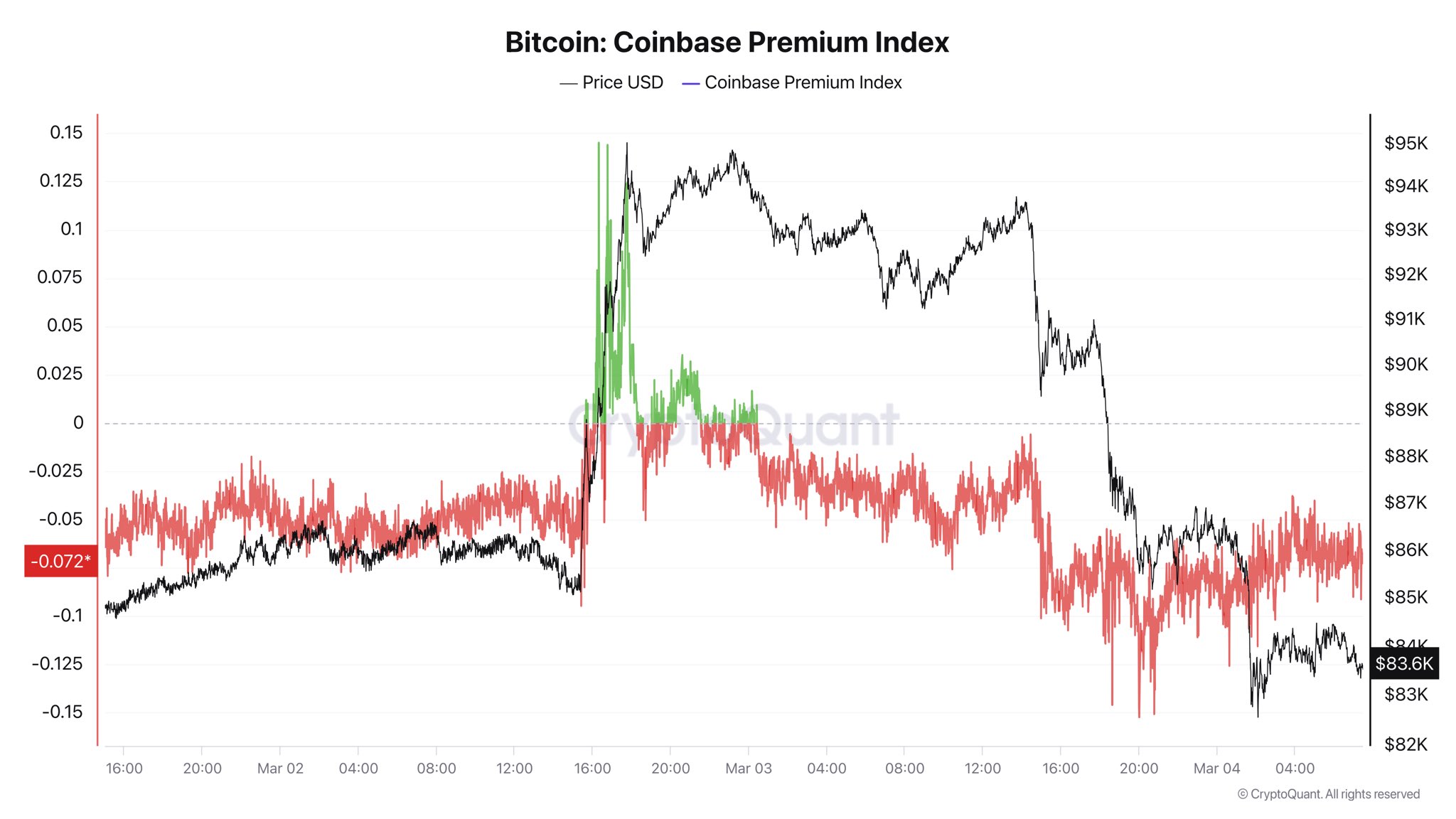
Ju‘s analysis suggests that recent Bitcoin price action has been caused by whale activity on Coinbase, a major U.S. exchange. His post references the Coinbase Premium Index, which monitors the gap between the price of Bitcoin on Coinbase and on other international exchanges.

This index is often used to gauge institutional interest and U.S. investor sentiment. According to Ju, the market’s mood today is significantly different from late 2024, when enthusiasm and inflows were stronger.

Bitcoin’s Fundamentals Remain Strong

Despite the slowdown, Ju remains optimistic about Bitcoin’s long-term direction. He emphasized that despite no significant on-chain activity today, Bitcoin still has solid fundamentals in place. One factor supporting such a statement is the continued scale-up of Bitcoin mining operations and the introduction of additional mining rigs.

Also, Bitcoin’s price movement has created a symmetrical triangle pattern, and that may be the deciding factor for its next direction. Having recently touched the $82,000 level again, experts look at the 61.8% Fibonacci level as a critical support area.

If Bitcoin does not hold above this level, it may be forced to dip further towards $70,000.

On the other hand, a break above the short-term resistance trendline would send Bitcoin back to $92,000, the way towards a potential rally.

Ju also pointed out that an early end to this cycle would be an undesirable scenario for multiple stakeholders, such as old whales, mining companies, traditional finance (TradFi) players, and even Donald Trump. The sentiment suggests that a rebound to a new all-time high is still likely despite ongoing bearish performance. 

Market Outlook: Will Bitcoin Regain Its Strength?

Ultimately, whether or not the bull cycle continues will depend critically on Bitcoin’s capacity to hold onto important support levels throughout the latest downturn. 

Potential triggers that could regain investor confidence in the U.S. market include macroeconomic changes and regulatory developments, which many traders also monitor.

IMF Forces El Salvador to Cease Bitcoin Purchases as Part of Extended Loan Agreement

The International Monetary Fund (IMF) has introduced new conditions to limit El Salvador’s engagement with Bitcoin under an extended $1.4 billion loan agreement.

In a new memorandum on Monday, the IMF outlined several conditions, including a ban on voluntary Bitcoin accumulation by the public sector. The restrictions come as the IMF strengthens its oversight of the country’s Bitcoin adoption policies.

Beyond limiting Bitcoin purchases, the IMF has also prohibited the issuance of government debt or tokenized financial instruments linked to Bitcoin. This restriction prevents the country from using Bitcoin-backed instruments to finance public sector projects.

Revised Bitcoin Law

In line with these new terms, the Salvadoran government has already taken steps to address Bitcoin-related risks. The government recently amended its Bitcoin Law to clarify the legal status of Bitcoin, removing its designation as legal tender.

Notably, in the latest update, the Salvadoran government has committed to ending public involvement in the Chivo Bitcoin project by March 2025, with full discontinuation by July 2025.

Key steps include liquidating the Bitcoin trust fund (Fidebitcoin), publishing financial audits, and ensuring that Chivo clients’ U.S. dollar funds are safeguarded at the Central Reserve Bank.

A new governance framework for managing government-owned Bitcoin and other crypto assets will be established. Notably, investment guidelines and risk-minimization policies are set to be enacted by December 2025.

Interestingly, the government has also agreed to stop acquiring new Bitcoins and issuing Bitcoin-linked debt. Additionally, no new public entities will engage in Bitcoin operations unless necessary for managing existing assets.

Image
An excerpt from IMF publication

El Salvador Continues Bitcoin Accumulation Despite IMF Conditions

Despite the IMF’s restrictions, President Nayib Bukele has continued acquiring Bitcoin for the country. Today, Bukele announced another purchase, bringing El Salvador’s total Bitcoin holdings to 6,100 BTC.

This move raises questions about how the Salvadoran government will navigate its Bitcoin strategy under the IMF’s funding conditions.

The development has sparked significant attention in the crypto community. Some suggest that El Salvador has an extended deadline to fully comply with the IMF conditions.

Mexican Billionaire Salinas Commits 70% of His Wealth to Bitcoin 

Mexican billionaire Ricardo Salinas reveals that 70% of his liquid investment portfolio is now in Bitcoin and Bitcoin-related assets. 

With an estimated net worth of $5.8 billion, Salinas, one of Mexico’s most prominent business magnates, shared this update during a recent interview with Bloomberg. 

The announcement indicates a massive upgrade from his earlier allocation of 10% to Bitcoin in 2020, confirming his growing confidence in the pioneering crypto asset as a reliable destination for wealth preservation.

Salinas Attracted to Bitcoin

Salinas, who heads the sprawling Grupo Salinas conglomerate—including ventures like TV Azteca and Total Play Telecomunicaciones—explained that his portfolio now consists primarily of Bitcoin, gold, stakes in gold mining companies, and shares in his own businesses. 

Interestingly, his portfolio is devoid of traditional investments like bonds or stocks outside his enterprises. “I don’t have a single bond, and I don’t have any other stocks except my own,” he stated, stressing his departure from conventional financial instruments. 

According to the billionaire, the remaining 30% of his liquid assets is invested in gold and gold miners, assets he views as reliable complements to Bitcoin’s potential.

Salinas has been a vocal advocate for Bitcoin and has long championed its value as a protection against inflation and fiat currency volatility, these concerns are particularly relevant in Latin America, where economic instability has historically challenged wealth preservation. 

His journey with Bitcoin began years ago, and he has since leveraged his platform, boasting over 2 million followers on X, to promote the cryptocurrency. Last month, he spotlighted Strategy Chair Saylor’s prediction of a BTC rise to $13 million.

Notably, Salinas has even hinted at ambitions to integrate Bitcoin into his banking operations, once stating he aimed to make Banco Azteca the first Mexican bank to accept it. However, this vision is still unfolding at press time.

Salinas’ bold reallocation comes amid a broader surge in Bitcoin’s price. Despite a 17% decline last month, Bitcoin is still up 42% since September 2024. In November alone, the asset surged 37.32% on the back of Donald Trump’s election victory.

Bitcoin Adoption Gains Momentum

Salinas is not alone in his enthusiasm for Bitcoin. This appetite for the premier crypto asset has grown among institutions and individual investors. 

Strategy (formerly MicroStrategy), a business analytics firm led by Michael Saylor, stands out as a corporate pioneer, holding over 499,000 BTC worth $41.28 billion as of press time. The firm confirmed plans to buy more $42 billion worth of BTC through 2027 and has persistently purchased more tokens nearly every week. 

Other firms like Japan’s Metaplanet have also shown a similar interest in BTC. Notably, Galaxy Research forecasts Bitcoin could hit $185,000 in 2025, driven by this rising adoption among institutions, corporations, and even nation-states like El Salvador.

Cardano Founder Endorses ADA and XRP as Safe Blue Chip Cryptos, Says Solana Is ‘Mid’ 

0

Cardano Founder Charles Hoskinson characterizes XRP and ADA as safe blue chip cryptocurrencies while referring to Solana as mid. 

Hoskinson made this known during an interview with David Gokhshtein, the host of the Gokhshtein podcast. In the interview, Hoskinson highlighted the possible criteria behind the selection of the assets that will feature in the U.S. crypto reserve. 

The U.S. government announced initial support for five cryptos: BTC, XRP, SOL, ETH, and ADA. 

ADA and XRP Received High Ratings 

Commenting on the selection, Hoskinson expressed confidence that ADA and XRP had better ratings, which led to their inclusion in the reserve. 

He highlighted their longevity and resilience, noting that both coins have been in existence for a long time and have survived various challenges, from market downturns to team changes. Despite these challenges, he emphasized that ADA and XRP have continued ranking in the top 10. 

Notably, the Cardano founder referred to both assets as ‘safe blue chip cryptos’ based on their resilience and longevity. 

Solana Is Mid 

However, he described Solana as ‘kinda mid’ because it is neither new nor old. Nonetheless, he acknowledged Solana’s resilience, especially its ability to survive the FTX incident in 2022, which plunged its price to around $8. Interestingly, SOL rebounded from the dust, soaring to an all-time high of $294 in January 2025. 

Furthermore, Hoskinson described Solana and Ethereum as the standard for smart contracts in the crypto market. He seemed impressed that the first five digital assets selected for the U.S. strategic crypto reserve include Bitcoin, the two-largest smart contract tokens, and two blue chip cryptocurrencies with strong communities and longevity. 

Meanwhile, he questioned which cryptos would be added next, referencing assets like Avalanche and Hedera Hashgraph as examples. 

Next Steps? 

The Cardano boss recommended establishing a working group to determine the selection criteria for future support. Apparently, the Presidential Working Committee created in January might oversee this process and set the standard for future selection. 

Furthermore, he mentioned that this group will also ascertain the asset procurement and management. In particular, the Cardano founder suggested that the U.S. Treasury Department might be in charge of the procurement. 

While many aspects of the U.S. crypto reserve remain uncertain, Hoskinson believes they will be addressed in the coming weeks or months. 

In the meantime, the industry expects more details about the reserve in the upcoming Crypto Summit, slated for March 7. White House AI & Crypto Czar made this known over the weekend. 

Treasury Secretary Says Trump Focused “On Bringing Interest Rates Down”: What It Means for Bitcoin and Crypto

U.S. Treasury Secretary Scott Bessent has recently stoked excitement in the Bitcoin and crypto community.

Speaking to Fox News on Tuesday, March 4, ahead of President Donald Trump’s Congressional address, Bessent stressed that the administration is focused on bolstering the economy through various means, including “bringing interest rates down.”

The statement has sparked excitement as lower interest rates have become synonymous with rising Bitcoin and crypto asset prices. This is because lower borrowing costs typically lead to improved liquidity and appetite for risk, leading to more capital flows to crypto.

The 2021 bull market has largely been attributed to these low-interest rate conditions, while the 2022 bear market has primarily been attributed to the Federal Reserve’s hawkish shift to rein in inflation.

However, the interest rates referred to by Bessent are not the short-term borrowing costs solely controlled by the Fed. Bessent is referring to the 10-year Treasury yield, which is not just influenced by the Fed but also fiscal policy from the Treasury.

It is equivalent to the government’s borrowing rate and influences things like mortgage rates and corporate borrowing. By trying to bring this rate down, the government aims to reduce the cost of servicing its debts while stimulating economic growth through more affordable business loans and mortgages.

While a reduction in the 10-year yield does not translate to Fed interest rate cuts, it may have similar effects on crypto assets. Specifically, lower yields could make risk assets like Bitcoin and crypto more attractive.

At the time of writing, Bitcoin and the broader crypto market do not appear to have reacted to Bessent’s statements. Bitcoin, for example, is still trading near recent lows at $84,000.