Home Blog Page 901

FBI Confirms North Korea Behind Bybit Hack, Urges Concerted Effort to Prevent Laundering

0

The Federal Bureau of Investigation (FBI) confirms the involvement of North Korea in the Bybit hack.

Over the past few years, North Korean state-sponsored actors have terrorized the crypto space, and their reign of terror shows no signs of slowing. In the latest instance, law enforcement has confirmed that these actors are behind the $1.5 billion Bybit hack, which has been described as the world’s largest-ever crypto heist.

TraderTraitor

The Federal Bureau of Investigation has confirmed the involvement of North Korea in the Bybit hack.

“The Federal Bureau of Investigation (FBI) is releasing this PSA to advise the Democratic People’s Republic of Korea (North Korea) was responsible for the theft of approximately $1.5 billion USD in virtual assets from cryptocurrency exchange, Bybit, on or about February 21, 2025,” the agency wrote in a Wednesday, February 26 statement.

The FBI said it had given the codename TraderTraitor to the malicious cyber activity. 

Highlighting that these actors were already moving fast to launder the funds stolen from the Bybit hack, the agency called on several industry participants, including exchanges, bridges, and DeFi services, to block transactions tied to the heist.

The agency presented 51 wallets, which it said had held assets from the heist and were connected to North Korean hackers, potentially narrowing down a list of over 11,000 wallets provided by blockchain analytics firm Elliptic.

As of Thursday, February 27, hackers have already moved 206,000 ETH from the loot, representing over 40% of the total 499,000 ETH, according to prominent crypto analyst Yujin, popularly known as “EmberCN.”

These funds have been converted to other assets like Bitcoin and DAI using platforms like THORChain. 

On Tuesday, February 25, Yujin warned that hackers were on track to launder the entire loot in “half a month.”

“War”

Beyond law enforcement efforts, Bybit itself has declared “war” against North Korean state-sponsored hackers with a bounty campaign to freeze funds tied to the hack. Specifically, it has launched a website tracking wallets tied to the hackers to allow community members to participate in the investigation.

The exchange will reward submissions that lead to seizures with 5% of the seized or frozen funds.

A Safe Exploit

As previously explained by Bybit CEO Ben Zhou, hackers were able to take control of the exchange’s Ethereum cold wallet by tricking signers into signing a malicious transaction disguised as a routine asset transfer to the exchange’s hot wallet.

Further investigations from independent auditors have confirmed that the vulnerability did not originate from Bybit but from Safe, a widely respected crypto wallet provider used by the exchange.

According to the reports, the hackers somehow managed to infiltrate Safe’s infrastructure and inject a malicious wallet-draining code designed to activate once it interacted with Bybit’s contract address. 

Safe has issued a statement confirming the exploit. It noted that it has introduced extra security measures to prevent future occurrences while maintaining that its smart contracts were unaffected. 

Nonetheless, Bybit has already covered the hole sparked by the theft from a mix of “loans, whale deposits, and ETH purchases.”

Ethereum Sinks Deeper: Will ETH Price Hold Above $2,200?

Ethereum breaks under $2,400 as the crypto market crash intensifies. Will the declining ETH price hit $2,000?

With another day in the bear market, the industry loses $771 million in liquidation. With the downfall, Ethereum has broken under the $2,400 support level and is now trading at a market value of $2,337. 

Following the 6.40% dump last night, Ethereum is now testing its crucial support near the $2,200 mark. As the downfall continues, will Ethereum plunge to its psychological support of $2,000? 

Ethereum Freefall Continues

In the daily chart, the Ethereum price trend continues, creating its third consecutive bearish candle. This has dropped Ethereum’s price from $2,800 to a market price of $2,339. 

COINBASE:ETHUSD Chart Image by Trojan69420

Furthermore, it accounts for a nearly 20% crash in the past three days. The downfall has broken under the 23.6% Fibonacci level at $2,665. 

With the increasing bearish influence, the 100 and 200 AMA lines have given a negative crossover. This triggers a sell signal for price action traders. 

However, the daily RSI line reveals a minor bullish divergence amid the market crash. The daily RSI line hovers slightly above the oversold boundary level, hinting at a potential bullish comeback.

Institutions and Whales Dump ETH Holdings

Amid the market crash, the daily net outflow of the U.S. Ethereum spot ETFs has reached $94.27 million. This marks the highest outflow since January 27. 

Driving the outflows, BlackRock dumped $69.76 million in the market, followed by Fidelity offloading $18.38 million. Grayscale and Bitwise outflows reached $3.31 million and $2.81 million, respectively. 

Currently, the U.S. Ethereum spot market has recorded five consecutive days of outflows, which is the longest since November 2024.

Amid the declining trend, Ali Martinez, a crypto analyst, has highlighted multiple whales exiting from Ethereum. Over the past week, Ethereum whales have offloaded 440,000 Ethereum coins, leading to an increased supply in the market. Hence, with the sudden increase in supply, the downfall in Ethereum might be prolonged.

Ethereum Price Outlook: Will Bears Take It Below $2,000?

As per the Fibonacci levels, the downfall has reached the crucial support of $2,224. If bears push a daily closing price under this mark, the Ethereum price will likely touch the $2,000 psychological support. 

However, in an unlikely case of a bullish comeback, the 23.6% Fibonacci level at $2,665 remains the immediate price target.

Bitcoin Whales Dump 6,813 BTC in Rapid Sell-Off as Price Dips to $82K

0

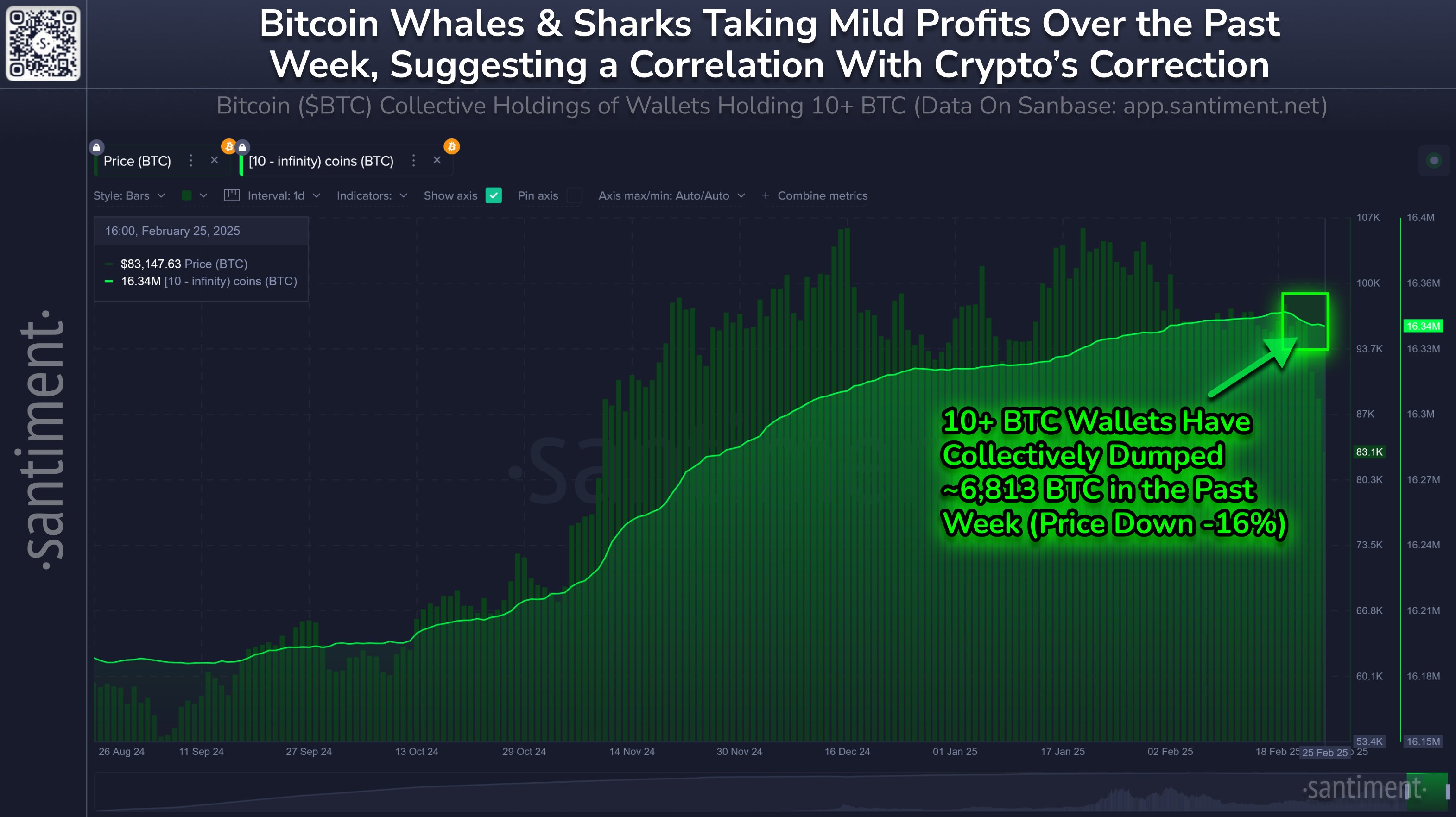
The recent Bitcoin plunge to $82K coincides with a massive sell-off of 6,813 BTC by whales and sharks.

This week, Bitcoin experienced a steep decline after a brief recovery, falling from around $96,500 to $82,455 before regaining some ground. At press time, Bitcoin traded at $86,009, marking a partial recovery of over $4,000.

The decline coincided with President Donald Trump’s statement about imposing 25% tariffs on the European Union. Additionally, on-chain data revealed significant selling activity from large Bitcoin holders or “whales.”

Whale Activity and Market Impact

A chart from Santiment highlighted the correlation between Bitcoin’s price drop and large wallet holders selling off their holdings. Wallets containing 10 or more BTC collectively sold approximately 6,813 BTC over the past week. 

Before this sell-off, these wallets had been accumulating Bitcoin, reaching a peak around mid-to-late January 2025 before beginning to decline. Historically, Bitcoin’s price movements have shown a strong link to accumulation and distribution patterns among whales and sharks.

Meanwhile, another dataset from IntoTheBlock provided insights into Bitcoin ownership distribution among mid-term holders and short-term traders. Over the past week, mid-term holders (Cruisers) declined by 1.60%.

Short-term traders (Traders) saw the most significant decrease, dropping by 3.72%. This shift in distribution suggests reduced short-term trading activity amid the latest market downturn.

Image


Bitcoin Volatility Compared to Previous Cycles

It is important to note that despite the latest price correction, Bitcoin’s overall volatility remains lower than in previous bull runs. Historical data shows that during the 2011-2013 cycle, Bitcoin had an average drawdown of 19.19%, with a maximum decline of 49.45%.

The 2015-2017 cycle saw an average drawdown of 11.49%, with a maximum of 36.01%. The 2018-2021 cycle had an average drop of 20.41%, reaching a peak decline of 62.62%.

In contrast, the current cycle has demonstrated lower volatility with a maximum 26% drop, suggesting a more stabilized market. Market observers attribute this trend to Bitcoin’s growing institutional adoption and its evolving role as a financial asset.

BTC Performance Since Cycle Low

Bitcoin has increased 5.48 times since its most recent cycle low of $15,400 in January 2023. When comparing past cycles at a similar point, the 2011-2015 cycle saw a 284.28x rise, while the 2015-2018 cycle recorded a 7.26x increase. The 2018-2022 cycle saw a 16.86x rise.

While the current cycle’s performance appears less aggressive than previous ones, Bitcoin’s steady growth indicates a different market environment. Unlike earlier cycles, which experienced extreme volatility, Bitcoin now follows a more controlled pattern.

SEC Asks Court to Freeze Lawsuit Against Tron and Justin Sun

0

The SEC lawsuit against Justin Sun and Tron Foundation is the latest crypto-related case in which the securities regulator is seeking to pause its proceedings. 

Yesterday, the U.S. SEC, Justin Sun, Tron Foundation, BitTorrent Foundation, and Rainberry filed a joint motion asking to stay their lawsuit for 60 days. The motion contended that the 60-day stay would enable the parties to explore a potential resolution.  

According to the filing, this stay would benefit all the parties involved in the lawsuit, the court, and the public interest. If an early resolution is reached during the stay, the court will conserve judicial resources by avoiding ruling on the defendant’s pending motion to dismiss. The parties plan to issue a joint status report within 60 days of the request approval. 

SEC v. Tron 

In July 2023, the SEC charged Sun and his companies with fraud, market manipulation, and offering unregistered securities. The securities regulator accused Sun and Tron Foundation employees of inflating TRX volume through 600,000 wash trades. 

However, Tron denied the allegation and filed a motion last year to dismiss the SEC’s complaint. U.S. District Judge Edgardo Ramos has not decided on Tron’s dismissal motion. Nonetheless, the parties are asking the court to freeze the lawsuit to explore a potential resolution.  

SEC Pulls Back on Crypto-Related Litigation 

This request is similar to a motion filed in the Binance lawsuit, which a federal judge recently approved. The development is part of the SEC’s efforts to end its multi-year enforcement action against the crypto industry. 

After freezing the Binance case, the SEC agreed to drop the Coinbase lawsuit, pending approval from its commissioners. 

Furthermore, the SEC ended its investigation into NFT trading marketplace OpenSea, decentralized exchange Uniswap, and crypto exchange Gemini. Last week, the commission dropped two appeals seeking to classify crypto businesses as security dealers. 

Ripple Case Still Ongoing 

While the SEC has paused and dropped several crypto-related lawsuits, the Ripple case remains ongoing in the Court of Appeals for the Second Circuit. 

Renowned legal expert Jeremy Hogan emphasized that the Ripple case is more complex to resolve than the Tron lawsuit. According to him, the Tron lawsuit is still in its early stage and has not progressed like Ripple’s, which already has a court ruling. 

This decision absolves Ripple of any wrongdoing during its retail sales of XRP. However, the court imposed a $125 million fine and injunction against the company for violating federal securities laws through its institutional sales. 

With the SEC ending its enforcement actions against crypto businesses, several experts project that the commission could dismiss its case against Ripple by agreeing to a reduced penalty than the $125 million fine Judge Torres ordered. 

Google Awards Shiba Inu Partner $200K Cloud Service Grant

0

Shiba Inu team has congratulated its partner K9 Finance DAO for receiving a $200,000 grant through the Google for Startups initiative. 

K9 Finance recently took to X to announce that it has been awarded a grant of $200,000 under the Google for Startups program. Per the announcement, the grant comes in the form of free access to Google Cloud services instead of direct cash. 

With the grant, K9’s development team can access Google Cloud’s infrastructure, security features, and artificial intelligence (AI) tools at zero cost. 

For context, Google introduced the Google for Startups program in 2011, which offers startups an opportunity to grow by connecting them to relevant products, resources, and people. 

Since its launch, thousands of startups, including Jumping Minds, Fixit, and 6Degrees, have leveraged Google Cloud to grow their businesses at zero cost. 

Benefits of the Grant 

According to K9, the $200,000 grant will help the project eliminate cloud expenses. With the funding, K9 aims to channel its financial resources into other areas, such as marketing and ecosystem expansion. 

In addition, K9 emphasized that the grant also enhances its legitimacy and credibility, as not every project gets Google funding. Consequently, K9 could gain significant attention from other established players in the tech and Web3 sectors. 

Lastly, the K9 team disclosed that its projects will offer more speed and scalability as Google Cloud powers its system. 

Beyond accessing Google Cloud services at zero cost, the team suggested that the grant will strengthen its long-term position, creating partnership opportunities, sustainability, and integration. 

Furthermore, it referred to the grant as an opportunity to position K9 Finance as a major force within Shibarium and the broader crypto ecosystem. 

Shiba Inu Team Reacts 

Expectedly, Shiba Inu’s Marketing Lead, Lucie, issued a celebratory reaction to Google’s $200,000 grant awarded to K9 Finance. Notably, the Head of Shiba Inu marketing referred to the grant as a huge milestone, given the opportunities associated with the backing. 

K9 Finance remains Shiba Inu’s official liquid staking partner. It allows users to stake BONE through its Bonecrusher decentralized application (dApp) while retaining the liquidity of their tokens. 

At press time, K9 boasts a total value locked (TVL) of $562,035, according to data from DeFiLlama. This represents a 75.24% decline from the peak TVL of $2.27 million, registered on December 12, 2024. 

CryptoQuant CEO on Bitcoin 16% Drop from All-Time Highs: “Way Too Early to Panic”

0

Amid the most recent Bitcoin and crypto market meltdown, CryptoQuant CEO Ki Young Ju argues that it is “way too early to panic.”

The crypto market has been sent into panic over the past few days as Bitcoin, the largest crypto asset by market capitalization, has experienced a sharp decline.

Specifically, the asset dropped to over three-month lows around the $82,300 price level, representing a nearly 25% slump from all-time highs of $109,600 and a 12% drop year-to-date (YTD) from an opening price of about $93,600.

Amid the panic, however, one prominent analyst has argued that the move is just par for the course of a crypto market bull cycle.

“Way Too Early to Panic”

Amid the most recent crypto market meltdown, Ki Young Ju, CEO of leading crypto analytics platform CryptoQuant, has argued that it is “way too early to panic.” 

In a thread on X on Thursday, February 27, Young Ju stressed that 30% corrections were typical in Bitcoin bull market cycles. He further pointed out that in the 2021 cycle, the asset dropped as much as 53% but still recovered to form a new all-time high.

Bitcoin price drawdown after discovery
Bitcoin price drawdown after discovery. Source: CryptoQuant

Consequently, Young Ju highlighted that max pain for Bitcoin this cycle could be around the $77,000 price point, aligning with a 30% drawdown from all-time highs.

At the same time, the analyst has suggested that Bitcoin will only be confirmed to be in a bear market when it falls below the cost basis of miners. On February 19, he estimated this to be $57,000.

Young Ju is not the only one to suggest that Bitcoin’s recent correction is modest compared to previous cycles.

Glassnode shared similar data on Wednesday, February 26. Unlike Young Ju, however, the platform has previously cautioned that Bitcoin’s next significant support could be around $71,000.

Cameron Winklevoss Slams SEC After Gemini Investigation Concludes Without Charges

0

The U.S. SEC has officially closed its probe into Gemini, a New York-based crypto exchange, and will not pursue enforcement action. 

The decision follows nearly two years of regulatory scrutiny and comes after the agency had previously issued a Wells Notice to the company.

SEC Ends Investigation Into Gemini

On Monday, the SEC informed Gemini’s legal counsel that the probe was ending without charges. The investigation had lasted 699 days, with the agency sending a Wells Notice 277 days before deciding to drop the case.

The development follows a series of similar decisions by the SEC, including the closure of investigations into Robinhood Crypto, Uniswap Labs, and OpenSea.

Cameron Winklevoss, co-founder of Winklevoss Capital Management and Gemini Exchange, criticized the SEC’s handling of the case. He noted the significant financial and operational toll caused by the prolonged investigation. 

The company reported substantial legal expenses and a broader impact on industry innovation and productivity. According to Gemini, the lack of clear regulatory guidelines before enforcement actions contributed to uncertainty within the cryptocurrency sector.

SEC’s Approach Faces Criticism

Notably, Winklevoss questioned the consequences of such investigations on industry growth. The company highlighted the challenges faced by engineers and developers who either abandoned the sector or hesitated to enter due to regulatory uncertainties. The co-founder further suggested that the SEC’s enforcement approach discouraged startup creation and stifled financial innovation in the United States.

As a measure to prevent similar occurrences, he proposed financial reimbursements for companies targeted without clear regulatory guidance. Under this approach, the SEC would be required to compensate firms for legal expenses incurred due to investigations that do not result in enforcement action.

Additionally, Winklevoss suggested that agency officials involved in “unjust” actions should face immediate dismissal, with their roles and decisions made publicly available.

Broader SEC Actions and Policy Shifts

The decision to drop the Gemini case aligns with recent shifts in SEC enforcement under the new administration. Following the resignation of former SEC Chair Gary Gensler, regulatory decisions have taken a more lenient direction.

Notably, the commission recently dropped cases against multiple crypto firms, including Robinhood Crypto and Uniswap Labs. Meanwhile, the SEC issued a stay in its ongoing investigation into Binance. Industry commentators believe Ripple’s case could be the next for a close.

Approval Next? Solana Futures ETFs Now on DTCC Website

0

The DTCC has listed the first-ever proposed Solana ETFs with tickers SOLZ and SOLT, looking to provide leveraged exposure to traditional investors.

Altcoin exchange-traded funds (ETFs) have gained momentum following the regulatory approval of similar products for Ethereum. Although they faced roadblocks in the previous administration, the new hierarchy in the Securities and Exchange Commission has warmed up to the prospects of sanctioning these products.

Recently, two Solana ETFs appeared on the Depository Trust and Clearing Corporation’s (DTCC) website, raising market users’ curiosity. Notably, upon approval, these investment products will give traditional investors exposure to the meme-ridden network.

Approval or Just Formalities?

The DTCC listed two Solana futures ETFs from Volatility Shares, a volatility-focused investment firm. The Volatility Shares Solana ETF (SOLZ) and the Volatility Shares 2x Solana ETF (SOLT) appeared on the DTTC’s “active and pre-launch” list.

Volatility ETFs on DTCC Website

The addition implies that these ETFs are eligible for clearing and settlement by the agency, which is crucial for effective trading. Notably, this is a notable step indicating progress in an investment product’s approval and listing process.

Nonetheless, their appearance on the DTTC list does not indicate approval for listing by the US SEC. This only means the issuer is preparing for the funds’ trading and settlement when the regulator finally approves them.

Futures ETFs: a Precursor to Spot Products

Volatility Shares filed to list and trade the futures ETF with the SEC in December. Among the three applications, SOLZ and SOLT provide 1x and 2x leveraged exposure to traditional investors, respectively.

Meanwhile, market speculators view futures ETFs as a precursor to spot products. On the basis of an already trading Bitcoin-based futures product, Grayscale pleaded and won its case against the SEC, forcing the agency to approve the spot products in January 2024.

The possible launch of the Solana futures products has raised optimism that the SEC would also sanction its spot counterpart. However, the regulator has yet to nod to any at this time.

Nonetheless, the Wall Street securities watchdog recently acknowledged spot ETF filings from multiple asset managers, including 21 Shares, Grayscale, Canary, Bitwise, and VanEck. Currently, the SEC is still seeking public comments on the products.

Bold XRP Prediction: Expert Says 20K XRP Might Be Worth $190 Million in the Future

0

Well-known XRP analyst Egrag has made an eye-catching prediction about the future price of XRP.

In a recent tweet, Egrag suggested that someday in the future, holdings of 20,000 XRP could be worth $190 million. Notably, a 20,000 XRP portfolio is currently worth only $43,400, with XRP’s unit price at $2.17. Essentially, Egrag is arguing for a future where the unit price rises by 437,688% to $9,500.

How the XRP Bold Prediction Came About

Egrag’s audacious prediction comes amid the news that Strategy (formerly MicroStrategy), the business intelligence giant led by Michael Saylor, has purchased an additional 20,356 Bitcoin for $1.99 billion.

With the comparison, Egrag suggests that just as 20,000 BTC could today be worth $1.99 billion, XRP’s price could increase significantly, potentially matching Bitcoin’s past success.

Furthermore, Egrag emphasizes that the potential to secure such a high-value return from XRP will be available to only a select few. He believes only investors with foresight and strategic timing may benefit from XRP’s future rise.

While Egrag’s prediction remains speculative, it adds to the growing optimism surrounding XRP’s future among enthusiasts. Predictions of XRP reaching $10,000 have been a popular topic in the crypto community.

While some see it as hypothetical, others have even argued that a $10K price could be considered “conservative” in the grand scheme of things. However, such claims have not gone uncontested by critics.

Community Members React, Suggesting Timelines

As expected, Egrag’s tweet attracted significant attention from community members. “Come on, mate! That would be $9,500 XRP! Is that not too much?” remarked X user Payman Sam.

Another commenter sarcastically pointed out that the prediction “makes sense” to mention when XRP hasn’t even reached a new all-time high after winning all its cases, receiving good news, and securing numerous partnerships.

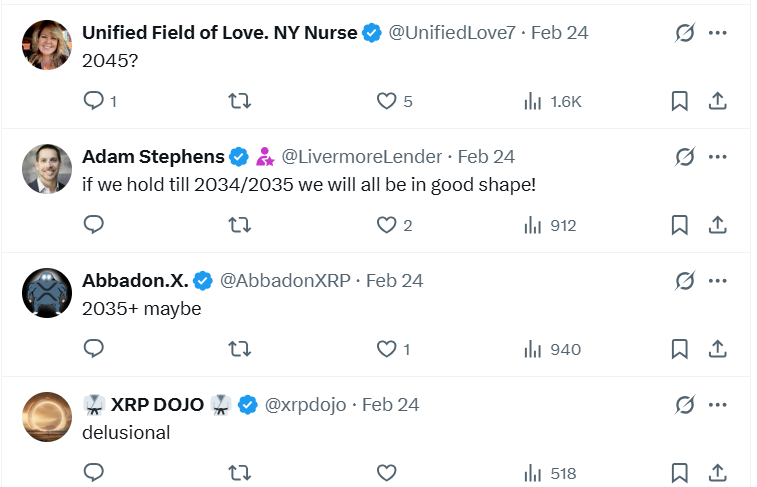
Meanwhile, some commenters have outrightly called the projection delusional. However, many in the comments were speculating on when 20,000 XRP could be worth $190 million. Some suggested a decade timeline, while a few others proposed 2045, essentially a two-decade timeline.

Interestingly, market commentators on the prediction platform Telegaon have asserted that even by 2050, XRP’s price would not have reached $300.

XRP Army reactions to bold prediction
XRP Army reactions to the bold prediction

Ripple Partners with South Korea’s BDACS to Launch Institutional-Grade Custody for XRP and RLUSD

0

Ripple announces a strategic partnership with BDACS, a South Korea-based digital asset firm, to provide institutional-grade custody service for XRP and RLUSD.  

Ripple unveiled the partnership today, noting that it aligns with South Korea’s Financial Services Commission’s (FSC) roadmap for regulatory approval. The roadmap aims to support institutional involvement in South Korea’s digital asset market. 

Under the partnership, BDACS will utilize Ripple Custody to provide custody solutions for its supported digital assets, including XRP and RLUSD. 

Ripple Custody 

Ripple Custody is an institutional-grade digital asset custody solution that offers bank-grade security for exchanges, custodians, and OTC desks. Recall that Ripple launched the solution in October 2024, allowing banks and fintech companies to safeguard digital assets on behalf of their clients. 

This move is part of Ripple’s effort to expand its offerings beyond payments into other crypto-related sectors. In the latest announcement, Ripple forecasted that the custody market could reach a valuation of $16 trillion by 2030. This ambitious goal is driven by the company’s expectation that 10% of the world’s GDP would be tokenized by then. 

Partners’ Expectations  

The collaboration is expected to yield positive results in the long term, given the partners’ expertise in different sectors. For instance, Ripple has over 60 regulatory licenses globally and has deep expertise in tokenization, payments, and digital asset management. 

BDACS ranks as one of the first licensed institutional custody providers that allows users to securely store and trade a diverse range of crypto assets, such as XRP, RLUSD, and AVAX. 

Ripple and BDACS Execs React 

Commenting on the development, BDACS’ CEO Harry Ryo remarked that its custody solution will support Ripple’s blockchain initiatives and also enhance the companies’ expansion within the digital asset ecosystem. 

Fiona Murray, Ripple’s APAC Managing Director, expressed excitement about the collaboration as it expands the company’s custody solution into South Korea. 

“Following the recent surge in the crypto market and new opportunities emerging under the FSC’s regulatory roadmap, we view this collaboration as a pivotal step in expanding the digital asset ecosystem,” Murray remarked. 

In a statement on X, Ripple President Monica Long remarked that South Korea is gearing up for a surge in institutional crypto adoption. She emphasized that Ripple has ‘planted’ another flag in the APAC region following its partnership with BDACS. 

According to her, institutional-grade custody solutions are essential, particularly as institutions prepare for an influx in crypto interest.