Home Blog Page 93

Hoskinson Says Cardano Still Has a Path to Success, Urges ADA to Break Away From Crypto’s Damaged Image

0

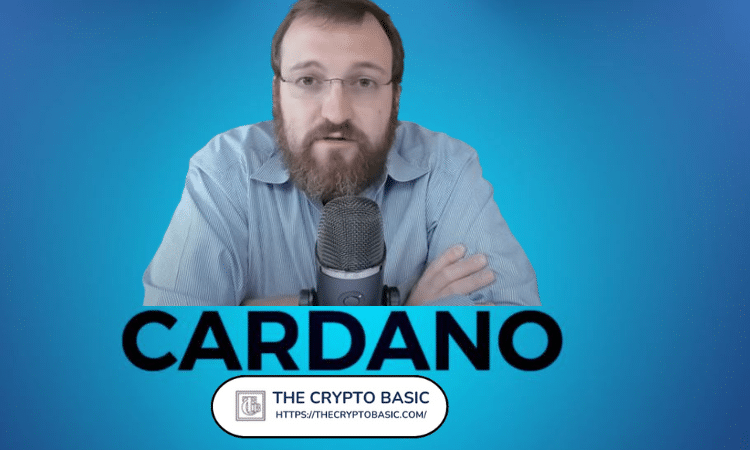
Despite recent market downturns, IOG CEO and founder Charles Hoskinson maintains that Cardano still has a clear path to success.

Speaking during a recent livestream, Hoskinson argued that the network’s long-term future will not depend solely on its protocol or ADA token. Instead, he emphasized that Cardano’s success ultimately rests on the commitment of its community. According to Hoskinson, the ecosystem remains highly adaptable and can evolve as market conditions change.

Cardano Can Reinvent Itself and Continue Growing: Hoskinson 

Hoskinson stressed that neither Cardano’s technology nor its branding is fixed. He noted that the ecosystem can upgrade its protocol, introduce new distribution models, launch entirely new initiatives, or even rebrand if necessary.

However, he believes one element remains irreplaceable: the community behind the network. According to him, Cardano’s true value lies in the developers, entrepreneurs, investors, and supporters who continue to build and contribute to the ecosystem. 

As a result, he remains confident that Cardano can achieve long-term success, as its community can adapt, innovate, and create new opportunities regardless of market conditions.

Hoskinson Says ADA Must Move Beyond Crypto’s Damaged Reputation

Meanwhile, Hoskinson offered a broader critique of the cryptocurrency industry. He argued that years of speculative excess, including meme coins, NFT bubbles, scams, market collapses, and Trump-themed tokens, have damaged the sector’s public image.

He believes many people no longer view cryptocurrency as a trustworthy industry. To ensure long-term survival, Hoskinson argued that Cardano must distance itself from that reputation and evolve into something more meaningful. 

He pointed to Midnight, Cardano’s partner chain, as an example of the type of project that reflects this strategic shift toward broader utility and real-world relevance.

Bear Markets Separate Conviction From Speculation

Hoskinson also emphasized that bear markets play an important role in strengthening ecosystems. Although downturns can be painful, he argued that they reveal which participants remain genuinely committed while forcing both individuals and communities to reassess their motivations and beliefs.

In his view, bear markets represent more than ordinary financial cycles. Rather, they serve as moments of self-reflection that test conviction and clarify who remains aligned with a project’s long-term vision.

His comments come as some longtime participants reassess their commitment to Cardano amid governance disputes and project shutdowns. Notably, prominent contributor Chicken recently announced his departure from the ecosystem, while crypto analyst Dan Gambardello revealed that he had shifted part of his ADA exposure into Sui.

Hoskinson Remains Confident in Cardano’s Future

Despite ADA falling below $0.20 and growing investors’ frustration, Hoskinson has continued to express confidence in Cardano’s future. Earlier, he argued that Cardano could eventually surpass Bitcoin and emphasized that the network possesses the resilience to survive and evolve under any circumstances, even without his direct involvement.

Ripple Shares How Institutions Can Seamlessly Add XRP to Their Treasury Account

0

Ripple has shown how institutions can bring XRP and its RLUSD stablecoin directly into their treasury operations through its Ripple Treasury platform. 

In an elaborate presentation, the company shared how businesses can activate digital asset accounts and add digital assets to their treasury workflows without leaving the platform.

Ripple Shows How Institutions Can Get Started With Digital Assets

During the presentation, Ripple explained that many customers want to benefit from digital assets, especially for instant cross-border payments and opportunities that remain available around the clock. 

However, according to the company, the first question many institutions ask is how they can begin using digital assets within their existing treasury systems.

Ripple said the process starts inside Ripple Treasury. Specifically, users can go to the Connectivity section and select Digital Assets, where they can view the available providers. 

Among those options is Ripple, which serves as the built-in route for customers looking to add digital assets directly through the platform.

After choosing Ripple and starting the setup process, users complete a one-time Know Your Customer (KYC) verification. The platform guides them through the required steps, allowing them to confirm their details, agree to the terms and conditions, and submit their application.

One-Time Setup Gives Access to Digital Asset Accounts

Ripple explained that once users complete the KYC process, Ripple Treasury automatically prepares everything needed for the account. When they select Start Setup, customers can create their digital asset accounts, activate the required services, and gain access through a single process.

The company stressed that institutions do not need to set up blockchain infrastructure or have deep knowledge of cryptocurrency. Notably, Ripple handles the technical side in the background, making it easier for treasury teams to start using digital assets.

After activation, users can select the digital asset accounts they want to bring into Ripple Treasury. The platform imports both balances and transaction records. It also uses real-time exchange rates to convert digital asset balances into the reporting currency selected by the organization.

Ripple added that once the accounts become active, every balance update and transaction appears across the treasury management system in real time.

Ripple’s GTreasury Acquisition

The presentation comes after Ripple transformed GTreasury into Ripple Treasury. In October 2025, Ripple announced its $1 billion acquisition of GTreasury, a Chicago-based treasury management system provider with more than 40 years of industry experience.

The acquisition gave Ripple access to a broad customer base that ranged from small and medium-sized businesses to Fortune 500 companies. Ripple completed the deal later in 2025.

By January 2026, the company officially launched Ripple Treasury. The platform combined GTreasury’s treasury management software with Ripple’s blockchain infrastructure. This creates a system that manages both traditional cash and digital assets from a single platform.

XRP and RLUSD Move Into Corporate Treasury Operations

Ripple expanded the platform in April 2026 with the launch of Digital Asset Accounts and Unified Treasury capabilities. The company noted that these represented the first native digital asset tools built directly into an enterprise treasury management system. 

Ripple Treasury now allows organizations to create and manage Ripple-hosted accounts that hold XRP and RLUSD directly within the platform. 

The system displays digital asset balances alongside fiat balances, provides real-time fiat valuations, and automatically records transactions. Customers only need to complete a one-time KYC process to connect directly with Ripple.

Up to 6,000% Cardano Gains—Analyst Explains Massive ADA Risk-to-Reward Ratio

0

Cardano could drop lower, but its good risk-to-reward ratio is already becoming too appealing to ignore if prices start rebounding.

This narrative is according to a live chart analysis from YouTuber Jayson Casper. While prices remain deep in the red, he believes that Cardano (ADA) is a “good asset” that could offer insane returns from the current level when market conditions start to improve.

Cardano at a Good Place

Casper first noted that Cardano is at a “good place” to start buying as its price remains well below prior highs. Currently around $0.178, the coin has fallen below its previous bear market lows around $0.22, after a lackluster price action during the bull market phase.

The analyst views the current level as a great entry point for long-term holders, citing its appealing risk-to-reward ratio should a recovery start.

However, his analysis does not rule out the possibility of further downside. A projected chart shows that two major supports lie below the current market price, with Casper noting that he is closely watching them.

Cardano Key Support Levels/Jayson Casper

The first is the important weekly support at $0.125, aligning with the 0.618 Fibonacci retracement level. This downtrend would not only represent a nearly 30% decline from the current market price but also potentially take ADA to price levels last seen in November 2020.

The chart shows that the second key support sits around the 0.786 Fibonacci level at $0.05, a staggering 72% crash from here. Although he sees this as very unlikely, Casper noted that he would grab the opportunity if it presents itself.

Upside Potential and Massive Risk to Reward

Casper is particularly interested in Cardano because it offers good rewards relative to the risks of exposure. The asset is already down over 90% from its all-time high and around key historical supports; hence, there is more room on the upside than on the downside.

To explain this, he used the percentage upside for a spot ADA buy if it reclaims key upside targets. In a case where Cardano rebounds from the support at $0.052 to its all-time high of $3.10, it would represent a 6,100%, or 59.6x growth.

Interestingly, even if it reaches only the bull market high of $1.32 in December 2024, it will amount to an almost 3,000% increase.

Furthermore, painted the reward prospects for Cardano if it starts to recover from $0.125. Reclaiming its all-time high would represent a 2,380% increase, and reaching a hypothetical new high of $4 would culminate in a 3,100% rally.

Notably, Casper is not the only analyst who sees Cardano as a trade with a good risk-to-reward ratio. Analyst Mathew Dixon mentioned this even when the coin was trading at $0.296 in February. The consensus is that ADA has survived periods of market weakness several times in its history and still has the capacity to do so in the future.

XRP at $10 Would Mean a $620 Billion Valuation, Analyst Says It’s Still More Achievable Than SpaceX at $15 Trillion

XRP YouTuber Zach Rector has compared the upside potential of XRP with that of newly public aerospace giant SpaceX. 

He argued that XRP offers a more realistic path to a 9x return on investment. 

In a post on X, Rector said XRP reaching $10 would generate roughly a ninefold return for investors. By comparison, he noted that SpaceX would need to grow into a $15 trillion company to deliver similar gains from its recent IPO valuation.

“Same return. Wildly different odds,” Rector wrote.

XRP at $10 Could Push Valuation Above $600 Billion

In a YouTube video, Rector explained the math behind his comparison. He noted XRP was trading around $1.13 with a market capitalization of about $77 billion and a circulating supply of roughly 62 billion tokens.

Under those conditions, a move to $10 would represent an increase of about 800%, turning a $1 investment into nearly $9. XRP’s market capitalization would also climb to around $620 billion.

Rector acknowledged that a valuation above $600 billion sounds enormous. However, he argued it remains achievable given XRP’s ambitions in global payments and tokenized assets.

He added that if XRP’s circulating supply eventually expands to its 100 billion maximum, a $10 price would imply a valuation of roughly $1 trillion.

According to Rector, both scenarios remain “very doable” over the long term.

SpaceX Faces a Much Bigger Challenge

Meanwhile, Rector contrasted XRP’s outlook with SpaceX, which recently went public at a valuation of about $1.75 trillion and briefly traded above a $2 trillion market capitalization.

To generate the same 9x return as XRP reaching $10, SpaceX would need to achieve a valuation of roughly $15 trillion to $16 trillion, he said.

According to Rector, that figure would exceed the combined value of the world’s three largest companies today. It would also require SpaceX to reach an unprecedented level of corporate valuation.

He emphasized that the comparison was not meant as criticism of SpaceX or its founder, Elon Musk. Rather, he said he was simply evaluating the likelihood of each asset producing similar returns.

Why Rector Favors XRP

Rector argued that crypto markets have already shown that digital assets can reach valuations in the hundreds of billions of dollars. He pointed to the growth of Bitcoin and Ethereum as examples.

By contrast, he said SpaceX would need to become several times larger than today’s biggest public companies to provide comparable gains.

Rector also noted that many of SpaceX’s largest gains were captured by early private investors and venture capital firms during the company’s two decades as a private business.

While he acknowledged that public investors could still profit from SpaceX, he concluded that XRP price has the better chance of delivering a 9x return over the next three to five years.

XRP Surges 13% as Millionaire Wallets Add 1.53B Tokens

0

Leading crypto analytics platform Santiment has highlighted XRP’s recent surge, attributing it to improving market conditions alongside increased accumulation by the token’s largest holders.

In a recent update, Santiment noted that XRP staged a sharp rebound, rising roughly 13% within 24 hours and briefly reclaiming the $1.28 level for the first time in two weeks. 

According to the analytics firm, the rally followed a broader market recovery as investors responded positively to reports that the U.S.-Iran conflict has reached a resolution. As geopolitical uncertainty diminished, traders regained confidence in risk assets, fueling gains across the cryptocurrency market.

While many altcoins benefited from the improved macro environment, Santiment argued that XRP’s recovery was significant because it came after a period of intense bearish sentiment. In recent weeks, investor confidence in XRP had fallen to one of its lowest levels of 2026, especially as the token retraced to $1.05. Consequently, the easing of market fears created ideal conditions for a powerful relief rally.

Millionaire Wallets Expand Their Control of XRP Supply

Notably, Santiment identified growing whale accumulation as a major driver behind XRP’s recent price strength. The firm’s on-chain data shows that wallets holding at least 1 million XRP now control 74.1% (45.98 billion tokens) of the asset’s total circulating supply. 

Interestingly, these large holders have continued accumulating despite recent market weakness. Over the past six months alone, millionaire wallets added approximately 1.53 billion XRP to their balances. This steady accumulation suggests that major investors remain confident in XRP’s long-term outlook even during periods of heightened volatility.

Image

Ripple’s Institutional Expansion and Growing Tokenization Activity on XRPL Reinforce Investor Confidence

Beyond whale activity, Santiment also highlighted Ripple’s expanding institutional payments ecosystem and the growing tokenization activity on the XRP Ledger as key factors supporting long-term optimism.

Ripple has continued to pursue strategic partnerships and infrastructure initiatives aimed at strengthening cross-border payments and enterprise blockchain adoption. As part of this effort, the company moved to acquire BC Payments Australia to secure an Australian Financial Services Licence (AFSL) and broaden the reach of its payment solutions in the region.

Earlier this year, Ripple’s subsidiary, GTreasury, acquired Solvexia to enhance its operational and reporting capabilities, further strengthening its enterprise-focused offerings.

Moreover, tokenization activity on the XRP Ledger continues to accelerate. Data shows that tokenized assets on XRPL have reached $3.7 billion in represented value, while the network hosts 293 real-world asset (RWA) projects.

As the tokenization market expands, many investors increasingly view XRP and the XRP Ledger as potential beneficiaries of the broader shift toward blockchain-based financial infrastructure. 

XRP Maintains Weekly Gains Despite Pullback

Meanwhile, XRP has surrendered a portion of its recent gains. As of press time, the token trades around $1.23, down from its intraday highs.

Nonetheless, XRP remains up 4.3% over the past 24 hours, while its weekly gain stands at 5.79%. The asset’s ability to hold onto most of its recent advance suggests that improving market conditions, combined with continued whale accumulation and institutional growth, continue to provide support for the cryptocurrency. 

Dogecoin Is Not Moving Like the Rest of the Crypto Market, but What Does This Mean?

0

A recent Dogecoin price analysis points to a divergence in trend between the prominent meme coin and most of the crypto market.

Analyst Moe highlighted this in an X post, as Dogecoin surprisingly trends downward while the broader crypto market is rebounding. For context, Bitcoin is up 1% and XRP by 3.6% since the start of the week. In contrast, DOGE has corrected almost 2% in the same timeframe, playing contrarian to the broader recovery trend.

Dogecoin Divergence Against Others

Moe’s analysis pointed out that this trend extends beyond this week alone. An accompanying chart shows that Dogecoin is forming a lower high on the daily chart while the crypto market cap excluding the top 10 is on a higher low trend.

Dogecoin Divergence on the 1D Chart/Moe

The analogy suggests that Dogecoin is showing weakness against most major assets outside the top 10 cryptocurrencies by market cap. While it might not seem like it now, the analyst believes this holds long-term bullish implications for the meme coin.

Further analysis emphasizes that there are precedents for this narrative. There have been several situations where DOGE has formed a similar divergence against other cryptocurrencies outside the first 10 market cap ranking in its history.

The first instance was between late 2018 and early 2022, when the token formed lower highs. During the same period, others formed higher lows. Notably, when the broader market turned bullish, Dogecoin bounced considerably to its current ATH of $0.74.

Similar instances happened in late 2021 and 2022, and in the current market. How past events unfolded continues to fuel Moe’s confidence as to how Dogecoin will react to this.

Dogecoin Historical Divergence/Moe

DOGE Lags Explained

Responding to the post, analyst Namtoshi Dogemoto provided further context. He explained that the current downward-sloping lower high trend from Dogecoin does not tell the full story. While it might seem bearish on the surface, it is a bullish relative weakness.

The rest of the altcoin market outside the top 10 cryptocurrency market cap ranking are sustaining an uptrend with their higher low formations, while DOGE lags. According to the commentator, that is building massive catch-up fuel for an outsized gain when the market sentiment turns bullish.

Dogemoto added that during altseasons, coins that show relative weakness are the ones that “rip the hardest” when capital starts to rotate. The analysis suggests that Dogecoin could perform exceptionally well in the next bull season owing to this divergence.

The analysis continues to build on the growing conviction that Dogecoin will reverse its current price weakness and target higher prices. Analysts see Dogecoin already close to bottoming, projecting a rebound that could finally take the token past the $1 mark.

For this to happen, however, market conditions would have to improve considerably from the current state. Trading volume remains subdued, showing slow market participation, with derivative interest further dwindling. In the past 24 hours, a futures outflow of $547 million compared to the inflow of $530 million shows the skepticism among market traders.

Dogecoin Futures Flow/Coinglass

XRP Ledger Leads Tokenized Asset Race With $1.9 Billion in RWA Inflows, Outpacing Ethereum

The XRP Ledger (XRPL) is strengthening its position in the real-world asset (RWA) tokenization market. 

Over the past 90 days, it recorded the highest net inflows among major blockchain networks. 

The milestone comes as tokenization continues to gain traction across the crypto industry. XRPL’s growth has recently outpaced several competing networks.

XRPL Records Highest RWA Inflows

According to data shared by RWA Foundation, XRP Ledger attracted $1.9 billion in net RWA inflows over the last 90 days, excluding stablecoins. That figure placed it ahead of Ethereum, which recorded $1.6 billion in inflows. Stellar followed with $1.4 billion.

Other networks ranked lower:

  • BNB Chain: $848 million
  • Solana: $611 million
  • Avalanche: $362 million
  • Sei Network: $202 million
  • Mantle: $90 million

Highlighting the achievement, the XRP Ledger Foundation said XRPL is “growing fast as a home for real-world assets.”

Image

Tokenized Asset Market Expands Rapidly

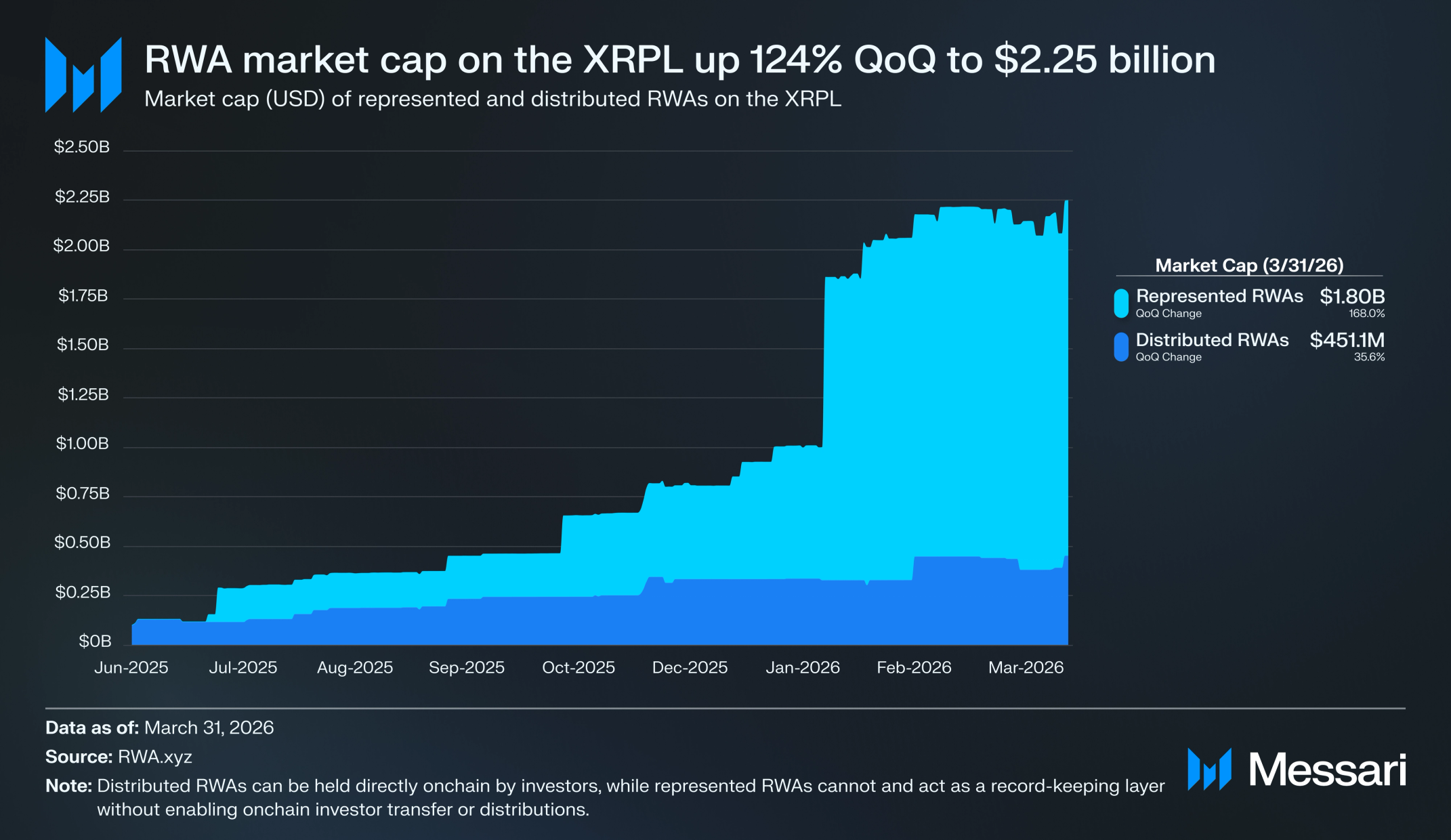
The latest inflow figures follow a sharp increase in tokenized assets on XRPL this year. According to Messari’s Q1 2026 report, XRPL ended the quarter with a total RWA market capitalization of $2.25 billion. That marked a 124.1% increase from the previous quarter.

Messari noted that XRPL ranked as the seventh-largest blockchain by RWA market capitalization at the end of Q1. Since then, it has climbed to fourth place.

The report also showed that XRPL’s distributed RWA market cap reached $451.1 million by quarter-end, up 35.6% from $332.7 million in the previous quarter.

RWA.xyz currently tracks 18 distributed RWAs and 312 represented RWAs on XRPL. Additional integrations are expected in the future.

XRPL Reached Key Milestone Faster Than Ethereum

XRPL’s rapid growth has helped it outpace several major blockchain networks in tokenization adoption.

Data from Evernorth shows that XRPL grew its tokenized RWA value from roughly $10 million in January 2025 to $400 million by April 2026. The network reached that milestone in about 15 months.

For comparison, Ethereum took nearly 36 months to grow from $10 million to $400 million in tokenized asset value. Evernorth’s data also showed that XRPL’s tokenized value increased 78% year-to-date, rising from $227 million to $404 million. Ethereum posted 36% growth over the same period.

The latest inflow data suggests capital continues to flow into XRPL’s tokenization ecosystem, reinforcing its position as one of the fastest-growing blockchain networks in the expanding RWA sector.

Cardano Future Sustainability May Depend on One Crucial Change, DRep Says

0

Cardano community figure and well-known DRep Jaromir Tesaf has raised concerns about the network’s long-term ability to fund itself and maintain security. 

In a recent publication, he discussed several issues that could affect Cardano’s future and shared what he believes needs to happen to keep the ecosystem sustainable.

Tesaf explained that Cardano’s security can remain sustainable over the long term only if transaction fees eventually take over the role currently played by reserve subsidies. 

He pointed out that the reserve continues to shrink over time, which means staking rewards are gradually declining.

Because of this, fee revenue will need to grow massively within the next five to ten years. If that does not happen, Cardano could face serious challenges, both in terms of network security and ecosystem funding.

Cardano Reserve Levels Continue to Fall

Speaking on these concerns, Tesaf noted that Cardano’s reserve has already been reduced by roughly half since the network’s early stages. At the beginning, during epoch 209, the reserve stood at ₳13.3 billion. Today, the figure has dropped to ₳6.3 billion.

He also mentioned changes in the Treasury. Specifically, the Treasury once reached an all-time high of ₳1.82 billion, but it currently holds ₳1.49 billion. Considering the present rate of spending, Tesaf estimated that the Treasury could run out in around five years.

He stressed that while the goal is to keep spending in line with Treasury income, the protocol does not guarantee such an outcome. According to Tesaf, DReps can approve very large Net Change Limits (NCL) and even modify those limits when necessary.

ADA Fee Revenue Remains Too Low

Tesaf mentioned fee income as a major factor in Cardano’s future sustainability. At the moment, the network generates an average of about ₳50,000 in fees per epoch. Over a year, that amounts to roughly ₳3.6 million, or around $600,000.

He pointed out that this fee income is approximately 100 times lower than the approved NCL. He also noted that Cardano currently earns about the same amount in yearly fees as some development teams request to build a real-world asset (RWA) platform.

At the same time, Cardano’s funding requirements are much larger. Tesaf stated that the network needs around ₳200 million to support infrastructure. Based on current prices, this equals roughly $60 million. As a result, current fee revenue does not even cover basic protocol maintenance costs.

He added that reserve funds remain the main source of Treasury income. Because of this, the Treasury continues to play an important role in securing Cardano’s future.

Treasury Must Fund Both Development and Expansion

Tesaf argued that the Treasury needs to support two major priorities. The first is completing the Cardano protocol and maintaining it over time. The second is growing the broader ecosystem.

He emphasized that Cardano will never truly be finished, as the network will always require research, improvements, and new features. For that reason, funding cannot focus only on maintenance, as ongoing development will remain necessary.

According to Tesaf, the price of ADA also has a major impact on funding. He noted that ₳350 million will be distributed during this year’s NCL period. At the current ADA price, that amount is worth only about $60 million. However, if ADA were trading at $1, the same allocation would be worth $350 million.

Tesaf warned that if ADA’s price continues to decline, Input Output (IO) and other teams may have to reduce their workforce. In that situation, some planned developments might not be delivered. On the other hand, a stronger ADA price could create opportunities for growth and expansion.

Strategic Decisions Will Be Critical

Tesaf said the Treasury must support ecosystem growth in addition to infrastructure and research. While stronger infrastructure can create long-term opportunities, it does not automatically bring users or adoption. He warned that without investment aimed directly at growth, Cardano may not fully benefit from the technology it builds.

The community figure pointed out that history has shown many examples where better technology failed to win because competing products attracted more users. To him, the current NCL period did not allocate enough funding toward ecosystem growth.

He also said ADA’s price played an important role in this outcome. Since IO will likely require the largest share of the budget, the company needs funding in specific dollar amounts. When ADA trades at lower prices, a larger portion of the NCL must be used to meet those needs. If ADA’s price rises, more funds become available for ecosystem growth.

Meanwhile, Tesaf said Cardano should focus on sustainable growth rather than waiting for future market cycles. While he understands that IO wants to complete the protocol, he questions whether that should be the main priority. 

He believes ADA’s price does not only depend on quality of the protocol but also on network effects such as user growth, partnerships, real-world use cases, liquidity, retaining existing builders, attracting new builders, and other initiatives that require investment.

For the next budget cycle, Tesaf called for a better approach to funding decisions. He suggested that key ecosystem participants provide estimates of their budget needs before the community approves the NCL. He also recommended that DReps agree on how much funding should go to major categories before approving Treasury withdrawals.

In addition, he proposed giving proposals more than six weeks for review and evaluating them alongside other proposals within the same category. According to Tesaf, Cardano’s current funding process reacts to immediate needs, and this leaves considerable room for improvement.

Hoskinson Dismisses Claims That Cardano Is Dead, Says ADA Can Survive Anything, Even Without Him

0

Charles Hoskinson has dismissed claims that Cardano is dying, arguing that ADA’s trajectory can change dramatically within a short period.

Hoskinson made the remarks during a recent livestream, where he addressed growing skepticism about ADA’s long-term potential. Notably, he stressed that crypto markets evolve rapidly and that current sentiment does not necessarily determine a project’s future.

To support his argument, Hoskinson pointed to Cardano’s performance during the 2020–2021 bull cycle. He noted that ADA surged from roughly $0.025 to nearly $3 within a year, demonstrating how quickly market sentiment and adoption can shift in the cryptocurrency sector.

Crypto Cycles Constantly Produce New Winners and Losers: Hoskinson 

According to him, the crypto market remains highly dynamic, with projects frequently rotating between periods of strength and weakness. As a result, he believes Cardano’s current challenges do not automatically dictate its long-term trajectory.

He suggested that many investors focus too heavily on present market performance while overlooking how rapidly conditions can change. Furthermore, he emphasized that mass adoption can accelerate unexpectedly, creating opportunities for projects that continue to build during difficult market environments.

Hoskinson Says Cardano Can Survive Without Him

Hoskinson also stressed that the Cardano ecosystem can withstand difficult periods as long as the community remains committed to its core principles.

Notably, he argued that Cardano’s future does not depend on his continued involvement. According to him, the network can survive even if he steps away, highlighting the strength of its decentralized structure and community-driven foundation.

Consequently, he dismissed recurring declarations that Cardano is dead and urged supporters not to believe such a negative narrative.

Criticism Intensifies Amid Ecosystem Challenges

Hoskinson’s remarks come as criticism of Cardano has intensified following a series of setbacks across the ecosystem. Over the past week, ADA suffered a sharp decline that pushed its price to a multi-year low of $0.1492. Although the drop occurred alongside a broader crypto market downturn, Cardano faced additional ecosystem-specific challenges.

These challenges included governance disputes that resulted in the cancellation of the Cardano Summit 2026, the shutdown of TapTools, and Hoskinson’s prediction that more ecosystem projects could fail before the year ends.

Meanwhile, his announcement of a temporary break and the migration of the community hub from X to Discord added to bearish sentiment. Several prominent contributors also signaled plans to leave the ecosystem, further fueling concerns among investors.

Founder Attempts to Restore Community Confidence

Despite the growing criticism, Hoskinson has recently sought to revive bullish sentiment within the Cardano community.

As previously reported, he argued that Cardano is the only blockchain ecosystem capable of running the world at scale. He also reiterated his belief that ADA could eventually surpass Bitcoin if the community continues to invest in the ecosystem.

For Hoskinson, Cardano’s current struggles represent only one phase of a broader market cycle rather than a permanent decline. Meanwhile, ADA has recently benefited from a broader market rebound. The cryptocurrency climbed to an intraday high of $0.1893 before retracing some of those gains. At press time, ADA was trading at $0.1768, reflecting a modest pullback after its recent recovery. 

Rubic Integrates StealthEX, Expanding Access to More Than 2,000 Cryptocurrencies Through Instant Non-Custodial Swaps

0

Rubic, a cross-chain and crypto aggregation platform, has announced the integration of StealthEX, a leading non-custodial instant cryptocurrency exchange. The new integration expands Rubic’s ecosystem by giving users direct access to more than 2,000 cryptocurrencies through StealthEX’s exchange infrastructure.

As the cryptocurrency market continues to evolve across multiple blockchain networks, users increasingly need efficient tools that simplify access to digital assets. Through this integration, Rubic users can seamlessly exchange a broader range of cryptocurrencies without leaving the platform, while maintaining control over their funds through a non-custodial experience.

The addition of StealthEX further strengthens Rubic’s mission of providing comprehensive cross-chain and swap aggregation solutions. By expanding available exchange options and supported assets, the platform continues to improve accessibility and convenience for traders, investors, and DeFi participants worldwide.

Expanding Rubic’s Aggregation Ecosystem

Aggregation has become a fundamental component of decentralized finance. With assets and liquidity spread across numerous networks and services, users increasingly rely on platforms that can simplify access to diverse crypto markets.

The integration of StealthEX enhances Rubic’s ecosystem by adding another powerful exchange provider to its growing network. Users can now access StealthEX’s crypto exchange services directly through Rubic, benefiting from a broader selection of assets and additional exchange opportunities.

The integration supports Rubic’s long-term vision of creating a unified environment where users can discover efficient cryptocurrency swap routes through a single interface. Instead of navigating multiple platforms to access specific assets, users can complete exchanges more conveniently within Rubic.

Beyond expanding asset availability, the integration improves flexibility for users managing portfolios across different blockchain ecosystems. As new cryptocurrencies continue to emerge, access to extensive exchange infrastructure becomes increasingly valuable.

Key outcomes of the integration include:

  • Access to more than 2,000 cryptocurrencies.
  • Additional exchange options within the Rubic ecosystem.
  • Greater flexibility when managing digital assets.
  • Improved access to liquidity sources.
  • A streamlined user experience through a single interface.
  • Continued support for non-custodial cryptocurrency trading.

Benefits for Users

The integration delivers several practical benefits for Rubic users.

Access to 2,000+ Cryptocurrencies

One of the most significant advantages is expanded access to digital assets. Users can exchange more than 2,000 cryptocurrencies, including both established and emerging tokens across multiple blockchain ecosystems.

Non-Custodial Experience

StealthEX operates as a non-custodial exchange, meaning users retain control of their assets throughout the swap process. This approach aligns with the principles of decentralized finance and allows users to maintain ownership of their funds.

Fast and Convenient Swaps

By integrating StealthEX directly into the Rubic interface, users can complete exchanges without switching between platforms. This reduces friction and creates a smoother trading experience.

Expanded Exchange Opportunities

Additional exchange infrastructure means users have access to more routes and asset pairs, improving flexibility when executing cryptocurrency swaps.

About StealthEX

StealthEX is a non-custodial instant crypto exchange designed to provide a simple, secure, and efficient way to swap digital assets. The platform enables users to exchange cryptocurrencies without storing customer funds, helping maintain user control throughout the transaction process.

img 2.

One of StealthEX’s key strengths is its extensive asset coverage. Supporting more than 2,000 cryptocurrencies, the platform offers access to a broad range of tokens and blockchain ecosystems. This allows users to diversify their portfolios and access a wider selection of digital assets.

StealthEX focuses on simplicity and ease of use, making crypto exchanges accessible to both experienced traders and newcomers. By removing unnecessary complexity and emphasizing convenience, the platform helps streamline the process of exchanging digital assets.

As demand for non-custodial services continues to grow, StealthEX plays an important role in supporting a more user-centric crypto ecosystem. Through integrations with platforms such as Rubic, the project contributes to greater accessibility and connectivity across the blockchain industry.

About Rubic

Rubic is a cross-chain and privacy aggregator designed to simplify swaps and transfers across multiple blockchain networks. By connecting users to bridges, DEXs, intent protocols, and privacy solutions, Rubic helps reduce the complexity often associated with navigating the DeFi landscape.

The platform focuses on solving one of the industry’s key challenges: fragmentation. With assets, liquidity, and privacy tools spread across different chains and protocols, users often face difficulties finding efficient ways to move and exchange cryptocurrencies while keeping their activity private. Rubic addresses this issue through aggregation technology that brings multiple services together within a single non-custodial interface.

Key strengths of the Rubic ecosystem include:

  • Cross-chain capabilities that enable asset transfers across multiple networks.
  • Aggregation technology that connects users with diverse liquidity sources, exchange providers, and privacy solutions.
  • Broad ecosystem connectivity through ongoing integrations and partnerships.
  • A user-friendly interface designed to simplify complex blockchain operations.
  • Route and cost optimization that helps users find efficient swap options.

The integration of StealthEX reflects Rubic’s commitment to continuously expanding its ecosystem and enhancing the user experience. By adding new exchange providers and increasing access to digital assets, Rubic continues to strengthen its position as a leading platform for cross-chain swaps and crypto aggregation.

Why This Integration Matters

The Rubic and StealthEX integration reflects several broader trends shaping the future of blockchain and decentralized finance.

As the number of blockchain networks and digital assets continues to grow, interoperability and accessibility have become increasingly important. Users expect seamless access to cryptocurrencies regardless of the underlying network or infrastructure.

Aggregation platforms help address these challenges by reducing fragmentation and simplifying interactions across the crypto ecosystem. At the same time, non-custodial exchange services support greater user control and align with the principles of decentralized finance.

By combining Rubic’s aggregation technology with StealthEX’s extensive crypto coverage, the integration contributes to a more connected and accessible digital asset ecosystem. It demonstrates how strategic collaborations can improve the user experience while supporting broader adoption of Web3 technologies.

As both projects continue to develop their ecosystems, the integration highlights a shared commitment to improving crypto accessibility, strengthening blockchain connectivity, and supporting the long-term growth of decentralized finance and Web3.

Disclaimer: This Press release article is provided by the Client. The Client is solely responsible for this page’s content, quality, accuracy, products, advertising, or other materials. Readers should conduct their own research before taking any actions related to the material available on this page. The Crypto Basic is not responsible for the accuracy of info and any damage or loss caused or alleged to be caused by the use of or reliance on any content, goods, or services mentioned in this press release article.

Please note that The Crypto Basic does not endorse or support any content or product on this page. We strongly advise readers to conduct their own research before acting on any information presented here and assume full responsibility for their decisions. This article should not be considered investment advice.