Home Blog Page 936

Ethereum Faces Oversold Conditions: Experts Weigh in on Buying Opportunities

0

As the Ethereum relative strength index (RSI) dips to 36%, a historically oversold level, crypto investors are eyeing potential buying opportunities.

Despite the ongoing bullish momentum in Bitcoin, Ethereum’s trajectory has been discouraging. A recently shared chart by analyst Marzell shows that Ethereum has lagged behind Bitcoin for up to six months.

However, according to Markus Thielen of 10x Research, ETH’s movement has created a high-risk, high-reward environment.

High-Risk, High-Reward Environment for Ethereum

In a statement, Thielen pointed out that Ethereum has experienced more fluctuations compared to Bitcoin in recent times, with its price movement showing less predictable patterns.

Thielen believes this volatility could present significant opportunities for investors, citing upcoming catalysts such as ETF approvals, major network upgrades, and new trading launches.

However, he acknowledged that market sentiment surrounding Ethereum is currently negative.

For instance, a separate post by analyst Michaël van de Poppe pointed out that the number of short positions on ETH has hit an all-time high, emphasizing a massively bearish sentiment among market participants.

However, Thielen stressed that history suggests overly pessimistic views can signal buying opportunities.

“Ethereum is not a token to get emotionally attached to. History shows that when sentiment turns overwhelmingly negative, opportunities can emerge,” Thielen wrote.

Furthermore, he explained that the recent price drop might present an attractive risk/reward setup, especially with other ecosystems, like Solana, losing momentum due to issues such as the TRUMP meme coin collapse and the slowdown in coin issuance with Pump.fun.

With multiple catalysts on the horizon, Thielen believes Ethereum could be ready for a comeback, making now a potentially favorable time to buy for investors looking to capitalize on the volatility.

Other Analysts’ Views on ETH

Interestingly, several other market analysts have voiced similarly bullish sentiments around Ethereum. Analyst “Crypto Caesar” reminded community members in a tweet today that the first quarter of every fourth cycle has historically been bullish for ETH, citing patterns from 2017 (up 353%) and 2021 (soared 167%).

Based on this, he argued that March could be promising for Ethereum.

Image

Further, renowned influencer Crypto Rover expressed a similar view, saying Ethereum “is about to explode,” also citing historical patterns. He projected ETH’s price could reach well above $22,500 if it fully replicates history.

Others agree with these optimistic perspectives, with some warning, “you are not bullish enough.”

Ethereum Foundation Adopts DeFi Strategy, Sends 45,000 ETH to Aave, Spark, and Compound

0

The Ethereum Foundation has harkened to community clamoring, sending $120 million worth of ETH to DeFi lending platforms in a new treasury strategy.

Market intelligence platform Arkham disclosed that the Ethereum Foundation’s multi-signature account moved a substantial part of its Ether stash to DeFi protocols. Specifically, the wallet transferred 45,000 ETH, worth $120 million, to three recipients.

DeFi platforms Aave, MakerDAO’s Spark, and Compound were the recipients of the tokens. They received 30,800 ETH ($82.2 million), 10,000 ETH ($26.7 million), and 4,200 ETH ($11.24 million), respectively.

New DeFi Strategy

Meanwhile, the shift is part of the Foundation’s new treasury strategy. This followed a hierarchical change in the non-profit organization’s leadership team amid growing community criticisms.

The Ethereum Foundation would start receiving yields on the tokens it recently moved to the DeFi platforms. The new strategy would serve as a means of earning extra funds without selling its Ether stash to fund operational costs.

Moreover, the 1.5% supply rate estimation suggests that the positions could accrue up to $1.5 million for the Foundation, relieving the growing burden of incessantly selling its Ethereum.

The Ethereum Foundation confirmed the move in a tweet on Thursday. Notably, the agency further disclosed that it would explore other options to boost its treasury, including staking.

Ethereum Foundation Heeds to Community Backlash

Before now, the Ethereum community had vehemently opposed the Foundation’s treasury strategy. Most concerns have been about its periodical Ether sales to fund operational expenses and their detrimental effect on the sentiment and price of the asset.

Although co-founder Vitalik Buterin publicly defended the NGO’s operations, the roar intensified. Ethereum enthusiasts called for a change in the leadership cadre, including suggestions to sack executive director Aya Miyaguchi.

Meanwhile, the community welcomed the recent development. One user applauded the move, calling it “smart treasury management.” However, another user asked for more deployments to DeFi protocols, stating that “these are rookie numbers” and that the Foundation needs to “pump those numbers up.”

Short-Term and Long-Term Bitcoin Holders Have Now Reduced Sell-Offs: Is a Rebound Imminent?

0

Bitcoin holders recently showed signs of confidence, with both short-term and long-term investors reducing sell-offs. 

Blockchain data indicates traders are selling fewer coins at a loss, suggesting reduced panic. Notably, this trend could set the stage for a potential price rebound, with macroeconomic factors and institutions potentially driving growth.

Short-Term Holders Reduce Sell-Offs at Loss

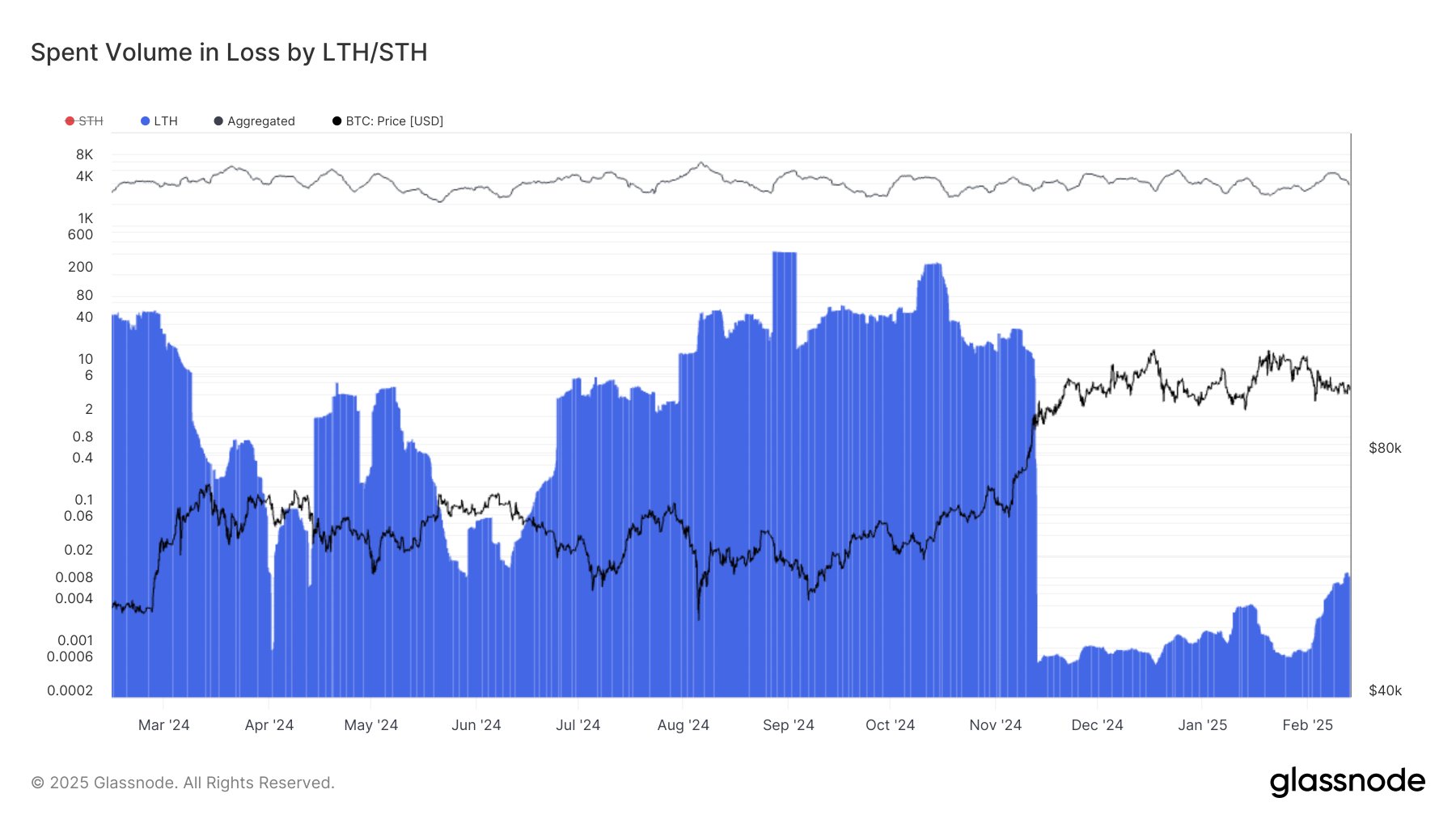
In one of its latest analyses, Glassnode reported that short-term Bitcoin holders, those who held BTC for less than 155 days, significantly reduced their sell-offs at a loss. 

The seven-day moving average of Bitcoin sold in loss had risen to a high of about 5,500 BTC earlier this month. However, this figure has now dropped to about 3,800 BTC, aligning with the yearly average of 3,500 BTC.  

Although February’s sell-off volume is mildly higher, it stays below the August 2023 top of 7,500 BTC. According to Glassnode, this suggests that short-term holders are under less pressure to sell in comparison to previous market downturns.  

Long-Term Holders Maintain Stability  

Moreover, the analytics firm also highlighted that long-term Bitcoin holders, those who have held their BTC for more than 155 days, remained largely unaffected by volatility. 

Bitcoin Spent Volume in Loss Glassnode

Their losses had been rather minimal over the past year, with the weekly average never going above 500 BTC. Glassnode confirmed that by recent measurements, this number had fallen to nearly zero.  

The resilience of long-term investors indicates that they are not reacting to short-term price movements, bolstering Bitcoin’s strong support levels. Specifically, their reluctance to sell suggests confidence in Bitcoin’s long-term growth.  

Bitcoin Whale Activity Shows Strong Support  

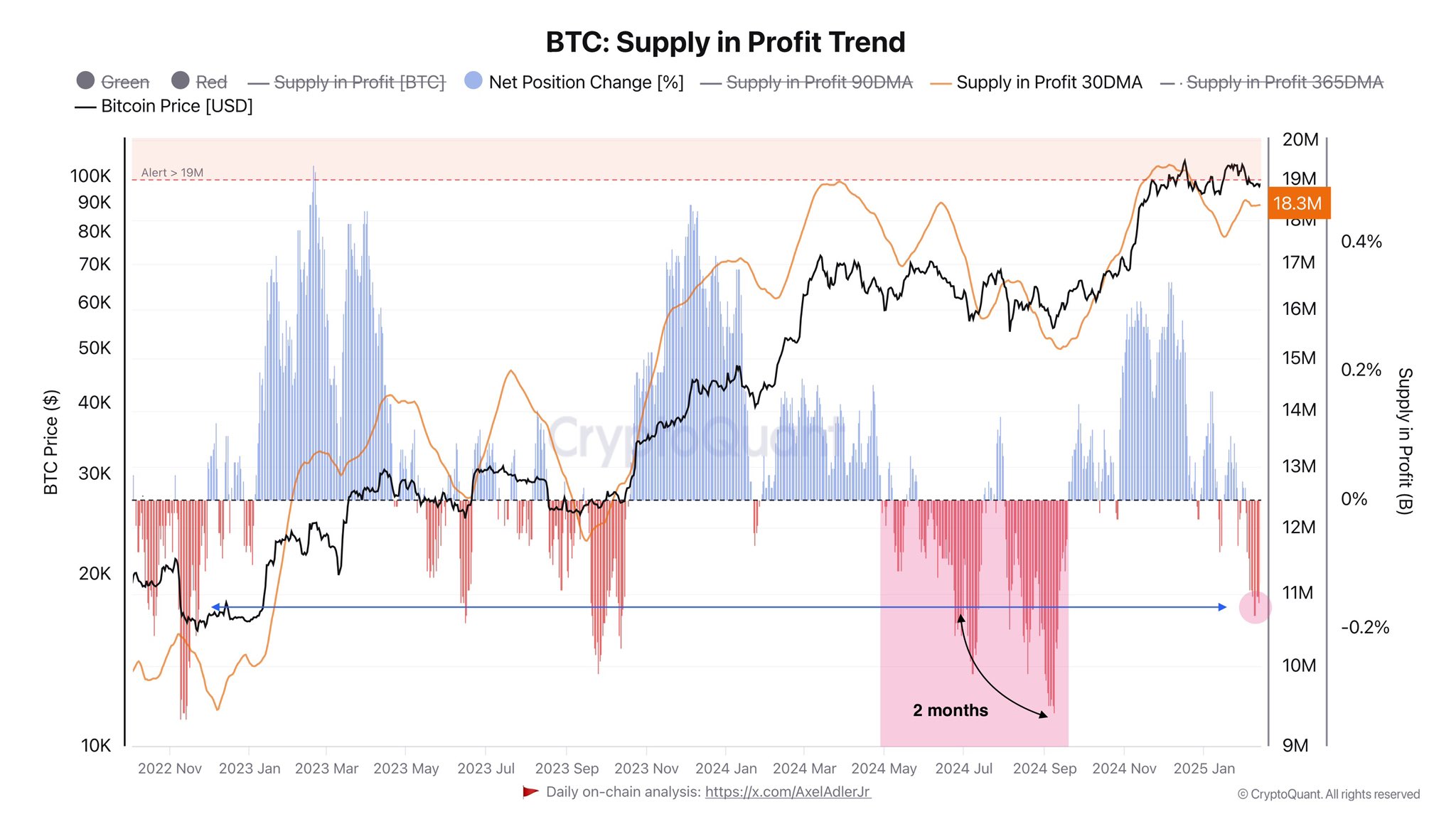
Meanwhile, CryptoQuant analyst Axel Adler Jr. recently observed that new Bitcoin whales, or large holders who have held BTC for less than 155 days, have an average realized price of $89,200. He believes this level has become a major support zone during Bitcoin’s current consolidation phase.  

Adler Jr. noted that whales who bought at this price would likely not sell at a loss, which could help market stability. He also pointed out that, besides a major panic-driven sell-off in September 2023, Bitcoin holders had mostly realized more profits than losses.  

In a separate disclosure, Adler Jr. further argued that the relatively low amount of Bitcoin sold at a loss makes profit trends more significant in this market cycle. He noted that during Bitcoin’s previous consolidation at $70,000, it took about two months to establish momentum for the next rally.

Bitcoin Supply in Profit Trend CryptoQuant
Bitcoin Supply in Profit Trend | CryptoQuant

However, he believes the current market dynamics have shifted. He noted that Bitcoin’s price movements were now more influenced by external news events, particularly discussions surrounding the U.S. President Donald Trump and the potential Bitcoin strategic reserve.

He suggested that such developments could speed up Bitcoin’s next upward push, deviating from past macro cycles.  

Liquidity Factors Could Boost Bitcoin Price  

To add to the bullish outlook, crypto analyst Miles Deutscher highlighted a potential liquidity boost from the U.S. Treasury General Account (TGA) drawdown, which could occur as a result of issues around the debt ceiling. 

He argued that this situation functions similarly to quantitative easing (QE), effectively injecting liquidity into the economy.  Deutscher pointed out that Bitcoin had rallied significantly during previous TGA drawdowns. In December 2022, BTC surged 84%, while in June 2023, it gained 23%. 

Currently, Bitcoin changes hands at $95,896. From this level, an 84% rally would push the asset to $176,448, while a 23% increase would send it to $117,952, both of which would represent new all-time highs.

National Bank of Canada Invests $2M in Bitcoin ETFs

0

The National Bank of Canada has made a notable move in the crypto market by purchasing Bitcoin exchange-traded funds (ETFs) valued at $2 million. 

This development follows increased institutional engagement in Bitcoin investment products and signals growing interest from traditional financial entities.

Market participants view the move as a potential signal of growing institutional interest in Bitcoin. Accordingly, some suggest that other Canadian banks could follow suit.

A Start of a Broader Trend?

Some interpret the purchase as the start of a broader trend, with institutions increasing their exposure to Bitcoin through regulated investment vehicles. The move aligns with the ongoing shift in traditional finance, where banks and asset managers gradually integrate Bitcoin into their portfolios.

However, skepticism remains within the crypto community. Some critics question why banks are opting for ETFs rather than holding Bitcoin directly. They argue that ETFs do not provide the same benefits as self-custody.

Others view the reliance on ETFs as a cautious approach that allows institutions to gain exposure to Bitcoin while mitigating regulatory and security concerns.

Meanwhile, BlackRock’s Bitcoin ETF launch in Canada has expanded options for investors seeking exposure to Bitcoin through regulated financial instruments.

Institutional Interest in Bitcoin ETFs Grows

BlackRock Asset Management Canada Limited recently introduced the iShares Bitcoin ETF. It trades under the tickers IBIT and IBIT.U on Cboe Canada, a primary stock exchange in the country.

The ETF provides a regulated method for investors to access Bitcoin through traditional brokerage accounts. Designed to track Bitcoin’s price movements, the fund allocates most of its assets to the U.S.-based iShares Bitcoin Trust ETF (U.S. IBIT), primarily consisting of long-term Bitcoin holdings.

The launch of the iShares Bitcoin ETF comes amid increasing institutional involvement in Bitcoin-related investment products. As spot Bitcoin ETFs gained traction, U.S. spot Bitcoin ETFs recorded a streak of inflows in January.

Central Banks and Bitcoin Considerations

Reports suggest that central banks are evaluating potential Bitcoin investments. Standard Chartered’s Geoffrey Kendrick noted that U.S. President Trump’s discussions on crypto reserves could influence central banks to consider holding Bitcoin. The U.S. government currently holds over 198,000 Bitcoins and could expand its holdings. 

In response, Czech National Bank Governor Ales Michl proposed allocating up to 5% of the central bank’s reserves into Bitcoin, with a meeting to discuss the proposal. Meanwhile, Bitcoin proponents in Switzerland advocated for a national vote to include Bitcoin in the Swiss National Bank’s reserves.

Bitcoin ETFs Gain Market Presence

Notably, crypto research firm Ecoinometrics recently highlighted the rising prominence of Bitcoin ETFs in the broader ETF market. According to data released on February 6, three Bitcoin ETFs have entered the top 100 by assets under management. 

As of the release, BlackRock’s IBIT ranked 31st with approximately $56.5 billion in assets. Meanwhile, Fidelity’s FBTC ranked 89th with $20.4 billion, and Grayscale’s GBTC held 94th with $19.5 billion.

Why Dogecoin Price is Set to Explode According to This Analyst

0

Dogecoin price may be set to explode soon, according to one prominent analyst.

“This may be your last chance before exploding to the upside!!” Highly followed market analyst “CobraVanguard” wrote about DOGE in a recent TradingView idea.

The analyst shared the memecoin’s daily chart, showing that it had retested a support level, coinciding with the 0.382 Fibonacci level that saw it bounce to highs of $0.43408 in January 2025. He had also predicted this initial January price bounce, albeit with a higher $0.47 target.

Citing the recent retest of this same level, CobraVanguard asserted that DOGE could surge to $0.32 and then $0.60, aligning with the 0.618 and 1.272 Fibonacci levels, respectively.

Screenshot 20250213 141607 TradingView
Dogecoin bounces on key support level on daily timeframe. Source: CobraVanguard

At the time of writing, these targets respectively represent 25% and 134% gains from the memecoin’s current price of $0.2569

Beyond the support level retest, the analyst also highlighted the appearance of a bullish divergence on the moving average convergence/divergence (MACD), used to identify price trends and entry points.

Meanwhile, CobraVanguard is not the only analyst to suggest that a potential DOGE rally will leave many behind.

“DOGE Season”

“Trader Tardigrade” recently asserted that the memecoin was in the middle of what he termed “DOGE Season,” adding, “You can’t chase it once it starts moving.”

The analyst made this claim, highlighting DOGE’s historical bull market performance. It has typically experienced an explosive rally punctuated by a months-long correction.

Indeed, the memecoin appears to be the throes of such a correction. The asset has dropped about 58% from highs of about $0.48434 to lows of $0.20178.

Raoul Pal Says Dogecoin Chart Greatest of All Time, Claims DOGE Is Harder Money Than Bitcoin

0

Raoul Pal recently argued that Dogecoin is superior to Bitcoin, asserting that the meme coin could become “the hardest money ever created.”

Pal made the attention-grabbing statement in a recent broadcast, making a case for Dogecoin’s dominance. The Global Macro Investor founder and CEO insisted that the prominent meme coin’s chart is super-bullish and branded it the “greatest chart of all time.”

Pal Makes Bold Dogecoin Statement

Dogecoin has always been one of Pal’s favorite assets. Recall that he once revealed that his portfolio contains a large concentration of the meme coin.

Now, the former hedge fund manager has branded Dogecoin’s chart the greatest of all time. He further describes the token as the king of all cryptocurrencies and argues that it will trump Bitcoin in the future.

Meanwhile, Pal based his Dogecoin superiority theory on its historical Bitcoin outperformance. He noted that the DOGE has outperformed the largest cryptocurrency by market cap by an impressive 500% since inception and expects the meme coin to extend the gains.

Remarkably, data confirms that Dogecoin has outperformed Bitcoin since its market debut in December 2013. The meme coin launched at $0.00056 and has surged 461,407% to its current price since then.

On the other hand, Bitcoin’s price at the time Dogecoin launched was around $1,210. With its current valuation of $96,340, the premier asset has increased by 7,862%

Breakout to Make Dogecoin The Hardest Money On the Galaxy

Meanwhile, Pal further noted that Dogecoin would further stamp its superiority to Bitcoin with an imminent breakout. Currently trending within a descending channel, the DOGE/BTC pair trades at 0.00000269.

DOGE Against Bitcoin Chart

He insisted that if DOGE breaks out against Bitcoin, it will become the “hardest money on the galaxy.” He speculated that Dogecoin would become the new standard, dethroning Bitcoin as the cryptocurrency leader.

Nonetheless, these bold predictions seem ambitious considering the gap in quality between the two assets. Bitcoin has grown to become a global asset spurred by its limited cap and historical price performance. 

However, although it has proved rewarding, Dogecoin’s meme coin origin and unlimited supply have raised concerns over the feasibility of Pal’s assertions.

Cboe Exchange Proposes Groundbreaking Amendment to Allow Ethereum Staking in ETFs

0

Cboe BZX Exchange has filed a regulatory request with the U.S. SEC seeking approval to allow Ethereum staking within ETFs.

The request, submitted on Form 19b-4, marks the first instance of a U.S.-based ETF proposing direct staking. If approved, this would enable investors to earn staking rewards from the fund, an option currently unavailable in Ethereum ETFs.

This news has sparked a rise in Ethereum amid market-wide fluctuations. At the time of this report, ETH is trading at $2,681, reflecting a 2.11% increase over the last 24 hours.

Proposed Amendments to Ethereum ETF Rules

The filing seeks to amend sections of the 21Shares Core Ethereum ETF to incorporate staking mechanisms. The proposal states that the sponsor may stake a portion of the trust’s ETH through staking providers, including the custodian or its affiliates.

However, sponsor affiliates would not be used for staking activities. In return, the trust would receive staking rewards in ETH, which could be classified as income.

Key conditions include restricting the sponsor from pooling the trust’s ETH with assets from other entities, aside from potential pooling at the staking provider level.

Additionally, the sponsor would not advertise staking services, guarantee specific returns, or solicit delegated stakes outside the trust. The sponsor will stake the Trust’s ether solely to maximize revenue generation, but it will not guarantee specific returns.

To mitigate risks, the filing specifies that staking activities will not require the trust’s ETH to leave custodial wallets. Instead, the staking process will utilize a “point-and-click” method, reducing the likelihood of theft.

However, the risk of slashing remains a possibility, and the sponsor has stated that it will not cover or subsidize such risks on behalf of the trust.

SEC Response Timeline

The filing states that the proposed amendments align with the Securities Exchange Act, particularly Section 6(b)(5), which focuses on market integrity and investor protection. The Exchange believes the change would enhance market efficiency and offer investors additional benefits through staking.

The SEC’s decision will follow the standard review process for 19b-4 filings, with a final deadline expected around late October. Historically, the SEC typically addresses such applications near the deadline, though the timeline may vary.

Meanwhile, Cboe BZX has also submitted another 19b-4 request related to ETF structures, focusing on amendments for in-kind creations and redemptions in Bitcoin and Ethereum ETFs.

If approved, this adjustment would allow authorized participants to exchange ETF shares for underlying assets instead of using cash, potentially improving market efficiency and reducing costs.

Bitcoin Traders Showing “Heightened Sensitivity” to Inflation: A Hidden Trading Opportunity?

0

Bitcoin traders are showing “heightened sensitivity” to inflation news.

This is according to the prominent crypto intelligence platform Santiment Feed.

In a Thursday, February 13 report, the firm disclosed that Consumer Price Index (CPI) discussions across social media platforms were at 15-month highs, showing significant concern, especially among retail Bitcoin traders.

Still, the firm has argued that a trading opportunity for savvy market participants could lie in this heightened sensitivity.

“Sell the Rumor, Buy the News?”

For context, the Santiment Feed report follows Wednesday’s hotter-than-expected U.S. inflation data release. Santiment highlights that shortly before the news broke, Bitcoin dipped 2% to around the $94,000 price point, only to rebound to the $98,000 level moments after the data release.

The platform argued that this could herald a profitable pattern for speculators looking to gain from short-term market volatility, arguing that market participants can expect retail traders to exit on the rumors of high inflation numbers and big players to step in to scoop up coins lower, sending the price higher after the fact.

“… this may be shaping up to be a ‘sell the rumor, buy the news’ scenario,” Santiment asserted.

Stronger-than-expected inflation numbers are currently seen as bad for risk assets like crypto as they reduce the chances of the Federal Reserve carrying out more interest rate cuts, which typically benefit the markets.

The crypto market’s recent weeks-long drought has largely been attributed to the Federal Reserve’s December 2024 decision to halve its rate cut projections for 2025.

With the market yet to decide on a clear direction, Bitcoin is trading around the $96,000 price point at the time of writing.

Bitcoin ETFs Are Eating Away Capital from Altcoin Rotation, Diminishing Altcoin Season

0

Bitcoin ETFs, while bullish for BTC, reduce the impact of the altcoin season with minimal capital rotation from BTC investors.

According to crypto analyst Miles Deutscher, the wealth effect that drove Bitcoin holders to reinvest in altcoins has diminished, altering the traditional market flow. Data from Glassnode further highlights a sharp decline in altcoin market capitalization, marking one of the most significant recent downturns.

The ETF Influence

Deutscher noted that historically, Bitcoin’s four-year halving cycle triggered wealth accumulation, leading to capital rotation into altcoins. As Bitcoin profits increased, funds typically flowed into Ethereum, large-cap cryptocurrencies, and smaller altcoins.

Deutscher notes that this cycle is now weakening due to fundamental market changes. In particular, the introduction of Bitcoin ETFs has significantly impacted this rotation.

Previously, Bitcoin holders kept their assets on centralized exchanges, reinvesting gains into other digital assets. Now, institutional investors and retail participants primarily hold Bitcoin through ETFs, which are settled in U.S. dollars rather than altcoins.

As a result, fewer funds remain within the crypto ecosystem, and capital is increasingly going toward traditional financial markets such as the S&P 500.

Institutional Investment Alters Liquidity 

A shift in investor behavior further distinguishes the current cycle from previous ones. Deutscher explains that Bitcoin ETF investors do not act like traditional crypto whales, who historically increased risk exposure after price surges.

Instead, ETF holders lack direct access to altcoins and trade Bitcoin ETFs against fiat currencies rather than transitioning into Ethereum or Solana. This shift impacts market liquidity and weakens the conditions necessary for an altcoin season.

Glassnode data corroborates this trend, noting that the altcoin market cap has fallen by $234 billion in the past two weeks. This represents one of the most substantial absolute drawdowns in recent history.

Although significant, the decline aligns with major sell-offs observed in 2024 and remains less severe than the May 2021 miner migration or the late 2022 LUNA and 3AC collapses.

The Breakdown of Fund Rotation

Another factor limiting capital rotation into altcoins is the increasing dominance of on-chain activity. Deutscher points out that wealth in the crypto space is now primarily engaged in DeFi, staking, and blockchain-based financial mechanisms rather than speculative trading on exchanges. This transition reduces the available liquidity for altcoin speculation.

Meanwhile, Bitcoin has remained more resilient despite the broader market decline. Glassnode reports that Bitcoin investors locked in $520 million in realized losses, a significant amount in this cycle.

However, this remains well below the $1.3 billion in losses recorded during the August 2023 yen-carry unwind. This highlights Bitcoin’s relative stability compared to altcoins.

Here Are Potential Timelines for Dogecoin to Soar 5,200% to $13.66

0

Several entities, such as Changelly and Telegaon, are optimistic about Dogecoin’s potential surge to $13.66, each outlining different timelines regarding when DOGE will hit this target. 

This week, the crypto market witnessed another downturn, causing slight pullbacks across major assets like Dogecoin (DOGE). The token plunged below the $0.25 price mark yesterday after the Federal Reserve announced a 3% inflation rate. 

Dogecoin Shows Resilience Amid Growing Institutional Interest 

However, DOGE showcased resilience by rebounding above the $0.25 level. Many experts attribute Dogecoin’s remarkable performance to long-term investors’ refusal to sell the token due to growing institutional interest in DOGE. 

For context, several asset managers, including Bitwise, are seeking to launch spot Dogecoin ETF in the U.S. According to Bloomberg analysts Eric Balchunas and James Seyffart, Dogecoin has a 75% odds of getting an ETF approved this year. The meme coin surpassed other assets in the analysis, including Solana (70%) and XRP (65%). 

Amid these projections, investors have been fantasizing about how DOGE ETFs could attract more capital into the Dogecoin ecosystem, replicating the success of Bitcoin. 

Dogecoin Surge to $13.66 

Consequently, they speculate that Dogecoin might soar to unprecedented levels, with some setting an ambitious target of $13.66. 

Currently, Dogecoin is trading at $0.2577, boasting a daily volume of $2.05 billion. It ranks as the eighth-biggest cryptocurrency with a valuation of $38.15 billion. 

Therefore, reaching the $13.66 target requires Dogecoin to rise 5,200% from the current price of $0.2577. At this price, Dogecoin’s market cap will skyrocket to $2.02 trillion. This assumes DOGE’s circulating supply remains the same at 148.02 billion tokens. 

Potential Timeline 

With several analysts eyeing Dogecoin’s potential surge to $13.66, we examined when this projection could become a reality for the meme coin, referencing predictions from top entities like Changelly, Telegaon, and ChatGPT. 

Changelly

Notably, experts at cryptocurrency trading platform Changelly forecast that Dogecoin will clinch the $13.66 target by January 2040. The experts believe this will be Dogecoin’s maximum price target by then, setting the asset’s minimum and average targets at $11.38 and $12.04, respectively. 

Telegaon

Interestingly, the famous crypto prediction platform Telegaon believes that Dogecoin will hit this target sooner than Changelly’s projections. According to Telegaon, Dogecoin will soar to a minimum price of $13.63 by 2030, five years from now. In the same year, they expect DOGE to trade at an average price of $15.49 and a peak price of $18.04. 

ChatGPT

Furthermore, the popular AI chatbot ChatGPT also predicted when Dogecoin could surge to $13.66. Referencing widespread suggestions, ChatGPT forecasts that Dogecoin will clinch the $13.66 target between 2029 and 2040. 

The chatbot expects this price to be driven by favorable market dynamics, broader crypto adoption, and other technological advancements.