Home Blog Page 980

Critic Jim Cramer Calls for Owning Bitcoin, Says It’s a Great Thing to Have in Portfolio

0

Jim Cramer, the host of CNBC’s Mad Money, advocates owning Bitcoin (BTC) in a diversified portfolio. 

During a recent segment of the Mad Money program, a caller asked Cramer to share his take on whether viewers should invest in Bitcoin or shares of MicroStrategy, the largest public holder of BTC. 

Responding to the inquiry, Cramer disclosed he owns Bitcoin, signaling his confidence in the premier cryptocurrency. He advised the caller and other viewers also to own Bitcoin. 

The CNBC Mad Money host characterized Bitcoin as a great asset to hold, emphasizing it is a valuable addition to a diversified portfolio. 

Cramer Kicks Against Investing in MicroStrategy Shares 

However, Cramer advocated against favoring shares of Bitcoin firm MicroStrategy over BTC itself. In particular, his statement suggests he is against indirect exposure to Bitcoin through MicroStrategy shares. 

Notably, MicroStrategy ranks as the largest public holder of Bitcoin, with a holding of 471,107 BTC. The asset acquired at an aggregate price of $30.4 billion is currently worth $48.38 billion. 

Given MicroStrategy’s large Bitcoin stash, BTC’s price action usually influences the performance of its shares. Hence, some investors tend to gain indirect exposure to Bitcoin by owning shares of MicroStrategy. 

However, Cramer is against this approach. He advocates for owning Bitcoin directly, ‘not MicroStrategy,’ as he stated. 

Mixed Reactions Trail Cramer’s Comment 

Cramer’s latest recommendation has triggered mixed reactions in the crypto community. While some crypto proponents commended him for backing Bitcoin, others expressed concern about his call for adoption, citing the humorous ‘Inverse Cramer’ theory. 

This is because his predictions usually move opposite the market’s direction. For instance, the Mad Money host said Bitcoin was topping out in January 2024, adding that investors should exit their positions in BTC. 

At the time, Bitcoin was trading at $47,100. Since he made the forecast, Bitcoin has soared by more than 100%, moving past $100,000. Specifically, as of today, Bitcoin is trading at $103,176 per BTC, up 4.88% over the past 24 hours.

Many investors, based on the ‘Inverse Cramer’ theory, project that Bitcoin might experience a significant downturn in the coming days.

Bitcoin Price Analysis: Bulls Eye $107K Amid Epic Comeback

Today, Bitcoin has marked a V-shaped reversal, surging to $103K. The question now is whether this recovery can sustain momentum to hit the $107K target.

As concerns surrounding DeepSeek AI subside, the crypto market is making a bullish move. The total crypto market capitalization has reclaimed the $3.5 trillion level, with Bitcoin bouncing back above the $103,000 mark.

With Bitcoin’s recovery rally helping the market regain a $2 trillion valuation, can BTC extend this rally to reach the $107,000 level?

Bitcoin Price Analysis

On the 4-hour chart, Bitcoin’s price trend displays a rapid V-shaped reversal after breaching the 200 EMA line. The 50% Fibonacci level at $98,611 has provided strong support, contributing to the formation of a morning star pattern.

BITSTAMP:BTCUSD Chart Image by Trojan69420

Following a lower price rejection that created a low at $97,750, Bitcoin is now back in action. It is currently trading at $103,227 and has broken above the 200, 100, 50, and 20 EMA lines. The next immediate target is the 78.6% Fibonacci level at $103,393.

However, higher price rejection points to ongoing resistance. The bullish reversal has driven the 4-hour RSI back to the midpoint, signaling an increase in demand.

Institutional Bitcoin Support Weakens Amid ETF Outflows

Despite the strong recovery, the recent downturn in U.S. tech stocks has led to a decline in institutional support for Bitcoin. On January 27, U.S. spot Bitcoin ETFs recorded an outflow of $457.48 million.

BlackRock remained the sole purchaser, with an inflow of $63.94 million. Meanwhile, Fidelity led the selling spree with an outflow of $268.59 million, followed by Grayscale’s GBTC with an outflow of $108.47 million.

Bitwise saw an outflow of $88.57 million, and ARK and 21Shares sold Bitcoin worth $50.11 million. VanEck was the smallest seller, with $5.68 million in outflows. The remaining six Bitcoin ETFs had no net outflow.

Bullish Speculations in Bitcoin Derivatives

In the past 24 hours, the crypto market saw liquidations amounting to $588.66 million. Amid the ongoing volatility, bullish sentiment is resurfacing in Bitcoin derivatives.

Open interest has reclaimed a $66 billion valuation, while the long-to-short ratio has risen to 0.9681. Similarly, funding rates have experienced a V-shaped recovery, now at 0.0085%.

These developments highlight a strong bullish momentum, suggesting the potential for an extended uptrend.

BTC Price Targets

As bullish speculation fuels Bitcoin’s V-shaped recovery, a breakout above the 78.6% Fibonacci level at $103,393 would signal a potential buying opportunity. The following price target, based on Fibonacci levels, is $107,123.

On the downside, crucial support levels are at the $100,000 mark and the 50% Fibonacci level at $98,611.

Trump-Inspired WLFI Not Buying XRP: Here’s One Possible Reason

0

Recent developments in the crypto scene have fueled speculation that the Donald Trump-led government might take over the Ripple XRP escrow. 

Notably, this move could eliminate the need to acquire XRP from the open market, an approach that contacts with how the World Liberty Financial Initiative (WLFI) project has been acquiring other crypto assets.  

WLFI Accumulation Spree 

For context, World Liberty Financial, a crypto project inspired by President Donald Trump, has continued to procure millions’ worth of different assets. The project has focused on amassing tokens like Ethereum (ETH), Wrapped Bitcoin (wBTC), Aave (AAVE), and Chainlink (LINK). 

For instance, during the latest major buying spree on January 20, 2025, amid Donald Trump’s inauguration, WLFI acquired over $100 million worth of assets, including 14,403 ETH at $3,333 per token and 94.94 wBTC for $9.84 million. The project also bought 177,928 LINK worth $4.7 million and 13,261 AAVE for a similar amount. 

This followed a previous accumulation campaign from December 2024. During this period, it purchased 2,631 ETH for $10 million at an average price of $3,801 per token and acquired 41,335 LINK tokens worth $1 million. 

Despite the buying spree, WLFI has not purchased XRP, the third-largest crypto by market cap. The XRP snub has triggered questions, given that XRP is currently the largest “Made in America” asset. Nonetheless, this has sparked speculation that the US government could be looking to amass XRP through other means.

Ripple Escrow

Notably, Ripple holds over 37.7 billion XRP in escrow, a reserve system designed to release 1 billion tokens monthly to ensure a steady supply. Community discussions have speculated that the U.S. government could bypass market acquisition entirely by leveraging these XRP holdings. 

Such a move would sync with the recent executive order signed by President Donald Trump, establishing a working group to explore a national digital asset stockpile. Scott Melker, Host of the Wolf of All Streets, suggested XRP was under consideration, citing reliable channels.

However, as these speculations gain ground, they have triggered a renewed aggressive campaign against XRP, particularly spearheaded by Bitcoin maximalists, who believe a national reserve should only contain Bitcoin.

Interestingly, Ripple has also been proactive in fostering relationships with the TRUMP administration. For instance, the company contributed $5 million in XRP to Trump’s inauguration fund and $300,000 to his presidential campaign. 

Could XRP Solve the National Debt Problem

As part of its lobbying efforts, some believe Ripple could donate its escrowed XRP to the government to proceed with including XRP in the national reserve. If this ever materializes, the U.S. government could take possession of approximately $140 billion in XRP tokens at no cost.

These community speculations have suggested XRP could help offset the national debt, currently at $36.4 trillion. However, supposing the U.S. government does procure the 37.7 billion XRP in escrow, for these tokens to settle the national debt, XRP would need to soar to $965 per token, a 31,029% rise from current levels.

Such a rally is largely improbable amid current market conditions. In addition, the suggestion that the Donald Trump administration could take over the XRP escrow remains speculative at press time, with no confirmation from the government or Ripple.

Tuttle Capital Files for Leveraged XRP, Cardano, and 8 Other Crypto ETFs

0

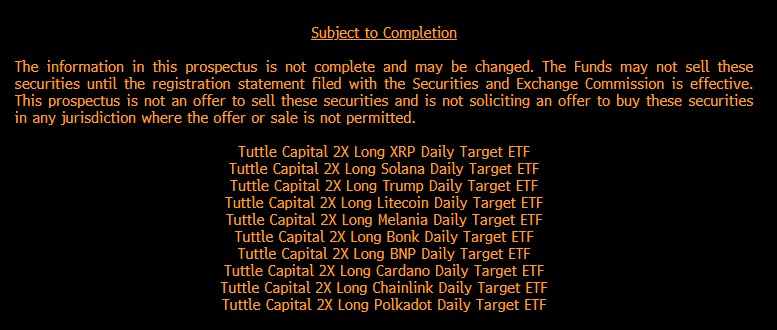
Filings for crypto-related ETFs have escalated since former chair Gary Gensler resigned, with Tuttle Capital applying for 10 different leveraged products.

Prominent Bloomberg analyst James Seyffart confirmed the latest filing from asset manager Tuttle Capital in a Monday post. According to the tweet, the investment advisory firm applied to the US Securities and Exchange Commission (SEC) to approve listing derivative exchange-traded funds (ETFs) of ten different crypto assets.

For context, a derivative-based ETF gives investors leveraged exposure to an underlying crypto asset. Although they come with high risks, the product has gained traction among certain market users with an appetite to amplify returns.

New ETF Filing for XRP and Cardano

Tuttle Capital’s filing includes exposure to major cryptocurrencies like XRP, Solana, Litecoin, and Cardano. The asset manager also seeks approval to list leveraged products for Chainlink, Polkadot, BNP, and meme coins like Trump, Melania, and Bonk.

Tuttle Capital ETF Filing

Meanwhile, Seyffart pointed out that some of the assets in the filing have no exchange-traded products (ETPs). Specifically, the prominent analyst stated that Tuttle Capital’s filing is the first US ETP for anything tracking Chainlink, Polkadot, Cardano, BNP, and Melania.

The product will provide investors with a 2x long (i.e., 2:1 exposure and reward ratio) of the daily movements of the crypto assets earlier mentioned. 

Filings Testing SEC’s Limits

US President Donald Trump has delivered some of his promises to the crypto industry, which included shuffling things on the regulatory front. Market analysts have speculated that with former SEC chair Gary Gensler now gone, ETF approval will be easier under the new pro-crypto hierarchy.

However, Seyffart implied that the new enabling environment has birthed unusual applications, as seen in some of the assets Tuttle Capital filed for. He even joked about starting a movement to reinstate Gensler as US SEC chair.

Seyffart explained that this situation involves issuers pushing the boundaries of what the SEC might permit. He added that the new crypto task force, headed by Hester Peirce, will likely play a major role in deciding what will be approved and what will not.

Bloomberg’s senior analyst Eric Balchunas also commented on the filing, noting that a 2x filing before a 1:1 exposure ratio is unusual. He also disclosed the application is a 40 Act filing and could be in the market in April unless the SEC disapproves.

Meanwhile, the filing came almost a week after Bitwise registered its Dogecoin spot ETF with the Delaware Department of State. Notably, the registration is the first step in applying for an ETF.

Senator Lummis Unveils Digital Asset Subcommittee “Dream Team”

0

Pro-crypto Republican Senator Cynthia Lummis unveils the inaugural members of the Senate’s first-ever digital asset subcommittee.

The President Donald Trump administration has ushered in significant body language shifts towards the crypto industry in the U.S. government. Among these major shifts is the formation of a digital asset subcommittee in the U.S. Senate led by Wyoming Senator Cynthia Lummis.

“Dream Team”

Pro-crypto Republican Senator Cynthia Lummis has unveiled the inaugural members of the Senate’s first-ever digital asset subcommittee.

In an X post on Monday, January 27, Lummis listed the eight members of the group, calling them “the digital asset dream team.” The team notably has equal numbers of Republicans and Democrats.

The members include strong crypto supporters like Republican Senators Bill Hagerty, Dave McCormick, and Bernie Moreno, as well as Democratic Senator Ruben Gallego, an upcoming pro-crypto voice who received significant support from pro-crypto PACs during the election. Gallego is also set to support Lummis in leading the subcommittee as its ranking member.

Beyond these pro-crypto voices, the subcommittee also features skeptics and Senators who have called for a hard line on crypto, including Democratic Senators Tina Smith, Mark Warner, and Chris Van Hollen.

Senate Digital Asset Subcommittee Members
Senate Digital Asset Subcommittee Members. Source X

The subcommittee’s bipartisan composition comes as its first priority is to pass bipartisan crypto legislation that promotes customer protections and innovations. Areas of focus include market structure, stablecoins, and a strategic Bitcoin reserve.

The subcommittee will also oversee federal financial regulators to ensure that they abide by the law in their dealings with crypto.

In line with this task of oversight, the group’s first order of business could be a hearing on the crypto industry’s claims of “debanking” featuring top banking regulators. Earlier in the month, Senator Lummis sent a letter to the Federal Deposit Insurance Corporation Chair Marty Gruenberg warning the agency against destroying documents related to its dealings and guidance around crypto.

CBOE Seeks SEC Approval for In-Kind Transactions in Bitcoin and Ethereum ETFs

0

The CBOE BZX Exchange has formally submitted a 19b-4 filing to the U.S. SEC regarding amendments to Bitcoin and Ethereum exchange-traded funds (ETFs).

This regulatory request, revealed by ETF Store President Nate Geraci on January 28, aims to revise the structure of the 21Shares Core Ethereum ETF and ARK 21Shares Bitcoin ETF. 

If approved, the changes would permit in-kind creations and redemptions, streamlining the process for these ETFs, which are already authorized for trading under BZX Rule 14.11(e)(4).

Cboe files 19b 4 filling

Focus on Institutional Participants

Specifically, the amendment targets Authorized Participants (APs), omitting retail investors from its scope. In-kind transactions would allow APs to exchange ETF shares for underlying assets rather than using cash, potentially enhancing market efficiency. This method could reduce transaction complexity and associated costs by eliminating the need for Bitcoin to be sold before acquiring ETF shares.

Industry observers responded to the filing with mixed insights. One commentator suggested that such a change might create a smoother market by reducing friction between ETFs and broader crypto markets.

Another analyst viewed the proposal as a potential indicator of increasing institutional participation and market advancement.

SEC’s Stance on 19b-4 Applications

CBOE BZX Exchange has submitted multiple 19b-4 filings in the past, but not all have gained SEC approval. The regulator previously dismissed similar applications for two proposed spot Solana ETFs, prompting their removal from CBOE’s official listings.

Discussions between the SEC and ETF issuers largely revolved around whether Solana should be classified as a security. The SEC has consistently argued in regulatory proceedings that Solana falls within its jurisdiction under securities law.

Typically, exchanges file 19b-4 documents on behalf of ETF issuers as part of the SEC’s review process. Upon acceptance, these filings are published in the Federal Register, initiating formal regulatory scrutiny.

In October 2024, the SEC approved rule modifications permitting trading options on spot Bitcoin ETFs. CBOE secured authorization to list options on ten Bitcoin ETFs, though the Grayscale Bitcoin Mini Trust (BTC) was omitted. 

Expert Says XRP to $10,000 is Not a Joke: Here’s Why

0

Shmoo, a well-known figure in the crypto community and co-founder of COINVIRAL, raised eyebrows with a bold statement regarding XRP future. 

In a tweet, he boldly stated that XRP could reach $10,000, emphasizing that this outlook was not a joke. “XRP to $10,000 is not a meme,” he wrote.

Notably, this statement suggests that Shmoo genuinely believes XRP has the potential to hit $10,000 per token. While the target is ambitious and speculative, his wording makes it clear that he sees this as a serious possibility, not just an unrealistic or meme-driven prediction.

However, Shmoo did not specify a timeline for when he believes the $10,000 price point could materialize for XRP. Interestingly, Shmoo is not the first influential voice in the crypto community calling for a $10,000 per token price for XRP.

Other Market Pundits Calling for $10,000 XRP

Last August, market commentator Levi Rietveld argued for a $10,000 target for XRP, citing Ripple’s growing role in central bank digital currencies (CBDCs). Based on comments from Ripple’s James Wallis, Rietveld highlighted Ripple’s global projects, which could drive XRP’s adoption and price. 

Earlier, Christian prophet Brandon Biggs proclaimed that “God” revealed to him that XRP would one day reach $10,000. Biggs shared this in a video, explaining that after praying for guidance on significant investments, God directed him to XRP, comparing it to the early days of companies like Apple.

Likewise, Edoardo Farina, CEO of Alpha Lions Academy, and Versan Aljarrah, founder of Black Swan Capitalist, discussed XRP reaching $10,000 as “inevitable” during a 2024 podcast.

Aljarrah argued that central banks and institutions like the IMF would “set” XRP’s price higher to ensure its use in large transactions. Farina supported this view, highlighting XRP’s technological edge and the potential for global expansion in the crypto market.

Furthermore, he compared XRP’s growth potential to Bitcoin’s rise. Farina emphasized that XRP’s real-world utility in cross-border payments and asset tokenization makes the $10,000 target “realistic and achievable.”

What $10,000 per XRP Means

While these projections are enticing, these ambitious market commentators often overlook the market cap implications of such a projection.

For context, the price of XRP is currently $3.10, with a market cap of $177 billion. For the third-largest crypto asset to reach $10,000 per token, its price must soar by 322,481% from its current value.

Moreover, this extraordinary price surge would put XRP’s market cap at $576.4 trillion, a hypothetical aspiration. To put this in perspective, global wealth is estimated at $454 trillion.

Essentially, should XRP alone control a market cap of $576 trillion, it raises the question of what global wealth would look like, or even the wealth of gold and Bitcoin, which are several times larger than XRP.

Ripple CEO Reveals His Take on Maximalism, Admits to Holding XRP and BTC

0

Ripple CEO Brad Garlinghouse has taken to X to share his opinion on the ongoing digital asset reserve debate, emphasizing the need for unity in the crypto industry. 

Garlinghouse first criticized maximalism within the crypto industry. Notably, this belief is prevalent in the crypto community, where some believe their favorite coin is inherently superior to others. 

However, Ripple’s CEO stressed that this perception is counterproductive to the broader goal of the crypto industry. According to Garlinghouse, there is a need for collaboration in the industry instead of competing destructively.

In parallel, Garlinghouse emphasized his belief in a multichain future by disclosing his investment in diverse cryptocurrencies. Specifically, he disclosed owning not just XRP but Bitcoin, Ethereum, and other digital assets.

This aligns with his call for a level playing field and unity in the industry rather than a situation in which maximalists promote one cryptocurrency at the expense of others. 

Ripple CEO Calls for a Representative Digital Asset Reserve

In this context, the Ripple CEO commented on the possible creation of a national digital asset reserve. This has been one of the hottest topics in the industry, with many crypto stakeholders sharing their opinions on how the government should approach it.  

For context, Bitcoin was at the forefront of consideration for the digital asset reserve after Donald Trump first revealed the initiative during his campaign. However, discussions have emerged that the U.S. government might include other coins, like XRP, in its national digital asset reserve. 

In particular, speculations suggest that the Trump administration plans to create an America-first reserve, favoring coins developed in the United States, such as XRP, Solana, and USD Coin.

Amid this speculation, Bitcoin maximalists, including VP of Riot Platforms Pierre Rochard, claimed that only BTC qualifies as a reserve currency asset. 

However, Garlinghouse suggested that the U.S. government reserve should reflect the diversity of the crypto industry rather than being centered on one coin, as many Bitcoin enthusiasts are advocating. 

This indicates that Garlinghouse supports establishing a digital asset reserve with multiple cryptocurrencies rather than BTC alone. 

The Ripple CEO made the comment days after a significant feud escalated between the Bitcoin and XRP communities. Several Bitcoin proponents, including Rochard, argued against including XRP in the potential digital asset reserve.

In the meantime, the government has not officially mentioned the names of crypto assets that will be featured in the reserve. Trump recently created a working group to evaluate the risks and benefits of creating the digital asset reserve. This group will submit a comprehensive report within 180 days from the date of the executive order. 

Here’s Why Dogecoin Could Surge by 10,000% Anytime Soon

0

As bearish sentiment worsens in the market, analysts are highlighting reasons why Dogecoin could see its value surge as high as 10,000% soon.

Today, the price of Dogecoin has dropped by 11%, falling toward the $0.30 support, which worsens its year-to-date performance. With the recent drop, the meme coin has lost all gains accrued in 2025, revisiting lows from 2024.

Despite this, market commentators believe Dogecoin still has sufficient room to turn things around for holders in the coming weeks.

Dogecoin Likely to Pump 8,076%

In a post on X, “Dogecoin Rise,” a market analyst with 432K followers suggested that Dogecoin could be primed for an 8,076% surge, citing a key historical pattern. The projection hinges on Dogecoin’s six-month chart, which highlights consolidation and breakout phases observed in previous market cycles.

For context, during the 2015-2018 cycle, DOGE rallied 3,284.93%, climbing to $0.01838. Similarly, in the 2018-2021 cycle, the price skyrocketed 8,025.24%, reaching its all-time high of $0.72995.

Now, in the 2024-2025 bull phase, the analyst predicts a similar surge if the historical pattern holds. Specifically, the chart points to a sustenance of the bull run, with DOGE targeting prices between $8.32 and $20.67, representing estimated gains of 3,223% to 8,076%.

The analyst also noted that, in a worst-case scenario, Dogecoin could still hit $8 as a minimum target.

Image
Dogecoin historical chart on the six-month timeframe

History Suggests DOGE Can Rally by 10,000% in 90 Days

Meanwhile, on-chain analyst Ali Martinez has an even more promising outlook for Dogecoin. In a separate post, Martinez pointed out that during the 2021 bull cycle, Dogecoin surged by an astonishing 10,000% within just 98 days to reach its all-time high. 

These explosive rallies demonstrate DOGE’s potential for rapid growth during bullish market conditions.

Meanwhile, a key highlight in Martinez’s analysis is that the current bullish market could end in around 90 days.

Bear Market Looming, But Dogecoin Can Still Pump Hard

In an earlier post, Martinez pointed out that Bitcoin’s ultimate market top could happen within 90 to 250 days, aligning with past cycles. Historically, Bitcoin peaked well after halving, with previous cycles seeing their tops 367 and 527 days post-halving.

The 2024 halving was 276 days ago, and Bitcoin recently set a peak at $109,114. If history repeats, the ultimate peak could come by mid to late 2025. In particular, this signals the potential end of the current bull cycle that began in late 2023.

Essentially, with the latest 10,000% projection for Dogecoin, Martinez suggests that while the end of the bull phase is nearing, the meme coin still holds promising potential that aligns with historical trends.

His projection aligns with previous consolidation and breakout phases observed on the six-month charts, emphasizing Dogecoin’s ability to deliver exponential gains in a short time frame.

Singularity Finance Teams Up With Particle Network To Streamline Tokenized AI Transactions

0

Singularity Finance said today it’s working with the chain abstraction technology provider Particle Network to try and boost the interoperability of tokenized artificial intelligence assets with decentralized finance protocols.

The collaboration will see the two projects pool their resources to address one of the key limitations of the blockchain industry, namely the lack of interoperability between different networks. In doing this, they aim to increase the accessibility of Singularity’s tokenized AI assets and make them available to use in DeFi protocols on any blockchain.

Created by a merger between SingularityDAO, Cogito Finance and SelfKey, Singularity Finance is an intriguing Layer-2 network that’s focused on tokenizing assets within the AI economy. It’s designed to tokenize AI assets such as large language models, training datasets and the computing resources needed to power AI applications.

By tokenizing every part of the AI economy, Singularity Finance aims to merge the fast-growing industry with the DeFi economy to increase decentralization. It will enable everyone to invest in AI and become a stakeholder in this key technology, which many believe will have a transformational impact on the world in the coming years. At the same time, it’s also building tools to automate investing in AI assets.

Particle Network is now set to help make all of this possible. It’s the creator of a modular Layer-1 blockchain that’s focused on “chain abstraction”. With its Universal Accounts, it enables users to engage with crypto and DeFi using a single, unified on-chain address that spans every blockchain.

Universal Accounts are designed to solve the headaches that arise with having to manage multiple crypto wallets for each and every blockchain. We live in a truly multichain world, where users must hold and manage tokens on each blockchain they interact with, be it Bitcoin, Ethereum, Polkadot, Cosmos, Solana or something else.

Managing so many wallets simply isn’t feasible for the vast majority of consumers, and the lack of network interoperability also causes headaches for developers, who must consider which blockchain to deploy their dApps on, and then try to make them play nicely with other networks when the time comes to try and expand into new markets.

By providing users with a single address that works for every blockchain, Particle Network makes it simple for people to buy, sell and swap crypto assets without worrying which network they live on. Users can just send funds from one chain to another.

Its Universal Accounts are compatible with both EVM and non-EVM networks, including Bitcoin. It does this through the use of ERC-4337 “smart accounts”, which are a new feature that expands the programmability and functionality of traditional crypto wallet accounts, making them compatible with any blockchain.

Universal Accounts will make life much easier for Singularity Finance’s users. For instance, if somebody wants to mint an NFT on the SFI chain but they only hold ETH in their wallet on the Ethereum mainnet, they would normally need to carry out multiple actions. The steps would include approving a bridging contract, then bridging their ETH to SFI, before approving the contract and finally, minting the NFT.

Particle Network streamlines these actions into just one, simple transaction, removing the headaches and hassles, making the process much more user-friendly. By doing so, it will enable the seamless flow of liquidity to and from the SFI chain, boosting its tokenized AI economy.

Singularity Finance Chief Executive Cloris Chen said the decision to collaborate underscores his project’s commitment to building a more inclusive AI economy.  “Together, we aim to accelerate progress and open new avenues for growth by integrating infrastructure solutions that simplify blockchain interactions and enhance the user experience,” he said.