Home Blog Page 985

Why MicroStrategy Faces Billions in Taxes Over Unrealized Bitcoin Gains

0

MicroStrategy looks set to pay billions in taxes on unrealized gains on its Bitcoin holdings.

The Michael Saylor-led business intelligence firm MicroStrategy has enjoyed significant success in the past year thanks to its bold Bitcoin treasury strategy, but its playbook could come at a hefty cost.

MicroStrategy Stares Down Huge Tax Bill

MicroStrategy may be set to pay billions in taxes on unrealized gains on its Bitcoin holdings.

On Friday, January 24, The Wall Street Journal reported that the business intelligence firm could be forced to pay billions in taxes on $19 billion in unrealized gains from its 461,000 Bitcoin holdings worth over $48 billion starting next year despite having not sold any coins.

The looming tax bill follows a “corporate alternative minimum tax” introduced with the Inflation Reduction Act of 2022 targeted at companies reporting high earnings with minimal taxable income. Under the rule, MicroStrategy faces a 15% minimum tax rate on adjusted earnings, a bill that could force it to liquidate some of its Bitcoin holdings for cash.

Still, MicroStrategy may be able to avoid this tax bill if it secures an exemption from the Internal Revenue Service.

Indeed, the IRS has already granted such an exemption to companies with unrealized gains from stock holdings, and there may be hope of such an exemption for firms holding crypto under the pro-crypto Donald Trump administration.

In a January 2 letter, MicroStrategy pushed for this exemption and described the tax rule’s effect on its business as unjust.

Interestingly, despite being aware of this looming tax bill, MicroStrategy has shown no signs of slowing or pausing its Bitcoin acquisition strategy.

Just on Tuesday, January 21, the firm disclosed an 11,000 BTC buy worth an estimated $1.1 billion. In 2025 alone, the firm has already acquired 14,600 BTC worth over $1.44 billion as new purchases are announced almost every week.

Meanwhile, this is the second time MicroStrategy has faced tax problems in recent years. In June 2024, it paid $40 million to settle tax fraud allegations.

Ripple Asks Court to Set This Deadline For the Filing of Its Cross-Appeal Brief in SEC Case 

0

Legal counsel representing Ripple in its ongoing lawsuit against the SEC seeks to file its cross-appeal brief by mid-April. 

Ripple’s lawyers made the request yesterday in a letter sent to Catherine O’Hagan Wolfe, the Clerk of the Court of Appeals for the Second Circuit. 

According to the letter, Ripple wants the court to set April 16, 2025, as the due date for the submission of its brief in the appeal and cross-appeal against the SEC.

The counsel disclosed that two parties involved in the appeal, including Ripple CEO Brad Garlinghouse and co-founder Chris Larsen, support this request. Although Ripple made the request yesterday, it became public knowledge today following an update from James K. Filan. 

Ripple Cross-Appeal Brief 

Meanwhile, the upcoming brief relates to Ripple’s cross-appeal. Recall that Ripple filed a cross-appeal shortly after the SEC indicated interest to appeal the company’s legal victory. Ripple aims to overturn the SEC’s victory regarding its institutional sales of XRP, which were deemed investment contracts. 

As previously reported, the district court ordered Ripple to pay a $125 million fine and imposed an injunction on the company’s future sales of XRP to institutional clients. The injunction followed Ripple’s violation of securities laws through its past institutional sales of XRP. 

On October 25, Ripple hinted at what the broader crypto community should expect from its cross-appeal brief. The company asked the court to review whether an investment contract requires an actual contract under the 1933 Securities Act. 

It sought clarification about whether its institutional sales of XRP, which were deemed securities, contained all elements of Howey. Ripple also brought up its fair notice defense and the Rule 65 arguments. The company will shed light on these arguments in its appeal brief that they might file in mid-April 2025. 

Court Grants Similar Request From SEC 

Recall that the SEC made a similar request last year in preparation for the filing of its opening appellate brief. On October 24, 2024, the SEC asked the court to set a deadline of January 15, 2025, for the filing of its opening appeal brief. The court granted the request a week later.

Notably, the SEC filed its opening brief last week in accordance with the court’s scheduling order. Now, Ripple wants the court to set a due date of April 16, 2025, for the filing of its brief. 

Legal Expert Thinks Ripple Won’t File Appeal Brief 

Commenting on the development, pro-XRP lawyer Jeremy Hogan, a Partner at Hogan & Hogan law firm, characterized the request as a ‘standard’ procedure, emphasizing that the court gave the SEC the same amount of time (90 days) to draft its initial brief. 

However, Attorney Hogan suggested that the SEC v. Ripple appeal might see a major development that could make it unnecessary for the company to file its brief on April 16, 2025. 

This development might be in the form of a settlement or outright dismissal of the lawsuit by the new SEC leadership. Attorney Hogan has consistently stated that the Second Circuit will not rule on the case, hinting at a potential dismissal.

Shiba Inu Investors Accumulate 7.63 Trillion SHIB in 2025

0

Shiba Inu investors holding between 0.1% and 1% of the total supply accumulated a staggering 7.63 trillion SHIB, while whale and retail holdings declined.

Shiba Inu recently dropped below the critical $0.00002 mark, a level that previously acted as a strong support. Coinciding with the broader market fluctuations this week, the token initially held its ground before slipping below this mark on Thursday.

However, in the last 24 hours, SHIB regained traction, rising 1.55% to $0.00002026, though it remains down 11.11% over the past week. 

Shiba Inu Investor Holdings Surging

A key observation amid this price fluctuation is that mid-sized investors have emerged as the dominant accumulators of SHIB this year. According to data from IntoTheBlock, addresses holding between 0.1% and 1% of the circulating supply have significantly increased their holdings.

As of January 20, these investor-tier wallets held 155.97 trillion SHIB, marking an increase of 7.63 trillion tokens from December 31, 2024, when they held 148.34 trillion SHIB. This figure represents 15.07% of the total SHIB supply, reflecting a 5.51% increase in holdings among this investor group.

Meanwhile, whale holdings have slightly declined. As of January 20, large holders controlled 569.57 trillion SHIB or 57.88% of the circulating supply. The figure marked a decrease from 575.41 trillion SHIB at the end of December when whales held 58.46% of the supply.

Retail participation also saw a slight dip, declining by 0.92%. On December 31, retail investors held 260.56 trillion SHIB, which has since fallen to 258.73 trillion SHIB, representing 26.29% of the total supply.

Shiba Inu holder disctribution
Shiba Inu holder distribution

Shift in Holding Patterns 

Further analysis reveals changes in SHIB holding periods. Short-term and long-term holders have been outpaced by cruisers—investors who hold SHIB between one and twelve months. 

In January, cruiser holdings surged by 13.52%, while long-term holders saw a modest increase of 0.05%. Conversely, traders—who hold SHIB for less than a month—declined by 31.93%, suggesting reduced short-term speculation.

Shiba Inu holders
Shiba Inu holders

SHIB Exchange Reserves Decline

Elsewhere, supporting the accumulation trends, CryptoQuant data reveal that Shiba Inu reserves on exchanges have also dropped significantly.

On January 21, the reserve hit an all-time low of 98.4 trillion SHIB, marking a 27.4% decline since the beginning of the year. This decrease came just a day after the U.S. presidential inauguration. 

Shiba Inu Exchange Reserves

Although reserves slightly rebounded to 98.6 trillion SHIB, they still reflect a 27.2% decline overall. A reduction in exchange reserves often indicates that investors are transferring assets to private wallets or staking platforms, lowering the available supply for selling.

31,000 Bitcoin Options Worth $3.2B Expire as Trump Signs Crypto Executive Order

0

Data from Greeks.live, a professional options trading platform, shows that approximately 31,000 BTC options expire today. 

These options had a put-call ratio of 0.48 and a maximum pain point of $100,000. The notional value of these expiring options reached $3.19 billion, indicating substantial market exposure.

The platform notes how Bitcoin has remained above $100,000, with heightened speculation regarding its emerging role as a reserve asset for the U.S. government and institutional investors.

Greeks.live mentions that Donald Trump is now president, and policy shifts in the coming months could significantly influence Bitcoin’s trajectory for a full year. Notably, on Thursday, Trump approved via an executive order the formation of a committee to oversee the benefits of a national Bitcoin reserve.

Bitcoin Market Volume Amid Policy Shifts

Further market data from CoinGlass underscores a surge in Bitcoin options trading, with options volume increasing by 58.50% to $4.76 billion. However, open interest in BTC options declined by 4.92% to $37.09 billion, signaling a shift in positioning as some traders closed existing contracts.

Despite this drop in open interest, overall derivatives volume soared by 132.35% to $187.02 billion.

Bitcoin derivatives data analysis

Increased Speculation in Ethereum Market 

Meanwhile, Ethereum options data from Greeks also indicates heightened trading interest. Today, approximately 174,000 ETH options expired with a put-call ratio of 0.47 and a maximum pain point of $3,300.

These contracts held a notional value of $580 million. Ethereum options volume rose by 38.06%, reaching $1.21 billion, reflecting increased market speculation.

According to CoinGlass, open interest in Ethereum options saw a sharper decline than Bitcoin, decreasing by 5.92% to $8.10 billion. However, the broader Ethereum derivatives market remained active, with total trading volume increasing by 89.40% to $54.30 billion.

This suggests that new speculative opportunities continue to emerge while traders are closing out existing positions.

Greeks.live also highlights that macroeconomic factors shaped recent market movements. For instance, the Bank of Japan has announced a 25 basis points rate hike. Meanwhile, the Federal Reserve meeting is expected to maintain the current rate stance with no immediate cuts. 

According to Greeks, these macro events are anticipated to remain stable in the short term. Traders are focusing on potential policy changes under the new administration and ETF inflows, with short-term options positioning emerging as a key strategy amid evolving market conditions.

Institutional Investment See Inflows

Meanwhile, U.S. spot Bitcoin ETFs recorded six consecutive days of inflows between January 15 and January 24. 

Data from SoSoValue indicates that these ETFs accumulated $3.7 billion in net inflows during this period, with over $1 billion on January 17 and more than $800 million on January 21.

Morgan Stanley, Goldman Sachs, Other Big US Banks to Work with Crypto as Trump Plans to Make US Global Crypto Hub

0

With Donald Trump planning to make the United States the global crypto hub, big U.S. banks have signaled interest in embracing the nascent asset class.

Banks like Morgan Stanley and Bank of America have indicated their interest in embracing crypto following Trump’s inauguration. Earlier this week, these banks expressed their desire to expand their operations into the crypto market. 

Morgan Stanley to Deepen Crypto Involvement 

Speaking in an interview yesterday with CNBC’s Andrew Ross Sorkin at the World Economic Forum in Davos, Switzerland, Morgan Stanley CEO Ted Pick said he plans to collaborate with U.S. authorities on crypto initiatives. 

According to Pick, this collaboration could allow the bank to explore its deeper involvement in crypto under Trump’s administration. Specifically, Pick mentioned that Morgan Stanley will partner with the Treasury Department and other federal agencies to ascertain how it can offer crypto-related services safely. 

Notably, his concern revolves around whether Morgan Stanley, a regulated financial institution, can act as a crypto-related ‘transactor’ under Trump’s administration. Morgan Stanley is among the top American banks that embraced crypto early. 

Following growing demand from its clients, the bank offered Bitcoin funds to its wealthy customers in 2021 and subsequently introduced its clients to Bitcoin exchange-traded funds (ETFs) last year.

Goldman Sachs Hopes to Own ‘Physical’ Bitcoin

For context, the Biden administration was rather aggressive in its crypto regulation approach. It prohibited banks from deeply getting involved with crypto assets and restricted them from physically owning the emerging asset class. 

David Solomon, the CEO of Goldman Sachs, highlighted this limitation in a recent interview with CNBC’s Sorkin. According to him, the current regulatory framework prohibits banks from owning ‘physical’ Bitcoin. 

Interestingly, he declared his willingness to discuss Goldman Sachs’ potential adoption of Bitcoin if regulatory changes occur. 

Bank of America Anticipates Widespread Crypto Adoption Among Banks Amid Regulatory Changes

Besides Pick and Solomon, other banking leaders, including Bank of America CEO Brian Moynihan, also indicated the bank’s interest in embracing cryptos. 

According to him, if U.S. regulators provided the much-needed regulatory framework for crypto, the nascent asset class could serve as another form of payment for Bank of America’s customers. 

Moynihan speculated that the banking system might showcase significant interest in crypto provided regulators establish the necessary rules legitimizing its use in business transactions. 

Trump to Make America Global Hub for Crypto 

Discussions about banks adopting crypto soared following Trump’s reelection. The 47th U.S. President has been clear about his support for the crypto industry, unveiling plans to make the United States the global hub for crypto technologies. 

He reiterated this plan during his virtual speech at the WEF in Davos, Switzerland. Just a few days after his inauguration, Trump is already making moves to provide the regulatory framework for crypto. 

Following his speech at WEF, he signed an executive order creating a Presidential Working Group for Digital Asset Markets. This committee will explore the potential creation of a national digital asset reserve and develop a regulatory framework for cryptos. 

The group is expected to submit a comprehensive report detailing its regulatory and legislative proposal for the crypto industry to the president within 180 days of signing the executive order. 

If the rules are clear and fair, more global banks may consider embracing crypto and offering services related to the industry. 

Triblu Founder Says XRP Holders Will Become Millionaires, and Billionaires—Here’s Why

0

Triblu Founder Joshua Dalton suggests XRP could be a better strategic reserve option for addressing the U.S. national debt.

His commentary comes amid growing speculation on the back of President Donald Trump’s crypto executive order. For context, the order assigns a newly formed Presidential Crypto Team to assess the feasibility of a digital asset reserve. 

While Bitcoin has dominated these conversations, the executive order specifically refers to “digital assets,” leaving room for alternatives like XRP or Solana, which are linked to American companies. Interestingly, previous reports have suggested the presidency could prioritize American-founded assets.

Triblu Founder Says XRP Holders Will Become Millionaires, Billionaires because of the following reasons.

XRP More Trustworthy

As these discussions take form, Dalton, the founder of IT service company Triblu LLC, triggered controversy with a new stance favoring XRP as a more trustworthy choice for a U.S. strategic reserve over Bitcoin. 

Dalton claims that Bitcoin’s anonymous creator, Satoshi Nakamoto, poses a risk despite most voices agreeing that such anonymity is a favorable factor. He argues that Nakamoto’s hidden identity leaves the door open to potential manipulation, especially if the entity happens to be linked to foreign entities like China.

On the other hand, Dalton highlighted Ripple’s role in XRP’s operation as an advantage. He believes the transparency and American roots of Ripple make XRP a safer and more reliable option for the U.S. government. In his opinion, relying on XRP aligns with national interests. 

XRP Reserve for Solving US National Debt 

Dalton then suggested that XRP could help in addressing the national debt issue. It bears mentioning that industry leaders like VanEck’s Matthew Sigel believe Bitcoin is the appropriate option for this.

For context, the U.S. national debt currently stands at $36.2 trillion and continues to grow. At this figure, even offsetting 80% of the U.S. debt, amounting to $28.9 trillion, would demand a massive Bitcoin price appreciation, considering Senator Cynthia Lummis’ plan to procure 1 million BTC.

For 1 million BTC to offset $28.9 trillion debt, representing 80% of the national debt, Bitcoin would need to appreciate a price of $28.96 million per token. This would demand a 27,549% increase from the current Bitcoin price of $104,741.

Meanwhile, individuals who believe XRP is a better alternative have discussed the possibility of the U.S. government taking control of Ripple’s escrowed XRP balance, which amount to 37.7 billion tokens, according to data from XRPScan.

With such holdings, XRP price would have to rally to a massive $786 to offset 80% of the total national debt worth $28.96 trillion. As XRP currently changes hands at $3.15, a surge to $786 would necessitate a 24,852% increase. While this is lower than the required rise in Bitcoin’s price, it still represents a massive growth rate.

A Millionaire Dream

In addition to this, Dalton asserted that XRP holders could emerge as millionaires and billionaires while Bitcoin proponents remain “stuck” with industry leaders like MicroStrategy Chairman Michael Saylor, whose firm has continued to accumulate Bitcoin.

Notably, for XRP holders with balances of, say, 10,000 XRP tokens to reach millionaire or billionaire status, the XRP price would need to rise substantially. For 10,000 XRP, currently worth $31,500, to rake in $1 million, XRP must rise 3,074% to $100. However, to hold $1 billion with 10,000 XRP, its price would need to surge 3,174,503% to $100,000.

Expert Says Dogecoin Next Run Could Hit $4, Here’s Why

0

As Dogecoin attempts to stage a comeback after consecutive bearish sessions, some analysts believe the next leg up could trigger an over 1,000% surge.

The price of Dogecoin has increased by 1.81% over the last 24 hours, trading at $0.3560. At this price, the meme coin is trading at an 11% discount from the higher levels it reached earlier this week.

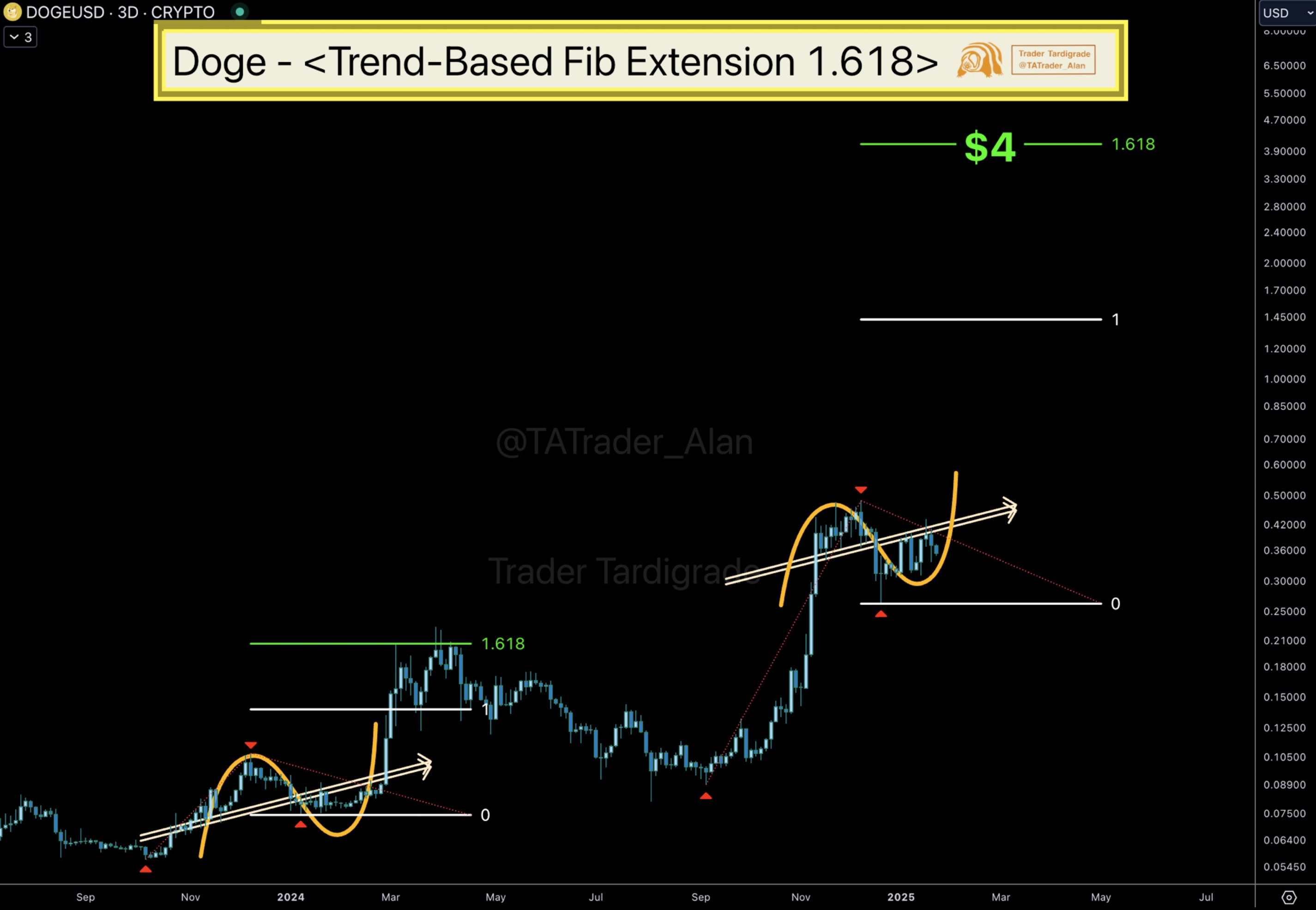
Amid this lackluster price action, trader Alan took to X to offer optimism to Dogecoin holders. Specifically, he remarked that the next Dogecoin rally could not only exceed the $1 mark but also reach as high as $4.

He referenced a chart, pointing out that the market had in earlier times witnessed the current Dogecoin pattern. Alan explained that he set the $4 target based on the trend-based Fibonacci 1.618 Extension level.

Dogecoin Historical Pattern Supporting $4 Price

Notably, the chart highlights repeating patterns of consolidation followed by breakouts since mid-2023. The late 2023 breakout initially saw Dogecoin’s price canceling a zero in December 2023, trading above $0.1050 after several months below that level.

However, it consolidated briefly before resuming the rally, with Dogecoin reclaiming a yearly high above $0.22 in March 2024 before consolidating again.

The peak value reached during that breakout aligned with the 1.618 Fibonacci level. For context, the full rally from $0.0578 in October 2023 to $0.2266 in March 2024 saw Dogecoin price soar by 292%.

Meanwhile, the following consolidation phase lasted about eight months until Dogecoin broke out again in November 2024. This rally saw Dogecoin hit $0.4850 in December, followed by several weeks of consolidation and revising previous lows.

Image
Dogecoin Trader Alan

Analysts like trader Alan believe the completion of the pattern that began in late 2024, replicating its past price action from 2023/2024, could push Dogecoin to a peak of $4, aligning with the Fibonacci 1.618 level.

Dogecoin Bull Flag pattern

In a separate commentary, market commentator Kamran Asghar pointed out that Dogecoin has formed a Bull Flag pattern on its 2-day chart. According to Asghar, this formation suggests a potential price target of over $2 for DOGE.

Notably, the Bull Flag is a continuation pattern indicating that a strong upward move could follow after consolidation.

Essentially, with these technical structures, analysts suggest a significant upward move could materialize by mid-2025 for DOGE.

Other market watchers have even used different technical observations to predict double-digit price targets for Dogecoin this year.

Supporting Factor for DOGE

While these projections are based on technical patterns, Dogecoin is also seeing a new fundamental factor that could further boost its price when the bull market returns. 

This week, at least two asset managers in the crypto community have declared their intent to list a Dogecoin ETF. Some market commentators believe this development could help DOGE’s price reach $15.

Dogecoin ETF Will Send DOGE Price to $15: Analyst

0

Prominent crypto analyst Ali Martinez asserts that a Dogecoin ETF will send DOGE price to double-digit price levels.

Amid a joint filing from REX Advisers and Osprey Funds and moves from Bitwise, the crypto space is rife with speculation of a potential Dogecoin (DOGE) exchange-traded fund launch and the possible implications for the meme coin’s price. In particular, one analyst has suggested that a traditional investment wrapper for the doggy-themed meme coin will send its price to double digits.

Dogecoin (DOGE) to $15?

Prominent crypto analyst Ali Martinez has asserted that an ETF will send Dogecoin (DOGE) to double-digit price levels.

In a recent X post, the analyst asserted that a DOGE ETF would push the price to a staggering $15 from about $0.36 at the time of writing. He supported this view with an analysis of the meme coin’s weekly candle chart, which he has often highlighted in recent weeks.

DOGEUSD weekly candle chart showing ascending channel formation
DOGEUSD weekly candle chart showing ascending channel formation. Source: Ali Martinez

The chart suggests that DOGE has been trading within an ascending channel since at least 2017 and is again moving from the lows of this channel with a $15 price target. Martinez’s statement indicates that he believes an ETF will be the catalyst the meme coin needs to hit this mouth-watering target.

However, reaching this price target will require the meme coin to claim a market cap of $2.2 trillion, about 41 times its current valuation of $53.2 billion. For context, that is currently more than Bitcoin’s market capitalization.

Still, Martinez has maintained that market cap does not matter in crypto, citing the fact that XRP ($183 billion) has a larger market cap than $12 trillion asset manager BlackRock ($158 billion).

Meanwhile, a DOGE ETF may only rake in between $1.6 billion and $3.2 billion in its first year based on a recent JPMorgan analysis of the uptake of Bitcoin and Ethereum ETFs, suggesting a 3% to 6% market cap penetration.

SEC Scraps Crypto Accounting Rule SAB 121 Following Gary Gensler’s Exit

0

The United States Securities and Exchange Commission (SEC) has canceled the controversial Staff Accounting Bulletin 121 (SAB 121).

In an interesting development, the SEC issued a new Staff Accounting Bulletin yesterday, SAB 122. This latest bulletin rescinds the guidance in Topic 5.FF related to accounting for obligations to safeguard crypto-assets held for platform users—a key element of SAB 121.

For context, SAB 121 required financial institutions holding crypto-assets on behalf of their customers to declare these assets as liabilities on their balance sheets.

Industry Reactions to SAB 121 Repeal 

Expectedly, policymakers and crypto enthusiasts have reacted to the cancellation of SAB 121.  

French Hill, Chairman of the House Financial Service Committee, expressed excitement that the SAB 121 rule has been rescinded. According to him, holding reserves against digital assets held in custody is not a standard financial practice. 

He commended the new SEC leadership for rescinding the rule and supporting digital assets and innovation in the U.S. 

SEC Commissioner Hester Peirce, popularly known as Crypto Mom, celebrated the repeal. She bid the rule farewell, noting that the measure ‘has not been fun.’ 

Meanwhile, Attorney John Deaton, a former U.S. senate candidate, suggested that Peirce’s comment reflects a rejection of former SEC Chair Gary Gensler’s approach to crypto. He suggested that her comment is similar to directing the figurative middle finger to Gensler. 

Furthermore, Senator Cynthia Lummis, the chair of the Senate Banking Digital Asset Subcommittee, also celebrated the SEC’s decision to repeal SAB 121. She labeled the rule a disaster for the banking industry, emphasizing that it had a negative impact on U.S. innovation.  

Controversies Surrounding SAB 121 

Since the SEC introduced the rule in March 2022, SAB 121 has been the subject of controversy. Crypto enthusiasts and U.S. lawmakers opposed the measure, emphasizing that it would hinder innovation in the industry and make crypto custody difficult. 

Last year, lawmakers voted against SAB 121 to repeal the measure. Despite this effort, former U.S. President Joe Biden vetoed the action on June 1, 2024. Attempts to override Biden’s veto ended in futility, as the move did not receive the necessary support from lawmakers. 

The repeal came just days after Gensler resigned from the SEC, prompting President Trump to appoint Mark Uyeda as acting chair. Since his appointment, Uyeda has been making big moves related to crypto. 

Earlier this week, he launched a crypto task force to develop a regulatory framework for digital assets. His goal is to change the commission’s enforcement-driven approach to crypto and establish clear and fair rules for the industry. 

Bitcoin Unfazed Despite Bank of Japan’s Rate Hike and Hawkish Stance: Here’s Why

0

Bitcoin and the broader crypto market show no signs of panic despite the Bank of Japan’s (BoJ) recent decision to deliver another rate hike.

The Bitcoin bull market has had many scares in the past year, but few stoked as much panic as speculation over the end of the yen carry trade in August 2024 as the Bank of Japan increased interest rates for the second time in 17 years.

For context, at the time, Bitcoin fell 14%, while most altcoins averaged over 20% drops. This historical context makes it hard to blame crypto market participants for panicking ahead of another BoJ rate hike. However, the rate hike has now come and gone without so much as a stutter from Bitcoin and the broader crypto market, begging the question of why.

Par for the Course?

Notably, on Friday, January 25, the Bank of Japan raised interest rates by another 25 basis points to bring the benchmark to 50 basis points, the highest level since 2008.

The BoJ cited sustained inflation and growing wages as reasons for its decision. What’s more, the BoJ has also signaled the possibility of further rate hikes if economic activity continues to rise as expected.

Despite this hawkish stance from Japan’s apex bank, crypto assets appear to be trading slightly higher on the day.

Bitcoin is trading near the $105,000 price point, representing a 2.4% uptick in the past 24 hours, per CoinMarketCap data at the time of writing. Ethereum, XRP, and Solana are also posting 5.5%, 1.4%, and 5.5% gains, respectively.

The market reaction comes as analysts assert that the market had anticipated the BoJ’s 25 bps rate hike. Amit Kukreja is among the market commentators who have shared this view.

“Japan raising rates is not a big deal,” he wrote on Friday, adding, “Yen Short float peaked in July as per CFTC data, everyone knew Japan would hike rates again and began deleveraging.”

By short float, Kukreja refers to the number of yen short positions investors have open as a result of the carry trade. The carry trade is a long-running investment strategy in which investors borrow cheap capital from Japan to invest in high-yield equities in the U.S. and Europe.

However, higher yen borrowing rates have meant that this capital is no longer cheap to borrow, requiring investors to adjust their positions. In August 2024, these adjustments came at a rapid pace as investors were surprised by Japan’s rate hike decision, leading to the resulting market crash.

After scaling the BoJ’s interest rate hike, all eyes are now on next week’s U.S. Federal Open Market Committee meeting. Crypto market investors hope the Fed will take a more dovish tone as December 2024’s core inflation data hinted at cooling inflation.