Home Blog Page 1022

US Senator Introduces Bitcoin Bill Allowing State Employees to Receive Salaries in BTC

0

US State Oklahoma introduces a Senate bill, the “Bitcoin Freedom Act,” to enable the acceptance of compensation in BTC.

Senator Dusty Deevers sponsored the bill. It proposes a framework allowing state employees, businesses, and individuals to receive payments and compensation in Bitcoin.

Notably, the bill empowers Oklahomans to utilize Bitcoin as a hedge against inflation and a financial alternative to traditional currencies.

Voluntary Bitcoin Payment System

Specifically, the Bitcoin Freedom Act would allow employees of the state of Oklahoma, private businesses, and individuals to negotiate and receive payments, including salaries and wages, in Bitcoin. Businesses could also opt-in to accept Bitcoin for goods and services. 

Notably, employees who choose to receive their compensation in Bitcoin can agree on a set price based on the market value of Bitcoin at either the beginning of the pay period or at the time of payment. The parties will document this price in an electronic record and could change it at the start of each pay period.

Meanwhile, the bill ensures that participation in the Bitcoin payment system remains voluntary, adhering to free-market principles. Moreover, it grants employees the option to adjust their payment preferences between Bitcoin, U.S. dollars, or a combination of both.

Exemptions for Digital Asset Firms

One of the bill’s key provisions is exempting certain digital asset firms from state money transmitter licensing requirements. This move aims to reduce the regulatory burden on cryptocurrency-related businesses and foster innovation in the state.

State Treasurer’s Role and Implementation Timeline

The Oklahoma State Treasurer will play a central role in implementing the Bitcoin payment system. Specifically, the bill directs the Treasurer to put out a request for proposal (RFP) to select a digital asset firm to process Bitcoin payments for state employees and vendors. 

They must finalize a contract with a select firm by January 1, 2026. This is to ensure the state has a system in place by that date.

Additionally, the Oklahoma Tax Commission is tasked with issuing guidance on the tax implications of receiving digital assets as payment. They will finalize this by the same deadline, providing clarity for taxpayers and businesses operating in the state.

Senator Deevers’ Vision for Oklahoma’s Future

Sen. Dusty Deevers, the bill’s sponsor, expressed his belief that Bitcoin presents a unique opportunity for Oklahomans to protect their earnings from inflation. He cited the decreasing purchasing power of the U.S. dollar in recent years. 

“As Bitcoin continues to rise and the dollar’s value continues to be printed away in Washington D.C., Oklahoma must act to protect our people,” Deevers said.

He also noted that Bitcoin is no longer a fringe financial asset, highlighting its growing acceptance within mainstream financial markets. 

Deevers is positioning Oklahoma at the forefront of cryptocurrency adoption in the U.S. According to him, the bill would place the state in a national leadership role in embracing new financial technologies.
Pundit Suggests $50 XRP Price Might Not Be Enough for Mass Adoption, But There’s a Catch

0

A recent commentary suggests XRP price would need to surpass even two-digit figures to support the anticipated mass adoption from banks.

The remarks triggered a debate within the XRP community about the XRP price and its capacity to support global financial transactions. This discussion arose from a post on X (formerly Twitter) by market analyst Lord Vendetta. 

Notably, his analysis set off a back-and-forth exchange with other notable XRP proponents. For context, a previous report from The Crypto Basic revealed that AI chatbots ChatGPT and Grok expect XRP price to increase substantially to meet the demand that would arise from mass adoption among banks.

Can Current XRP Price Support Mass Global Transactions?

Lord Vendetta agrees with this theory, arguing that the current XRP price of $2.35 is too low to sustain this anticipated mass adoption by financial institutions. He argued that even if XRP price stood at $50, about 20 billion tokens would be necessary to process $1 trillion in transactions daily.

This figure represents 40% of the total circulating supply. As a result, he questioned whether $50, $100 or even $10,000 per XRP would suffice in such scenarios. He suggested that the real XRP price is “impossible to calculate.” The market commentator then speculated that XRP might one day rival Bitcoin at $100,000. 

However, not everyone agreed with Vendetta’s commentary. An analyst named “Guy on the Earth” pointed out that XRP transactions are incredibly fast, settling in just three seconds. He emphasized that the same XRP tokens could be reused throughout the day, making such high price predictions less relevant.

Another community figure, Holo, made similar statements, highlighting XRP’s ability to process transactions rapidly. According to him, the token’s speed means that smaller, repeated transactions could achieve the same result as one large transaction. 

Holo also noted that breaking a $1 trillion transfer into multiple smaller payments would be more practical and could be executed within minutes.  

Liquidity is Important 

In response, Lord Vendetta argued that speed alone is not enough to support massive transaction volumes. He stressed the need for a highly liquid XRP market to facilitate such high-value transfers without friction. 

He maintained that even with XRP’s speed and liquidity, its current price would remain insufficient for the scale of the anticipated global financial transactions.

Holo countered by reiterating that the token’s ability to recycle within seconds mitigates the need for a higher price. He suggested that XRP’s efficiency and ability to divide large transfers into smaller ones make it more adaptable than Vendetta suggested.

Crypto Arsenal, another prominent XRP community figure, questioned the practicality of moving $1 trillion in a single transaction. Instead, he compared the scenario to SWIFT’s daily operations, which involve processing $5 trillion across 44 million transactions. 

He explained that if 40% of XRP’s supply were used for a $1 trillion transaction, those tokens would become available again within three to five seconds. He calculated that in theory, XRP could facilitate $1 trillion transactions more than 17,000 times daily.

Bitcoin-Hungry El Salvador Adds 11 BTC to Its Reserve in One Buy

0

El Salvador, the only country where Bitcoin remains legal tender, has increased its purchases again, supported by its pro-crypto president, Nayib Bukele.

The president confirmed the recent unusual purchase in a tweet on Thursday. Bukele shared a screenshot of the hefty purchase from El Salvador’s Bitcoin Office—a platform it designed to track its on-chain activities.

According to the website, El Salvador bought 11 BTC worth over $1.047 million on December 8. Notably, the acquisition diverged from its typical one bitcoin per day campaign amidst a resolution to double down on its purchases of the pioneering cryptocurrency.

El Salvador Doubles Down on Bitcoin

The Wednesday 11 BTC acquisition is El Salvador’s third massive one-time purchase since December 20. For context, the North American country bought 11 BTC on December 20 and another one on December 22 before repeating yesterday.

Meanwhile, the growing exposure follows the country’s resolution to double down on Bitcoin. El Salvador’s senior Bitcoin adviser, Max Keiser, disclosed that the government will ramp up its accrual of the largest cryptocurrency by market cap, targeting 20,000 more BTC.

El Salvador holds 6,022 Bitcoin tokens worth $567 million at the current market price. However, the country spent $145 million to acquire the assets, which cost an average of $45,641 per coin.

Bukele Eyes More Bitcoin

El Salvador has acquired 62.42 BTC in the past 30 days, about 33 BTC more than it usually purchases. Still, Bukele seems hungry to buy more at a discounted price.

The president reacted to a recent development involving the United States’ possible Bitcoin sales, stating it could mean he can buy the asset at a discount. For context, a federal court cleared the US Department of Justice (DOJ) to sell 69,370 BTC ($6.5 billion) confiscated from the Silk Road clampdown.

Notably, this development came less than 12 days before the inauguration of pro-crypto president Donald Trump. The 47th US president vowed never to sell America’s Bitcoin but to buy more as a strategic reserve asset.

Court Clears DOJ to Sell 69,370 Bitcoin Linked to Silk Road

0

A U.S. federal judge has approved the Department of Justice’s (DOJ) request to sell a whopping $6.5 billion worth of Bitcoin confiscated in connection with the Silk Road crackdown. 

Popular media outlet DB reported the development today, noting that the DOJ has been authorized to sell 69,370 BTC, worth $6.5 billion. DB shared the report after a DOJ official confirmed the development in the early hours of today. 

According to the anonymous source, the federal judge authorized the sale of the 69,270 BTC on December 30. However, the public had no knowledge of the decision until today, following a statement from a DOJ official. 

Silk Road Bitcoin Controversy 

For context, the United States government seized 69,370 Bitcoin from operators of the darknet marketplace Silk Road. This platform operated from 2011 to 2013, serving as a hub for illegal activities, including the sale of drugs. At the time, these malicious actors used Bitcoin as a form of payment to keep their operations discreet. 

Following an intensive investigation, an unnamed entity referred to as ‘Individual X’ in the case surrendered all 69,370 Bitcoin to the government. 

The government has been making significant moves to sell the assets, citing Bitcoin’s price volatility as the major reason why it needs to offload the BTC. However, its request was delayed by a lawsuit filed by Battle Born Investments, which claimed ownership of the funds through a bankruptcy estate. 

In October, the U.S. Supreme Court declined to hear Battle Born’s appeal contesting the ownership of the seized asset, paving the way for the latest decision.  

Following the court’s decision, counsel to Battle Born accused the DOJ of using ‘procedural trickery’ to abuse the Civil Asset Forfeiture process. Nonetheless, a DOJ spokesperson disclosed that the agency will proceed with the sale in accordance with the court’s judgment. 

El Salvador President Reacts 

Reacting to the court ruling, El Salvador’s president Nayib Bukele suggested that the move might give investors the opportunity to purchase Bitcoin at discounted prices. This indicates that President Bukele expects the price of Bitcoin to crash during the sale. 

As expected, the development mounted heavy pressure on the broader crypto market. On Wednesday, Bitcoin crashed from around $95,500 to $92,800.

However, the premier cryptocurrency has rebounded above the $94,000 mark in the hours leading up to press time. It is currently trading at $94,303, representing a decline of 2.2% in the past day. 

Expert Predicts How Much It Will Cost to Buy 10,000 XRP in 2025

0

A market expert spotlights historical data on the cost of procuring 10,000 XRP over the past four years, predicting how much the figure could be in 2025.

Notably, the recent commentary, which came from market analyst CryptoBull, demonstrates XRP’s impressive price performance over the years, as well as the occasional turbulence that has ravaged the XRP market within this period. 

Prices of 10,000 XRP in 2020 and 2021

CryptoBull stressed that as of 2020, during the bear market exacerbated by the COVID-19 market crash, investors could procure 10,000 XRP for just $1,100. Data confirms this disclosure, as XRP did collapse to a floor price of $0.11 in March 2020, costing $1,100 for 10,000 tokens.

However, what the analyst failed to mention was that the market demanded more capital for the same assets in January 2018, during the 2017/2018 bull market. For context, at the all-time high price of $3.31, investors looking to amass these 10,000 tokens needed to commit $3,310. 

XRP’s collapse in the 2020 bear market presented an opportunity to accumulate the tokens at a massive discount. However, the price of the asset has continued to increase since then. 

CryptoBull noted that a year later, in 2021, it cost investors $2,000 to buy the same 10,000 tokens. This is accurate because in January 2021, XRP traded at a low of $0.20.

XRP Price Prediction CryptoBull
XRP Price Prediction | CryptoBull

Cost of Buying 10,000 XRP in 2022, 2023 and 2024

Meanwhile, the market analyst further revealed that as of 2022, market participants looking to purchase the 10,000 XRP tokens could only get them at a price of $3,000. As of July 2022, two months after the Terra implosion, XRP witnessed a floor price of $0.30.

Further, CryptoBull stressed that the amount required to buy the 10,000 XRP tokens increased to $6,000 in 2023, as XRP changed hands at $0.60 in several months, especially from July to August 2023.

This amount skyrocketed to $22,400 in December 2024, when XRP increased to a price of $2.24. Since then, XRP’s price has continued to post gains, currently trading for $2.40. At the current price, it would cost $24,000 to purchase the 10,000 tokens. 

Projected Price of 10,000 XRP in 2025

Interestingly, CryptoBull believes this figure will skyrocket further this year, 2025. According to the market watcher, at some point, procuring the same 10,000 XRP tokens would demand that investors spend a whopping $330,000. This implies that the analyst expects XRP price to soar to $33 in 2025.

Several other market commentators have projected the $33 price. In September 2024, crypto market watcher EGRAG suggested XRP could reach $27 to $33. Analyst Bobby A predicted a similar $33 price last August. In addition, wealth mentor Linda Jones speculated two months back that XRP’s 4-year cycle could push prices to $33.

For context, XRP would need to rally by as much as 1,275% from its current position to claim the lofty $33 price. At this price, XRP’s fully diluted valuation would sit at $3.3 trillion, making the attainment of this range rather difficult for the altcoin.

Pundit Says Dogecoin to Outperform Majors like Bitcoin, XRP Soon

0

Crypto pundit WIZZ predicts Dogecoin will soon outperform major assets like Bitcoin and XRP, fueled by Elon Musk’s upcoming marketing efforts.

Dogecoin has been one of the major victims in the latest bearish storm that has overtaken the crypto market. On Tuesday, the meme coin traded at $0.3978, coming close to recapturing the $0.400 price level last seen in December 2024. 

However, the bears quickly overtook market sentiment, and Dogecoin revisited lows at $0.34. This marked a significant 15% dip from its January high.

Nonetheless, this performance has not deterred the optimism of some Dogecoin bulls. In a recent tweet, “WIZZ,” a crypto commentator with over 768K followers on X, argued that Dogecoin will stage a comeback and outperform the leading crypto assets.

“Dogecoin will outperform most majors,” he said.

This sentiment expects Dogecoin to surpass its top rivals, such as Bitcoin, Ethereum, Solana, XRP, and BNB.

Dogecoin Outperforming Top Assets

Notably, the 30-day timeframe shows Dogecoin’s performance is the worst compared to these leading tokens. Specifically, Dogecoin is trading with a massive loss of 20%, while Solana and Ethereum are seeing 13% monthly losses. Meanwhile, Bitcoin, XRP, and BNB are seeing just around a 3% loss in the same 30-day period.

However, looking at an extended window like the 90-day timeframe, Dogecoin’s current price boasts a 225% gain. Others are seeing gains below 60%, except XRP, which boasts a more impressive 340% gain.

Yet, WIZZ emphasized that Dogecoin could even far outperform these leading crypto assets soon. He gave a near three-to-six-month timeline for this projection to unfold.

“Elon Musk Dogecoin Marketing Starting Soon”

According to him, the Dogecoin bull run would be led by Elon Musk’s efforts. “Elon Marketing starts soon,” WIZZ wrote.

Notably, Musk is well-known for his open and subtle promotion of Dogecoin, which has often led to dramatic price swings for the meme coin.

Now that Musk is heading the incoming “Department of Government Efficiency,” aka DOGE, under the Trump administration, enthusiasts expect Dogecoin to benefit from the subtle correlation.

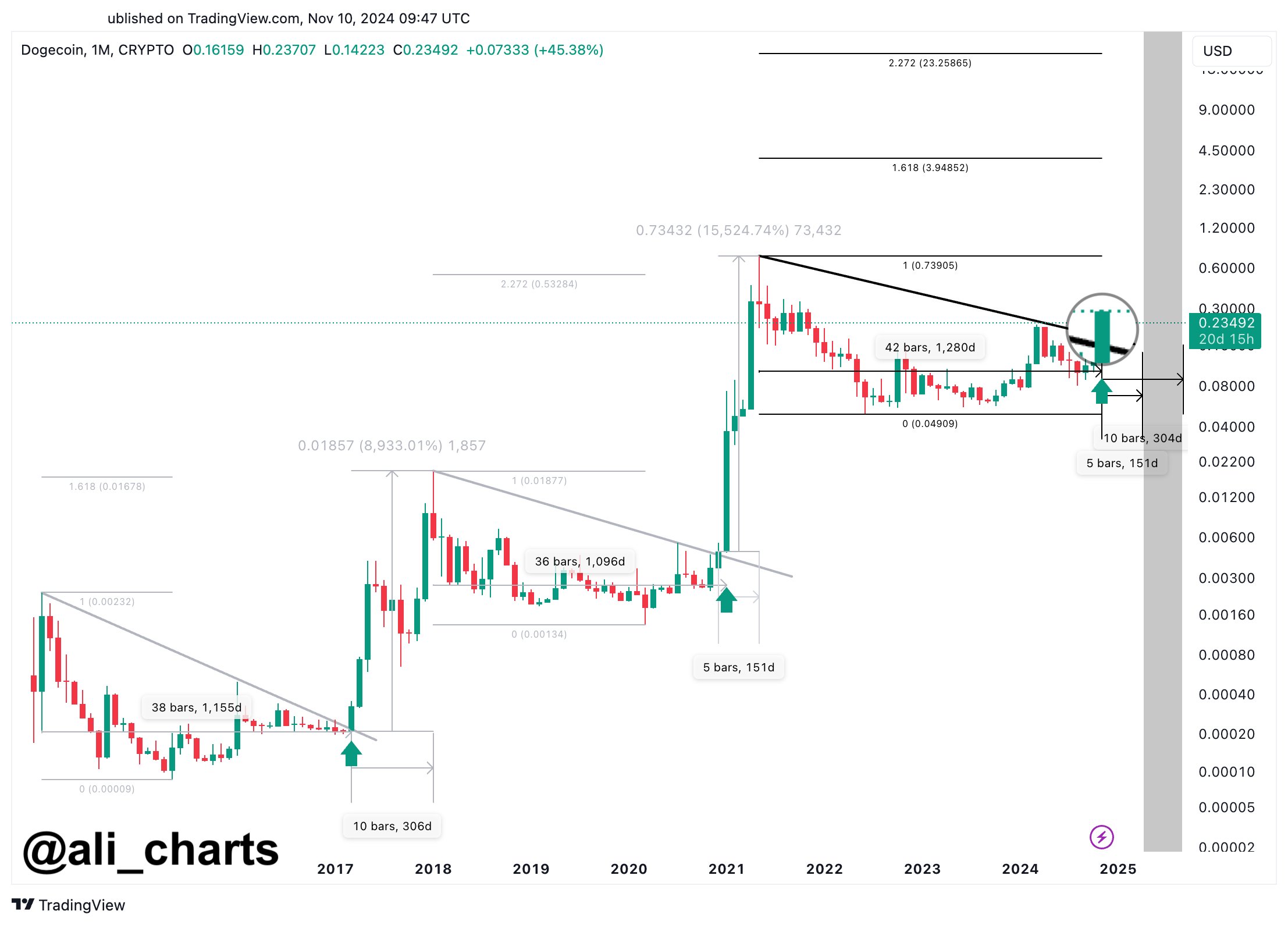
Notably, most analysts expect Dogecoin to repeat its performance in the last bull season. A chart shared by analyst Ali Martinez shows that Dogecoin registered a 15,524% growth during the 2020/2021 bull run.

Musk’s promotion of Dogecoin throughout the season contributed significantly to the ascent.

Image
Dogecoin historical chart by Ali Martinez

Martinez projected that Dogecoin’s price could reach up to $23 if the trend from the last season unfolds again this time. Some other analysts are even calling for $37 for Dogecoin in this cycle.

Meanwhile, conservative estimates have highlighted between $1 and $3 as realistic projections for Dogecoin.

Bitcoin Risks $90K Dip Amid Declining Funding Rates, Analysis

0

Bitcoin and the broader crypto market are experiencing a sharp decline, with BTC hitting lows of $94,550 today. 

This follows Bitcoin’s brief return to the six-figure price range earlier this month, reaching $102,720 just yesterday. The dramatic bearish turn has prompted analysts to explore on-chain indicators to identify potential triggers.

Shayan, a verified author at the analytics platform CryptoQuant, has pointed to a decline in Bitcoin funding rates within the derivatives market as a critical factor.

Funding rates reflect the demand for Bitcoin derivatives and play a major role in sustaining price trends. A strong rally is typically accompanied by a rise in funding rates, indicating robust demand.

However, Shayan noted that the recent surge in Bitcoin’s price lacked significant funding rate support in the early stages, with rates only seeing a sharp rise midway through the rally. This delay suggests weaker-than-expected market commitment, leaving Bitcoin vulnerable to price corrections.

Market Hesitation and Capital Outflow

This situation is notably observable in the rally that led Bitcoin to an all-time high in December 2024.

For instance, data from Coinglass shows that the Bitcoin Open Interest Weighted Funding Rate stood at 0.0906% as of December 5, 2024. At that time, Bitcoin was trading at $102K.

However, the rate decreased in the subsequent days even as the price of Bitcoin continued to rise. Specifically, it dropped sharply as Bitcoin encountered rejection at $108,300 on December 17, 2024.

This decline shows a reduction in traders’ commitment, with many losing confidence in Bitcoin’s ability to maintain its upward trajectory.

Bitcoin funding rate chart Coinglass

In his commentary, Shayan confirmed that the observed decline in funding rates signals not only capital outflows from the derivatives market but also insufficient support to sustain the bullish momentum.

Essentially, leveraged traders showed minimal interest in maintaining their positions as Bitcoin traded in the six-figure range, fearing a major correction. This translated into broader hesitation among market participants, further weighing on Bitcoin’s price.

Yesterday, when Bitcoin was trading above $102K, the funding rate dipped to 0.0044% from 0.0113% the previous day.

Bitcoin Risks Deeper Correction

The current trend now points to a potential test of lower price levels. Shayan argued that if Bitcoin fails to maintain support above the $90K level, it could face increased selling pressure.

Furthermore, he stated that traders may lose even more confidence. He projected deeper corrections and the possibility of revisiting lower Fibonacci levels or psychological price thresholds.

However, if funding rates recover and strong buying activity returns to the market, Bitcoin could stabilize and continue its ascent, resuming its bullish path.

At press time, Bitcoin is trading at $95,060, indicating the threat of further declines.

Thailand to Pilot Bitcoin Payments For Tourists This Year

0

Pichai Chunhavajira, the Deputy Prime Minister of Thailand, has announced a pilot project that will allow tourists to leverage cryptos like Bitcoin (BTC) as an alternative payment method. 

Local news outlet The Nation reported today that Chunhavajira made this known in a keynote at an event hosted by the Marketing Association of Thailand. 

Speaking at the event, Chunhavajira, Thailand’s Minister of Finance, disclosed that the government is embarking on an initiative to test cryptocurrencies as an alternative payment method in tourism-focused cities. 

According to him, this move will enable tourists to pay for goods and services whenever they visit these regions with crypto. The initiative will also maintain Thailand’s competitiveness in the global market while ensuring that the country does not lose out on business opportunities.

Per the report, the pilot project will launch later this year in Phuket. Notably, the experiment will operate within existing legal frameworks, eliminating the need to amend current laws. 

This development was first reported last month after Thailand’s former prime minister, Thaksin Shinawatra, introduced a proposal to allow tourists to make payments using Bitcoin. At the time, Binance’s Thai subsidiary, Gulf Binance, declared its support for the initiative. 

If launched, Thailand will join other countries, like Russia, that have embraced crypto as an alternative means of payment. 

Reasons Behind the Project 

Chunhavajira highlighted two major drivers of the project: the rising popularity of crypto assets among foreign tourists and their growth potential. 

The minister cited Bitcoin as a case in point, suggesting a high demand for the premier cryptocurrency, worth over $2 trillion.

Once the project launches, foreign tourists will be required to register their crypto assets, such as Bitcoin, on Thai exchanges. They will also have to verify their identities before they can use their cryptos for payments. 

The Thai government will also create a clearing house that will convert these crypto transactions to the country’s fiat currency. It is worth mentioning that there is a growing adoption of crypto in Thailand. 

Growing Adoption of Bitcoin in Thailand 

The Nation reported that even though the government has yet to begin the pilot project, a small crypto-savvy village in Kalasin’s Huay Phueng district of Thailand is already embracing the nascent asset for real-world use cases. 

Popular crypto-focused YouTube channel Right Shift revealed that an unnamed Bitcoin proponent introduced this initiative. This individual set up a coffee shop in the village as part of efforts to teach residents how to leverage Bitcoin as a payment method instead of fiat currencies. 

So far, the crypto advocate has persuaded over 80 businesses, including a noodle store, to accept Satoshi (the smallest units of BTC) as a payment method via a Bitcoin Lightning app. According to Right Shift, this move is gradually transforming the village into a ‘Bitcoin town. ‘ 

Bitcoin Price up Only Until August 2025? Peter Brandt Notes “Typical Corrections”

0

Veteran trader Peter Brandt offers a market insight many have taken to mean that the Bitcoin price is unlikely to experience a major correction until August 2025.

After a strong start to the week with Bitcoin above the $100,000 price point, the crypto market is back in the red again as stronger-than-anticipated U.S. economic data releases dampened interest rate cut expectations.

Amid the slump, veteran commodities trader Peter Brandt has offered a medium-term market insight that has many optimistic.

No Bitcoin Slump Until August 2025?

Veteran trader Peter Brandt presented insights many have taken to mean that Bitcoin is unlikely to experience a major correction until August 2025.

In a Wednesday, January 8 comment on X, crypto trader Nilesh Rohilla shared his view with Brandt that it was better to target time than price with Bitcoin. He highlighted key windows like the first 18 months after the Bitcoin halving and the 12 months after the U.S. elections, which have historically seen price upticks.

Responding to the comment, Brandt noted that he agreed with Rohilla’s view while highlighting a pattern in the analyst’s chart.

Rohilla shared a daily candle chart showing Bitcoin’s price action from November 2023 till date, circling the asset’s price action between November 2023 and February 2024 and the price action from November 2024 till date, likely in anticipation of price repeating the pattern. The pattern saw Bitcoin start correcting from a point in December 2023 before kicking off a rally sometime in February 2024.

BTCUSDT daily candle chart showing price action from November 2023
BTCUSDT daily candle chart showing price action from November 2023. Source: Nilesh Rohilla

Brandt asserted that the circled patterns were “very typical corrections” that Bitcoin has replicated throughout its history. He added that he did not expect the pattern to repeat until August 2025.

The Hump Slump?

On close inspection, the circled pattern appears to be the Brandt-named “hump slump bump dump pump,” Bitcoin correction pattern or hump slump for short. As has been highlighted by the veteran trader, the leading crypto asset’s parabolic runs have historically been littered with this pattern.

On December 29, Brandt asserted that Bitcoin was likely in this pattern again but noted that a steeper decline was necessary for it to complete. Specifically, Bitcoin had to breach the horizontal support near the $89,000 price point.

One potential way Brandt noted that Bitcoin could complete this pattern is by fulfilling a head and shoulders pattern he identified on the asset’s daily candle chart. Previously, Brandt had said that the target of this pattern was $78,000. On Wednesday, however, he adjusted this target to $73,000.

BTCUSDT daily candle chart showing head and shoulders pattern
BTCUSDT daily candle chart showing head and shoulders pattern. Source: Peter Brandt

Regardless, the analysis points to a significant market flush before Bitcoin can firmly resume its upward trajectory.

South Korea Plans to Allow Institutions to Invest in Bitcoin and Crypto

0

South Korea has revealed plans to slowly integrate institutional investors into the Bitcoin and crypto market amidst a friendlier stance on digital assets.

A report from local news outlet Yonhap uncovered this shifting sentiment. The Wednesday report stated that South Korea’s top regulatory agency, the Financial Services Commission (FSC), will start allowing crypto investment among institutions.

Before now, only retail investors have had uncensored access to crypto investment. Although South Korea has not officially passed any embargo, it has discouraged institutions from meddling with cryptocurrency.

The FSC to Slowly Allow Institutional Bitcoin Exposure

Per the report, the top regulatory body will collaborate with the Digital Asset Committee, its advisory sector on cryptocurrency. The FSC will introduce institutional players to crypto trading in phases, kicking off with non-profit organizations.

Furthermore, the South Korean regulator will enact new regulations, building on its already existing framework. For context, it passed a Virtual Asset User Protection Act in July 2024 to protect investors from bad actors in the sector. This came nearly two years after Terra, founded by South Korea’s Do Kwon, collapsed, leading to billions in losses.

Moreover, the FSC will introduce new postulations to the framework, including stablecoin, crypto exchange, and token listing regulations. The regulator would also enact laws scrutinizing the eligibility of major shareholders in a digital asset firm.

South Korea to Encourage Digital Assets

The FSC’s new outlook followed a global warming toward digital assets. Notably, while running for power, the now-impeached President Yoon Suk-yeol promised to create a conducive environment for cryptocurrency. However, he had yet to enact the regulation before the notorious December political tussle that led to his impeachment.

Meanwhile, South Korea’s efforts to foster crypto adoption mirror those of other countries. For instance, Thailand recently announced plans to launch a Bitcoin payment pilot program.

Also, Russia has allowed crypto mining and confirmed the use of Bitcoin for international trade settlement. This came after its president, Vladimir Putin, stated that no one can ban cryptocurrency.