Flare CEO Hugo Philion has outlined several strategic initiatives designed to accelerate the growth of XRPFi and increase Flare’s total value locked (TVL).
Philion shared these insights during a Flare-hosted AMA session over the weekend. His remarks offered a clearer view of how Flare plans to position itself as a leading infrastructure layer for XRP-based decentralized finance.
Key Points
Flare CEO Hugo Philion outlined several initiatives to accelerate XRPFi growth and increase Flare’s TVL.
Increasing stablecoin liquidity that can be paired with XRP deployments and expanding partnerships with institutions already committed to XRPFi on Flare are among Flare’s priorities.
Another key focus area is expanding adoption of Flare Data Connector (FDC) services.
Flare currently has a TVL of around $209 million, with 156 million XRP locked in its vault.
Philion Outlines XRPFi Initiatives Flare Is Working On
During the AMA, a user asked whether Flare was considering new measures to boost TVL, including raising minting limits or encouraging exchanges to allocate XRP liquidity to users as a demonstration of confidence in the ecosystem.
In response, Philion declined to disclose any unannounced products or partnerships. However, he emphasized that Flare is actively pursuing several strategic initiatives.
According to Philion, one of the company’s primary goals is to source additional stablecoin liquidity to support XRP deployments across the ecosystem. Since stablecoins play a critical role in decentralized finance by facilitating lending, trading, and collateralization, the firm believes expanding liquidity remains essential for scaling XRPFi activity.
Flare Also Prioritizing Institutional Partnerships and RWA Tokenization
In addition, Philion revealed that Flare is strengthening partnerships with institutions already committed to deploying XRPFi solutions on the network. One of the company’s institutional partnerships includes an alliance with VivoPower, under which the Nasdaq-listed firm committed to deploying $100 million in XRP to the network.
Additionally, the company is seeking new partners that hold substantial XRP reserves capable of being deployed into decentralized finance applications.
Furthermore, Philion disclosed that Flare is advancing trials involving real-world assets (RWA) through its Confidential Compute technology stack. This initiative could enable institutions to experiment with tokenized financial products while preserving privacy and meeting compliance requirements.
Another major focus area involves expanding the use of the Flare Data Connector (FDC). Philion noted that partnerships with organizations seeking decentralized data solutions could drive broader FDC adoption and increase fee generation across the network.
Flare Strengthens XRP DeFi Capabilities
Flare has already built a strong reputation within the XRP community through its XRPFi initiative. The platform enables users to transform idle, non-yielding XRP into productive assets without modifying the core XRP Ledger (XRPL).
Flare achieves this through its upgraded FAsset system, which provides a non-custodial bridging protocol that allows XRP to move securely onto the Flare network as FXRP. Currently, 156.19 million XRP, valued at approximately $208.91 million, are locked in Flare’s core vault. Meanwhile, FXRP’s total supply has reached 158.41 million tokens, with 143.4 million already deployed across DeFi protocols to generate yield.
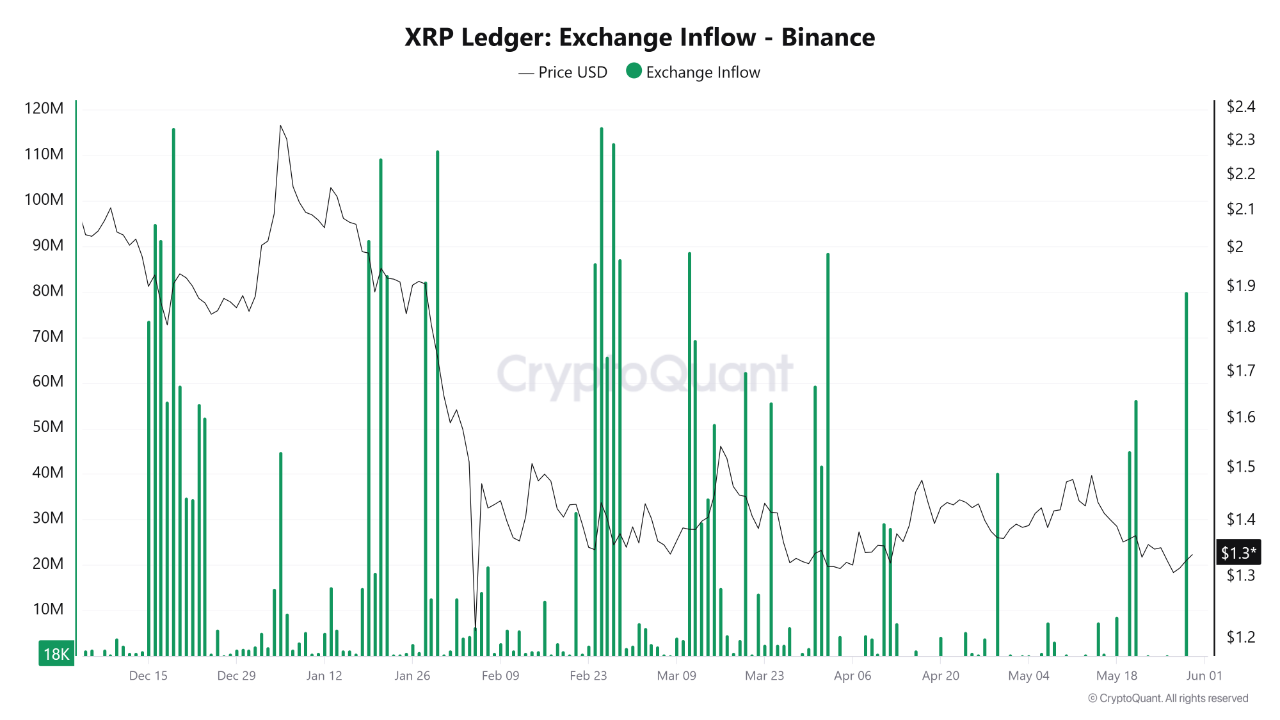
XRP exchange inflows to Binance fell to their lowest level of 2026 in May, indicating weaker selling activity amid the ongoing recovery campaign.
XRP remains under pressure as the market continues to face uncertainty, although the token has shown signs of recovery in recent days.Notably, after dropping to $1.26, XRP immediately climbed back above the $1.30 mark.
Meanwhile, verified CryptoQuant analyst Arab Chain recently revealed that XRP inflows to Binance fell to their lowest level since the beginning of 2026 during May, a sign that fewer tokens were moving onto the exchange.
Key Points
XRP recovered above $1.30 after recently falling to a low of $1.26 amid ongoing market uncertainty.
Binance recorded only 215 million XRP in inflows during May, the lowest monthly figure of 2026.
The decline in exchange inflows suggests fewer holders are moving XRP to exchanges for immediate selling.
Most daily XRP inflows during May stayed below 1 million tokens, with only a few major spikes.
XRP inflows have steadily declined since the start of the second quarter of 2026.
May Sees the Weakest XRP Inflows of the Year
According to Arab Chain, XRP inflows to Binance dropped throughout May as uncertainty continued across the crypto market. Data shows that only 215 million XRP entered Binance during the month, with those tokens worth roughly $292 million based on market prices at the time.
This was the lowest monthly inflow recorded so far in 2026. Compared to earlier months, much less XRP moved to Binance, confirming a drop in activity involving transfers to the exchange.
Arab Chain explained that lower exchange inflows often indicate weaker selling activity. Notably, investors usually send assets to exchanges when they plan to sell or trade them. When inflows decline, it can suggest that more holders are keeping their XRP off exchanges instead of preparing to sell.
Daily Figures Show Consistently Low Activity
The chart data also shows that XRP recorded several unusually low daily inflow figures throughout May, which drove the monthly total down.
XRP Exchange Inflow to Binance | CryptoQuant
For instance, on May 3, Binance received only 407,000 XRP, and this figure slipped further to 328,000 XRP on May 4. Later in the month, inflows dropped to 134,000 XRP on May 17. The lowest reading came on May 31, when just 18,000 XRP flowed into Binance.
In fact, most days during May recorded inflows below 1 million XRP, with some of the sessions falling under 500,000 XRP. There were only a few major spikes during the month, and the largest occurred on May 29, when Binance recorded an inflow of 80 million XRP.
Lower XRP Inflows May Show Longer Holding Periods
The data also revealed that XRP inflows have been trending lower since the start of the second quarter of 2026. This decline has taken place alongside a period of relatively stable prices and lower volatility compared to earlier months.
According to Arab Chain, such conditions could suggest that the market is entering a quieter phase, with less short-term speculation and more investors choosing to hold their assets for longer periods.
He also noted that falling exchange inflows do not automatically signal a bullish market. However, they often reflect lower immediate selling interest, especially when prices remain stable or move gradually higher.
XRP Eyeing a Recovery
While on-chain data shows lower selling activity, market analyst Chart Nerd recently discussed XRP’s recovery attempt after the latest breakdown. In an analysis, he noted that XRP managed to close above the daily 0.5 Fibonacci level around $1.33 over the weekend.
He said this could open the door for a move toward the 50-day exponential moving average, which currently sits at $1.38. He also noted that weekend trading usually comes with lower liquidity, but Monday could bring higher market activity.
XRP Symmetrical Triangle | Chart Nerd
Meanwhile, data from his chart showed that XRP still trades below the lower trendline of its symmetrical triangle pattern after recently breaking beneath it. As a result, the asset remains in a difficult position. To improve its outlook, XRP must reclaim the $1.38 level and then break above $1.40.
Stocks are at all-time highs and Bitcoin isn’t. That’s the setup heading into the back half of the week, and it’s the gap worth keeping an eye on.
The S&P 500 and Nasdaq both closed at fresh records on Tuesday, tech leading the way, as traders priced in a possible US-Iran de-escalation. Bitcoin (BTC) sat the move out. It’s hovering around $76,000 after clawing back from a sub-$75,000 low earlier in the week, and on a day when risk assets were flying, that’s a weak look.
A Correlation That’s Started to Break
S&P 500 in white and Bitcoin in orange Source: TradingView
For most of this year Bitcoin has traded like a leveraged version of the stock market. The two moved more or less in lockstep off the April low, with the 30-day correlation to the S&P running near 0.74 back in March. The chart above shows what’s changed: through the back half of May the lines fan apart, equities grinding to new highs while Bitcoin rolls over. When a relationship that tight starts to break, it usually means something specific to crypto is getting in the way.
Why Bitcoin Isn’t Following
A few things, really. Spot demand has been soft, and ETF inflows have slowed to the point where buyers just aren’t soaking up supply the way they were earlier in the year. The macro picture doesn’t help: inflation has crept back up to around 3.8%, mostly on energy and producer costs rather than the consumer running hot, and yields are still elevated with the 10-year near 4.5%. That’s a backdrop that rewards caution rather than chasing risk, and Bitcoin tends to feel that more than equities do.
There’s also the simple fact that crypto doesn’t have a clear story right now. Equities have AI, gold has the geopolitical bid, and Bitcoin is caught between narratives. Without one, it’s harder to pull in the fresh money lifting everything else.
What the On-Chain Data Says About the Levels
BTC Realized Price by Age. Source: Glassnode
The on-chain picture lines up with what the price charts are showing, and it helps explain why the rally stalled where it did. Glassnode’s Realized Price by Age data tracks the average price different groups of holders paid for their coins, which effectively turns those cost bases into support and resistance.
The buyers from three to six months ago sit up around $85,000, right in the 80,000 to 85,000 zone where price was just rejected. With that group now underwater, their cost basis acts as overhead supply, more holders waiting to sell closer to breakeven, which is part of why that resistance has been so hard to clear. The newest buyers, those from the past week to a month, sit closer to $77,000, essentially where price is trading now. That leaves the most recent cohort hovering around breakeven, a fragile spot, because a move lower would tip them into a loss and risk the kind of selling that drags price toward the next support. The broader takeaway from the same data is that demand hasn’t recovered enough to absorb the selling into strength, which fits a market that rallied into resistance and got rejected rather than one breaking out.
The Weekly Bitcoin Chart
Bitcoin weekly chart. Source: TradingView
On the weekly, Bitcoin printed a bearish engulfing candle right on a retest of the 80,000 to 85,000 zone. That area matters because it lines up with the 50% retracement and the weekly 20 EMA, so it isn’t an arbitrary number, it’s where a few things converge. Earlier in the year the weekly 20 EMA also crossed below the 50 EMA, and historically that cross has only really turned up near the start of Bitcoin’s bear phases. For now price is getting rejected there rather than reclaiming it, and until that changes the bigger structure stays under a cloud.
The Daily Bitcoin Chart
Bitcoin daily chart. Source: TradingView
The daily is the shorter-term version of the same story. The local uptrend that drove price up into resistance has broken, Bitcoin’s back under the daily 20 and 50 EMAs, and it’s chopping around in a tight range in the mid-70,000s. This is the inflection point. Lose the range lows and the next real support to watch is 70,000 to 72,000. Reclaim the range and the door reopens to another run at 80,000 to 85,000. Whichever way it breaks should tell us plenty about the higher timeframe.
The Levels That Matter
Resistance: 80,000 to 85,000, the high timeframe wall, backed by the 50% retracement, the weekly 20 EMA, and the three to six month on-chain cost basis
Support: 73,000 to 70,000 first, then 60,000 as the structural floor if things really unwind
None of this is a verdict. Record-high stocks and a lagging Bitcoin is a gap that closes eventually, it’s just that nobody can honestly say yet which side gives. The things worth watching before turning more constructive are spot demand and ETF flows ticking back up, yields easing, or crypto finally finding a catalyst of its own. Short of that, the range in the mid-70,000s is doing the talking, and it’s worth letting it.
Trading Bitcoin and Global Markets with PrimeXBT
As Bitcoin continues to lag behind record-high equities, traders may look beyond crypto-only exposure and toward opportunities developing across other global markets.
PrimeXBT, a global multi-asset broker and crypto asset service provider, allows users to use Bitcoin and other digital assets as trading capital to access global markets beyond crypto itself. Through its PXTrader 2.0 platform, traders can access Crypto Futures alongside Forex, indices, commodities, and shares from one integrated ecosystem, allowing them to respond to opportunities developing across different asset classes while remaining within a crypto-native setup.
The platform combines a professional-grade trading environment featuring advanced TradingView-powered charting and analytical tools, competitive pricing designed for active traders, and integrated risk-management features such as cross and isolated margin options to help navigate volatile market conditions with greater control and flexibility.
As Bitcoin and equities continue to move out of sync, PrimeXBT offers traders a more connected way to respond to opportunities developing across both crypto and traditional financial markets.
PrimeXBT is a global multi-asset broker and crypto asset service provider trusted by traders in more than 150 countries. The platform bridges traditional and digital markets within one integrated environment, redefining versatility and innovation in online trading. Clients can access Forex, CFDs on indices, commodities, shares, crypto, and Crypto Futures, as well as buy, store and exchange cryptocurrencies. This unified experience extends across both the native PXTrader 2.0 platform and MetaTrader 5, supported by advanced risk-management tools and a wide range of funding options in crypto, fiat and local payment methods. Since 2018, PrimeXBT has focused on empowering traders through broad multi-asset access, fair and transparent conditions, professional-grade technology and dedicated human support. By combining expertise, trust and a client-first approach, PrimeXBT sets a benchmark of excellence in the financial industry and provides traders with the tools they need to trade, grow and succeed with confidence.
Disclaimer: This article is provided by the Client. The Client is solely responsible for this page’s content, quality, accuracy, products, advertising, or other materials. Readers should conduct their own research before taking any actions related to the material available on this page. The Crypto Basic is not responsible for the accuracy of info and any damage or loss caused or alleged to be caused by the use of or reliance on any content, goods, or services mentioned in this article.
Please note that The Crypto Basic does not endorse or support any content or product on this page. We strongly advise readers to conduct their own research before acting on any information presented here and assume full responsibility for their decisions. This article should not be considered investment advice.
Chart data shows XRP currently displaying a similar liquidity structure to Stellar amid the latter’s recent massive price surge.
Following the DTCC’s announcement that it had selected the Stellar blockchain for its securities tokenization project, Stellar (XLM) jumped more than 40%, reaching $0.29 before pulling back to around $0.25 at the time of writing.
This surge has brought attention to XRP due to its price correlation with XLM. Crypto analyst CryptoInsightUK believes XRP could be preparing for a similar breakout, arguing that the asset now shows many of the same signs that appeared before XLM’s recent rally.
Key Points
XLM jumped more than 40% after DTCC chose Stellar for its securities tokenization initiative.
CryptoInsightUK says XRP is now seeing a similar liquidity structure to XLM following its surge.
The XLM price broke out of its trading range before XRP during a similar setup in November.
The analyst argues that large short positions above XRP could fuel a strong rally through a short squeeze.
Based on liquidity analysis, CryptoInsightUK believes XRP could revisit $3.60 and potentially reach $4.20-$4.30.
XLM Typically Moves Before XRP
In a recent video analysis, CryptoInsightUK noted that while XRP and XLM tend to move alongside each other, XLM typically makes the first move before XRP follows.
To prove this, he called attention to the November 2024 rally, noting that XLM appeared to break out of its trading range before XRP did. According to him, on Nov. 11, 2024, XRP had not yet moved decisively above its local range high of about $0.63, even though it was beginning to test key resistance levels.
On the other hand, XLM managed to break above its range high area roughly one or two days earlier. While XRP continued to move sideways around Nov. 11 and 12, XLM had already started showing strength. According to the analyst, XRP did not begin its more meaningful upward move until around Nov. 16 or 17.
He also pointed out that XRP did not fully break through a resistance level that had held it back for months until roughly Nov. 28. Although XLM never reached new all-time highs during that period, he believes the comparison is still useful because XLM clearly broke out of its local range before XRP did.
Why the XRP-XLM Relationship Matters
According to CryptoInsightUK, the two assets tend to move closely together when their charts are compared. However, he observed that XLM usually stays slightly ahead of XRP and often starts moving first.
For that reason, he believes traders should pay attention to XLM’s latest rally. While he noted that he is not predicting that XRP will surge within the next day or two, he thinks XLM’s move could be an early signal that XRP is getting ready for a breakout of its own.
The analyst said he is encouraged by XLM’s continued strength because positive momentum in one major blockchain project can often lift interest across the wider market.
Liquidity Levels Suggest More Room to Run
CryptoInsightUK then analyzed XRP’s and XLM’s liquidity data.He explained that XRP has spent a long time moving within a narrow range while large amounts of liquidity have built up above the current price.
XRP Liquidity Clusters | CryptoInsightUK
He acknowledged that some liquidity still exists below the market and that XRP could potentially fall toward $1.22. However, he believes the larger opportunity lies above current levels. He highlighted liquidity clusters around $1.70 and $1.80, saying that if XRP reaches those areas, the move could become much stronger.
The analyst then compared XRP’s liquidity chart with XLM’s. Before its recent rally, XLM also had a large amount of liquidity sitting above the price. Although both assets had liquidity below them, he said the overall structure looked very similar.
XLM Liquidity Clusters | CryptoInsightUK
One difference was that XLM did not have major liquidity levels until around $0.40, while XRP has liquidity spread across much higher price zones. Considering past market behavior, he believes assets often accelerate once they move into these heavily populated liquidity areas.
A Short Squeeze Could Add Fuel to the XRP Rally
CryptoInsightUK also argued that much of the liquidity above XRP comes from traders holding short positions. If price moves higher, those traders may be forced to close their positions, which requires buying XRP and can push the market even higher.
Although he noted a liquidity gap between $1.90 and $2.40, he stressed that XRP still has much more liquidity above it than XLM did before its breakout. If a strong catalyst appears, he believes XRP could move through these levels quickly.
Essentially, he suggested XRP could eventually return to at least $3.60. Speaking further, he also said that if a certain reading on his chart is not caused by an API error, XRP could potentially reach between $4.20 and $4.30.
XRP exchange-traded funds (ETFs) continued to attract investor capital on Friday, recording the largest inflows among all crypto ETF products.
Meanwhile, Bitcoin and Ethereum funds extended their ongoing streaks of outflows.
Key Points
XRP ETFs led inflows with $11.9M in a day, extending 16-day streak to $1.42B total net inflows.
Bitcoin ETFs saw $125M outflows while Ethereum lost $17.9M, extending 10- and 14-day selloff streaks.
Altcoin ETFs also saw gains, including HYPE $9.5M, SOL $1.32M, LINK $1.04M, while majors stayed flat.
XRP ETF holdings hit 775M XRP (~1.26% supply), with rapid growth and over $1B AUM since late 2025 launch.
XRP ETFs Welcome $12M
According to SoSoValue data, XRP ETFs attracted $11.88 million in fresh investments on Friday. This pushed cumulative net inflows to $1.42 billion.
Bitwise led the inflows with $7.36 million. Canary Capital followed with $2.38 million, while Franklin Templeton added $2.14 million. Products from 21Shares and Grayscale recorded no new inflows during the session.
The latest figures mark XRP’s 16th consecutive day of positive ETF inflows. The streak began on April 30 and continues to gain momentum.
XRP ETF | SoSoValue
Notably, the steady demand comes as investors continue pulling money from both Bitcoin and Ethereum ETF products.
Bitcoin and Ethereum ETFs Bleeding
Bitcoin ETFs recorded net outflows of $125.31 million on Friday, led by BlackRock’s withdrawals. The world’s largest cryptocurrency has now seen 10 consecutive days of ETF outflows. During that period, investors have withdrawn roughly $3 billion from Bitcoin funds.
Bitcoin ETFs
Ethereum ETFs have experienced a similar trend. On Friday alone, Ethereum products lost $17.91 million.
Ethereum has now posted 14 straight days of ETF outflows. Approximately $720 million worth of ETH has left funds during the streak. BlackRock also led the latest round of Ethereum withdrawals.
Altcoin ETFs
While XRP led all crypto ETF inflows, several altcoin ETFs also attracted fresh capital. Hyperliquid (HYPE) ETFs brought in $9.5 million, while Solana ETFs added $1.32 million.
Chainlink products attracted $1.04 million, and Hedera (HBAR) ETFs recorded $249,730 in inflows. ETFs tied to BNB, Dogecoin, Litecoin, and Avalanche saw no new inflows.
Among all crypto ETFs that posted positive flows on Friday, XRP ranked first. The performance highlights continued investor demand despite weakness in the spot market.
XRP ETF Adoption Continues to Expand
The strong inflow streak aligns with broader growth in the XRP ETF market, according to Messari’s latest State of XRP Q1 2026 report.
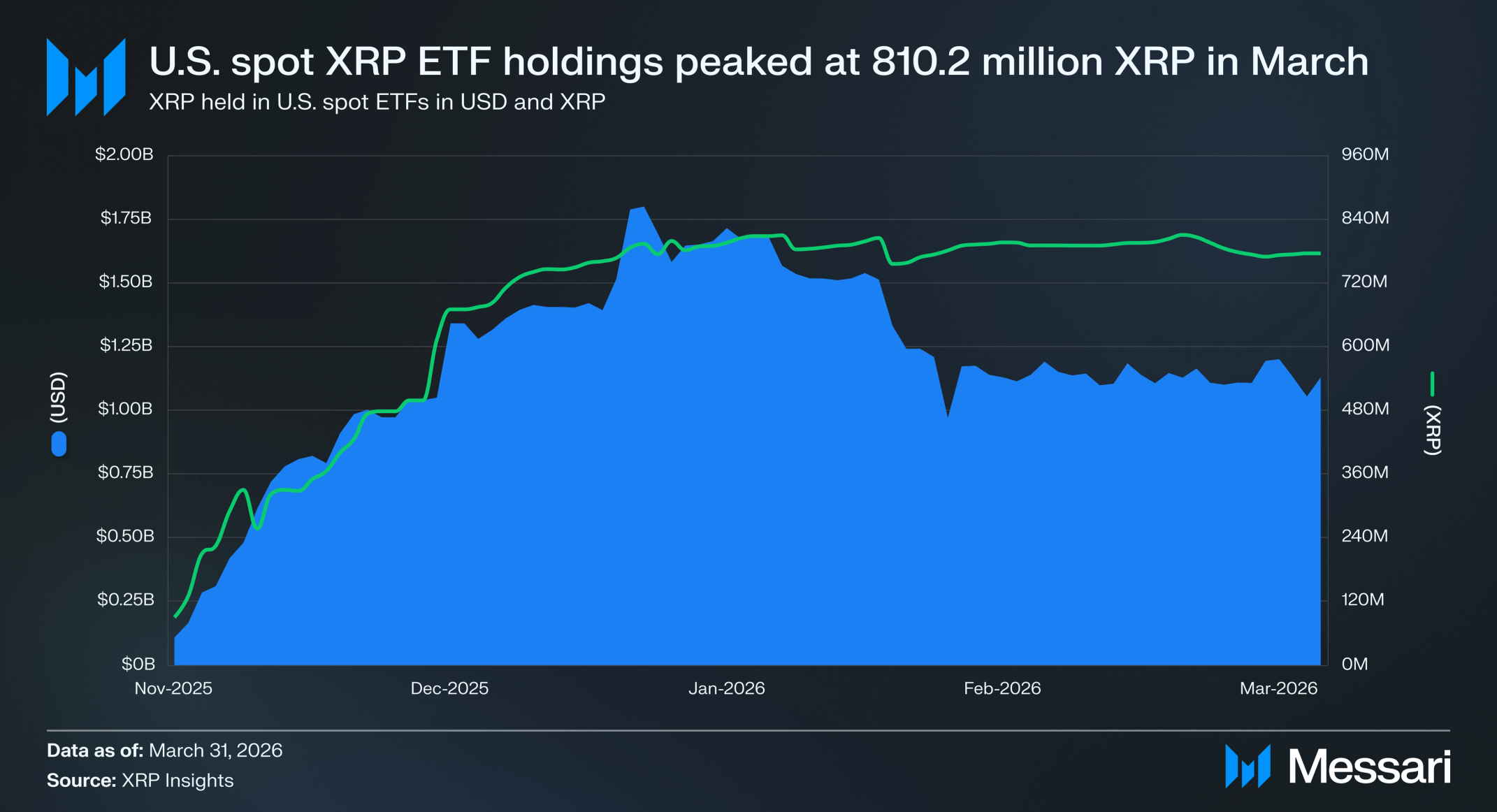
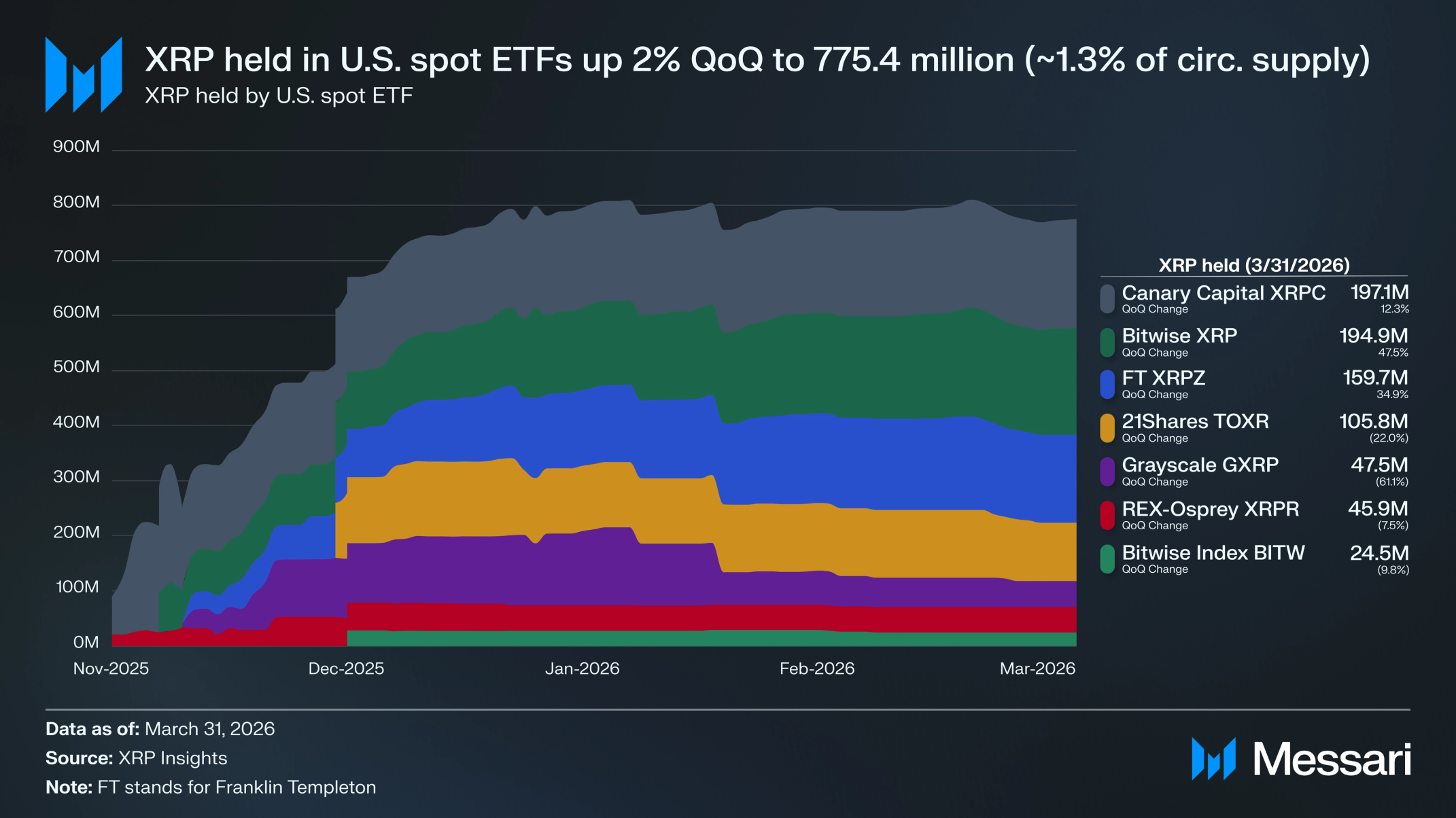
The report shows that U.S. spot XRP ETFs held 775.4 million XRP at the end of the first quarter of 2026. That represented about 1.26% of XRP’s circulating supply.
ETF holdings increased 1.9% quarter-over-quarter. They also reached a peak of 810.2 million XRP on March 3, 2026.
Messari noted that U.S. spot XRP ETFs launched in the fourth quarter of 2025 following SEC approval. The products surpassed $1 billion in assets under management in less than four weeks.
The milestone made XRP ETFs the fastest-growing crypto ETF category since Ethereum ETFs. It also expanded access for both retail and institutional investors.
Canary Capital’s XRPC ended the quarter as the largest U.S. spot XRP ETF by holdings. The fund controlled 197.1 million XRP, up 12.3% from the previous quarter.
Bitwise followed with 194.9 million XRP, representing a 47.5% quarterly increase. Franklin Templeton’s XRPZ held 159.7 million XRP after growing 34.9%. Meanwhile, 21Shares’ TOXR held 105.8 million XRP.
Unlike the Bitcoin and Ethereum ETF markets, the XRP ETF sector remains more evenly distributed. No single fund dominates the market.
According to Messari, the four largest U.S. spot XRP ETFs each control between 13% and 26% of total XRP ETF assets.
Morgan Stanley has become the latest major U.S. financial institution to disclose exposure to XRP through regulated investment products.
The disclosure appeared in the bank’s Q1 2026 Form 13F filing with the U.S. Securities and Exchange Commission (SEC), which reported holdings as of March 31, 2026. However, the size of its investment remains very small compared to its overall portfolio.
Key Points
Morgan Stanley becomes the latest major U.S. financial institution to gain exposure to XRP.
The bank revealed holding about $15,000 worth of two XRP ETF products.
While the investment size remains small compared to the bank’s overall portfolio, it shows growing institutional interest in XRP.
The disclosure comes after Goldman Sachs exited its XRP ETF position.
XRP ETFs have recorded a net inflow of $256 million in 2026 despite XRP’s price struggles.
Morgan Stanley Adds Exposure Through Two XRP ETFs
Morgan Stanley’s filing comes shortly after reports revealed that Goldman Sachs completely exited its XRP ETF positions during the same quarter. While Goldman Sachs chose to step away, Morgan Stanley moved in the opposite direction.
According to its recently submitted Q1 2026 Form 13F, Morgan Stanley reported holding 1,700 shares of the Volatility Shares XRP ETF (XRPI). The position had a reported value of approximately $12,886.
The bank also disclosed ownership of 100 shares of the Grayscale XRP Trust ETF (GXRP). The latest data values this position at about $2,602.
Together, these holdings gave the bank a total XRP ETF exposure of roughly $15,488. Although the amount is very small, it represents Morgan Stanley’s first reported XRP-related positions through regulated ETF products.
The firm did not purchase XRP directly. Instead, it gained exposure to XRP’s price movements through investment funds linked to the asset.
XRP Position Small Compared to Morgan Stanley’s Portfolio
The newly disclosed XRP holdings make up only a tiny fraction of Morgan Stanley’s broader investment portfolio. The bank’s Q1 2026 Form 13F showed total reported holdings worth approximately $1.659 trillion spread across thousands of investments managed by different divisions of the firm.
The filing also showed that Morgan Stanley has much larger positions in other crypto-related products. Specifically, the bank held significant exposure to Bitcoin ETFs, including positions worth around $1 billion in the iShares Bitcoin Trust (IBIT) and the Fidelity Wise Origin Bitcoin Fund (FBTC).
Market observers see Morgan Stanley’s XRP ETF purchase as more important for what it represents than for its actual size.
While investment worth about $15,488 is extremely small for a firm of Morgan Stanley’s size, the move aligns with a larger trend of traditional financial institutions gaining exposure to XRP through regulated investment products.
XRP ETFs Continue to Attract Investor Demand
Morgan Stanley’s disclosure comes at a time when XRP ETF products are seeing strong investor interest. U.S. spot XRP ETFs launched around November 2025, giving both institutional and retail investors regulated ways to gain exposure to XRP.
These funds have performed strongly in recent weeks despite XRP’s price consolidation. Recent data shows that XRP ETFs have recovered all losses recorded earlier this year and added about $256 million in net inflows for the year.
Notably, investor demand picked up during April, when the products recorded their highest monthly inflow total of the year at $81.59 million. The momentum has continued into May. Thirty days into May 2026, XRP ETFs had already attracted $131.94 million in inflows, putting them on track to surpass April’s record.
Throughout May, the products have not recorded a single day of net outflows, showing continued investor interest despite XRP’s price struggles.
Goldman Sachs Exits XRP Positions
The Morgan Stanley disclosure also arrived as Goldman Sachs moved in the opposite direction. Reports confirmed that the investment bank completely sold its XRP ETF holdings during Q1 2026.
Goldman Sachs first entered the sector in Q4 2025, building approximately $154 million worth of positions across XRP ETFs offered by Bitwise, Grayscale, Franklin Templeton, and 21Shares. At the time, those holdings represented about 73% of known institutional XRP ETF ownership.
However, by March 31, 2026, Goldman Sachs reported zero shares in any XRP ETF product. The bank fully exited its XRP ETF positions and also sold its Solana ETF holdings.
Ripple Chief Legal Officer and National Cryptocurrency Association (NCA) President Stuart Alderoty says Ripple has grown into a full-service crypto infrastructure provider for businesses.
The company now offers solutions for payments, custody, tokenization, liquidity, and treasury management. Alderoty shared this during an interview with the New York Stock Exchange.
He discussed Ripple’s expanding role in enterprise crypto adoption and also highlighted new research showing that cryptocurrency adoption continues to grow across the United States.
According to Alderoty, Ripple has spent more than 13 years building infrastructure for companies that want to use blockchain technology.
“If you’re a large or medium-sized enterprise and want to adopt crypto for payments, custody, tokenization, liquidity, or treasury management, we become a one-stop shop to do that,” he said.
Key Points
Ripple says it now offers payments, custody, tokenization, liquidity, and treasury services for enterprises.
The NCA reports that 67 million Americans now own or use crypto, signaling growing mainstream adoption.
About 12 million new users joined the crypto economy in the past year, expanding adoption nationwide.
Crypto ownership now spans generations, with strong participation from both younger and older Americans.
67 Million Americans Now Own or Use Crypto
Alderoty’s comments came alongside the release of the NCA’s latest State of Crypto Holder Report. The study was conducted in partnership with Harris Poll. The survey reached 40,000 Americans. It found that about 67 million Americans now own or use cryptocurrency.
The findings suggest that digital assets have moved far beyond their niche beginnings and are becoming increasingly mainstream.
Alderoty said crypto is no longer competing directly with traditional finance. Instead, the two industries are operating side by side.
He noted that consumers are using both traditional financial services and crypto products. This trend is growing as financial technology platforms add digital asset features.
Stuart Alderoty on NYSE
12 Million New Crypto Users Added in One Year
One of the report’s biggest findings was the addition of 12 million new crypto users between the 2025 and 2026 surveys.
Alderoty said the latest growth is coming from a broader range of people than in previous years. New users increasingly include women, construction workers, and manufacturing employees.
Accordingly, he argued that crypto is no longer limited to tech enthusiasts or Silicon Valley investors. Adoption is spreading across mainstream America.
The NCA’s data also show that crypto ownership is widespread across geographic regions. Holders are located in nearly every state and congressional district.
Traditional Finance and Crypto Continue to Converge
Alderoty credited much of the recent growth to the increasing integration of crypto and traditional financial services. He compared crypto adoption to the rise of smartphones. Consumers did not switch overnight, but gradually adopted the technology because it improved everyday experiences.
According to the survey, most crypto holders now see cryptocurrency as a reliable, established, and mature technology.
Alderoty believes crypto will become even more common as banks, financial institutions, and apps continue offering digital asset services. He said consumers may eventually use crypto without thinking much about the technology behind it.
As an example, he pointed to future payment systems that could let users choose between cash, debit cards, credit cards, or crypto wallets in a single app. The transaction would be processed seamlessly in the background.
Crypto Adoption Expands Across Generations
The report also found that crypto ownership spans multiple age groups. According to the survey, 18% of new crypto holders are between 18 and 24 years old. Meanwhile, 28% are over the age of 55.
Alderoty said these figures show that cryptocurrency is becoming a lasting part of the financial system for both younger and older generations.
He added that many younger users will grow up in a world where crypto exists alongside traditional financial products. It could become a standard option for payments, savings, and investing.
A market expert has explained that the XRP repricing event will come from institutional liquidity demand, not retail speculation.
XRP has declined alongside the broader crypto market, falling more than 2% this month and over 27% year-to-date. The decline has added to investor concerns, with most questioning when the much-discussed “XRP repricing” could occur.
Amid the weak market sentiment, Digital Asset Investor (DAI), a prominent XRP community figure, recently argued that many investors misunderstand what such a repricing would look like, suggesting that it would come from institutional liquidity demand.
Key Points
XRP has fallen more than 2% this month and over 27% this year, adding to investor angst.
DAI insists the expected XRP repricing event will not happen through retail anticipation.
According to him, this event could be triggered by increased institutional demand for liquidity.
Higher XRP prices will be necessary for larger transactions, deeper liquidity, lower slippage, and cheaper cross-border payments.
XRP Investors Focus on Market Weakness
Digital Asset Investor mentioned this during his latest video commentary. First, he addressed the growing fear among XRP holders as prices continue to struggle alongside the broader crypto market.
While many investors have reacted negatively to the downturn, he said he remains focused on the long-term picture. According to him, his main concern is finding enough money to buy more XRP, not worrying about the price decline. He added that he hopes to make another purchase within the next day or two.
The market commentator also highlighted recent remarks fromEasyA co-founder Dom Kwok, who discussed why crypto markets remain under pressure even as positive developments continue to emerge across the industry.
Kwok highlighted several reasons, including inflation concerns, traders selling after major announcements, increased attention on AI-related investments, and the fact that market sentiment often follows price action. Despite this, he said sentiment could change once interest rates peak and another major catalyst enters the market.
How XRP Repricing Could Happen
Speaking further, DAI said many people expect the XRP repricing process to happen in the wrong way. He argued that investors are unlikely to witness the event simply by watching CoinMarketCap and waiting for the price to suddenly rise.
He called attention to an explanation from Charusan, whom he believes has a better understanding of how the process could work.
According to Charusan, many retail investors wrongly assume that banks would purchase XRP at $589 or similar prices as a speculative investment. He argued that this is a misunderstanding of XRP’s role in international payments.
To explain his position, Charusan mentioned a situation where a bank needs to move $10 billion. He said the institution could use XRP liquidity to complete the transfer instead of relying on expensive nostro-vostro accounts.
In such a scenario, the system would source $10 billion worth of XRP from available liquidity. According to Charusan, this liquidity could come from any market participant, including individual XRP holders.
Why Higher XRP Prices Will be Necessary
The XRP sourced would then be used to complete the transaction instantly before settling into currencies such as the South Korean won (KRW), Turkish lira (TRY), Japanese yen (JPY), euro, or U.S. dollar.
Charusan argued that this is why a much higher XRP price could become necessary. To him, a higher price would create deeper liquidity, making it easier to process large transactions without significant market impact. He also said that higher prices would reduce slippage and lower transaction costs for financial institutions.
However, despite the optimism, it is important to note that such a repricing event may not play out at all. While XRP could see higher prices in the future, investors should be prepared for a scenario where the value does not skyrocket to ambitious levels.
XRP utility continued to grow in the first quarter of 2026 as institutional adoption of the XRP Ledger (XRPL) increased.
According to a new report from Messari, growth came from tokenized real-world assets (RWAs), stablecoins, and decentralized finance applications.
The report showed that XRP usage within the XRPL ecosystem continued to rise. Average daily transactions increased 35.3% quarter-over-quarter to 2.48 million.
At the same time, U.S. spot XRP ETFs expanded their holdings to 775.4 million XRP. That represents about 1.26% of XRP’s circulating supply.
Key Points
XRP utility grew in Q1 as daily XRPL transactions jumped 35.3% to 2.48 million and ETF holdings reached 775M XRP.
XRPL’s tokenized real-world asset market surged 124% to $2.25 billion, ranking fourth among blockchain networks.
Ripple’s RLUSD stablecoin expanded 45% to $340.3 million, becoming the largest stablecoin on XRPL.
Messari says ETFs, RLUSD, and new XRPL features are driving institutional adoption and expanding XRP utility.
XRP Maintains Top Market Position Despite Quarterly Decline
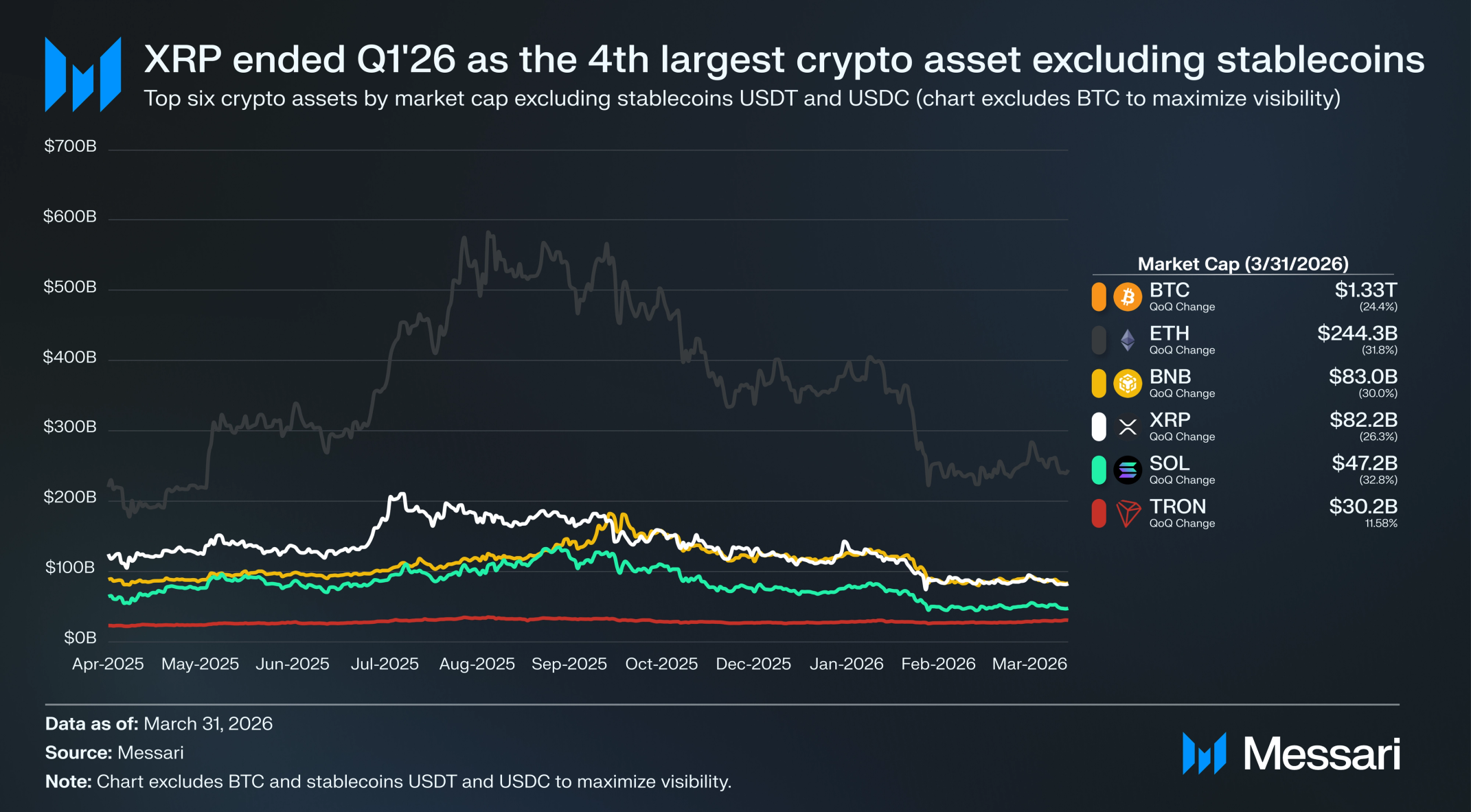
Notably, XRP ended Q1 2026 as the fourth-largest cryptocurrency excluding stablecoins. Only Bitcoin, Ethereum, and BNB had larger market capitalizations.
The asset closed the quarter with a market cap of $82.21 billion. That was down 26.3% from the previous quarter as the crypto market corrected amid the bear season.
Despite the decline, XRP still accounted for 3.9% of the total crypto market capitalization excluding stablecoins. It also remained the dominant asset among chains that use federated consensus. XRP represented 93.7% of the native asset market value in that category.
Messari noted that XRP’s role within the XRPL ecosystem continues to expand. One example is the network’s upcoming native lending protocol. The feature will allow users to lend and borrow XRP directly on-chain, adding another layer of utility for the asset.
Spot XRP ETFs Continue to Accumulate
Institutional demand remained strong through U.S. spot XRP ETFs. By the end of Q1, the funds held 775.4 million XRP, up 1.9% from the previous quarter. ETF holdings reached a peak of 810.2 million XRP on March 3, 2026.
The market remained relatively balanced among four major issuers. Canary Capital’s XRPC led with 197.1 million XRP under management. Bitwise followed closely with 194.9 million XRP.
Franklin Templeton’s XRPZ held 159.7 million XRP. Meanwhile, 21Shares’ TOXR managed 105.8 million XRP.
According to Messari, spot XRP ETFs became possible after the Ripple-SEC legal dispute was resolved in August 2025. The outcome removed regulatory uncertainty surrounding XRP’s status in secondary market trading.
RLUSD and XRPL Real-World Assets Post Explosive Growth
Meanwhile, tokenized real-world assets were among the fastest-growing sectors on XRPL.
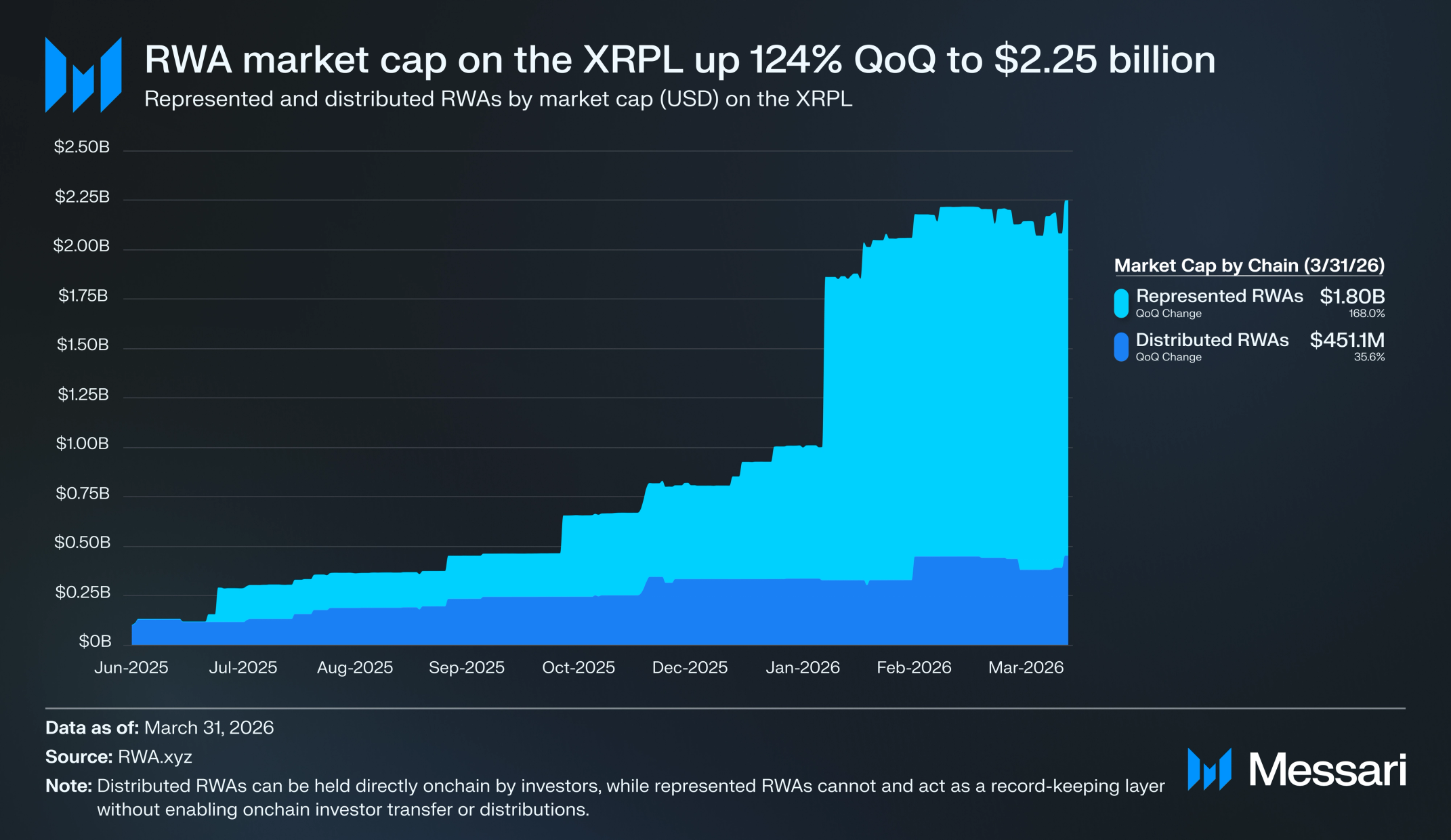
The network’s RWA market capitalization jumped 124% quarter-over-quarter to a record $2.25 billion. This growth helped XRPL move into the top tier of blockchain networks supporting tokenized assets.
At the time of publication, Messari ranked XRPL as the fourth-largest blockchain network by RWA market capitalization.
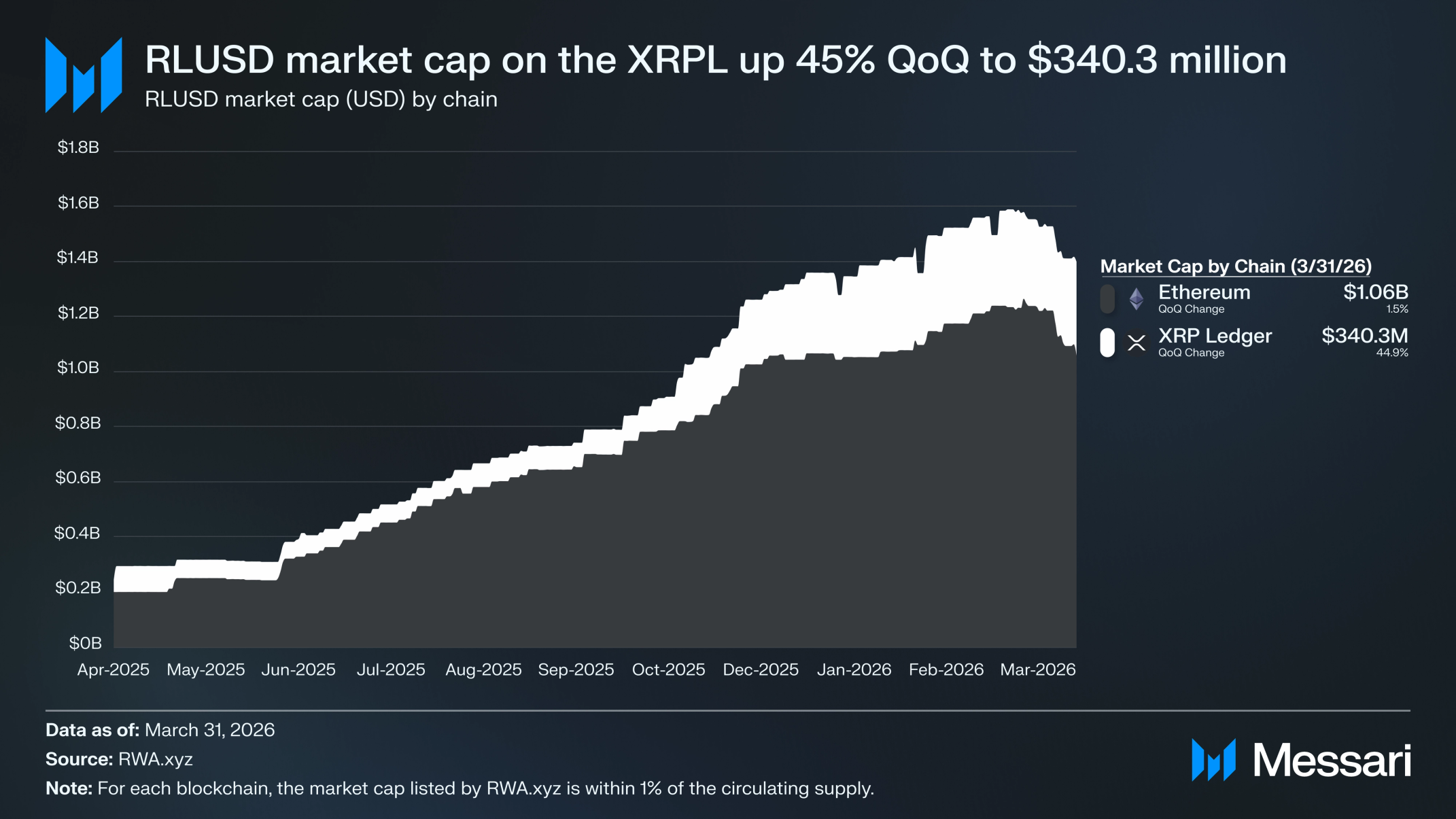
Ripple’s stablecoin, RLUSD, also expanded rapidly. Its market capitalization on XRPL grew 45% during the quarter to $340.3 million. That made it the largest stablecoin operating on the network.
Messari said new identity, compliance, and privacy-focused upgrades are helping attract institutional participants. As adoption increases, XRP benefits from several forms of network activity. These include transaction fees, reserve requirements, liquidity provisioning, and asset bridging.
Network Activity Climbs While Trading Volumes Cool
Network activity increased significantly during the quarter. Trading volumes, however, moved lower.
Average daily XRP spot trading volume fell 32% quarter-over-quarter to $2.69 billion. Average daily perpetual futures volume also dropped 28.6% to $2.99 billion.
The decline was broadly in line with XRP’s falling market capitalization during the quarter.
Despite weaker overall trading volumes, decentralized trading activity continued to grow. XRP spot volume on decentralized exchanges rose 9.4% quarter-over-quarter to $11.7 million.
The increase suggests that more trading activity is gradually shifting toward on-chain infrastructure.
XRP Supply Continues to Face Deflationary Pressure
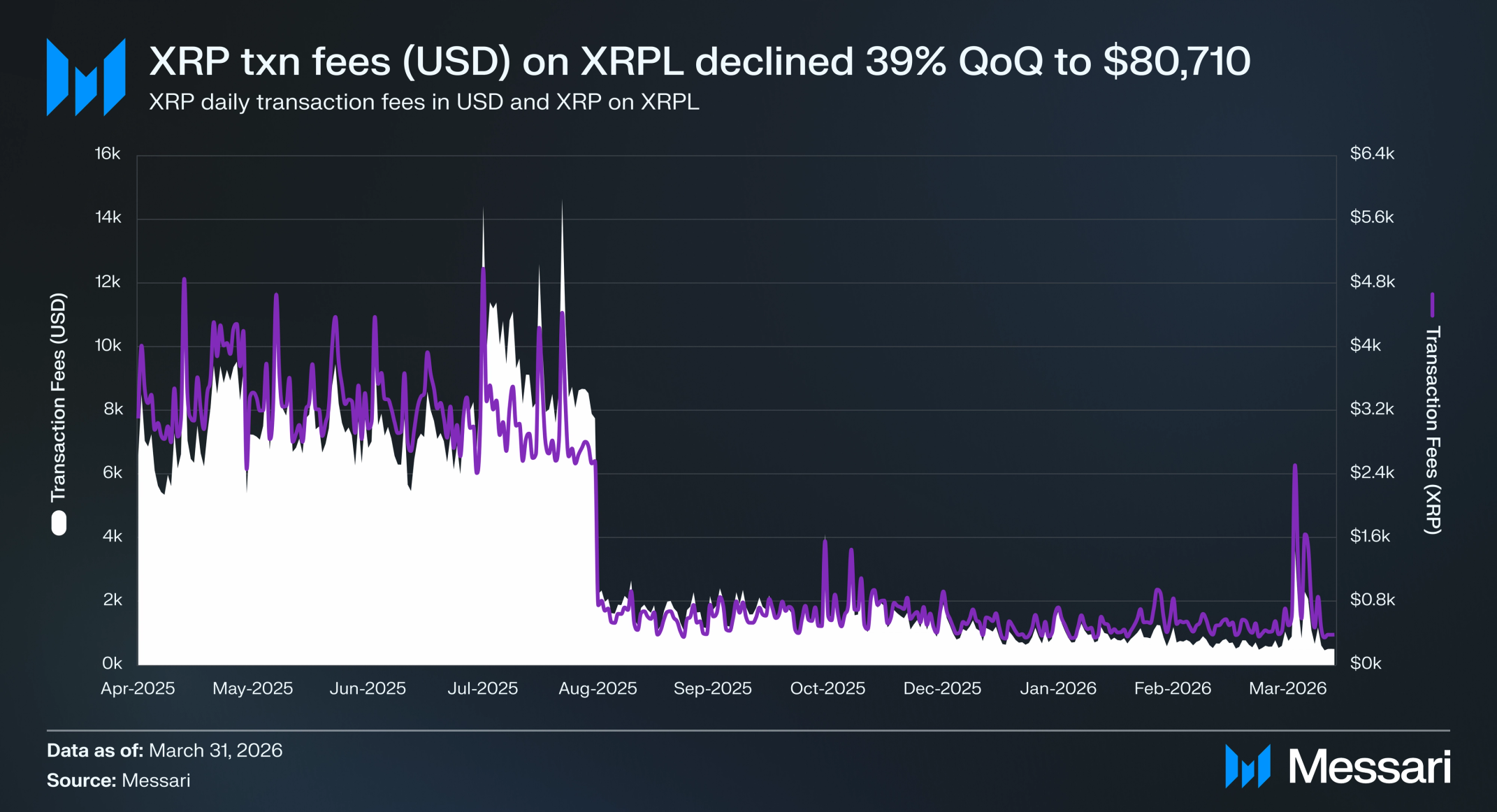
The report also highlighted XRP’s built-in burn mechanism. On XRPL, transaction fees are permanently destroyed instead of being distributed to validators.
During Q1, transaction fees paid in XRP fell 12% to 50,750 XRP. Measured in dollars, fees declined 39.3% to $80,710.
Since the network launched, approximately 14.3 million XRP has been burned through transaction fees.
The burn rate remains relatively small because XRPL transaction fees are extremely low. Even so, the mechanism continues to create gradual deflationary pressure on XRP’s fixed maximum supply of 100 billion tokens.
Institutional Adoption Remains a Key XRP Narrative
Messari’s latest report suggests that XRP’s growth story is becoming increasingly tied to institutional adoption rather than speculation alone.
Spot ETFs now hold more than three-quarters of a billion XRP. RLUSD continues to expand, while the XRPL’s tokenized asset market has surpassed $2 billion.
These developments are helping position XRPL as infrastructure for regulated financial applications.
As new lending, compliance, privacy, and tokenization features are introduced, Messari believes XRP’s utility within the ecosystem could continue to expand throughout 2026.
IOG Director of Software Architecture Nicolas Biri has expressed strong confidence that Cardano’s Ouroboros Leios upgrade will be successfully delivered this year.
His comments underscore increasing belief within the Cardano ecosystem that Leios can significantly boost throughput while preserving decentralization and security.
Key Points
IOG Director of Software Architecture Nicolas Biri expressed strong confidence that Cardano’s Ouroboros Leios upgrade will launch successfully in 2026.
Biri emphasized that development is progressing steadily, reflecting growing confidence in the project’s successful delivery.
Cardano founder Charles Hoskinson expects Leios to become operational before the end of the year.
According to IOG, Ouroboros Leios could deliver a 10x to 65x increase in network throughput and potentially support over 1,000 TPS.
IOG Director Expresses Confidence in Leios Launch
In a recent statement, Nicolas Biri expressed confidence in Cardano’s Ouroboros Leios scaling initiative. He praised the engineering efforts led by Sebastian Nagel and his development team, highlighting the substantial progress made so far.
His remarks followed Charles Hoskinson’s projection that the Cardano community could have Leios in place by the end of the year. According to Hoskinson, the upgrade could position Cardano as the first third-generation blockchain to fully address the blockchain trilemma by achieving meaningful scalability without sacrificing decentralization or security.
JUST IN: #Cardano$ADA Founder Charles Hoskinson says "end of the year we have Leios, and we were the last of the third generations to truly scale. We solved the blockchain trilemma." pic.twitter.com/2KdsXqBlKH
— Angry Crypto Show (@angrycryptoshow) May 29, 2026
In response to Hoskinson’s comments, Biri stated that Nagel’s team is conducting the intensive engineering work required to bring Leios to life. He noted that development is progressing well and reiterated his confidence that the upgrade will be successfully delivered, potentially before the end of the year.
Leios Progress
Ouroboros Leios is expected to become a cornerstone of Cardano’s long-term scaling strategy. The protocol aims to increase network throughput and improve transaction-processing efficiency through advanced parallelization techniques.
Notably, Charles Hoskinson has repeatedly indicated that Leios could launch this year. He has also proposed a 24/7 development approach to accelerate its delivery.
More recently, IOG confirmed that the project is approaching a critical milestone. Last month, the company announced that the highly anticipated Leios testnet is scheduled to launch in June 2026.
Why Leios Matters
According to IOG, the upcoming testnet marks the transition of Ouroboros Leios from years of academic research and extensive simulations into real-world deployment. The company also stated that the protocol is designed to deliver a 10x to 65x increase in throughput, potentially enabling Cardano to process more than 1,000 transactions per second (TPS).
Although the Leios testnet is expected to launch in June, the timeline for a full mainnet deployment remains unclear. Nevertheless, recent comments from both Hoskinson and Biri suggest that development is advancing steadily.