Home Blog Page 1191

Ripple Says Leaving Nothing on the Table, Files Cross-Appeal Against SEC Ruling

0

San Francisco-based crypto payments company Ripple officially files a cross-appeal against the SEC “to ensure nothing is left on the table.”

Ripple submitted its cross-appeal notice in the U.S. District Court of New York yesterday, requesting a review of the court’s final judgment entered on August 7, 2024. 

Notably, famous defense lawyer James K. Filan shared the development yesterday in an X post.

The company’s cross-appeal notice comes a week after the SEC officially appealed the Ripple decision. 

Brief Summary of Ripple Judgment 

Recall that the SEC and Ripple secured partial victories in the summary and final judgments. While the court ruled that Ripple violated securities laws through its institutional sales of XRP, it declared that the company’s programmatic sales and other distributions of the token are not investment contracts.

Consequently, the court ordered Ripple to pay a fine of $125 million for violating the law through its institutional sales. It also imposed an injunction on Ripple’s future institutional sales, ordering the company to seek the SEC’s permission before conducting these transactions. 

Ripple’s cross-appeal notice showed that the company is unsatisfied with the court’s verdict on its XRP-related institutional sales. Hence, the company seeks to overturn the decision in the U.S. Court of Appeals. 

With Ripple and the SEC seeking an appellate review of Judge Analisa Torres’ verdict, both appeals are expected to be combined into a single case in the Second Circuit. 

Ripple Wants Nothing Left on the Table 

While Ripple has yet to file its official cross-appeal brief, the company’s CLO Stuart Alderoty provided hints of what crypto enthusiasts should expect. 

According to him, the SEC appealed Judge Torres’ decision because it lost on all key aspects of the case. However, he said Ripple is cross-appealing to ensure “nothing is left on the table.” 

The company’s appeal will focus on the argument that an investment contract cannot exist without a contractual agreement outlining the rights and obligations between the parties. 

It bears mentioning that this argument relates to Ripple’s institutional sales of XRP, which Judge Torres declared a security. 

Potential SEC Appeal Brief

Furthermore, Alderoty stated what to expect from the SEC’s appeal brief. The Ripple CLO said the SEC had already confirmed that it would not appeal Judge Torres’ ruling that XRP is not a security. 

Moreover, Alderoty added that the agency apologized for suggesting in another case that a token itself can be a security, effectively affirming this position as the law. 

While the SEC may not appeal XRP’s non-security status, Alderoty believes the regulator might challenge the decision on Ripple’s programmatic XRP and other distributions to employees and developers. 

It should be recalled that Judge Torres ruled that these transactions are not investment contracts. Last year, the SEC sought an immediate appeal to challenge these decisions, but the judge denied its request. 

Even though Alderoty expected the SEC to appeal these rulings, he predicted that the regulator would lose again. In conclusion, the Ripple CLO suggested that the company is anticipating the appellate court to end the SEC’s misguided attack on the crypto industry. 

Ripple CEO Reacts 

Reacting to the development, the CEO of Ripple, Brad Garlinghouse, expressed frustration with the SEC and its chair Gary Gensler, saying the commission should not have appealed if they cared about the crypto industry. 

However, he noted that the SEC is only focused on creating havoc rather than providing clarity. Following Ripple’s cross-appeal, Garlinghouse said the company hopes to seal the SEC’s fate and end its regulation-by-enforcement agenda.
285 Days Into 2024: Top Analyst Warns Bitcoin Bull Market Must Arrive in 14 Days to Avoid Longest Halving Year Sideways Trend

0

Bitcoin is on the verge of facing its longest sideways movement in a halving year, with no new ATH in over 30 weeks.

Bitcoin’s price movement during the 2024 halving cycle has triggered attention due to its extended sideways trend. Ki Young Ju, CEO and founder of CryptoQuant, points out that if a bull market does not emerge within the next 14 days, Bitcoin will experience its longest period of sideways movement in a halving year. 

Historically, this point in previous halving cycles has shown signs of strong upward growth, but 2024’s cycle deviates from the historical trend. This unusual performance raises questions about whether the expected bull run will occur or continue to be delayed.

Comparing 2024 with Previous Halving Cycles

Per Young Ju’s chart, in the 2024 halving cycle, Bitcoin’s return index remains relatively flat, hovering just below a 1.5x cumulative return.

Compared to previous cycles, the growth is notably slower, with no significant upward trend emerging. At this stage, in prior halving years, Bitcoin typically experienced stronger price performance. 

For instance, the 2020 halving cycle saw Bitcoin’s return multiple reach close to 4x by this point in the year, signaling the start of a major bull run. However, the current cycle has shown limited movement, leading to concerns about whether Bitcoin will follow its historical upward trajectory.

Sideways Trend Impact

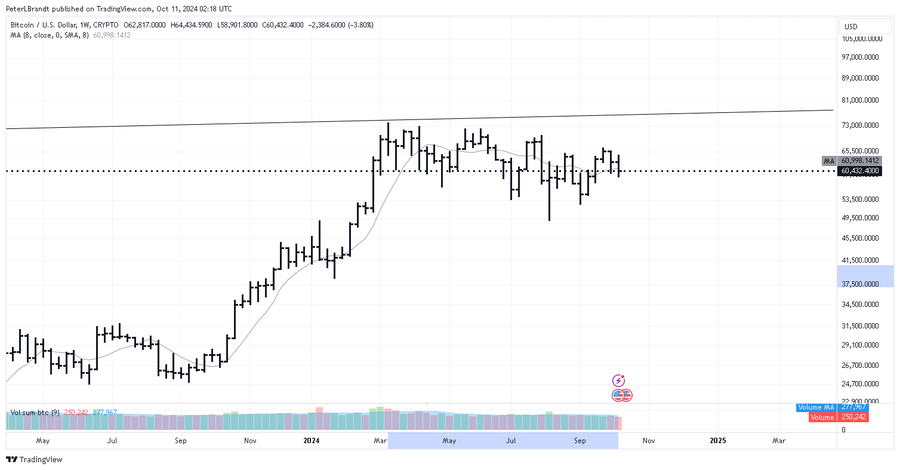
This update follows veteran trader Peter Brandt’s analysis of the implications of Bitcoin’s recent struggle to breach its all-time high (ATH). According to Brandt, Bitcoin has not set a new ATH in 30 weeks, a pattern that often precedes a market decline. 

If this trend continues, Bitcoin could face a major correction, with the possibility of a 75% collapse. Bitcoin’s current price hovers near its 8-week simple moving average of $60,998, reflecting ongoing uncertainty in the market.

Bitcoin’s Long-Term Strength Against Gold

While Bitcoin faces short-term challenges, its long-term strength compared to gold remains noteworthy. Brandt’s analysis of the BTC/GLD ratio highlights Bitcoin’s consistent outperformance of gold in recent years. 

However, Bitcoin is nearing a resistance level at 32 oz of gold, a key threshold that could determine its future trajectory. If Bitcoin can surpass this resistance, its value could surge, with potential targets exceeding 100 oz per Bitcoin. 

Shiba Inu Takes a Ride in Elon Musk’s Latest Driverless Cybercab

0

Shiba Inu has been spotted inside Tesla’s latest futuristic electric vehicle, the Cybercab, an autonomous taxi expected to offer affordable premium transportation.

On Thursday evening in Los Angeles, Tesla CEO Elon Musk unveiled the highly anticipated robotaxi at the “We, Robot” event. The Cybercab is a sleek two-door vehicle resembling a compact version of Tesla’s Cybertruck.

Musk entered the stage in one of the robotaxis, showcasing 20 others all moving autonomously without human control.

Notably, the Cybercab stands out for its lack of pedals and a steering wheel, accommodating only two passengers. It navigates exclusively using artificial intelligence and cameras, avoiding the extra hardware found in some competing robotaxis.

Shiba Inu Takes a Ride in Elon Musk’s Robotaxi

Amid the presentations designed to illustrate how Tesla’s robotaxi will operate when available to the public, a Shiba Inu was spotted inside one of the driverless cars, happily commuting without any human presence.

Dogecoin’s official handle on X drew the crypto community’s attention to this moment, asking Elon Musk to confirm if it was indeed a Shiba Inu in the robotaxi.

Price Details about Tesla’s Cybercab

With the Cybercab, Musk is making a stride toward autonomous transportation, presenting premium point-to-point travel without a driver at a low cost. He revealed that the price of autonomous transport will be so low that people can think of it as individualized mass transit.

He noted that the average cost for bus transportation in a city is about $1 per mile. In contrast, the operating cost for the Tesla Cybercab is expected to be around 20 cents per mile. Including taxes and other fees, the total cost is likely to range between 30 to 40 cents per mile. Musk emphasized that the car will be affordable, with expectations for a launch price below $30,000.

Regarding the timeline for the launch, Musk stated that Tesla expects to start fully autonomous, unsupervised Full Self-Driving (FSD) in Texas and California next year, involving the Model 3 and Model Y. As for the Cybercab, which is highly optimized for U.S. transport, he provided an optimistic timeline for production to begin around 2026 or possibly before 2027.

Bitnomial Sues SEC Over XRP Futures, Challenges Claims That XRP Is a Security

0

Crypto derivatives exchange Bitnomial has sued the US SEC, claiming it has overreached its jurisdiction with the latest attempt to prevent the listing and trading of XRP futures.

According to the filing, Bitnomial claimed that XRP futures were a contract under the jurisdiction of the Commodities Futures Trading Commission. However, the US SEC claims that the futures product is a securities product and requires joint approval from it and the CFTC.

Bitnomial stated in the lawsuit that the SEC argued that listing the XRP futures contract violated federal securities law. The SEC also required that it meet certain requirements before listing, including registering as a securities exchange.

For context, Bitnomial revealed it filed for an XRP US Dollars Futures product with the CFTC in August after a court ruled that XRP was not a security. As a result, offering a futures contract tied to the XRPL native token does not constitute an investment contract.

Bitnomial Argues XRP is Not a Security

According to the filing, the derivatives exchange argues that XRP is not a security and that offering a futures contract that tracks the asset’s performance does not constitute an investment contract.

Bitnomial cited the court ruling rejecting the regulator’s views that XRP was a security. Notably, a federal court ruled in July 2023 that XRP was not a security and that the sales of XRP on an exchange or by executives do not constitute an investment contract.

Meanwhile, Bitnomial is seeking that the court declare XRP futures are not a security contract. The exchange also asked that a legal injunction preventing the SEC from taking any legal action against it should it list the product be issued.

It bears mentioning that the SEC has filed a notice of appeal, seeking to contend with Judge Analisa Torres’s August 7 ruling. However, the regulator has not disclosed the scope of the appeal.

Lawsuits Involving the SEC Piles On

The SEC has recently been involved in several legal brawls with crypto firms. The regulator is either suing a company or getting sued. For instance, the SEC sued market maker Cumberland on Thursday, claiming it was operating as an unregistered dealer.

Furthermore, Crypto.com sued the SEC on Tuesday after it received a Wells Notice from the regulator. The exchange claimed that the Wall Street securities top dog was overstepping its jurisdiction by regulating the sector.

Notably, Ripple also filed a notice of counter-appeal on October 10. Per the filing, the firm cross-appealed the SEC’s October 2 appeal and the August 7 ruling.

SEC Makes U-Turn, Says XRP Is a Security 

0

The United States Securities and Exchange Commission (SEC) still considers XRP a security despite a New York district court declaring the token a non-security last year. 

Leading crypto derivatives exchange Bitnomial revealed this development yesterday in a lawsuit against the SEC. 

Bitnomial Sues SEC Over Its Claim About XRP 

The lawsuit, filed in an Illinois district court yesterday, challenges the SEC’s claim that it has regulatory authority over its planned XRP Futures contract. 

For context, in August, Bitnomial applied with the U.S. Commodity Futures Trading Commission (CFTC) to launch a futures contract for XRP. The filing comes shortly after U.S. District Judge Analisa Torres issued the final judgment in the SEC v. Ripple case. It should be recalled that Judge Torres rejected the SEC’s claim that XRP is a security. 

However, with Bitnomial seeking to launch an XRP Futures contract, the Wall Street top cop contacted the exchange, claiming that the product falls under its regulatory purview. According to Bitnomial, the SEC classified the XRP Futures contract as a “security futures.” 

It also warned the crypto derivatives exchange that it would violate federal securities law if it launches the XRP Futures Contract without complying with its rules. 

SEC Supports Its Assertion That XRP Is a Security 

Notably, pro-XRP lawyer Bill Morgan called attention to a part of Bitnomial’s complaint that shows the SEC supporting its claim that XRP is a security. 

According to Bitnomial, while discussing with the SEC, the regulator, on August 23, gave the derivatives exchange three summary judgment briefs from its lawsuit against Ripple to justify its claim that XRP is a security. 

In the brief, the SEC argued that Ripple violated Section 5 of the Securities Act via its sales of XRP. Notably, the regulator claimed that XRP is a security defined by the Howey Test. 

Reacting, Bitnomial noted that the SEC failed to mention that a New York district court rejected its claim that all sales of XRP at issue constitute investment contracts. Per Bitnomial, the court found that while certain XRP sales were securities, the token itself is not a security. 

The SEC’s omission of Judge Torres’ verdict could be seen as misleading. The SEC only provided information from its summary judgment brief to support its claim that XRP is a security while ignoring the judge’s verdict, which says otherwise. 

Will SEC Challenge XRP’s Non-Security Status?  

It bears mentioning that the SEC is seeking to overturn the Ripple judgment through an appeal. While the SEC has not officially filed its brief, there are speculations that the regulator would not appeal XRP’s non-security status. The regulator admitted this last year during its failed interlocutory appeal attempt in the Ripple case. 

According to the SEC, XRP, the underlying asset of Ripple’s securities transactions, is a computer code with no inherent value. Whether the SEC would change this position and challenge XRP’s non-security status in its appeal brief remains unclear. 

Brandt Says 30 Weeks Since Bitcoin Non-Convincing ATH, Drop of 75% Looming

0

Veteran trader Peter Brandt points out that Bitcoin (BTC) has not set an all-time high (ATH) in over 30 weeks, a pattern that often leads to severe market declines. 

Brandt disclosed this in his latest analysis despite his generally bullish outlook for BTC. The analyst’s recent report suggests the ongoing market trend could follow previous ones where an asset collapses 75% after failing to breach its ATH for 30 weeks.

Bitcoin Struggles Below ATH

For context, Bitcoin hit its latest all-time high above $73K in early March. However, following this peak, a correction ensued. Bitcoin has since failed to transcend this retracement due to geopolitical tensions and economic uncertainty.

Despite demonstrating resilience, BTC is currently 18% down from the ATH. Meanwhile, data from the chart below confirms that this week would mark the 30th week since Bitcoin dropped from the $73K all-time high. 

Bitcoin 1W Chart
Bitcoin 1W Chart

According to Brandt, classic market trends suggest Bitcoin could face further bearishness in the near future. Data from his chart shows that BTC is hovering near its 8-week simple moving average (SMA), which stands at $60,998. 

A Ranging Market

The failure to decisively break beyond this MA could signal weakness. For the past several months, Bitcoin has traded within a tight range, struggling to make a decisive move upward. Brandt sees this consolidation as a precursor to a downward move.

BTC 1W Chart Peter Brandt
BTC 1W Chart | Peter Brandt

The analyst’s chart also points out a long-term resistance trendline that Bitcoin has struggled to break above. BTC has made multiple attempts to rally, but each time it has faltered. 

Further, the trading volume does not show any signs of strong conviction in either direction. The volume moving average currently sits at 277,967 BTC. If Brandt’s 75% collapse begins from the current price, BTC could drop to $15K, levels last seen in Q4 2022.

Contrasting Opinions

In response to Brandt’s assertions, veteran trader Mike Alfred made a contrasting opinion. Alfred suggested that Brandt’s focus on chart patterns rather than Bitcoin’s strength could lead to missing the premier crypto asset’s long-term potential.

He pointed out that Bitcoin often defies technical analysis, largely due to its unique position in the global financial system. 

According to Alfred, Bitcoin’s future remains bright as long as governments continue printing money. He noted that the firstborn crypto asset operates under different rules than traditional assets and should not be evaluated solely on past patterns.

However, Brandt maintained his observations. He revealed that Bitcoin is the largest asset in his personal portfolio, indicating that his analysis is not about shorting the market but making a realistic assessment. 

The analyst had previously suggested BTC could hit $150K this cycle as its top price. However, Brandt often uses the “strong opinions, weakly held” mantra to confirm that he can alter his opinions based on changing market conditions. At press time, Bitcoin trades for $60,607, down 3.51% this week.

Expert Predicts XRP Price if BTC Hits $115K and ETH Reaches $8,000

0

A prominent market watcher argues that XRP could witness nearly eight-fold gains if Bitcoin reaches $115K or Ethereum hits $8,000.

The crypto market turned bullish last week when Bitcoin surged past a four-week high of $64,000. This renewed optimism was reflected in the global crypto market cap, which rose from just over $2.01 trillion to more than $2.21 trillion today. In other words, the crypto market has seen over $200 billion inflow within a week.

Amid this booming market, analysts are revising their outlooks for prominent cryptocurrencies, projecting promising futures for assets like XRP as market sentiment strengthens.

One well-known trader, “Altcoin Moe,” has recently updated his forecasts for several assets. In a recent post on X, Moe shared his price predictions for XRP and 27 other cryptocurrencies.

Bitcoin to $115K and Ethereum to $8,000

Expectedly, Bitcoin led the pack, with the trader noting he anticipates an all-time high for Bitcoin at the $115,000 price point. At the time of reporting, Bitcoin is just $63,193. Reaching the $115K target would require the premier cryptocurrency to grow further by 81% in this ongoing bull market.

Meanwhile, as for the altcoin king Ethereum, the trader expects even better price returns for investors. Specifically, Moe projected Ethereum could reach a price of $8,000 in this bull run. This would amount to a return of over 210% from its current price of $2,573.

Notably, he stressed that these targets for Bitcoin and Ethereum are realistic projections for this bull run. While this trader has outlined promising outlooks for Bitcoin and Ethereum, he is proposing an even better future for top altcoins like XRP in this.

Projected XRP Price When Bitcoin Hits $115K, Ethereum $8K

Trader Moe noted that the realistic target for XRP in this season is $5. XRP is worth around $0.5908 as of today. This $5 outlook translates to a massive ROI of 745% from current prices.

Essentially, Moe anticipates that as Bitcoin rallies by 81% to a new ATH at $115K, XRP would see more commendable growth, seeing near eight-fold price gains.

It is worth noting that in the last bull run, Bitcoin registered a cumulative growth of 721%. XRP largely experienced a similar growth trajectory, registering a 942% gain when its bull run encountered resistance at $1.96. 

While this gain is commendable, XRP enthusiasts believe XRP would have performed even better, save for the SEC lawsuit at the time, which scared many away from XRP.

However, this lawsuit has ended, and the popular belief is that XRP will see explosive growth once again, similar to 2017.

Additionally, Moe is bullish on other top altcoins, including Chainlink (LINK), with a target of $125, Binance Coin (BNB) at $1,000, and Avalanche (AVAX), which he expects to reach $300.

Korean SEC Takes Formal Steps Toward Bitcoin ETF Approval

0

The Korean regulator is forming a virtual asset committee to explore Bitcoin ETF approval and corporate crypto accounts, likely reducing the Kimchi premium.

The Financial Services Commission (FSC) in South Korea has initiated the formation of a virtual asset committee. This committee aims to address critical issues surrounding the approval of spot exchange-traded funds (ETFs) and the opening of corporate accounts for crypto exchanges.

According to Ki Young Ju, founder of CryptoQuant, this development is bullish as it is expected to reduce the Kimchi premium, a phenomenon in which cryptocurrencies trade at higher prices in South Korea compared to other markets. As arbitrage funds and market makers enter the Korean market, price discrepancies may be minimized, creating more balanced trading opportunities.

Notably, this move signals a significant step toward regulating and expanding the crypto industry in the country. The FSC’s decision aims to establish a more structured and transparent framework for managing virtual assets, as detailed in its recent report presented during the National Assembly’s State Affairs Committee’s audit on October 10.

Virtual Asset Committee’s Role in Regulations

The virtual asset committee will play a pivotal role in shaping policies for South Korea’s virtual asset market. Comprising government officials from key ministries such as the Financial Services Commission, the Ministry of Justice, the Ministry of Strategy and Finance, and the Ministry of Science and ICT, as well as nine civilians, the committee will advise on critical regulatory issues. 

One of the primary focuses of the committee will be evaluating the potential approval of Bitcoin spot ETFs, which are currently restricted under the Capital Market Act. This committee will also explore the possibility of allowing corporate accounts for crypto exchanges, which are currently prohibited due to concerns about money laundering.

Strengthening Market Oversight 

In addition to the formation of the virtual asset committee, the FSC has emphasized the importance of market oversight. The regulator highlighted ongoing efforts to combat market manipulation and unfair trading practices. 

Furthermore, the FSC has established a non-profit foundation, the Digital Asset User Protection Foundation, to safeguard user assets from businesses that have closed or suspended operations.

Crypto ETF Developments in the U.S. Market

While South Korea moves forward with its regulatory efforts, the U.S. market has also seen notable developments. Canary Capitals, a leading investment management firm, filed an S-1 form with the U.S. SEC on October 8, announcing its intention to launch an XRP ETF. 

The filing positions Canary to offer investors exposure to XRP, one of the largest cryptocurrencies by market capitalization. With investor demand driving this move, the proposed Canary XRP ETF will benchmark its value against the CME CF Ripple-Dollar Reference Rate. The filing, however, leaves out key details, such as the fund’s ticker and exchange listings.

Bitcoin Volatility in Japan Hits 2-Year High Amid Yen Instability, Trading Volumes Plummet by 50%

0

The Japanese Bitcoin (BTC) market has witnessed a surge in volatility, tied closely to the recent instability of the Japanese Yen (JPY). 

After decades of relative calm, the JPY entered a period of heightened fluctuations this year, influenced by the Bank of Japan (BoJ) shift in its monetary policy. 

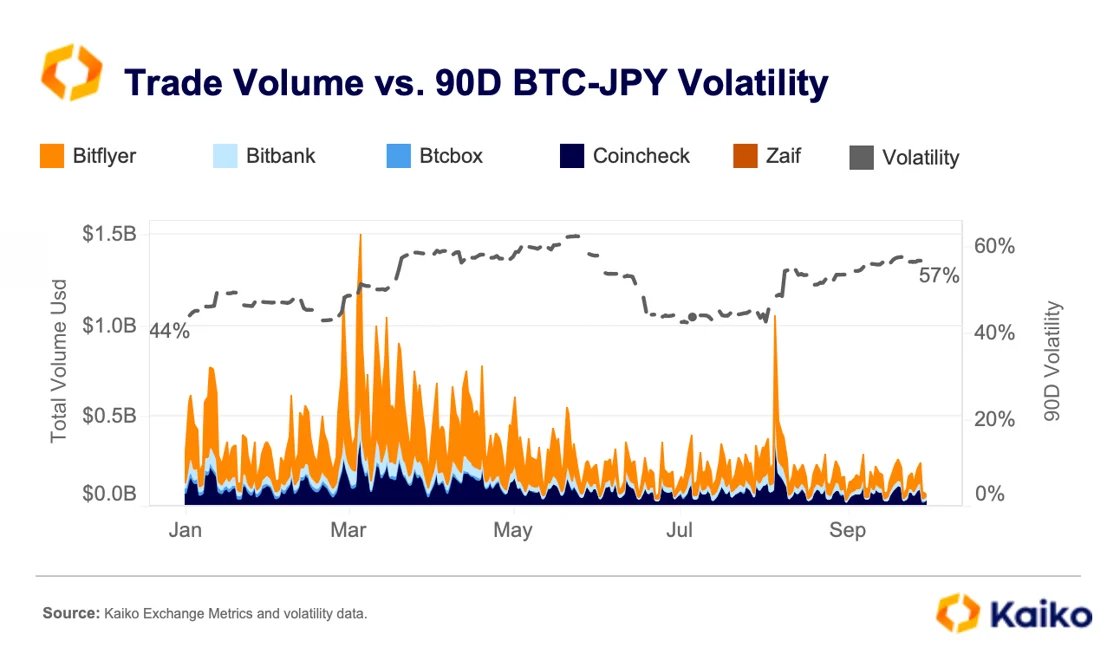
Accordingly, the 90-day volatility of the BTC/JPY trading pair surged in August. Analytic platform Kaiko noted that the BTC/JPY volatility even overtook that of BTC/USD, which is a record occurrence. Specifically, the event last occurred two years ago, in July 2022.

Consequently, this significant spike has caused Japanese traders to approach the crypto market with caution, significantly reducing trading volumes.

Factors Influencing BTC/JPY’s Record Volatility Spike

Notably, the sudden volatility in the Japanese Yen can be traced back to a series of monetary policy changes and external factors. First, the BoJ cut interest rates in August, driving the yen to a seven-month high.

However, those gains were short-lived. Dovish comments from newly appointed Prime Minister Shigeru Ishiba, alongside vital U.S. economic data and growing geopolitical tensions, contributed to the yen’s subsequent decline.

Japanese Crypto Market Takes Hit, Trading Volume Plummets by 50%

This yen instability has directly impacted Japan’s cryptocurrency market. Despite a global rally in the crypto market in September, trading volumes in the BTC/JPY market have been flat.

Specifically, the daily volumes on Japanese exchanges such as Bitflyer, Bitbank, and Coincheck stayed at around $200 million from August, which is half the average of $400 million observed between January and July. 

Image
Kaiko

Essentially, the uncertainty surrounding the yen has likely kept traders on the sidelines, making them reluctant to re-engage with the market.

On the other hand, trading volumes on U.S. and South Korean exchanges have increased during the same period. In particular, the sentiment turned more bullish in September, buoyed by improving macroeconomic data. The bullish sentiment is evident in the fact that Bitcoin traded as high as $66,480 in the last days of September.

CryptoQuant: Stablecoin Liquidity Hits Record Highs as Ripple Prepares to Enter the Market

0

As Ripple prepares to make an impact on the stablecoin market with its upcoming Ripple USD (RLUSD) stablecoin, market liquidity has reached record levels.

Though still in its beta testing phase, the Ripple stablecoin has taken center stage in recent times, as Ripple aims to strengthen its position in the stablecoin market, having previously penetrated the custody scene with the acquisition of Metaco. 

Ripple Gears for RLUSD Launch

A recent report from CryptoQuant suggested that Ripple could leverage RLUSD to target remittances and money transfers, noting that the project will likely take advantage of the established infrastructure of the XRP Ledger (XRPL), as well as the Ethereum network. 

Ripple announced its plans to penetrate the stablecoin market in April, noting that the market, worth $150 billion at the time, is projected to skyrocket beyond $$2.8 trillion in the next four years. 

Notably, four months after they introduced the product, Ripple launched beta testing on the Ethereum network and the XRPL in August. So far, the testing phase has minted and burned millions of the token. Ripple CEO confirmed last month that the project will launch in a matter of weeks.

Stablecoin Market Hits New Highs

Meanwhile, as Ripple prepares for the full-scale release of RLUSD, the broader stablecoin market is experiencing unprecedented growth, according to the CryptoQuant report.

As of late September 2024, stablecoin liquidity reached record highs, with the total market capitalization of major stablecoins hitting $169 billion. This marks a $40 billion, or 31%, increase year-to-date (YTD), signaling a growing demand for stablecoins.

Stablecoin Market Share CryptoQuant
Stablecoin Market Share | CryptoQuant

Stablecoins, such as RLUSD, have become important for liquidity, as they provide traders with a secure way to hold and move funds between volatile digital assets and fiat currencies.

Further, stablecoin balances on centralized exchanges have also surged to record levels, particularly with USDT leading the way. USDT balances on the Ethereum network (ERC20) reached $22.7 billion in October, reflecting a 54% increase, or $8 billion, since the beginning of the year. 

Similarly, USDT balances on the TRON network have grown to $8.5 billion, all of which is held on centralized exchanges. This increase in liquidity could have a positive impact on crypto prices, as larger stablecoin reserves provide traders with more capital to execute trades efficiently.

USDT’s dominance in the stablecoin market continues to grow, currently accounting for 71% of the market. Notably, USDT boasts a market cap of nearly $120 billion, representing a 30% YTD increase. 

Meanwhile, USDC from Circle follows with a 21% market share, having reached a $36 billion market capitalization—a 44% YTD growth. The combined market cap growth of these two stablecoins has been pivotal in driving up liquidity across the crypto ecosystem.

Potential Impact on Prices 

CryptoQuant pointed out that an increase in stablecoin market capitalization is often associated with rising Bitcoin and other crypto prices. This underscores the importance of stablecoins in the broader crypto market.

Ripple’s RLUSD stablecoin could experience substantial growth once it exits the beta phase, especially given its original dual network functionality on XRPL and Ethereum. 

CryptoQuant confirmed that the XRPL decentralized exchange (DEX) has already seen a high volume of fiat currency transactions, including USD and Chinese Yuan, alongside popular stablecoins like USDT and USDC.