Home Blog Page 1192

Hoskinson Addresses Negative Sentiment Surrounding Cardano, Says ADA Is Not Dying 

0

Cardano founder Charles Hoskinson takes to X to address recent negative sentiment surrounding the Cardano project on the microblogging platform. 

According to Hoskinson, the negative sentiment reflects the desired result of Voltaire, which launched recently introducing decentralized governance to the Cardano ecosystem. 

Rationale Behind Recent Negative Sentiment 

Hoskinson stated that the criticism aimed at Cardano lately does not suggest that the project is somehow failing. Instead, he asserted that the negative sentiment stems from long-standing unresolved issues, such as a lack of partnerships, pent-up grievances, unfunded growth strategies, and unexplored roadmaps. 

The Cardano boss suggested that the previous governance model could not meet the ecosystem’s needs; hence, some community members took to X to express their grievances. 

However, with the introduction of Voltaire, Hoskinson believes that Cardano’s governance is well-equipped to address these demands while establishing a new roadmap to foster the ecosystem’s growth. 

Hoskinson Reveals His Grievances 

Like some aggrieved community members, Hoskinson revealed that he also has many unaddressed issues, such as Cardano Native Assets (CNA) and stablecoin support. 

Hoskinson indicated that he knows what needs to be done to enhance CNA’s performance, ranging from custody to liquidity. While Hoskinson promised to address these challenges, he expressed optimism that community-led governance would also do its part. 

Difference Between Cardano and Other Blockchains 

Meanwhile, Hoskinson highlighted the core difference between Cardano’s operations and those of other crypto projects. According to him, while Cardano favors a more transparent approach, other blockchains engage in dirty tricks and backroom deals. 

He suggested that Cardano’s dedication to transparency has attracted envy from these malicious projects. Per Hoskinson, Cardano is focused on long-term growth and integrity rather than short-term gains, market manipulations, and getting undue advantage. 

Furthermore, he emphasized that Cardano is not dying, adding that the project hopes to remain a true cryptocurrency, “not the patron of Blackrock and Wall Street for number go up preferences.”  

Cardano Remains the Number 1 Blockchain 

Hoskinson has continued to heap praises on Cardano at every opportunity he gets. For him, Cardano is in a league of its own, with no project measuring up to its standard. 

Earlier this month, he emphasized that Cardano remains the best in the blockchain industry despite not fully implementing decentralized governance and other amazing items on its roadmap. 

While Cardano’s recent upgrades have been impressive, the cryptocurrency’s price action has lagged. Prominent market observer Ali Martinez recently asserted that Cardano is currently in the depression phase of the market cycle. Nonetheless, Martinez stated that the current phase represents a buying opportunity that could potentially lead to massive gains. 

In the meantime, Cardano is priced at $0.3342, representing a decline of 1.48% over the past seven days. 
Cardano Becomes First Blockchain to Host a Legally Binding Smart Contract in Argentina

0

The Cardano network became the first to host a legally enforceable smart contract in Argentina amidst increased traction.

The Cardano network’s apparent traction in Argentina has reached a new milestone after the blockchain recently hosted the first legally binding smart contract, fully compliant with the country’s laws. For context, a smart contract is an on-chain program that automatically executes an action in compliance with agreed-upon terms.

In a tweet on Tuesday, Cardano ambassador Mauro Andreoli revealed that Cardano has achieved a significant milestone after he signed a judicially enforceable blockchain-based agreement with fellow ambassador Lucas Macchiavelli.

Smart Contract Details

Per the smart contract, Macchiavelli received 10,000 ADA ($3,362 at the current market price) from Andreoli, payable at a 10% interest rate for four months. 

The agreement was also legally notarized, with both parties providing certain information. This included the network where the smart contract was initiated, the wallet address, and the transaction ID. The legal document also contained data like the two Cardano ambassadors’ names, addresses, and identity numbers.

Meanwhile, Macchiavelli confirmed the receipt of the 10,000 ADA in a tweet, teasing he would invest them in Cardano native tokens. He noted he would reveal further details of the venture when the contract ends.

Move to Fast-Track Widespread Adoption

Andreoli stated that the smart contract agreement would foster the adoption of the technology among corporate bodies in Argentina to draft commercial transactions. He also asserted that it would create a system where the judiciary acknowledges smart contracts as a means of legal agreement.

The Cardano ambassador further implied that the technology’s scope is not limited to loan applications. Andreoli insisted that smart contracts could be used in agreements like rentals, purchases, and other legal transactions.

Furthermore, Andreoli stated that Argentina already has legal frameworks for contracts of this nature. He cited the Argentine Civil and Commercial Code and the Presidential Decree 70/23, issued by the incumbent crypto-friendly president, Javier Milei.

Notably, under the new Milei leadership, Argentina has ramped up its digital asset adoption. An earlier report shows that Cardano founder Charles Hoskinson will discuss crypto adoption with President Milei in a conference later this month.

It bears mentioning that digital assets and blockchain technology have recently gained increased real-world utility. In September, an English court recognized stablecoin Tether as property in a fraud-related legal battle. This also came after a legal entity classified cryptocurrencies as a means of salary payment in the United Arab Emirates.

7K Ethereum Tokens Sent to Exchanges as PlusToken’s $1.3B ETH Stash Awakens

0

The crypto market saw the movement of 7,000 Ethereum tokens from PlusToken’s seized $1.3B stash to exchanges, signaling potential liquidation after years of inactivity.

Notably, in early August 2024, the Ethereum assets seized from the infamous PlusToken scheme resurfaced on-chain for the first time in over two years. The first significant movement occurred with a transfer of 15.7K ETH from previously dormant addresses associated with the scheme. 

These transfers included efforts to obfuscate the transactions, mirroring tactics used during the 2020 and 2021 movements of the scheme’s assets. The reactivation of these funds has raised concerns of further distribution, given the scale of the Ethereum token still held in these addresses.

Ethereum Transfers Hint at Selling Intentions

Over the past 24 hours, roughly 7,000 ETH, part of the remaining 542K ETH linked to the PlusToken seizure, was sent to exchange deposit addresses, indicating potential plans to sell these tokens. 

These transfers come after a long period of inactivity, as the ETH assets had largely remained untouched since mid-2021, when 280,000 ETH was sold via lesser-known exchanges. This recent move suggests a continuation of the gradual liquidation strategy first observed during the handling of the seized PlusToken Bitcoin in 2019 and 2020.

In that earlier period, over 150,000 BTC linked to PlusToken was sold, placing significant selling pressure on the Bitcoin market. In contrast, the Ethereum portion of the scheme’s assets remained mostly intact until recently. The latest movement of ETH introduces fresh concerns.

Historical Context of PlusToken Asset Sales

The PlusToken scheme, which was active from 2018 until its unraveling in mid-2019, accumulated substantial amounts of Bitcoin and Ethereum through its MLM-style crypto Ponzi operation.

By the time the authorities arrested the masterminds, the scheme had collected 194,000 BTC and 830,000 ETH. While much of the Bitcoin was sold between late 2019 and early 2020, the Ethereum remained largely untouched until now.

With the latest transactions showing over 7,000 ETH sent to exchanges, and more likely to follow, this situation presents a new supply overhang for Ethereum.

Recent transactions suggest the entity handling the funds may pursue a gradual liquidation strategy similar to that employed with the Bitcoin sales, where over $1.3 billion worth of BTC was sold in less than a year.

Although only 7,000 ETH has been sent to exchanges thus far, the potential sale of the entire $1.3 billion in remaining ETH could exert prolonged selling pressure on Ethereum in the coming months.

The Bifrost Bridge is XRP Direct Teleportation to Valhalla: Analysis

0

XRP long-term price chart shows signs of resilience, with analyst Egrag suggesting the token remains in an upward trend with the “Bifrost Bridge.” 

In a recent analysis, Egrag highlighted this bullish sentiment while examining XRP’s performance over a three-month timeframe. He pointed out the strength of the “Bifrost Bridge,” a support zone that has held steady for nearly 2,650 days.

According to Egrag, the three-month timeframe reveals that the Bifrost Bridge still remains firm for XRP. He stressed that this high timeframe adds weight to his bullish outlook. It also confirms the positive case for XRP across other timeframes as well.

How XRP Is Holding Firm Above the Bifrost Bridge

For context, the Bifrost Bridge in Egrag’s analysis represents an ascending trend line that has been in place since 2014. This trend line intersects XRP’s candlestick pattern on the three-month chart, showing that for the past decade, XRP’s price has consistently remained above this ascending line.

Image
XRP historical chart showing Bifrost Bridge

Egrag revealed that XRP has not closed even half of a price candle inside the Bifrost Bridge over a three-month timeframe in the last seven years. He believes this is an indication that the crypto asset is maintaining a solid structure on higher timeframes.

As a result, he emphasized that XRP has been in an upward trend since its breakout in April 2017. Despite the usual market fluctuations, the token has consistently respected its support levels over the years.

Historically, XRP traded much lower years back in 2017 when its price included two zeros. Currently, it’s trading at $0.5289. This has bolstered Egrag’s confidence that XRP remains in an uptrend, even though it is currently 84% below its all-time high from 2018.

The Bifrost Bridge: XRP Army’s Direct Teleportation to Valhalla

Egrag’s analysis suggests that as long as XRP stays above the critical support level of $0.28, broader market corrections and temporary dips are insignificant. “Everything else is just noise,” he stated.

He encouraged traders to view these moments as opportunities to accumulate more XRP or trade other assets to grow their XRP holdings.

Ultimately, he emphasized that the Bifrost Bridge is the XRP community’s direct teleportation to Valhalla, a metaphor for achieving the ultimate goal of financial success or reaching new all-time highs.

Ripple Compliance with ISO 20022 Could Drive XRP Integration Into Traditional Financial Systems

0

Although XRP has nothing to do with ISO 20022, the coin might still benefit from Ripple’s involvement with the messaging standard. 

The significance of ISO 20022 to the global financial industry cannot be overemphasized. Financial institutions are recognizing the importance of the ISO 20022 messaging standard, as reflected in the rate at which they have complied with the concept. 

Financial Institutions Complying with ISO 20022 Standard 

Approximately 72% of global banks on the SWIFT network are projected to migrate to the ISO 20022 standard by the November 2025 deadline. Additionally, more institutions are expected to comply with the messaging standard by 2025 as part of SWIFT’s ongoing transition.

For context, ISO 20022 is a globally recognized standard for financial messaging, enabling seamless electronic data exchange between financial institutions worldwide. Notably, SWIFT aims to replace its current messaging standard (MT) with ISO 20022, driving broader adoption and compliance among financial institutions.

Ripple Becomes Part of ISO 20022 

Initially developed as a messaging standard for traditional financial institutions, the concept is gradually extending into the crypto sector. 

Crypto-related companies, like Ripple, have become part of the global messaging standard for financial transactions. The crypto payments company announced its membership in May 2020. 

At the time, Ripple emphasized that its compliance with ISO 20022 standard would allow RippleNet clients to access a network of global financial institutions through a unified API for all counterparty transactions. 

Is XRP ISO 20022 Compliant? 

Following Ripple’s compliance with ISO 20022, some community members speculate that XRP is also compliant with the messaging standard. Some commentators, including Ben Armstrong (BitBoy), have conferred the title “ISO 20022 compliant coin” on XRP due to Ripple’s involvement with the concept. 

Last month, BitBoy stated that the ISO 20022 standard was developed with XRP in mind. However, prominent XRP community members debunked this claim. They referred to a statement from Ripple’s CTO, David Schwartz, refuting XRP’s relationship with ISO 20022. 

“XRP has nothing to do with ISO 20022,” Schwartz remarked. 

The Ripple exec mentioned that while ISO 20022 is a messaging standard for payments, XRP is only a cryptocurrency. 

David Schwartz debunks XRP relationship with ISO 20022

How XRP Might Benefit from Ripple’s Compliance with ISO 20022 

Although XRP cannot be referred to as an ISO 20022-compliant coin, it could benefit from Ripple’s involvement with the messaging standard. 

XRP could be integrated into existing financial systems, especially among ISO 20022-compliant banks, potentially driving the coin’s adoption. Interestingly, XRP’s utility in cross-border payments could also drive its adoption among ISO 20022-compliant institutions. 

For context, XRP facilitates faster and low-cost cross-border settlements through Ripple’s payment solution On-Demand Liquidity (ODL), now Ripple Payment. On ODL, XRP functions as a bridge asset between two fiats, eliminating the issues associated with traditional cross-border settlements, including high transaction fees and slower processing time. 

With Ripple being an ISO 20022-compliant company, more financial institutions complying with the messaging standard could adopt XRP for cross-border settlements. 

Chiliz (CHZ) Heads for Post-Retest Jump to $0.091 After Dropping to $0.067

With the recent correction phase testing the inverted head and shoulder breakout, is Chiliz (CHZ) preparing a launch to $0.091?

As the Bitcoin price is struggling to uphold the $61k support, a market-wide selling spree puts the altcoin back to critical support. Amid such conditions, the Chiliz token is down with a second bearish day and hangs at a crucial supply-turned-demand zone near $0.067. 

Will the CHZ price sustain above this critical zone for a post-retest jump to $0.074?

Chiliz Price Analysis

Following a bearish reversal from the $0.074 resistance level, Chiliz’s price has dropped by 8.09% over the past two days. The current price of CHZ is $0.0679, reflecting an intraday decline of 3.12%.

However, the ongoing correction comes as a potential retest of a bullish pattern. During the reversal from $0.058 to the uptrend, Chiliz’s price action formed an inverted head and shoulder. The previous positive cycle from $0.058 to $0.074 accounted for a 27.5% surge. 

With the neckline breakout near $0.067, this correction suggests a potential retest phase. Additionally, the long-tail intraday candle indicates a possible post-retest reversal.

CRYPTO:CHZUSD Chart Image by Trojan69420
CHZ chart Trading View

Furthermore, the intraday candle finds support at the 20-day EMA (red) and the 38.20% Fibonacci level at $0.06636. Crucial EMAs—50-day, 100-day, and 200-day—remain in bullish alignment, offering multiple dynamic support levels.

However, the sudden drop in the daily RSI from the overbought zone to the midpoint signals a decline in bullish momentum, leaving technical indicators mixed in the short term.

Will Chiliz Hit $0.091?

Based on the Fibonacci levels, an uptrend continuation with a post-retest reversal will rechallenge the 78.60% level at $0.074. A bullish breakout will lead the way to the next swing high at the 1.618 level at $0.091. 

On the flip side, the crucial support levels for Chiliz are $0.063 and $0.058.

Cardano at Risk of Plummeting to $0.22 After Falling Below Key Support Levels: Analysis

0

Cardano struggles below key support levels, with analysts noting potential risks and a possible recovery phase.

Cardano’s recent price action has sparked significant attention, especially after testing the $0.3680 resistance level on October 7. Despite an attempt to break higher, ADA has faced a notable decline, similar to Bitcoin and Ethereum.

The crypto formed a short-term top, followed by a fresh downturn, slipping below key support levels at $0.3550. This downward momentum aligns with a broader trend observed in the broader market.

Potential Risks for Cardano

A TradingView analyst known as Siyamakbayrami provided insights into Cardano’s price movement, highlighting a descending weekly trend. The analyst’s chart illustrates a sharp uptrend leading to ADA’s peak of approximately $0.80 in March.

However, a significant correction followed, erasing most of those gains. As a result, ADA entered a consolidation phase, trading within a narrow range of $0.33 to $0.45. This range reflects a period of market indecision, often seen as a crucial turning point for assets.

According to the analyst, if Cardano fails to maintain its current support at $0.33, the next significant support level could be between $0.22 and $0.26.

Notably, Cardano was last seen in this range in 2023. Essentially, the analyst is projecting a severe price crash for ADA that could erase all gains accrued since the beginning of the year. At press time, ADA is trading at $0.3385, down by 1%.

Holder Sentiment and Resistance Levels

In addition to technical analysis, the Global In/Out of the Money analysis sheds light on the sentiment of Cardano holders. The data shows that 77.50% of addresses holding ADA are out of the money, having purchased at prices above $0.33. 

As a result, any rise in ADA’s price could face selling pressure from these holders, especially as it approaches key resistance levels between $0.35 and $0.54. The potential for resistance in these zones is high, as many holders may seek to exit their positions to recover losses.

Analyst Predicts Recovery 

Separately, crypto analyst Ali Martinez expressed that Cardano investors are in the depression phase of the market cycle. This stage, marked by pessimism and negativity, may present a unique buying opportunity. 

Historically, the depression phase often signals market bottoms. Martinez points out that while sentiment is low, this phase precedes a potential rally. Investors who accumulate during these downturns could benefit from a recovery as the market transitions into a disbelief phase.

Stripe Reanables Crypto Payment After Officially Adding Support for USDC

0

Payment giant Stripe officially reintegrates crypto payment solutions into its platform, now allowing settlements in Circle’s USDC stablecoin.

Six months after announcing it would add support for crypto payments on its platform, Stripe has officially honored its commitment. On Wednesday, Stripe officially included USDC payment options, allowing transaction settlements with the stablecoin.

Stablecoin’s product lead, Jeff Weinstein, disclosed the integration, tweeting that crypto was officially back on Stripe. Circle’s CEO, Jeremy Allaire, confirmed the latest development, allowing USDC payments in over 150 countries.

It bears mentioning that the Wednesday integration officially ends Stripe’s six-year discontinuation of crypto payments. In 2018, the payment giant announced it would no longer support Bitcoin payments on its platform after allowing it for four years. Notably, Stripe cited market volatility, slow transactions, and high fees as reasons behind the halt.

Stripe Enables USDC Payment

Stripe introduced the “Pay With Crypto” option on its platform on Wednesday, allowing users to pay merchants in USDC. The mechanism will enable businesses based in the US to accept stablecoin payments through the Stripe Checkout, Elements, or the Payment Intent API.

Notably, the USDC payments would only be initially processed on the Ethereum, Solana, or Polygon networks. Stripe will automatically convert the USDC received to fiat and settle with the merchant.

Meanwhile, Stripe revealed a transaction limit for users. The platform will not process payments exceeding $10,000 per transaction or $100,000 monthly for a single user. Furthermore, each transaction will incur a 1.5% transaction fee.

Other Stripe Crypto Venture

The Wednesday integration came after Stripe announced it has allowed access to the Avalanche network through its platform. The collaboration will enable its users exclusive access to crypto products and decentralized applications in the Avalanche ecosystem. 

Furthermore, Avalanche’s Core wallet will integrate Stripe’s fiat-to-crypto onramp solution, allowing users to buy the AVAX token directly through a debit or credit card issued by the payment giant.

Notably, Stripe launched its onramp services in December 2022 following the FTX implosion. The product aims to remove the complexity of purchasing cryptocurrencies through third parties like centralized exchanges.

Meanwhile, Stripe strengthened its crypto comeback in June after announcing that European Union customers could buy Bitcoin, Ethereum, and Solana through debit cards. 

Stripe’s crypto push mirrors a broader adoption of the sector among fintech solutions. PayPal and Visa have long embraced digital assets, providing their users with diverse means of exposure to the nascent industry.

Analyst Identifies Potential Targets for Solana as It Approaches Major Breakout

0

Solana (SOL) is currently trading within a tight consolidation range, leading prominent market watcher Edward to anticipate a potential breakout. 

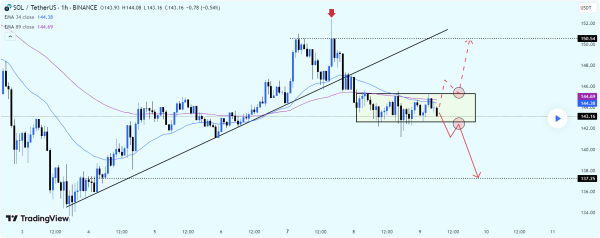
The cryptocurrency’s price has been oscillating between $143.33 and $144.70, without making a decisive move in either direction. 

Edward confirmed in a TradingView analysis that SOL is showing hesitation but may soon break out of this range, a move that could determine its next major trend. Several factors are influencing the price, including technical indicators and broader market events.

Consolidation Phase and EMA 

Per the analyst, SOL’s sideways movement has created a defined trading range, with prices consistently testing both support and resistance levels. The current consolidation pattern has traders anticipating a breakout to the upside or downside. 

SOLUSD 1H Chart
SOLUSD 1h Chart

Edward points out that the price is trading below both the 34-period and 89-period exponential moving averages (EMAs), which indicates that the short-term momentum remains slightly bearish. However, if SOL can break above these key moving averages, the market could witness a shift in sentiment.

This setup has left the analyst preparing for two potential scenarios. A bullish breakout above $144.70 could push the price toward the next resistance level of $150.54. Conversely, a bearish move below $143.33 could trigger a pullback to $137.25, creating a key support level to watch.

Solana’s Potential Catalysts

While the technical factors suggest mixed outcomes, broader market events may also help in determining Solana’s price movement. Notably, market analyst Geoff Kendrick from Standard Chartered predicted significant gains for Solana, especially in light of political developments. 

Kendrick believes Solana could surge by up to 500% if Donald Trump wins the 2024 U.S. presidential election, driven by expectations of a favorable regulatory environment for crypto assets under a Trump administration.

According to Kendrick, Solana’s ecosystem could benefit from such a scenario, with the approval of a Solana spot exchange-traded fund (ETF) potentially driving demand and price.

Market Sentiment and Crowd Perception

Adding to the current uncertainty around Solana’s price is the bearish sentiment observed across the market. Data from Santiment, a market intelligence platform, shows that Solana, along with other top cryptocurrencies, has been subject to negative crowd narratives. 

Historically, assets experiencing a downturn in sentiment have seen subsequent price increases. Santiment’s data reveals that Solana could soon benefit from this pattern, with a weighted score of -0.400815.

Here are Prominent Signs Financial Market is Preparing for XRP ETFs

0

After several months of anticipation, the XRP community is finally seeing signs that an XRP exchange-traded fund (ETF) could become a reality.

Bitcoin and Ethereum opened the door to crypto ETFs this year, building on applications filed back in 2023. With their ultimate approvals, the XRP Army speculated that XRP deserves to be the next crypto asset ETF in the financial space, given its prominence and clear regulatory status.

This prospect is quickly becoming a reality due to recent market developments. In a Wednesday post on X, researcher Anderson highlighted several points supporting the view that the market is gearing up for XRP ETFs.

Signs the Market Is Preparing for XRP ETFs

First, Anderson noted that Grayscale’s decision to open an XRP Trust in September is a strategic move that could lead to an XRP ETF.

Notably, Grayscale is the leading crypto asset manager. The crypto community eagerly awaits Grayscale’s official XRP ETF move, given its prominence in the asset management business.

Meanwhile, other major crypto asset managers have made official moves to list an XRP ETF. Bitwise opened the floor on October 2 by submitting its application with the U.S. SEC.

Financial commentators like Eric Balchunas of Bloomberg have remarked that Bitwise’s bold decision to seek an XRP ETF could be seen as a bet on Donald Trump’s emergence as the next U.S. president, as they view its approval as unlikely under the current SEC chairman.

However, asset manager Canary Capital has joined Bitwise in the race for an XRP ETF. It submitted an application with the SEC on October 8.

Notably, this marks Canary’s first foray into digital assets, led by Steven McClurg, who cited strong investor demand for alternatives to Bitcoin and Ethereum as a driving force behind the initiative.

Discussion of XRP ETF to Feature at Ripple Swell

Interestingly, the fast-approaching Ripple Swell, an annual conference hosted by the company, will feature discussions on crypto ETFs. The 2024 edition will be held from next Monday, October 14, and crypto ETFs are on the agenda.

The session will be hosted by Bloomberg’s Balchunas, a senior ETF analyst. It will feature industry executives like Hunter Horsley of Bitwise, Tim McCourt of CME Group, Maja Vujinovic of Ogroup, and Anna Paglia of State Street Global Advisors.

Before XRP ETF Filings Became a Thing

Additionally, Anderson recalled a few months ago when BlackRock CEO Larry Fink avoided commenting on the prospect of the company filing for an XRP ETF. This occurred during an interview with FOX in January when he was asked for his thoughts.

Rather than rule out the possibility or express optimism, he chose a conservative approach and refrained from commenting. Ripple’s CEO also adopted a similar approach during an interview in February, but he later stated that an XRP ETF “is inevitable.”

At the time, members of the XRP community viewed these responses as positive indicators. Now that the prospect is gradually becoming a reality, they reflect on these moments with optimism.