Home Blog Page 1193

Here is Why Bitcoin Fell to $60,300 Today And Volume Dropped by 17%

0

Bitcoin faces selling pressure as $5.64B in realized profits is recorded, with bearish institutional sentiment.

Bitcoin experienced a tough Wednesday, opening above $62,000 before dropping to a low of $60,300 as of this writing. This marked a 2.33% price decline within 24 hours, adding to an overall negative weekly performance, affirming the world’s largest crypto remains in a bearish trend.

Meanwhile, recent data indicates that a significant portion of investors have capitalized on their holdings, leading to billions in realized profits.

Billions in Realized Profits 

Recent insights from on-chain data, shared by expert Ali Martinez, reveal that $5.64 billion in Bitcoin realized profits were recorded in the last 24 hours. This profit-taking behavior typically leads to selling pressure, which can drive prices lower or lead to short-term consolidation. 

Bitcoin: Sell-side Risk Ratio

Notably, whenever there is a significant spike in realized profits, as shown on Martinez’s chart, Bitcoin’s price tends to either stabilize or decline. This relationship between profit-taking and market corrections has been observed repeatedly.

Additionally, the trading volume for Bitcoin dropped by 17% during the same period. This lower trading volume suggests decreased activity compared to previous days.

Bearish Institutional Sentiment

Another critical indicator pointing to sustained selling pressure for the largest crypto is the Coinbase Premium Index. This index tracks the price difference between Bitcoin on Coinbase, which is predominantly used by U.S. institutions, and Binance, popular among global retail traders. 

A negative reading on the Coinbase Premium Index suggests stronger selling pressure from U.S. institutions. According to data from CryptoQuant, the Coinbase Premium has dropped to -41, marking a significant sell-off by institutional investors in the U.S.

For context, the U.S. apex court recently granted approval for the sale of $4.38 billion Bitcoin from Silk Road held by the U.S. government.

Throughout October, the Coinbase Premium Index has consistently stayed in negative territory, indicating a preference for selling Bitcoin on Coinbase over other platforms. Historically, negative readings on this index have preceded further price declines for Bitcoin.

Upside Projections Despite Bearish Sentiment

Despite the prevailing bearish sentiment, analysts still see long-term potential for Bitcoin. Technical analysis indicates that Bitcoin is outperforming traditional assets like gold.

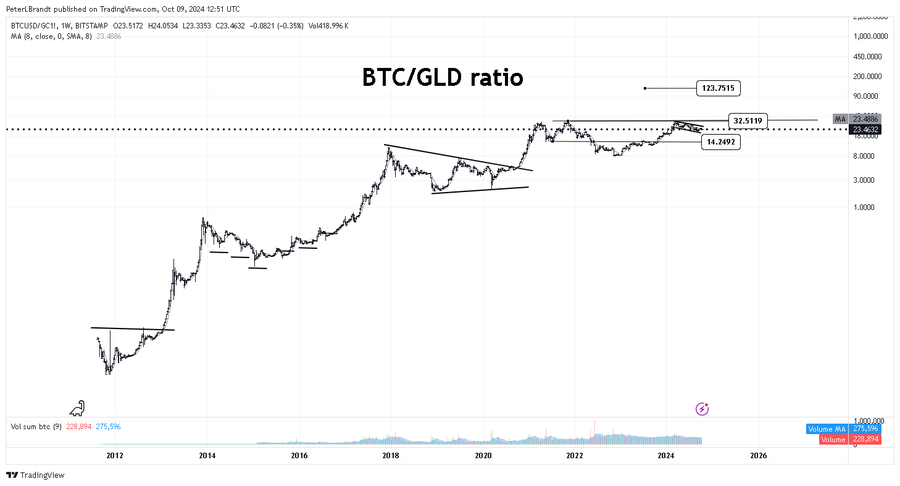
Veteran chartist Peter Brandt has highlighted the BTC/GLD ratio, which measures Bitcoin’s value relative to gold, showing an uptrend. This ratio suggests that Bitcoin has consistently outperformed gold in recent years.

Brandt points to Bitcoin’s potential to break through key resistance levels in the BTC/GLD ratio. A breakthrough at 32 ounces of gold could signal a significant rally for Bitcoin, with projections indicating it could rise to over 100 ounces per Bitcoin.
Ripple Launches New Crypto Custody Service for Banks and Fintech Companies

0

San Francisco-based firm Ripple Labs is launching a new crypto custody service, diversifying its business from cross-border settlements into custody. 

CNBC reports today that Ripple has launched a new service to help fintech companies, including banks, store digital assets on behalf of their clients. This move is part of the company’s expansion into the crypto custody sector under its subsidiary, Ripple Custody.

Through its Ripple Custody division, the San Francisco-based company is rolling out features designed to streamline crypto management.

These include pre-configured security settings, anti-money laundering (AML) monitoring tools, and a user-friendly interface, all aimed at providing seamless custody solutions. This strategic move allows Ripple—already known for its use of XRP and Ripple Payments—to diversify its offerings beyond payment settlements.

Ripple Custody is built to secure the private keys associated with digital assets while adhering to global regulatory standards, ensuring a compliant and secure environment for institutional clients.

The broader crypto custody market is forecasted to experience exponential growth, potentially reaching $16 trillion by 2030. Additionally, Ripple’s new services will enable clients to tokenize real-world assets like fiat currencies and commodities on the XRP Ledger, granting them access to a decentralized exchange (DEX) with low-fee trading options.

Ripple Custody has already seen substantial traction, with customer growth surging over 250% year-over-year. Ripple Custody counts HSBC and DBS among its clients.

This expansion is further supported by Ripple’s strategic acquisitions of Metaco and Standard Custody & Trust Company, bolstering the company’s expertise and infrastructure in digital asset custody.

XRP and Solana Among Cryptos Hit Hard by Negative Sentiment, Chance of Recovery?

0

Santiment reports negative sentiment on top cryptos like Solana, and XRP, as bearish crowd narratives grow amid market downturn.

The latest data from market intelligence platform Santiment indicates a shift in crowd sentiment towards several top cryptocurrencies, including Solana (SOL), and XRP.

As the broader crypto market experiences a downturn, these assets have garnered some of the most negative crowd narratives. Per Santiment, historically, assets with bearish sentiment often see an eventual rise. 

XRP Faces Uncertainty 

XRP, in particular, has been the subject of increased negativity, despite a slight price increase of 0.78% in a day. Notably, XRP’s trading volume has dropped by 14.87% over the past 24 hours, while its market capitalization remains at $30.13 billion. 

The sentiment weight for XRP currently stands at -0.33963, reflecting growing concerns among investors. These concerns stem largely from the legal case between the U.S. Securities and Exchange Commission (SEC) and Ripple. 

The SEC’s recent filing of a Notice of Appeal has introduced fresh uncertainty to the market, with investors monitoring the next steps in the case. The submission of the SEC’s docketing statement within the appeal window could lead to significant price fluctuations for XRP. 

Solana’s Bearish Sentiment 

Similarly, Solana (SOL) has witnessed a downturn in sentiment, with a weighted score of -0.400815. Over the past week, Solana’s price has declined by 1.19%, and its trading volume has decreased by 25.41%, totaling $1.54 billion. Despite these struggles, Solana maintains a strong market capitalization of $66.23 billion.

The market sentiment surrounding Solana has been particularly negative, as traders remain cautious about the asset’s future. However, projections from a Standard Chartered executive offer some hope. The bank anticipates that Solana could outpace Ethereum (ETH) in the coming years, with a potential fivefold rise in SOL’s price.

LINK and ETH Also See Negative Sentiment

Beyond XRP and Solana, other top cryptocurrencies like Chainlink (LINK) and Ethereum (ETH) have also experienced significant bearish sentiment.

Chainlink holds the highest negative sentiment score among the top 20 cryptocurrencies, with a weighted score of -0.574032. LINK’s daily trading volume has dropped by 11.61%, bringing its total to $235.95 million, while its market cap remains stable at $6.65 billion.

Ethereum follows with a sentiment score of -0.476884. Despite a slight price increase of 0.10% over the past week, the crowd sentiment has turned negative. Ethereum’s price currently sits at $2,433.46, with a market cap of $292.94 billion.

Bitcoin and Other Cryptos Affected

Bitcoin (BTC), the largest cryptocurrency by market cap, has not been spared from the negative sentiment. With a score of -0.457617, Bitcoin’s price has only dropped by 0.65% over the past week, but its trading volume has seen a more significant drop of 19.38%, currently at $24.83 billion. 

Other notable assets experiencing bearish narratives include Optimism (OP), Polygon (MATIC), Sui (SUI), Cronos (CRO), Fantom (FTM), and Avalanche (AVAX). 

Majority of Assets See Bearish Sentiment

According to Santiment, approximately 52% of assets with market capitalizations above $1 billion are experiencing similar negative sentiment trends.

Following Santiment’s observation, a community member humorously compared Bitcoin’s performance in “Uptober” to the film “The Hunt for Red October.” Santiment responded, agreeing that overly mainstream narratives, like expecting October to always be bullish, can lead to market corrections driven by retail FOMO.

Financial Analyst Reveals How XRP Could Skyrocket to $60 Overnight Using SWIFT Model

0

Levi Rietveld, a financial analyst and crypto commentator, has projected that XRP could surge “overnight,” leveraging its potential role within SWIFT’s vast global payment network.

With SWIFT handling trillions of dollars in daily transactions, Rietveld suggests even a small percentage of this volume shifting to XRP could trigger a massive price surge. The financial analyst provided the mathematical breakdown of how the projected scenario could play out for XRP.

The Math for XRP Price Based on SWIFT Volume

Rietveld first cited a 2017 paper indicating that SWIFT manages around $5 trillion in daily transactions, equating to $1.25 quadrillion annually. However, he speculated that the current figure is likely currently around $7 trillion daily. This translates to around $1.8 quadrillion annually, based on 250 business days.

Meanwhile, Rietveld noted that SWIFT fees are astronomical, with some transactions costing up to $1,000. In this context, XRP emerges as a superior alternative, offering faster, cheaper, and more reliable transactions.

The analysis considers the hypothetical scenario in which XRP captures just 5% of SWIFT’s market share. Notably, 5% of SWIFT’s daily volume of $7 trillion amounts to $350 billion. As of today, XRP has a daily trading volume of approximately $1 billion, with its price around $0.52.

Essentially, in the speculative scenario where XRP captures just 5% of SWIFT’s global transactions, it could experience a 350-fold increase in its daily market volume.

Rietveld theorized that this scenario would translate to XRP reaching around $50 per coin. This suggests a proportional rise in price corresponding to the increase in market volume. However, it bears mentioning that this evaluation angle is inherently flawed.

Meanwhile, Rietveld further posited that if XRP captures 10% of SWIFT’s volume, its price could reach $100. Also, he argued that at 20%, XRP could exceed $200, though these are all speculative estimates.

Essentially, the financial commentator seeks to emphasize that the potential price impact of XRP capturing even a small portion of SWIFT’s volume is enormous. 

In his view, it’s not far-fetched for XRP to capture 5% or more of SWIFT’s business, given XRP’s advantages in cost and speed and its elimination of the need for businesses to hold large reserves of various currencies.

Call to Accumulate XRP and Timeline for Price Projections

Accordingly, Rietveld urged the investing public to continue accumulating XRP. He projected a supply shock that could occur when institutions start buying up XRP, as a large portion is locked in escrow. According to him, the remaining public supply will be in high demand, driving the price higher.

“It’s going to allow us to see XRP’s price catapult to levels never seen before,” he stated.

He concluded that XRP could easily reach $200 per coin within the next ten years and expects it to surpass $10 within the next year.

FBI Creates Its Own Token to Indict Four Market Makers for Market Manipulation

0

US prosecutors have indicted three financial firms and fifteen individuals for market manipulation after the FBI created its own token to catch bad actors.

According to a press release by the US Attorney’s Office on Wednesday, the charged entities were involved in wash trading and inflicting losses on retail investors. For context, wash trading is an internal act of buying and selling an underlying token to boost trading volume and investor interest.

Notably, federal prosecutors emphasized that it was the first criminal indictment against financial entities for crypto fraud and market manipulation.

US Prosecutors Clampdown Bad Actors

Per the press release, the market makers involved included Gotbit, ZM Quant, CLS Global, and MyTrade. The Boston division of the US Justice Department claimed these financial firms carried out a years-long practice of investor fraud and market manipulation.

The prosecutors noted that they have made a few arrests, and five entities have agreed to plead guilty. Also, the agency recovered $25 million worth of cryptocurrencies from the companies in question and deactivated the trading bots the companies used to wash trade over 60 different tokens.

Notably, the agency arrested and charged the CEO of Gotbit and MyTrade, as well as two employees of ZM Quant and one from CLS Global. Furthermore, authorities arrested and indicted the founder of the Saitama project for contracting the market makers to artificially boost its token.

FBI, SEC Role in Investigation

The report shows the investigation resumed when the SEC reported suspected market manipulation activity on the Saitama crypto project. Notably, the company’s market valuation was $7.5 billion at its peak.

The Federal Bureau of Investigation began investigating the company and created a token called NextFundAI. The intelligence department used the Ethereum-based token to attract and indict the fake market makers who promised to manipulate the cryptocurrency.

Notably, the SEC has filed a civil charge against ZM Quant, Gotbit, CLS Global, and nine other individuals. The regulator claims they defrauded investors and sold unregistered securities.

Meanwhile, the FBI’s NextFundAI token tactics have sparked a series of reactions among the crypto community. Among them is a tweet from on-chain forensics analyst TruthLab that the FBI-tied wallet had deep connections with some major tokens.

The analyst revealed that the FBI-tied wallet, which the agency doxxed during the launch of NextFundAI, acquired SHIB before the Ethereum co-founder burned 410 trillion SHIB in May 2021 and owned significant assets like Bored Ape and Doodles. The wallet procured billions of SHIB from May 13 to 16, 2021, before the Buterin burn.

TruthLab also alleged that the recent charges may have been a cautious approach by “a cartel” to protect its activities. He asserted that the FBI may have been on the toes of certain influential persons, and they disclosed these wallets to fight back.

Ripple CTO says Only XRP Can Be Used For This Function, Confirms XRP Won’t Be Replaced by RLUSD

0

The Ripple CTO addresses concerns around the potential impact of the Ripple stablecoin, RLUSD, on the role of XRP in the ecosystem. 

The stablecoin, expected to launch in the coming weeks, could be used for On-Demand Liquidity (ODL) in certain areas, among other potential applications. Still in its beta testing phase, Ripple has minted millions of tokens on the XRP Ledger (XRPL) and Ethereum.

Concerns Around the RLUSD

However, as the launch draws nearer, some community members worry that RLUSD may replace XRP in utility, particularly in areas where XRP has long played a significant role.

Most recently, an XRP enthusiast directly addressed these concerns to Ripple’s CTO, David Schwartz. The investor questioned whether RLUSD would be a net positive for XRP.

This is considering the belief that RLUSD could perform up to 70% or more of XRP’s current functions, particularly in cross-border payments. The enthusiast expressed feelings of uncertainty and frustration, worried that the upcoming stablecoin could sideline XRP.

Ripple CTO Affirms XRP Utility

In response, David Schwartz reassured the community that XRP’s role on the XRP Ledger (XRPL) remains central and irreplaceable. He stressed that network participants can only use XRP to pay transaction fees on the XRPL, a unique function that no other asset, including RLUSD, can perform. 

Also, every account on the XRPL is required to hold XRP as reserve. Furthermore, Schwartz highlighted that XRP stands apart because it has no counterparty risk, cannot be frozen, and has no jurisdictional limitations, which offers advantages over any stablecoin.

Schwartz also mentioned a key structural feature that gives XRP an edge on the XRPL: autobridging. This feature, which allows XRP to automatically connect liquidity between different assets, strengthens its utility in the ecosystem. 

This makes XRP more than just a transaction fee payment method. Notably, it acts as a central bridge asset that helps facilitate liquidity and value transfers across different currencies and digital assets.

However, Schwartz acknowledged that if a stablecoin like RLUSD or another one proves to be more efficient in performing most of XRP’s functions, then XRP could indeed lose some of its utility. He admitted that in such a scenario, XRP could face competition from stablecoins, irrespective of the specific impact of RLUSD.

Increasing Fees to Boost XRP Scarcity

In response, another community member asked Schwartz if he would consider raising fees on the XRPL, and possibly increasing the minimum 10 XRP required to open a wallet on the XRPL.

The question stemmed from a belief that increasing transaction fees or the minimum XRP wallet balance could drive up scarcity and potentially boost the altcoin’s value. For context, the XRPL automatically burns fees in XRP, having so far burned 12.9 million XRP since inception.

Schwartz clarified that the decision to increase fees or the minimum balance is not his alone. These matters are subject to a consensus process within the XRP Ledger ecosystem. 

However, the Ripple CTO personally opposed the idea of using higher fees to create artificial scarcity for XRP. He explained that the XRPL should prioritize serving its users, rather than focusing on generating passive gains for XRP holders. 

He believes the ledger should exist to provide utility to users who actively engage with it, rather than catering to speculative investors.

Despite his stance on fees, Schwartz noted that smart contracts on the XRPL could eventually lead to higher transaction fees. Recall that Ripple recently confirmed plans to introduce programmability on the XRPL through its EVM sidechain and a native smart contracts mechanism.

Top Legal Expert Explains Why Ripple Should File Cross Appeal in SEC Case

0

Famous legal expert James Murphy (a.k.a. MetaLawMan) suggests that Ripple file a cross-appeal regarding its XRP sales to institutions in the SEC case. 

Recall that Judge Analisa Torres declared that Ripple’s institutional sales of XRP were investment contracts. Consequently, the judge imposed a penalty of $125 million against the company following its violation of federal securities law through its institutional sales. 

Ripple Should Cross-Appeal SEC Ruling 

With the SEC appealing the Ripple ruling to overturn some parts of Judge Torres’ verdict, like programmatic sales, Attorney Murphy suggests that the payments company needs to also file a cross-appeal to challenge the ruling on institutional sales. 

Speaking in a recent interview with Kristi Warner of CryptoLaw, Murphy asserted that Ripple’s XRP sales to institutions do not constitute investment contracts. 

He explained that these institutions were wholesalers who acquired XRP from Ripple at discounted prices to resell for profit without sharing the gains with the crypto payments company. 

The lawyer compared the move to wholesalers buying oranges from W.J. Howey in 1946 to resell for profit. Murphy emphasized that the transaction did not indicate that the wholesalers at Howey were going into business with Howey. 

“They are simply receiving the commodity at a discount and making enough profits by selling it to retail. The difference between what they bought and sold it for is not an investment in Howey. Hence, anybody in their right mind will agree that it is not an investment contract,” Attorney Murphy remarked. 

Institutional XRP Sales Are Commodity Transactions, Not Securities 

Notably, the lawyer stated that the institutional clients in Ripple also acted like wholesalers in the Howey company by purchasing XRP at discounted prices for resale to retail clients. 

As a result, he emphasized that Ripple’s institutional XRP sales should not be classified as securities transactions since these institutions were not directly investing in the crypto payments company. 

According to him, if these institutions wanted to invest in Ripple, they would have bought the company’s stock, not XRP. Therefore, Attorney Murphy suggested that Ripple’s institutional sales should be classified as commodity transactions rather than securities. 

Notably, he suggested that Ripple file a cross-appeal and argue that its institutional XRP sales are not investment contracts because it only sold XRP as a commodity to wholesalers. 

Ripple Considers Cross-Appeal 

Meanwhile, Ripple is considering whether to file a cross-appeal. The company made this known through its chief legal officer (CLO), Stuart Alderoty. Should it decide to overturn Judge Torres’ decision on institutional sales, Ripple has until October 17 to officially file its cross-appeal notice. 

If Ripple files the cross-appeal, the Second Circuit will merge this action with the SEC’s appeal into a single case. With the deadline fast approaching, it remains to be seen whether Ripple will officially cross-appeal the SEC ruling. 

XRP to $20 as Analysts Say They’ve Never Seen a Bull Flag This Long

0

Market analysts identify an unprecedented bull pennant on the XRP chart, arguing that its presence could result in major price surges.

The analyses come as XRP price struggles at important support levels amid the recent market correction. As the broader market battles to retain the bullish momentum, XRP’s woes deepened with the appeal notice filed by the U.S. SEC in the Ripple lawsuit.

XRP Forms 7-Year Bullish Pennant

Despite XRP’s unique struggles, market analyst Armando Pantoja recently shared a 1-week chart for XRP, calling attention to a massive unprecedented 7-year bullish pennant formation. 

Data from the chart shows that XRP has consolidated within this triangle since its $3.31 peak in early 2018. The weekly chart shows a gradual upward trend since 2020 when the SEC’s lawsuit began, forming the base of the pennant, while the upper line slants downward. 

XRP 1W Chart Armando Pantoja
XRP 1W Chart | Armando Pantoja

The volume profile indicates that traders have remained cautious, with XRP’s price movement becoming tighter over time. Pantoja pointed out the rarity of such a prolonged bullish pennant, and he believes this could be a precursor to a massive upward price movement.

As XRP moves close to the tip of this pennant, this suggests that a breakout might happen soon, with the price coiling in a manner that usually precedes explosive moves. 

XRP Targets $10-$20

Another analyst, Mikybull, discussed XRP’s price potential, focusing on a longer-term 2-month XRP chart. His chart identifies a parallel channel formation, showing XRP’s price action as it moves within an ascending range. 

XRP 2M Chart Mikybull

The middle line of the channel has served as key support, and XRP has been bouncing back from it, inching closer to a potential breakout. Mikybull pointed to the repeated historical highs, suggesting that XRP is aligning with a pattern that could send it skyrocketing. 

The Bollinger Bands on the chart show that XRP is nearing the edge of a squeeze, where volatility compresses, setting the stage for a sharp move either way. However, Mikybull is confident in a bullish outcome, noting that the market’s pessimism about XRP’s prospects could actually fuel its rise to $10-$20.

The analyst also leveraged the William %R, which suggests that XRP is at a point in its cycle similar to where it was before its previous major rallies. According to Mikybull, the amount of bearish sentiment surrounding XRP could set the stage for one of the most remarkable price surges in this market cycle.

Meanwhile, at press time, XRP trades for $0.5402, having recorded a 1.89% increase over the past 24 hours. This rebound came on the back of the collapse to the $0.52 region following the SEC’s appeal notice. Bulls retook moderate control after the price stabilized at this level.

Brandt Sees Bitcoin Outpacing Gold, Predicts BTC Rally to 123 oz, Aligning with $323K

0

Veteran technical analyst Peter Brandt recently suggested that Bitcoin continues to outperform gold in the long-term store-of-value narrative. 

He noted this in his latest analysis of the BTC/GLD ratio. According to the market veteran, the premier crypto asset has been steadily “kicking gold’s arse” and could be on the verge of a monumental rally if it can break key resistance levels.

Bitcoin vs Gold

In his chart, Brandt revealed a long-term uptrend in the BTC/GLD ratio, indicating Bitcoin’s increasing strength relative to gold over the past few years. The ratio previously found support in the high teens, specifically around the 14 oz mark, which helped launch the current rally.

Bitcoin to Gold Ratio Peter Brandt
Bitcoin to Gold Ratio | Peter Brandt

Brandt identified an important resistance level at 32 oz of gold. This level has previously capped Bitcoin’s strength, marking a major area of contention between bulls and bears. 

If Bitcoin can break through this roadblock, Brandt sees a target of over 100 oz of gold per Bitcoin, with a long-term projection reaching as high as 123.75 oz. Based on current gold prices (around $2,613 per ounce), this translates to a Bitcoin price target of $323,358.

In addition, the chart shows that Bitcoin’s price movements have followed a pattern of rising wedges and breakout formations. Notably, BTC has seen an uptrend since bottomed out in 2018. The current setup is forming another ascending triangle, a bullish pattern.

Interestingly, Bitcoin has shown similar parabolic runs in the past, and if it can maintain its current upward trajectory, there is a high probability of reaching Brandt’s target.

Meanwhile, the market veteran estimates there is a 30% chance that the market could “roll over,” as Bitcoin’s dominance might falter. However, the Bayesian analysis still gives a strong possibility of Bitcoin outpacing gold if the resistance is breached.

BTC/GLD Short-Term Outlook

Meanwhile, the short-term BTCGLD outlook advises immediate caution. Notably, BTC is currently trading below the 21-week Simple Moving Average (SMA) of 25.59 oz per BTC, as it currently changes hands around 23.27 oz. 

Bitcoin’s failure to break above this moving average shows possible short-term weakness. Also, the Relative Strength Index (RSI) stands at 45.49, pointing to a neutral-to-bearish sentiment. 

Bitcoin vs Gold
Bitcoin vs Gold

The RSI has seen a downward slope over the past few weeks, adding to concerns about Bitcoin’s immediate potential to reclaim bullish momentum. To initiate a sustained rally, Bitcoin would need to break back above the 21-week SMA and push the RSI into bullish territory.

The 21-week SMA has always acted as a key pivot for Bitcoin. The last major breakout above this moving average occurred in October 2023, when Bitcoin traded at around 16 oz per BTC. 

This breakout ignited a powerful 112% surge, driving Bitcoin to a peak of 34 oz in March 2024. If Bitcoin can regain this level of momentum and surpass the 25.59 oz mark, it could lead to a renewed upward trend, possibly targeting Brandt’s projection.

Here is the Only Thing That Can Take Shiba Inu to $0.001 and $0.01

0

While Shiba Inu has the potential to reach greater heights despite the current tokenomics, only one factor is capable of catalyzing a rise to more ambitious targets.

Some of these ambitious targets include the $0.001 and $0.01 goals. Notably, the major reason these ambitious targets have garnered attention recently is Shiba Inu’s history of astronomical surges.

Optimism Among Shiba Inu Investors

For instance, a CoinGecko report from last May confirmed that a $12 investment in Shiba Inu yielded $1 million within a year. This made SHIB one of the most successful crypto assets despite launching just over four years ago. 

Expectations of a repeat of the success have attracted more investors. IntoTheBlock data confirms that Shiba Inu’s addresses have grown to 1.35 million at press time. Notably, this figure represents an addition of over 30,000 addresses this year.

Shiba Inu Addresses by Time Held IntoTheBlock
Shiba Inu Addresses by Time Held | IntoTheBlock

Amid the network growth, lofty predictions have kept hope alive. Last month, market analyst Krao predicted that SHIB was on the verge of reaching the $0.001 level. In July, market commentator Luis Delgado said a Shiba Inu rise to $0.01 was a certainty. 

However, while Shiba Inu is capable of reaching lower goals, such as the ATH of $0.00008 and the $0.0001 region, despite current market conditions, its ability to claim loftier targets like $0.001 and $0.01 would depend on a change in tokenomics.

Only Factor That Allows SHIB to Hit $0.001 and $0.01

This change would involve a drastic reduction in its circulating supply, which currently stands at 583.5 trillion, per data from Shibburn. With this much supply, there is not enough money in the market to sustain the market cap that these ambitious targets could produce.

For instance, due to its 583.5 trillion token supply, a price increase to $0.001 would push Shiba Inu to a valuation of $583 billion. While this is possible, the Shiba Inu market would require an influx of a massive amount of new capital from multiple sources, including a spot ETF.

Meanwhile, with the 583.5 trillion tokens in circulation, a surge to $0.01 would skyrocket Shiba Inu’s market cap to $5.83 trillion. This valuation is not feasible even in the next decade. Nonetheless, a decrease in circulating supply through token burns can help soften the resulting market cap.

Notably, if Shiba Inu’s circulating supply is reduced by 95%, this would leave 29.15 trillion tokens in circulation. At this figure, a $0.001 price would lead to a market cap of $29.15 billion, while a $0.01 price would result in a $291.5 billion valuation.

However, as the ecosystem team noted, such a massive burn might not be possible without community cooperation. Notably, no individual is capable of arbitrarily controlling the Shiba Inu supply, as it is currently inaccessible.

As a result, holders of the token would need to contribute to burns. One way the ecosystem team calls for cooperation is through the use of Shibarium, a layer-2 solution that burns SHIB with portions of its base transaction fees.