Uphold President Nancy Beaton recently explained why investors are paying attention to XRP, specifically highlighting the retail and institutional side.
Beaton discussed this during a special edition of Ripple’s “Crypto in a Minute,” renamed “XRP in a Minute” for the occasion, while speaking from the just-concluded XRP Las Vegas (XRPLV) event.
Key Points
Uphold’s Nancy Beaton shared two reasons investors continue to show interest in XRP.
On the retail side, Beaton mentioned the upcoming ability to earn yield natively on the XRPL.
For the enterprise aspect, she called attention to growing interest around tokenization and institutional crypto adoption.
The XRP Ledger has continued to make advancements toward native yield and RWA tokenization this year.
Why Retail Shows Interest in XRP
Beaton noted that based on what she saw and heard at the XRPLV event, interest mainly comes from two areas: retail investors and institutional players.
For retail investors, Beaton mentioned the expected ability to earn returns directly on XRP. This idea relates to new features being developed on the XRP Ledger, specifically the XLS-66 Lending Protocol, which works alongside XLS-65 for Single Asset Vaults.
These tools would allow users to lend their XRP through built-in systems on the XRPL. Specifically, investors could place their funds into pooled vaults, including ones focused on XRP or stablecoins like RLUSD.
From there, borrowers could access structured or even uncollateralized loans with fixed interest rates, set repayment terms, and protections such as first-loss capital coverage. The goal is to give users a way to earn passive income and keep control of their assets on-chain.
At press time, the XLS-66d amendment had entered validator voting after the release of XRPL v3.1.0 in late January 2026. To go live, it needs 80% approval for two straight weeks. At the moment, it stands at 22.86%, which is still far from the required level.
Despite this, interest is already building. Notably, Evernorth has publicly said it plans to use the system and has pointed to the possibility of multi-billion-dollar yearly returns for the XRP community.
Other parts of the ecosystem also support the trend. Specifically, the automated market maker feature, introduced through XLS-30 in 2024, already lets users earn fees by providing liquidity.
Why Institutions Show Interest in XRP
Beaton also highlighted interest from institutions. She stressed that this interest is due to traditional financial firms moving toward blockchain technology, and the XRPL sits in a position to benefit.
The XRP Ledger stands out in this area because it supports tokenization directly, processes transactions quickly, keeps costs low, and includes built-in compliance features. These strengths match what institutions need as they explore tokenizing real-world assets and moving operations on-chain.
The XRPL has continued to see growth in tokenized RWA, with the network adding $1.4 billion within the past 30 days to reach $3.9 billion. This made XRPL the fastest-growing network in the real-world asset space during this period.
Several major partnerships have materialized in this area. For instance, Archax has provided tokenized access to abrdn’s £3.8 billion liquidity fund. In addition, Ondo Finance has launched its OUSG product, which represents tokenized U.S. Treasuries, on XRPL with RLUSD integration.
Shiba Inu traders suffered major leveraged liquidations after SHIB experienced sharp volatility and double-digit losses over the past few days.
More than 2 billion Shiba Inu tied to leveraged positions were erased within 24 hours as the broader crypto market continued facing intense selling pressure. Notably, bullish traders absorbed most of the losses, with long positions accounting for the overwhelming majority of liquidations.
Key Points
More than 2.45 billion Shiba Inu tied to leveraged positions were liquidated within 24 hours.
Long liquidations accounted for roughly $10,980, equivalent to approximately 1.92 billion SHIB.
Short liquidations totaled about $3,030, representing approximately 531.57 million SHIB.
Investors withdrew approximately 527.98 billion SHIB while depositing around 330.35 billion tokens.
Shiba Inu Dips Over 12% in One Week
The broader cryptocurrency market has remained highly volatile since the weekend, triggering steep declines across several digital assets, including Shiba Inu.
For context, SHIB traded around $0.0000065 on May 14 before plunging below the $0.000006 level and dropping to $0.0000057. Although the token posted a modest 24-hour rebound of about 1.53%, it still has a weekly decline of 12.63%.
Over 2B Shiba Inu Tokens Liquidated
Consequently, the downturn triggered widespread liquidations among leveraged traders. According to CoinGlass data, traders lost approximately $14,010 on SHIB positions over the past 24 hours. At the current price of $0.0000057, the liquidated positions represented 2,457,894,736 (2.45 billion) SHIB tokens.
Bullish traders suffered the heaviest losses during the sell-off. CoinGlass data showed that long positions accounted for roughly $10,980 of total liquidations, equivalent to 1,926,315,789 (1.92 billion) SHIB. In contrast, short liquidations totaled about $3,030, representing 531,578,947 (531.57 million) SHIB at current prices.
The imbalance suggests that many traders expected SHIB to recover or stabilize following earlier declines. However, continued market weakness pushed prices lower, automatically closing many leveraged long positions.
Shiba Inu liquidation
197B SHIB Withdrawn from Exchanges
Meanwhile, the extreme volatility seen over the weekend has started to ease as investors withdraw more SHIB from exchanges. According to CryptoQuant data, exchange withdrawals significantly exceeded deposits over the past day.
Specifically, investors deposited approximately 330.35 billion SHIB into exchanges while withdrawing around 527.98 billion tokens. As a result, the market recorded a net outflow of roughly 197.44 billion SHIB tokens, signaling reduced selling pressure and potential accumulation activity among holders.
Cardano-based meme coin creator Snek.fun launches creator fees, allowing token creators on the platform to earn a percentage of trading volume directly in ADA.
The feature introduces a new monetization model for projects launched through Snek.fun while creating stronger incentives for creators to increase trading activity around their tokens.
Key Points
Snek.fun has launched creator fees that allow token creators to earn ADA directly from trading activity.
Creators can earn 0.3% of trading volume before token graduation and 1% after graduation.
Songmarketcap founder Jure Karamarko criticized the Cardano community for showing very little interest in the update.
The project made an impressive debut in September 2024, attracting more than 20,000 users within 10 seconds.
Snek.fun Launches Creator Fees for Token Creators
Snek.fun has unveiled a new creator fee system that enables token creators to earn ADA directly from trading activity generated by their projects.
The platform recently announced the update, stating, “Creator fees are live.” Through the feature, creators can now monetize their tokens’ trading volumes more directly, marking a significant shift toward creator-focused monetization within the Cardano memecoin ecosystem.
In addition, a demo video accompanying the announcement revealed that creators can earn 0.3% of trading volume before a token graduates and 1% after graduation. The platform accumulates these rewards directly on Snek.fun, while creators can withdraw their earnings through a simplified “claim all” button.
Cardano Community Reacts
The feature quickly generated excitement across parts of Cardano’s memecoin community. Many users described the update as a strong incentive for developers and communities to launch tokens on Snek.fun.
However, the development did not receive the widespread attention many supporters expected. Consequently, Songmarketcap founder Jure Karamarko criticized the Cardano community for overlooking the update.
Karamarko argued that Snek.fun’s revenue-sharing model offers better terms than what Pump.fun provided at its peak. Furthermore, he suggested that the feature could significantly boost ecosystem activity and ADA trading volumes. Despite this potential, he criticized the Cardano community for paying limited attention to the launch.
He also contrasted the muted reaction to creator fees with the intense debate surrounding governance proposal voting, suggesting that parts of the community may have misplaced priorities.
Snek.fun’s Early Success
It is worth noting that Snek.fun is affiliated with SNEK, Cardano’s most popular meme coin project. The platform debuted in September 2024 and quickly gained widespread adoption across the Cardano ecosystem.
As previously reported, Snek.fun attracted more than 20,000 users within 10 seconds of launch, overwhelming the protocol’s servers during its first few hours online.
The XRP Ledger has witnessed the fastest growth in tokenized real-world assets (RWA) in the past month, beating heavyweights Solana and Ethereum.
Purpose-built for RWA tokenization, the XRP Ledger has continued to welcome tokenized assets in recent times. Over the past 30 days, data confirms that the network’s RWA value has grown 55%, adding nearly $1.4 billion. This makes it the fastest-growing chain within this period.
Key Points
Tokenized RWA on XRP has grown 55% over the past month, with $1.4 billion added.
XRP has seen the largest growth rate among top networks in the last month, beating Ethereum (-7.4%), Solana (+13.5%), and BNB (+5.18%).
The growth was mostly spearheaded by the JMWH commodity product, which added nearly $900 million in a day.
XRP’s total RWA value has hit $3.9 billion, closing in on the $4 billion milestone.
XRP’s growth resulted in a 61% increase in its market share of the global RWA sector.
XRP Sees 55% Rise in RWA Value, Adding $1.4B
Data provided by RWA.xyz, the leading tokenized RWA analytics platform, confirms this impressive growth recorded by the XRP ecosystem.
Specifically, 30 days ago, the XRP Ledger hosted $2.51 billion worth of total tokenized real-world assets (excluding stablecoins). This placed it as the eighth-largest chain in terms of RWA value, behind ZKSync Era and Solana.
However, since then, the network has witnessed a massive expansion. Notably, XRP has recorded a 55.4% increase in its RWA value over the last month, soaring to a high of $3.9 billion (excluding stablecoins). This translates to an additional $1.39 billion added to the XRP ecosystem within the past 30 days.
XRP Ledger on RWA Table
With the latest increase, the XRP Ledger has now overtaken both ZKSync Era and Solana, which respectively boast $3.2 billion and $2.8 billion worth of tokenized assets.
XRPL Stands Out as Fastest-Growing RWA Chain
Interestingly, the XRPL’s recent performance makes it the fastest-growing RWA chain in the last 30 days, beating recognized names such as Ethereum, BNB Chain, and Solana.
For context, while XRP’s tokenized RWA value has grown by more than 55% over the past 30 days, BNB Chain has only seen a 5.18% increase, while Solana recorded a 13.50% rise in the same period.As for Ethereum, the network lost 7.40% of its RWA within this timeframe, losing $1.51 billion, as value dropped to $18.9 billion.
Meanwhile, XRP’s market share of the global RWA sector has also increased by a larger margin, up 61.24% in the last month to 1.05%. Before now, XRP had a 0.65% market share. This puts it directly below BNB Chain, which boasts a 1.07% share with $4 billion in RWA value.
Much of XRP’s latest growth came from an increase in JMWH value. For the uninitiated, JMWH is an energy commodity product on the Justoken platform. The product, which resides solely on the XRP Ledger, recorded an $895 million increase within a day, spearheading XRP’s recent RWA growth.
Cardano founder Charles Hoskinson has spotlighted a major teaser from web3 wallet Lace, hinting at an upcoming major upgrade focused on performance and usability.
Following the launch of Laver 2.0, the team behind Cardano’s official light wallet said it is entering a new development phase centered on faster innovation, improved usability, and deeper community-driven enhancements.
Hoskinson later reposted the update on X, amplifying its significance across the wider Cardano ecosystem.
Key Points
The Lace team revealed that Lace 2.0 represented far more than a standard software update, but a foundation for the wallet’s long-term evolution and future scalability.
According to the team, Lace 2.0 introduced a new development framework that enables faster innovation cycles.
The team confirmed that additional upgrades are already in active development, focusing on performance optimization and better usability.
Cardano founder Charles Hoskinson retweeted the post, signaling its relevance to the ecosystem.
Lace Team Highlights the Importance of Version 2.0
Less than a month after releasing Lace 2.0, the wallet team revealed that the upgrade represented more than a routine software update. Instead, the developers described it as the foundation for the platform’s long-term evolution.
The announcement followed two weeks of community feedback, including posts, replies, and feature requests from users. According to the team, Lace 2.0 introduced a new framework that enables faster development cycles and more efficient feature rollouts.
The developers added that the upgrade delivered capabilities the project previously lacked, particularly the ability to ship improvements consistently while responding more rapidly to community demands.
New Upgrade Underway
The Lace team also confirmed that additional upgrades are already in development. These upcoming improvements will focus heavily on performance, usability, and a more continuous rollout of features shaped by user feedback.
Moreover, the developers stressed that the initiative goes beyond a temporary patch cycle. Instead, they described it as a new direction for the wallet and its future roadmap.
Cardano Founder Reacts
Meanwhile, Hoskinson reposted the announcement, giving the update greater visibility. Within the Cardano ecosystem, the founder frequently amplifies developments he considers important, making his engagement notable for ADA holders and ecosystem participants.
Launched in April 2023 by Input Output Global, Lace became Cardano’s first native light wallet. The platform functions as a gateway to Web3 services, enabling users to stake ADA and manage Cardano-native NFTs.
Since launch, the wallet has undergone several upgrades, with Version 2.0 marking one of its most ambitious releases. The update transformed Lace into a multi-chain platform by integrating Cardano, Midnight, and Bitcoin into a unified interface. It also introduced shielded addresses for enhanced transaction privacy alongside a redesigned user interface.
Earlier this month, the team rolled out follow-up patches to address bugs affecting some users, including a white-screen issue tied to migrations from legacy Nami wallets.
XRP has slipped into a volatility vacuum as trading activity and leverage decline, but this could lead to a rapid price expansion.
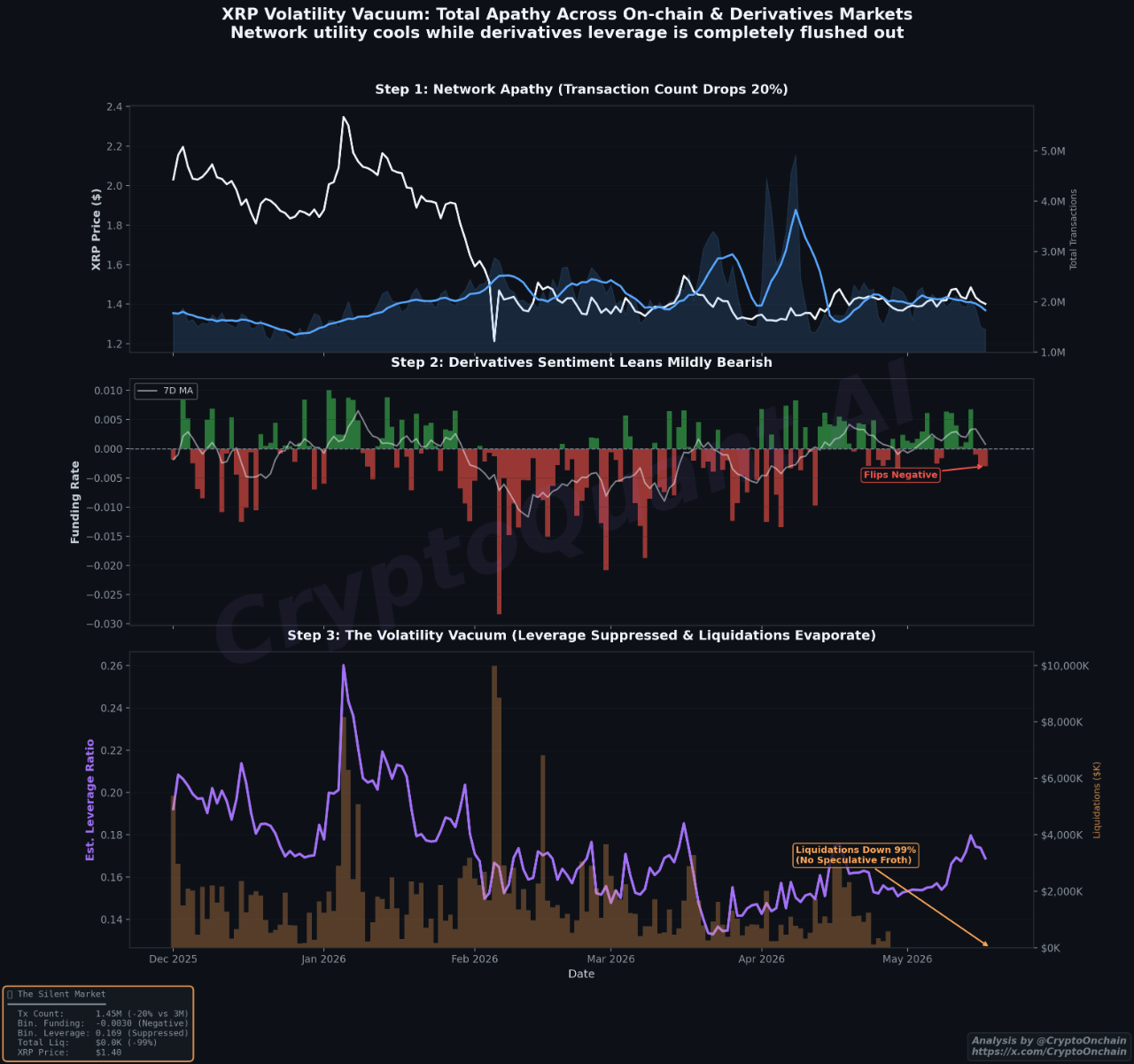
Amid the ongoing market pullback, verified CryptoQuant analyst CryptoOnChain says XRP is now moving through what he calls a volatility vacuum. He believes the current situation could lead to a massive price move once the market gets a major catalyst.
Key Points
XRP climbed to $1.58 on May 14 before falling to $1.38 during the wider crypto market correction.
CryptoOnChain says XRP is undergoing a “volatility vacuum” as trading activity and leverage decline.
XRP Ledger daily transactions dropped 20% over three months to around 1.78 million transactions.
Binance’s Estimated Leverage Ratio dropped to 0.173, below its six-month peak of 0.260.
This volatility vacuum could act as a precursor to a price expansion once the right catalyst hits.
Ali Martinez says a close above $1.50 could send XRP toward $1.80.
Weak Activity Across the XRP Market
In hisanalysis, CryptoOnChain said XRP is trading in a very quiet market as prices fall.Specifically, after XRP climbed to $1.58 on May 14, it collapsed alongside the rest of the crypto market, and the bearish momentum has intensified following hot U.S. inflation data.
Amid the downturn, the analyst called attention to slowing activity on the XRP Ledger, noting that the network’s daily transaction count has fallen by 20% compared to three months ago. Daily transactions now stand at around 1.78 million, showing weaker participation across the network.
He also highlighted weakness in the derivatives market. According to him, Binance funding rates have moved into negative territory at -0.003. Meanwhile, total liquidations have dropped by 99%, falling to only a few thousand dollars per day.
CryptoOnChain explained that lower transaction activity alongside negative funding rates usually indicates a quiet market with limited interest from traders. He said the drop in network activity shows weaker organic usage, while futures traders appear slightly bearish and continue paying to hold short positions.
XRP Enters Volatility Vacuum
Despite the bearish funding rates, CryptoOnChain said the derivatives market shows encouraging data. He pointed out that Binance’s Estimated Leverage Ratio remains low at 0.173, far below its six-month high of 0.260.
XRP Enters Volatility Vacuum | CryptoQuant
Notably, the 99% collapse in liquidations shows traders are no longer using heavy leverage in either direction. As a result, the analyst believes speculative activity has largely faded from the market. To him, XRP currently lacks the excessive leverage that usually drives sudden squeezes higher or lower.
CryptoOnChain said XRP has now entered what he calls a classic volatility vacuum, where risk appetite remains low, and market participants show little interest. He explained that traders have mostly cleared out leveraged positions, and on-chain activity has also slowed.
According to him, these periods of exhaustion and low liquidity often come before large price swings. He believes the market is now resetting and waiting for a strong macroeconomic or fundamental event to trigger the next major move.
Key XRP Breakout Levels
In a separate analysis, market analyst Ali Martinez also mentioned that technical signals suggest a major move could be close.
Martinez said XRP’s 3-day chart is showing its tightest Bollinger Band squeeze in more than a year. He explained that when volatility tightens this much, the market often sees a sharp price expansion soon after.
I'm tracking the tightest Bollinger Band squeeze on the XRP's 3-day chart in over a year. When volatility compresses this tightly, it’s a signal that a violent price expansion is approaching.
According to him, the current range between $1.50 and $1.29 is a no-trade zone. Instead of entering positions early, Martinez said traders should wait for the market to confirm its direction before making moves.
According to him, a clean 3-day candlestick close above $1.50 would confirm bullish momentum and could push XRP toward his main target at $1.80. On the other hand, a close below $1.29 would weaken the bullish outlook and could send XRP down toward the key psychological support level at $1.
The crypto API market has matured into specialized providers serving distinct niches. Some focus on aggregated market and wallet data. Others handle non-custodial swaps. A few specialize in trading signals or wallet integration. Developer roundups in 2026 echo this split, separating RPC infrastructure from aggregated data APIs. This guide compares six providers across coverage, pricing, technical capabilities, and ideal use cases.
The right choice depends on what your product actually needs. Most production stacks combine two or three. Below is a quick overview, followed by detailed analysis of each provider.
Quick Comparison Overview
Provider
Best For
Starting Price
Key Strength
CoinStats API
Comprehensive aggregated market data plus wallet and portfolio
Free (credit-based)
Reliable all-in-one data layer trusted by 1M monthly users
ChangeHero
Non-custodial crypto swaps
Free (revenue share)
Wide partner network, fixed and floating rates
altFINS API
Trading analytics and signals
Free / $39+/mo
150+ indicators, 130+ pre-built signals
StealthEX
Non-custodial swap infrastructure
Free (revenue share)
Privacy-first, no user accounts required
CoinPaprika
Market data and project metadata
Free / $99+/mo
Founder profiles via “People” endpoint
Phantom API
Embedded wallet integration
Free
Social login, multi-chain SDK
Table of Contents
Detailed Provider Analysis
Comparison by Use Case
Technical Comparison
Pricing Comparison
Conclusion and Recommendations
Detailed Provider Analysis
1. CoinStats API ⭐ Best All-in-One Crypto API
Comprehensive, reliable, all-in-one crypto data API with aggregated market, wallet, and DeFi coverage.
Company Overview:CoinStats’ crypto API aggregates comprehensive market data, wallet balances, DeFi positions, and news. Everything sits under one REST API. Developer communities often describe it as a popular all-in-one solution. The same infrastructure powers CoinStats, the consumer app with 1M monthly users. That production base gives the API a reliable track record at scale.
Core Strengths
100,000+ Coins Across 200+ Exchanges: Real-time and historical pricing across centralized and decentralized venues. Coverage includes Binance, Coinbase, Hyperliquid, and others. Spot prices, volumes, and market caps return in a consistent schema.
Multi-Chain Wallet Support: A single endpoint returns balances, transactions, and DeFi positions across 120+ blockchains. Networks include Solana, Ethereum and EVM chains, and Bitcoin with xpub/ypub/zpub formats.
10,000+ DeFi Protocols: Staking, lending, LP positions, and yield are detected automatically. They return alongside standard wallet balances. No additional integrations are required.
Portfolio and News Layers: Portfolio data returns total value, holdings breakdown, and performance over time. Aggregated news from 200+ sources surfaces trending topics for research dashboards.
MCP Server for AI Agents: CoinStats MCP Server exposes the same data layer to LLMs through Model Context Protocol. AI agents connect inside Claude Code, Cursor, and VS Code. They can query balances, prices, and positions through natural language.
Token Security Checks:Token security API flags honeypots, hidden fees, and upgradeable contracts. Wallets and trackers can screen assets before swaps.
Data Specifications
Assets: 100,000+ cryptocurrencies
Exchanges: 200+ centralized and decentralized
Blockchains: 120+ networks for wallet and DeFi data
Historical Depth: Roughly 10 years of pricing data
API Type: REST API plus MCP Server
Pricing
CoinStats API uses a credit-based pricing model. Developers receive a free tier at signup. Credits scale with endpoint complexity and request parameters. A single-chain wallet balance costs fewer credits than balances across all networks. Usage tracking and credit costs are documented transparently.
💡 Recommended: Start with the free tier for prototyping. Upgrade as request volume scales.
Ideal For
Portfolio trackers and multi-chain wallet apps
Market data aggregators and research dashboards
AI agents that need structured crypto data
DeFi trackers and yield analytics tools
Fintech products that blend pricing with portfolio views
Limitations
Does not expose raw blockchain RPC or node-level access
Not designed for microsecond-level high-frequency trading
Documentation Quality: ⭐⭐⭐⭐⭐ Well-organized hub at coinstats.app/api-docs with endpoint references and code examples.
2. ChangeHero ⭐ Best for Wallet Swap Integration
Non-custodial swap engine trusted by major hardware and software wallets.
Company Overview:ChangeHero is a non-custodial instant crypto exchange. Founded in 2017, it has built a reputation in the wallet integration space. Partners include Trezor, Exodus, Tangem, OneKey and many other hardware and self-custody wallets. The exchange engine is exposed through a public API for partner integrations.
Core Strengths
350+ Cryptocurrencies: Asset coverage extends to over 350 cryptocurrencies. New ones are added regularly based on partner demand.
Fixed and Floating Rate Swaps: Both rate types are supported through the same endpoints. Fixed rates lock in receive amount. Floating rates target the best market price at execution.
Aggregated Liquidity: Sources include multiple trading venues such as Binance, Huobi, OKEx, and KuCoin. If one source goes down, transactions continue uninterrupted.
Free Integration: No setup or monthly fees apply. Partners earn through customizable commissions on each transaction.
Custom Setup: ChangeHero offers flexible integration customization tailored to partner requirements. This includes optimized swap routing for faster execution, dedicated exchange flows, custom fee configurations, and zero-fee stablecoin swap options for selected pairs. The team works directly with partners to adapt the integration to specific wallet UX, liquidity, and monetization needs.
Trusted Partner Network: Trezor, Exodus, Edge, MoonPay, Tangem, OneKey and other wallets ship with ChangeHero swap functionality. That track record speaks to API stability.
Data Specifications
Coins Supported: 350+
Settlement Time: Typically under 15 minutes
Rate Options: Fixed and floating
User Features: Flexible partner configuration
API Type: REST API
Uptime: 99% reported track record
Pricing
Integration is free of charge. Partners earn through customizable commissions on each swap. There are no minimum volume commitments. Multiple API keys with different commission structures are supported for added flexibility.
💡 Recommended: Use the free integration with a custom partner commission tuned to your volume.
Ideal For
Wallets adding in-app swap functionality
Hardware wallet integrations
Payment platforms and white-label exchange services
Web3 apps that monetize through swap fees
Limitations
Not a market data provider
Pricing feeds and portfolio data must come from a separate source
Documentation Quality: ⭐⭐⭐⭐⭐ Comprehensive with clear endpoint reference and code examples.
3. altFINS Analytics Data API ⭐ Best for Trading Signals
Pre-computed indicators and ready-to-use trading signals delivered via API.
Company Overview:altFINS Analytics Data API focuses on technical analysis and pre-computed signals. Rather than returning raw OHLC data, the API ships with calculations done. That eliminates months of indicator and strategy development time.
Core Strengths
150+ Technical Indicators: Includes SMA, EMA, RSI, MACD, Stochastic, Williams %R, CCI, ADX, ATR, and more. Trend, momentum, volume, and pattern recognition indicators all sit in one feed.
130+ Pre-Built Signals: Cover trend reversals, momentum shifts, breakouts, volume spikes, and crossover events. Ready-to-use rather than requiring custom logic.
Fundamental Metrics: TVL, total revenue, protocol revenue, market cap ratios, and growth rates over multiple timeframes. Useful for blending fundamentals with technicals.
MCP Server for AI Agents: Adapts the API for natural language queries from LLMs. AI trading copilots can consume signals without extra middleware.
Data Specifications
Assets: 2,000+ cryptocurrencies
Exchanges: Aggregated from 30 venues
Time Intervals: 15m, 1h, 4h, 12h, 1d
Historical Depth: 7+ years
API Type: REST API plus MCP Server
Pricing
Plan
Price
Credits
Rate Limit
Free
Free
1K/month
30/min
Hobbyist
$39/month
100K/month
120/min
Startup
$99/month
300K/month
120/min
Standard
$299/month
1M/month
300/min
Professional
$699/month
3M/month
600/min
💡 Recommended: Standard plan ($299/month) for professional traders and small teams.
Ideal For
Algorithmic trading bot developers
AI agents and trading copilots
Quantitative researchers running backtests
Signal-based platforms and analytics dashboards
Limitations
Narrower asset coverage than broad-market APIs
No wallet tracking, portfolio data, or onchain analytics
Documentation Quality: ⭐⭐⭐⭐⭐ Detailed API reference with indicator explanations and code examples.
4. StealthEX ⭐ Best for Privacy-First Swaps
Non-custodial swap infrastructure with no mandatory account creation.
Company Overview:StealthEX is a non-custodial cryptocurrency exchange. Its API lets developers embed swaps into wallets, trading terminals, and payment tools. End users do not need StealthEX accounts to trade. The platform is known for prioritizing privacy.
Core Strengths
2,000+ Coins and Tokens: Coverage across multiple networks. One of the wider asset selections in the swap category.
Floating and Fixed Rates: Both options are supported through the API. Floating matches market price at execution. Fixed locks in the receive amount for longer confirmation windows.
Privacy-First Approach: No mandatory KYC checks for standard swap volumes. Risk-based screening can apply on flagged transactions only.
Compact Documentation: Endpoints cover currency lists, rate estimates, exchange creation, and status lookups. Easy to integrate.
Revenue-Sharing Model: No subscription fees. No monthly minimums during early testing. Easy to prototype.
Data Specifications
Coins Supported: 2,000+
Settlement Time: Typically 5 to 30 minutes
Rate Options: Fixed and floating
API Type: REST API
KYC: Not required for standard volumes
Pricing
Free integration with revenue sharing. Partners earn on transaction volume routed through their integration. No monthly commitments are required.
💡 Recommended: Test integration on the free tier before scaling.
Ideal For
Wallets adding swap functionality
DEX aggregators and payment processors
Web3 apps and Telegram bots
Privacy-focused crypto products
Limitations
Not a market data or analytics provider
Price feeds and portfolio tracking need a separate source
Documentation Quality: ⭐⭐⭐⭐ Compact and easy to navigate.
5. CoinPaprika ⭐ Best for Project Metadata and Founder Profiles
Long-running market data API with unique team and founder data.
Company Overview:CoinPaprika is a long-standing crypto market data provider. It has delivered pricing and project data since 2018. Uptime sits at 99.9%. Data is sourced from over 500 inputs and aggregates 350+ active exchanges.
Core Strengths
10,000+ Coins: Pricing, volumes, market caps, and rankings across centralized and decentralized exchanges.
“People” Endpoint: Returns biographies, social profiles, and team positions for crypto project founders. A unique feature compared to other market data APIs.
13 Years of Historical Data: OHLCV, market caps, and global market metrics. Useful for research and backtesting.
Project Metadata: Team information, descriptions, social links, and tag-based categorization. Reduces the need for separate data sources on detail pages.
MCP Server: Integration with Claude, Cursor, and VS Code. A sister product called DexPaprika covers onchain DEX data.
Data Specifications
Assets: 10,000+
Exchanges: 350+
Historical Data: 13 years
API Type: REST plus WebSocket on higher tiers
Uptime:9%
Pricing
Plan
Price
Notes
Free
Free
20K calls/month, no API key required
Starter
$99/month
Internal use only
Business
$799/month
Adds sub-daily OHLCV intervals
Ultimate
$1,499/month
Internal use only
Enterprise
Custom
Required for commercial public-facing apps
💡 Recommended: Free tier for prototyping. Enterprise contract required for commercial public-facing apps.
Ideal For
Market overview pages and asset directories
Internal dashboards and research tools
Projects needing founder and team metadata
Non-commercial and academic projects
Limitations
Free tier capped at 2,000 assets with 5 to 10 minute price refresh
WebSocket streaming gated behind Enterprise plans
Commercial use cases require separate Enterprise contract
Documentation Quality: ⭐⭐⭐⭐ Clean and well-organized.
6. Phantom API ⭐ Best for Solana Wallet Integration
Embedded wallet SDK with social login for mainstream user onboarding.
Company Overview:Phantom API is the developer interface behind one of the largest Solana wallets. The embedded wallet SDK lets apps integrate wallet functions directly. No browser extension is required. Phantom supports around 7 million monthly active users. That gives the API a solid production track record.
Core Strengths
Multi-Platform SDKs: React, React Native, browser, and server SDKs cover web, mobile, and backend use cases.
Social Login: Users sign in with Google or Apple instead of installing a browser extension. Removes a major onboarding hurdle for non-crypto-native users.
Multi-Chain Support: Solana primarily, with Ethereum and EVM chain support in active development.
Built-in UI Components: Pre-styled connect components handle the full wallet flow with minimal code.
MCP Server: AI agents in Claude Desktop, Cursor, and Claude Code connect through it. They can interact with wallet functions through natural language.
Data Specifications
Chains Supported: Solana plus EVM chains in development
Free for developers. Phantom has indicated plans for monetization tied to dApp integrations. No upfront costs apply currently.
💡 Recommended: Free integration for any Solana app targeting mainstream users.
Ideal For
Solana dApps and DeFi protocols
Mobile-first crypto apps
Products targeting mainstream users
Apps that want social-login wallet onboarding
Limitations
EVM support is still rolling out
Not a market data, swap infrastructure, or analytics provider
Documentation Quality: ⭐⭐⭐⭐⭐ Comprehensive with starter templates and example implementations.
Comparison by Use Case
Multi-Chain Portfolio Tracking and Aggregated Data
🏆 Top Choice: CoinStats API
CoinStats API delivers comprehensive aggregated market data alongside wallet, DeFi, and portfolio analytics. One integration returns market prices, multi-chain balances, DeFi positions, and news. Its 1M-user production base gives the API a reliable foundation. Developer communities frequently describe it as a popular all-in-one solution. That mix makes it a practical default for most use cases in crypto.
Algorithmic Trading and Signals
🏆 Top Choice: altFINS Analytics Data API
altFINS delivers 150+ pre-computed indicators and 130+ ready-to-use signals. That eliminates the need to build indicator math from scratch. Backtesting against 7+ years of history is supported.
Non-Custodial Swap Integration
🏆 Top Choices: ChangeHero and StealthEX
Both let developers embed swaps without building exchange infrastructure. ChangeHero leans toward broad partner integration with hardware wallets. StealthEX leans toward privacy-first flows with no user accounts.
Wallet Integration on Solana
🏆 Top Choice: Phantom API
Phantom API delivers an embedded wallet experience with social login. That makes it a fit for Solana apps targeting mainstream users.
Lightweight Market Data and Project Metadata
🏆 Top Choice: CoinPaprika
CoinPaprika fits projects that need market data plus founder and team metadata. The free tier works well for non-commercial prototyping.
Technical Comparison
Provider
Update Frequency
Best Use Case
CoinStats API
Real-time pricing, ~5 second wallet sync
Portfolio tracking, multi-chain dashboards
ChangeHero
Quote refresh under 1 second
Embedded swap widgets
altFINS API
Minute-by-minute updates
Trading signals, technical analysis
StealthEX
Real-time quote estimation
Embedded swap widgets
CoinPaprika
3 to 10 minute refresh on free tier
Market overview, asset directories
Phantom API
Real-time wallet operations
Solana app wallet integration
Pricing Comparison
Free Tiers
All six providers offer a free tier or free credits. CoinStats API, altFINS, ChangeHero, StealthEX, and Phantom API are free to start. No credit card is required. CoinPaprika offers 20,000 monthly calls free without an API key.
Entry-Level Paid Plans
altFINS Hobbyist starts at $39/month for 100K credits. CoinPaprika Starter starts at $99/month with internal-use restrictions. CoinStats API uses credit-based scaling rather than fixed tiers.
Mid-Tier and Pro Plans
altFINS Standard at $299/month covers professional trading teams. CoinPaprika Business at $799/month adds sub-daily intervals. CoinStats API scales transparently with usage.
Enterprise
CoinPaprika Ultimate at $1,499/month and custom Enterprise contracts unlock commercial public-facing use. CoinStats API offers higher-volume custom plans on request.
Conclusion and Recommendations
Top Picks by Category
Best Overall for Multi-Chain Crypto Apps: CoinStats API
Comprehensive aggregated market data with multi-chain wallets, DeFi positions, and news in one integration. The 1M-user consumer base gives the API a popular and reliable foundation. That all-in-one positioning fits most general-purpose crypto products. Free tier with credit-based scaling.
Best for Trading Analytics: altFINS API
150+ pre-computed indicators and 130+ ready-to-use signals. Designed for trading bots and AI agents. Standard plan at $299/month for professional teams.
Best for Embedded Swaps with Hardware Wallets: ChangeHero
Free integration with revenue sharing. Trusted by Trezor, Exodus, CoolWallet, and other major wallets. Fixed and floating rates supported through the same API.
Best for Privacy-First Swap Infrastructure: StealthEX
Free integration with revenue sharing. No mandatory KYC for standard swap volumes. Coverage across 2,000+ coins makes it strong for altcoin-heavy flows.
Best for Solana Wallet Integration: Phantom API
Embedded SDK with social login. Free for developers. Best fit for products targeting mainstream users.
Best for Project Metadata: CoinPaprika
10,000+ coins with unique founder and team metadata. Free tier for non-commercial use. Paid plans from $99/month for internal applications.
Final Thoughts
The crypto API landscape rewards matching providers to specific use cases. Most production stacks combine two or three.
Choose CoinStats API for comprehensive aggregated market data with wallet, DeFi, and portfolio analytics
Choose ChangeHero for embedded non-custodial swaps with hardware wallet partner integration
Choose StealthEX for privacy-first swap infrastructure with broad altcoin coverage
Choose altFINS for ready-to-use trading signals and technical analysis
Free tiers are available across all six providers. Test integrations before committing. Most successful crypto products use two or three APIs together. That covers full data and infrastructure needs.
Bitcoin suffered heavy ETP outflows last week, but long-term holders have increased exposure to the crypto leader.
Data from Bitwise in Europe highlighted this mixed development for Bitcoin in a report on Monday. It highlighted that crypto assets struggled to keep pace with traditional markets last week as heavy exchange-traded product outflows weighed on sector sentiment.
However, beneath the short-term weakness, on-chain data continues to show a different long-term trend developing. Specifically, long-term Bitcoin holders are still accumulating aggressively, tightening available supply.
Key Points
Last week, the global crypto ETPs recorded net outflows of $1.23 billion, with Bitcoin ETPs alone accounting for $1.03 billion of that figure.
The Bitwise Cryptoasset Sentiment Index dropped from its highest level since May 2025 back into neutral territory.
Long-term BTC holders now control approximately 14.85 million coins, the highest ever recorded.
Broader macroeconomic developments remain a major price catalyst for Bitcoin.
Crypto Markets Face Pressure Amid $1.23B Outflows
Last week, the global crypto ETPs recorded net outflows of $1.23 billion, with Bitcoin (BTC) investment products alone accounting for more than $1.03 billion of that figure.
Notably, US spot Bitcoin ETFs led the decline, driven by major outflows from the 21Shares Bitcoin ETF (ARKB), the Fidelity Wise Origin Bitcoin Fund (FBTC), and BlackRock’s iShares Bitcoin Trust (IBIT). Last week’s outflows ended their six-week inflow streak.
Meanwhile, Ethereum products experienced similar pressure, recording roughly $258.7 million in outflows during the same period.
As capital rotated out of crypto products, market sentiment also deteriorated sharply. The Bitwise Cryptoasset Sentiment Index dropped from its highest level since May 2025 back into neutral territory. Meanwhile, the Crypto Fear & Greed Index returned to “fear” conditions as risk appetite weakened across both crypto and traditional markets.
Long-Term Bitcoin Holders Hit New ATH
Despite weaker short-term sentiment, on-chain metrics continue to highlight strong accumulation among long-term Bitcoin holders. Data shows that wallets holding BTC for more than 155 days now control approximately 14.85 million coins, the highest level ever recorded. Interestingly, this represents 74.3% of Bitcoin’s circulating supply.
Bitcoin LTH Supply/Bitwise
Historically, this type of redistribution from short-term participants to long-term holders often appears during the later stages of bear markets. It also reduces the liquid supply because long-term holders are statistically less likely to sell their coins during periods of volatility.
In addition, Bitcoin’s Sell-Side Risk Ratio has dropped to one of its lowest readings on record, signaling extremely limited capital movement across the network. Bitwise believes these low-liquidity conditions frequently precede larger volatility events once demand returns eventually.
Bitcoin On-Chain Analysis
The asset manager also highlighted that Bitcoin trades around the critical $76,000-$80,000 range. Notably, this zone now aligns with several important technical and on-chain levels, including the short-term holder cost basis near $78,300 and the True Market Mean around $78,600.
Meanwhile, the 200-day moving average at $81,800 acts as a major overhead resistance. Bitcoin attempted to reclaim this level last week but faced rejection amid hotter-than-expected inflation readings and renewed geopolitical uncertainty.
Although market activity remains muted for now, Bitwise believes the broader setup still supports the possibility of a longer-term bottom formation over the next one to two months.
Macro Conditions Could Spark the Next Bitcoin Recovery
Beyond crypto-specific data, the report highlighted that the broader macroeconomic developments remain a major focus for Bitcoin markets. Rising Japanese bond yields and ongoing weakness in the yen have intensified concerns around sovereign debt sustainability in Japan.
The 30-year Japanese government bond yield recently reached a fresh all-time high, while the 10-year yield climbed to levels not seen since the late 1990s. Analysts warn that continued pressure in the Japanese bond market could eventually force central bank intervention.
If major central banks begin easing financial conditions to stabilize bond markets, Bitcoin could benefit from the resulting liquidity environment.
At the same time, political and regulatory developments in the United States are also drawing attention. Kevin Warsh has entered as the next Federal Reserve chair. The Digital Asset Market Clarity Act also recently advanced through the Senate Banking Committee with bipartisan support. How these developments shape market sentiments could propel the next directional price move.
A new discussion around Flare Networks is drawing attention in the XRP community.
In a tweet, community figure Eri highlighted what she called one of the network’s biggest strengths: verifying activity on the XRP Ledger and Bitcoin without revealing sensitive user data.
Eri pointed to comments from Encrypted Finance, a project building a privacy-focused layer on Flare’s infrastructure. According to her, the system could support up to 48 private operations at the protocol level, including minting, swapping, lending, borrowing, staking, sealed auctions, and dark pool trading.
Key Points
Flare’s privacy layer could enable confidential XRP Ledger and Bitcoin activity without exposing user data.
Encrypted Finance says the system supports private swaps, lending, staking, and sealed auctions.
Flare combines confidential compute, decentralized pricing, and cross-chain verification tools.
The privacy-focused infrastructure is now live on Flare Networks’ Coston2 testnet.
Privacy Push for Public Blockchains
Encrypted Finance argued that public blockchains were originally for transparency and settlement, not financial privacy.
Wallet balances, transactions, trading activity, and user behavior remain permanently visible on most chains. While this level of openness works for verification and settlement, it creates problems for users and institutions that require confidentiality.
To address this, the project introduced what it calls “confidential execution” on Flare. The system uses Flare Confidential Compute, which relies on trusted hardware enclaves to process encrypted instructions privately.
Specifically, the project said instructions are entered encrypted, processed inside sealed environments, and leave encrypted again, preventing operators from viewing user activity or internal data.
XRP Ledger Verification Without Public Exposure
One of the key features highlighted was the role of the Flare Data Connector (FDC). The infrastructure allows users to verify that events occurred on the Bitcoin or XRP Ledger without publicly exposing sensitive information.
Encrypted Finance explained that the system combines three main components at the protocol level:
Flare Confidential Compute for encrypted transaction execution
Time Series Oracle for decentralized pricing data
Flare Data Connector for cross-chain verification
According to the project, this setup enables privacy decentralized finance activity while still maintaining verifiable blockchain settlement on Flare Networks.
Potential Use Cases for XRP and Cross-Chain Finance
Encrypted Finance outlined several possible uses for the technology, including private swaps, lending, borrowing, staking, governance voting, treasury management, cross-chain transfers, limit orders, and FAsset minting and redemption.
The project also highlighted features that are difficult to implement on fully transparent blockchains, such as dark pools for large trades and sealed-bid auctions.
According to the team, users and applications would control what information they share and who can view it, instead of exposing all activity on a public blockchain.
Notably, the infrastructure is currently live on Flare Networks’ Coston2 testnet, which the project describes as the first step toward expanding confidential finance across public blockchains.
Tesla, Inc. remains one of the most watched companies in global markets, and market participants have continued to assess whether it is good stock to buy for the long-term in its current position.
Since its founding in 2003 and its stock market debut in 2010 at $17 per share (split-adjusted to about $1.27), the company has grown beyond its early identity as a niche electric vehicle maker. Today, it operates in the technology, energy, and artificial intelligence sectors, putting it in a category of its own.
As of May 15, 2026, Tesla’s stock closed at $422.24, giving it a marker cap of about $1.59 trillion. Over the past year, the stock has traded between $273.21 and $498.83, posting a year-to-date decline of roughly 6.11%.
In Q1 2026, Tesla delivered 358,023 vehicles (up 6% year-over-year) and produced 408,386 vehicles. The company reported $22.39 billion in revenue (up 16% YoY) and $477 million in net income (up 17% YoY), with a non-GAAP EPS of $0.41.
Its energy segment reached a new high with 8.8 GWh deployed during the quarter. However, production exceeded deliveries by more than 50,000 units, increasing inventory to 27 days of supply. This indicated some short-term demand pressure.
Discussions around Tesla comes down to how investors choose to define the company. Some see it as an automaker facing slower growth and rising competition, while others believe it is a company looking to conquer the autonomy, AI, and energy infrastructure sectors.
This article looks at both sides to help answer whether Tesla makes sense as a long-term investment.
Tesla at a Glance
Tesla’s valuation shows strong expectations about its future instead of its current earnings. With a market cap of around $1.59 trillion, the stock trades at a price-to-earnings ratio between 390x and 406x, above traditional automakers and even most technology companies.
In 2025, Tesla generated about $94.8 billion in revenue, marking its first annual decline, while delivering roughly 1.64 million vehicles, a drop of about 8.6% year-over-year. These figures suggest that its automotive business has entered a more mature phase, where growth is no longer guaranteed.
Tesla operates across three main segments:
The automotive division includes vehicle sales, regulatory credits, and its Full Self-Driving (FSD) software.
The energy segment focuses on products like Megapack and Powerwall.
Meanwhile, the AI and robotics area includes FSD development, the Robotaxi (Cybercab) concept, and the Optimus humanoid robot.
The company runs major Gigafactories in the United States, China, and Germany, while its expansion into Mexico remains delayed.
Meanwhile, its energy business continues to gain momentum, with 46.7 GWh deployed in 2025 and 8.8 GWh already delivered in Q1 2026. FSD adoption is also growing steadily, with more than 1 million users reported in some estimates.
Essentially, Tesla’s current valuation depends on future opportunities in autonomy, robotics, and energy, instead of its present-day automotive performance.
Tesla Stock Price History
Tesla has come a long way since it went public on Nasdaq. Shortly after its IPO in mid-2010, the stock dropped 16.32% in July of that year, as it briefly touched a low of $0.9987.
However, the company entered a strong growth phase in October 2012, climbing to $19.43 by September 2014. After a period of consolidation, it reached $25.97 in September 2017, before falling to $11.80 by June 2019, a decline of more than 54%.
This downturn set the stage for one of the most notable rallies in the market. Specifically, Tesla surged to $414 in November 2021, then fell to $101 in January 2023.
It later recovered and reached a new all-time high of $488 in December 2024, shortly after Donald Trump’s election victory. Since then, the stock has continued to move in cycles, alternating between gains and pullbacks.
In 2026, Tesla started the year on a weak note, declining for three straight months from January to March and losing 18.8%, which pushed it below the $400 level. It has since recovered, gaining 2.66% in April and more than 10% in May, although it remains down 6% for the year and 13% below its peak.
Despite these fluctuations, long-term investors have seen exceptional returns. A $10,000 investment at the 2010 IPO would now be worth about $3.32 million, representing a total gain of 33,128%. This track record supports the long-term bullish case.
tesla stock price
Why Investors Consider Tesla a Long-Term Buy
Tesla proponents often mention its structural advantages as bullish cases for the stock.
One major strength is in its vertical integration, which allows the company to control much of its production process and improve efficiency over time.
Meanwhile, another advantage is its data. Notably, Tesla has collected billions of miles of real-world driving data, including about 3.8 billion miles in city driving and over 200 million autonomous miles in some updates. This data is important in improving its self-driving systems.
The energy business also strengthens Tesla’s position. With margins ranging between 29% and 39%, it often outperforms the automotive segment. In addition, FSD subscriptions provide recurring revenue, with an estimated 1.1 to 1.3 million paying users. This adds a high-margin income stream.
Interestingly, Tesla’s long-term vision extends into new markets. Specifically, projects like the Optimus humanoid robot and the Robotaxi network target large opportunities in labor and transportation.
While these initiatives remain in development, they contribute significantly to investor confidence, especially given Elon Musk’s history of pursuing ambitious goals.
Tesla’s Growth Drivers for the Future
Tesla’s future growth depends on more than vehicle sales. The company’s Robotaxi (Cybercab) initiative seeks to introduce self-driving ride services in at least 9 cities in 2026, with the potential to scale further if successful.
The energy segment has also continued to grow. After reaching 46.7 GWh in 2025, Tesla deployed 8.8 GWh in Q1 2026 alone. Its Megapack 3 production, expected to ramp in 2026, targets up to 50 GWh of annual capacity. Analysts estimate a 168% growth rate in this segment and expect it to contribute more than 20% of total profits by 2027.
Tesla is also making progress in robotics. Notably, the Optimus robot could enter limited production in 2026, starting with factory tasks before expanding into broader use cases.
Meanwhile, Tesla continues to refine its vehicle lineup, scale Cybertruck production, and develop more affordable models. Its unboxed manufacturing process seeks to reduce costs by 20% to 30%, which could improve margins over time.
Overall, analysts expect Tesla to generate between $105 billion and $110 billion in revenue in 2026 due to growth in energy and software.
Risks of Investing in Tesla Long-Term
Despite its strong potential, Tesla faces several risks that investors should not ignore.
Execution remains one of the biggest concerns. Projects like FSD, Robotaxi deployment, and Optimus have often taken longer than initially planned.
Competition is another major challenge. In 2025, BYD sold 2.26 million vehicles, surpassing Tesla’s 1.64 million deliveries. Although Tesla regained the lead in pure electric vehicles in Q1 2026 with 358,000 units compared to BYD’s 310,000, the competition continues to intensify.
Valuation also adds pressure. With a P/E ratio above 390x, Tesla must deliver strong results to justify its price. Any shortfall could lead to sharp declines in the stock.
Other risks include reliance on Elon Musk, broader economic conditions, and high capital spending estimated at $20 billion to $25 billion, which may limit free cash flow. The 27-day inventory level in Q1 2026 further suggests that demand may be soft in certain markets.
Tesla vs. Competitors
Tesla still holds an advantage in areas such as software, charging infrastructure, and overall margins. However, competitors are catching up, especially in terms of production volume and pricing.
While Tesla reclaimed the pure EV lead in Q1 2026, companies like BYD have continued to grow quickly. Traditional automakers are also becoming more competitive as they expand their electric vehicle offerings.
One major difference lies in valuation. Tesla trades at a much higher multiple than companies like General Motors, which operate with single-digit P/E ratios. This is due to Tesla’s focus on energy and autonomy, but it also increases the risk if expectations are not met.
What Analysts Say About Tesla Stock
tesla stock in 2026
Wall Street is still divided on Tesla. The company’s push from being primarily an electric vehicle maker to pursuing AI, self-driving cars, and robotics has made it harder for analysts to agree on where the stock is headed. Currently, the general consensus across major financial platforms sits at Hold.
Public.com, using 26 analysts, shows a Hold consensus, with 27% rating the stock a Strong Buy, 23% a Buy, 35% a Hold, and 16% a Sell or Strong Sell. Meanwhile, MarketBeat’s pool of 41 analysts comes down to 19 Buys, 17 Holds, and 5 Sells.
Also, price targets for the next 12 months cluster between $395 and $413. Specifically, $406.65 from Public.com, $398.42 from MarketBeat, and $403.59 from Benzinga. With the stock trading at around $422, those targets suggest a modest downside from current levels.
Meanwhile, the most optimistic Tesla bull is Dan Ives of Wedbush Securities, who has set a $600 price target and maintains an Outperform rating. Ives has consistently called 2026 a breakout year for Tesla due to the expected launch of its Robotaxi service across dozens of cities, alongside continued growth in AI.
In his more optimistic projections, he sees Tesla’s market cap potentially climbing to between $2 and $3 trillion, calling the company a “physical AI” platform in the making.
Financial firm Stifel also holds a Buy rating, with a $508 target. The firm highlights active Robotaxi pilots in Austin and the Bay Area, plans to expand to more cities in the first half of 2026, steady improvements to Full Self-Driving software, and progress on Optimus, which is targeting production before the end of 2026.
However, the skeptics have raised some concerns. GLJ Research has one of the lowest targets on the Street at $24.86, holding a Sell rating issued in April 2026. This is due to doubt that Tesla can realistically deliver on its most ambitious plans.
JPMorgan’s Ryan Brinkman remains at Underweight with a $145 target, citing growing capital costs, weakening EV demand, and questions about whether autonomous driving can ever be a viable business at scale.
UBS shifted to Neutral in April 2026 with a $364 target, and Barclays holds a similar view at $360. Earlier this year, Wells Fargo’s Colin Langan mentioned targets around $125, highlighting concerns about Tesla’s camera-only approach to self-driving and the strain that ongoing investments are placing on margins.
Tesla Stock Price Prediction: 2026, 2030, and 2040
Tesla’s long-term price outlook depends on how well it executes its strategy.
For 2026, base estimates range between $450 and $550, with revenue projected at $105 billion to $115 billion. Bullish scenarios place the stock above $700, while bearish cases fall between $250 and $350. Interestingly, Ark Invest previously predicted a target of $4,600 for 2026.
By 2030, base projections suggest a range of $800 to $1,200, with optimistic cases reaching $2,000 to $3,000 or more, and bearish outcomes between $300 and $600.
In 2040, base estimates range from $2,000 to $4,000, while bullish scenarios exceed $10,000, and bearish cases fall between $500 and $1,500.
Is Tesla Overvalued or Undervalued?
Using traditional valuation metrics, Tesla appears expensive due to its high P/E and price-to-sales ratios. However, these measures do not fully account for its potential in AI, robotics, and energy.
If Tesla succeeds in scaling these areas, its current valuation could prove reasonable over time. At the same time, the stock already reflects strong expectations, which means there is limited room for error.
Should You Buy Tesla Stock Today?
Tesla may suit investors who are comfortable with risk and have a long-term outlook of five to ten years or more. Those who believe in its direction across AI, autonomy, and energy may see value despite its volatility.
However, it may not appeal to investors who prefer stable and predictable returns. Managing position size and tracking major milestones,.such as Robotaxi launches, Optimus development, and margin trends, is important.
Tesla has a mixture of high potential and high uncertainty. Its past performance shows what is possible, but its future will depend on how well it executes its plans in a more competitive and demanding market.
FAQs
Is Tesla, Inc. a good long-term investment?
Tesla can be a strong long-term investment for those who believe in its direction around technology, AI, and energy. Its past performance shows massive returns, but the high valuation and execution risks show investors should be cautious and have a long-term mindset.
What will Tesla stock be worth in 2030?
Estimates vary, but most projections place Tesla between $800 and $3,000+ by 2030. The final outcome will depend on how well the company succeeds in major areas like autonomy, robotics, and energy growth.
Is Tesla stock a buy, sell, or hold?
Most analysts currently rate Tesla as a Hold. Whether to buy, sell, or hold depends on your risk tolerance and confidence in Tesla’s long-term catalysts.
What are the biggest risks of investing in Tesla?
Major risks include delays in self-driving and robotics development, rising competition from companies like BYD, possible valuation declines, reliance on leadership, and economic pressures that could affect demand and margins.
How has Tesla stock performed historically?
Tesla has delivered exceptional long-term gains, rising thousands of percent since its IPO. However, this growth has come with repeated sharp declines, showing that volatility remains a major part of the stock’s behavior.
Is Tesla better than other EV stocks?
Tesla stands out in areas like software, technology integration, and business diversification. However, competitors are catching up in production volume and pricing. This makes the overall leadership position more competitive.
Can Tesla stock reach $1,000?
Reaching $1,000 (a 136% rise from current prices) is possible in a bullish scenario. The company has reached similar valuation levels before, but achieving this again will depend on strong execution.