Home Blog Page 1223

Crypto Mom Hester Peirce Backs Repeal of SAB 121, Calls it an Unnecessary Burden on Industry

0

SEC Commissioner Hester Peirce has acknowledged that the agency granted exemptions to specific entities to provide crypto custody services for Bitcoin and other cryptocurrencies, bypassing the restrictions imposed by SAB 121.

Peirce disclosed this position during yesterday’s SEC hearing with the House Financial Services Committee.

The Controversy Over SAB 121

For context, the SEC’s Staff Accounting Bulletin 121 (SAB 121) requires companies holding digital assets for customers to report them as liabilities on their balance sheets. This has sparked controversy, as it disrupts traditional accounting practices and adds financial burdens on companies offering crypto custody services.

The crypto industry views this rule as regulatory overreach, arguing that it unnecessarily increases business costs and stifles innovation. Specifically, financial institutions have found it challenging to comply with SAB 121, as it complicates their ability to safely and affordably offer custody services for digital assets.

Critics also highlight a lack of transparency from the SEC, particularly regarding exemptions from the rule, which has caused further confusion within the industry.

Interestingly, SAB 121 has united both chambers of Congress, which passed legislation to overturn the rule in July. However, the bill was vetoed by President Biden.

Nevertheless, U.S. lawmakers continue to push for the SEC to rescind SAB 121. They argue that it stifles the growth of the crypto sector while providing little benefit in terms of investor protection. 

SEC Chairman Not Rescinding SAB 121

During the latest hearing, SEC Chairman Gary Gensler was specifically asked whether he would commit to rescinding SAB 121. He declined, asserting that it represents “good accounting.”

Gensler’s main defense is that the rule pertains to the treatment of assets in bankruptcy. After multiple crypto bankruptcies, courts have classified certain assets as liabilities, which forms the basis of the accounting bulletin.

Crypto Mom Agrees to Rescind SAB 121

In contrast, Commissioner Hester Peirce, known as “Crypto Mom,” expressed her agreement to rescind SAB 121 when a similar question was posed to her. She suggested that the SEC should revisit the drawing board to determine the appropriate accounting standards for this space. 

Peirce emphasized the importance of involving the public in the process rather than simply issuing a staff bulletin and enforcing it.

She also pointed out that while the rule technically applies to public companies, the SEC has extended it to broker-dealers and is now beginning to roll it back for certain entities.

Additionally, Peirce noted that SAB 121 has contributed to Coinbase being the only custodian for crypto assets among ETF issuers in the U.S.

“SAB 121 makes it very hard for people to be custodians in this space,” she commented.
Binance Refutes Claims of a Data Breach Involving 13 Million Users

0

Leading crypto exchange Binance has refuted circulating speculations of a data breach affecting almost 13 million users on its platform.

Amidst swelling speculations of a data breach on the largest crypto exchange by trading volume, Binance has refuted these claims. The exchange noted that it has investigated the assertions and found them to be false.

Data Breach?

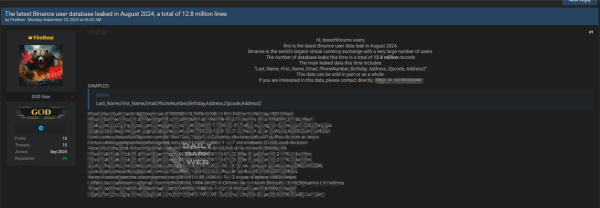
Per a post on the dark web, a threat actor claimed he had obtained sensitive information of about 12.8 million Binance users. Firebear, as his username states, alleged he acquired the data during a platform comprise in August 2024.

Firebear, also known as Greavys, stated that the data contained first names, last names, e-mail addresses, zip codes, birthdays, and secondary addresses of these Binance users.

Furthermore, the cybercriminal asserted that this information was for sale, and he would auction it off either in parts or in whole to interested buyers through his Telegram account.

This concerning development drew skepticism among Binance users and the entire crypto community, as information of this nature could be used for cyber fraud and phishing activities.

Binance User Data
Alleged Binance User Data

It bears mentioning that Greavys and other dark web cybercriminals have successfully carried out notable scam activities before. In August, they posed as Google and Gemini representatives and exploited users’ Bitcoin wallets. The group used remote control software and obtained $242 million from victims.

Binance Refutes Claims

Meanwhile, Binance assured users that these claims were false. The exchange stated that its security team investigated the assertions and found no data breach in August.

Notably, the leading exchange was also involved in a data compromise scandal earlier in the year. In February, an account called Termf leaked what was allegedly private information of Binance users on GitHub.

The leaked data contained information like Binance’s internal passwords and multi-factor authentications. Notably, after a copyright request, Binance took down the GitHub post, claiming the contents were outdated.

Meanwhile, cybersecurity experts reacted to the supposed data breach, calling for caution. A researcher at Blockaid, Oz Tamir, advised Binance users to tighten security around their accounts.

Tamir noted that although Binance has denied the claims, events like this precede phishing attacks. He encouraged users to implement the two-factor authentication security layer to avert the chances of being victimized.

Bitcoin Country El Salvador Now 8th Safest Nation in the World

0

El Salvador, a Bitcoin-friendly country, has now become one of the safest nations in the world amid drastic policies from Bitcoin advocate Bukele.

El Salvador’s transformation under President Nayib Bukele has been nothing short of remarkable. Once one of the most dangerous countries in the world, El Salvador is now ranked as the 8th safest nation, according to recent reports.

Data shared by media outlet Radar Hits confirms that up to 88% of the El Salvadoran population now feels safe walking alone. 

This is a contrast to its situation a decade ago when violence and crime were rampant. For context, historical data confirms that from 2015 to 2016, about 70% of the population felt unsafe walking, while only 30% felt safe. 

Notably, the recent data suggests that Kuwait tops the list for countries whose citizens feel safe walking alone, with about 99% of people having a sense of safety. Meanwhile, Singapore also boasts a high rate of 94%, with Norway and Saudi Arabia both seeing 92%.

President Bukele’s Tough Stance

Despite El Salvador being 8th on the list, its progress from 30% feeling safe to 88% within eight years is particularly commendable. A key driver of this transformation has been President Nayib Bukele’s tough stance on crime. 

His “state of exception” policy, introduced in March 2022, allowed mass incarcerations of gang members, drastically reducing violence. Despite criticism from human rights organizations, who argue that this policy bypasses legal safeguards and harms civil liberties, the impact on public safety has been undeniable. 

The policy helped arrest thousands, but some organizations argued that certain individuals were innocent. Interestingly, the murder rate in El Salvador plummeted, leading to the country’s new reputation as a safer destination for both residents and tourists.

El Salvador’s Bitcoin Bet

Notably, Bukele’s reforms also extended beyond security to the economic scene. One of his most controversial decisions was adopting Bitcoin as legal tender in 2021, alongside the U.S. dollar. 

Initially, the move faced backlash from international financial institutions, many of which warned that this could destabilize El Salvador’s economy. Agencies like Fitch Ratings even downgraded the country’s credit rating, predicting financial disaster.

However, Bukele’s Bitcoin gamble is now paying off. The country’s Bitcoin bonds, once considered high-risk, have soared in value. Bukele committed to buying 1 BTC a day from November 2022. Data shows the country now holds 5,883 BTC, with a profit of $60.5 million.

These profits are mostly due to a rebound in Bitcoin’s price, with the premier crypto’s resurgence triggering growing confidence in El Salvador’s financial management. 

Multiple global investors, once skeptical, are now backing the country, attracted by opportunities in Bitcoin mining and renewable energy projects that leverage the country’s natural resources.

A Boost in Tourism and Digital Economy

Further, Bukele’s administration has also focused on infrastructure and digital connectivity. Tourism is booming, with initiatives like SurfCity and the hosting of major international events, such as the 2023 Central American and Caribbean Games, drawing global attention to the country.

While Bukele’s policies continue to face criticism—particularly from those who see his governance style as authoritarian—the results speak for themselves. El Salvador’s economy is stabilizing, tourism is growing, and for the first time in years, Salvadorans feel safer in their own country. 

Crypto Mom Says SEC Should Have Admitted Earlier That Crypto Assets Aren’t Securities Themselves

0

SEC Commissioner Hester Peirce, popularly referred to as Crypto Mom, addresses the regulatory ambiguity surrounding crypto classification during a recent congressional hearing.

Yesterday’s hearing saw five SEC commissioners, Gary Gensler, Hester Peirce, James Lizarraga, Mark Uyeda, and Caroline Crenshaw, testify before the U.S. House Financial Services Committee. As reported earlier, this landmark event marked the first time since 2019 that all SEC commissioners testified before Congress. 

Peirce Criticizes SEC Over Its Imprecise Language 

During the hearing, Peirce criticized the SEC for using imprecise language to create confusion about whether a token itself is a security or part of an investment contract. According to Crypto Mom, the agency’s continuous use of imprecise language has wrongly suggested that the token itself is a security. 

She emphasized that this lack of clarity affects how the token can be traded in the secondary market and who can list it. Notably, Crypto Mom slammed the commission for neglecting its duty by not being precise with industry stakeholders.   

SEC Should Have Admitted Long Ago That Crypto Tokens Aren’t Securities 

Interestingly, Peirce referenced the SEC’s comment in the Binance lawsuit, in which the agency apologized for the confusion it created through its use of the term “crypto asset securities.” 

Earlier this month, the SEC admitted in a footnote that the term does not imply that crypto assets are securities themselves but a shorthand for the sets of contracts and expectations surrounding the distribution of the token. 

Reacting to the comment, Peirce said the SEC should have admitted earlier that the token itself is not a security. 

SEC Treats Digital Assets Differently from Physical Ones

Rep. William Timmons questioned Peirce about non-fungible tokens (NFTs), specifically asking whether the commission views physical arts as securities. Responding, Peirce said no, prompting Timmons to express concerns about the implications if the SEC categorizes NFTs as securities. 

In response, Peirce expressed worries about how the SEC has treated digital assets differently from physical assets, finding this approach problematic. 

It’s Not Feasible for Crypto Firms or Issuers to Register With The SEC 

Meanwhile, Congressman Zach Nunn quizzed Peirce whether it is feasible for crypto-related companies and issuers to “come in and register” with the SEC. 

In response, Crypto Mom emphasized that it is not feasible realistically, noting that only a few firms have been successful with registration. 

Commissioner Uyeda Says SEC Rulemaking Condition Is Below Average Under Gensler 

The lack of regulatory clarity for the United States crypto industry has raised concerns among investors and policymakers. 

Congressman Mike Lawler voiced this concern during the recent congressional hearing when he asked Uyeda whether he believes the SEC has lost its “gold standard” under Gensler’s leadership. 

Commenting, Uyeda expressed disappointment with the current situation at the SEC, noting that he has served under six chairpersons over the years. According to him, the SEC’s current state of rulemaking is below average, suggesting that the commission’s reputation has declined drastically. 

When asked to address Uyeda’s criticism, Gensler acknowledged that they both have different policy-making views. Nonetheless, Gensler noted that the comment summaries that Uyeda refers to are available to the public, adding that the commissioner also “gets those well in advance of a vote.” 

Cardano Founder Calls Ethereum a Dictatorship Controlled by Vitalik Buterin

0

Cardano founder Charles Hoskinson has likened the operations of the Ethereum network to a dictatorship controlled by Vitalik Buterin.

In Cardano latest news, Hoskinson stated in an interview at the Token2049 conference in Singapore that the Ethereum network’s overdependence on its 30-year-old co-founder, Vitalik Buterin, has defeated the decentralization claims of the blockchain.

The Cardano founder stated the Ethereum network could not do anything without the influence of Buterin, with whom he co-founded the network housing the second largest crypto asset by market cap. He further criticized Ethereum’s governance model, asserting that every plan and operation starts and ends with Buterin.

Furthermore, Hoskinson insisted that nothing could be accomplished on Ethereum without Buterin. He stated that the Russian-born developer oversaw everything, from the next hard fork to the next step on the blockchain’s roadmap.

“Everybody looks to him for the roadmap. Everybody looks to him for inspiration, and he’s also the only person who has enough power to rally people,” Hoskinsoin stated, adding that the Ethereum network will not effectively execute its next hard fork without Buterin.

Notably, Hoskinson was one of the eight founders of the Ethereum network. However, his aspirations for the project conflicted with Buterin’s, leading to his layoff at a 2014 congregation in Switzerland.

Buterin Altering Ethereum’s Roadmap

The Cardano founder also accused Buterin of altering Ethereum’s original roadmap to shard the network, allowing the blockchain to incorporate rollups and layer-2s. This model was widely seen as monolithizing the blockchain to scuffle multichain.

With this model, the Ethereum network became scalable and housed several layer 2s and zero-knowledge (zk) rollups like Arbitrum, Base, Polygon zk, and Optimism.

According to Hoskinson, Buterin came up with the idea of L2s, drumming up the innovation until the Ethereum developers bought it. The IOHK founder explained that Ethereum preferred a drop in traction to its mainnet over incurring fee revenues from these sidechains.

Cardano Dispels Dictatorship and Anarchy

Meanwhile, Hoskinson argued that the Cardano network has dispelled the dictatorship seen in Ethereum and the anarchy on the Bitcoin network. He stated that the new community-driven, fully decentralized Voltaire era dissipated the chances of centralized governance for the Cardano ecosystem.

The Voltaire era went live on the Cardano network on September 1 after the implementation of the Chang hard fork. Under the new governance model, ADA holders will pick decentralized representatives (Dreps) to oversee the network’s affairs.

Furthermore, Hoskinson stated that the Voltaire era on Cardano has helped solve the governance trilemma. He noted that efficiency, effectiveness, and integrity were the core qualities of good governance, and the Chang upgrade has inculcated these factors into the Cardano network.

While admitting he played a crucial part in Cardano governance before now, he stated that the blockchain could thrive now with or without his input. Notably, Hoskinson has said on several occasions that his role on the Cardano network has drastically reduced after the hard fork, declaring Cardano independent.

Expert Predicts Shiba Inu Price if XRP Reaches $200

0

A widely followed account in the crypto community, “LunaClassicHQ,” recently outlined price predictions for various crypto assets like Shiba Inu and XRP as the ongoing bull run gains traction.

Earlier today, Bitcoin re-attained the $64,000 price level and continues to preserve those gains. Bitcoin’s bull trend was ignited on September 18 following a favorable U.S. economic policy.

The leading crypto traded at a low of $59,218 that day but has since risen to $64,800 over the past week, marking approximately a 10% gain. These gains have notably impacted the broader altcoin market, prompting analysts to issue bold forecasts for some of the most prominent tokens.

in this Shib crypto news, In a post on X today, LunaClassicHQ highlighted audacious price predictions for 18 crypto assets, including Shiba Inu and XRP.

First, it suggested a 2025 peak of $150,000 for Bitcoin and $10,000 for Ethereum. From Bitcoin’s current level of $64,200, this target requires a price increase of 133%. However, Ethereum’s proposed target of $10,000 demands a more formidable advancement of 281% from its current price of $2,624.

Furthermore, LunaClassicHQ has projected a peak of $200 for XRP in the ongoing bull market. For context, XRP is valued at just $0.5884 today, meaning reaching a $200 price point would require an astonishing rally of 33,890%.

This isn’t the first bold prediction for XRP. Multiple analysts have argued that once XRP breaks out of its long-term downtrend, its next destination could be an all-time high beyond $200.

Shiba Inu Price if XRP Reaches $200

Interestingly, XRP isn’t the only crypto asset for which LunaClassicHQ has suggested a daring price forecast. For the top-ranking meme coin, Shiba Inu, it proposed a target of $0.05, implying that SHIB would need to eliminate three zeros by next year.

Currently, Shiba Inu is trading at $0.00001496, and reaching $0.05 would require an astronomical price increase of over 334,124%. Given this extreme growth requirement, many crypto enthusiasts have challenged LunaClassicHQ’s projections as unrealistic for the current market cycle.

However, LunaClassicHQ is not the first notable figure in the crypto community to propose $0.05 as Shiba Inu’s peak for this ongoing cycle. A few months ago, two prominent commentators from the Bitcoin community boldly asserted that Shiba Inu could reach a peak of $0.05.

While many have dismissed this target due to the relatively short timeline proposed, some other notable entities in the crypto space, such as the crypto exchange Changelly, believe the price level is attainable but with a more extended timeline.

For instance, this exchange argues that SHIB could reach $0.03 by 2050. Meanwhile, the analytic platform Telegaon suggested that Shiba Inu could reach $0.05 by 2040.

CoinW, a top exchange, also recently boldly projected Shiba Inu could surge by over 7,627,665% to reach $1.

Over 383M XRP Moved from Bitstamp Activated Address to Single Wallet

0

XRP sees increased activity, major wallet transactions, and market consolidation.

XRP recently experienced a surge in buying activity, coinciding with a surge to the $0.60 mark. However, the upward momentum has since stalled, leading to a phase of sideways consolidation. During this period, the market has observed significant transactions involving large amounts of XRP.

XRP Transactions Linked to Exchanges

Notable transactions occurred on September 24, 2024, as a new address activated by Bitstamp sent millions of XRP on four occasions to a receiving wallet, totaling 383 million XRP. 

The first transaction, which took place at 16:07 UTC, involved the transfer of 98.852 million XRP, worth approximately $57.8 million, between two unknown wallets. This was followed by three similar transfers of 95 million XRP each, valued between $55.5 million and $55.8 million, occurring within minutes of each other.

Following these transactions, the receiving wallet subsequently moved 1 million XRP to another new unknown wallet, further fueling market speculation.

Amid these movements, additional activity caught the attention of market watchers. Upbit, a South Korean exchange, transferred 30 million XRP, worth about $17.4 million, to an unidentified wallet.

Whale Alert, a prominent crypto transfer tracker, flagged this large transfer. The substantial transfers by XRP whales often signal holding intentions, which can be seen as a bullish indicator since they may reduce sell pressure on the market.

Ripple Co-Founder Transfers Raise Concerns

The activity did not stop with large bags and exchanges. Chris Larsen, Ripple’s co-founder and one of the largest XRP holders, moved 20 million XRP. 

These funds were transferred from Larsen’s known wallet to a private wallet previously linked to sales on Binance, with subsequent transactions directed towards Binance. This chain of transfers has amplified market speculation about potential sell-offs.

Potential Breakout for XRP?

However, while XRP’s market movements draw scrutiny, analysts continue to study its price action. Sahintas, a prominent market analyst, suggests that XRP could nearly double its previous all-time high in the coming months.

According to his analysis, XRP’s price remains volatile but shows potential for a significant breakout. Earlier this month, XRP dropped to $0.5026 before rebounding and testing the $0.60 resistance level. 

Cardano Founder Says Everything is Going as Foreseen For Midnight

0

Charles Hoskinson, the Cardano founder, confirms that the Midnight development progress is proceeding as the team has planned.

The latest comment came on the back of a sneak peek shared by one of the developers working on the Devnet. Notably, Stevan Lohja, a Developer Relations Engineer at Input Output (IOHK), recently shared an image showing the ongoing development of Midnight. 

The image, posted on X, displayed technical logs from the “midnight-node-testnet,” showing processes such as syncing blocks and validating operations. These activities are important in ensuring the Midnight network’s stability, progress, and functionality.

In the image, Lohja reveals processes such as block syncing and session starts, calling the public’s attention to the network’s real-time activity. Essentially, this shows that Midnight is advancing towards a stable test environment. Consequently, the testing of the network could be on track to move to the next stage. 

Cardano Founder Responds

In response to Lohja’s post, Cardano founder and IOHK Chief, Charles Hoskinson, shared a lighthearted comment. He replied with a Star Wars meme of Emperor Palpatine, with the caption: “Everything is proceeding exactly as I have foreseen.” 

The statement aimed to assure the Cardano and Midnight communities that the privacy sidechain’s development is progressing without any setbacks. 

Hoskinson, who has been vocal about Cardano’s layered approach to blockchain innovation, remains confident that Midnight will fulfill its promise of privacy and regulatory compliance through zero-knowledge cryptography.

Midnight to Prioritize Privacy and Compliance

For the uninitiated, Midnight is designed as a data-protection sidechain for Cardano. It seeks to combine privacy with regulatory compliance, making use of zero-knowledge cryptography to allow private transactions and decentralized applications without sacrificing security or transparency. 

The network’s native tokens, NIGHT and DUST, are important for this architecture. Specifically, the chain will leverage NIGHT for governance and utility, while DUST will serve as a gas token. Together, these tokens form the core of Midnight’s economic system.

The team behind Midnight recently released the whitepaper—dubbed Nightpaper—which details the technological framework, roadmap, and vision for the sidechain. 

Notably, the document outlined the network’s goal to bridge the gap between privacy and compliance. Nightpaper also laid out a development roadmap, revealing upcoming milestones as the project moves toward the mainnet in the future.

Currently, Midnight is in the Devnet phase, with the testnet set to go live soon. The upcoming testnet will give the public the ability to experiment in a secure, sandboxed environment.

Chartist Reveals Timeframe for XRP Push to $6.3

0

Sahintas, a market analyst and crypto chartist, believes XRP has the potential to surpass its current all-time high by nearly two-fold in the coming months.

The analyst disclosed this in a recent analysis of XRP’s price movements as the market remains in an indecisive state. Recall that XRP collapsed to a low of $0.5026 earlier in the month amid the broader market turbulence.

However, it witnessed an impressive recovery, subsequently retesting the $0.60 psychological resistance. Nonetheless, after retesting $0.60, XRP has been in a consolidation phase, as buyers and sellers remain in a state of flux.

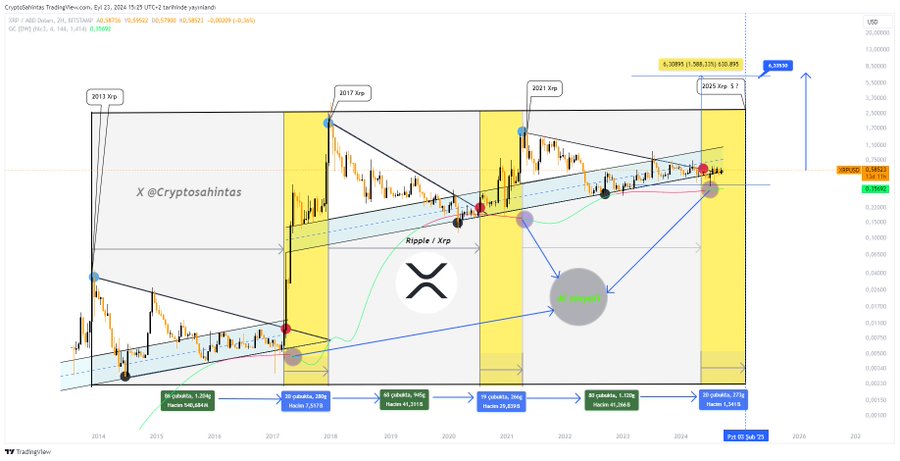
Despite this, analysts like Sahintas are optimistic about XRP’s long-term potential. In his latest analysis, the market commentator presented patterns in the monthly XRP chart. His aim was to draw attention to the consistency in these patterns, and how it suggests an imminent upsurge for XRP.

XRP Symmetrical Triangles

Notably, XRP has continued to witness symmetrical triangle structures over the years. The altcoin has so far recorded three of these triangles since 2013. Specifically, the first one formed when XRP dropped from the $0.0614 peak in December 2013. 

This triangle lasted over three years until a breakout occurred in February 2017. XRP rode on the breakout to surge to a $3.31 all-time peak in January 2018. 

XRP Symmetrical Triangles

Nonetheless, a collapse from this high resulted in the formation of the second symmetrical triangle. The second triangle ran from January 2018 to June 2020, with XRP staging a breakout amid the COVID-19 pandemic. XRP eventually reached a high of $1.96 in April 2021.

XRP Price Could Target $6.3

Another correction from this top price has now resulted in the formation of the third symmetrical triangle. Notably, this third triangle has lasted till this year, with an imminent breakout set to catapult XRP to greater heights. Sahintas believes the next top could be $6.3, marking a 963% spike for XRP.

The market analyst expects XRP to clinch this price level in 2025 but failed to specify the month. Besides Sahintas, other market watchers have called attention to this symmetrical triangle, setting varying price targets. Some argue that the current triangle started in 2018, with a rally to $0.90 set to breach it. 

Currently, XRP changes hands at $0.5923, struggling to overcome the $0.60 pivotal resistance level. Some commentators have emphasized the importance of the $0.60 point, which XRP has continued to battle. Analyst Xoom noted that XRP’s three most potent resistance levels rest on $0.65, $1.6 and $3.35. 

Here’s How Much Shiba Inu Could Be Worth If Its Price Soars 7,692,207% Like in 2021  

0

Shiba Inu could record a meteoric price increase if it replicates the historic 7,692,207% surge observed between 2020 and 2021.  

Many investors consider Shiba Inu to be one of the most successful crypto projects in the market. This assertion is triggered by Shiba Inu’s impressive performance in its early days. 

Shiba Inu Rich History 

For context, Shiba Inu officially launched on August 1, 2020. The token struggled in its early days, with its price plummeting heavily in subsequent months. As a result, many dismissed SHIB as just another failed memecoin experiment. 

Not relenting, the Shiba Inu ecosystem team adopted an efficient marketing strategy that eventually put SHIB in the limelight. According to reports, Shiba Inu’s pseudonymous founder, Ryoshi, sent half of SHIB’s total supply (500 trillion tokens) to Ethereum co-founder Vitalik Buterin in 2021. 

With Buterin expecting Shiba Inu to become worthless in the short term, he immediately burned 410.24 trillion of these tokens and sent the remaining to charities. However, Shiba Inu’s value surged tremendously like a seed planted on fertile soil. SHIB proceeded to hit an all-time high of $0.00008845 in October 2021, elevating the token to the list of the top 10 biggest crypto assets by market cap at the time. 

SHIB Surges 7,692,207% in 2020/2021 

This meteoric price increase transformed early Shiba Inu investors into overnight millionaires. Notably, popular crypto price tracking platform CoinGecko reported that early investors who invested $12 in Shiba Inu in 2020 cashed out $1 million the following year. 

It bears mentioning that this tremendous growth represents an increase of 7,692,207%. Shiba Inu’s success story motivated new investors to acquire SHIB, with the hope that the token could replicate its 2021 rally in the 2024/2025 bull market. 

Experts Say SHIB Is Mirroring Its 2021 Pattern 

While it is unlikely that Shiba Inu could repeat the rally due to its hefty circulating supply, several experts have issued multiple analyses showing that SHIB is mirroring its 2021 trend. 

In April, top crypto educationist Rafaela Ligo emphasized that Shiba Inu was mirroring a pattern it exhibited in the 2021 bull run, which could pave the way for a remarkable rally. 

Here is SHIB’s Price If It Repeats Its 2021 Rally of 7,692,207% 

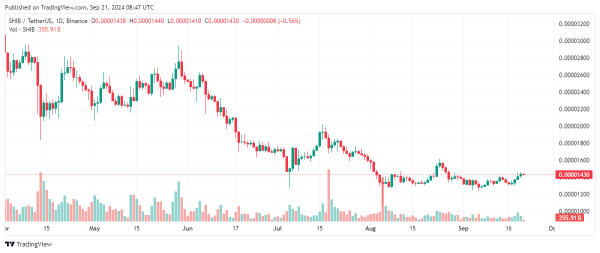
As this speculation gains momentum, we analyzed how much SHIB could be worth if it registers another 7,692,207% surge in this bull run, as it did in 2021. Currently, Shiba Inu is trading at $0.00001430, down 0.35% in the past 24 hours. 

SHIBUSDT 2024 09 21 09 47 20

Applying the 7,692,207% growth rate to Shiba Inu’s current price would elevate the asset’s value to $1.1. This jaw-dropping price increase could take Shiba Inu’s market cap from $8.41 billion to $647.68 trillion, assuming the token’s circulating supply remains stable at 589.27 trillion.   

Should Shiba Inu attain this price, a portfolio of 10 million SHIB (currently worth $143) would be valued at $11 million.