Home Blog Page 13

Bitcoin Treasury Firm Smarter Web Could Nearly Double Under TD Cowen’s Revised Stock Target

0

TD Cowen has become more optimistic about The Smarter Web Company’s stock, raising its valuation target to £0.73 ($0.99) from £0.64 ($0.87).

The firm maintained its Buy recommendation on the Bitcoin treasury company, with the new target sitting about 90% above Monday’s market price. The revision comes as Smarter Web works on MORE, a preferred-share plan designed to add another source of long-duration capital.

Smarter Web traded at £0.385 ($0.52) on Monday, compared with £0.38 ($0.51) at the end of Friday’s session. The move represented a 1.32% daily increase, according to London Stock Exchange data.

MORE Gives Smarter Web Another Financing Route

In research distributed to clients Monday, a TD Cowen team headed by Lance Vitanza focused on how MORE could change the company’s access to capital. If the plan is completed, Smarter Web would gain an additional mechanism to fund itself over the longer term.

The analysts placed the proposal within an evolving approach to financing across businesses that hold Bitcoin as a treasury asset. Such companies are experimenting with a wider mix of capital structures, ranging from preferred equity and collateral-backed borrowing to convertible instruments and other structured funding arrangements.

How MORE Is Expected to Work

Details published by Smarter Web last week show that MORE would pay investors weekly dividends. The dividend rate would vary, and because the dividends are cumulative, any unpaid dividends would remain due.

Investors in MORE would receive preferential treatment under the security’s liquidation terms and would also be covered by its redemption provisions. Ownership of MORE would not, however, provide voting rights on shareholder matters.

Two approvals remain part of the proposal: shareholders must back it, and the Financial Conduct Authority must approve the related prospectus.

Smarter Web Reports 11.5% YTD BTC Yield

Treasury results were another element of TD Cowen’s assessment. Smarter Web calculated its BTC Yield at about 11.5% from the beginning of the year through Sept. 2.

That result absorbed a drag of around 420 basis points connected with the July 23 repayment of the TOBAM conversion. Meeting that repayment involved disposing of roughly 178 Bitcoin.

TD Cowen Maps Out a Wide Range for Bitcoin

Bitcoin was closing in on $78,000 on Monday, CoinGecko data showed. Even at that price, the largest cryptocurrency by market capitalization stood around 38% beneath its peak of almost $126,000.

For December, TD Cowen’s central projection uses a Bitcoin price of about $100,000. A stronger outcome in its modeling takes BTC to $175,000, whereas the weakest scenario puts it at $25,000.

Separately, TD Cowen expects the pace of Smarter Web’s acquisitions to build gradually until it resembles the level recorded in fiscal 2025.

South Korea’s Crypto Tax Faces Fourth Postponement Push Ahead of 2027 Rollout

0

South Korean crypto investors are making another attempt to delay the country’s digital asset tax, with a petition seeking a two-year extension having secured enough public support to reach lawmakers.

The government, however, is still preparing to introduce the tax from January 1, 2027. 

The latest petition has collected 50,000 verified signatures, the level required to send the proposal to the appropriate National Assembly committee. If lawmakers do not approve another postponement, this would end a series of three previous delays to the tax plan.

What Crypto Investors Could Pay From 2027 

The tax would apply when an investor’s crypto gains for the year exceed 2.5 million won, or approximately $1,856.

Gains above that allowance would be subject to a total rate of 22%, combining a 20% base tax with a 2% local component. The framework covers earnings from selling, transferring, or lending digital assets.

Government Is Still Preparing for the Tax

Despite the renewed campaign for a delay, the government’s position has not changed. 

Lee Hyoung-Il, a nominee for Minister of Economy and Finance, said over the weekend that the tax remains on track, Yonhap News Agency reported.

Investors are also expected to receive more guidance before implementation. Lee said the National Tax Service plans to release detailed standards for crypto taxation later this year.

Why Investors Are Asking for Another Delay

Investors and crypto industry participants behind the push say the country’s tax infrastructure and crypto market structure are not sufficiently prepared for the levy.

The anonymous author of the latest petition also pointed to financial pressure across the market. The petitioner said many crypto holders are carrying significant losses and claimed that operating profits at major Korean crypto companies have fallen by as much as 90%, while the wider industry is also in the red.

The petition further argues that introducing the tax under these conditions would reduce a wealth-building opportunity for younger investors and put them at a disadvantage in terms of equal opportunity.

Another concern is where investors could choose to trade. According to the petitioner, the tax may push some users toward overseas crypto platforms. The petition also argues that the market’s high volatility could leave the government collecting relatively little tax revenue.

How the Petition Reached Lawmakers

South Korea’s National Assembly operates an electronic petition platform that allows citizens to request legislative changes.

A proposal that receives 50,000 verified signatures within 30 days is automatically referred to the appropriate standing committee for review.

Crypto Tax Has Already Been Postponed Three Times

The dispute follows repeated changes to the tax timeline, with South Korea postponing implementation of the crypto tax three times.

Opposition has also previously gone beyond calls for postponement.

In May, another petition asked lawmakers to abolish the planned crypto tax entirely. That petition collected 50,000 signatures in just eight days.

The petition was subsequently referred to a committee, but no further action followed.

Ripple Stablecoin RLUSD Becomes Third-Fastest-Growing Stablecoin of 2026

0

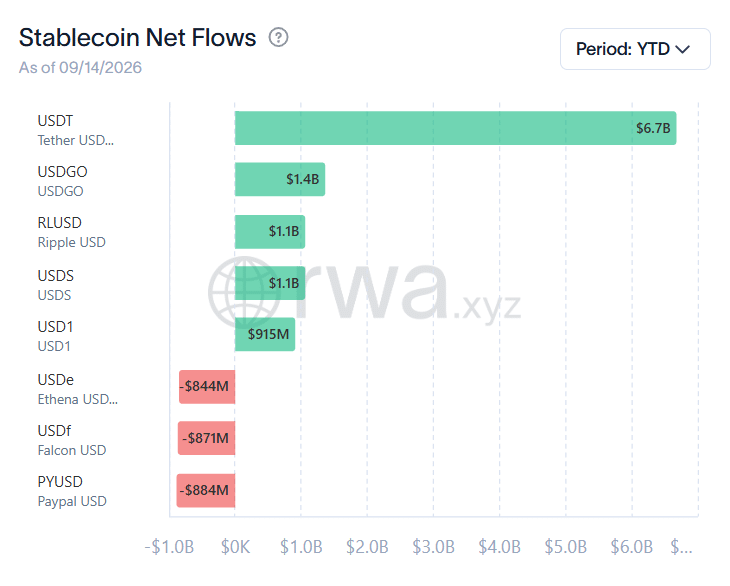
The Ripple stablecoin, RLUSD, has become the third-fastest-growing stablecoin in 2026, having added over $1 billion to its market cap this year alone.

This is according to data provided by RWA.xyz, the leading source of tokenized RWA data. Notably, RLUSD’s growth this year comes as Ripple seems to have ramped up minting of the stablecoin across the Ethereum and XRP Ledger networks. 

RLUSD Adds $1.1B in 2026

The data confirms that RLUSD has grown by exactly $1,070,909,067 this year. This makes it the third-fastest-growing stablecoin in the crypto and tokenization market in 2026, only behind Tether’s USDT and Anchorage’s USDGO, an enterprise stablecoin.

For context, USDT, which maintains its strong lead as the largest stablecoin in the market, has added about $6.7 billion to its valuation this year, putting it first among the fastest-growing stablecoins of 2026 so far. USDGO secures second with a growth of $1.4 billion in 2026.

Ripple Stablecoin Adds Over $1B

Meanwhile, below RLUSD are USDS from Sky Protocol (formerly MakerDAO) with $1.063 billion added this year and the USD1 stablecoin launched by Donald Trump-inspired World Liberty Financial last March.

Further data also indicates that it hasn’t been all green for stablecoins in the market this year, as some projects have recorded declines in their valuations. Specifically, USDe from Ethena, USDt from Falcon and PYUSD from PayPal have seen their market caps decline by -$844 million, -$871 million and -$884 million, respectively.

Ripple USD Now Eighth-Largest Stablecoin

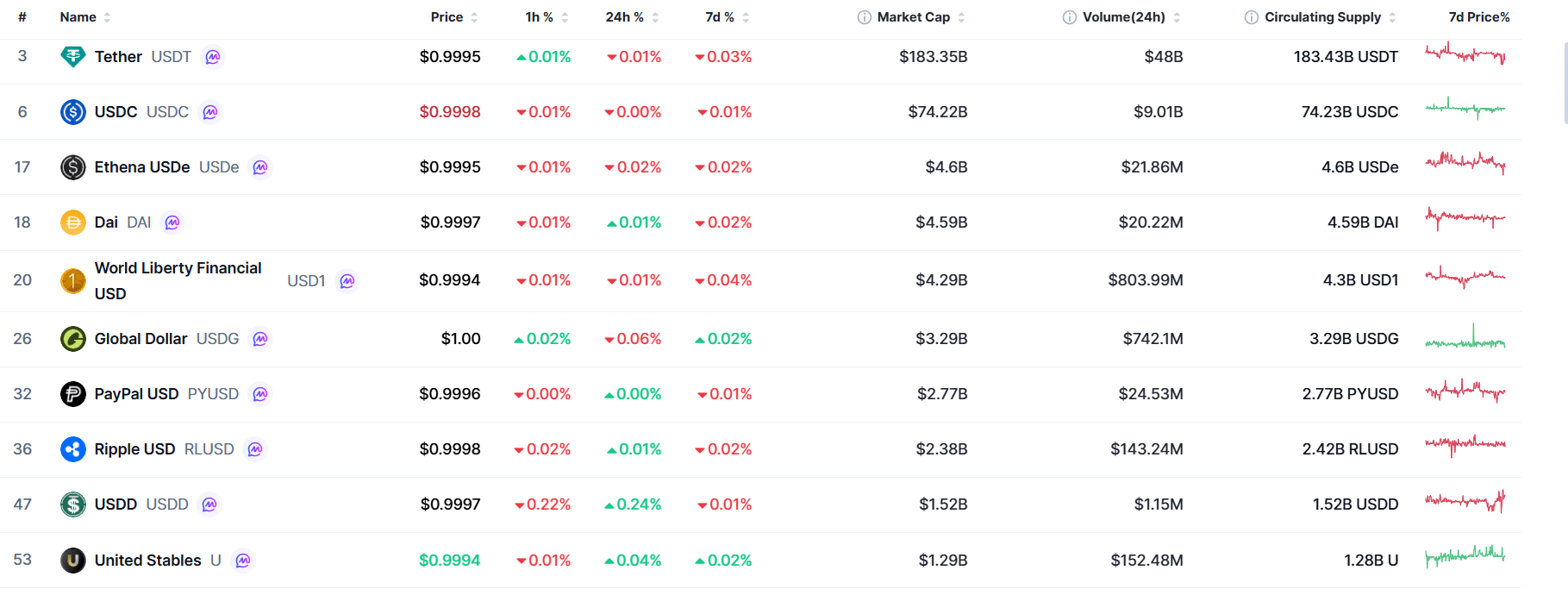
With its impressive growth this year, the Ripple stablecoin hit the $2 billion milestone in August. Since then, it has welcomed an additional $380 million, bringing its total market cap to $2.38 billion at the time of this press.

On-chain data sourced by a community-driven RLUSD tracker confirms this represents a drop in the stablecoin’s market value over the past week. Notably, Ripple has burned $98.2 million worth of RLUSD in the last 7 days, while minting just $73.9 million. This leaves a net supply change of -$24.3 million within this period.

Most of this recent activity occurred on the XRP Ledger, with $45.6 million minted and $61.5 million burned on the network over the past week. As a result, the XRPL now hosts $1.013 billion of the total $2.38 billion RLUSD market cap. Ethereum leads with $1.369 billion.

Meanwhile, the $2.38 billion market valuation means RLUSD has maintained its spot among the top 10 stablecoins in the market, currently sitting in the eighth position. 

RLUSD Among Top 10 Largest Stablecoins
RLUSD Among Top 10 Largest Stablecoins | Source: CoinMarketCap

Despite seeing declines in their valuations this year, Ethena’s USDe and PayPal’s PYUSD still rank above RLUSD in terms of largest stablecoins by valuation. Specifically, USDe sits third with $4.6 billion, while PYUSD is seventh with $2.77 billion. RLUSD needs an additional $390 million to overtake PYUSD.

Symbiosis Recovers 15 BTC After Bitcoin Bridge Exploit, Opens 20% Recovery Bounty

0

Symbiosis, a cross-chain liquidity protocol, said it retrieved about 15 BTC after its Bitcoin Bridge was exploited on Sept. 11. 

The recovered assets, currently valued at roughly $1.15 million, have been moved to a team-controlled multisignature wallet.

Blockchain security firm Blockaid said the exploit involved Symbiosis’s BridgeV2 contract on BNB Chain and resulted in about 46.1 billion syBTC being created and transferred to a newly established address. Despite the scale of that issuance, the apparent attacker converted only around 4.39 WBTC using Uniswap v4 on Ethereum, receiving approximately $336,000.

The amount of syBTC generated exceeded Bitcoin’s fixed maximum supply of 21 million coins by more than 2,000-fold. DeFiLlama records the attack as an unbacked cross-chain mint and estimates the loss at $336,000.

Symbiosis Restores Bitcoin Swaps While Its Own Bridge Stays Offline

Symbiosis said a weakness in the bridge enabled the attack, though it has not released additional information explaining the vulnerability. Following the breach, the protocol disabled its native Bitcoin routes and separated the compromised bridge from its broader system.

The disruption did not extend to routes operating across EVM networks, TON, or TRON. Octopools also stayed available, and Symbiosis said its relayer network remained functional.

Bitcoin swapping has since resumed through THORChain and Chainflip, which provide external routing for the protocol. Symbiosis has yet to reactivate its own Bitcoin Bridge.

Symbiosis initially gave the attacker until Sept. 13 to receive a white-hat reward worth 20% of the funds in return for their recovery. Once that deadline passed, the protocol said it would make a reward at the same rate available to anyone who supplies information that results in additional funds being retrieved.

The project said it is communicating directly with all liquidity providers affected by the attack and is preparing a compensation plan. Details determining who qualifies for compensation are due to be released shortly.

Liquid and Hyperbridge Incidents Highlight Risks From Unbacked Bridge Assets

The Symbiosis exploit came less than a week after a separate flaw was used to attack Blockstream’s Liquid Network. That incident allowed roughly 4,000 LBTC without corresponding backing to be generated and exchanged for Bitcoin held by the network.

The attacker later returned approximately 3,400 BTC. Blockstream rejected the attacker’s demand for a bounty tied to the roughly 598.5 BTC that remained outstanding, according to earlier reporting by The Crypto Basic.

A similar gap between unauthorized token creation and the amount that could initially be extracted also appeared in the Hyperbridge exploit in April. The attacker minted about 1 billion bridged DOT, while early estimates put realized losses on Ethereum at roughly $237,000. Hyperbridge later revised total realized losses across affected networks to approximately $2.5 million.

Symbiosis says transactions handled by the protocol have exceeded $10 billion since it launched around five years ago. DeFiLlama puts its current total value locked (TVL) at approximately $7 million and records about $3.19 billion of bridge volume since its dataset for the protocol began.

XRP Elliott Wave Blueprint Reveals One Last Drop Before a Potential Run to $2.25

0

XRP could witness another decline before resuming its upward push, according to an Elliott Wave analysis of the 1-hour chart.

The structure suggests that the correction that followed XRP’s August 2026 rally may not be over yet, which leaves room for another decline before a possible move toward $2.25. XRP was trading near $1.37 at press time, sitting below its August high.

XRP’s August Rally May Not Yet Be Over

XRP rose 28.5% in August 2026, marking the strongest August performance since 2021. The token climbed from around $1.00 to nearly $1.70, and the rally also drew massive institutional interest.

Notably, US spot XRP ETFs attracted $150.28 million during the final two weeks of August, taking cumulative inflows to $1.68. However, much of this buying came after XRP had already posted an upward push, which left the token open to a pullback.

On the hourly chart, XRP reached a high of about $1.69 in August, just below the major resistance area between $1.90 and $2.10. 

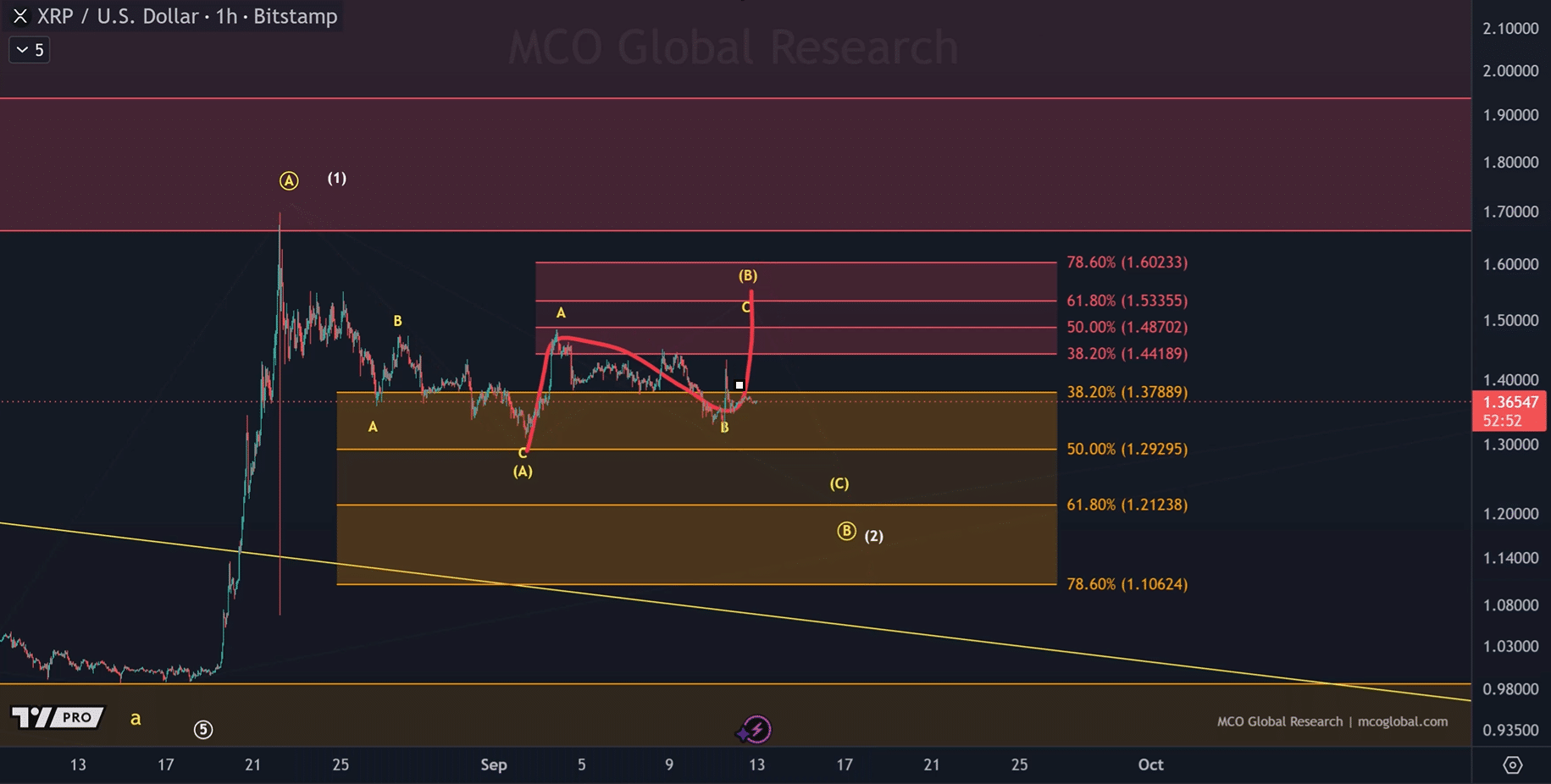
The Elliott Wave count treats this rise as Wave 1, which represents the first major move in a larger uptrend. With this structure, Wave 1 normally leads to Wave 2, a correction that gives back part of the earlier gains. XRP’s September decline fits a possible Wave 2 pattern, with the price now near $1.38.

XRP Correction Could Have Another Leg

The broader Wave 2 correction contains a smaller A-B-C pattern. Within the structure, Wave A reached a low near $1.29, while Wave B later pushed XRP back up to around $1.53.

XRP has since fallen toward the $1.37889 Fibonacci level, which the chart identifies as a possible B-wave position within a final C-leg pattern. The lack of a clear upward impulse from a recent low suggests that the correction may still have more room to run.

XRP Elliott Wave Structure

Based on this, XRP could first recover toward the $1.53-$1.62 area before falling again and completing Wave 2. This means the token could experience another short-term rebound before making a final move lower instead of immediately starting a sustained rally.

$1.10 Remains the Crucial Level

Three Fibonacci levels below the current price now mark the main support area for a possible Wave 2 bottom. The first is $1.29295, which represents the 50% retracement and sits close to the earlier Wave A low. The next level is $1.21238, which marks the 61.8% retracement.

The lowest level is $1.10624, representing the 78.6% Fibonacci retracement. Together, $1.29, $1.21, and $1.10 make up the orange support zone shown on the chart, where Wave 2 could potentially find its bottom.

The $1.10 level remains especially important for the bullish setup. As long as XRP avoids closing below this level, the potential Wave 3 setup remains valid. However, a break below $1.10 would weaken the current Elliott Wave count.

Wave 3 Could Target $2.25

If XRP completes Wave 2 within the $1.10-$1.38 support area and then produces a strong upward impulse, the next major target could sit between $1.93 and $2.25. The chart places this range as the potential target for Wave 3, which often becomes the strongest move within an Elliott Wave sequence.

The existing resistance area between $1.90 and $2.10 also falls within this projected target range, which makes it an important area to watch. 

However, it is difficult to set a precise Wave 3 target until XRP confirms where Wave 2 ends. A bottom near $1.29 would produce a different projection from a bottom near $1.10.

Other market signals also support this outlook. Prediction markets currently point to $1.60 as the most likely September outcome for XRP, while a drop toward $1.20 remains a notable alternative. The latter sits close to the $1.21238 61.8% Fibonacci retracement.

Senate Republicans Finalize CLARITY Act After Trump Agrees to Most Ethics Provisions

0

A U.S. Senate effort to establish a federal market structure for digital assets is approaching a critical procedural vote after Republican negotiators produced a revised CLARITY Act that makes concessions on government ethics, stablecoin rewards, and several regulatory provisions.

Sens. Cynthia Lummis, Tim Scott, and John Boozman released the latest version of H.R. 3633 late Sunday, calling it their final draft and saying it includes 126 substantive changes Democrats sought. The text would become the substitute amendment if senators agree on Tuesday, Sept. 15, to invoke cloture.

The revised ethics framework incorporates most of a proposal associated with Sens. Thom Tillis and Ruben Gallego. Among its provisions, state attorneys general would gain an enforcement role over conflict-of-interest requirements covering government officials.

Some Democrats had made the ethics language a condition of their support. The Associated Press previously reported that President Donald Trump had largely accepted the proposed restrictions.

Trump and his family have drawn political scrutiny over their involvement with crypto projects and assets, including World Liberty Financial, the USD1 stablecoin, and the TRUMP memecoin. A financial disclosure from Trump showed crypto-related income exceeding $1.4 billion in 2025, raising conflict-of-interest questions as his administration develops crypto policy.

Under the latest bill language, the restrictions would apply to public officials and employees as well as elected presidents, vice presidents and members of Congress. Their spouses would also be covered, while the text does not set comparable limits for other relatives such as their children. 

Lummis said Trump had voluntarily accepted what she described as unusually stringent ethics restrictions for federally elected officials, judges and their spouses. She argued that the concessions addressed Democratic demands and that Democrats should now support the legislation.

Treasury Could Temporarily Curb Stablecoin Rewards

Another change targets concerns that payment stablecoins could pull deposits away from smaller banks. For the first 18 months following enactment, the Treasury secretary would have authority to activate restrictions on stablecoin rewards if community banks experience substantial deposit withdrawals linked to payment stablecoins.

The provision adds to an ongoing dispute between the banking and crypto industries over how stablecoin incentives should be treated. The legislation bars platforms from providing interest merely for holding stablecoins but leaves room for rewards tied to their use.

The American Bankers Association has sought stronger limits. Its president and CEO, Rob Nichols, said Sunday that bankers and customers had spent the August recess telling senators that locally held deposits support lending in their communities. He said the association was encouraged by increased Senate attention to what it calls a loophole involving stablecoin interest.

The draft makes changes beyond stablecoins. Certain software developers would face narrower money-transmission registration requirements through amendments to the Blockchain Regulatory Certainty Act, alongside a civil safe harbor. Provisions under the Senate Agriculture Committee’s jurisdiction would establish controls involving affiliate trading and conflicts of interest, while separate language addresses the reach of state consumer-protection laws. 

Calendar Leaves Little Room After Tuesday’s Vote

Republicans cannot advance cloture on their own. The motion needs 60 votes, while the party controls 53 Senate seats. Assuming every Republican backs it, seven votes would therefore have to come from Democrats or independents. 

Clearing that threshold would move the measure into debate rather than secure its passage. Senators would still need to deal with amendments and vote on the legislation itself, after which the House would have to act on the Senate’s substitute text.

Congress has limited time available for those steps. The Senate’s tentative calendar calls for a state work period starting Oct. 5 ahead of the Nov. 3 midterm elections. The House has also canceled its scheduled weeks of Sept. 21 and Sept. 28. 

Patrick Witt, executive director of the White House Council of Advisors for Digital Assets, urged passage after negotiations that he said had lasted more than a year. 

Lummis offered a more severe assessment of the consequences of missing the current Congress, saying last week that another opportunity to enact CLARITY could be delayed until 2030, with jobs, investment and tax revenue lost in the intervening years. 

The revised draft also appeared to strengthen expectations that the bill would pass. On Polymarket, the probability of the CLARITY Act passing this year rose to roughly 32% from about 22%.

Shytoshi Kusama Sparks Fresh Shiba Inu Speculation With Cryptic X Profile Changes

0

The broader Shiba Inu community is speculating about Shytoshi Kusama’s next move after the lead ambassador quietly made cryptic changes to his X profile.

Kusama has remained largely absent from X for the past four months. His last post came on May 13, 2026, when he expressed admiration for his right-hand man, Kaal Dhairya. Since then, members of the Shiba Inu community have continued to watch for a fresh update from the Shiba Inu figurehead that could provide insight into the ecosystem’s development.

Kusama Makes Cryptic Changes to His X Profile

Rather than publish a new post, Kusama recently updated key sections of his X profile.

His previous bio read, “Pure Focus: AI/App Site: R.OS Finishing Touches. Beta website complete. Final bug pass.” He has since replaced the detailed description with a single word: “polish.”

Kusama also changed his location marker. He replaced the previous “Backlog, Marketing, Positioning” description with “Close.” 

These changes quickly caught the attention of members of the Shiba Inu community, particularly because Kusama has developed a reputation for using cryptic messages to communicate potential developments.

However, Kusama has yet to explain the meaning behind the latest updates. Therefore, it remains unclear whether they relate to Shiba Inu. 

Shiba Inu Lead Kusama X Profile

Could the Changes Relate to Kusama’s AI Project?

One possible explanation involves Kusama’s independent AI project.

In February 2026, Kusama shared details about an AI-powered relationship platform designed to help users identify trends, friction points, and potential compatibility risks.

If the latest profile changes relate to this project, the word “polish” could indicate that Kusama is completing its final refinements. Likewise, changing his location marker to “Close” could suggest that the project is approaching a launch or another major milestone.

Nonetheless, Kusama has not confirmed any connection between the profile changes and the AI initiative. As a result, these interpretations remain speculative until he provides further details.

Shiba Inu Continues to Face Market Weakness

Kusama’s prolonged silence comes as Shiba Inu continues to face weakness in the broader crypto market.

At press time, SHIB traded around $0.000005255, down 23.88% year-to-date and 4.34% over the past week. The token has also dropped 94.06% from its all-time high of $0.00008845.

Meanwhile, Shiba Inu’s burn activity remains relatively subdued. Around 6.88 million SHIB, worth $36, had been burned over the previous 24 hours. Shibarium has also continued to experience an indexing issue. Shibariumscan remains stuck in an indexing state, displaying incomplete blockchain data with only about 52% of blocks indexed.

Against this backdrop, the Shiba Inu community remains eager for fresh communication from Kusama. 

Ripple Supercharges Treasury With New GSmart AI Tools

0

Ripple has expanded GSmart, its AI tools built into Ripple Treasury, with new features for forecasting, managing liquidity, assessing risk, reconciliation, and reporting.

Ripple’s enterprise customers already use GSmart. The new features help finance teams use AI while still following company policies, approval processes, and audit requirements.

AI Works Within Treasury Rules

Ripple said GSmart helps solve a growing problem: companies are using more AI agents, but many lack strong rules to manage them.

Gartner expects the average Fortune 500 company could use more than 150,000 AI agents by 2028. Yet only 13% of organizations say they currently have enough governance for AI agents.

For treasury teams managing financial operations, Ripple says AI should provide useful recommendations without taking control away from people.

GSmart separates calculations from AI. Financial calculations are handled by fixed, reliable systems, while AI reviews company policies, spots patterns, and explains its recommendations.

Treasury teams still have the final say and must approve financial actions.

Renaat Ver Eecke, SVP of Ripple Treasury, said CFOs need to adopt AI while making sure financial decisions remain clear, controlled, and compliant. He added that GSmart follows each company’s treasury policies and provides transparent recommendations while keeping humans in control.

GSmart Adds AI Agents and Analytics

The expanded GSmart platform includes AI agents for forecasting, liquidity, risk, reconciliation, and reporting. Each AI agent monitors a specific task, recommends an action, explains which company policy supports it, and waits for human approval before taking action.

Ripple is also adding Knowledge Studio, which lets treasury teams set the policies and controls that guide how the AI works. Analytics Studio helps teams analyze treasury data and create AI-powered reports. Its Ask GSmart assistant lets users ask questions and get insights from their treasury data.

Existing Customers Are Already Using GSmart

Ripple said many of its enterprise customers are already using GSmart. About 60% of eligible customers use Risk Insights, which helps find unusual risks and policy violations.

Another 44% use Forecast Insights, which compares expected cash flow with actual cash flow to spot possible cash shortages. Ripple said GSmart is part of its plan to create one treasury platform for both traditional money and digital assets.

The new AI features add tools that help finance teams predict and manage their money. Ripple Treasury aims to let teams view, predict, move, and earn on cash and digital assets from one platform.

XRPL Foundation Is Bringing Traditional Finance Directly to the XRP Ledger, CTO Says

0

The XRP Ledger Foundation is working to add more traditional financial features to the XRP Ledger, according to CTO Denis Angell.

At Rare Evo, Angell spoke with Ray Fuentes about the foundation’s work, including the upcoming Lending Protocol, Single Asset Vaults, agentic payments, and other infrastructure projects.

“We are writing TradFi primitives into the XRP Ledger,” Angell said, highlighting the foundation’s direction for the network.

XRPL Adds More Traditional Finance Features

Angell said the XRP Ledger is a decentralized network where developers can build features for different needs. While it does not currently support general-purpose smart contracts, developers can propose changes that validators can vote on.

One major development is the Lending Protocol, which is already on the network and can be voted in. Angell said it will allow users to earn yield on their assets, something he believes the XRP Ledger has been missing.

Another key development is the Single Asset Vault, which Angell called his favorite project. He compared it to a traditional mutual fund. Users will be able to deposit their assets into a pool, which would then be invested. 

If the investments earn money, the returns would go back into the pool. Users can later withdraw their funds.

Angell said these developments show that the XRP Ledger is adding more traditional financial tools directly into the network, instead of relying only on smart contracts.

Token Payment Channels to Help AI Agents

The CTO also highlighted agentic payments as another area being developed on the XRP Ledger. The network is working on payment channels for tokens, not just XRP. This will allow for new ways to approve and complete payments.

Angell compared some of these features to how credit card payments are authorized. He said token payment channels will also be useful for AI agents, allowing them to make and complete payments on their own.

XRP Ledger Foundation Expands Infrastructure

Angell also talked about changes happening at the XRP Ledger Foundation. The foundation plans to distribute the xrpld software and host related files as it takes on more responsibility for the network’s infrastructure.

It is also improving its monitoring systems. These systems could collect validator logs when problems occur, such as a ledger halt. This would help the foundation understand what went wrong and respond faster.

The foundation is also reviewing how the network’s infrastructure is managed and considering whether it should run more of the infrastructure itself, including its own servers and data centers.

Vet Highlights “Deep Alpha”

After the interview, XRPL validator Vet described Angell’s comments as “deep deep Alpha” about the XRP Ledger and fintech. Vet also mentioned plans to create committees within the XRPL Foundation to help with more technical and ecosystem-related work.

The comments show that the foundation wants to expand the XRP Ledger beyond simple payments and add more financial features directly to the network. With lending, vaults, token payments, and AI-powered payments being developed, the XRPL will eventually support a much wider range of financial applications.

Blockstream Rejects Liquid Hackers’ 10% Bounty Demand as 598 BTC Remains Unreturned

0

Blockstream has rejected a 10% bounty request from the group behind the Liquid Network breach, with 598 BTC from the incident still unreturned.

Blockstream said withholding assets obtained without authorization in exchange for payment does not constitute legitimate security research, distinguishing responsible disclosure from taking funds without permission.

The company had been in contact with the actors as it sought to recover user funds. Blockstream is now asking them to return what remains without attaching any financial conditions.

Hackers Seek 10% Bounty

The group outlined its terms in an on-chain message that Samson Mow, JAN3 CEO and former Blockstream chief strategy officer, shared on Wednesday. The proposal called for Blockstream to fund a 10% bounty and claimed Liquid holders could face a 15% loss without an agreement.

The demand came after the Sept. 6 breach of Liquid, when about 4,000 BTC was taken from the network’s federation wallet. The Bitcoin involved was valued at roughly $320 million at the time.

Of that amount, 3,400 BTC was subsequently sent back after fixes were applied to the affected bridge nodes, leaving 598 BTC unrecovered.

If those coins are withheld, Blockstream plans to involve law enforcement and seek assistance from exchanges, service providers and blockchain investigators. Such cooperation could help track where the Bitcoin moves and determine who controls it.

Liquid Moves Toward Restoring Operations

Meanwhile, Liquid took an initial step toward restoring the network on Thursday after implementing software fixes introduced in response to the breach.

Blocks began being created again, but without regular user transactions. Transfers between Bitcoin and Liquid also remained unavailable as the network continued to recover.