Home Blog Page 12

Hoskinson Says Cardano Cannot Succeed Without Embracing Midnight and Other Major Ecosystem Projects

0

Cardano founder Charles Hoskinson has urged the community to embrace projects such as Midnight, arguing that the blockchain’s long-term success depends on the applications built on its infrastructure.

Hoskinson made the remarks during his recent livestream, titled “Devs versus Builders,” where he addressed criticism surrounding Midnight and its recent strategic changes. He stressed that the privacy-focused blockchain should not be viewed as a competitor or separate venture. Instead, he described Midnight as a major project built within the broader Cardano ecosystem.

Cardano’s Value Depends on the Projects Built on It

According to Hoskinson, Cardano’s purpose extends beyond serving as a smart contract platform or facilitating ADA transactions. He argued that the network creates greater value when developers use its infrastructure to build applications that attract real users, customers, and economic activity.

He pointed to existing Cardano projects, including SNEK, DexHunter, and SundaeSwap, as examples of applications the community has generally embraced. However, he questioned why some community members appear resistant to Midnight despite its scale and growing prominence within the ecosystem.

Moreover, Hoskinson warned that pushing back against successful projects could discourage other developers from building on Cardano.

“If Cardano is going to succeed, Cardano needs to embrace the projects that make it succeed,” Hoskinson remarked. 

Hoskinson Calls for a More Welcoming Ecosystem

Against this backdrop, Hoskinson argued that the Cardano community must foster an environment that encourages projects to grow rather than criticizing them for becoming too successful or prominent.

He suggested that the community should not treat Midnight differently simply because it has emerged as one of the largest and most significant projects associated with Cardano. Instead, projects that build on Cardano and expand its reach should strengthen the ecosystem’s overall value. 

At the same time, Hoskinson emphasized that Midnight must also meet users where they are. In particular, he urged the project to prioritize simplicity, universality, and low-cost operations. According to him, technological improvements alone cannot overcome cultural challenges within an ecosystem.

Hoskinson Urges the Cardano Foundation to Promote Midnight

Meanwhile, Hoskinson also called on the Cardano Foundation to publicly support Midnight and give greater visibility to its developments.

He questioned why the Foundation would not actively promote Midnight, which he described as the largest project built on Cardano, noting that other major blockchain ecosystems regularly highlight significant applications and projects within their networks.

Furthermore, Hoskinson criticized what he viewed as an imbalance in public messaging. According to him, negative developments surrounding Midnight tend to attract attention, while positive milestones, including partnerships and other progress, receive less visibility.

Midnight’s Success Could Strengthen Cardano

Ultimately, Hoskinson framed Midnight’s success as closely tied to Cardano’s broader growth. In his view, the ecosystem cannot thrive merely by operating blockchain infrastructure; it must also support the projects that use that infrastructure to deliver products and services.

He also reiterated his commitment to Cardano’s long-term success. Although he said he has the option to step away and retire, Hoskinson stressed that he remains involved because he believes the work is far from finished.

Cardano Privacy Sidechain Midnight Winds Down Developer Relations Team

0

Midnight, the privacy-focused blockchain ecosystem associated with Cardano, is winding down its dedicated Developer Relations (DevRel) team as it reshapes how it attracts and supports builders.

In a recent announcement, the Foundation said the move forms part of a broader strategy to expand who can build on Cardano’s privacy sidechain, Midnight, beyond traditional software developers.

Midnight Targets a Broader Group of Builders

Traditionally, the crypto industry has defined a builder as someone who can write and deploy code. However, Midnight argues that artificial intelligence is changing this model by reducing the technical barriers to turning ideas into functional software.

As a result, people with product ideas, industry expertise, and entrepreneurial experience can create applications without advanced programming skills.

Midnight highlighted the growth of AI-powered development platform Replit as evidence of this shift. Replit now has more than 60 million users worldwide, demonstrating how quickly the pool of people capable of building applications, websites, and products is expanding.

According to Midnight, this growing pool of builders presents a significant opportunity for its ecosystem.

Midnight Shifts Focus to AI-Native Tools

Rather than focusing solely on helping developers build privacy-preserving applications, Midnight now wants to make its ecosystem accessible to a much broader group of potential builders.

To achieve this, the project plans to prioritize AI-native tools, simpler pathways into the ecosystem, and programs that support builders from the initial idea through deployment.

Midnight said this strategy builds on initiatives already underway, including Build Club and Night Sky. The project also highlighted an important distinction between developers and builders. While a developer may start by asking what they can build, a builder may begin by asking what problem they can solve. Therefore, Midnight wants its ecosystem to support both approaches.

Midnight acknowledged that the tools and workflows required for this new model are still evolving. Consequently, the project will initially work with a focused group of builders to test the approach, determine what works, and improve the experience before expanding it further.

Midnight Rejects Claims of Favoring AI Over Developers

Meanwhile, the development has sparked debate within the Cardano community, with some critics arguing that the Midnight Foundation is prioritizing AI at the expense of developers.

However, the foundation rejected this interpretation, stressing that its new strategy does not replace developers but instead expands the audience it aims to serve.

Under the new model, Midnight expects its builder community to include developers, founders, operators, designers, and domain experts who can leverage AI and other tools to turn ideas into functional products. 

Robinhood Chain Nears $1 Billion TVL as Analyst Cites Four Growth Drivers

0

Robinhood Chain has expanded rapidly since its July 1 debut. StoneX analyst Mark Palmer attributes the momentum to Robinhood’s brand, open token creation, gas subsidies, and a feedback loop linking memecoins with tokenized stocks.

Total value locked (TVL) on the network is nearing $1 billion, while decentralized exchange (DEX) volume reached $1.88 billion on Sunday. Palmer also said Robinhood Chain now accounts for more than half of Uniswap’s trading volume.

Palmer outlined the four drivers in a Monday note responding to investor questions after initiating coverage of Robinhood shares with a “buy” rating and a $170 price target. He described the blockchain’s early traction as strong across multiple measures.

Four Factors Behind Robinhood Chain’s Growth

Robinhood’s consumer reach is one factor supporting the network’s growth, according to Palmer. He pointed to CASHCAT as an example, noting the token gained viral exposure after Robinhood CEO Vlad Tenev followed its account.

The blockchain’s open structure provides another catalyst. Developers do not need Robinhood’s approval to issue tokens, helping create a high-volume launch environment. Pons has reportedly handled around 10,000 token creations per day, including approximately 25,000 on Sept. 2.

Trading incentives are also contributing to activity. Robinhood absorbs gas costs on wallet swaps worth more than $5, lowering transaction expenses for users.

The final factor is the connection between memecoins and tokenized equities. Palmer cited Long.xyz, a launchpad built on Robinhood Chain, where community tokens can be paired with Robinhood’s tokenized stocks.

Palmer argued that growing interest in memecoins can drive trading in the tokenized stocks paired with them. At the same time, those equity links can give the memecoins an additional narrative, reinforcing activity on both sides.

Crypto-Native Users Account for Most Activity

Robinhood’s brokerage customers currently represent only a small share of activity across its blockchain. CoinDesk Research estimates that Robinhood app users generate just 1% to 2% of the chain’s transactions. Palmer said most activity instead comes from Uniswap, crypto trading terminals, and token launchpads.

The rise in transaction activity has coincided with stronger liquidity metrics. Robinhood Chain’s stablecoin market capitalization moved above $1 billion last week, rising about 12% from the previous week and 72% over the past month. USDG represents 67% of the total, followed by Ethena’s USDe at 30%.

XRP Ledger Sets New Record With 3,254 Transactions in Single Ledger

0

The XRP Ledger (XRPL) processed a record 3,254 transactions in a single ledger, showing that the network can handle high transaction volumes while still reaching consensus quickly.

Hussein Zangana, an XRPL validator known as Vet, shared the milestone on X and called it a new network record.

The record came just one day after Vet reported another high-speed ledger, with several ledgers processing more than 2,000 transactions in a short period.

XRPL Uses a Flexible Transaction Limit

Vet explained that the XRP Ledger (XRPL) does not use a fixed limit for how many transactions can fit into a ledger. Instead, XRPL uses a flexible target. If a ledger handles more transactions than the target and still closes quickly, the network can increase the target.

Meanwhile, if a ledger takes more than five seconds to reach consensus, the network reduces the target. This lets XRPL adjust how many transactions it processes based on network conditions, rather than using a fixed limit.

Unlike traditional blockchains, XRPL does not have a fixed-size block. The transactions and data in each ledger can vary in size, while the ledger header has a fixed size.

Not All 3,254 Transactions Put the Same Load on XRPL

Vet explained that processing 3,254 transactions does not mean they were all equally difficult for the XRPL to handle. Most of the transactions in the record ledger were simple XRP payments involving just one drop of XRP, which puts very little strain on the network.

More complex transactions, such as those involving the decentralized exchange (DEX), cross-currency payments, or NFTs, require more processing.

For example, 500 simple XRP payments could put less strain on the network than 200 complex DEX transactions. This means that the number of transactions alone does not show how much work the network is actually doing. XRPL supports many transaction types, including XRP payments, tokens, NFTs, and DEX trades.

XRP Ledger Maintained a 3.8-Second Ledger Close

The new record came shortly after another period of high activity on September 13. Vet reported a ledger with 2,713 transactions. Even with this high number, the ledger closed in just 3.8 seconds and the network maintained stable consensus.

He later said several ledgers had processed more than 2,000 transactions within short periods.

Most of those transactions were also simple one-drop XRP payments. Vet said they were sent through a group of 20 accounts and appeared to be part of bot testing activity. However, he could not confirm the exact reason behind the activity.

XRPL Improvements Put to the Test

The high transaction activity has also highlighted improvements made to the XRP Ledger in recent years.

When someone asked Vet if the record was linked to these improvements, he said that many upgrades and security improvements had been added to the network.

He also said he had asked Denis Angell, CTO of the XRP Ledger Foundation, to investigate the unusual activity. Vet said it appeared that someone was testing the network’s limits.

Overall, the event shows how XRPL handles sudden increases in activity. Instead of focusing only on the number of transactions, the network also considers how quickly consensus is reached.

XRP Breakout Incoming? Ali Martinez Sets $1.38 as Key Level for Move Toward $1.60

0

XRP is approaching a breakout after holding a key support level, and analyst Ali Martinez says $1.38 is the critical level to watch.

A break above this level could set the stage for a move toward $1.60. According to CoinMarketCap, XRP is trading around $1.38, up 2.6% over the past 24 hours. However, the token remains down 1.55% over the past week, showing that the recent recovery has not fully erased its losses.

XRP Holds $1.31–$1.35 Support

Martinez first highlighted XRP’s setup after the token fell sharply over the past three weeks. XRP dropped about 20%, falling from $1.70 to $1.35. Martinez said profit-taking contributed to the decline and noted that whales sold or moved around 90 million XRP during the previous week.

Despite the selling pressure, XRP found support around $1.35. About 2.29 billion XRP had previously traded near this level, making it a significant price area.

Martinez identified the broader support zone at $1.31–$1.35. As long as XRP remains above this zone, the token is positioned to test the top of its current triangle pattern. The chart shows XRP trading inside a triangle, setting up a significant price move.

$1.38 Becomes XRP’s Key Breakout Level

The key level to watch is $1.38. Martinez said a strong move above $1.38 would confirm XRP’s breakout and put $1.60 in focus. 

In a follow-up post, he sounded even more confident, writing, “IT’S HAPPENING!” However, he stressed that XRP needs to close and remain above $1.38 to confirm the breakout.

Once XRP establishes $1.38 as support, the next major target is $1.60. A move from $1.38 to $1.60 represents roughly a 16% gain. Martinez has also identified $1.68 as a longer-term target if XRP’s recovery continues.

XRP Network Activity Drops 90%

The potential breakout comes as XRP’s network activity has fallen sharply. Martinez reported that daily active addresses dropped 90.18%, from 388,492 to 38,163. The decline shows that network activity has fallen significantly alongside XRP’s drop from $1.70.

The combination of whale selling and weaker network activity raises concerns about the strength of XRP’s recovery. However, the token has held the $1.35 support level, keeping the bullish setup intact. For the breakout to remain valid, XRP needs to clear $1.38 and turn that level into new support.

Traders Watch the Next Move

XRP is now trading around $1.38, the exact level Martinez identified as the breakout trigger. A sustained move above $1.38 puts $1.60 in focus, followed by $1.68 if buying momentum continues. On the downside, a failure to hold $1.38 would send XRP back toward the $1.31–$1.35 support zone.

For now, XRP is up 2.6% over the past 24 hours and is testing a critical resistance level. The next strong close above $1.38 will determine whether the recent recovery develops into a larger breakout.

XRP Sees Weekly ETF Inflows as Bitcoin ETFs Bleed $463M

0

XRP ETFs attracted nearly $19 million in new investments last week, while Bitcoin ETFs saw $463 million in withdrawals. This suggests investor interest is shifting among crypto ETFs in the U.S.

Between September 7 and 11, Bitcoin ETFs recorded $463 million in net outflows, according to SoSoValue data. This ended a three-week streak of weekly inflows. Meanwhile, XRP ETFs continued to attract new money during the same period.

Image

XRP ETFs Attract $18.9M

Specifically, spot XRP ETFs received $18.9 million in new investments last week. This was more than Solana ETFs, which attracted $10.3 million.

Meanwhile, Ethereum ETFs performed even better, bringing in $197 million and marking their fourth straight week of inflows.

The numbers show investors weren’t leaving crypto ETFs completely. Instead, they continued putting money into some altcoin ETFs even as Bitcoin ETFs saw withdrawals.

XRP’s strong inflows are notable because demand for these ETFs has remained steady for months. Bloomberg ETF analyst James Seyffart called XRP ETF flows “surprisingly resilient.” In late August, total inflows had reached nearly $1.8 billion.

Institutional Interest in XRP Grows

The latest inflows show that XRP investment products are becoming more popular with traditional investors.

Charles Schwab’s funds reported more than $1 million invested in the Grayscale XRP Trust ETF, according to an SEC filing. This shows that traditional investment funds are adding XRP ETFs to their portfolios.

XRP is also the largest holding in the Cyber Hornet S&P 500 & XRP 75/25 Strategy ETF.

As of June 30, XRP made up 22.5% of the fund’s assets, compared with 6.1% for NVIDIA and 5.2% for Apple. The fund combines investments in the S&P 500 with XRP, targeting 75% in S&P 500 stocks and 25% exposure to XRP.

Although the fund is still small, it gives traditional investors another regulated way to invest in XRP.

Goldman Sachs Leads XRP ETF Investors

Major financial firms are also investing in XRP ETFs. Goldman Sachs reported about $87.45 million in XRP ETF holdings in the second quarter, making it the largest institutional holder among the firms mentioned. 

Jane Street reported about $16.64 million, while Millennium Management had around $16.20 million.

These figures show holdings as of June 30, so they may have changed since then. However, they show that major financial firms are taking part in the XRP ETF market.

Ultimately, the numbers confirm demand has remained strong despite big changes in XRP’s price. 

While the latest numbers show a clear difference between Bitcoin and XRP ETFs, it does not necessarily mean investors are moving from Bitcoin to XRP. It simply shows that demand for XRP ETFs has remained positive even as Bitcoin ETFs faced a weak week.

XRP Payment Volume Spikes 224% to 348M Tokens

0

XRP Ledger (XRPL) payment volume recently surged by a massive 224% to nearly 350 million tokens amid the latest price recovery.

While XRP’s price has struggled in 2026, down more than 24% this year, the XRPL has continued to record impressive milestones. In the most recent episode, daily payment volume on the network surged by 224% from the previous day’s figure.

XRP Payment Volume Hits 348M Tokens

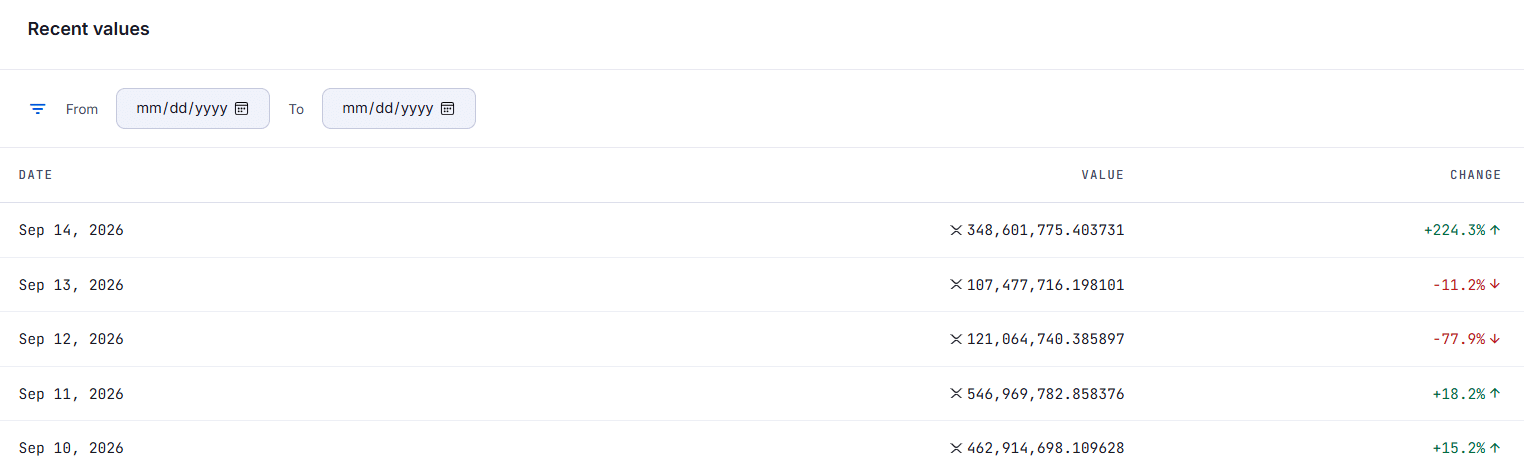
According to data provided by XRPScan, a leading XRPL block explorer, this spike resulted in 348.6 million XRP worth of payment volume. At the current price of $1.39 per XRP, this translates to $484 million at press time. For context, the previous reading stood at 107.477 million XRP.

Daily XRP Payments Volume XRPScan
Daily XRP Payments Volume | Source: XRPScan

Importantly, the latest surge represents the largest rise in daily payments volume recorded by the network this month. However, this pales in comparison to the overall 881% spike witnessed on Aug. 31, right before the network saw a massive 1.403 billion XRP volume on Sept. 1. 

Still, the latest increase is notable because it marks a revival of payments volume on the XRPL after two days of consistent declines. Specifically, the metric crashed by 77.9% on Sept. 12 and then dropped by another 11.2% by Sept. 13 before the recovery today.

Despite the recent 224% spike, the resulting 348 million XRP volume remains lower than most of the highs recorded this month alone. 

For instance, after the 1.403 billion XRP reading on Sept. 1, the XRPL saw another volume high of 564.5 million XRP on Sept. 3, with 546.9 million XRP on Sept. 11. These mark the three largest daily volumes so far this month.

The latest rise in payments volume comes on the back of a mild price reversal recorded by XRP today. Notably, after dropping 1.85% on Sunday, Sept. 13, XRP has begun today on a bullish note, up 4.37% on the day, as it changes hands at $1.3995, looking to reclaim $1.40.

XRP Ledger Sees Mixed Trends

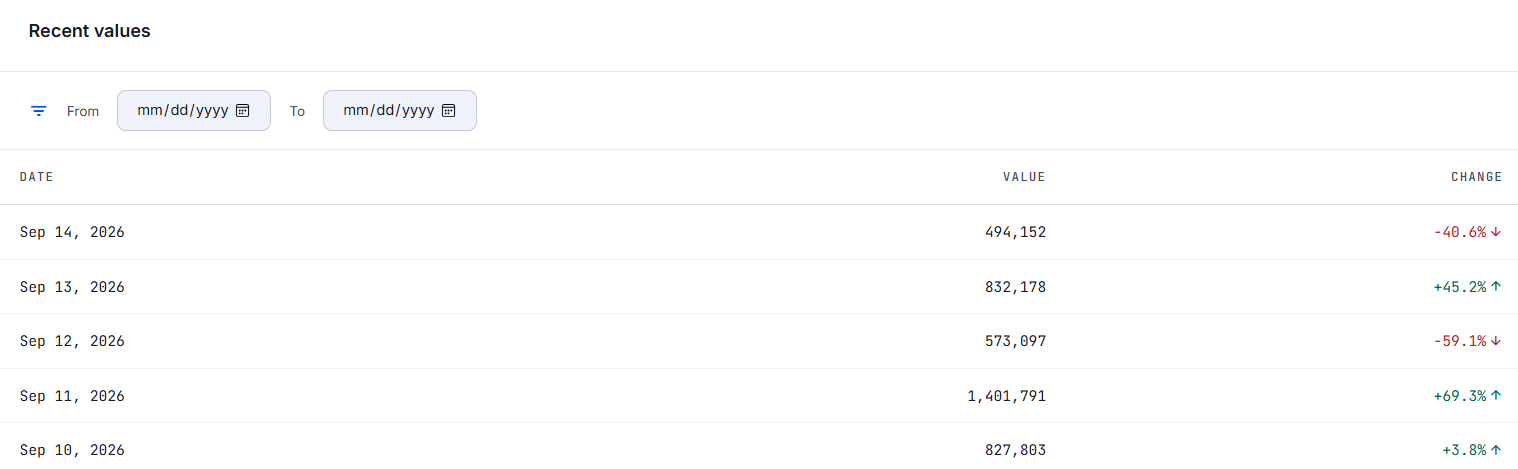
However, while payment volume in XRP has spiked from the previous day’s figures, the actual number of payment transactions has declined. Notably, XRPL payments have dropped to 494,152 at press time, representing a 40.6% decline from the previous reading.

Daily XRP Payments XRPScan
Daily XRP Payments | Source: XRPScan

This drop came after payments spiked 45% to 832,178 on Sept. 13, just two days before the recent peak of 1.4 million. Notably, the latest reading of 494,152 payments represents a considerable drop from the 30-day average of 758,000 payments recorded daily. 

In addition to this, total transactions on the XRP Ledger have declined 41% to around 956,000, a massive drop from the daily average of 2 million transactions recorded in the past 30 days. Also, successful transactions have collapsed by a similar 41% to 754,000.

Nonetheless, it is important to note that these represent today’s readings. With the day still hours from closing, final figures may be considerably higher than what the network has recorded as of press time.

Cardano DeFi Hit as Splash DEX Loses Over 2.4M ADA and 1.98M OADA in Exploit

0

Cardano-based decentralized exchange (DEX) Splash has suffered a security exploit that drained millions of ADA and OADA from its ADA/OADA StableSwap pool.

Both Splash and Cardano-based DeFi yield optimization platform Optim Finance confirmed that the exploit was isolated to the Splash pool supporting ADA and OADA.

Splash’s ADA/OADA Pool Drained

According to Splash, the incident occurred on September 13, 2026, between 00:47 and 00:48 UTC. During the attack, the exploiter drained the affected pool through two transactions.

The second transaction removed 2,434,648.42 (2.43 million) ADA and 1,988,222.18 (1.98 million) OADA from the pool. After accounting for the attacker’s 9,870 ADA deposit, the net ADA drain amounted to 2,424,778.42 ADA.

Splash attributed the exploit to a vulnerability in the pool’s validator. Specifically, the validator calculated the tradable reserve by subtracting accrued protocol fees from the pool’s actual balances but failed to verify that the resulting reserve remained positive.

Per the update, the attacker manipulated the fee counter and then spent the pool’s actual ADA balance below that counter. Consequently, the validator accepted a negative reserve and allowed the attacker to withdraw both assets.

The exploit also affected liquidity venues pairing OADA with various tokens. However, Optim Finance said the collateral damage appeared limited to those pools. Splash likewise confirmed that other pool types were not affected.

Following the incident, Splash paused the protocol and removed liquidity from the affected venues. Consequently, the DEX currently has no meaningful OADA liquidity, preventing users from swapping OADA for ADA through the exploited pool.

Movement of Stolen Funds 

After draining the pool, the attacker moved the stolen OADA into a thin OADA/FLDT pool on Minswap and converted part of the holdings into ADA.

Splash said the attacker received only about 115,000 ADA from the sale because of the pool’s limited liquidity. Meanwhile, 1.76 million OADA remained in the Minswap pool at the time of the report, trading at only a small fraction of its intended peg. 

Splash therefore warned users against adding fresh ADA/OADA liquidity, as doing so could expose them to arbitrage involving the remaining OADA.

The attacker also distributed the stolen ADA across six deposit addresses before consolidating the funds into four custodial clusters.

Splash attributed 786,851 ADA to KuCoin and another 550,000 ADA to Gate.io. The remaining 1.21 million ADA was held in custodial systems whose operators had not yet been identified.

Splash is now investigating the exchange-linked funds and said it will contact KuCoin and Gate.io while continuing to trace the attacker’s wallets.

In the meantime, the DEX has invited the attacker to contact its team to resolve the incident through a bug bounty or white-hat recovery arrangement.

Splash Exploit Adds to Cardano DeFi Security Concerns

The Splash exploit comes amid several recent security incidents involving projects across the Cardano ecosystem.

Last week, Dano Finance suffered an exploit involving its lending pools across 26 transactions. Attackers reportedly drained 523,546 USDA, 457,808 USDM, 737,708 USDCx, 7,131,442 NIGHT and 0.728 BTC.

Separately, Cardano-based DeFi platform Empowa disclosed unauthorized transfers involving approximately 143,710 ADA and 48,219 NIGHT from project-controlled treasury wallets. In June, SecondFi also reported that hackers stole more than 16 million ADA from 374 user wallets.

Therefore, the latest Splash exploit adds another significant security incident to a growing list of exploits and unauthorized transfers affecting Cardano’s decentralized finance sector. 

Bernstein Says Markets May Be Underestimating Clarity Act Progress

0

Bernstein analysts said Monday the Clarity Act now appears more likely to make headway than markets anticipated last week, following Republican concessions on issues raised by Democrats ahead of Tuesday’s Senate procedure.

The research and brokerage firm’s analysts, led by Gautam Chhugani, said markets have not fully factored in the possibility of a favorable legislative surprise. The probability attached to the outcome on Kalshi has risen back above 30%.

The Senate will decide Tuesday whether to overcome the procedural barrier needed to take up the measure. Clearing that stage requires 60 votes. Republicans hold 53 Senate seats. Even with full Republican support, Democrats or independents must provide additional votes to reach the 60-vote threshold.

That threshold may be within reach. Bloomberg previously reported that seven to 10 Democrats appeared interested in ultimately supporting the bill.

Republican Changes Seek to Resolve Democratic Objections

Late Sunday, Senate Republicans published what they characterized as the completed version of the Clarity Act, saying the text reflected 126 significant changes made in response to Democratic requests.

Ethics provisions are among the areas where lawmakers made concessions. President Donald Trump accepted most elements of a bipartisan ethics proposal, including giving state attorneys general an enforcement role.

The framework also includes conditions involving the disposal of crypto assets or their placement in a blind trust. Taken together, Bernstein said the ethics offer is likely the strongest available and may be sufficient to bring several Democrats behind the procedural measure. That would keep negotiations active ahead of the legislation’s ultimate consideration. 

In addition, Bernstein said some Senate Democrats may be mindful of being portrayed as hostile to crypto with the midterms approaching. The firm noted that the crypto lobby has supported candidates from both major parties.

Stablecoin Provisions Provide Guardrails for Banks

The revised measure also seeks to ease banking-sector concerns by allowing the Treasury secretary to suspend stablecoin rewards for a limited period if their use causes significant deposit outflows at community banks.

Bernstein said the provision gives banks safeguards against risks tied to stablecoin returns and the possibility of deposits leaving during banking-sector distress.

If the measure does not become law, third-party platforms could continue offering customers the complete return available on stablecoin holdings that are not otherwise in use.

For that reason, Bernstein characterized defeat of the Clarity Act as the most unfavorable result, including for banking interests.

Fed Announcement Adds Another Major Market Event

Tuesday’s Senate action will come a day before Fed officials announce their next move on rates, giving markets two major events to digest in quick succession.

Bernstein said the combination of an unsuccessful legislative outcome and a hawkish Fed could cause a substantial market decline. The analysts also described existing market positioning as tilted toward bearish expectations.

The outcomes could produce sizable price fluctuations, upward or downward, across both cryptocurrencies and publicly traded crypto companies.

Agency Action Could Accelerate Without Legislation

Still, Bernstein has said that even if the legislation fails, U.S. crypto regulation could continue advancing as the SEC and CFTC move ahead with rulemaking under their existing authorities.

The analysts maintained that position Monday, saying greater regulatory activity could help crypto stocks regain ground after an immediate negative reaction.

CFTC Chair Michael Selig has similarly said that regulators may ultimately have to establish the rules if Congress fails to enact the measure.

Bitcoin Treasury Firm Smarter Web Could Nearly Double Under TD Cowen’s Revised Stock Target

0

TD Cowen has become more optimistic about The Smarter Web Company’s stock, raising its valuation target to £0.73 ($0.99) from £0.64 ($0.87).

The firm maintained its Buy recommendation on the Bitcoin treasury company, with the new target sitting about 90% above Monday’s market price. The revision comes as Smarter Web works on MORE, a preferred-share plan designed to add another source of long-duration capital.

Smarter Web traded at £0.385 ($0.52) on Monday, compared with £0.38 ($0.51) at the end of Friday’s session. The move represented a 1.32% daily increase, according to London Stock Exchange data.

MORE Gives Smarter Web Another Financing Route

In research distributed to clients Monday, a TD Cowen team headed by Lance Vitanza focused on how MORE could change the company’s access to capital. If the plan is completed, Smarter Web would gain an additional mechanism to fund itself over the longer term.

The analysts placed the proposal within an evolving approach to financing across businesses that hold Bitcoin as a treasury asset. Such companies are experimenting with a wider mix of capital structures, ranging from preferred equity and collateral-backed borrowing to convertible instruments and other structured funding arrangements.

How MORE Is Expected to Work

Details published by Smarter Web last week show that MORE would pay investors weekly dividends. The dividend rate would vary, and because the dividends are cumulative, any unpaid dividends would remain due.

Investors in MORE would receive preferential treatment under the security’s liquidation terms and would also be covered by its redemption provisions. Ownership of MORE would not, however, provide voting rights on shareholder matters.

Two approvals remain part of the proposal: shareholders must back it, and the Financial Conduct Authority must approve the related prospectus.

Smarter Web Reports 11.5% YTD BTC Yield

Treasury results were another element of TD Cowen’s assessment. Smarter Web calculated its BTC Yield at about 11.5% from the beginning of the year through Sept. 2.

That result absorbed a drag of around 420 basis points connected with the July 23 repayment of the TOBAM conversion. Meeting that repayment involved disposing of roughly 178 Bitcoin.

TD Cowen Maps Out a Wide Range for Bitcoin

Bitcoin was closing in on $78,000 on Monday, CoinGecko data showed. Even at that price, the largest cryptocurrency by market capitalization stood around 38% beneath its peak of almost $126,000.

For December, TD Cowen’s central projection uses a Bitcoin price of about $100,000. A stronger outcome in its modeling takes BTC to $175,000, whereas the weakest scenario puts it at $25,000.

Separately, TD Cowen expects the pace of Smarter Web’s acquisitions to build gradually until it resembles the level recorded in fiscal 2025.