Home Blog Page 1302

XRP to $125: Top Financial Advisor Explains the Math Using Forex Market Data

0

A top financial advisor outlines how XRP could attain $125 per token, using hypothetical calculations based on the Forex market volume.

XRP continues to trade around the $0.55 region with negative trajectories across weekly, monthly, and even yearly timeframes. Essentially, XRP’s price has been unimpressive. Meanwhile, pundits in the crypto community continue to foresee a future where the asset trades beyond even three-digit values.

Whiplash, a widely followed financial advisor in the crypto community, is the latest to argue XRP’s potential to attain values beyond $100. He expressed this sentiment in a recent post on X.

Mathematics of XRP Attaining $125 

In the post, he speculatively outlined the mathematics behind how a $125 price point for XRP could be attainable. Specifically, this eye-catching figure stems from a calculation based on the assumption that XRP could one day handle a significant portion of the daily trading volume in the global foreign exchange (Forex) market.

First, Whiplash noted that XRP has a maximum supply of 100 billion tokens, with around 60 billion in circulation. He pointed out that the Forex market saw trading volumes reach $7.5 trillion per day in April 2022.

Whiplash speculates that if XRP were to facilitate this level of transaction volume, the value of each token could theoretically reach $125. He arrived at this value by dividing the FX market volume by XRP’s circulating supply of 60 billion. 

Essentially, this mathematics suggests that for XRP to have sufficient liquidity to process a $7.5 trillion market volume, the token must be worth at least $125. For context, XRP currently sells for $0.5656. Reaching the speculative price of $125 implies an astonishing 22,000% increase.

How XRP Holders Could be “Earning” $100K

However, the entirety of XRP’s supply is not under the control of a single entity. This weakens the assumption that all of XRP’s supply would be used to process FX market transactions.

Interestingly, Whiplash proposed a solution. He suggested that instead of selling XRP at such high values, holders could stake or loan their tokens to facilitate transactions, potentially earning significant returns.

In particular, Whiplash speculated that with XRP valued at $100 per token, owning just 1,000 XRP could yield $100,000 per day from staking, assuming a 100% return—though actual returns would likely be much lower, similar to interest on a loan.

It is important to note that these scenarios are highly speculative and assume XRP’s adoption on an unprecedented scale. It is also improbable that XRP alone would process the FX market’s $7.5 trillion volume, as other players are present.

Moreover, critics have continued to dismiss this popular mathematics as wishful thinking. Nonetheless, it highlights the growing interest and optimism surrounding XRP’s future potential.

Every Transaction to Burn Shiba Inu as Long Awaited SHIB Burn Portal Goes Live

0

In a startling development, the team behind the Shiba Inu ecosystem has finally launched the long-awaited SHIB burn portal on Shibarium. 

The team announced the development yesterday through Shibarium’s official X handle, emphasizing that the community-driven burn portal is now operational. 

Dubbed ShibTorch, the portal is designed to burn SHIB from every transaction initiated on Shibarium, potentially reducing Shiba Inu’s circulating supply. It bears mentioning that ShibTorch functions as an interactive dashboard where the community can monitor and participate in SHIB burns. 

ShibTorch Implements EIP-1559 

In a follow-up blog post, Shiba Inu provided insight into the newly introduced ShibTorch portal. The blog post highlighted the reasons behind burning SHIB, which include inflation control, supply reduction, and incentivizing holders. 

It explained that ShibTorch is equipped with EIP-1559 features. According to the blog post, the EIP-1559 upgrade, introduced on August 5, 2021, improved fee predictability and introduced two fee structures- priority and base fees. 

The Base fee is the minimum gas required for processing transactions, adjusted based on network congestion. On the other hand, the priority fee represents tip users pay miners to prioritize their transactions. 

Process of Burning SHIB on ShibTorch

With the implementation of EIP-1559 features on ShibTorch, users’ fees on Shibarium are also divided into base and priority fees. The base fee is automatically locked in the burn contract, while the priority fee is directed to validators. 

Any user can initiate the burn when 100 BONE tokens are accumulated from the transaction fees in the burn contract. The accumulated BONE is transferred to the Ethereum mainnet, exchanged for SHIB, and then those tokens are burned, thus reducing the total supply.

The portal has already burned 3,263,580 (3.26 million) SHIB tokens at press time. 

Meanwhile, the Shiba Inu team has been working relentlessly to introduce the highly anticipated burn portal on the Shibarium mainnet. In January 2024, the protocol launched on the testnet version of Shibarium, Puppynet. Despite launching on Puppynet in January, the portal still faced significant delays before going live on the mainnet. 

The ShibTorch mainnet launch comes over a week after Shibarium completed a major hard fork. Following the hard fork, Shibarium received a new Bor version, v1.1.2-bone. This upgrade introduced a burn mechanism on Shibarium, paving the way for the highly anticipated ShibTorch portal. 

Analyst Expects XRP to Breach $6, Sets Timeline for Ultimate $32 Target

0

The market analyst expects XRP to rally to a new all-time high by the end of August following a breakout from a persistent descending trendline.

XRP is poised for a significant rally, according to an analysis by community analyst XRP Hawker. He drew parallels to the market movement in 2017, where XRP experienced a dramatic surge. 

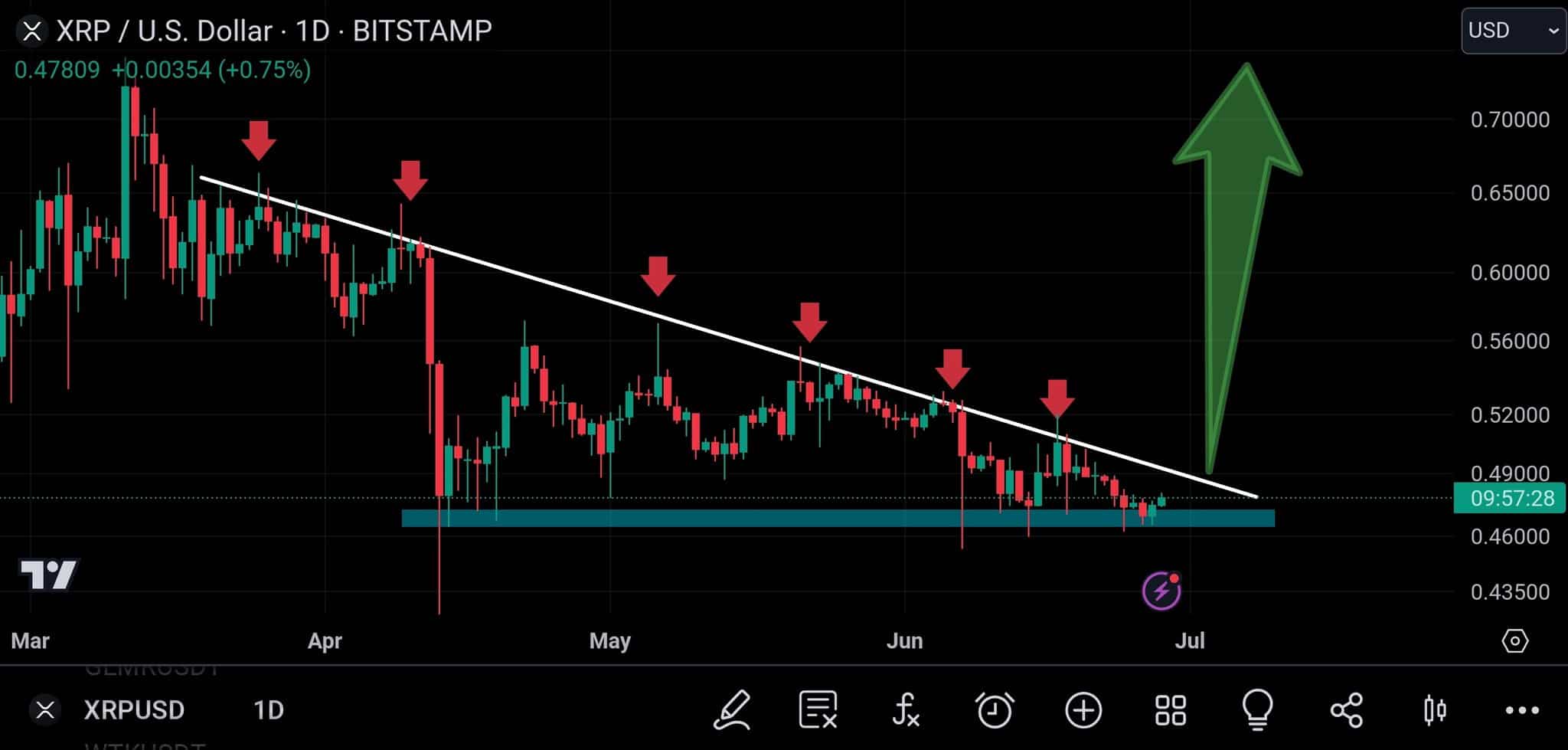
In an accompanying chart, the analyst points to a descending trendline that has been a significant resistance level for XRP throughout the months leading up to July. This trendline, marked by several failed breakout attempts, shows that XRP struggled to break through this level. 

XRP Poised for a Breakout Rally

Despite these breakout attempts, XRP has been consistently recording lower highs since April. However, the chart also spotlights a solid support zone between $0.46 and $0.49, where the price has bounced multiple times.

XRP 1D Chart XRP Hawker
XRP 1D Chart | XRP Hawker

XRP Hawker expects a potential breakout scenario, suggesting that once XRP convincingly breaches this descending trendline, it could trigger a rally toward higher price levels. This breakout is currently on the horizon as XRP gradually moves toward the apex of the descending triangle.

If his prediction holds, XRP could see its value rise to approximately $6.10 by the end of August. This would mark a 981% price spike from the current position. Following this rise, the analyst expects a corrective phase, bringing the price down to around $2.38 by September. 

Nonetheless, XRP Hawker asserts that this corrective phase would set the stage for a final, aggressive push. According to him, the final push could take XRP to an ultimate target of $32, potentially marking the climax of the altcoin season by early November. Interestingly, analyst Dark Defender also expects a rally to $36.

XRP Current Position

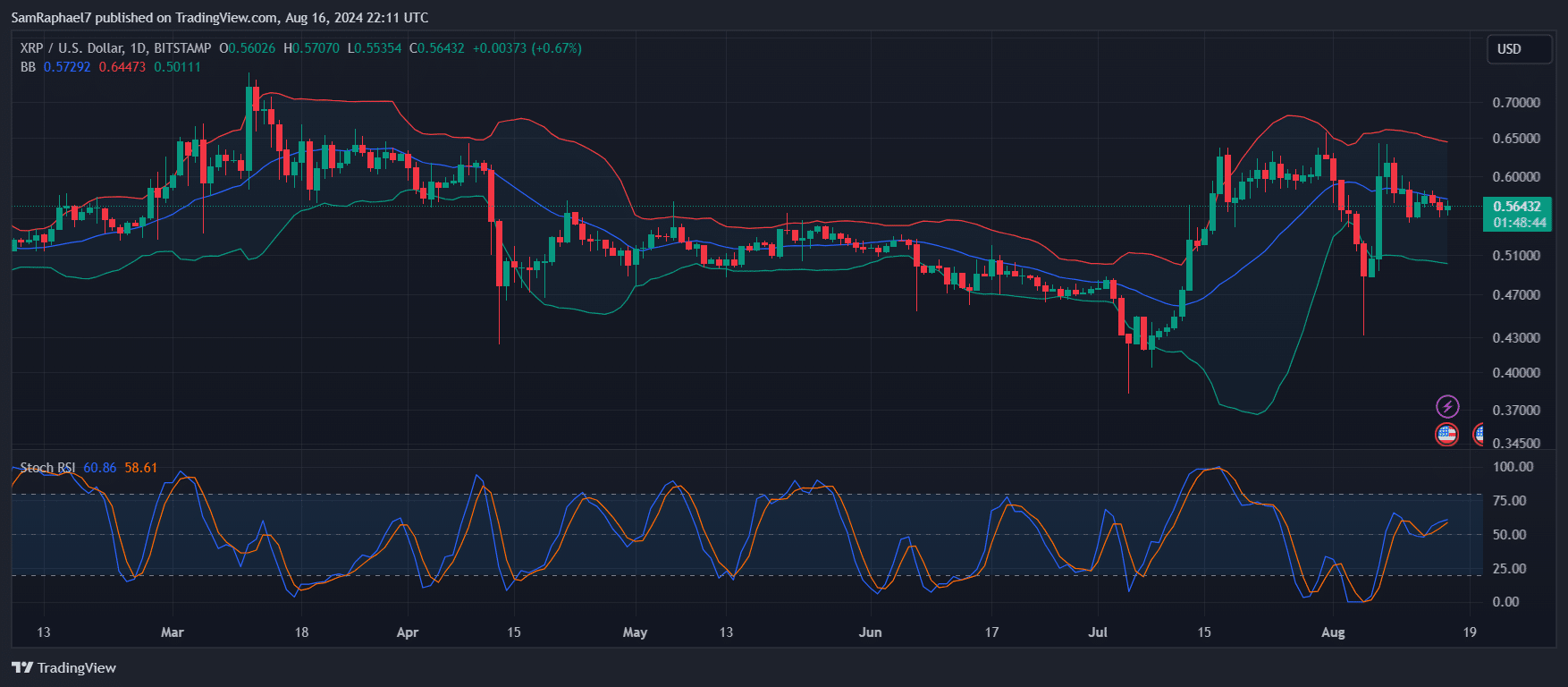
Meanwhile, XRP’s short-term position sends mixed signals for the market amid the ongoing bearishness. Currently changing hands at $0.5643, XRP is trading below the middle Bollinger Band ($0.5729) but above the lower band ($0.5011).

After retesting the middle band (20-day SMA), XRP failed to break above it and has retraced. This suggests that the price is in a consolidation phase, possibly gathering momentum for the next move.

XRP 1D Chart 111446
XRP 1D Chart

Trading below the middle band often indicates bearish pressure, but the fact that XRP is still above the lower band signals that the market is not in extreme bearish territory. The wider distance between the bands reflects a period of increased volatility, which often precedes a significant move in either direction. 

Moreover, the Stochastic RSI shows that XRP is in the mid-range of the oscillator. This indicates that the market is neither overbought nor oversold, leaving room for either a bullish or bearish move.

If the Stochastic RSI crosses into the overbought territory, we might see a short-term price increase, possibly in line with the broader bullish forecast.

Ethereum Key Support Zone: 1.62M Addresses Hold 50M ETH, Will It Hold?

0

Ethereum is on the brink of a crucial test as recent data indicates a potential continuation of its downward trend. 

In a recent update, crypto analyst Ali Martinez highlighted a key support zone between $2,300 and $2,380 for Ethereum. The analyst revealed that within this range, approximately 1.62 million addresses collectively held 50.38 million ETH at the time of the update. 

The significance of this support zone lies in the large volume of ETH held by these addresses. It represents the largest cluster of buyers who entered the Ethereum market after the $2,200 level to $3,000.

For comparison, in the $2,430 to $2,507 range, 1.4 million addresses hold only 3.74 million ETH, whereas in the $2,278 to $2,340 range, 1.89 million wallets hold 50.4 million ETH.

This concentration suggests that bearish market pressure will likely be more strongly defended around the $2,300 level, making it a critical point for market watchers.

Most Ethereum Investors In Profit

With Ethereum’s price at $2,617, over 61 million accumulated ETH tokens are “in the money,” meaning investors are holding them at a profit. These tokens represent 90.80% of all Ethereum tokens purchased within the $2,220 to $3,000 price range, indicating that most ETH holders are still in profit.

Additionally, according to Martinez’s chart, there’s an “At the Money” price range between $2,617.21 and $2,693.61. In this range, 92.82k addresses hold $242.82 million worth of ETH, where investors are neither in profit nor at a loss.

This range reflects a current equilibrium point, providing insight into the ongoing struggle between buyers and sellers. However, Ethereum’s price must stay above these levels to avoid further bearish momentum.

Screenshot 79
IntoTheBlock

Bearish Patterns Highlighted by Market Veteran

Renowned market veteran Peter Brandt recently contributed to the bearish sentiment surrounding Ethereum. Brandt highlighted a rising wedge formation on a four-hour chart, a pattern often seen as a precursor to a bearish reversal.

This week, Ethereum’s price retested a breakout point, briefly spiking above $2,700, but the momentum quickly faded. Brandt also observed that the 18-period simple moving average (SMA) acts as resistance at the wedge’s upper boundary, further weakening the upward trend.

Additionally, the declining average directional index (ADX) indicates a lack of strong directional movement in the market, reinforcing the likelihood of a downward breakout.

ETH Long-Term Projections 

Amid the current market uncertainty, some analysts remain optimistic about Ethereum’s long-term potential. A recent CoinGecko study presents varying price predictions, with estimates ranging from $4,400 to $166,000. Cathie Wood of Ark Invest offers the most bullish forecast, projecting a rise to $166,000 by 2032. 

Meanwhile, other analysts suggest more modest short-term gains, with predictions ranging between $6,000 and $8,000. As Ethereum hovers near crucial support, these projections highlight the contrasting views on its future trajectory, making this a pivotal moment for ETH holders.

BlackRock’s Bitcoin and Ethereum ETF Holdings Surpass Grayscale for the First Time

0

BlackRock’s combined ETF holdings from spot Bitcoin ETF and Ethereum ETF have now surpassed Grayscale’s holdings for the first time ever.

According to a recent disclosure from Arkham Intelligence, BlackRock now holds a combined $21.217 billion worth of BTC and ETH in its iShares Bitcoin Trust (IBIT) and iShares Ethereum Trust ETF (ETHA). 

Of this figure, the asset manager’s Bitcoin ETF (IBIT) takes the larger balance, boasting over $20 billion worth of Bitcoin in assets under management (AUM). Meanwhile, the recently launched Ethereum ETF (ETHA) commands nearly $900 million in AUM.

BlackRock Surpasses Grayscale in Crypto ETF Holdings

The holdings within these BlackRock ETFs surpass the balances held by Grayscale in its multiple ETF products, including the Grayscale Bitcoin Trust (GBTC), the Grayscale Bitcoin Mini Trust (BTC), the Ethereum Trust (ETHE) and the Ethereum Mini Trust (ETH). 

For context, Grayscale announced the launch of the Bitcoin Mini Trust in March amid impressive performance from the broader ETF market and shortly after Bitcoin surpassed its all-time high. The company also introduced the Ethereum Mini Trust last month.

These four Bitcoin and Ethereum ETF products from Grayscale hold a combined $21.202 billion worth of BTC and ETH products, according to Arkham Intelligence. This figure is $15 million less than the cumulative value of BlackRock’s ETF holdings, placing BlackRock above Grayscale for the first time ever.

However, Arkham Intelligence confirmed that its Grayscale dashboard could highlight a higher figure than what the firm holds in exchange-traded funds.

This is because Arkham’s resources also track the Grayscale Digital Large Cap Fund (GDLC), a basket investment instrument that contains BTC, ETH, Solana (SOL), XRP and Avalanche (AVAX). However, the GDLC, though boasting $460 million in AUM, is not an ETF. 

A Contrasting Trend

The latest feat from BlackRock is especially significant, considering it recently jumped into the crypto scene, but has now overtaken the largest crypto investment firm in ETF holdings. This is partly due to consistent withdrawals from GBTC, with $25 million in net outflows recorded yesterday.

Following the latest data, GBTC has now observed $19.57 billion in net outflows since spot Bitcoin ETFs went live in January. Meanwhile, IBIT recorded $16.2 million in net inflows yesterday, bringing its total cumulative net inflow above $20 billion. 

Expectedly, this contrasting trend with BlackRock and Grayscale ETFs have spilled into their Ethereum products. Since July 23, when spot Ethereum ETFs began trading, Grayscale’s ETHE has recorded $2.386 billion in net outflows. In contrast, BlackRock’s ETHA has witnessed $967.1 million in net inflows.

Transactions on the Tron Network Hit Annual High Amid 90% Fee Reduction

0

Tron’s increased on-chain transaction volume has raked in staggering revenues for the blockchain, surpassing Ethereum and Solana.

Transactions on the Tron network have hit their highest point since the start of the year, as data showed the blockchain processed a daily transaction of 7.99 million. This is largely due to the surging user interaction on the blockchain network.

Data from IntoTheBlock shows a steady increment in weekly transaction volume since the start of February. The blockchain saw its lowest weekly transaction volume in February after recording a mere 28.5 million. However, user influx has gone parabolic since then, growing over 38% to 48.54 million weekly transactions from August 5.

Tron Stats 16 8 24
Tron Transaction Count | IntoTheBlock

The Tron network’s resurgent transactional acumen can be tied to reduced transaction fees. According to Tron’s founder, Justin Sun, the charges for transacting on the network have dropped by 90%.

Sun tweeted on Friday that transaction fees on the Tron network and memecoin creator SunPump are now 0.352 TRX, equivalent to $0.04576. This places the network among the cheapest in the cryptocurrency sector.

Tron’s transactional relevance was also reported a few days ago, with data confirming the network controlled one-third of transactions made on Visa’s USDT annual settlement for Q2 2024. The network settled USDT for the payment giants worth $1.25 trillion.

Tron Reaps Revenue Benefits

The increased on-chain activity on Tron has brought ample revenue to the blockchain. According to Token Terminal, Tron has surpassed the revenue generation of other networks, including Ethereum and Solana.

Tron has generated $152 million in the past 30 days, almost three times Ethereum’s and more than six times that of the Solana network. Ethereum and Solana have generated $57.95 million and $24.84 million in the past month, respectively.

Tron Stats 2 16 8 24
Tron

Sun reacted to Tron’s revenue performance, stating the network “could even surpass 42 billion this year, making it the most profitable blockchain on Earth” if this trend continued.

UAE Court Recognizes Salary Payments in Crypto

0

The Dubai Court of First Instance has validated salary payments in crypto assets like Bitcoin, Ethereum, XRP, and others under employment contracts.

The ruling represents a significant milestone in the United Arab Emirates’ legal stance on cryptocurrency. In particular, it marks a departure from the court’s previous position in 2023. At the time, the same claim was dismissed due to the lack of precise valuation of the cryptocurrency involved.

Background of the Case 

The case involved an employee who sued their employer for wrongful compensation termination and unpaid wages. The job agreement specified a salary in fiat currency and an extra 5,250 EcoWatt tokens. The dispute arose when the employer failed to pay the cryptocurrency piece of the salary for half a year.

In 2023, the court recognized the inclusion of EcoWatt tokens in the work contract. However, it declined to enforce crypto payment as the employee failed to provide a reliable method for converting the tokens’ value into traditional currency. 

According to attorney Irina Heaver of UAE-based law firm NeosLegal, this ruling reflects a conservative approach, highlighting the need for tangible proof when dealing with non-traditional forms of payment.

In a notable reversal, the court ruled in the employee’s favor this year. It mandated the payment of the cryptocurrency salary as outlined in the employment contract without requiring conversion to traditional currency. 

Heaver noted that this decision marks a significant milestone in the growing recognition of cryptocurrency in employment contracts. She believes it signifies a progressive approach towards the integration of crypto assets within the nation’s legal and economic systems.

Furthermore, the lawyer observes that this decision establishes a favorable precedent, promoting increased crypto adoption in daily financial transactions.

Notably, countries like New Zealand have already begun accepting cryptocurrency as a legitimate form of payment for income and salaries. Also, as The Crypto Basic reported in 2022, a financial institution in Texa offered employees Bitcoin salary.

Essentially, as the use of crypto assets continues to gain traction, more regions will likely follow suit and adopt similar approaches, paving the way for a more widespread acceptance of cryptocurrency in mainstream financial transactions.

Trader Makes an Insane 100x Gain on Tron-Based Memecoin

0

The insane gain from traders on SUNDOG could spark a memecoin frenzy on the Tron network.

A memecoin trader has pulled off a 100x gain amid bearish market sentiments. Data from Lookonchain shows that a proper-timed Tron network-based token purchase saw a trader turn $650 into over $67,300 in seven hours.

The data confirms that the unidentified wallet address TEP7….VWT1da bought memecoin SUNDOG late Thursday. Notably, the user acquired 6.87 million SUNDOG for just 5,000 TRX ($650).

Seven hours later, after the memecoin had surged significantly, the wallet sold 4.57 million SUNDOG for 522,840 TRX ($68,000), making a profit of 517,840 TRX ($63,700). This represented a massive 104,000% of his initial investment in the memecoin.

At press time, the user still had an unrealized gain of $76,000 (584,615 TRX) from his unsold 2.29 million SUNDOG. According to CoinMarketcap, SUNDOG was changing hands at $0.054 with a 24-hour trading volume of $3.92 million.

Extraordinary gains in this manner are very common in the crypto sector. The Crypto Basics reported a scenario where a patient PEPE trader turned $83 into $79.4 million. There were other cases where a trader flipped 2 SOL to $260,000 on memecoin SHAD, and another user benefited from another user’s pricing error and made 250,000 ADA from 0.5 ADA.

Meme Frenzy on Tron?

This builds on a trend of massive gains realized from memecoin investments in this market cycle. However, market participants have not observed these trends on the Tron network. Most insane memecoin gains have been typical on the Solana network recently. Tokens like Dogwifhat (WIF), BONK, and POPCAT have all emerged from the blockchain, which has been termed the “Ethereum Killer.”

With SUNDOG’s successful outing and reduced traction from Solana-based memecoins, traders might turn to Tron-based memes for the outstanding gains seen from the aforementioned trader. Meanwhile, DeFi protocol Sun.io has released SunPump, a platform that allows users to create memecoins on the Tron network.

Meanwhile, the memecoin sector has struggled recently, declining over 26% in market cap in the past 30 days. At press time, the memecoin cap stood at $39.5 billion, with Dogecoin and Shiba Inu comfortably leading the pack.

Potential SEC Appeal: Ripple CLO Says Only Less Than 10% of Appeals Lead to Reversal 

0

Stuart Alderoty, the CLO of Ripple, expresses confidence that the appellate court will not reverse Judge Analisa Torres’ ruling in the SEC case.

In a recent CryptoLaw interview, The CLO cited two major factors that make him believe the SEC will not win on appeal against Ripple. Alderoty references a statistical trend relating to the success rate of appeals in the U.S., specifically in the Second Circuit, where the Ripple case could go if appealed. 

Alderoty suggested that less than 10% of appeals in the Second Circuit result in reversal. 

“Statistically, the courts of appeal, particularly the Second Circuit where this case [SEC v. Ripple] could go, reverses lower courts less than 10% of the time,” Alderoty remarked. 

The Ripple CLO cited the statistics to indicate the difficulty in overturning lower courts’ decisions in the Second Circuit. 

Additionally, Alderoty said Judge Torres’ careful treatment of all the issues in the case led Ripple to believe that any potential appeal from the SEC would likely be unsuccessful. 

SEC v. Ripple Final Verdict 

Alderoty’s statement comes less than two weeks after Judge Analisa Torres issued the highly anticipated final judgment. It bears mentioning that the verdict ended in a stalemate for the parties. 

As reported earlier, she imposed a fine of $125 million against Ripple instead of the SEC’s proposed $2 billion penalty. In this decision, the judge denied the SEC’s request for disgorgement and prejudgment interest. 

On the other hand, she issued a permanent injunction prohibiting Ripple’s future sales of XRP to institutions. Consequently, Judge Torres ordered Ripple to obtain a registration statement before selling any securities to U.S. institutions. 

SEC Might Appeal 

Following the ruling, top legal experts speculated that the parties, especially the SEC, might appeal. Popular legal expert James Murphy, a.k.a. MetaLawMan, highlighted disgorgement concerns and programmatic sales ruling as possible reasons for the SEC appeal. 

He speculated that Judge Torres’ ruling on programmatic sales and disgorgement could impact other SEC-related cases. Hence, the regulator might move to reverse these decisions on appeal. 

Alderoty Hopes SEC Doesn’t Appeal 

Meanwhile, Ripple’s CLO said that although he would not be surprised if the SEC appeals, he hopes the commission will not. According to him, the Ripple lawsuit, which has zero evidence of fraud or harm to XRP buyers, does not advance the SEC’s core mission of protecting the market and investors. 

Nonetheless, he believes both the Second Circuit and Supreme Court will continue to reject the SEC’s attempt to expand the U.S. securities law through the case. 

In the meantime, he asserted that regardless of whether the SEC appeals, the law of the land is that XRP in itself and secondary market trading of the token are not securities.  

Bitcoin Funding Rates on Binance Hit Year’s Lowest Level, Will Bearish Momentum Continue?

0

Bitcoin’s funding rates on Binance have recently reached their most negative level for the year, indicating a shift in market sentiment. 

This is according to a recent CryptoQuant report. Notably, per the report, Binance holds the largest share of open interest (OI). As a result, the fact that funding rates on the exchange have turned negative could suggest a short-term bearish outlook.

The report emphasizes how this change in funding rates mirrors Bitcoin’s fluctuating price behavior, especially since November 2023, when Bitcoin saw a significant price surge before experiencing intermittent corrections and a gradual decline into August 2024.

Funding Rates Turn negative

Funding rates on Binance are essential indicators of market sentiment. These rates reflect the payments exchanged between traders based on differences in the perpetual contract price and the spot price. Positive rates indicate a bullish market, while negative rates suggest bearish conditions. 

The volatility in these rates became more pronounced in Q3 2024, as the rates fluctuated between positive and negative values. Notably, in November 2023, funding rates briefly turned negative when Bitcoin’s price neared the $25K mark.

Now, in August 2024, they have reached their most negative point of the year, coinciding with Bitcoin’s recent price decline. 

The rise of Bitcoin’s price began in November 2023, after the Binance funding rates turned positive, surging from the $25K range to over $70,000 by June 2024. This swift increase was accompanied by occasional corrections, but overall, the price trend remained upward. 

As of August 2024, Bitcoin’s value has fallen to approximately $58,000, reflecting ongoing market volatility. 

April Halving Sparked Funding Rate Drop

Recall in April, data from the Bitcoin futures and derivatives markets revealed that Bitcoin’s funding rate had turned negative for the first time this year, just before the halving event. Market research firm Kaiko spotlighted this shift while analyzing Bitcoin’s network performance leading up to and following the April 20 halving. 

According to Kaiko’s recent report, the halving has already begun to exert a broad influence on Bitcoin’s market dynamics. Notably, one key effect occurred right before the halving, when Bitcoin’s funding rate shifted into negative territory for the first time in 2024.

Capital Flow Shifts in Bitcoin and Ethereum

Adding to the negative sentiment, recent data reveals a notable shift in capital flows within the crypto market. According to Glassnode, capital inflows for Bitcoin and Ethereum have dropped significantly in the past two weeks. 

This decrease from $20 billion to $14 billion suggests a decline in investor interest, likely due to increasing concerns over market volatility. Simultaneously, investments in stablecoins have surged from $2 billion to $4 billion.