Home Blog Page 159

XRP “Boring” Price Hides Strong On-Chain Signal

The price of XRP may be moving sideways near $1.35, but underlying data suggests a very different story is unfolding beneath the surface.

A fresh analysis from community figure Xaif points to the Network Value to Transactions (NVT) ratio as a key signal investors may be overlooking. Market participants often describe this metric as crypto’s equivalent of a price-to-earnings ratio.

Key Points

  • XRP trades sideways near $1.35, but falling NVT signals stronger real usage backing its current valuation.
  • NVT dropped from 1,200+ to ~170, suggesting less speculation and more utility-driven demand.
  • Lower exchange reserves and rising ETF inflows point to tightening supply and growing institutional interest.
  • With MVRV at lows and sentiment bearish, historical patterns suggest a potential bottom and rebound setup.

NVT Collapse Signals Stronger Fundamentals

Notably, the NVT ratio measures whether a network’s valuation is supported by real usage. High readings typically indicate speculative excess, while lower levels suggest stronger utility relative to price.

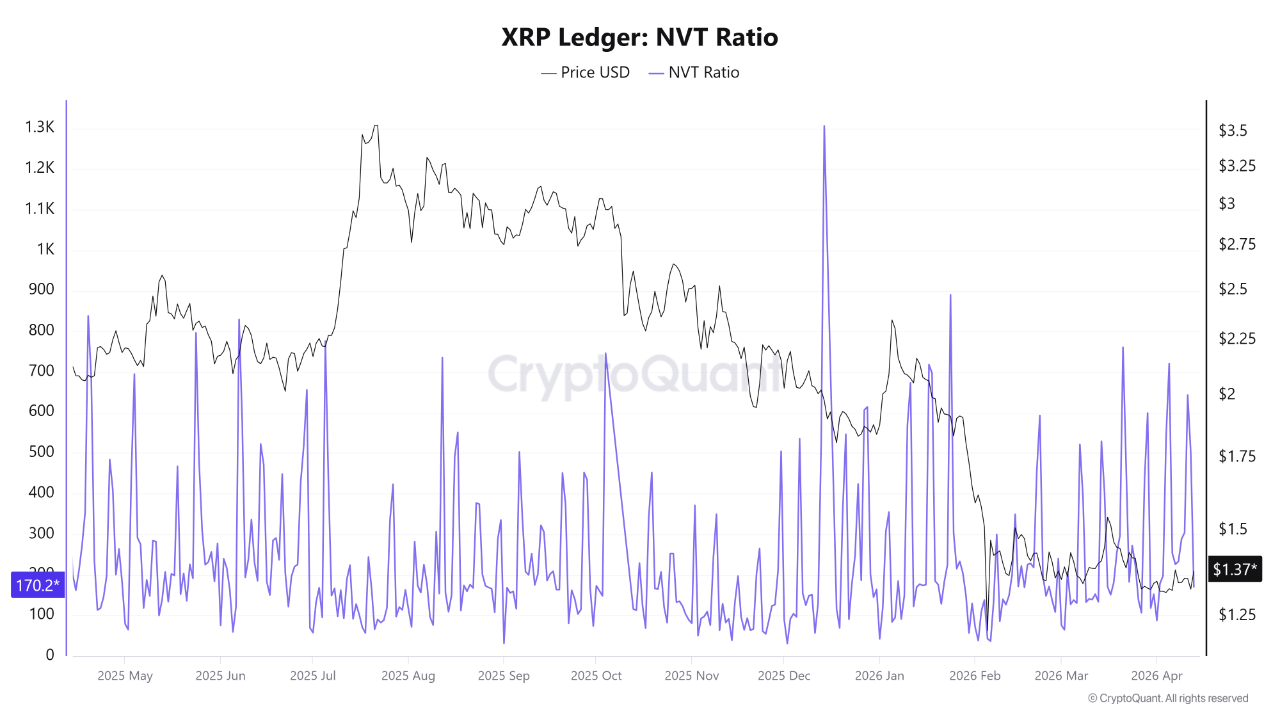
According to the data, XRP’s NVT has dropped significantly to around 170, a stark contrast to mid-2025 levels, when it spiked above 1,200. That earlier surge coincided with XRP trading above $3, driven largely by speculative demand rather than sustained network activity.

Now, the picture appears different.

Xaif argues that at current levels, XRP’s valuation is significantly better supported by actual on-chain usage. This suggests the network is seeing stronger real demand relative to its price than during previous highs.

Market Structure Quietly Tightening

Beyond the NVT shift, several additional factors are reinforcing the accumulation narrative. Over $1.23 billion in capital is locked in spot XRP ETFs, signaling institutional interest.

Xaif added that exchange reserves are trending lower, suggesting reduced sell pressure. Moreover, NVT volatility is compressing, pointing to a potential buildup phase.

This combination suggests a market structure that is tightening rather than weakening.

NVT Ratio chart | CryptoQuant

More Supporting Factors

Meanwhile, XRP’s price is down about 60% from its 2025 peak and is facing extreme bearish sentiment, with FUD near peak levels. Early Bitcoin adopter Lucky Luciano believes this negativity signals a potential bottom, noting that markets often reverse when sentiment turns overwhelmingly negative.

Data from Santiment supports this view, showing bearish sentiment at a two-year high, levels that have previously preceded rebounds. As retail investors exit and confidence drops, contrarian signals suggest a possible relief rally ahead.

“Boring” Phase or Pre-Breakout Setup?

Also, XRP’s MVRV has dropped to FTX-era lows, with holders averaging a 41% loss. Persistent losses and weak sentiment have pressured the price, but historically, such low MVRV levels signal an opportunity zone.

Similar conditions in December 2022 led to a price surge of over 60%, suggesting potential upside if buyers gain the upper hand.

Currently, XRP is trading at $1.35, down 1.1% over the past day and 8% over the past month, frustrating holders.

In sum, while XRP’s price action appears uneventful and retail sentiment remains muted, on-chain indicators are painting a more promising outlook.

The underlying data suggest the asset could be building momentum stronger than its previous rally.

Cardano Faces Make-or-Break Moment at $0.243: Analyst

0

Popular crypto market analyst Ali Martinez has highlighted a critical technical level that could determine Cardano next major price move. 

His analysis follows a slight pullback across the broader crypto market, which pushed Cardano’s price from around $0.25 down to roughly $0.24.

Key Points

  • Ali Martinez describes $0.243 as a “make-or-break” pivot zone that could determine Cardano’s next trend. 
  • If buyers successfully defend the $0.243 support, Cardano’s price could soar 23% to $0.30. 
  • A close below this level could potentially send ADA’s price down 58% to $0.10. 
  • Cardano remains below its 50-day SMA near $0.26, with trading volume dropping 19.71% to $471.51 million. 

Cardano Returns to Key Pivot Zone

In his latest analysis, Martinez explains that ADA has returned to a decisive technical level that could shape its next move. Specifically, he identifies the $0.243 zone as a historical pivot point or a “make-or-break level” for Cardano’s trend. 

In the past, this level has acted either as strong support that triggers rebounds or as a breakdown point that leads to deeper losses. 

If buyers successfully defend this support, the market could stage a relief rally. In that scenario, Martinez projects that Cardano may attempt to recover toward the next major resistance around $0.30, representing a potential gain of about 23% from the pivot zone. 

Such a rebound would suggest that investors still view the current price region as an attractive accumulation area.

Breakdown Could Trigger Deeper Losses

However, Martinez warns that a daily close below $0.243 would mark a significant structural failure for Cardano’s price trend. 

If the support breaks, market confidence could weaken and trigger a deeper correction. Under that scenario, ADA could fall toward yearly lows near $0.10, representing a 58% decline from the pivot level. 

Cardano $ADA 3-day chart shows a horizontal support line at $0.243. The price is currently resting exactly on this floor. Arrows indicate previous rebounds from this level, while a red arrow illustrates the downside risk toward $0.10 if the support is lost.

ADA Lags Behind Major Cryptocurrencies

Meanwhile, Cardano continues to lag behind larger cryptocurrencies such as Bitcoin and Ethereum. While ADA gained only 2.12% during the latest market bounce, Bitcoin and Ethereum rose by 5.64% and 9%, respectively.

Following the rally, both Bitcoin and Ethereum moved above their 50-day simple moving averages (SMA). In contrast, Cardano remains below its own 50-day SMA, which currently sits near $0.26. 

Moreover, Cardano’s trading activity has started to cool after a brief surge earlier in the week. At press time, ADA trades at $0.2402, down 1.85% over the past 24 hours and 7.78% over the past week. Similarly, trading volume has dropped 19.71% over the past day to $471.51 million, suggesting a decline in short-term momentum. 

Market Updates: Bitcoin Devs Push BIP-361 to Freeze Quantum-Vulnerable Coins; Bitwise CIO Sees BTC Overtaking Gold in Market Cap; Deutsche Börse Takes 1.5% Stake in Kraken Parent

0

Latest Market Updates: As of 15th April 2026.

Developers Propose Freezing Quantum-Vulnerable Bitcoin

A group of Bitcoin developers led by Jameson Lopp has introduced a draft proposal to secure the network against emerging quantum computing threats.

The proposal, known as BIP-361 and published on GitHub earlier this week, is part of a broader three-step roadmap focused on strengthening Bitcoin’s defenses in a post-quantum world.

Specifically, the proposal highlights risks tied to older Bitcoin addresses. Early Pay-to-Public-Key (P2PK) wallets are not resistant to quantum attacks. Estimates suggest roughly 1.7 million BTC are stored in such addresses.

To mitigate this risk, the authors propose freezing these coins before quantum computers can exploit them. Notably, this category includes dormant holdings linked to Bitcoin’s creator, currently valued at around $74 billion.

According to developers, this preemptive move would help contain systemic risk. While removing dormant coins from circulation could marginally increase scarcity, a large-scale theft enabled by quantum computing could severely undermine trust in the network.

Bitcoin’s Market Potential Could Surpass Gold: Bitwise CIO

Meanwhile, alongside these technical discussions, market analysts are increasingly optimistic about Bitcoin’s long-term trajectory.

For instance, in a recent X post, Matt Hougan, chief investment officer at Bitwise, argues that Bitcoin’s total addressable market could eventually surpass that of gold. He attributes this outlook to shifting global financial dynamics and Bitcoin’s expanding real-world utility.

As an example, Hougan pointed to reports that Iran is exploring the use of crypto payments for ships transiting the Strait of Hormuz. This development suggests Bitcoin is evolving beyond a store of value into a functional tool for cross-border transactions, particularly in geopolitically sensitive regions.

Furthermore, he noted that Bitcoin is gaining recognition as a neutral financial alternative, which could significantly broaden its use case. Based on this thesis, Hougan reiterated his earlier projection: if Bitcoin captures just 17% of the global store-of-value market, its price could approach $1 million per coin over time.

For context, Bitcoin is currently trading near $74,500, with a market capitalization of approximately $1.4 trillion, according to CoinGecko. Gold, by comparison, trades at around $4,854 and commands a market cap of roughly $33.7 trillion.

Kraken Signals IPO Intent Despite Earlier Doubts

In the corporate sector, crypto exchange Kraken appears to be moving forward with long-discussed plans to go public.

Specifically, speaking at the Semafor World Economy 2026 conference, Co-CEO Arjun Sethi confirmed that the company has confidentially filed for an IPO with U.S. regulators.

Although earlier reports suggested a potential delay due to unfavorable market conditions, Sethi did not directly address those claims. Nevertheless, his confirmation indicates that Kraken has not abandoned its IPO ambitions, thereby keeping the prospect of a major crypto listing firmly on the table.

Deutsche Börse Invests $200M in Kraken Parent

At the same time, Kraken has secured fresh backing from traditional finance.

In particular, Deutsche Börse Group has invested $200 million in Payward, Kraken’s parent company, acquiring a 1.5% stake. The deal values Kraken at $13.3 billion, representing a notable decline from its $20 billion valuation in November 2025.

Kraken stated that the investment is strategically focused on bridging the gap between crypto and traditional financial systems. Ultimately, the goal is to develop a unified infrastructure tailored to institutional clients.

US Lawmakers Struggle to Resolve Stablecoin Yield Dispute

On the regulatory front, uncertainty continues to weigh on the industry’s outlook.

U.S. lawmakers remain divided over how to handle stablecoin yield, a key issue that has stalled progress on broader crypto legislation. In response, Senator Thom Tillis is reportedly preparing a draft proposal to address the matter.

The debate centers on whether third parties should be allowed to offer yield on stablecoins. On one side, traditional banks favor restrictions, citing concerns about deposit outflows.

On the other hand, crypto firms strongly oppose such limits, as yield products are central to their business models.

According to Politico, Tillis acknowledged that disagreements persist, noting that some stakeholders have yet to review the full draft. He also confirmed that there has been partial progress on anti-evasion measures. However, key questions around enforcement and yield provisions remain unresolved.

So far, the White House has hosted three meetings between industry participants and regulators. If consensus remains elusive, a fourth session may be scheduled to reach a compromise.

XRP Price Analysis: XRP Ready for a Breakout as Whale Accumulation Builds

0

XRP is gearing up for a price breakout as the broader crypto market turns bullish and whales accumulate the coin in large numbers.

XRP moved one place lower in the crypto market ranking, with BNB overtaking it to become the third-largest cryptocurrency by market cap excluding stablecoins. This comes as XRP continues to consolidate, trailing the momentum seen among large-cap coins like Bitcoin and Ethereum.

At the time of writing, XRP trades at $1.35, down a little over 1% in the past 24 hours. The coin has also remained almost unchanged in the past seven days, down just 1.9%, further confirming how stagnant its price has been lately.

XRP Price Analysis

Despite this consolidatory trend, the positive is that the XRP price has held support. While it has not yet broken out, the altcoin has maintained the $1.30-$1.33 support zone, keeping hopes of a breakout alive.

XRP Price Analysis/TradingView

Notably, XRP has consolidated around the mid $1.30s for over two weeks now, building momentum for a breakout. For context, the longer a consolidation, the stronger the breakout. Now, with the broader market recovery and sentiments improving, it is only a matter of time before XRP breaks out.

The crucial point to watch is the 50-day moving average. XRP has faced rejection on the last two attempts to break above this dynamic resistance, peaking at around $1.395 on April 7 and 14.

Multiple retests weaken selling pressure, and if XRP keeps hitting this supply wall, a breakout could be imminent. Currently at $1.38, breaking above the 50-day MA with strong volume sets the pace for a rally to the next resistance stronghold around $1.46.

However, further market participation could help this course. Futures trading volume is down 2.67% in the past 24 hours, and XRP spot activities have dropped 7.38% in the same timeframe. XRP open interest has also dropped 4.43% in the past day, indicating slower spot and derivative traction towards the coin.

Whale Accumulation Provides Support

However, amid the XRP consolidation, whales are accumulating in large numbers. Recent data confirmed that XRP whales bought 20 million XRP in the past week, pushing their stash above 3.7 billion tokens.

Coinglass’ XRP spot flow also confirms an increased accumulation among holders. In the past 24 hours, $130.52 million flowed into exchanges, while $131.48 million flowed out, resulting in a net outflow of $966,180. The pattern becomes even clearer on higher timeframes, with $685.18 million entering exchanges and $694.11 million leaving.

XRP Spot Flow/Coinglass

The trend indicates clear accumulation relative to distribution, as holders move their stash into self-custody wallets for long-term holding. Such accumulation near support further builds the momentum for a breakout and subsequent price expansion.

Ripple CEO Says Clarity Act Window Is Open but Less Confident in April Timeline

0

Ripple CEO Brad Garlinghouse says the U.S. crypto industry may finally achieve regulatory clarity through the proposed Digital Asset Market Structure Clarity Act.

He made the remarks while marking his 11th anniversary at Ripple, reflecting on the company’s long campaign for clearer digital asset regulations in the United States.

After more than a decade of advocacy, Garlinghouse believes the momentum in Washington indicates that the crypto industry is closer than ever to achieving regulatory clarity. 

Key Points

  • Ripple CEO Brad Garlinghouse says the U.S. crypto industry is approaching a decisive moment in its push for regulatory clarity. 
  • He suggested that growing momentum in Washington suggests the industry is closer than ever to achieving clear crypto regulations through the Clarity Act. 
  • The Ripple CEO disclosed that the window to pass the Clarity Act is currently open, but warned that the opportunity may not last forever. 
  • Despite initially projecting that the Clarity Act would become law this month, recent delays have lowered his confidence in that timeline. 

Clarity Act Window Now Open: Garlinghouse   

Following meetings with key lawmakers in Washington, including Bill Hagerty and Patrick McHenry, Garlinghouse said the crypto sector is closer than ever to securing clear regulatory rules. He added that the industry’s long fight for regulatory clarity has been worthwhile.

Notably, policymakers are working toward what could become the first comprehensive U.S. regulatory framework for digital assets through the Clarity Act. The proposed legislation aims to define how digital assets are classified and regulated.

As discussions continue, Garlinghouse stressed that the “window” for meaningful legislation, particularly the Clarity Act, is open. However, he warned that this opportunity may not last indefinitely and urged industry stakeholders to act while momentum remains strong. 

Why Clear Legislation Still Matters Despite the SEC’s Recent Shift

Garlinghouse expressed a similar view at the Semafor World Economy Summit. During a fireside chat, he pointed to a recent joint statement from the U.S. SEC and the CFTC. 

The agencies issued joint guidance that introduced the first formal taxonomy for classifying digital assets under U.S. federal law. Notably, the statement categorized XRP as a digital commodity.

According to Garlinghouse, the coordinated approach between the two regulators could mark the end of what he described as years of regulatory hostility toward the crypto industry. Nonetheless, he emphasized that regulatory alignment without legislation remains fragile. 

He warned that a future change in SEC leadership could revive aggressive enforcement policies unless Congress establishes clear statutory guidelines. For this reason, Garlinghouse continues to view the Clarity Act as essential for creating permanent rules governing digital asset classification and oversight. 

Ripple CEO Less Optimistic About April Timeline

Earlier in February, he predicted an 80% chance that the bill would become law by April. However, delays caused by disagreements over certain provisions, particularly stablecoin yield restrictions, have reduced his confidence in the timeline.

Despite the slower progress, Garlinghouse believes negotiations may be nearing a breakthrough. He suggested that growing frustration among lawmakers and industry participants could ultimately push both sides toward compromise.

Current Standing 

The debate over stablecoin yields has been a major sticking point. Several crypto companies, including Coinbase, have opposed restrictions that prevent stablecoin issuers from offering yield to users, arguing that the rule primarily benefits traditional banks.

The dispute delayed legislative progress, prompting the U.S. Senate Banking Committee to postpone its markup session, initially scheduled for January. Sources now indicate the markup could occur later this month.

According to crypto journalist Eleanor Terrett, lawmakers typically announce markup notices about a week before the scheduled date. Therefore, if they plan to hold the markup in the last week of April, they will likely announce by next week. 

In the meantime, recent insider reports suggest that crypto firms and banking executives may have reached a compromise on the stablecoin yield issue. This development could help revive momentum for the Clarity Act.

NVT Analysis Shows Why XRP Is More Fundamentally Sound at $1.37 Than at 2025 Highs

0

XRP has seen a sharp price drop this year, but NVT data suggests the asset is now in a stronger position than when it traded at higher levels last year.

While XRP has declined 51.7% since October 2025, an analysis from CryptoQuant author YJ shows that the current price has better support from real network activity, indicating that the XRP market may have moved away from speculative trading toward more stable fundamentals.

Key Points

  • XRP has dropped 51.7% since Q4 2025, yet current data shows it is fundamentally stronger than when it traded near $3.6 in 2025.
  • The NVT ratio, now at 170.2, has cooled from 2025 highs, showing the current price has better support from real transaction activity.
  • In 2025, daily transactions ranged between 1.1 million and 2.2 million, but in 2026 they increased to 1.79 million-3 million.
  • Transaction activity in 2026 has remained consistently strong, never falling below 1.7 million.
  • Institutional demand has grown, with about $1 billion flowing into spot XRP ETFs.

XRP Fundamentals Strong Despite Price Decline

While XRP has declined to $1.37, YJ pointed out in his recent market exposition that today’s price aligns better with actual network activity. 

In 2025, XRP reached much higher levels, including $3.6 in July 2025, but those prices were not as strongly supported by real usage. 

Now, even at a lower price, the data shows stronger participation across the network, suggesting the market has moved away from speculation and toward more solid fundamentals.

What the NVT Ratio Shows About Value

To explain this, YJ called attention to the Network Value to Transaction (NVT) ratio, a common tool used to assess crypto valuations. 

For context, the NVT ratio compares a network’s total value to the volume of transactions taking place on it. It works in a similar way to the Price-to-Earnings (P/E) ratio used in traditional markets, which shows how much investors are paying compared to a company’s earnings.

XRP NVT Ratio CryptoQuant
XRP NVT Ratio | CryptoQuant

A high NVT ratio usually means the market value is rising faster than actual usage, which can indicate overvaluation or hype. On the other hand, a low NVT ratio suggests strong network activity compared to price, which can signal that the asset is fairly valued or even undervalued.

XRP Market Reset From 2025 to 2026

YJ noted that XRP’s valuation cooled down from late 2025 into early 2026. During 2025, the NVT ratio saw large spikes, showing that prices had moved ahead of real activity. Over time, these spikes eased, and the metric became more stable.

Right now, the NVT stands at 170.2, which sits within a neutral-to-low range compared to the higher levels seen in 2025. This shows that the current $1.37 price has stronger support from real transaction volume than before. 

YJ also noted that in April 2026, the NVT line has been moving in tighter patterns, which shows volatility compression. This often comes before a bigger price move. Even though the price has stayed within a narrow range, the steady network activity suggests the foundation remains strong.

XRP Seeing Rising Network Activity 

Transaction data confirms why the NVT is in a better position today. In 2025, when XRP traded mostly between $2 and $3, daily transactions ranged from 1.1 million to 2.2 million, with only a few spikes up to 2.6 million. Notably, daily transactions never went above 2.8 million between February and December 2025.

Now, despite the lower price between $1.3 and $1.4, activity has increased. Specifically, daily transactions range from 1.79 million to 3 million, with some spikes above 4.4 million. In one case last month, transactions reached 5.17 million, the highest level in two years. 

Throughout 2026, activity has stayed strong, never dropping below 1.7 million, with the lowest point being 1.74 million on Jan. 1, 2026. This shows that more users are engaging with the network even as the price remains lower, improving the NVT ratio.

YJ also called attention to developments surrounding growing institutional interest. He noted that spot XRP ETFs have now witnessed over $1 billion in inflows. This adds more stable and meaningful transaction volume, which helps keep the NVT ratio from rising too high.

EMURGO CEO Praises Hoskinson, Says Midnight Completes Missing Layer in Cardano Architecture

0

EMURGO CEO Phillip Pon says the launch of Midnight delivers a foundational capability that completes an important missing layer in Cardano architecture. 

This aligns with Cardano founder Charles Hoskinson’s commentary that Midnight is designed to complement Cardano, not compete with it.

Key Points

  • EMURGO CEO Phillip Pon states that the launch of Midnight introduces capabilities missing from the Cardano ecosystem.
  • Midnight is a dedicated partner chain that integrates with Cardano, adding specialized privacy features.
  • Beyond the underlying blockchains, Pon explains that ADA and NIGHT are designed to work together to strengthen the ecosystem.
  • He also praises Charles Hoskinson, emphasizing that few founders show the same level of persistence in advancing their projects.

Midnight Completes Missing Architecture in Cardano

In a recent commentary, Pon emphasized that developers built Midnight specifically as a partner chain to Cardano. The network integrates specialized features, particularly privacy and secure data processing, directly into the ecosystem.

As a result, Midnight expands the range of applications developers can build on Cardano and broadens the network’s user base.

Midnight has already achieved notable milestones in recent months, which supporters believe are accelerating ecosystem growth. For example, Midnight secured partnerships with Google Cloud and AlphaTon Capital to explore privacy-focused solutions for Telegram’s self-preserving AI agents.

In addition, U.K.-based Monument Bank has used Midnight’s technology to tokenize customer deposits on a public blockchain.

While these organizations directly leveraged Midnight, their involvement also draws increased attention to Cardano, strengthening the ecosystem.

NIGHT and ADA Are Stronger Together

Meanwhile, Pon stated that ADA and NIGHT, Midnight’s native token, are stronger together. Specifically, ADA continues to secure and power the Cardano network, while NIGHT enables Midnight’s specialized functionality.

Together, this structure enhances Cardano’s overall utility and helps sustain its long-term relevance. However, the market downturn has weighed on both assets.

NIGHT, which quickly surpassed a $1 billion valuation after launch, now holds a market cap of about $596 million and trades at $0.03592. Meanwhile, ADA trades at $0.2388, down 28.24% year-to-date.

This decline comes amid the crypto winter that has plagued the market in recent months. Nonetheless, Pon stressed that such downturns have historically been temporary and often precede renewed growth.

Pon Praises Hoskinson’s Leadership

Meanwhile, Pon praised Charles Hoskinson, describing him as one of the most dedicated leaders in the crypto industry. He noted that throughout his career, he has rarely seen a founder demonstrate such persistence in advancing their projects’ success.

Notably, Hoskinson played a key role in launching Midnight as a partner chain. He also revealed that he personally committed $200 million to support its development.

Looking ahead, he expects Midnight to complement Cardano further while accelerating DeFi activity through integrations with Bitcoin and XRP. Moreover, he continues to focus on rolling out Leios, a scaling solution designed to improve Cardano’s performance.

Shiba Inu Price Analysis: Here’s What Next as Range-Bound SHIB Registers Golden Cross

0

Shiba Inu remains stuck within a range on higher timeframes, but has made a golden crossover on the shorter timeframes. What could happen next?

Shiba Inu (SHIB) trades at $0.000005826, down slightly over the past 24 hours. Its price continues to consolidate while larger-cap coins recover considerably, a trend that saw it lose its place as the second-largest meme coin by market cap to MemeCore (M).

Market users are exercising caution amid the price weakness, as evidenced by a 16% decline in trading volume over the past 24 hours. Shiba Inu’s open interest also took a hit, dropping 8% in the same timeframe to 9.37 trillion SHIB ($56.24 million). This suggests that both spot and derivative participants are looking elsewhere. 

Shiba Inu Golden Cross

However, Shiba Inu recently printed a golden cross on the 30-minute timeframe, an optimistic sign despite the negative trend. For the uninitiated, this cross happens when the 50-period moving average pushes above the 200-period moving average, signaling that buying momentum is increasing.

The golden crossover occurred on Tuesday, signaling a shift in momentum. At the crossing, SHIB printed its largest green candle of the day on the 30-minute timeframe, rising 1.35%.

Shiba Inu Golden Cross/TradingView

Currently, this crossover still holds, even though SHIB has consolidated lower from the intraday high of $0.00000603. This trend could see the meme coin rebound considerably when momentum returns and if the broader market conditions remain favorable.

However, it is worth noting that some analysts view a golden cross as a passive indicator that reflects what has already happened in the market. The crossover on lower timeframes is also tricky, as a death cross can also easily form. As such, higher-timeframe confirmation remains crucial.

SHIB Outlook as Price Remains Range-Bound

Meanwhile, Shiba Inu is in a range on higher timeframes. On the daily chart, the token has trended within a channel for 35 days, dating back to March 11. Within this wedge, it has shuffled between the upper resistance and lower support trendlines.

Shiba Inu Range-Bound/TradingView

Currently, SHIB is approaching the channel’s lower support after a 2.83% drop on Tuesday. If bears continue to dominate proceedings, the price may fall to retest the support around $0.00000562. Losing this level could cause the meme coin to break down, targeting $0.00000523 first, then $0.0000050.

However, regaining momentum around the current level or the support paves the way for a retest of the channel’s upper resistance at $0.00000625. A breakout, if momentum persists, targets $0.00000644 first. The next major resistance is around the February 14 lower high of $0.00000725.

Notably, to sustain an uptrend, SHIB needs to reclaim key moving averages. At its current price of $0.00000585, it trades slightly above the 50-day MA at $0.00000584. The next key level is the 100-day MA at $0.00000656.

Bitcoin Eyes $80K as Whales Accumulate 27,652 BTC, Triggering $76K Move

Bitcoin bulls are regaining momentum, and on-chain data suggests a potential breakout toward $80,000 in the near term.

The asset is currently trading around $74,900, up 4.7% in the past 24 hours, after briefly touching $76,060, its highest level in over a month. This move comes as bulls attempt to build momentum above the critical $74K zone.

Key Points

  • Bitcoin targets $80K as whales add 27,652 BTC, boosting bullish breakout momentum above the $74K zone.
  • The BTC price faces $75K–$76K resistance with strong support near $71.5K per order books.
  • Analysts see breakout toward $80K–$85K, with 70%+ odds if $72K support holds.
  • Whales accumulate 27.6K BTC as confidence rises, but rejection may trigger a pullback.

Liquidity Battle Defines Short-Term Direction

According to CoinGlass data, Bitcoin’s order book reveals a battleground. Heavy sell liquidity is stacked between $75,000 and $76,000, while strong bid support sits lower around $71,500.

This setup implies that holding above $74K keeps the bullish structure intact and opens the door for a push into the $75K–$76K resistance zone. However, failure to maintain this level could trigger a rotation back toward lower support levels.

Analysts See High Probability of $80K Break

Meanwhile, market analyst Michaël van de Poppe notes that Bitcoin is consolidating just below resistance and preparing for a potential breakout. He noted that if the price pushes above $75K with strong volume, he expects a move toward $80K–$85K, where higher timeframe resistance levels lie.

Interestingly, he adds that if the $72K support holds, the probability of Bitcoin reaching $80K this month rises significantly above 70%.

Strength in the broader market, despite ongoing geopolitical uncertainties, further supports this bullish outlook.

Van de Poppe also points out that such a move could trigger amplified gains across altcoins. He argues a 10% Bitcoin rally could translate into 20–30% gains for select altcoins.

Bitcoin Whale Accumulation

Elsewhere, on-chain data from Santiment shows that large Bitcoin holders, wallets with 1,000 to 10,000 BTC, are increasing their positions. These whales now control over 4.25 million BTC, representing 21.3% of the total supply. This is the highest level since mid-February.

Notably, these whales accumulated over 27,600 BTC, worth more than $2 billion, in a single day. This signals strong confidence among large investors, which may explain the ongoing BTC price rebound.

Image

Ultimately, Bitcoin is at a key turning point, with strong support below and resistance ahead. If it decisively breaks above $75K, it could quickly move toward $80K and higher. If it gets rejected, a short pullback may come first.

Tether Launches Self-Custodial Wallet With Bitcoin Support

0

Tether has launched tether.wallet, a self-custodial digital wallet that gives users direct access to its global financial infrastructure.

The wallet supports key digital assets, including BTC, USD₮, USA₮, and XAU₮. Moreover, it enables seamless transactions across multiple blockchains, including Bitcoin and the Lightning Network.

With this move, Tether transitions from operating primarily as a backend liquidity and settlement layer to offering a direct-to-consumer product to simplify digital asset usage.

Key Points 

  • Tether has launched tether.wallet, a self-custodial wallet that gives users direct access to its global crypto infrastructure. 
  • The wallet supports several assets, including Bitcoin, USDT, USA₮, and XAU₮. 
  • Bitcoin stands out as the only major asset in the wallet not issued by Tether.
  • The wallet removes the requirement to hold separate tokens for transaction fees, allowing Bitcoin fees to be paid directly in BTC.

Tether Supports Bitcoin in Its Wallet 

For context, Tether has operated largely behind the scenes, providing liquidity, settlement, and stablecoin infrastructure across more than 160 countries over the past decade. Its flagship asset, USDT, has become the most widely used digital representation of the U.S. dollar in crypto markets.

Now, with tether.wallet, Tether brings this infrastructure directly to users. The wallet supports digital dollars (USDT and USA₮), tokenized gold (XAU₮), and Bitcoin.

Notably, these assets function across multiple blockchains, including Bitcoin and its L2 Lightning Network, Ethereum, Polygon, Plasma, and Arbitrum, ensuring broad accessibility and interoperability.  

Meanwhile, Bitcoin remains the only major asset supported by the wallet that Tether does not issue. This inclusion highlights Bitcoin’s continued importance in the crypto ecosystem and could expand its everyday utility, particularly in regions with limited banking infrastructure.

Core Features

Per the announcement, Tether designed the wallet with simplicity and accessibility at its core. Instead of relying on complex cryptographic addresses, users can send and receive funds using human-readable usernames.

In addition, the wallet removes the need for separate tokens to pay transaction fees, allowing users to complete payments directly with the asset they are transferring. For instance, if a user is sending BTC, a portion of the asset will be used to cover transaction fees. 

Security remains a central focus. The wallet signs transactions locally on users’ devices, ensuring that private keys stay fully under user control at all times.

It runs on Tether’s Wallet Development Kit (WDK), an open-source framework that enables developers, machines, and even AI agents to build and operate self-custodial wallets. 

Tether Targets Mass Adoption with 570M User Base

Commenting on the launch, CEO Paolo Ardoino stated that tether.wallet represents the next phase of Tether’s mission to expand global financial access. He noted that the company’s infrastructure already supports over 570 million users, and the new wallet aims to make that technology directly accessible to everyday individuals.

Ardoino added that the product removes technical barriers that have slowed mainstream crypto adoption while preserving key principles such as open access, self-custody, and independence from intermediaries.  

Meanwhile, Tether continues to demonstrate strong confidence in Bitcoin. The company currently holds 96,184 BTC, valued at approximately $7.27 billion, as part of its reserves.

According to Ardoino, early Bitcoin adopters could see significant long-term rewards, reinforcing the company’s bullish stance on the asset’s future.