Home Blog Page 158

Murad Highlights XRP Community as Blueprint for Parabolic Growth

0

Prominent memecoin analyst Murad Mahmudov has identified Cardano and XRP communities as the gold standard for brand power and parabolic growth. 

He recently argued that explosive crypto growth stems not only from fundamentals and technology but also from deeply committed communities, such as those behind XRP and Cardano.

Key Points

  • Murad Mahmudov identifies the Cardano and XRP communities as benchmarks for brand power and significant growth in crypto.
  • He characterizes these communities as highly passionate, stubborn, obsessed, and relentless in defending and promoting their ecosystems.
  • Mahmudov urges investors to actively watch for the emergence of the next XRP Army or Cardano Army when evaluating opportunities.
  • He further argues that SPX6900 is following a similar community-driven growth model, positioning it as a potential breakout phenomenon.

How XRP and Cardano Armies Drive Parabolic Rallies: Mahmudov

In an X post, Mahmudov urged investors to focus on narrative strength when evaluating opportunities. Rather than relying solely on innovation, he emphasized collective belief as a powerful market force. Specifically, he advised investors to watch for the emergence of the next XRP Army or Cardano Army.

He described these communities as passionate, obsessed, stubborn, and relentless. Although outsiders may view such traits as irrational, Mahmudov maintained that they are essential ingredients for parabolic rallies.

XRP and Cardano Supporters

Given their solid technologies and real-world use cases, XRP and Cardano have built powerful identities that supporters actively defend and promote.

XRP advocates consistently position the token as a solution for global payments. While some financial institutions already utilize it, supporters expect broader adoption over time.

Similarly, Cardano proponents promote ADA as a more secure and sustainable alternative to earlier blockchains like Ethereum and Bitcoin. They also highlight the network’s resilience, governance, and organized development approach.

As a result, these highly engaged communities continue to counter negative sentiment and FUD while attracting new participants. For instance, during the SEC lawsuit against Ripple, XRP supporters organized and contributed to efforts that helped secure the company’s partial legal victory.

Next Big Phenomenon in Crypto Market

Against this backdrop, Mahmudov argued that SPX6900 follows a similar blueprint. He positioned it as the next major phenomenon, suggesting it could even evolve beyond the models established by XRP and Cardano.

Notably, SPX6900 launched in September 2024 as an Ethereum-based meme coin to satirize traditional financial markets, with a narrative centered on “flipping the S&P 500.”

Unlike XRP and Cardano, which often rallied alongside upgrades or bull cycles, SPX6900’s growth has largely been driven by social media hype.

This was particularly evident in July 2025, when the token surged to an all-time high of $2.28. At press time, it is down 85% from its ATH, trading at $0.3427.

Bitcoin Wholecoiners Grow Rarer as Exchange Flows Hit 2018 Lows

The Bitcoin holder spectrum is seeing a significant shift in investor behavior.

New data from CryptoQuant analyst Darkfost shows a major decline in “wholecoiner” activity across exchanges.

Key Points

  • Wholecoiner activity is declining as Bitcoin’s rising price makes owning 1 BTC harder for many investors.
  • Transfers of 1 BTC or more to exchanges have dropped sharply, returning to levels last seen in 2018.
  • ETFs and new access routes are reducing the need for direct BTC ownership and on-chain exchange activity.
  • Fewer large holders moving BTC suggests lower selling pressure and a tightening available supply.

Bitcoin Wholecoiners Becoming Increasingly Rare

Wholecoiners, investors holding at least 1 BTC, are gradually becoming less common, largely due to Bitcoin’s long-term price appreciation. As BTC becomes more expensive, accumulating a full coin is increasingly out of reach for many participants.

This trend is now clearly reflected in exchange flows.

Exchange Flows Fall to Multi-Year Lows

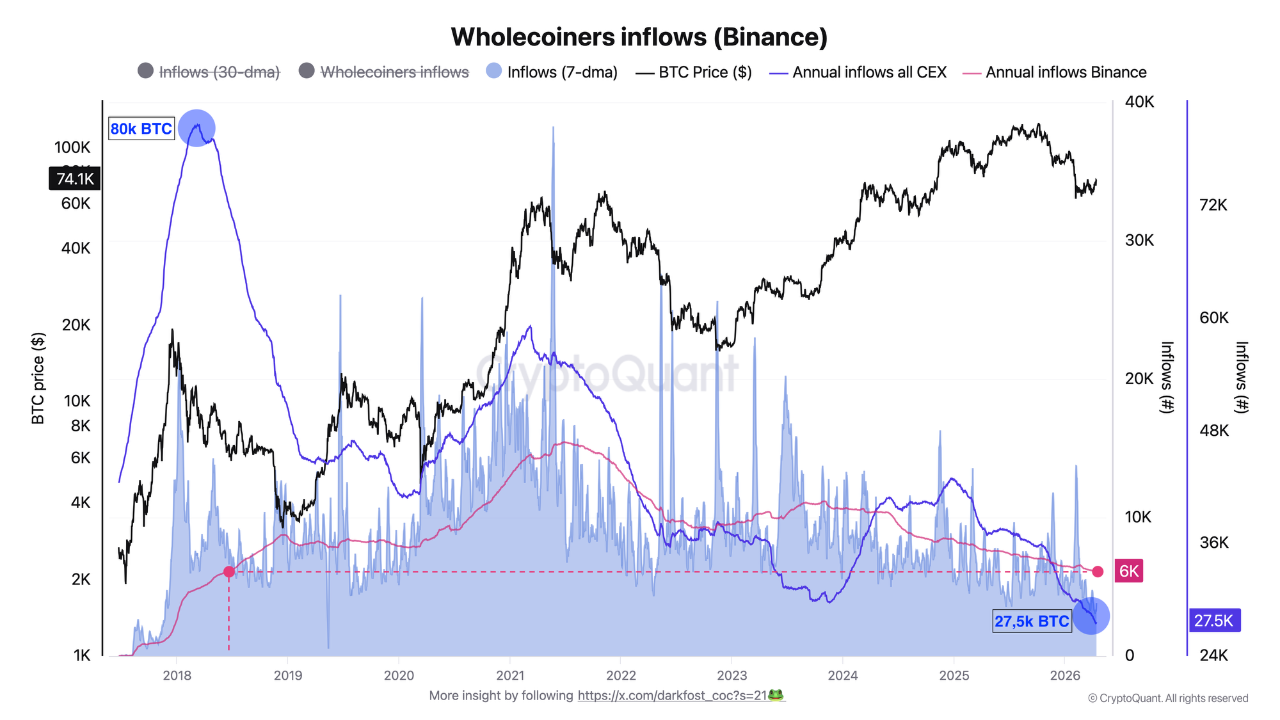
On the Binance platform, monthly average transfers of 1 BTC or more to exchanges have fallen to about 6,000 BTC. This marks a steep decline from the 15,400 BTC recorded during the 2021 market cycle, bringing activity back to levels last seen in 2018.

Across all exchanges, the drop is even more pronounced. Large transfers have fallen to roughly 27,500 BTC globally, compared to the 80,000 BTC peak in 2018, a nearly threefold decrease.

quicktake-image

Bitcoin’s price helps explain why. The premier cryptocurrency trades at $74,100 today, and at its all-time high, it reached $126,200. Meanwhile, in 2018, Bitcoin traded below $20,000, while in 2021 it peaked near $69,000.

In other words, it now costs nearly four times more to own one full BTC than it did in 2018.

ETFs and New Access Routes Reshape the Market

Beyond price appreciation, structural changes in the market are also driving this shift.

The introduction of spot Bitcoin ETFs in 2024, alongside the expansion of trading platforms, has created alternative ways for investors to gain exposure to BTC without directly holding the asset. This reduces the need for on-chain transfers to exchanges.

Specifically, ETFs now hold over 1.61 million BTC, accounting for nearly 8% of the total supply — something that didn’t exist just three years ago.

Long-Term Holding Reduces Selling Pressure

At the same time, a growing segment of investors appears to be adopting long-term holding strategies. This behavior further limits the movement of large BTC amounts to exchanges, typically associated with selling activity.

In sum, the decline in wholecoiner flows points to a transformation in Bitcoin’s market structure. With fewer large holders moving coins to exchanges, selling pressure is easing while a larger portion of the supply becomes increasingly illiquid.

This combination could play a key role in shaping Bitcoin’s future price dynamics if demand continues to rise against a tightening available supply.

Bitcoin Bull Score Index Shows Market May Have Now Officially Entered a Recovery Path

0

The Bitcoin Bull Score Index indicates that the BTC market may have now slipped into a recovery path amid recent price gains.

Bitcoin recently retested $76,000 after recording higher highs and higher lows since the March 29 floor. Amid the rebound push, data from CryptoQuant shows the Bull Score Index (BSI) has risen to 40, indicating that the market may have now officially entered a recovery path.

Key Points

  • Amid Bitcoin’s recent push to $76,000, the Bull Score Index (BSI) climbed to nearly 40, its highest since October 2025.
  • Historical data shows the BSI had fallen from 80 in October 2025 to 10 by early March 2026 before the recent rebound.
  • The current reading shows neutral market conditions, but indicates that BTC may have slipped into a recovery path.
  • Analysts warn that Bitcoin must hold above $72,000 or risk losing its latest gains.

Bitcoin Rebounds from March Lows

Verified CryptoQuant analyst Arab Chain called attention to this improving trend amid Bitcoin’s recent price surge. For context, Bitcoin has started to recover after dropping to $65,000 toward the end of March, as its short-term trend records a bullish change. 

Since March 29, the price has moved upward overall, forming higher highs and higher lows, despite a few intermittent daily pullbacks along the way.

The recovery picked up pace earlier this week, pushing Bitcoin to $76,000 on Tuesday, April 14, its highest level in about a month. Although the price has pulled back slightly from this level, it has held its upward direction and is now trading around $74,300, suggesting that the recovery is still intact.

Bitcoin Bull Score Index Shows Recovering Market

As the price trend improves, analyst Arab Chain notes that Bitcoin’s Bull Score Index (BSI) now shows early signs of recovery after months of weak performance. The index has risen to nearly 40 points, its highest level since October 2025, as BTC trades around $74,000.

He clarified that this level still falls within a neutral range, but it shows that market conditions are improving. In recent months, the index moved up and down, with several drops before settling around its current level. 

This pattern suggests that supply and demand are now more balanced. Essentially, the market is no longer in a strong uptrend, but it is also not showing clear weakness.

Arab Chain also pointed out that the index remains below the strong bullish level above 60, but stays above the extreme pessimism zone below 40. This places Bitcoin in a middle phase, where investors are waiting for new signals to decide the next direction. 

He added that the market looks more stable now, even though momentum is still weaker than it was in October 2025. If the index continues to rise, it could support a stronger upward move in the coming period.

Historical Data Confirms Recovery Bias

Historical data confirms that the Bull Score Index stood at 80 in early October 2025 but dropped to 40 by Oct. 10, 2025, as Bitcoin fell from its $126,000 all-time high to $120,000. This marked the start of a broader decline.

Bitcoin Bull Score Index CryptoQuant
Bitcoin Bull Score Index | CryptoQuant

By the end of October 2025, Bitcoin had dropped further to $110,000, while the index fell to 20. The weakness continued into November and December 2025, when the index reached 10. 

The metric later recovered slightly to 20 in January 2026, but then slipped again to 10 by early March. Since then, the index has gradually climbed back to around 40, supporting the idea that the market is slowly recovering.

What Next for Bitcoin?

Despite the signs of recovery, what comes next remains unclear. Analyst Ted Pillows noted that buying activity linked to Michael Saylor may pause for about one to two weeks, which could reduce demand in the spot market. 

Bitcoin 2D Chart Ted Pillows
Bitcoin 2D Chart | Ted Pillows

He stressed that Bitcoin needs to stay above $72,000 to keep its current gains, warning that a drop below that level could erase the recent rally.

Meanwhile, market watcher Aralez said the market has already taken liquidity between $75,000 and $76,000. From here, he shared two possible paths. In one case, Bitcoin could pull back to around $73,000, slow down, form a base, and then move higher toward $77,000 and above.

In the second scenario, which he currently considers more likely, Bitcoin could drop through $73,000, fall below $71,000, and continue down toward the $69,000 to $70,000 range. Still, he noted that he is waiting for clearer signals before making a move.

XRP Wallets Holding 1,000 to 100,000 Coins Hit 1.1M, Highest Level in History

0

The number of XRP wallets holding between 1,000 and 100,000 tokens has climbed to 1.1 million, marking a new historical peak.

This milestone comes amid increased retail participation in the XRP market despite declining prices. For context, the XRP price has collapsed 52% since the ongoing downtrend began in October 2025. However, during this period, the market has welcomed over 77,000 more retail wallets holding 1,000 to 100,000 coins.

Key Points

  • The XRP price has dropped 52% since October 2025, currently hovering around $1.35.
  • Despite price struggles, the number of wallets holding between 1,000 and 100,000 XRP has increased by 77,500.
  • These retail wallets have now climbed to 1.1 million, a new peak in XRP’s history.
  • Amid the increase in number, wallets in this tier have accumulated over 500 million XRP since Q4 2025.
  • Meanwhile, whale XRP addresses have instead demonstrated varying trends.

Retail XRP Wallets Hit New Peak Despite Price Turbulence 

Data provided by market resource Santiment confirms this bullish trend. Notably, amid the weakening market sentiment, retail participation seems to have only increased.

As of October 2025, wallets holding 1,000 to 10,000 XRP stood at 745,310, while those with 10,000 to 100,000 XRP hovered around 282,780. Together, the network hosted 1,028,090 wallets with balances between 1,000 and 100,000 XRP.

Today, Santiment’s data shows that these wallets have climbed to 1,105,590, marking an increase of 77,500 since October 2025. Of this, 806,230 wallets hold 1,000 to 10,000 coins, while 299,360 wallets hold between 10,000 and 100,000 XRP. The latest figure represents their highest number in XRP’s history. 

Retail XRP Wallets Santiment
Retail XRP Wallets | Santiment

This milestone indicates that XRP has continued to welcome more retail investors despite its price struggles.

Notably, the number first increased to a previous peak of 1,095,830 in early February, but immediately crashed to 1,088,450 days later. It has since continued to increase, recently hitting the new milestone.

Retail Accumulating 

Expectedly, this rise in the number of retail addresses has coincided with a similar increase in their cumulative balance, as investors attempt to procure more XRP tokens at lower prices.

For context, XRP wallets with 1,000 to 10,000 coins held 2.46 billion XRP as of Oct. 1, 2025, while those with 10,000 to 100,000 tokens held 7.58 billion XRP. Together, these addresses had a cumulative balance of 10.04 billion XRP.

This figure has since increased to 10.56 billion XRP, also representing a new historic peak in their balance. The latest reading indicates that these retail XRP wallets have accumulated 520 million XRP since the ongoing downturn began, a testament to their resilience in times of market stress.

Varying Trends Among XRP Whales

While retail XRP wallets have consistently demonstrated positive behavior, the trend has been mixed among XRP whales, as some tiers of addresses have consistently accumulated more tokens while others have distributed.

For one, shark and whale addresses holding between 100,000 and 10 million XRP have reduced their cumulative balance from 13.12 billion XRP in October 2025 to 10.05 billion XRP today. This indicates that these XRP wallets have distributed 3.07 billion XRP since October 2025.

XRP Whales Santiment
XRP Whales | Santiment

On the other hand, XRP whales with 10 million to 100 million XRP have been on an accumulation spree. These addresses increased their cumulative balance from 7.89 billion XRP in October 2025 to 11.31 billion XRP today, confirming that they have accumulated 3.42 billion tokens.

Bitcoin Price Forecast: BTC Struggles at $75,000 Again, but $85,000 Still Possible

0

Bitcoin is struggling around a familiar resistance level, as earlier bullish momentum has faded, but the chances of forging ahead remain.

Bitcoin is showing a familiar bullish signal, and the past few days have proved this. The largest cryptocurrency by market cap has demonstrated resilience lately, overcoming early-month setbacks to regain higher prices.

On Tuesday, it rallied to a high of $76,100, its highest price since early February. From the lows of $65,692 this month, this reflected a 15.8% price growth. Currently, BTC has retained just 8.45% of that, as its price has pulled back considerably from the high.

Bitcoin Price Analysis

Yesterday’s intraday high saw Bitcoin (BTC) reclaim a familiar resistance level: the $75,000 mark. It surged past this supply zone to $76,100 but failed to close above it on the daily chart. The selling pressure around the area proved too strong for bulls, pulling the asset’s price to a close at $74,164.

Bitcoin Stalls at $75,000/TradingView

Meanwhile, this is not the first time Bitcoin has failed in its attempt to break this resistance. The premier asset also reached $76,000 on March 17 but met a similar supply wall, forcing an even larger correction than yesterday, down to $73,920.

Stalling at the exact $75,000 resistance not only suggests the market is not yet ready for higher prices but also reemphasizes its importance. The strength gathered after last month’s rejection was not enough to breach the stronghold resistance, putting Bitcoin at risk of dropping lower again.

Interestingly, Bitcoin was not up against this familiar resistance alone but also the 100-day simple moving average (SMA). This dynamic indicator sits at $94,935, joining forces with the usual supply wall around the zone to frustrate bulls.

Failing to clear this resistance puts the Bitcoin price at risk of falling back into the $68,000-$65,000 price range, with the 50-day MA at $69,680 serving as potential support.

$85,000 Still in Sight

Nonetheless, the chances of Bitcoin rallying higher remain. The crypto leader continues to hold the micro support level at $72,000, as identified by analyst Michael van de Poppe. Notably, BTC trades at $74,036 at the time of writing.

Holding $72,000 allows Bitcoin to build the momentum to break the $75,000 resistance. When it closes above the area with strong volume, it could target much higher prices.

Van de Poppe identified the $80,000-$85,000 range as the possible target, claiming it could happen before the end of April. The move would see BTC reclaim levels not seen since late January.

Meanwhile, daily RSI stands at 60.74, indicating that there is still room for further upside before entering the overbought territory above 75. The MACD also signals bullish momentum, with large green histograms not hinting at an imminent price reversal. Additionally, the MACD line at 1,201.91 is well above the signal line at 590.84, supporting bullish price action.

Market Updates: Ripple Pilots Tokenized Bonds in South Korea, XRP Ledger Taps Boundless for Privacy Upgrade, Tether Launches Self-Custody Wallet

0

Latest Market Updates: As of 15th April 2026.

Global crypto markets witnessed a series of significant developments today. Ripple unveiled a bond tokenization pilot in South Korea, while the XRP Ledger announced a privacy-focused integration with Boundless. At the same time, U.S.-listed Bitcoin ETFs attracted strong inflows, and Tether launched a new self-custodial wallet.

Ripple Partners With Korean Insurer for Tokenized Bond Settlement

To begin with, Ripple announced a partnership with Kyobo Life Insurance to pilot blockchain-based settlement for government bonds within South Korea’s financial system.

As part of the initiative, Ripple will deploy its custody platform, Ripple Custody, to handle the issuance, settlement, and storage of tokenized bonds.

The move targets longstanding inefficiencies in traditional bond markets, where settlements typically involve multiple intermediaries and can take up to two days. By contrast, blockchain-based processes enable near real-time execution.

If successful, the pilot could reduce counterparty risk and improve capital efficiency. Ripple also indicated that the project may expand into broader tokenized treasury operations across South Korea’s financial ecosystem.

XRP Ledger Adds Privacy Layer via Boundless Integration

Alongside its bond initiative, Ripple’s ecosystem is progressing on the technological side. In a separate announcement, the XRP Ledger revealed an integration with Boundless to enhance transaction privacy.

The upgrade leverages zero-knowledge technology tailored for institutional use, allowing sensitive transaction details to remain hidden while still meeting regulatory requirements.

According to Boundless CEO Shiv Shankar, the system conceals key information such as transaction size and counterparties, while enabling regulators to access necessary data through selective disclosure.

This approach strikes a balance between privacy and transparency, potentially unlocking new institutional use cases such as cross-border payments, treasury management, and over-the-counter (OTC) trading.

Bitcoin ETFs Record Strong Daily Inflows

Meanwhile, market activity reflected growing institutional confidence. On Tuesday, U.S.-listed spot Bitcoin ETFs recorded inflows of $411.5 million, according to data from SoSoValue.

This marked the second-largest daily inflow of April and pushed total net flows for 2026 into positive territory, reaching roughly $245 million year-to-date. Total assets under management also climbed above $96.5 billion, the highest level since mid-March.

Notably, no ETF posted outflows during the session, based on data from Farside Investors.

Leading the gains was BlackRock’s IBIT, which attracted about $214 million in a single day. The fund has now extended its inflow streak to five consecutive sessions, totaling nearly $696 million.

Similarly, Morgan Stanley’s MSBT maintained its five-day streak, accumulating around $84 million. Other contributors included ARK 21Shares’s ARKB and Fidelity’s FBTC, which added $113 million and $45 million, respectively.

Daily spot Bitcoin ETF flows

Tether Launches Multi-Asset Self-Custody Wallet

Amid growing institutional demand, product innovation across the crypto sector continues to accelerate. Reflecting this trend, Tether has launched a new multi-asset wallet service, tether.wallet.

The wallet supports several Tether-issued digital assets, including USDT, XAUt, and USAT. It also enables transactions in Bitcoin. As a self-custodial solution, it gives users full control over their funds, eliminating reliance on third-party custodians.

To further simplify the user experience, the platform eliminates the need for separate gas tokens, allowing transaction fees to be paid directly in the asset being transferred. It also introduces human-readable usernames ending in “@tether.me,” replacing complex wallet addresses with more intuitive identifiers.

Evernorth Is a Capital Allocation Platform for XRP, CEO Says

Evernorth is positioning itself as a new gateway for institutional exposure to XRP.

CEO Asheesh Birla has confirmed that the firm will function as a capital allocation platform for the XRP ecosystem. Notably, the company is preparing to go public on the Nasdaq under the ticker XRPN. This would allow investors to gain exposure through equity rather than directly purchasing XRP.

Key Points

  • Evernorth plans a Nasdaq listing under XRPN, offering equity-based exposure to XRP for institutional investors.
  • Backed by Ripple, Kraken, and Pantera, the firm raised over $1B to expand XRP via lending and DeFi strategies.
  • CEO Asheesh Birla says crypto is shifting from retail speculation to infrastructure-led institutional finance.
  • Evernorth aims to bridge TradFi and crypto, positioning XRP as a core layer for payments, tokenization, and finance.

Evernorth Targets Public Listing with XRPN Ticker

Earlier this month, Evernorth filed with the U.S. SEC and is advancing toward a public listing. This move could open the door for traditional investors to participate in XRP-related opportunities through regulated markets.

The firm has already raised over $1 billion from major backers, including Ripple, Kraken, and Pantera Capital, with an additional $200 million coming from SBI Holdings.

Rather than acting as a passive investment vehicle, Evernorth plans to expand its XRP holdings through institutional lending and DeFi strategies built on the XRP Ledger.

Shift From Retail Speculation to Institutional Infrastructure

According to Birla, the digital asset market is undergoing a major transition. What began as a retail-driven space is now evolving into infrastructure-focused finance.

The rise of stablecoins, tokenized real-world assets like U.S. Treasury bonds, and regulated investment products such as ETFs is reshaping how capital enters the market. Institutional investors are drawn not by speculation, but by efficiency, programmability, and compliance-ready frameworks.

This mirrors earlier transformations in traditional finance, where technological innovation combined with regulatory clarity unlocked large-scale institutional participation.

Institutional Capital Set to Reshape Market

Birla emphasized that institutional investors bring a different approach compared to retail participants. Their involvement requires strict governance, transparency, and auditable systems.

As this long-term capital enters the market, it could reduce volatility and improve overall infrastructure quality. More importantly, it enables the development of sustainable financial systems beyond trading, including lending, settlement, and treasury management.

XRP as a Core Financial Layer

Within this evolving landscape, XRP is a key infrastructure asset. It boasts strong liquidity in regulated markets like Japan and South Korea, demonstrating its ability to operate at scale.

Its design for fast settlement and interoperability makes it suitable for use cases such as cross-border payments, tokenization, and on-chain financial services.

As the industry shifts toward building financial systems on blockchain networks, proponents view XRP as a bridge between traditional finance and decentralized ecosystems.

Evernorth’s Role in Bridging Traditional Finance and Crypto

Evernorth aims to serve as that bridge by operating as a publicly listed company that deploys capital directly into the XRP ecosystem.

Birla explained that institutional capital cannot simply move into digital assets without familiar structures in place. Instead, vehicles like Evernorth provide a compliant layer that allows investors to access blockchain opportunities without overhauling their existing frameworks.

Essentially, Evernorth is positioning itself as a key intermediary in the convergence of traditional finance and digital assets.

XRP ETFs Just Recorded Their Biggest Daily Netflow Since February

0

XRP ETFs have posted their strongest daily inflow since February 2026 on the back of the latest XRP price rebound.

After a period of weak performance during recent market volatility, XRP ETFs have begun regaining momentum. Notably, the products have now recorded three straight days of net inflows, with the latest daily figure of $11.2 million marking their highest since early February.

Key Points

  • XRP ETFs recorded $11.2 million in daily net inflows, the highest since February.
  • Only Bitwise Asset Management and Franklin Templeton contributed to the inflows, while other funds saw no activity.
  • The recent inflow extends a recovery trend that began on April 10 and has led to three days of consistent gains.
  • This marks the first three-day inflow streak since they bled out in early March.
  • Total cumulative inflows have now climbed to $1.23 billion.

Biggest Daily Net Inflow Since Early February

According to data from Sosovalue, XRP ETFs attracted $11.2 million in net inflows on April 14, in line with broader gains across crypto ETF products that day.

This marks the largest single-day inflow since early February. The last comparable figure was on February 6, when inflows reached $15.16 million. Since then, the funds failed to record another double-digit inflow day, even during a seven-day positive streak between February 24 and March 4.

The latest inflows were driven entirely by the Bitwise XRP ETF (XRP) and Franklin Templeton’s XRP ETF (XRPZ). Specifically, Bitwise’s XRP ETF brought in $4.56 million, while Franklin Templeton’s XRPZ fund added $6.64 million. All other XRP ETFs reported no flows for the day.

XRP ETFs On Recovery Path

The recent performance builds on a gradual recovery push that began on April 10, following a difficult stretch between March and early April when price pressure weighed on investor sentiment.

After a strong run in late February, XRP ETFs experienced four straight days of net outflows between March 5 and March 10. Since then, flows have remained uneven.

However, the momentum started to improve last Friday, with inflows of $9.09 million, followed by a smaller $1.46 million at the start of the week. The latest $11.2 million inflow completes a three-day streak, marking the first since early March.

XRP ETFs Record Three Straight Daily Inflows

Over these three days alone, XRP ETFs have attracted a combined $21.75 million in new capital. This has pushed total cumulative inflows to $1.23 billion.

For context, the highest cumulative inflow recorded was $1.28 billion on Jan. 16. However, this figure crashed after a $53.3 million outflow on Jan. 20. It has continued to fluctuate since then.

Market Updates: Goldman Sachs Files for Income-Focused Bitcoin ETF, X Rolls Out Smart Cashtags, Apple Pulls Fake Ledger App After $9.5M Loss

0

Latest Market Updates: As of 15th April 2026.

The crypto and fintech space saw major developments today. Goldman Sachs moved to launch a new Bitcoin income ETF, while X expanded financial features. Meanwhile, Apple shut down a large crypto scam, and a key US Federal Reserve nominee disclosed deep ties to crypto and AI investments.

Goldman Sachs Files for Income-Focused Bitcoin ETF

Goldman Sachs is deepening its push into crypto markets with a new ETF proposal filed with the US Securities and Exchange Commission (SEC) on April 14, 2026.

According to the preliminary prospectus, the proposed Bitcoin Premium Income ETF seeks to balance steady income generation with long-term capital appreciation. Instead of holding Bitcoin directly, the fund will gain exposure through Bitcoin-linked exchange-traded products (ETPs) and derivatives.

To generate returns, the strategy will rely on selling call options against its holdings. This covered-call approach can produce consistent premium income, though it may cap upside potential during strong market rallies.

The filing specifies that at least 80% of the fund’s assets will remain tied to Bitcoin-linked instruments. Additionally, up to 25% may be allocated via a Cayman Islands subsidiary, a common structure for managing commodity-related investments under US regulations.

Notably, the fund’s options coverage could range between 40% and 100% of its holdings. This flexibility allows the strategy to adapt to changing market conditions. It potentially performs well in stable or moderately rising environments, but likely underperforms during sharp upward price movements.

X Launches Smart Cashtags in the US and Canada

In parallel with developments in crypto finance, X has introduced a “smart cashtags” feature for iPhone users in the US and Canada.

This feature allows users to tap ticker symbols and instantly view live price charts alongside related conversations. It integrates both stock and cryptocurrency data within the app.

In Canada, the rollout goes a step further. Through a partnership with Wealthsimple, users can also trade assets directly within the app. However, this trading functionality is not yet available to US users.

Nikita Bier, head of product at X, described cashtags as an early building block in a broader financial ecosystem. The move aligns with Elon Musk’s long-term ambition to transform X into an “everything app,” integrating payments, commerce, messaging, and social networking into a single platform.

Apple Removes Fake Ledger App Behind $9.5M Loss

Meanwhile, Apple has taken action against a fraudulent cryptocurrency application that resulted in significant investor losses.

The app, which impersonated Ledger Live, reportedly deceived more than 50 users and led to approximately $9.5 million in stolen funds, according to blockchain analysis.

Apple said the developer, operating under the name “SAS Software Company”, used deceptive tactics, presenting the app as legitimate before prompting users to enter sensitive recovery phrases.

One victim, musician Garrett Dutton, reported losing 5.9 Bitcoin, valued at roughly $420,000. He said the loss occurred after he had installed the fake app and had entered his credentials.

Apple has since permanently removed the developer account.

Fed Chair Nominee Discloses Crypto and AI Investments

At the policy level, developments in Washington are also drawing attention. Federal Reserve chair nominee Kevin Warsh has disclosed significant financial holdings ahead of his Senate confirmation.

The filing, submitted to the US Office of Government Ethics, reveals investments in several crypto-related firms, including Compound, Kinetics, and Dapper Labs.

In addition, Warsh holds positions in multiple artificial intelligence companies. These include firms such as Delphi and Factory.

His disclosures also highlight significant wealth, including more than $50 million in the Juggernaut Fund. He further reported over $10 million in consulting income linked to the firm of Stanley Druckenmiller.

Warsh, nominated by Donald Trump, is expected to succeed Jerome Powell. His nomination was announced in January 2026 and formally advanced in March.

XRP “Boring” Price Hides Strong On-Chain Signal

The price of XRP may be moving sideways near $1.35, but underlying data suggests a very different story is unfolding beneath the surface.

A fresh analysis from community figure Xaif points to the Network Value to Transactions (NVT) ratio as a key signal investors may be overlooking. Market participants often describe this metric as crypto’s equivalent of a price-to-earnings ratio.

Key Points

  • XRP trades sideways near $1.35, but falling NVT signals stronger real usage backing its current valuation.
  • NVT dropped from 1,200+ to ~170, suggesting less speculation and more utility-driven demand.
  • Lower exchange reserves and rising ETF inflows point to tightening supply and growing institutional interest.
  • With MVRV at lows and sentiment bearish, historical patterns suggest a potential bottom and rebound setup.

NVT Collapse Signals Stronger Fundamentals

Notably, the NVT ratio measures whether a network’s valuation is supported by real usage. High readings typically indicate speculative excess, while lower levels suggest stronger utility relative to price.

According to the data, XRP’s NVT has dropped significantly to around 170, a stark contrast to mid-2025 levels, when it spiked above 1,200. That earlier surge coincided with XRP trading above $3, driven largely by speculative demand rather than sustained network activity.

Now, the picture appears different.

Xaif argues that at current levels, XRP’s valuation is significantly better supported by actual on-chain usage. This suggests the network is seeing stronger real demand relative to its price than during previous highs.

Market Structure Quietly Tightening

Beyond the NVT shift, several additional factors are reinforcing the accumulation narrative. Over $1.23 billion in capital is locked in spot XRP ETFs, signaling institutional interest.

Xaif added that exchange reserves are trending lower, suggesting reduced sell pressure. Moreover, NVT volatility is compressing, pointing to a potential buildup phase.

This combination suggests a market structure that is tightening rather than weakening.

NVT Ratio chart | CryptoQuant

More Supporting Factors

Meanwhile, XRP’s price is down about 60% from its 2025 peak and is facing extreme bearish sentiment, with FUD near peak levels. Early Bitcoin adopter Lucky Luciano believes this negativity signals a potential bottom, noting that markets often reverse when sentiment turns overwhelmingly negative.

Data from Santiment supports this view, showing bearish sentiment at a two-year high, levels that have previously preceded rebounds. As retail investors exit and confidence drops, contrarian signals suggest a possible relief rally ahead.

“Boring” Phase or Pre-Breakout Setup?

Also, XRP’s MVRV has dropped to FTX-era lows, with holders averaging a 41% loss. Persistent losses and weak sentiment have pressured the price, but historically, such low MVRV levels signal an opportunity zone.

Similar conditions in December 2022 led to a price surge of over 60%, suggesting potential upside if buyers gain the upper hand.

Currently, XRP is trading at $1.35, down 1.1% over the past day and 8% over the past month, frustrating holders.

In sum, while XRP’s price action appears uneventful and retail sentiment remains muted, on-chain indicators are painting a more promising outlook.

The underlying data suggest the asset could be building momentum stronger than its previous rally.