Home Blog Page 160

Tether Launches Self-Custodial Wallet With Bitcoin Support

0

Tether has launched tether.wallet, a self-custodial digital wallet that gives users direct access to its global financial infrastructure.

The wallet supports key digital assets, including BTC, USD₮, USA₮, and XAU₮. Moreover, it enables seamless transactions across multiple blockchains, including Bitcoin and the Lightning Network.

With this move, Tether transitions from operating primarily as a backend liquidity and settlement layer to offering a direct-to-consumer product to simplify digital asset usage.

Key Points 

  • Tether has launched tether.wallet, a self-custodial wallet that gives users direct access to its global crypto infrastructure. 
  • The wallet supports several assets, including Bitcoin, USDT, USA₮, and XAU₮. 
  • Bitcoin stands out as the only major asset in the wallet not issued by Tether.
  • The wallet removes the requirement to hold separate tokens for transaction fees, allowing Bitcoin fees to be paid directly in BTC.

Tether Supports Bitcoin in Its Wallet 

For context, Tether has operated largely behind the scenes, providing liquidity, settlement, and stablecoin infrastructure across more than 160 countries over the past decade. Its flagship asset, USDT, has become the most widely used digital representation of the U.S. dollar in crypto markets.

Now, with tether.wallet, Tether brings this infrastructure directly to users. The wallet supports digital dollars (USDT and USA₮), tokenized gold (XAU₮), and Bitcoin.

Notably, these assets function across multiple blockchains, including Bitcoin and its L2 Lightning Network, Ethereum, Polygon, Plasma, and Arbitrum, ensuring broad accessibility and interoperability.  

Meanwhile, Bitcoin remains the only major asset supported by the wallet that Tether does not issue. This inclusion highlights Bitcoin’s continued importance in the crypto ecosystem and could expand its everyday utility, particularly in regions with limited banking infrastructure.

Core Features

Per the announcement, Tether designed the wallet with simplicity and accessibility at its core. Instead of relying on complex cryptographic addresses, users can send and receive funds using human-readable usernames.

In addition, the wallet removes the need for separate tokens to pay transaction fees, allowing users to complete payments directly with the asset they are transferring. For instance, if a user is sending BTC, a portion of the asset will be used to cover transaction fees. 

Security remains a central focus. The wallet signs transactions locally on users’ devices, ensuring that private keys stay fully under user control at all times.

It runs on Tether’s Wallet Development Kit (WDK), an open-source framework that enables developers, machines, and even AI agents to build and operate self-custodial wallets. 

Tether Targets Mass Adoption with 570M User Base

Commenting on the launch, CEO Paolo Ardoino stated that tether.wallet represents the next phase of Tether’s mission to expand global financial access. He noted that the company’s infrastructure already supports over 570 million users, and the new wallet aims to make that technology directly accessible to everyday individuals.

Ardoino added that the product removes technical barriers that have slowed mainstream crypto adoption while preserving key principles such as open access, self-custody, and independence from intermediaries.  

Meanwhile, Tether continues to demonstrate strong confidence in Bitcoin. The company currently holds 96,184 BTC, valued at approximately $7.27 billion, as part of its reserves.

According to Ardoino, early Bitcoin adopters could see significant long-term rewards, reinforcing the company’s bullish stance on the asset’s future. 
Bitcoin OG Says XRP Bottom Is Close Amid Peak FUD and 60% Dip

XRP is facing one of its most pessimistic sentiment phases in recent years. 

Meanwhile, Lucky Luciano, a well-known early Bitcoin adopter, believes this could be exactly what the market needs for a turnaround.

The veteran investor pointed to a familiar pattern in market cycles, noting that extreme bearishness often appears just before a reversal. His view comes as XRP has dropped roughly 60% from recent highs, with fear, uncertainty, and doubt (FUD) dominating discussions.

Luciano summarized the situation by noting that when the crowd turns overwhelmingly negative, the “bottom is usually close”. Accordingly, he added that patience tends to reward investors willing to wait.

Key Points

  • XRP sentiment hits extreme lows as price drops by 60%, signaling a potential market bottom may be forming.
  • Bitcoin OG Lucky Luciano says peak fear and FUD often appear just before major reversals.
  • Santiment data shows bearish sentiment near 2-year highs, a pattern that has preceded rebounds.
  • MVRV at FTX-era lows suggests XRP may be in an “opportunity zone” if accumulation begins.

Sentiment Data Signals Possible Reversal

Luciano’s comments were in response to fresh data from Santiment, which highlighted a dramatic shift in XRP’s social sentiment.

According to the analytics firm, bearish commentary around XRP is now at its third-highest level in the past two years. Historically, this kind of sentiment imbalance has often preceded price rebounds.

Santiment’s data shows a recurring trend:

  • February 2025: Bearish sentiment spiked, followed by a strong rebound
  • October 2025: A similar setup led to a temporary bounce
  • Current conditions: Bearish sentiment has again surged, with the bullish-to-bearish comment ratio sitting around 1.02 to 1

This pattern reflects a core market principle: prices tend to move against the majority’s expectations when retail sentiment reaches extremes.

Image

XRP Down Sharply as Retail Confidence Fades

The recent downturn has been significant. XRP has fallen more than 60% over the past nine months after trading as high as $3.66. This has pushed many retail investors to step away from the market.

This capitulation is exactly what contrarian investors typically watch for. As retail exits positions and sentiment deteriorates, the probability of a relief rally tends to increase.

XRP MVRV at FTX-Era Lows

Meanwhile, a separate metric further confirms that an opportunity may be emerging for XRP. As the coin trades at $1.37, it leaves holders with an average 41% loss, according to Santiment.

Moreover, Glassnode data shows that more than half of XRP’s supply is underwater, with persistent realized losses and only 43.4% of supply in profit. This sustained selling pressure has weighed on XRP’s recent recovery attempts.

As of April 7, the MVRV ratio has dropped to levels last seen during the FTX collapse. However, historically low MVRV levels suggest XRP may be entering an “opportunity zone.” Similar conditions in 2022 preceded a 63% rebound, hinting at potential upside if accumulation begins.

Contrarian Setup Builds

With XRP sentiment now deeply negative and historical data pointing to similar setups preceding rebounds, some analysts are beginning to call for an all-time high run.

While no immediate reversal is guaranteed, the alignment of extreme FUD with past behavioral patterns suggests XRP may be approaching a key inflection point.

Grayscale Shares Why the $110T Wealth Transfer to Younger Generations Could Benefit Crypto

0

A new report from Grayscale Investments says that a projected $110 trillion transfer of wealth could become a major long-term driver for the crypto market. 

The report, written by Zach Pandl, Head of Research, suggests that this imminent development may represent one of the biggest financial changes in modern history.

Key Points

  • Americans aged 60+ hold about $110 trillion, which will shift to younger generations over time.
  • Industry estimates place the total wealth transfer between $84 trillion and $124 trillion by 2045-2048.
  • These younger generations show stronger crypto adoption, with 45% of Gen Z and Millennials owning crypto compared to 18% of Gen X and Boomers.
  • Grayscale Investments says the imminent $110 trillion wealth transfer to younger generations could benefit crypto.
  • A 2% allocation of the $110 trillion could add $2.2 trillion to crypto markets.

Generational Divide in Crypto Adoption

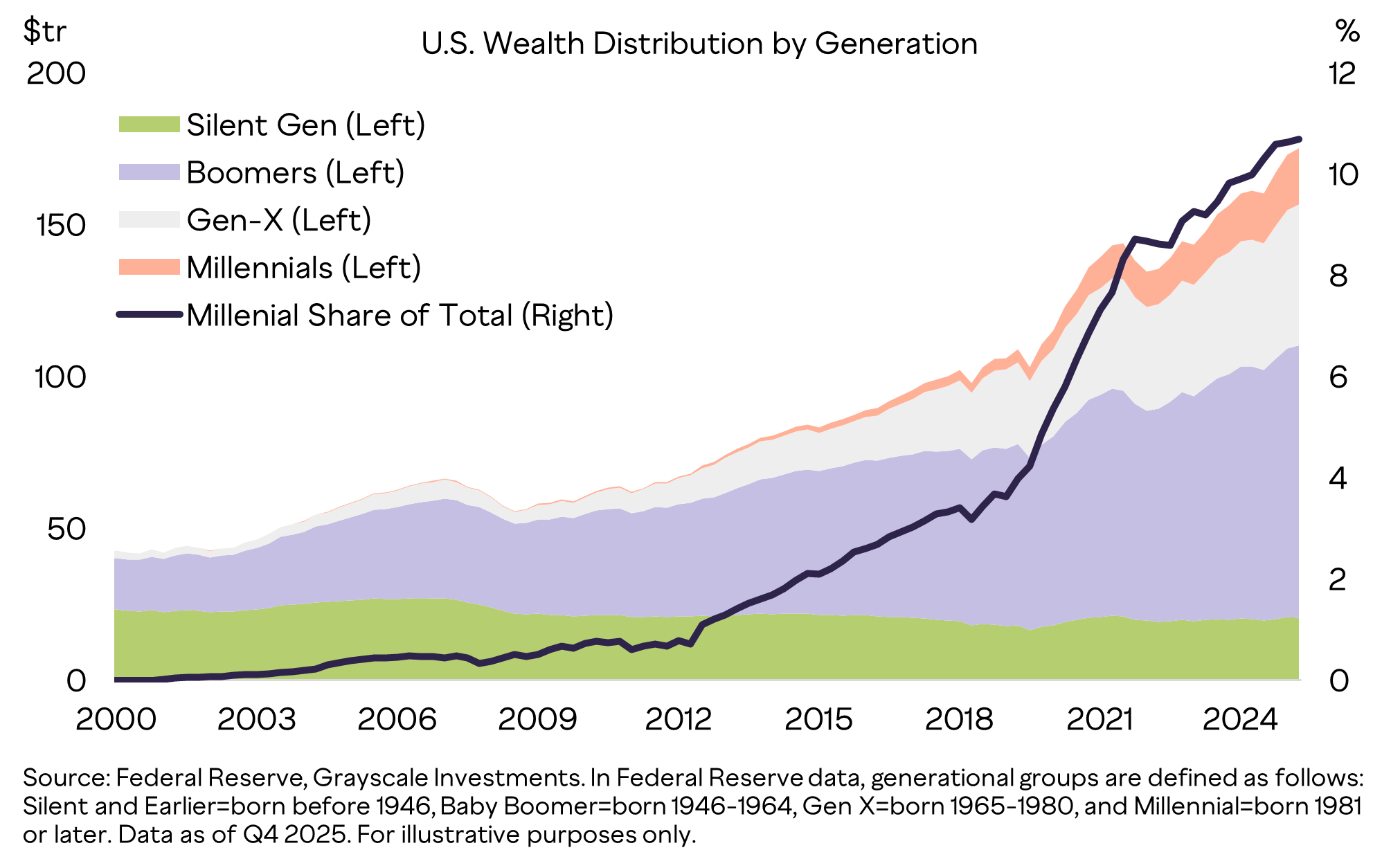
The Grayscale report points out that Baby Boomers are the richest generation in U.S. history, holding close to $90 trillion in wealth at the end of last year, based on Federal Reserve data. 

Combined with the Silent Generation, Americans aged around 60 and older control about $110 trillion in total net worth. Over time, this wealth will move to younger generations through inheritance and other transfers.

US Wealth Distribution by Generation

Grayscale notes that these younger generations think very differently about investing, especially when it comes to crypto. Data from Coinbase’s State of Crypto survey reveals that 45% of Millennial and Gen Z investors hold crypto. However, only 18% of Gen X and Baby Boomer investors do.

Meanwhile, Pew Research data shows a wider gap. Specifically, only 8% of Americans aged 50 and above have ever used or invested in crypto. This shows a difference between generations, which could change how money is invested as wealth moves to younger people.

Potential Impact on Crypto Market Valuations

The report says the upcoming wealth transfer could have a massive impact on crypto prices and market size. As younger people receive more wealth, they may choose to invest more of it in digital assets.

Grayscale provided an estimate for perspective. If just 2% of the $110 trillion moves into crypto, this would create about $2.2 trillion in new demand. For comparison, the total global crypto market is currently worth about $2.52 trillion, so this inflow could nearly double the market.

The report concludes that this shift could support long-term growth in crypto, not merely short-term price movements.

Broader Industry Data Supports the Thesis

Other industry data supports this view. Recent estimates from Cerulli Associates and Merrill Lynch suggest that between $84 trillion and $124 trillion will move from older to younger generations between 2045 and 2048. 

Of this figure, about $46 trillion is expected to go to Millennials, $39 trillion to Gen X, and $15 trillion to Gen Z, with the rest mostly going to charities.

Grayscale’s $110 trillion estimate sits within this range. Analysts generally see this imminent wealth transfer as positive for crypto, especially since younger generations are 2-4x more likely to own and invest in digital assets.

Crypto Ownership Trends and Demographics

Crypto adoption has grown a lot since the early 2020s. The Security.org 2026 Cryptocurrency Adoption and Sentiment Report, based on 992 U.S. adults surveyed in late 2025 and early 2026, found that 30% of adults, or about 70.4 million people, own crypto. 

This is up from 27% in 2024, after reaching 33% in 2022 during the pandemic boom and then dropping during the market downturn. Ownership has now stabilized, as a result of spot Bitcoin ETF approvals and pro-crypto policies.

Further data from Security.org confirms the younger generation’s affinity to crypto: 19% of those aged 18-29 own crypto, 32% for ages 30-44, 31% for ages 45-59, and 17% for those aged 60 and above. About two-thirds of crypto owners are between the ages of 30 and 59.

Bitcoin Could Hit $85,000 Before the End of April, Sending Altcoins Rallying by 2-3x

0

Bitcoin could see further upside from its current price before the end of this month, sending altcoins rallying by two- or threefold.

Notably, the crypto leader has been on a good run of form lately, showing resilience amid the geopolitical tension in the Middle East. It is up over 6% in the past 24 hours, reclaiming $76,000 for the first time in almost one month. Still, there could be more in the pipeline for Bitcoin (BTC) before the end of April.

Key Points

  • Bitcoin could leverage the momentum from the global market recovery to reclaim the $80,000 to $85,000 range before April ends.
  • Breaking $75,000 with volume support would ensure the Bitcoin rally continues to $85,000.
  • As long as Bitcoin remains above the $72,000 support level, there is over a 70% chance it trades above $80,000 before the end of April.
  • Altcoins could be a beta play, likely to rally between two and three times Bitcoin’s price increase.

Bitcoin Reaction at $75,000 Crucial

Michael Van de Poppe, the founder of MN Fund and a prominent market analyst, sees Bitcoin surpassing its current price before the end of this month. In his Tuesday X post, he noted that BTC would leverage the momentum from the global market recovery to reclaim the $80,000 to $85,000 range before April ends.

Notably, the premier crypto asset last trended around this price area on January 29, when it fell 5% from $89,100 to $84,500. As such, the 12.8% rally from the current price of $75,300 would take BTC to an over-three-month high.

But the analyst noted that breaking $75,000 with volume would ensure the rally continues. Breaching this resistance stronghold with confirmation of strong market participation sets the tone for this rally to $80K-$85K, where the next strong supply pressure lies in higher timeframes.

Bitcoin Targets $85,000 by End of April/Michael van de Poppe

Interestingly, this scenario is already in play, with the coin surging to $76,000 amid a 93% spike in trading volume over the past 24 hours.

Van de Poppe also highlighted the $72,000 support as a crucial point. As long as Bitcoin remains above this zone, he believes there is over a 70% chance that the price trades above $80,000 before the end of April.

Altcoins Can Do 2-3x the Bitcoin Rally

Meanwhile, van de Poppe sees altcoins outperforming Bitcoin. He called them a beta play, likely to rally 2-3x Bitcoin’s price increase. For perspective, if BTC increases by 10%, altcoins will likely rise by 20% to 30% or even higher.

Notably, Ethereum has recently shown this prospect. It outperformed Bitcoin in March and continues to serve as a high-leverage beta in the current market. For context, while Bitcoin has increased 5% in the past 24 hours, Ether has increased by over 8%, culminating in a 1.38x performance lead.

While most other altcoins have not yet hit this trajectory, the analyst expects them to if the current market conditions persist. Typically, the market has grown in a measured way, with capital flowing first to Bitcoin and large caps, then rotating further into the broader altcoin market.

XRP Futures Flows Spike 294% to $46M as Interest Returns Amid Price Rebound

Amid the recent XRP price rebound, futures flows have spiked 294% to $46 million, as leverage returns to the derivatives market.

XRP has bounced with the broader market, reaching $1.37 at press time after posting a 3.83% gain on Monday, its first intraday increase in three days. The price rebound shows that buyers are stepping back in, with the structure behind the move confirming a return of speculation in the derivatives market.

Key Points

  • XRP futures activity has surged alongside the price rebound, with 24-hour net inflows jumping 294.78% to $46.15 million.
  • The market recorded $1.59 million in short liquidations out of $1.79 million total over 24 hours.
  • Despite a rise in volume, XRP saw -$10.07 million in 24-hour net outflow, indicating investors are moving XRP off exchanges.
  • While these factors remain bullish for XRP, too many longs could oversaturate the market, leading to a consolidation.

XRP Futures Flows Surge as Traders Return

As XRP recovers above $1.37, derivatives market data provided by Coinglass shows that XRP’s futures net inflows jumped by 294.78% over 24 hours to +$46.15 million. This follows a period of low interest and indicates that traders are once again taking positions in size.

Over shorter timeframes, the 4-hour data shows $71.16 million, a net inflow of +$753.28K. In 8 hours, inflows reached $111.03 million against $106.32 million in outflows, leading to a +$4.71 million net inflow. Over the 12-hour window, inflows rose to $286.18 million compared to $277.18 million in outflows. 

XRP Futures Flows
XRP Futures Flows

Notably, the consistent increase in net inflows across all timeframes confirms that leveraged traders are building positions again. Such activity usually increases volatility, but it also provides fuel for stronger upward moves when supported by real demand.

Short Liquidations Add Momentum to the Upside

Expectedly, XRP’s sudden recovery effort alongside the growing interest has had an impact on short positions. In the last 12 hours, total liquidations reached $328.11K, with $70.87K from long positions and $257.25K from shorts.

Over 24 hours, total liquidations climbed to $1.79 million, including $195.70K in long liquidations and a much larger $1.59 million in short liquidations. Essentially, shorts accounted for 88% of the total figure, as the market forced bearish traders to close their positions.

XRP Liquidations
XRP Liquidations

Such a move often helps drive prices higher in the short term. However, what makes the current development more interesting is that it is not happening in isolation. The liquidations are occurring alongside rising participation and tightening supply, which strengthens the overall recovery setup.

XRP Spot Flows Show Investors Are Holding, Not Selling

While futures flows have continued to see positive trends, spot market data follows the opposite direction. The 8-hour timeframe shows inflows at $27.34 million against $26.45 million in outflows, producing a +$893.47K net inflow. 

Meanwhile, in the 12-hour window, inflows stood at $62.99 million while outflows rose to $67.40 million, leading to a -$4.42 million net outflow.

XRP Spot Flows
XRP Spot Flows

Across 24 hours, inflows totaled $131.03 million, while outflows exceeded that at $141.10 million, leaving a -$10.07 million net outflow and a -203.62% net change. This indicates that investors are moving XRP off exchanges.

When assets leave exchanges, it often means holders plan to keep them rather than sell. This reduces available supply on trading platforms, making it easier for prices to move up when demand increases.

What’s Next for XRP?

XRP’s recovery shows a stronger structure. Short liquidations have already helped push prices higher, but the move no longer represents a short squeeze. The market is seeing a combination of tightening supply, active demand, and growing derivatives interest.

This improves the chances of further upside. XRP could move toward the $1.40-$1.44 resistance range, and if momentum holds, it may extend toward $1.50 or even $1.70. However, the sharp increase in futures activity brings risk. If too many long positions build up too quickly, the market could slow down or see short-term pullbacks.

Extremely Good News for DeFi on XRP as SEC Signals Flexibility on Trading Interfaces

The decentralized finance (DeFi) ecosystem around XRP may be entering a new phase of growth.

A new regulatory move from the U.S. SEC aims to lower barriers to building crypto trading interfaces.

Key Points

  • SEC signals flexibility, lowering barriers for crypto trading interfaces and boosting XRP DeFi growth potential.
  • XRP Ledger’s built-in DEX lets developers tap shared liquidity without building standalone exchanges.
  • Non-custodial design may exempt XRPL interfaces from broker-dealer rules under new SEC guidance.
  • Clearer rules could accelerate XRP DeFi innovation, giving it an edge as crypto regulation tightens.

XRP Ledger’s Built-In DEX Gets Regulatory Tailwind

XRPL validator Vet described the development as “extremely good news for DeFi on XRP,” pointing to the native design of the XRP Ledger.


Unlike many blockchain ecosystems, the XRP Ledger already includes a protocol-level decentralized exchange (DEX), complete with order books, automated market makers, and built-in cross-currency routing.

This means developers can plug into an existing shared liquidity layer rather than building standalone exchanges.

Because transactions are executed directly on-chain and users retain control of their funds, interface providers do not custody assets or handle execution themselves. This architectural advantage is now becoming more relevant in light of the SEC’s latest stance.

SEC Clarifies When Interfaces Don’t Need Broker Registration

For context, in its April 13 statement, the SEC outlined conditions under which providers of “Covered User Interfaces,” such as trading apps or wallet integrations, may not need to register as broker-dealers.

The guidance applies when platforms:

  • Do not hold user funds
  • Do not execute or route trades
  • Provide only neutral tools for users to initiate transactions
  • Operate based on transparent, objective parameters

This aligns closely with how XRPL-based interfaces function. Since the XRP Ledger handles transaction routing, execution, and order matching at the protocol level, developers building front-end access points may fall within this non-broker category if they meet the outlined conditions.

“Public Bazaar” Model for Liquidity

Vet stressed that XRPL’s DEX acts like a shared “public square” or bazaar, where all participants access the same liquidity pool. This contrasts with siloed DeFi applications that require separate infrastructure and user onboarding.

As a result, developers can launch faster without building complex backend systems. Users can access markets without relying on intermediaries. Additionally, regulatory exposure may be reduced due to the non-custodial design.

Implications for XRP DeFi Growth

The combination of built-in exchange functionality and clearer regulatory boundaries could accelerate innovation on the XRP Ledger.

Developers may now feel more confident building wallets, interfaces, and aggregators without the immediate burden of broker-dealer compliance.

Meanwhile, the SEC noted that the guidance is temporary and subject to change within five years. However, the current clarity provides a meaningful window for experimentation and expansion.

For XRP, this positions its DeFi ecosystem as structurally aligned with emerging regulatory expectations, giving it an edge as the crypto market adapts to tighter oversight.

Cardano Price Analysis: ADA Still Stuck Below 50 MA as It Lags Behind Bitcoin and Ethereum

0

The Cardano price is struggling to replicate the form seen in Bitcoin and Ethereum, with the 50-day moving average serving as key resistance.

At the time of writing, Cardano (ADA) changes hands at $0.243, up 2.12% in the past 24 hours. While this is an admirable move, given that it closed very poorly last week after an over 5% drop on Sunday, ADA has failed to match the momentum recorded by other assets.

For perspective, the 2% rise is conservative compared to the 5.64% and 9% growth witnessed by Bitcoin and Ethereum over the same timeframe. The gap in performance widens even more on higher timeframes. ADA has remained almost unchanged in the past 7 days, while BTC has increased by 8.7% and ETH by 13.2%.

This trend is notable for Cardano, as it appears to be depegging from two of the largest cryptocurrencies by market cap. Bitcoin has broken out to reclaim $74,500, and Ethereum has served as a higher-leverage beta play for the premier crypto asset, reaching $2,388. However, all ADA, like most other altcoins, could do is consolidate.

Cardano Price Analysis

A look at the daily chart shows why that could be the case for ADA. Both BTC and Ether have broken above the 50-day simple moving average (SMA), but that is not the case for the “Ethereum killer.”

Cardano 1-day Chart/TradingView

The current Cardano price of $0.243 lies below the 50D SMA at $0.260. Notably, this dynamic trendline is crucial, as it serves as a borderline for price trends. Trading below it reinforces bearish trends, while a break above shifts momentum to the bullish side.

Interestingly, ADA has failed to sustainably trade above this MA since early October 2025. While it did between July and August 2025, its price rose 52% from $0.67 to $1.019. However, since breaking below in October 2025, its price has dropped by 70%, from $0.819 to the current level.

As a result, breaking above the 50-day moving average resistance could be the gamechanger for ADA. Until this occurs, bears are still in control, and the coin could continue to underperform against Bitcoin and Ethereum.

Cardano On-Chain Metrics Support Bears

Meanwhile, Cardano could be reacting to negative on-chain metrics. While trading volume has increased over the past 24 hours, open interest has dropped slightly, signaling the futures market’s disinterest in ADA.

Cardano futures flows further highlight this trend. Specifically, $207.5 million has flowed into derivative contracts in the past 24 hours, while $211.1 million has flowed out, suggesting that traders closed more futures positions in dollar terms than they opened during this period. A combination of dwindling OI and futures flow suggests traders are looking elsewhere for stronger price momentum.

Cardano Spot and Futures Flow/Coinglass

Spot flows also do not look good for ADA. Over the past 24 hours, holders have moved more of the token to exchanges, possibly for sales. Inflows stood at $34.53 million and outflows at $32.78 million, reflecting this trend. Such activities add selling pressure, further resisting Cardano’s price.

XRP RSI Now Eyes Golden Cross at Rising Channel Bottom

The XRP RSI currently eyes a golden cross at the bottom of a rising channel, triggering speculation that this could be the starting point of a rally.

XRP’s downward price action has resulted in six consecutive monthly losses, with the crypto asset’s price down 25% year-to-date. Amid the downturn, XRP has dropped to the bottom of a rising channel, while its weekly RSI eyes a golden cross. 

Key Points

  • XRP’s 25% price drop this year has pushed it to the bottom of a multi-year rising channel on the weekly timeframe.
  • This has resulted in a retest of the rising channel’s lower support trendline.
  • Precious retests of the trendline in 2017 and 2024 preceded massive rallies for XRP.
  • The latest retest coincides with a potential golden cross on the weekly XRP RSI, building the case for an upsurge.

XRP Hits Rising Channel Bottom

This structure was highlighted by market pundit CW amid XRP’s current struggles. For context, since pulling back from the $3.6 all-time high in July 2025, XRP has continued to face turbulence alongside the rest of the crypto market, down 62% from the peak. 

CW found that the ongoing market turbulence has pushed XRP to the bottom of a rising parallel channel that has endured on the weekly chart for nearly a decade. Notably, the chart shows this channel visible as far back as 2017, with its three boundaries, the upper, middle, and lower trendlines, guiding XRP’s price action.

Notably, XRP’s decline to this bottom confirms the dominance of selling pressure in the market, as bears have successfully pushed it to retest the lower trendline of the channel, representing lows last seen during the November 2024 upsurge.

XRP RSI Now Eyeing Golden Cross

In addition to XRP’s drop to the rising channel’s bottom, data from CW’s chart also confirms that the weekly XRP RSI now eyes a golden cross. For context, an RSI golden cross occurs when the RSI line moves above its moving average (the signal line). 

XRP 1W Chart CW
XRP 1W Chart | CW

Such a golden cross indicates that the market may have begun witnessing increasing bullish pressure, leading to the RSI line rising faster than the signal line. At the time of CW’s analysis, XRP traded for $1.34, with the golden cross yet to play out. As of this press, the cross has already occurred, with XRP changing hands at $1.37.

The convergence of XRP’s price at the bottom of the falling channel and the RSI golden cross makes an extremely bullish case for a potential upward price push. “This indicates the starting point of a rally,” CW remarked.

Historical Data Around the Falling Channel Bottom

Historical data surrounding how XRP has reacted to the falling channel bottom also adds to this case. Specifically, each time XRP retested the lower trendline of the falling channel, what followed was a rapid upward price action.

For instance, when XRP’s price collapsed to $0.003 in January 2017, the asset retested this lower trendline. From here, an explosive surge occurred, pushing prices from the $0.003 low in January 2017 to the $3.31 peak by January 2018. 

This pattern played out again in 2024. Specifically, when XRP dropped to the $0.38 low in July 2024 and $0.5 in October 2024, it retested the falling channel’s lower trendline on both occasions. After the October 2024 retest, XRP rebounded sharply, reaching the $3.4 high in January 2024. CW believes a similar pattern could emerge this time.

Bullish CEO Names Cardano and Midnight Among Potential Long-Term Crypto Winners 

0

CEO of Bullish Exchange, Tom Farley, recently highlighted Cardano and Midnight among the cryptocurrencies he believes could emerge as long-term winners. 

Farley argued that the industry will likely favor multiple crypto projects rather than being dominated by a single blockchain. In this environment, different networks will serve distinct use cases, ranging from decentralized finance to enterprise and regulated applications.  

Key Points

  • Bullish CEO Tom Farley highlighted Cardano and Midnight as potential long-term winners in the crypto market. 
  • He also identified Ethereum and XRP as potential winners in the crypto landscape. 
  • He warned that the rise in the number of competing networks could lead to liquidity fragmentation. 
  • Cardano founder Charles Hoskinson continues to emphasize that Cardano remains competitive in the evolving blockchain industry. 

Cardano and Midnight to Thrive 

During a recent interview, Farley explained that Bullish already works closely with the Solana ecosystem. However, he emphasized that the market will not consolidate around one dominant platform.

Instead, he expects several networks to coexist and succeed. Among them, he mentioned Cardano and Midnight as projects with strong long-term potential. Farley also cited other major players, such as Ethereum and XRP, as potential winners in the crypto ecosystem.

His remarks highlight the recognition of ecosystems beyond the most dominant chains. It signaled that emerging and evolving projects could still capture significant market share.

Cardano’s Roadmap Aims to Strengthen Its Position

Although both Cardano and Midnight have recently faced bearish market pressure, supporters remain confident in their long-term prospects and technological roadmap.

Cardano founder Charles Hoskinson has repeatedly emphasized that Cardano remains competitive in the evolving blockchain landscape. 

Notably, developers are actively working toward this goal. Hoskinson has pointed to the upcoming Ouroboros Leios upgrade as a major step forward. The enhancement aims to help Cardano address the blockchain trilemma by simultaneously improving decentralization, scalability, and security. 

Midnight Expands the Cardano Ecosystem

Meanwhile, Midnight recently launched on mainnet as a partner chain to Cardano. The project focuses on “rational privacy,” enabling users to share sensitive data while still meeting regulatory requirements.

Hoskinson has dismissed concerns that Midnight could compete with Cardano. Instead, he believes the new network will complement Cardano and significantly expand its decentralized finance ecosystem, increasing its DeFi activity by as much as tenfold.

Even in its early stages, Midnight has attracted notable partnerships, including connections with Google, Telegram, and UK-based Monument Bank. This growing interest has also drawn renewed attention to the Cardano ecosystem. 

Despite the optimism, Tom Farley has cautioned about a potential downside. As capital and users spread across multiple blockchains, he suggested that liquidity could become increasingly fragmented. 

Cardano Could Reprice Higher as Actual Network Usage Surges

0

Cardano is seeing genuine demand, as evidenced in the notable surge in key network metrics, and the ADA’s value could reprice to reflect this.

Typically, real adoption of an asset influences prices. Simple economics demonstrates that as demand increases and supply fails to match the scale of demand, the underlying asset is likely to reprice over time. This could be the case for Cardano (ADA), which has seen an increase in on-chain activity over the past few months.

Key Points

  • Everstake, a leading custodial staking infrastructure provider, recently highlighted a massive uptick in Cardano network activity.
  • The daily active addresses have increased by an impressive 1,464% over the first three months of the year to 12,000 users per day.
  • Transactions on Cardano grew by a staggering 4,278% to approximately 120,000 transactions.
  • An alignment of active user participation and transaction spike reflects a “genuine increase in demand.”
  • Importantly, growing demand forces the market to reprice ADA’s price higher.

The Cardano Network Buzzing

Everstake, a leading custodial staking infrastructure provider, recently highlighted a massive uptick in Cardano network activity. Over the past three months, key network metrics have ticked up considerably, reflecting the blockchain’s genuine utility and demand for its native tokens.

What is intriguing is that the uptick comes at a time when prices have struggled. Specifically, ADA has dropped 27% since the start of the year and over 81% from the cycle’s high of $1.32 in December 2024. Macroeconomic uncertainties and cyclical price trends have contributed to this trend; yet, traction towards Cardano has continued to increase over the past three months.

For context, Everstake highlighted a vertical expansion in daily active addresses, as users are increasingly using the network. This metric has increased by an impressive 1,464% over the first three months of the year to 12,000 users per day.

Cardano Daily Active Users Spike/Artemis

Furthermore, transactions on Cardano have also ticked up during this period. It grew by a staggering 4,278% to approximately 120,000 transactions, confirming actual network usage rather than just an increase in users.

Genuine Increase in Demand

The buzz around the Cardano network is notable, Everstake insisted. An alignment of active user participation and transaction spikes reflects a “genuine increase in demand,” according to the firm.

Usually, network activity drops when the market is slow, as users exercise caution. However, this has not been the case for Cardano over the past few months. More users have moved value over the network, leveraging its efficient infrastructure.

The increase has also coincided with periods of surging whale activity. For context, Cardano wallets holding 10 million ADA and more have increased in number to a 4-month peak, as large holders accumulate the token.

Massive Implications for Cardano

As explained earlier, this has massive implications for the network’s native token, and Everstake shares this narrative. The firm believes that if this level of activity persists, several things will change for Cardano, including its price.

First, it strengthens the fundamental value of Cardano as a research-driven and fully decentralized ecosystem. It also facilitates increased organic demand for its infrastructure, such as RWA tokenization, stablecoin liquidity, and DeFi.

Importantly, growing demand forces the market to reprice ADA’s price higher. This means the token’s price will rise beyond its current level to unprecedented prices, driven by surging network adoption.