Home Blog Page 17

SEC Filing Confirms Charles Schwab Holds $1 Million in XRP ETF

0

Charles Schwab’s family of funds has revealed that it holds more than $1 million in a spot XRP ETF.

According to its latest SEC filing, Charles Schwab holds $1,011,417 worth of Grayscale XRP Trust ETF shares as collateral. The disclosure confirms that XRP ETFs are increasingly becoming part of traditional investment portfolios.

XRP Becomes Top Holding in S&P 500 Strategy ETF

Meanwhile, another SEC filing shows XRP taking a major position in a regulated investment fund.

Cyber Hornet’s S&P 500 & XRP 75/25 Strategy ETF lists XRP as its largest holding, at 22.5% of the fund. That is more than NVIDIA at 6.1% and Apple at 5.2%.

The ETF gives investors exposure to both XRP and the S&P 500, creating another way for traditional investors to invest in XRP through a regulated product.

Together, these filings show that XRP is becoming more common in traditional financial products.

XRP ETF Inflows at $1.8 Billion

The latest filings add to the growing demand for XRP ETFs. Bloomberg ETF analyst James Seyffart said XRP ETF flows have been “surprisingly resilient,” with data showing that total inflows have reached $1.8 billion since the ETFs launched.

Inflows rose from about $150 million in November 2025 to around $1.79 billion by August 26, 2026. This happened even though XRP’s price has been very volatile.

Goldman Sachs, Jane Street and Millennium Hold XRP ETFs

Meanwhile, more major financial firms are also investing in XRP ETFs. Q2 filings showed that Goldman Sachs had about $87.45 million in XRP ETF exposure, making it the largest holder among the institutions highlighted by Seyffart.

Jane Street held about $16.64 million, while Millennium Management held around $16.20 million. Other companies with XRP ETF holdings included Marex UK Holdings, Intesa Sanpaolo, Ironbridge Private Wealth, Wolverine Asset Management, and Citadel Advisors.

XRP ETF Demand Is Growing

Indeed, demand for XRP ETFs has increased in recent months. Weekly inflows reached about $110.49 million at the end of August.

On a monthly scale, August attracted $159.18 million, compared with $27.29 million in July. That represents a 463% increase. So far in September, the inflows have reached $14.86 million.

Among the biggest issuers is Bitwise with approximately $600 million in total inflows, followed by Canary with $490.75 million in inflows since launch. 

With Charles Schwab holding more than $1 million in a Grayscale XRP ETF and XRP becoming the largest holding in another investment fund, these filings show that XRP is becoming more common in traditional financial products.


Iran Eases Currency Rules as Bitcoin, USDT Gain Role in Cross-Border Trade: Report

0

Iran has reportedly changed its foreign-exchange framework to give companies more options for bringing export income back into the country, with the new arrangements permitting digital assets in international payments amid tighter US sanctions.

According to a Wednesday report from the Financial Times, Iranian businesses can now use Bitcoin (BTC) and Tether’s USDt (USDT) to pay overseas counterparties, with transactions processed through domestic crypto exchanges.

Exporters have also gained more control over money they earn outside Iran. Rather than sending those proceeds through the state-run exchange system and converting them at government-set rates, companies can put the funds directly toward their own import costs.

US Targets Iranian Crypto Assets and Exchanges

Washington has meanwhile targeted Iranian activity in the crypto sector through measures covering both trading platforms and digital assets. In early June, the Treasury sanctioned four Iranian crypto exchanges under its “Economic Fury” campaign.

Treasury Secretary Scott Bessent said shortly before those sanctions were unveiled that the United States had gained control of Iranian digital assets valued at approximately $1 billion.

Bessent announced another action on July 14, saying US authorities had directed the freezing of crypto worth more than $130 million in wallets connected to Iran’s central bank.

Separate blockchain research has also revealed the extent of crypto activity involving sanctioned Iranian parties. TRM Labs said in June that transactions linking CoinEx to sanctioned Iranian entities totaled more than $3.8 billion over more than seven years.

CoinEx disputed suggestions that it maintained business ties with the Iranian state or crypto trading platforms based in the country. The exchange also said it had not helped sanctioned entities obtain financing.

Hunter Biden Unveils LAPTOP Airdrop Structure and Burn-or-Charity Mechanism Ahead of Launch

0

Hunter Biden has detailed how his LAPTOP memecoin will distribute its 1 billion-token supply, including community airdrops and a mechanism that will either burn tokens or allocate them to charity based on the outcomes of 30 publicly identified real-world events.

The memecoin is scheduled to launch Wednesday on Base Layer 2. Phoenix Veritas Foundation, which issues and operates LAPTOP, will make 10% of the total supply available through its claim portal at the token generation event. A further 10% is reserved for a later community airdrop that Phoenix Veritas can distribute at its discretion.

The initial 10% is divided between two eligible groups. Subscribers to Hunter Biden’s personal “Where’s Hunter?” Substack are entitled to 8% of the total token supply, while 2% is allocated to people who suffered losses from President Donald Trump’s TRUMP memecoin.

Biden criticized Trump and his token while explaining the LAPTOP distribution. He said almost 1 million wallets collectively lost $3.8 billion on TRUMP and argued that the token was another instance in which Trump had damaged trust. 

Real-World Outcomes Decide Fate of 30% of LAPTOP Supply 

Thirty percent of LAPTOP is assigned to 30 public predictions involving real-world events. The specified scenarios include Trump being impeached during his presidential term and Democrats gaining control of either the U.S. House or Senate in 2026. According to LAPTOP’s website, many events are tied to prediction markets on Polymarket.

Each prediction determines what happens to its corresponding token allocation. If the specified event occurs, those tokens will be permanently removed from supply. If the outcome does not materialize, the associated tokens will instead be transferred to charity. 

Charitable distributions are not limited to tokens attached to unsuccessful predictions. Biden said another 50 million LAPTOP tokens will be given to charity regardless of how the 30 events are resolved. 

Beyond explaining how the supply will be distributed, Biden also told prospective holders not to rely on him or anyone else to increase the token’s value. He described LAPTOP as a way to communicate a message rather than merely hold an asset.

Founders Receive 30% as Biden Recasts Laptop Controversy

Biden did not explain how the rest of the supply would be distributed in his X post. However, LAPTOP’s official disclosure states that 30% is reserved for the project’s founding team, which includes Biden. The allocation cannot begin unlocking for six months, after which the tokens will be released gradually over the following two years.

Liquidity accounts for another 10% of the supply. The Phoenix Veritas Foundation treasury receives 5% to finance continuing operations. 

Beyond its tokenomics, LAPTOP’s identity is rooted in the laptop controversy that followed Biden into the 2020 U.S. presidential election. He left the device at a Delaware repair shop in 2019, and its contents included financial records, emails concerning his foreign business activities, and personal media depicting his drug addiction.

Republicans in Congress later relied on material from the laptop while investigating whether Joe Biden, then a presidential candidate, had participated in his son’s business dealings. The former president was not charged. Prosecutors subsequently introduced files from the drive as evidence in Hunter Biden’s 2024 federal firearm trial, which ended in his conviction.

In explaining the memecoin, Biden said he was taking something his political opponents and the media had used against him and turning it into a symbol of resilience, redemption, and recovery. He portrayed the creation of LAPTOP as his response to the laptop having been turned into a political weapon.

Cardano Founder Challenges Critics, Says “Show How ADA Goes to the Moon Without Me”

0

Cardano founder Charles Hoskinson has challenged critics calling for his removal from the Cardano ecosystem to explain how the price of ADA would soar without him.

His comments followed criticism sparked by a post from DexHunter. One critic argued that Hoskinson should be “fired from everything” associated with Cardano, claiming that his departure would give Cardano and its Cardano Native Tokens (CNTs) greater potential to surge.

Rather than dismissing the criticism, Hoskinson challenged his detractors to present a detailed alternative.

“I’d love someone to explain, step by step, how a post-Charles goes to the moon,” Hoskinson remarked.

He also asked critics to identify exactly what he currently controls within Cardano, shifting the debate toward the network’s governance and decentralization structure.

Hoskinson’s response effectively places the burden of proof on those advocating for his departure. If removing him would unlock Cardano’s growth, he wants critics to explain precisely how that transition would work and why it would strengthen the ecosystem.

Cardano’s Performance Fuels Leadership Debate

The exchange reflects a broader disagreement within the Cardano community over the project’s development pace, market performance, and leadership.

In particular, ADA has fallen sharply from its 2021 peak above $3. At press time, the token traded at $0.2212, down 92.88% from its all-time high of $3.10. The prolonged decline has also pushed Cardano out of the top 10 crypto by market cap, with ADA ranking 15th.

Although several major cryptocurrencies have suffered substantial declines, critics continue to blame Hoskinson and his company, Input Output Global (IOG), for part of Cardano’s struggles.

Hoskinson has acknowledged that he also suffered significant losses from ADA’s decline, amounting to about $3 billion. Nonetheless, criticism of his leadership continues to circulate across the community.

Supporters counter that Cardano’s transition toward community-led governance distributes responsibility across ADA holders, developers, and other ecosystem participants rather than concentrating it on Hoskinson.

Hoskinson Remains Bullish on ADA’s Recovery

Meanwhile, Hoskinson has repeatedly argued that ADA’s downturn is temporary. He expects the token to recover as Cardano completes major initiatives, including the Leios scaling upgrade and related hard forks, while continuing to strengthen its governance framework and broader ecosystem.

He has also made an ambitious prediction that ADA could return to the top 10 crypto by the end of the year. In the longer term, Hoskinson has set an even bigger goal of seeing Cardano reach the No. 1 position on CoinMarketCap.

However, these projections remain highly speculative. ADA would need to overcome significant market-cap, adoption, and ecosystem-growth hurdles to achieve such milestones. Moreover, broader crypto-market conditions could also play a major role in determining whether Hoskinson’s bullish outlook materializes.

XRP Eyes $2.12 With 5.8:1 Risk-Reward as Bulls Defend Key Support

0

XRP price is showing a bullish setup after reclaiming the $1.40 level, and analyst Nebraskangooner has identified $2.12 as the upside target.

His chart shows an entry around $1.43, a stop level near $1.31, and a profit-taking target of $2.12. That means risking about 8.3% for a potential 48.1% gain, giving the trade a risk-reward ratio of roughly 5.8:1.

Nebraskangooner described the setup as offering a strong risk-reward opportunity but said he is not personally taking the trade.

XRP Price Needs to Hold Support

The key level is the 99-day simple moving average (99 SMA), which is acting as support. Nebraskangooner said XRP price needs to stay above this level to maintain its upward momentum.

The main support sits around $1.31–$1.32. A sustained break below this zone would weaken the bullish setup and invalidate the trade idea. Meanwhile, on the upside, $2.12 is the main target, with resistance around $2.10–$2.15.

XRP price chart by Nebraskangooner

XRP Gains While the Market Stays Flat

At press time, XRP was trading around $1.43, up 3.16% in 24 hours, making it one of the stronger-performing major cryptocurrencies while the broader market remained mostly flat.

XRP has recovered from its early-August low of about $0.987 and climbed to around $1.70 in late August before pulling back and finding support in the $1.30–$1.40 range.

The price of the coin is now at a key decision point. Holding $1.31–$1.32 keeps the path toward $2.12 intact, while a decisive break below that support would weaken the bullish outlook. From $1.43, XRP needs to gain about 48% to reach the $2.12 target.

Imminent Golden Cross

Other market watchers are also issuing bullish outlooks for XRP. As The Crypto Basic reported yesterday, XRP is approaching a potential golden cross, a bullish technical signal that occurs when a shorter-term moving average crosses above a longer-term average. 

The setup is drawing attention because a similar pattern previously preceded XRP’s price rally from roughly $2.20 to above $3.60, a gain of more than 63%. Still, past performance does not guarantee another rally.

BINANCE:XRP/USD Chart showing Imminent Golden Cross

XRP has traded between $1.30 support and $1.50 resistance for about three weeks. The 20-week EMA sits near $1.28, while the 50-week EMA is around $1.53, making $1.50–$1.53 a key resistance zone.

Analyst ChartNerd says a decisive break above $1.50 could strengthen the bullish outlook, while a drop below $1.20 would signal weakness.

Best AI Platforms for Cryptocurrency Trading

0

Cryptocurrency markets move fast, and keeping up with price shifts, on-chain activity, and trading signals across dozens of networks is a real challenge for retail traders and investors. Over the past few years, AI-powered tools have changed how people approach this work, offering automated analysis, pattern recognition, and data aggregation that would take hours to do manually.

The demand for platforms has grown steadily as more traders look for ways to cut through noise and act on cleaner data. These tools range from signal generators and backtesting engines to full trading automation and on-chain analytics dashboards. Each one serves a different type of user, from developers building custom strategies to everyday investors tracking wallet activity.

Blockchain.ai for On-Chain Data and AI Market Tools

Blockchain.ai is a multi-chain analytics platform that brings together on-chain data with AI-driven market signals, making it a valuable resource for crypto AI trading. The platform assembles token tracking, wallet monitoring, liquidity pool data, DEX trade activity, charts, and swap functionality in one interface. This lets users access both raw blockchain data and automated analysis without switching between multiple tools.

For practical use, traders can monitor movements of large wallets on Ethereum and track changes in liquidity pools across several blockchains. Spotting a sudden drop in liquidity pool depth can inform timely exit or entry decisions. Developers can use the platform’s API to integrate real-time token monitoring into their own dashboards.

The platform works well for traders who want raw on-chain data paired with AI-generated signals. Pricing details should be confirmed directly on the site, as tiers can change. Coverage depth varies based on the blockchain network.

3Commas for Automated Trading Signals and Bot Management

3Commas is a trading automation platform that connects to major centralized exchanges via API. Users can run bots, set up automated strategies, and receive signals from third-party providers through the platform.

The platform offers grid bots, dollar-cost averaging bots, and options bots. Dollar-cost averaging involves purchasing an asset in smaller increments rather than all at once. It is suitable for traders who want to automate repetitive strategies without writing code. 3Commas connect to centralised exchanges only. It does not cover decentralised exchanges or on-chain activity, so it is not the right fit for traders who focus on DEX activity.

Pionex for Built-In Trading Bots at No Extra Cost

Pionex is a centralized exchange with 16 built-in trading bots included at no additional charge. Users do not need a separate subscription to access automation. The bots cover grid trading, arbitrage, and leveraged strategies.

This setup is ideal for traders who are new to automation and want to test strategies without paying for a third-party tool. The exchange charges a flat 0.05% trading fee, which is lower than what is typically found on many other exchanges.

The drawback is that users are limited to the Pionex exchange itself. Traders who prefer trading on Binance or Coinbase will find that Pionex bots do not apply there.

TradingView for Charting, Backtesting, and Pattern Detection

TradingView is a charting platform used by a wide range of traders. It includes AI-assisted pattern detection tools that flag potential chart formations and price levels based on historical data. It supports strategy backtesting through its Pine Script language.

Pine Script lets users write and test indicator-based strategies against historical price data before running them live. Free access is available, as well as paid plans.

TradingView is a charting and analysis tool, not a trade execution platform on its own. Users still need a connected broker or exchange to place orders. It also does not provide on-chain data.

Nansen for Wallet Tracking and DEX Liquidity Monitoring

Nansen labels blockchain wallet addresses using a large database of tagged entities. Users can see whether a wallet belongs to a known exchange, fund, or active trader. The platform covers Ethereum and several other major networks including some with active DEX ecosystems.

Traders can use it to track where large holders are moving funds and to monitor liquidity shifts across decentralised protocols.

Cryptohopper for Cloud-Based Bot Trading and Strategy Marketplace

Cryptohopper runs trading bots in the cloud, meaning strategies keep running even when a computer is off. It connects to major centralised exchanges and includes a marketplace where users can purchase pre-built strategies from other traders.

The platform is suitable for traders who want to run automated strategies without building them from scratch. A free tier with limited features is available.

Pre-built strategies from the marketplace carry no guarantee of performance. Past results shown by strategy sellers do not predict future returns. Cryptohopper also does not support decentralised exchanges.

Time to Choose

Choosing between these platforms depends on what traders actually need. If on-chain data and multi-chain visibility are a priority, Blockchain.ai and Nansen may be worth considering. For automating trades on centralised exchanges without writing code, 3Commas, Pionex, and Cryptohopper each provide different entry points.

No single platform covers every use case. Traders running bots on a centralized exchange have different needs from developers tracking DEX liquidity. Select the tool that fits requirements instead of making decisions based solely on a platform’s feature list. If you are interested in exploring advanced strategies or want to streamline your analysis and automation, consider checking out platforms specializing in crypto AI trading for more tailored features.

Coinbase XRP Balance Suddenly Adds $7.74B: Here’s What Happened

0

Coinbase, America’s largest crypto exchange by trade volume, suddenly saw its XRP balance increase by $7.74 billion worth of tokens.

This is according to a new disclosure from XRPScan, a leading XRPL block explorer. Specifically, on Sept. 8, the cumulative XRP balance controlled by the Coinbase exchange increased by a whopping 5.569 billion XRP tokens worth $7.74 billion.

Coinbase XRP Balance Adds $7.74B

The XRP Rich List Bot, a community-driven automated bot tasked with identifying significant changes in XRP account balances, first identified this change, confirming that Coinbase’s cumulative XRP holdings had suddenly spiked by 4,870% within the hour.

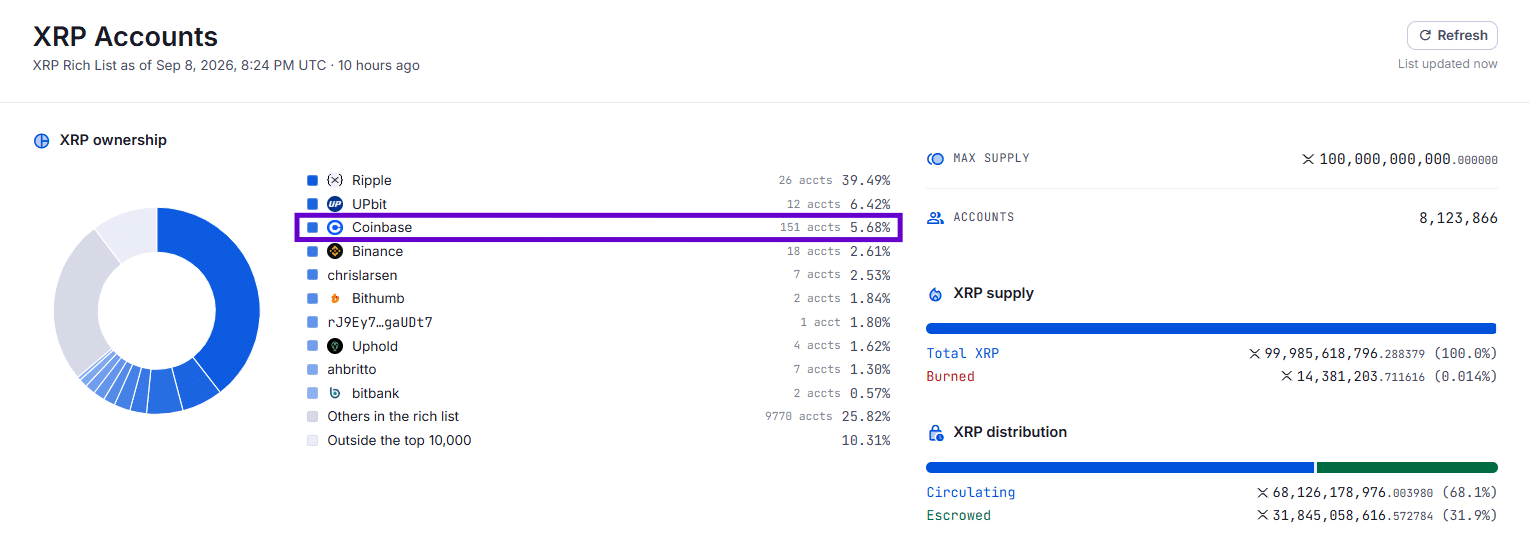
For context, updated data from XRPScan confirmed this change, showing that Coinbase had moved from a low position to become the third-largest XRP-holding entity with up to 5.683 billion XRP tokens, representing about 5.684% of the total XRP supply, within the XRP Rich List.

Coinbase Becomes Third Largest XRP Holder XRPScan
Coinbase Becomes Third Largest XRP Holder | Source: XRPScan

Interestingly, in terms of largest XRP holders, Coinbase is now only below Ripple and Korean exchange Upbit, which respectively hold 39.481 billion XRP worth $54.88 billion and 6.416 billion XRP valued at $8.91 billion at the current XRP price of $1.39. Coinbase now holds more than double the XRP balance within Binance at 2.608 billion XRP.

Further data also shows that Coinbase boasts the highest number of XRP accounts for any single entity on the Top 10 list. Specifically, the exchange’s 5.683 billion XRP balance is held by 151 accounts, beating Ripple’s 26 accounts by a large margin.

Here’s What Happened

For the uninitiated, a massive increase in an exchange’s balance is not particularly a bullish sign for the token involved, as it could suggest that large investors are moving their balances to the exchange in an attempt to sell off their bags. 

However, an increase of this size is rather unprecedented, especially within such a short period of time. This indicates that another factor may be responsible for the recent change rather than a typical exchange inflow event.

Notably, XRPScan confirmed this in a recent disclosure surrounding the development. According to the block explorer, Coinbase did not actually gain 5.5 billion XRP tokens as suggested by its tracking systems. 

They instead revealed that the sudden balance change came from a recent identification of Coinbase XRP accounts that their system had failed to index earlier on. These newly identified accounts contain about 5.5 billion XRP, which led to the increase in Coinbase’s XRP balance after they were appropriately labeled.

Responding to the disclosure, XRP community members questioned whether these tokens actually belonged to Coinbase as an entity or to customers who hold XRP balances on the platform. XRPScan noted that the assets likely involve customer balances. 

Recall that The Crypto Basic called attention to multiple whale XRP movements carried out by Coinbase last year, which depleted their indexed balance from $2.88 billion to around $98 million. The recent development suggests that these transactions merely involved shuffling of assets within the exchange itself. 

Canary Capital to Launch First US Staked TRX ETF Under TRXS on Wednesday

0

Canary Capital will launch the first U.S. exchange-traded fund (ETF) offering both TRX exposure and staking on Wednesday. TRXS will serve as the fund’s trading symbol.

Beyond tracking TRX’s price, the new Canary fund can earn additional tokens by participating in Tron’s proof-of-stake mechanism. Canary said the ETF’s net asset value will reflect the staking rewards it receives.

TRX is the eighth-largest cryptocurrency, with a market capitalization of $32.1 billion, according to CoinGecko data.

Tron Executives Point to Stablecoin Activity

Justin Sun, who founded Tron, said the ETF gives institutional investors another way to gain exposure to the network. He described the launch as a sign of broader recognition of Tron’s role in the worldwide digital economy, pointing to the substantial volume of financial activity already taking place on the blockchain.

Canary Capital CEO Steven McClurg described Tron as an increasingly important part of the technology underpinning digital-asset payments and settlement as stablecoin use grows worldwide. He said Canary believes investors are looking beyond individual cryptocurrencies and paying greater attention to the blockchain networks enabling practical financial applications.

Canary Adds to Crypto Fund Rollout

The TRX product expands Canary Capital’s cryptocurrency ETF lineup, which also includes funds providing exposure to XRP, HBAR, and Litecoin.

$11B Asset Manager Sets the Record Straight on XRP Biggest Misconceptions

0

21Shares AG, a major asset manager with $11 billion in global AUM, has addressed several misconceptions surrounding XRP, including the belief that Ripple controls the XRPL.

Launched in 2012, XRP remains one of the oldest and most enduring digital assets in the blockchain industry. Despite its long history, XRP continues to face misconceptions about its technology, governance, and purpose.

In its guide, “What is XRP? A guide to one of crypto’s veterans,” 21Shares distinguishes between XRP, the XRPL, and Ripple while examining the network’s design, transaction model, supply mechanics, and role in global payments.

Ripple Does Not Control the XRP Ledger

One of the biggest misconceptions 21Shares addresses is the belief that Ripple controls XRP or the underlying blockchain.

The asset manager explains that Ripple is a private technology company, while the XRPL operates as an open, decentralized public blockchain and XRP serves as its native asset.

According to 21Shares, Ripple operates only one of the 35 validators on the XRPL’s default Unique Node List (UNL). Meanwhile, more than 150 known validators operate across the broader network, including universities, exchanges, businesses, and individuals.

Therefore, running a validator does not give Ripple unilateral control over the ledger. As 21Shares puts it, “Inventing the road [is not the same as] controlling the traffic.”

Although Ripple remains the ecosystem’s most prominent contributor, the XRPL remains open to developers, financial institutions, exchanges, and businesses that want to build on the network.

XRP, XRPL, and Ripple Have Different Roles

21Shares also clarified the distinction between XRP, the XRPL, and Ripple, as these terms are often used interchangeably despite referring to different entities.

In simple terms, the XRPL is the blockchain, XRP is its native digital asset, and Ripple is the company that develops payment and custody infrastructure using the network.

The relationship between Ripple and XRP also has a complex history. At launch, the founders gifted 80 billion of the 100 billion XRP supply to Ripple to support development. Then, in 2017, Ripple placed 55 billion XRP into escrow. Around 34 billion XRP remain in escrow today, according to 21Shares, with releases following a public schedule.

However, Ripple’s ownership of XRP does not give the company ownership or control of the underlying decentralized network.

XRP Has a Fixed 100 Billion Supply

21Shares also highlights XRP’s distinct supply structure.

All 100 billion XRP were created when the ledger launched. As a result, the network does not depend on mining or inflationary issuance to create new coins, and no additional XRP can be issued beyond the original supply.

Instead, the circulating supply gradually declines because the network permanently destroys a small amount of XRP whenever it processes a transaction.

The mechanism primarily helps protect the XRPL against spam attacks by making transactions costly enough to discourage abuse. At the same time, it permanently removes XRP from circulation.

According to 21Shares, more than 14 million XRP have been burned through this mechanism to date.

XRPL Targets Payments While Expanding Into Other Use Cases

According to 21Shares, the XRPL can settle transactions within three to five seconds at a cost of roughly $0.0002, while relying on a low-energy consensus mechanism rather than mining.

Moreover, the network’s architecture makes it well suited for payments, with XRP functioning as a bridge asset. This model can allow value to move between currencies without relying entirely on traditional correspondent banking networks.

For example, a payment can be converted into XRP, transferred across the XRPL within seconds, and then converted into another currency. 21Shares points to financial and payment institutions such as Japan’s SBI Holdings and Malaysia-based Tranglo as examples of the network’s payment-focused infrastructure.

However, the XRPL has expanded beyond payments. It now supports decentralized trading, stablecoins, and tokenized real-world assets. The asset manager specifically highlights Ripple’s RLUSD stablecoin, which had reached $2.4 billion, alongside roughly $4 billion in tokenized assets represented on the XRPL.

Meanwhile, 21Shares is also an established participant in the XRP ecosystem. The asset manager is one of the issuers of a spot-based XRP ETF. Its XRP ETF ranks as the fourth-largest among XRP ETFs, with $157 million in net assets, compared with $1.51 billion in cumulative net assets across the category.

XRP Price Target After Cup-and-Handle Retest

0

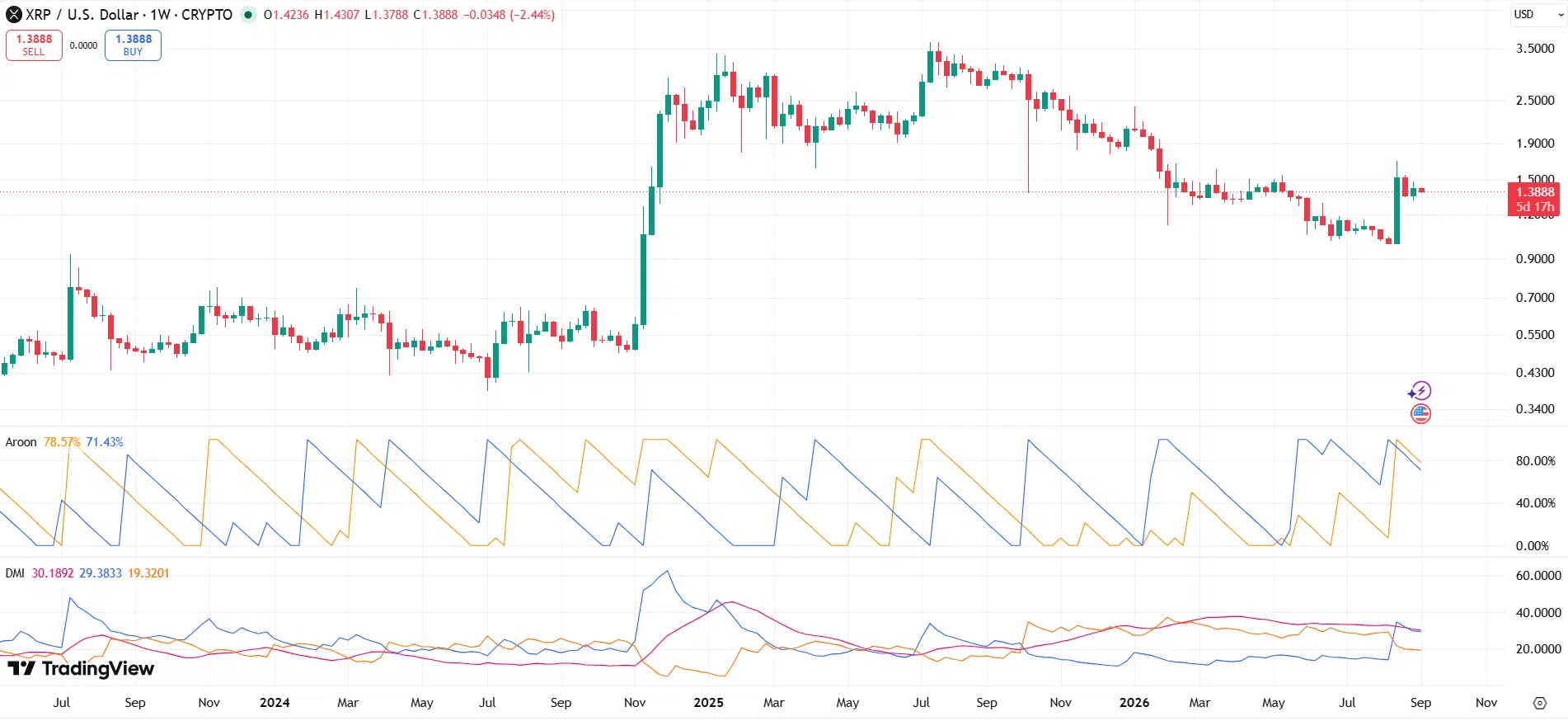
XRP has entered another important phase after its August rally, with the weekly chart now indicating a possible cup-and-handle breakout. 

The structure suggests that the recent decline may represent a retest of this breakout. If XRP holds key support and eventually clears the handle, the chart projects several upside targets, including $3.6330, $6.8899, and $13.5687.

XRP currently trades around $1.39, up roughly 3.5% over the past week. The structure begins with XRP’s decline from its July 2025 cycle high near $3.65 to about $0.99 in mid-August 2026, representing a drawdown of almost 73%. 

The August low then triggered an impressive recovery, with XRP gaining more than 60% within a few days and reaching an interim high near $1.70.

The rebound followed several positive developments, such as expected higher liquidity injection, renewed optimism surrounding the CLARITY Act, whale accumulation, and continued spot XRP ETF inflows. However, the rally could not hold its gains for long.

August Crash Leaves XRP in a Handle

On Aug. 22, XRP experienced a flash crash that pushed the token down more than 37% intraday. The move triggered roughly $500 million in leveraged long liquidations before XRP found some stability. Since then, the token has spent the first week of September moving within a tighter range between $1.30 and $1.50.

XRP Weekly Chart
XRP Weekly Chart

The current range gives the chart a structure that could develop into the handle portion of a larger cup-and-handle formation

Within this structure, XRP faces resistance around $1.45-$1.50, while buyers have stronger support near $1.35, followed by the $1.30-$1.31 area. As long as XRP maintains these levels, the bullish structure remains intact.

On the weekly chart, XRP’s recent price action also forms a descending wedge, with two converging trendlines containing the August rally and subsequent decline. The current consolidation near $1.30-$1.40 could represent the handle before XRP attempts to reclaim the resistance shelf above it.

Fibonacci Levels Point Toward $13

The Fibonacci extension from the previous price swing provides a series of potential upside objectives. The first target sits at $2.4062, followed by $3.6330, $6.8899, and finally $13.5687. Among these levels, $3.6330 is important because it matches XRP’s July 2025 cycle high near $3.65.

This makes the level a crucial test if XRP completes the cup-and-handle breakout. A successful move beyond that area could then shift attention toward the higher $6.8899 and $13.5687 Fibonacci extensions.

The $13 target, however, requires much stronger momentum than the initial breakout. From the current $1.39 price, reaching $13.5687 would require a rally of more than 800%.

XRP Must Hold $1.35

Several factors continue to support the bullish interpretation. First, XRP has remained above its 20-week EMA, a level it failed to reclaim in May before falling toward $0.98. Meanwhile, a potential golden cross could develop, which would add support to the longer-term bullish case.

However, momentum has already cooled. Weekly RSI has fallen to around 58 after previously reaching overbought territory, while trading volume has declined since early September. These conditions mean XRP needs renewed buying pressure to push through the $1.45-$1.50 resistance zone and confirm the handle breakout.

For now, $1.35 remains a key level for the bullish setup. A daily and weekly close below it would weaken the structure, while a break under $1.30 could expose the next support around $1.23. Such a move would put the cup-and-handle thesis under serious pressure before XRP could reach the $2.4062 or $3.6330 targets.