Home Blog Page 161

Cardano Could Reprice Higher as Actual Network Usage Surges

0

Cardano is seeing genuine demand, as evidenced in the notable surge in key network metrics, and the ADA’s value could reprice to reflect this.

Typically, real adoption of an asset influences prices. Simple economics demonstrates that as demand increases and supply fails to match the scale of demand, the underlying asset is likely to reprice over time. This could be the case for Cardano (ADA), which has seen an increase in on-chain activity over the past few months.

Key Points

  • Everstake, a leading custodial staking infrastructure provider, recently highlighted a massive uptick in Cardano network activity.
  • The daily active addresses have increased by an impressive 1,464% over the first three months of the year to 12,000 users per day.
  • Transactions on Cardano grew by a staggering 4,278% to approximately 120,000 transactions.
  • An alignment of active user participation and transaction spike reflects a “genuine increase in demand.”
  • Importantly, growing demand forces the market to reprice ADA’s price higher.

The Cardano Network Buzzing

Everstake, a leading custodial staking infrastructure provider, recently highlighted a massive uptick in Cardano network activity. Over the past three months, key network metrics have ticked up considerably, reflecting the blockchain’s genuine utility and demand for its native tokens.

What is intriguing is that the uptick comes at a time when prices have struggled. Specifically, ADA has dropped 27% since the start of the year and over 81% from the cycle’s high of $1.32 in December 2024. Macroeconomic uncertainties and cyclical price trends have contributed to this trend; yet, traction towards Cardano has continued to increase over the past three months.

For context, Everstake highlighted a vertical expansion in daily active addresses, as users are increasingly using the network. This metric has increased by an impressive 1,464% over the first three months of the year to 12,000 users per day.

Cardano Daily Active Users Spike/Artemis

Furthermore, transactions on Cardano have also ticked up during this period. It grew by a staggering 4,278% to approximately 120,000 transactions, confirming actual network usage rather than just an increase in users.

Genuine Increase in Demand

The buzz around the Cardano network is notable, Everstake insisted. An alignment of active user participation and transaction spikes reflects a “genuine increase in demand,” according to the firm.

Usually, network activity drops when the market is slow, as users exercise caution. However, this has not been the case for Cardano over the past few months. More users have moved value over the network, leveraging its efficient infrastructure.

The increase has also coincided with periods of surging whale activity. For context, Cardano wallets holding 10 million ADA and more have increased in number to a 4-month peak, as large holders accumulate the token.

Massive Implications for Cardano

As explained earlier, this has massive implications for the network’s native token, and Everstake shares this narrative. The firm believes that if this level of activity persists, several things will change for Cardano, including its price.

First, it strengthens the fundamental value of Cardano as a research-driven and fully decentralized ecosystem. It also facilitates increased organic demand for its infrastructure, such as RWA tokenization, stablecoin liquidity, and DeFi.

Importantly, growing demand forces the market to reprice ADA’s price higher. This means the token’s price will rise beyond its current level to unprecedented prices, driven by surging network adoption.

DTCC Prepares for Tokenization Rollout, XRP Army Uncovers Exciting Link

The narrative around XRP is gaining fresh momentum after a new update involving the DTCC sparked speculation in the crypto community.

XRP analyst ChartNerd drew attention to DTCC’s latest report, which mentions plans to launch an early tokenization service in the second half of 2026. He said it may seem like a “nothingburger” at first, but it could have more expansive implications for XRP.

Key Points

  • DTCC plans a 2026 tokenization rollout, sparking fresh XRP speculation across the crypto community.
  • Analyst ChartNerd says the update may look minor but could have broader implications for XRP.
  • Ripple’s Hidden Road has joined DTCC’s FICC and integrated XRP Ledger for faster settlement.
  • DTCC’s push for interoperable tokenized markets strengthens XRP’s long-running institutional narrative.

DTCC Pushes Toward Tokenized Markets

According to DTCC’s April 13 report, the new service will allow securities within its system to be recorded on distributed ledger technology (DLT) while still operating through its existing centralized infrastructure.

The initiative marks a move from experimentation to execution in tokenization. Specifically, DTCC plans to combine blockchain with traditional finance systems, rather than replace them.

At a U.S. House hearing, DTCC leadership said tokenization should comply with existing laws and regulations. The goal is to improve post-trade processes, make assets easier to transfer, and maintain market stability.

The scale of this move is significant. DTCC processes transactions across key subsidiaries such as DTC, NSCC, and FICC, which are core to the U.S. financial system.

XRP Community Connects the Dots

The XRP community has linked the development to Ripple, given past connections between Ripple and DTCC-related systems.

One major talking point is Ripple’s 2025 acquisition of Hidden Road (now Ripple Prime). This prime brokerage firm became a member of DTCC’s Fixed Income Clearing Corporation (FICC).

For context, the system processes several trillion dollars in daily U.S. Treasury trades, placing Ripple in close proximity to one of the world’s largest financial clearing networks.

Ripple Prime has integrated the XRP Ledger into Hidden Road’s operations, enabling faster post-trade processing. Meanwhile, the company also made its stablecoin, RLUSD, a collateral asset.

Tokenization Infrastructure Fuels Broader Speculation

Meanwhile, further fueling the narrative is DTCC’s earlier acquisition of Securrency, now part of its Digital Assets division. The technology supports tokenized securities across multiple blockchains, including networks compatible with Ripple’s infrastructure.

Community researcher SMQKE argues that this opens the door for assets like XRP, alongside others, to potentially play a role in settlement layers connected to DTCC systems.

While no official confirmation supports this claim, the interoperability angle continues to excite XRP holders.

DTCC itself emphasized that interoperability will be critical, warning that fragmented tokenization efforts could increase costs and reduce liquidity. Its approach favors open standards and infrastructure that connect digital assets with existing financial systems.

XRP Narrative Strengthens

In sum, the convergence of DTCC’s tokenization push, Ripple’s institutional expansion, and blockchain interoperability has added another layer to XRP’s long-standing institutional adoption narrative.

Ultimately, DTCC’s 2026 rollout represents a major step toward bringing tokenized assets into mainstream finance. For XRP holders, it is another development worth watching closely.

Top American Music Producer Exits Shiba Inu After Dumping His Last 1.78B SHIB

0

Blockchain analytics firm Arkham Intelligence reports that American music producer and former NFT advocate Steve Aoki has exited his position in Shiba Inu.

The latest transaction appears to mark the end of Aoki’s multi-year involvement with the token. On-chain data shows that he sold his remaining Shiba Inu holdings along with some Ethereum and transferred the proceeds to the U.S.-based exchange Gemini. 

Key Points

  • Steve Aoki sold 1.78 billion SHIB (about $10,340), fully exiting his Shiba Inu position after holding it for several years.
  • He also reduced his Ethereum holdings, retaining only about 5 ETH in his wallet.
  • The proceeds from these sales were transferred to the Gemini crypto exchange.
  • Weeks earlier, Aoki liquidated his Pepe holdings, suggesting the sell-off extends beyond SHIB alone. 

Aoki Closes His Shiba Inu Position

Blockchain wallets linked to Aoki executed a series of transactions this week. However, the latest activity drew particular attention from Arkham Intelligence, which confirmed that the music producer had fully liquidated his Shiba Inu holdings.

According to Arkham, Aoki sold approximately 1.78 billion SHIB, worth about $10,340 at the time of the transaction. This single sale effectively closed his position in Shiba Inu after holding the token for several years. Shortly after completing the sale, Aoki transferred the proceeds to the crypto exchange Gemini.

Meanwhile, the SHIB liquidation forms part of a broader selling trend. In recent weeks, Aoki also exited his position in the meme coin Pepe and reduced his exposure to Ethereum, leaving only five ETH in his wallet. 

Image

SHIB Decline Erodes Earlier Purchases

Aoki accumulated his SHIB tokens through several transactions over time. For instance, in January 2024, he swapped 2.2 ETH, then worth roughly $5,000, for 507.66 million SHIB.

However, the price of Shiba Inu has declined significantly since then. At the current price of about $0.000005872, the same $5,000 would now purchase approximately 851.06 million SHIB, illustrating the token’s steep depreciation.

Furthermore, technical indicators suggest that the downturn could continue. Analysts note that SHIB recently broke below an ascending support line, prompting projections of a potential decline toward $0.0000052. 

Beyond SHIB, Aoki has also experienced substantial losses in the NFT market. According to Arkham Intelligence, the DJ still holds seven NFTs from the Bored Ape Yacht Club. He purchased these assets for over $800,000 during the 2021 NFT boom.

Today, however, each NFT is valued at roughly $13,800, reflecting the sharp correction across the digital collectibles market. 

Market Updates: Ethereum Near $2,400 Sparks Diverging Whale Bets; HSBC Pilots Tokenized Deposits on Canton Network; Adam Back Denies Satoshi Claim

0

Latest Market Updates: As of 14th April 2026.

Ethereum Near $2,400 Triggers Diverging Whale Bets

Ethereum briefly approached the $2,400 mark before pulling back, setting off sharply contrasting moves among large investors.

At the local peak, Billy Luedtke, CEO of Intuition, moved to lock in gains. He sold 3,285 ETH at $2,372.24, securing roughly $7.79 million, according to Arkham Intelligence.

Meanwhile, this sale was part of a broader exit strategy that began on March 8, during which he offloaded 8,771 ETH worth $19.14 million at an average price of $2,182.

At the same time, another large wallet (0x455…A433E) pivoted away from Ethereum, rotating capital into Bitcoin. The holder swapped 2,831 WETH for 90.46 WBTC in a transaction valued at $6.74 million.

Image

This exchange was based on a conversion rate of $74,607 per Bitcoin. Consequently, the move signals a shift in near-term preference toward Bitcoin.

In contrast, whale investor nemorino.eth leaned further into Ethereum. The wallet accumulated 1,347.37 ETH at an average price of $2,226.54, committing approximately $3 million. Notably, this purchase reflects a bullish stance on Ethereum’s potential upside despite recent volatility.

HSBC Tests Tokenized Deposits on Blockchain

Meanwhile, HSBC advanced its blockchain initiatives by completing a pilot for tokenized deposits on the Canton Network.

Specifically, the trial simulated core financial operations, including the issuance, transfer, and settlement of tokenized deposits. It also tested atomic settlement alongside digital assets. HSBC’s Global Payments Solutions division led the initiative.

Notably, this marks the bank’s first use of tokenized deposits on a public blockchain. The pilot aimed to demonstrate interoperability between different settlement systems, an essential requirement for scaling digital financial infrastructure.

Building on this effort, HSBC highlighted its Tokenized Deposit Service, which allows clients to convert fiat currencies into digital assets for instant transfer within the network.

The system supports multiple currencies, including USD, EUR, GBP, SGD, and HKD. It is designed to enable continuous, real-time settlement and programmable payments.

Adam Back Rejects Satoshi Nakamoto Claims

In a separate development, early Bitcoin contributor Adam Back pushed back against renewed speculation about his identity in an interview with Bloomberg Podcasts, firmly denying claims that he is Satoshi Nakamoto.

Back supported his stance with several technical arguments. He noted that, had he created Bitcoin, he would have used different privacy techniques and avoided certain formatting errors found in early code. He also pointed to IRC chat logs showing him asking others about Bitcoin’s mechanics, behavior inconsistent with that of its creator.

His comments come in response to a report published a week earlier by The New York Times, which suggested he could be behind Bitcoin, reigniting debate within the crypto community.

U.S. Lawmakers Revise Crypto Tax Proposal

On the regulatory front, U.S. lawmakers have reintroduced a revised version of the Digital Asset PARITY Act, signaling a shift in how crypto transactions may be taxed.

The updated draft removes the previously proposed $200 exemption for stablecoin transactions. Instead, it introduces a rule under which gains or losses are not recognized unless a stablecoin’s value falls below 99% of its redemption value.

Additionally, the proposal extends wash sale rules to digital assets and clarifies the distinction between passive staking and active trading.

Market Updates: Bitcoin at $74K Triggers $527M in Liquidations, Bernstein Downplays Quantum Risk, ex-CFTC Chair Chris Giancarlo Exits Law for Crypto/AI

0

Latest Market Updates: As of 14th April 2026.

The crypto market saw a surge in activity over the past day with Bitcoin’s breakout above $74,000. This price move triggered widespread liquidations and renewed accumulation by large holders.

At the same time, analysts weighed in on longer-term risks tied to quantum computing. Meanwhile, a prominent U.S. regulatory figure signaled a significant career pivot.

Bitcoin Rally Triggers $527M in Liquidations

Indeed, Bitcoin’s upward momentum caught many leveraged traders off guard. This has resulted in $527 million in liquidations over the past 24 hours, according to Coinglass.

In particular, short positions bore the brunt of the losses, with $425.69 million wiped out, compared to $101.73 million in long liquidations. This imbalance highlights how heavily traders were positioned against the rally.

In total, more than 176,000 accounts were liquidated during the move. Notably, the largest single liquidation, worth $12.4 million, occurred on the BTC/USDT pair on the Aster perpetual exchange.

By asset, Bitcoin led with $226.93 million in liquidations, followed by Ethereum at $134.20 million and RAVE at $41.63 million.

Crypto Liquidations in Past 24 Hours

Bitcoin Whales Expand Holdings to 21% of Supply

Amid the volatility, on-chain data from Santiment indicates that large Bitcoin holders continued to accumulate.

Wallets holding between 1,000 and 10,000 BTC now control approximately 4.25 million BTC, equivalent to 21.3% of the total supply. This marks the highest concentration since mid-February and suggests a steady accumulation trend in recent weeks.

Notably, these whales added 27,652 BTC in a single day on Sunday, valued at over $2 billion. This surge in buying coincided with Bitcoin’s 4.3% daily gain, pushing the price to $74,257.

Image

Bernstein Says Quantum Risks Already Reflected in Bitcoin Price

Despite the bullish accumulation trend, longer-term concerns remain part of the market narrative. In a recent research note, Bernstein argues that fears surrounding quantum computing are already reflected in Bitcoin’s valuation.

Specifically, the firm points to Bitcoin’s nearly 50% decline from its October 2025 peak of $126,198 as evidence that multiple risk factors, including potential cryptographic vulnerabilities, have been priced in.

This analysis comes two weeks after Google researchers suggested that advanced quantum systems could potentially break existing cryptographic methods using fewer than 500,000 qubits. In theory, this could allow a private key to be cracked in nine minutes, close to Bitcoin’s block time.

However, Bernstein maintains that the threat is not immediate. The firm estimates that developers have a three- to five-year window to implement quantum-resistant solutions. It also notes that progress in privacy tools and cryptography may help offset these concerns.

Chris Giancarlo Steps Away from Law to Focus on Crypto and AI

Rounding out today’s developments, Chris Giancarlo, the former CFTC chairman commonly referred to as “Crypto Dad,” has announced that he will resign from his position as Senior Counsel at Willkie Farr & Gallagher by the end of April.

From now on, he plans to dedicate his efforts fully to digital assets, artificial intelligence, and public policy. His next phase will include advisory roles, private investments, and research initiatives, according to a statement shared on X.

During his tenure at Willkie, he advised crypto firms on regulatory strategies and helped expand the firm’s digital asset practice.

“CryptoDad” Book Set for October Release

In parallel with this transition, Giancarlo is preparing to release a new book in October titled “The New Adventures of CryptoDad.”

The book will explore the evolution of the crypto industry in the context of major political and economic developments, including the 2024 U.S. presidential election and the early phase of a second Trump administration.

It will also examine the broader shift toward an “Internet of Value,” and how it is reshaping global financial systems.

Bitcoin Investors Are Not Selling as Inflows on Binance Drop to 2020 Levels

0

Bitcoin flows into exchanges have dropped to levels not seen in over six years, signaling a market that has not allowed uncertainty to shape sentiment.

Rather than panic as prices consolidate, Bitcoin (BTC) holders are choosing to hold onto their stash. This sentiment is not borne of hype but of a conviction among market investors that the current phase is only temporary and that the premier asset would rebound from the setback.

Key Points

  • Inflows to Binance, the largest trading platform globally in terms of trading liquidity, have declined sharply.
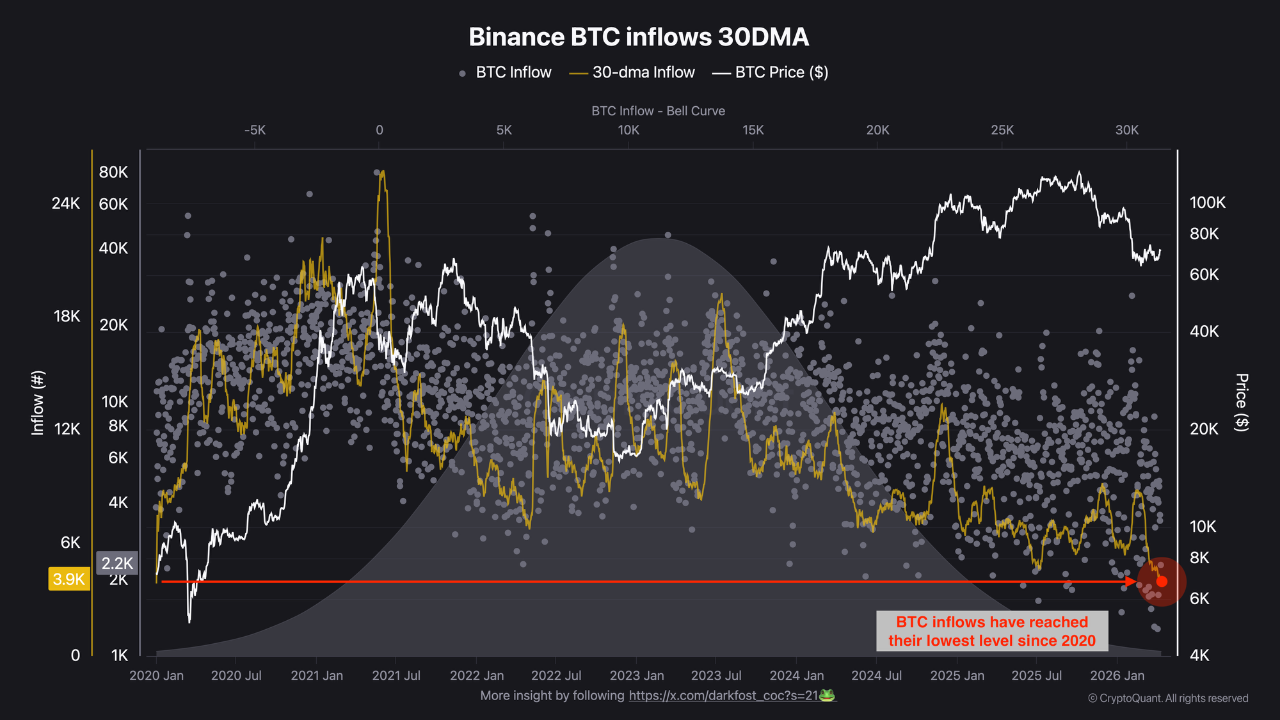
  • The 30-day moving average has fallen to around 3,998 BTC, marking a low last observed over six years ago in 2020.
  • What this means is that most holders are not willing to sell their stash, preferring to keep them in self-custody wallets.
  • This situation stands in stark contrast to previous periods marked with stress or euphoria.
  • Daily inflows on Binance exceeded 19,000 BTC in July 2023 and surpassed 25,000 BTC in May 2021, with the historical average sitting near 11,000 BTC.
  • Some capital that flowed through exchanges may now be moving through alternative channels.

Bitcoin Inflow to Exchange Drops

Recent data from CryptoQuant’s verified author, Darkfost, highlighted this disposition. According to the Monday analysis, inflows to Binance, the largest trading platform globally in terms of trading liquidity, have declined sharply. 

The 30-day moving average has fallen to around 3,998 BTC, marking a low comparable to conditions last observed over six years ago in 2020. What this means is that most holders are not willing to sell their stash, keeping them in self-custody wallets for long-term holding rather than on platforms where they can easily sell.

Bitcoin Inflow to Binance Lower Than Historically Normal

Interestingly, this situation stands in stark contrast to previous periods marked with stress or euphoria. Typically, after the market peaks or when macro uncertainties kick in, Bitcoin holders have historically sold more than they do now.

For context, daily inflows on Binance exceeded 19,000 BTC in July 2023 and surpassed 25,000 BTC in May 2021. With the historical average sitting near 11,000 BTC, current deposit levels of 3,988 BTC are roughly three times lower than typical market conditions.

Binnce's Bitcoin 30D MA Inflow/CryptoQuant
Binance’s Bitcoin 30D MA Inflow/CryptoQuant

Notably, this decision to keep assets off platforms is admirable, given the backdrop of global market uncertainties. Geopolitical tension in the Middle East and the United States’ failure to strike a deal with Iran continue to influence oil prices, pressuring the global economy. 

Choosing to HODL Bitcoin rather than dump highlights a behavioral shift among market participants, who believe that Bitcoin will make a comeback. Again, this behavior reflects a shift in how participants respond to uncertainty. Rather than selling off quickly amid price swings, many appear to be waiting for a clearer direction before making significant moves, reducing immediate selling pressure.

Structural Changes May Be Influencing Market Flows

Beyond sentiment, structural factors may also be contributing to the trend. Some capital that previously moved directly onto exchanges could now be flowing through alternative channels, including institutional products such as Bitcoin spot exchange-traded funds. This shift reduces the need for exchanges while still allowing users to easily gain exposure or sell their assets.

In essence, these signals suggest that the market is in a phase of waiting rather than a breakdown. While uncertainty remains elevated, the absence of heavy inflows into exchanges suggests that holders are holding relatively steady, with no clear signs of capitulation at this stage.

“No Matter Which Formation, XRP is Going to $9,” Analyst

A well-regarded data analyst has expressed optimism in the future of XRP, insisting that regardless of the formation it takes, the price is heading to $9.

This suggestion came from Celal Küçüker, a prominent market watcher, who believes XRP still has the potential to reach new heights in the foreseeable future despite the persistent market-wide downturn that has kept prices down 25% this year alone.

Key Points

  • XRP has dropped 25% year-to-date, having recorded six consecutive monthly losses.
  • This downtrend now puts XRP back within a downward-sloping parallel channel that has endured since Q4 2024.
  • XRP is now retesting a horizontal support trendline within the channel.
  • The next reasonable direction is an upward breakout if the horizontal support holds.
  • A breakout above the parallel channel would push XRP’s price to $9 regardless of the path it takes.

XRP Back Inside the Parallel Channel

Küçüker disclosed this in his latest analysis of XRP’s price action, expressing confidence in the asset’s future prospects despite the current price struggles. Specifically, XRP has now dropped 52% since the ongoing downturn began in October 2025, 25% this year, and 62% from its all-time high.

As a result of these price struggles, XRP has now slipped back into a downward-sloping parallel channel that guided its price action during the correction from the $3.4 peak in January 2025. The channel started forming in Q4 2024, and XRP’s rally to $3.4 by January 2025 helped it retest the upper trendline, but it faced resistance here and pulled back.

Amid the pullback, XRP consistently traded deeper into the channel until it rebounded in July 2025, breaking out above the channel and reaching the $3.6 peak. This peak aligned with a horizontal resistance trendline that capped further momentum.

The correction that followed led XRP to retest the breakout, and by October 2025, the asset had already fallen back into the structure. XRP has remained within the channel since then.

XRP Eyeing Breakout

Küçüker is already expecting an upward breakout from this channel despite XRP’s downward price action taking it toward the lower end of the structure. XRP is now retesting a horizontal support trendline within the channel, and it could build strength for this imminent breakout if the horizontal support holds.

XRP 1W Chart Celal Kucuker
XRP 1W Chart | Celal Kucuker

Data from Küçüker’s chart shows that the analyst expects XRP to sharply break above the channel once bullish momentum returns, but to face initial resistance at $3.3776, which aligns with the roadblock at the overhead horizontal resistance trendline. From the horizontal support to the horizontal resistance represents a 171.38% rally.

“XRP is Heading to $9”

The market watcher believes XRP could pull back after meeting this roadblock, potentially dropping to retest the parallel channel breakout at the channel’s upper trendline, where it would find support. From here, a recovery could ensue, which would help XRP breach the horizontal resistance at $3.3776.

Küçüker expects XRP’s rally to continue until the crypto asset hits the $9.19 price, which would represent a new all-time high and a 171.37% increase from the horizontal resistance trendline. “No matter which formation you look at, Ripple is heading to $9,” he said, calling XRP the second-best altcoin after Ethereum.

Head of Product at X Hints at New Launch to Fix Crypto’s Rough Year

0

Nikita Bier, Head of Product at X and an advisor to the Solana ecosystem, has hinted that he may launch a product to address the difficult year for the crypto market.

In a post today, Bier sparked renewed discussion across the crypto community about how to tackle crypto’s turbulent year. His comment comes as many investors grow frustrated with market volatility, regulatory uncertainty, and a slowdown in momentum across the digital asset space.

Key Points

  • X’s Head of Product, Nikita Bier, hinted at a potential product to tackle crypto’s recent challenges.
  • His dual involvement at X and within the Solana ecosystem could influence the direction of any upcoming launch.
  • The crypto market continues to struggle with volatility, regulatory uncertainty, and weakening investor sentiment.
  • Bitcoin and Ethereum have posted notable declines in early 2026, as progress on the Digital Asset Market Clarity Act remains stalled amid ongoing legislative debates.

Crypto Market Faces a Challenging Start to 2026

The cryptocurrency industry has endured a turbulent year marked by market volatility and policy uncertainty. Against this backdrop, Bier suggested that the sector may need a fresh wave of innovation to regain momentum.

Specifically, he argued that the solution might lie in building something new to address the challenges the industry has faced this year.

Indeed, the early months of 2026 have disappointed many investors. For instance, Bitcoin has lost roughly 20% of its value since the start of the year. Similarly, Ethereum has declined by about 20.3% during the same period.

Meanwhile, regulatory developments have also slowed. The highly anticipated Digital Asset Market Clarity Act has stalled amid disagreements between banking groups and crypto stakeholders over key provisions in the bill.

Consequently, these challenges have intensified calls for new solutions that could restore confidence and expand real-world use cases for digital assets.

Potential Influence From X and Solana

Industry observers believe Bier’s roles at X and within the Solana ecosystem could influence the direction of any new product. Currently, Bier leads product development at X, where the company continues to explore several digital features.

Notably, the platform plans to introduce X Money, an integrated financial services system that analysts believe could eventually support cryptocurrency payments.

In addition, Bier has repeatedly teased the development of Smart Cashtags, a feature that allows users to view live financial data, including real-time prices and charts. He also suggested that the tool could enable trading in stocks and cryptos directly on the platform.

At the same time, Bier’s advisory role with Solana places him at the intersection of social technology and decentralized infrastructure.

Track Record of Building Viral Consumer Apps

Notably, Bier has a strong track record of building consumer apps that quickly gain traction and attract acquisitions from companies like Facebook and Discord.

He is known for creating engaging products for everyday users. Bringing this approach to crypto could result in tools that make blockchain much easier to use. However, he has not shared any details yet.

For now, the crypto community has rallied around his latest teaser for a crypto-focused product, expressing eagerness for the reveal.

Japan’s Largest E-commerce Giant Rakuten to Integrate XRP for Its 44M Users

0

Rakuten, the largest e-commerce platform in Japan, is expanding its crypto services by adding XRP to the Rakuten Wallet.

Starting April 15, the move will allow users to both trade and use XRP for payments, bringing the asset into a highly regulated market. This introduces XRP to a wide audience through Rakuten’s ecosystem, including its popular payment platform.

Key Points

  • Rakuten Wallet will list XRP alongside XLM, DOGE, SHIB, and TON for spot trading starting April 15.
  • The integration gives XRP access to 44 million Rakuten Pay users.
  • Users can convert more than 3 trillion Rakuten Points worth $23 billion directly into XRP.
  • XRP can be used for payments at over 5 million merchant locations through Rakuten Cash and Rakuten Pay.
  • A promotional campaign offers users up to JPY 100,000 in XRP rewards to boost adoption.

Rakuten Expands Crypto Offering with XRP Integration

Rakuten revealed the latest development in a recent press release, confirming that it plans to add XRP as both a tradable asset and a payment option from April 15. Alongside XRP, Rakuten Wallet will list Stellar (XLM), Dogecoin (DOGE), Shiba Inu (SHIB), and Toncoin (TON) for spot trading.  

Notably, this move builds on Rakuten’s earlier support for XRP, including margin trading introduced in spring 2020, where users could trade pairs like XRP/JPY with up to 2x leverage.

Rakuten Wallet operates under strict rules as an FSA-licensed platform and a member of the JVCEA, showing that this rollout follows Japan’s clear crypto regulations. 

Introducing XRP to 44M Users

Rakuten plans to bring XRP to a wide audience through its payment system. The Rakuten Pay app alone has 44 million users, and this places XRP in front of everyday consumers, not just crypto traders. 

Across its ecosystem, Rakuten has over 100 million member IDs in Japan, while its global reach extends to a range of 1.7 to 2 billion users across more than 70 services in over 30 countries.

Interestingly, one major feature will allow users to convert Rakuten Points directly into XRP. The company has issued more than 3 trillion points, worth about $23 billion USD, creating a large pool of value that can now move into crypto. For context, Rakuten issued around 620 billion points in 2022.

Users can also fund Rakuten Cash, the platform’s e-money service, using XRP. This makes it easier to use crypto for daily spending. Rakuten already introduced a similar feature in 2021, when it allowed users to charge Rakuten Cash with Bitcoin, Ethereum, and Bitcoin Cash.

Boosting XRP Real-World Use Across 5M Merchants

This integration gives XRP a use case in everyday payments across Japan. Users can spend funds through Rakuten Cash at more than 5 million merchant locations, including large retail stores and convenience shops.

Rakuten’s ecosystem supports large-scale activity, with annual e-commerce gross merchandise value reaching about 5.6 trillion yen. The addition of XRP will help connect crypto with one of the biggest consumer markets in Japan.

Further, Rakuten Bank has passed 17 million accounts, and the broader ecosystem links shopping, banking, and payments under one account system. This could allow users to move XRP easily between trading, rewards, and spending.

To support the launch, Rakuten Wallet will run a campaign where users can earn up to JPY 100,000 (about $670–$700 USD) in XRP rewards through trading. This is expected to encourage more users to try the new feature early.

Market Updates: Strategy Buys 13,927 Bitcoin, BitMine Adds 71.5K Ethereum, Circle Defends Freeze Policy After $280M Drift Exploit

0

Latest Market Updates: As of 13th April 2026.

Strategy Expands Bitcoin Holdings With $1 Billion Purchase

Strategy continued to deepen its exposure to Bitcoin by announcing the acquisition of 13,927 BTC, valued at approximately $1 billion. The company reported an average purchase price of $71,902 per coin.

Following this latest buy, Strategy’s total holdings rose to 780,897 BTC as of April 12, 2026. Its cumulative investment now stands at $59.02 billion, with an average cost basis of $75,577 per Bitcoin. The firm also reported a year-to-date Bitcoin yield of 5.6% for 2026, underscoring its ongoing conviction in the asset.

BitMine Records Largest Weekly Ethereum Accumulation Since December 2025

While Bitcoin remained in focus, Ethereum also attracted significant institutional inflows. BitMine Immersion Technologies disclosed that it acquired 71,524 ETH over the past week, its largest weekly purchase since December 2025.

Subsequently, as of April 12, the company held 4.87 million ETH, representing roughly 4.04% of the total supply. This makes it the world’s largest known holder of Ethereum reserve.

To enhance returns, BitMine has staked 3.335 million ETH, currently valued at around $7.4 billion, and projects approximately $212 million in annual staking income.

In total, the firm reported $11.8 billion in combined crypto and cash holdings, including $719 million in liquid assets and equity investments.

Circle Responds to Criticism Following Drift Exploit

Elsewhere, USDC issuer Circle addressed mounting criticism over its handling of funds linked to a recent exploit. Speaking at a press conference in Seoul, CEO Jeremy Allaire stated that the company freezes wallets only when directed by law enforcement or court orders.

Notably, the comments follow a $280 million exploit involving Drift Protocol last week, described as a sophisticated, long-term attack involving social engineering techniques, potentially tied to North Korean actors.

On-chain investigator ZachXBT criticized Circle for failing to freeze approximately $230 million in USDC linked to the incident. The funds were reportedly bridged from Solana to Ethereum via Circle’s infrastructure.

In response, Allaire reiterated that Circle operates strictly within legal frameworks. He stressed that unilateral action by private firms in such cases could raise serious ethical and legal concerns.

U.S. SEC Relaxes Requirements for Certain DeFi Interfaces

Meanwhile, the U.S. Securities and Exchange Commission (SEC) has issued new guidance on crypto interfaces.

Specifically, the agency indicated that certain platforms, including DeFi front-ends, mobile applications, and wallet extensions, can operate without a broker-dealer registration, provided they meet specific conditions.

To qualify, platforms must avoid order routing, offering investment advice, or taking custody of user assets. They are also required to maintain fixed, neutral fee structures. The guidance applies to self-custodial wallet interfaces and is set to remain in effect for five years unless revised.

American Bankers Association (ABA) Criticizes White House Report on Stablecoins

At the same time, the American Bankers Association (ABA) criticized a recent White House advisory report on stablecoins, arguing that it overlooks key risks.

In particular, the group warned that yield-bearing stablecoins could draw deposits away from community banks, potentially increasing funding costs and constraining local lending.

Notably, the White House report had argued that yields on stablecoins may only drain 0.02%—just over $2 billion—from the banking sector, which is not very significant. Moreover, the report noted that such funds will remain within the overall U.S. financial system, rather than draining it.

However, the ABA has cautioned that rapid adoption of such instruments could outpace existing safeguards, leaving the financial system exposed.

According to the ABA, the current policy approach may underestimate the broader systemic risks associated with stablecoins growth.