Home Blog Page 1617

Market Analyst Says Falling wedge Can Take Shiba Inu to $0.00001486

0

Shiba Inu (SHIB) price has been on a major bearish correction spree, but expectations of rebound are returning to its ecosystem.

Shiba Inu has one of the most enthusiastic communities in the Web3 scene, and their confidence over the potential of the token to surmount challenges is high. This optimism is currently being showcased by community member and analyst SHIB KNIGHT on X.

According to him, there is an intense whale accumulation that might ultimately send the token on a bullish ride in the near term.

Projected Shiba Inu Bullish Scenario

According to SHIB KNIGHT’s data, Shiba Inu is forming a falling wedge pattern on the weekly timeframe. He pointed out that SHIB whales bought the coin intensively at the $0.00000875 Golden Zone Support.

With this intense accumulation, he suggested that the price of the token may hold from further falling at this level. Following this foundation, $SHIB KNIGHT posited that under bullish circumstances, the price targets of SHIB will be between the $0.00000896 to $0.00001486 range.

Shiba Inu’s price drawdown has seen the coin fall to a monthly low of $0.00000846 amid intensive capital flight.

At the time of writing, the price and market capitalization of the token are down 0.83% in 24 hours to $0.00008853 and $5,218,519,898, respectively. Buying enthusiasm is also seeing a bearish sentiment as trading volume is down by 22% to $88,564,332.

Despite this outlook, the projected price floor of $0.00000875, as inferred by $SHIB KNIGHT, might usher in brighter days ahead for the token.

Broadening SHIB Utility Through Shibarium

The short-term price recoveries of Shiba Inu are hinged on a few factors that are in the full glare of observers. Building the positive sentiment that can drive prices higher depends partly on the advances in Shibarium, the protocol’s Layer-2 scaling solution.

Should new projects make their way to Shibarium, it might help jerk up the demand for SHIB, which in turn might have a positive impact on the price. Shibarium burns could also help with the extensive supply problem.
Old Bitcoiner From 2011 Recommends This Solana Memecoin

0

Popular Bitcoin OG Davinci Jeremie has caught the eye for a recent video revealing his investment in a new Solana memecoin, PONKE.

Back in 2013, when many people were still skeptical of Bitcoin, Davinci Jeremie encouraged many to get in on the cryptocurrency. One of his most viral content on YouTube includes a video posted on May 9, 2013, in which he urged his listeners to invest at least $1 in BTC.

The Bitcoin price at the time was $120, meaning investors who listened to the suggestion may have made significant gains if they obeyed the call to get exposure to BTC. At that point, though, Davinci Jeremie was already a Bitcoin OG, having adopted the cryptocurrency back in 2011, according to his X bio.

Fast forward to the present, the early Bitcoin investor has gone on the record for promoting a memecoin created on the Solana blockchain. Memecoins are cryptocurrencies created mainly for fun and culture and tend to exhibit high levels of volatility.

Davinci Jeremie Backs PONKE Memecoin, Coin Surges 100%

In a January 20, 2024 video that many may consider a reminisce of his early 2013 Bitcoin video, Jeremie recorded himself investing $100 in the PONKE memecoin. The influential figure purchased the token by exchanging $100 worth of SOL for PONKE using the popular Solana DEX Raydium.

The Bitcoin OG did not disclose whether he was paid to make the post about PONKE, as has been the case for some influencers in the past. However, Davinci Jeremie’s video included a customary disclaimer that investors will bear the outcome if they choose to follow his choice to buy BONKE. 

He added that investors must not put $100 in the memecoin if that is all they have got. Notably, he also issued a similar call for Shiba Inu (SHIB) back in October.

PONKE price
PONKE price

Meanwhile, the above chart from Coingecko shows that the price of PONKE surged following the video’s release. From around $0.037, the coin rose as high as $0.097 within the next five days. The price has since dropped to around $0.08 at the time of writing.

Ripple Now Has One Less Lawsuit to Worry About: Details

0

Leading crypto payments company Ripple has finally put an end to its legal tussle with global money transfer service provider GCC Exchange.

Although the development was first revealed by GCC Director Yash Rajesh earlier this year, top XRP community member “WrathofKahneman” called attention to the news in a recent tweet.

Ripple Vs. GCC Exchange Lawsuit  

Recall that Ripple sued GCC Remit in July 2023 for failing to fulfill payment obligations for 40,000 XRP transfers worth over $15 million. Apparently, the transaction relates to GCC’s use of Ripple’s On-demand Liquidity (ODL) solution for cross-border settlements.

Notably, Ripple transferred the XRP to GCC under a supply agreement reached by the parties in 2022. However, GCC violated the terms of the agreement following its failure to settle outstanding invoices for 40,000 XRP transfers.

As a result, Ripple sued the company in the High Court of Justice of England and Wales, seeking the payment of outstanding invoices, as well as compensation for the accumulation of late fees.

Parties Settle Multi-Month Lawsuit

In an exciting development, Rajesh disclosed that the parties had agreed on a settlement to end the multi-month lawsuit. Rajesh told openPR in a recent interview that the parties reached a confidential settlement agreement “with no admission of liability.” 

Following the lawsuit’s resolution, GCC Exchange can focus on its strategic vision and continue offering money transfer services globally.

It is unclear whether GCC will continue to utilize Ripple’s solution or XRP for cross-border payments.

One Less Lawsuit to Worry About

The resolution of the GCC lawsuit is a positive development for Ripple as the number of legal battles it is currently involved in has reduced by one. However, the company is still embroiled in lawsuits against the U.S. SEC and a group of XRP investors led by Vladi Zakinov.

Despite Ripple’s involvement in these two cases, the company focuses more on the SEC lawsuit. The outcome of the SEC case could have a major impact on Ripple’s operations in the United States.

For instance, market analysts and top journalists believe the SEC lawsuit could prevent investment managers from filing for an XRP spot exchange-traded fund (ETF) with the regulator.

As reported earlier, Ripple recorded a partial victory against the SEC last year when a federal court ruled that its programmatic sales and other distributions of XRP did not constitute investment contracts. However, the court declared that Ripple’s past direct institutional sales of XRP violated securities law.

The case is now in the remedies stage, as the parties seek to determine the appropriate penalty for Ripple’s securities law violation.

Ripple CTO Reveals Strategic Move into $10 Trillion Crypto Custody Market with Metaco, HSBC

0

Ripple CTO David Schwartz has provided insights into Ripple’s strategic move into the projected $10 trillion crypto custody market with significant players such as Metaco and HSBC.

His remark on the subject came during a recent interview on the Thinking Crypto Podcast. Specifically, the conversation shed light on Ripple’s acquisition of Metaco, a custody-focused firm.

The host referenced last year’s news about Ripple’s acquisition of Metaco and its subsequent partnership with global banking giant HSBC. He inquired about the specifics of these moves and whether HSBC would integrate the XRP Ledger into its operations.

It Aligns with Ripple’s Pursuit of Institutional Adoption

In response, Schwartz disclosed that the decision to delve into the custody scene was driven by the need for a comprehensive solution in Ripple’s pursuit of being a “one-stop shop” for institutional adoption of cryptocurrencies. 

He highlighted the importance of offering a platform encompassing access to the XRP Ledger, tokenization, and payments. He noted that a secure custody solution was a crucial component of this vision.

Furthermore, Schwartz expressed that institutions looking to venture into the crypto space would first turn to a provider offering custody, liquidity services, payment solutions, and connectivity to on-ramps and off-ramps.

“By adding custody, that’s going to make Ripple the leading enterprise solution provider in the space,” emphasized Schwartz.

On this premise, the Ripple CTO revealed that after evaluating various companies, Ripple acquired Metaco in May 2023. Per his admission, this marked Ripple’s largest acquisition at a quarter of a billion dollars. 

Custody Market to Hit $10 Trillion by 2030

Furthermore, Schwartz underscored the significance of the custody market, projecting it to reach $10 trillion by 2030.

“Custody is a massive market, something like 10 trillion dollars by 2030, and the increases in tokenization mean that’s just going to grow,” said Schwartz. 

Moreover, he stressed that a secure and reliable custody solution becomes paramount as institutions become the main drivers. According to him, secure storage will be crucial whether for central bank digital currencies (CBDCs) or stablecoins.

HSBC Seeks to Solve Compliance Issues

Commenting on the alliance with global banking giant HSBC, Ripple CTO pointed out that HSBC plans to introduce a custody service for digital assets tailored to their clients. 

According to him, this approach resembles a layering service, wherein HSBC utilizes advanced technology for custody. The noteworthy aspect of this arrangement is that HSBC assumes responsibility for compliance on behalf of its clients.

History Indicates Further Correction for Bitcoin Following Recent Surge Before Approval of Spot BTC ETFs

0

According to historical trends, the ongoing correction in the price of Bitcoin (BTC) might have more surprises ahead.

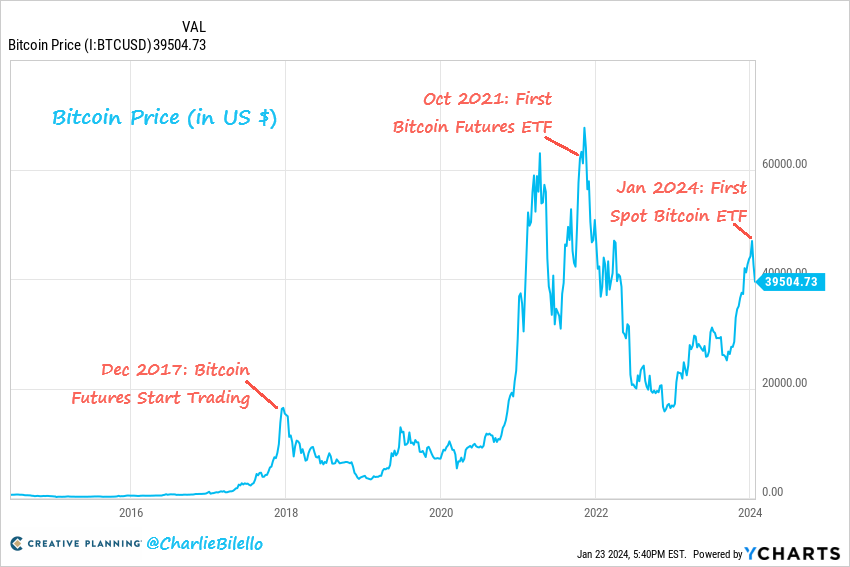
As Charlie Bilello, the Chief Market Strategist at Creative Planning Investor, pointed out, Bitcoin price always faces massive corrections after a big event in its history. 

Notably, since the start of the year, Bitcoin has dropped by 5.31%, and at the time of writing, the digital currency is up by 0.4% in the past 24 hours to $40,061.82. The coin’s market cap has jumped by an equal rate to $785,832,653,173, while the trading volume is down by 34.82% to $20,163,194,327.

The Charlie Bilello Observation

According to Bilello, history does not necessarily repeat itself but typically rhymes sometimes. Bilello highlighted the bull run of December 2017, a mega surge that saw Bitcoin jump to a high price above $17,500 at the time. This bull run preceded the start of Bitcoin Futures trading and recorded an 84% correction afterward. 

A similar event occurred in October 2021 when Bitcoin charted a rally toward its All-Time High (ATH) of $68,789.63. This rally came before the approval of Bitcoin Futures ETF and bagged a 78% correction afterward.

The similarity in this trend has partially played out with the price of Bitcoin jumping earlier this year in the run-up to the approval of spot Bitcoin ETF products by the US Securities and Exchange Commission (SEC). The second leg of this pattern is a correction, for which the coin has recorded a 20% slump thus far.

Image Source: https://twitter.com/charliebilello/status/1749928195619496006

Should there be a perfect alignment with its historical trend, Bitcoin may plunge more in the coming weeks.

Bitcoin Price Floor to Watch

With Bitcoin failing to flip the $40,000 price mark into a sustainable support zone, analysts have projected what they believe might be the ultimate bottom for this ongoing market drawdown. 

As reported earlier by The Crypto Basic, Ali Martinez, the renowned market analyst, Bitcoin may drop as low as $33,000. He posited strongly that this might be the case if the coin drops below the $38,000 support zone.

Many other analysts share Martinez’s sentiment, however, the consensus is that in the long term, the spot Bitcoin ETF product and the forthcoming halving event will have a positive impact in the price of BTC moving forward.

Fair Value Calculator Places XRP at $5.38 Amidst $50 Billion Trading Volume

0

The Athey and Mitchnick fair value calculator for XRP shows that the crypto asset would be valued at over $5 at a volume of $50 billion.

The price of XRP has traded below the $1 mark since December 2021, with the fifth largest cryptocurrency locked between $0.3 and $0.9 for the majority of the past two years.

However, the famous Athey and Mitchnick fair value calculator suggests that XRP is still grossly undervalued and could be worth $5 based on certain metrics.

Introduced in 2018, the metric is based on a research paper released by then-Stanford professor Susan Athey and Stanford MBA candidate Robert Mitchnick. The paper sought to assess XRP’s true value, arguing that the cryptocurrency was undervalued.

Following the introduction of the research paper, developers built a calculator that adopts the basic parameters that Athey and Mitchnick used to calculate XRP’s actual value. Using this calculator, The Crypto Basic recently computed XRP’s potential value if volume rises significantly in the next two years.

Key Parameters 

For the latest calculations, The Crypto Basic inputted certain required parameters. For instance, we put the total estimated daily transaction volume for XRP at $50 billion.

This figure is slightly higher than the highest-ever recorded XRP daily trading volume of $36.95 billion in April 2021. Hence, such volume is undoubtedly realistic if market sentiment reaches peak euphoria.

Notably, we did not change the 5-day average time provided by the calculated as the average time between the transfer of one XRP between wallets. This metric measures how long it takes before a user moves the XRP they have received in their wallet, for which five days represents a fair timeline.

Meanwhile, we put the store of value in USD figures at $0.08 billion ($80 billion). For this figure, we assume that XRP will hit a market cap of $80 billion within the next two years, a realistic figure given the asset’s market cap rose as high as $94.6 billion and $81 billion in 2017 and 2021, respectively.

Moving forward, we put the circulating supply for XRP at 59 billion tokens. This assumes the regular 200 million injection of new coins from escrow. Ripple typically unlocks one billion coins monthly. However, it returns 800 million tokens to escrow and retains the rest.

Hence, we assume that this flow will be maintained over the next two years, bringing approximately 4.8 billion coins into circulation to add to the current circulating supply of 54.3 billion.

Lastly, we set the interest rate to discount value at the default value of 5. This metric seeks to calculate the average interest rate on holding XRP between the two defined periods, which is between the present time and the next two years.

XRP To Be Valued at $5.38 Per Coin

Using the six core metrics, the XRP fair value calculator predicts a $5.38 price for XRP if the cryptocurrency could see its trading volume go as high as $50 billion within the period. This would represent a more than 1000% increase from XRP’s current price of around $0.51.

XRP Fair Value Price

Although such an outcome is not guaranteed, a complete victory or settlement in Ripple’s ongoing lawsuit with the United States Securities and Exchange Commission (SEC) may provide a springboard. Ripple’s chief legal officer expects the case to climax in 2024.

Additionally, many analysts note how the landmark lawsuit may have prevented XRP from reaching its full potential during the last crypto bull market. If the crypto market goes on a 2-year run as many predict, XRP may have its moment again in the spotlight.

Shiba Inu Reveals Key Initiative For 2024 

0

The team behind the Shiba Inu ecosystem has once again unveiled its grand plan for the year 2024.

In a lengthy X thread yesterday, the Shiba Inu ecosystem team stated that it plans to revolutionize digital identity in the Web 3.0 ecosystem this year.

Shibdentity: Shiba Inu’s 2024 Plan

Specifically, the tweet highlighted Shibdentity as Shiba Inu’s grand plan for 2024. For context, Shibdentity focuses on creating simple and unique identities for users of various Web3 protocols.

Through Shibdentity, users can easily adopt a Shib Name, offering a unified and secure way to help them maintain their digital presence.

Notably, the Shib Name initiative is akin to the unique usernames people adopt on regular social media platforms like X.

Rationale Behind Shiba Inu’s Collaboration With D3 

The team reiterated that it collaborated with leading domain startup D3 Global to reshape how users interact with the broader digital space. Per the announcement, the collaboration will help to craft a new digital identity within the Shibarium ecosystem and beyond.

Interestingly, the team plans to leverage D3’s domain infrastructure expertise in transitioning Shib Name from a mere concept to a global standard.

“This collaboration [with D3] is not just about technology; it’s about shaping the future of online identity […] Together, we’re fine-tuning Shib Names to be intuitive and user-friendly, ensuring they become a natural part of your digital life,” the announcement adds.

According to the team, the partnership’s ultimate goal is to simplify the process of sending and receiving crypto assets using Shib Name. Additionally, both D3 and Shiba Inu teams plan to integrate Shib Name into the global “internet’s fabric,” allowing people to use the solution as a universal key to unlock different web3 doors.

Shiba Inu Lead Shares Similar Vision

It bears mentioning that Shiba Inu’s 2024 plan aligns with a similar vision shared by lead developer Shytoshi Kusama.

As reported earlier, Kusama disclosed that with the support of D3, Shiba Inu plans to invade the internet. The plan involves applying for a .Shib Top-Level Domain (TLD) and tapping into an infrastructure with a whopping 5.3 billion users.

At press time, pre-registration for Shib Name is still ongoing. Interested users can pre-register for the service to reserve their unique Shib Name.

To do this, you must first check for the availability of the Shib Name using the search tool on D3. If available, pre-register for early access to Shib Names by inputting your email address. You’ll be notified via email when the official registration commences. 

Ripple CTO Compares XRPL to Google, Says XRP Should be Winner for Cross-currency Payments

0

Ripple chief technology officer, David Schwartz, has likened XRP blockchain value proposition in the payment landscape to the utility of tech behemoth Google in the search engine business.

This remark came during an exclusive interview with CoinDesk. Ripple CTO elaborated on the evolving crypto ecosystem, emphasizing the niche where the XRP Ledger aims to excel — cross-currency payments.

Specifically, the interviewer inquired about the growing trend toward a multi-chain crypto ecosystem, where each chain possesses distinct use cases.

Considering these varied niches and specialties, the CoinDesk journalist asked whether the concept behind the XRPL implies that it aims to emerge as the predominant choice for payments.

XRP Winner for Cross-currency Payments

In his response, the Ripple CTO asserted that he firmly believes the XRP Ledger, with its native asset XRP, is set to excel in cross-currency payment solutions and liquidity provision. 

According to him, XRPL’s design and optimizations specifically cater to these use cases. Drawing a parallel, he suggested that a failure in the niche areas would be akin to Google failing in its primary search function.

In his words:

“I strongly believe that the XRP Ledger is the best option for cross-currency payments and liquidity provision. It was developed specifically for this purpose and everything has been optimized for this particular use case. Therefore, if it fails to deliver in this area, it would be like Google failing in search.”

Emphatically, the Ripple CTO’s confidence in XRP stems from its tailored design for facilitating efficient cross-border transactions.

He sees it as an ideal solution for the challenges associated with cross-currency payments, envisioning it as the go-to platform for seamless transactions across different currencies.

XRPL Could Serve Smart Contract Purposes

Meanwhile, Schwartz acknowledged XRPL’s potential to serve as a hub for an ecosystem that goes beyond its primary focus. 

He highlighted the possibility of other chains evolving around it, catering to various use cases. It includes smart contracts, carbon markets, real-world asset tokenization, stablecoins, and tokenized securities.

“I’ll take succeeding at a different use case over failing any day,” Schwartz remarked.

Ripple Vs SEC Today: Ripple Rejects SEC Misstatement of Fact in Latest Motion

0

The remedies litigation in the legal tussle between the U.S. SEC and Ripple intensifies as the defendant seeks permission to file a sur-reply to the regulator’s motion to compel.

Ripple has filed a new motion seeking permission to file a sur-reply regarding the SEC’s motion to compel. As usual, the recent development in the SEC v. Ripple lawsuit was shared by seasoned lawyer James K. Filan.

SEC Motion to Compel

On January 23, the U.S. SEC filed a reply to support its motion to compel Ripple to produce its audited financial statements from 2022 to 2023 and post-complaint contracts governing institutional sales of XRP.

As reported earlier, the SEC referred to Ripple’s arguments as false, emphasizing that the records it seeks would help it present relevant facts in the remedies litigation.

Ripple Seeks Permission to File Sur-Reply

Following the SEC’s reply, Ripple filed a motion in the late hours of yesterday, asking Magistrate Sarah Netburn to allow it to file a sur-reply. Interestingly, Ripple attached the sur-reply to the motion in anticipation of the court’s approval.

According to the filing, the sur-reply intends to correct major fact misrepresentations presented by the SEC in its latest reply. Ripple said the SEC made a false claim, stating that its argument did not specify that it would be burdened by producing the post-complaint contracts.

Furthermore, Ripple said the SEC doubled down on its misstatement, asserting that it recently produced all XRP sales contracts from 2020 to 2023 in the Zakinov class action.

“Ripple did not produce any contracts post-dating December 22, 2020 in Zakinov. Nor did Ripple ‘catalogue’ these contracts in connection with the class action litigation,” it added.

SEC Discovery Request Extends Beyond Institutional Sales

The XRP-affiliated company stated that the SEC’s discovery request extends beyond its institutional sales of XRP to other distributions. For instance, Ripple specified that the post-contracts the SEC seeks also include XRP-related grants and donations.

Notably, these transactions relate to other distributions, which the court ruled as non-investment contracts in July 2023.

“The Court should disregard these misstatements of fact raised for the first time in the SEC’s reply,” Ripple added.

It is now left for Magistrate Netburn to decide whether to grant Ripple’s sur-reply. Additionally, the magistrate will determine whether to rule in Ripple’s or the SEC’s favor.

A favorable ruling for the SEC suggests that the court will compel Ripple to produce the post-complaint contracts relating to institutional sales and audited financial statements from 2022 to 2023.

However, if the court rules in Ripple’s favor, the company will not be compelled to produce these records.

In the meantime, the case is still in the remedies-related discovery phase, slated to end on February 12. From March 13 to April 29, the parties will submit their respective briefs in relation to the remedies proceeding.

Ripple CTO Explains Passive Income Potential with XRP

0

Ripple CTO David Schwartz recently explained the workings of the upcoming XRPL AMM feature with regard to the potential for XRP holders to earn passive income.

Schwartz revealed this in a recent exchange on X. Notably, Panos Mekras, co-founder of Anodos Finance, initially took to X, drawing an analogy as he aimed to explain the upcoming XRPL AMM (Automated Market Maker). 

He likened the AMM to a self-running market stall, where the prices are determined by supply and demand rather than an individual’s influence.

This mechanism automatically adjusts prices based on the trading activity, ensuring a constant flow without manual intervention.

Responding to Mekras, a community member expressed concerns about the risk of losing one’s XRP with the AMM. Schwartz stepped in to allay these concerns.

He emphasized that, as long as the AMM has no bugs, there would be no broken invariant, ensuring a secure investment.

Ripple CTO Breaks Down AMM Workings

Schwartz explained that when users provide liquidity to the AMM by depositing into its pools, they receive liquidity tokens specific to the AMM they contributed to. Schwartz detailed a rather unconventional method to measure the value of these tokens. 

It involves calculating the square root of the product of the amount of the first and second assets received upon redeeming tokens, divided by the number of liquidity tokens owned.

The AMM’s goal is to increase this calculated value over time, irrespective of the prices of the underlying asset. This approach aims to transform volatility into a consistent increase in the actual value of the tokens. 

This increase would materialize even if the asset’s ending price is the same as its starting price during the period of volatility.

However, Schwartz cautioned that while this minimizes losses in certain scenarios, it does not guarantee absolute immunity to value decreases.

The advantages of this system include the purported impossibility of losing value by the defined metric, the ability to convert volatility into yield, and the opportunity to earn yield by facilitating trades with a spread. Additionally, users may not incur as much loss if the value of one of the underlying assets drops.

On the flip side, the upcoming XRPL AMM could present challenges. Users may not gain as much during asset price increases compared to holding the assets directly. 

There’s no guaranteed yield, and potential losses exist if prices decline. Moreover, there’s exposure to at least two assets, and counterparty risk remains, even with a stable asset like the dollar. Schwartz also noted that a bug could lead to an unexpected incident.

Potential for Passive Income

Responding to a community member’s request for numerical examples, Schwartz provided a hypothetical scenario. His scenario presented a minimal volatility situation where XRP drops from $0.50 to $0.40 and then rises back to $0.50, with a 0.5% pool spread.

In this case, users who initially put 2 XRP and $1 (amounting to $2) in the pool would end up with liquidity tokens worth $1.79 during the drop to $0.40 and $2.0007 during the rise back to $0.50, resulting in a gain despite XRP closing with the price it started with ($0.50).

Schwartz acknowledged the simplicity of this example and highlighted the potential for more gains in scenarios with frequent, smaller price movements. He emphasized that these calculations assume perfect arbitrage without considering the impact of liquidity takers.

Meanwhile, the XLS-30D amendment, which would implement the AMM feature on the XRP Ledger, is on the verge of attaining validators’ consensus. The Crypto Basic revealed yesterday that consensus has hit 60%, with 21 validators voting Yea. This figure is now 62%, with 22 Years.