Home Blog Page 162

Market Updates: Strategy Buys 13,927 Bitcoin, BitMine Adds 71.5K Ethereum, Circle Defends Freeze Policy After $280M Drift Exploit

0

Latest Market Updates: As of 13th April 2026.

Strategy Expands Bitcoin Holdings With $1 Billion Purchase

Strategy continued to deepen its exposure to Bitcoin by announcing the acquisition of 13,927 BTC, valued at approximately $1 billion. The company reported an average purchase price of $71,902 per coin.

Following this latest buy, Strategy’s total holdings rose to 780,897 BTC as of April 12, 2026. Its cumulative investment now stands at $59.02 billion, with an average cost basis of $75,577 per Bitcoin. The firm also reported a year-to-date Bitcoin yield of 5.6% for 2026, underscoring its ongoing conviction in the asset.

BitMine Records Largest Weekly Ethereum Accumulation Since December 2025

While Bitcoin remained in focus, Ethereum also attracted significant institutional inflows. BitMine Immersion Technologies disclosed that it acquired 71,524 ETH over the past week, its largest weekly purchase since December 2025.

Subsequently, as of April 12, the company held 4.87 million ETH, representing roughly 4.04% of the total supply. This makes it the world’s largest known holder of Ethereum reserve.

To enhance returns, BitMine has staked 3.335 million ETH, currently valued at around $7.4 billion, and projects approximately $212 million in annual staking income.

In total, the firm reported $11.8 billion in combined crypto and cash holdings, including $719 million in liquid assets and equity investments.

Circle Responds to Criticism Following Drift Exploit

Elsewhere, USDC issuer Circle addressed mounting criticism over its handling of funds linked to a recent exploit. Speaking at a press conference in Seoul, CEO Jeremy Allaire stated that the company freezes wallets only when directed by law enforcement or court orders.

Notably, the comments follow a $280 million exploit involving Drift Protocol last week, described as a sophisticated, long-term attack involving social engineering techniques, potentially tied to North Korean actors.

On-chain investigator ZachXBT criticized Circle for failing to freeze approximately $230 million in USDC linked to the incident. The funds were reportedly bridged from Solana to Ethereum via Circle’s infrastructure.

In response, Allaire reiterated that Circle operates strictly within legal frameworks. He stressed that unilateral action by private firms in such cases could raise serious ethical and legal concerns.

U.S. SEC Relaxes Requirements for Certain DeFi Interfaces

Meanwhile, the U.S. Securities and Exchange Commission (SEC) has issued new guidance on crypto interfaces.

Specifically, the agency indicated that certain platforms, including DeFi front-ends, mobile applications, and wallet extensions, can operate without a broker-dealer registration, provided they meet specific conditions.

To qualify, platforms must avoid order routing, offering investment advice, or taking custody of user assets. They are also required to maintain fixed, neutral fee structures. The guidance applies to self-custodial wallet interfaces and is set to remain in effect for five years unless revised.

American Bankers Association (ABA) Criticizes White House Report on Stablecoins

At the same time, the American Bankers Association (ABA) criticized a recent White House advisory report on stablecoins, arguing that it overlooks key risks.

In particular, the group warned that yield-bearing stablecoins could draw deposits away from community banks, potentially increasing funding costs and constraining local lending.

Notably, the White House report had argued that yields on stablecoins may only drain 0.02%—just over $2 billion—from the banking sector, which is not very significant. Moreover, the report noted that such funds will remain within the overall U.S. financial system, rather than draining it.

However, the ABA has cautioned that rapid adoption of such instruments could outpace existing safeguards, leaving the financial system exposed.

According to the ABA, the current policy approach may underestimate the broader systemic risks associated with stablecoins growth.

XRP Open Interest Crashes to $2B+: Here’s How This Impacts Price Recovery Chances

0

The XRP open interest has continued to decline, as investors fail to return to the derivatives market after the October 2025 crash.

XRP remains under pressure as the broader market downturn continues into its seventh month. Amid the price decline, on-chain data from Glassnode shows market participation has not recovered after the October 2025 crash, with the XRP Open Interest (OI) still sliding.

Key Points

  • XRP’s open interest dropped from 7 billion XRP in October 2025 to 2 billion XRP, marking a 71% collapse.
  • OI has since declined further to 1.5 billion XRP worth, showing that traders have not rebuilt positions.
  • Coinglass data shows OI peaked above $10 billion in July 2025 before falling after the October 10 crash.
  • Low OI shows weak momentum in the short term but could support a stronger and more stable rally if accumulation continues over time.

XRP Seeing Weak Derivatives Activity

In its recent analysis, Glassnode stressed that a major deleveraging event took place in early October 2025, when XRP perpetual futures open interest fell from 7 billion XRP to 2 billion XRP, a 71% drop. This decline came as many leveraged positions were wiped out during the price crash.

Since then, open interest has continued to shrink. Specifically, it has dropped another 25% to 1.5 billion XRP, now valued at about $2.01 billion. 

XRP Open Interest Glassnode
XRP Open Interest | Glassnode

According to Glassnode, this sustained decline shows that traders have not returned to the derivatives market. Notably, this is largely because market participants are still cautious and unwilling to take on high-risk positions.

Historical Data

Additional data from Coinglass confirms this trend. The chart shows that the XRP open interest rose from about $4 billion in June 2025 to over $10 billion in July 2025. This increase happened during a strong rally that pushed XRP to a new all-time high of $3.6.

After reaching this peak, both price and open interest started to fall. However, open interest stayed relatively high between $7.3 billion and $8.2 billion from late July to early October 2025, showing that traders were still active. 

This changed after the Oct. 10, 2025, crypto market crash, which caused heavy liquidations across the market. During this period, the XRP open interest dropped from $9 billion on Oct. 7 to $3.49 billion by Oct. 19, 2025.

XRP Open Interest Trends Coinglass
XRP Open Interest Trends | Coinglass

The decline continued in the following months. Specifically, open interest stayed near $3 billion until January 2026, then fell further to $2.6 billion by early February 2026. 

It now stands at about $2.4 billion based on Coinglass data. This is slightly higher than Glassnode’s figure of $2.01 billion (1.5 billion XRP), mainly because Coinglass tracks a wider range of data. Even so, both sources show that open interest has not recovered since the October crash and has kept falling.

How Does This Impact XRP’s Recovery Chances

With lower open interest, price movement often becomes weaker and less clear. Notably, fewer active positions mean less momentum, which can lead to slow trends, weak breakouts, and short rallies that do not last. This helps explain why XRP has struggled to hold gains during recent attempts to recover.

Meanwhile, lower leverage also reduces the chances of sudden, sharp moves caused by liquidations. This can make the market feel calmer for a while. However, if open interest starts to rise again, volatility could quickly rise.

There are two ways to look at the current situation. On the bearish side, the low open interest shows weak confidence, suggesting that large traders are either staying away or quietly buying in the spot market instead of using leverage. This can slow down any strong recovery.

On the other hand, the drop in XRP’s open interest could be a healthy reset over the long term. When the market removes excess leverage, it becomes more stable, which can support stronger and more lasting rallies later on. In most cases, major uptrends begin after this kind of reset.

Crypto Asset Inflows Hit $1.1B as Bitcoin Leads Recovery, XRP Sees Steady Demand

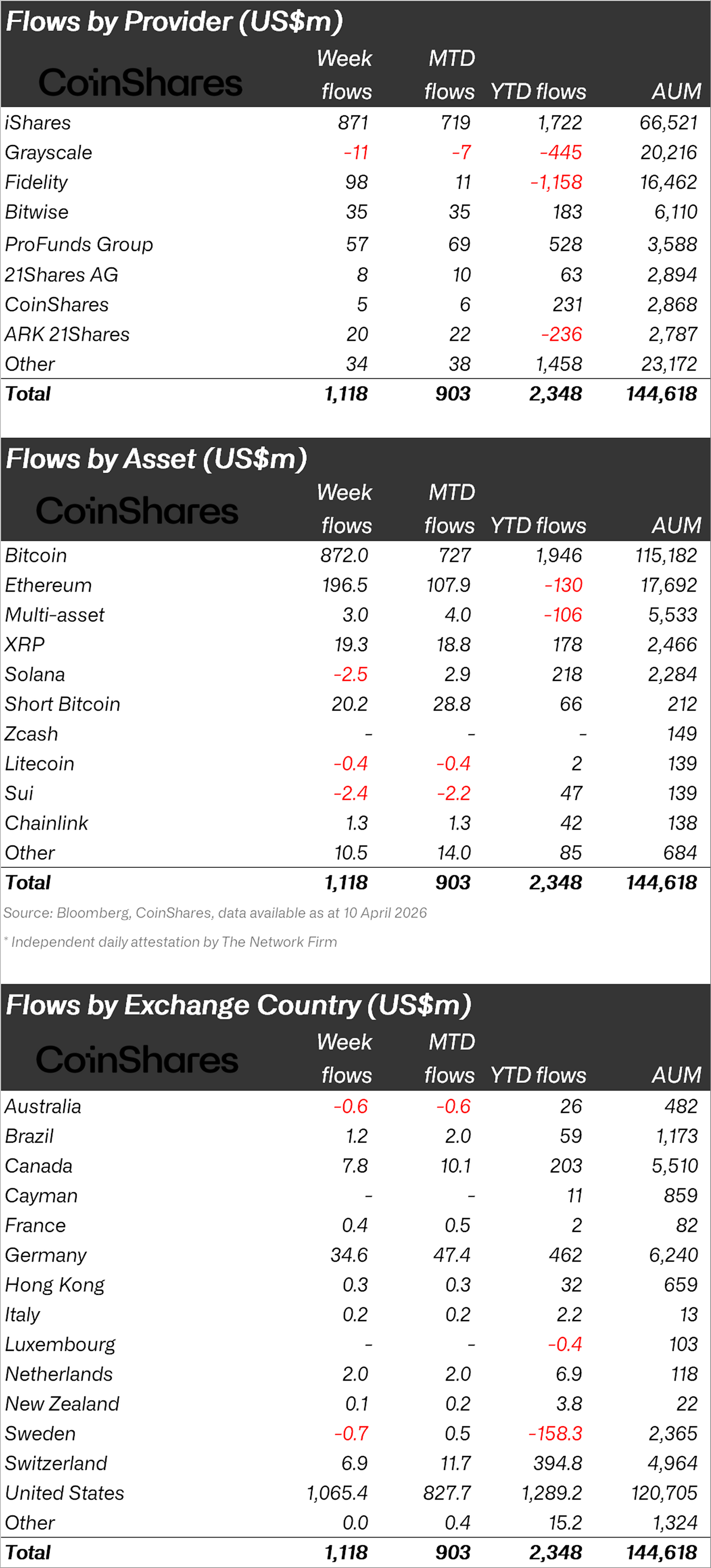
Crypto asset investment products recorded $1.1 billion in inflows last week, marking the strongest weekly total since early January, according to a new report from CoinShares.

Key Points

  • Crypto funds saw $1.1B inflows, the strongest since Jan, led by Bitcoin recovery momentum.
  • Bitcoin led inflows with $871M as institutional demand strengthens YTD momentum.
  • Ethereum rebounded with $196M inflows while XRP saw steady demand and trading volumes stayed below average.
  • U.S. dominated inflows at $1.06B, while Germany, Switzerland, and Canada saw smaller gains amid uneven risk appetite.

Strong Weekly Inflow

The surge marks a revival of risk appetite among investors. The development is supported by easing geopolitical tensions tied to developments in Iran and softer-than-expected U.S. economic data on consumer spending and inflation.

Despite the strong inflows, trading activity remains below average. Weekly volumes rose 13% to $21 billion but still lag behind the $31 billion year-to-date average.

Meanwhile, total assets under management (AuM) have rebounded to levels last seen in early February, signaling broader market stabilization.

U.S. Dominates Inflows

The inflows were heavily concentrated in the United States, which accounted for $1.06 billion, about 95% of the total.

Elsewhere, Germany posted $34.6 million in inflows, while Canada and Switzerland registered smaller investments of $7.80 million and $6.90 million, respectively. Other regions showed minimal activity, highlighting how localized the current investor optimism remains.

Bitcoin Leads, But Bears Stay Active

Bitcoin attracted the bulk of inflows, pulling in $871 million for the week. This brings its year-to-date total to nearly $2 billion, strengthening its position as the primary institutional focus.

However, bearish sentiment hasn’t disappeared. Short-Bitcoin products saw $20.2 million in inflows, the largest since November 2024. This suggests some investors are hedging or positioning for potential downside.

Ethereum Rebounds, XRP Maintains Momentum

Ethereum saw a notable recovery, recording $196.5 million in inflows. Despite this, it remains one of the few major assets still in a net outflow position year-to-date.

XRP continued to attract steady interest, bringing in $19.3 million. While smaller compared to Bitcoin and Ethereum, the inflows suggest consistent investor confidence.

Solana Sees Minor Outflows

In contrast, Solana recorded slight outflows of $2.5 million, making it one of the few assets to see negative movement during the week.

Overall, the data points to a market recovery led by Bitcoin, with selective strength in altcoins like XRP. Broader participation remains uneven across regions and assets.

50 Countries Expand Bitcoin Access Since 2020 as Global Adoption Accelerates: River

0

A new analysis from the crypto investment platform River Financial shows that at least 50 countries have expanded access to Bitcoin (BTC) since 2020.

The firm compiled a dataset tracking government actions related to Bitcoin over the past six years. Overall, the data show that most regulatory changes have moved toward greater acceptance and integration rather than restrictions. 

In fact, River’s broader research suggests that at least 50 countries have improved access to Bitcoin through regulatory measures since 2020, compared with only 4 that tightened restrictions. 

Key Points 

  • Analysis from River Financial shows that at least 50 countries have expanded access to Bitcoin since 2020. 
  • More countries are opening access than restricting it, with only four nations tightening crypto regulations over the same period. 
  • Of these Bitcoin-friendly jurisdictions, 34 countries have approved Bitcoin ETPs, enabling regulated investor exposure to BTC.
  • Some restrictions remain, with countries like Venezuela banning Bitcoin mining in 2024 and China maintaining strict limits on crypto mining activities.

34 Countries Offer Bitcoin ETPs 

One of the clearest indicators of growing acceptance is the rapid rise of institutional investment vehicles. According to River, 34 countries have approved Bitcoin exchange-traded products (ETPs), allowing investors to gain regulated exposure to the cryptocurrency.

Countries that currently offer Bitcoin ETFs include the United States, Canada, Switzerland, Germany, Sweden, and Hong Kong, among others. These investment products have increasingly served as a bridge between traditional finance and the digital asset ecosystem, particularly in developed markets. 

Meanwhile, Russia adopted a different strategy. Instead of focusing primarily on investment products, the country legalized Bitcoin mining and permitted its use for international payments in 2024, opening another pathway for state-level crypto integration. 

Image

Major Regulatory Milestones

Several policy decisions highlighted in the chart mark turning points in Bitcoin’s integration into mainstream finance. In the United States, regulators allowed banks to custody Bitcoin in 2025, enabling financial institutions to hold the asset on behalf of clients and expand crypto-related services. 

In Europe, the Czech Republic introduced tax reforms that exempt long-term Bitcoin holdings from capital gains taxes, signaling a supportive stance toward digital asset investment. 

Emerging Markets Drive Adoption

The data also highlights a growing shift among emerging economies, where governments are increasingly legalizing Bitcoin use. 

For instance, Nigeria legalized Bitcoin in 2023, a significant move given the country’s large and tech-savvy population. Argentina followed a similar path in 2023, legalizing Bitcoin payments as part of broader economic reforms aimed at stabilizing its financial system.

Likewise, Bolivia reversed its earlier stance and legalized Bitcoin in 2024, marking another example of regulatory change in Latin America.

These policy shifts suggest that countries facing inflation, currency volatility, or limited access to global financial infrastructure may be more willing to experiment with alternative financial systems.

Restrictions Remain Limited

Despite the overall expansion in access, some governments continue to impose restrictions. For example, Venezuela banned Bitcoin mining in 2024, citing concerns over energy consumption and regulatory oversight. China also maintains strict restrictions on Bitcoin mining, which prompted a large share of global mining activity to relocate elsewhere.

As a result, the United States now hosts the largest share of global Bitcoin mining activity, underscoring how regulatory environments can reshape the industry’s geography.

Even so, River’s data indicates that restrictive policies remain relatively rare compared with the growing number of measures that expand access to Bitcoin worldwide.

Iran Accepts Bitcoin for Oil Transit 

The analysis resurfaced amid renewed attention to Iran’s use of Bitcoin in international trade. Reports indicate that the country may require vessels to pay transit tolls in Bitcoin to pass through the Strait of Hormuz, one of the world’s most critical oil shipping routes.

Reacting to the development, River posted a sarcastic message on X, noting that Iran chose Bitcoin over more than 100 traditional currencies as a payment method. The firm emphasized the irony of the decision, noting that critics frequently label Bitcoin a Ponzi scheme or warn of future quantum-computing threats, yet a nation-state still chose to use it for settlement.

Market Updates: Stack BTC Buys 37 Bitcoin for UK MP Nigel Farage; American Musician Loses $420K BTC in Fake Ledger App Scam; Ether Machine Drops SPAC Deal

0

Latest Market Updates: As of 13th April 2026.

Stack BTC Expands Bitcoin Holdings Through Nigel Farage Purchase

In a latest development, UK-based Bitcoin treasury firm Stack BTC, led by former Chancellor Kwasi Kwarteng, has confirmed a new acquisition linked to Nigel Farage.

The company purchased 37 BTC, worth approximately £2 million, on behalf of Farage. With this transaction, Stack BTC’s total holdings have increased to 68 BTC.

In a post on X, the firm described Farage as the first sitting MP and UK party leader to have publicly disclosed acquiring Bitcoin.

This development follows an earlier investment made by Farage roughly one month ago, when he reportedly invested £215,000 in Stack BTC through his media company, Thorn In The Side Ltd. That investment gave him an estimated 6.3% stake in the firm.

Capital B Adds More Bitcoin to Corporate Treasury

In a parallel move, Capital B has further expanded its Bitcoin treasury, acquiring 37 BTC for approximately €2.3 million.

This latest purchase brings the company’s total holdings to 2,925 BTC, reinforcing its position as one of Europe’s largest corporate Bitcoin treasuries. The firm, listed on Euronext Growth in France, continues to prioritize Bitcoin accumulation as a core strategy.

Additionally, Capital B reported a year-to-date Bitcoin yield of 1.25% and a net gain of 35.3 BTC.

The acquisition was funded through a combination of convertible bond conversions and new share issuance. It includes participation from Blockstream Capital Partners and UTXO Management.

The company’s average purchase price now stands at €92,096 per Bitcoin, bringing its total investment cost to €269.4 million.

Musician Loses $420K in Fake Ledger App Scam

While institutional accumulation continues, a separate incident highlights persistent security risks in the crypto sector.

American musician Garrett Dutton, known as “G. Love,” reportedly lost his entire Bitcoin retirement savings after falling victim to a malicious application. 

He is said to have lost 5.9 BTC, worth approximately $420,000, after downloading a fake Ledger Live app and entering his seed phrase. His funds were subsequently drained.

The stolen Bitcoin had been accumulated over nearly a decade, making the loss particularly significant.

Blockchain investigator ZachXBT confirmed the theft and traced the movement of funds to KuCoin-linked deposit addresses across multiple transactions.

Digital Asset Funds See $1.1 Billion in Weekly Inflows

Despite ongoing security concerns, investor demand for digital assets strengthened significantly last week.

Investment products recorded $1.1 billion in inflows, the highest since January 2026, according to CoinShares data. Bitcoin led the trend with $871 million in inflows, accounting for nearly 80% of the total.

Ethereum attracted $197 million. Meanwhile, XRP saw $19 million in inflows. Short Bitcoin products also gained traction, recording $20 million in inflows — the highest since late 2024 — suggesting a more cautious but active trading stance.

The surge in inflows follows softer US inflation data and easing geopolitical tensions, both of which improved overall risk sentiment. Year-to-date inflows into Bitcoin products have now exceeded $2 billion.

Ether Machine Ends SPAC Merger Plan Amid Market Uncertainty

In a final major development, Ether Machine has withdrawn from its planned public listing after mutually terminating its SPAC merger with Dynamix Corporation.

The proposed deal would have taken the Ethereum-focused treasury company public via a Nasdaq-listed SPAC structure. However, weakening market conditions ultimately led both parties to abandon the agreement.

Following the termination, the deal includes a $50 million payment obligation, reportedly due within 15 days to Dynamix Corporation. The payer has not been publicly identified in confidential filings.

Top Trader Says XRP Is No Longer in Accumulation, Eyes Short Opportunities

Analyst Lars Kooistra says XRP may be entering a more bearish phase after a recent shift in market structure, despite earlier signs of accumulation.

XRP’s price continues to hover around $1.32, with negative performance across daily, weekly, and monthly time frames. While some expect a bullish reversal, Kooistra believes it may take time.

Key Points

  • XRP shifts from accumulation to distribution as analyst warns bearish structure may be forming.
  • Price hovers near $1.32 with weakness across daily, weekly, and monthly time frames.
  • Trader Kooistra targets shorts near supply zones, expecting a possible move lower if resistance holds.
  • Analysts remain split, with some eyeing a $0.70 downside while others still predict new XRP all-time highs.

From Accumulation to Distribution

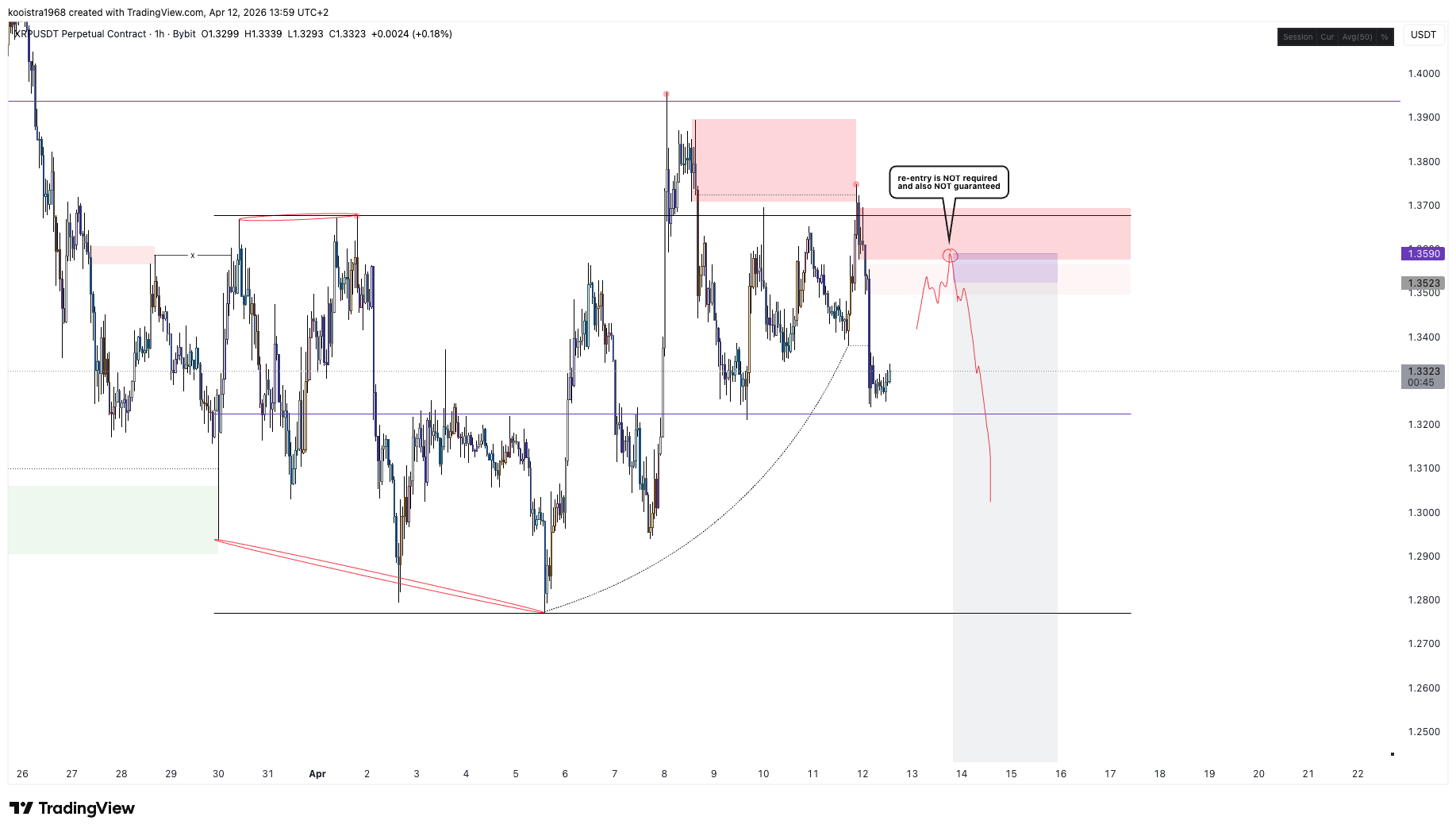
In his latest update, Kooistra explained that XRP initially followed a TCT accumulation schematic, which pushed the price upward and invalidated his earlier short setup. That move forced him to close his position at breakeven, as the price revisited higher levels instead of continuing downward.

However, the structure has now evolved.

According to him, XRP has transitioned into a higher time frame distribution pattern, suggesting that sellers may be regaining control after the temporary upside move.

Bearish Bias Still in Play

Kooistra also noted that the higher time frame still shows price compression, which often precedes a strong move, and he expects that move to be downward.

He is now looking for short opportunities around key supply zones, especially areas with unfilled orders.

However, he warned that the price may not return to those levels, as the market could already be in a distribution phase. Essentially, missing an entry now may not guarantee another chance later.

Image

Earlier Outlook

Just days earlier, Kooistra had a different outlook.

Specifically, on April 10, he observed that XRP had confirmed an extended accumulation model, invalidating expectations of a breakdown. At that point, he noted there were no clear re-entry opportunities, as the price maintained strength.

Going further back to April 7, his strategy was firmly bearish. He described a “go big or go home” short setup, operating in what he called a pro-bearish environment. That position was partially de-risked after a 20% take-profit at the range low, with expectations of a deeper “bearish flush” if support failed.

Key XRP Levels and What Comes Next

The latest chart shows XRP struggling below a major supply zone around the mid-$1.30s, with price currently hovering near $1.33.

Kooistra’s projected path suggests a possible short-term bounce or consolidation, followed by a sharp move lower if resistance holds.

On higher time frames, the chart also highlights downside targets extending toward the $1.20–$1.10 region.

Image

Ultimately, Kooistra’s analysis suggests that even when bullish setups appear, higher time frame pressure can shift momentum back to the downside.

XRP has shown strength in recent sessions, including a move above $1.40 last week, but this momentum has since reversed, with some analysts expecting new lows.

Risk of $0.70 Still Lingers

Last week, analyst ChartNerd warned that XRP could fall toward $0.70 if it fails to break resistance at $1.80 and $2.00. While maintaining this bearish outlook, the analyst noted he would be happy to be proven wrong but insists the risk of a drop below $1 remains.

Analyst Casi Trades shares a similar outlook. She noted that XRP’s brief rebound has ended, with a likely fall toward $0.85 in worst-case scenarios.

Yet other bullish commentators, like Dark Defender and Javon Marks, are calling for a new all-time high run for XRP based on the current setup.

XRP RSI Has Now Reached the Same Level That Preceded Every Major Price Explosion Since 2016

The weekly XRP RSI has recently dropped to the same level that preceded every major price breakout since 2016.

XRP has not fared well since dropping below the $3.6 all-time high in July 2025. Data shows that its weekly RSI has continued to collapse ever since, recently slumping below 32.78. Each time the weekly XRP RSI has dropped below this mark, what followed was a major breakout.

Key Points

  • XRP has declined by 63% from the $3.6 peak in July 2025, and this has resulted in a drop in its RSI.
  • The weekly XRP RSI has crashed below 32.78, currently sitting at 32.37, as the price stands at 1.33.
  • Every major breakout that XRP has recorded since 2016 has followed a similar RSI drop below 32.78.
  • This trend played out during the 2017 upsurge, the 2021 rally, and most recently, the 2024 price spike.
  • Each time this occurred, the weekly RSI failed to reach oversold levels before the price explosion.

XRP Price Struggles Lead to RSI Crash

This is according to a recent analysis by CryptoInsightUK, a prominent market commentator, amid XRP’s price struggles. Notably, the consistent price downturn that has engulfed the XRP market since July 2025 has led to a 63% price drop from the all-time high of $3.6.

Amid this decline, the XRP RSI has continued to collapse. Specifically, the weekly RSI hit a high of 70 in July 2025, when XRP claimed the $3.6 peak. Since then, it has witnessed consistent declines, recording lower highs and lower lows each week, as it forms a falling channel.

The declines have now resulted in the weekly XRP RSI reaching a low of 32.37 at press time, marking an over 4-year bottom. While this still sits above the 30 mark, confirming that the indicator did not slip into the undervalued region, it still presents a golden opportunity for investors.

Historical Context Makes a Bullish Case

CryptoInsightUK called attention to historical context indicating that the current XRP RSI position has often led to impressive price spikes. Specifically, every breakout the XRP price has recorded since 2016 has occurred after the weekly XRP RSI dropped below 32.78.

XRP Weekly RSI CryptoInsightUK
XRP Weekly RSI | CryptoInsightUK

For context, the RSI hit 32.76 in November 2015, when XRP’s price dropped to a low of $0.00416. This marked XRP’s floor price for that downturn, but it took over a year for a breakout to occur. However, once it occurred, XRP spiked from $0.005 in late February 2017 to $3.31 by January 2018.

Also, the weekly XRP RSI dropped to 32.67 in March 2020, as the price hit $0.1275. This marked the bottom for the bear market, with XRP eventually breaking out to $1.96 by April 2021. Meanwhile, the RSI saw similar lows when XRP’s price dropped to $0.38 in July 2024. This occurred before the November 2024 upsurge that led to $3.4 by January 2025.

Could XRP Repeat the Pattern?

Now, the weekly XRP RSI has again dropped below 32.78, currently reading 32.37 at the time of reporting. If history repeats, the XRP price could witness an explosive surge sometime in the future. However, it remains unclear when this will play out, if it does play out. Also, it remains to be seen if the RSI will close this week below 32.78.

Interestingly, CryptoInsightUK also pointed out that the weekly RSI had only officially hit the oversold level once, when it dropped to 28.09 in June 2022. However, the explosive run did not occur until after the RSI slipped below 32.78 again in mid-2024.

Speaking on this, an XRP community commentator stressed that most analysts and investors often focus on the RSI reaching oversold levels before confirming their bullish bias. However, history confirms that declines below 32.78 have been sufficient for an explosive surge later on, though these rallies often come after extended periods of time.

Market Updates: Justin Sun Accuses WLFI of Contract Blacklist Misuse, Alameda Moves $16M SOL for FTX Payouts, Aave Labs Secures $25M Funding

0

Latest Market Updates: As of 13th April 2026.

Justin Sun Accuses WLFI of Contract Manipulation

A major controversy has emerged between Justin Sun and the Trump-linked crypto project WLFI, setting the tone for today’s market developments.

In a post on X, Sun alleges that the platform embedded a hidden blacklist function within its smart contract, which was used to freeze his wallet in September 2025 without prior notice.

As WLFI’s largest investor, Sun has raised broader concerns about the project’s governance. Specifically, he claims that voting mechanisms were structured to justify freezing investor assets. In addition, he alleges that the team extracted undisclosed fees and misused community funds. Sun further describes the operation as functioning like a “personal ATM.”

Data from Bubblemaps indicates that Sun’s frozen holdings total roughly 545 million WLFI tokens, which have declined by more than $80 million in value since the freeze.

However, WLFI has strongly denied the allegations, calling them unfounded and accusing Sun of misconduct. The project has also signaled potential legal action, suggesting the dispute could escalate into court proceedings.

XRP Sentiment Falls Into Extreme Fear Zone

While the WLFI dispute dominates headlines, XRP is experiencing a sharp rise in negative sentiment.

Data from Santiment shows that fear, uncertainty, and doubt (FUD) surrounding XRP have reached their third-highest level in two years. In a recent post on X, Santiment noted that such extreme bearish sentiment has historically preceded market rebounds.

At present, XRP is trading at $1.33, down 63.6% from its July 2025 high of $3.65, according to CoinGecko. This prolonged downturn appears to have driven many retail investors out of the market, potentially creating conditions for a sentiment-driven recovery.

Image

Alameda Research Moves $16M SOL for Potential Creditor Repayments

In parallel, developments tied to the FTX bankruptcy continue to unfold. 

Alameda Research has unstaked and transferred approximately $16 million worth of Solana (SOL) tokens to a wallet associated with creditor repayments, according to data from Arkham Intelligence.

This follows a similar transaction about a month ago, reinforcing a pattern of unstaking and reallocating funds. While there has been no official confirmation of imminent payouts, the repeated activity suggests that the repayment process remains active.

Aave DAO Approves $25M Funding Plan for Aave Labs

Amid these developments, decentralized finance continues to push forward. 

The Aave DAO has approved a major funding package for Aave Labs under its “Aave Will Win” initiative, with nearly 75% of voters supporting the proposal. The plan allocates $25 million in stablecoins over 12 months, along with 75,000 AAVE tokens that will vest over four years.

This dual-structure approach aims to sustain operations while aligning long-term incentives. Notably, this vote addresses only the funding component, with additional proposals related to product expansion and ecosystem growth expected in future governance rounds.

Michael Saylor Outlines Bitcoin-Backed Dividend Strategy

Rounding out today’s updates, Michael Saylor has outlined a strategy linking dividend sustainability to Bitcoin’s long-term growth.

In a post on X, Saylor suggested that an annual increase of just 2.05% in Bitcoin’s value could allow MicroStrategy to sustain dividend payments indefinitely. Company data indicates that current reserves could cover dividends for approximately 48.7 years.

MicroStrategy currently holds 766,970 BTC, acquired at an average price of $75,648, with total holdings valued near $54.58 billion. Its preferred stock, STRC, offers an annual yield of 11.5%, trades near its $100 par value, and pays dividends monthly.

Importantly, proceeds from these issuances are reinvested into Bitcoin, reinforcing the company’s long-term accumulation strategy.

The Next XRP Bull Run Will Be Massive, Top Market Analyst Says

0

XRP could be poised for a decisive move to new highs in the next bullish market phase, according to a prominent market analyst.

This analysis comes from Ali Martinez, who, in a Sunday tweet, predicted a huge price move for XRP, the fourth-largest cryptocurrency by market cap. His projection hinges on a decisive breakout from a long-standing triangle pattern on higher timeframes.

Key Points

  • XRP is trending within a giant 9-year ascending triangle on the 1-month chart which formed in 2017.
  • Its recent notable price action was a rejection near the upper resistance in August 2025.
  • Now, following the resistance rejection, XRP could follow the same script it has followed since 2017 and retreat to the triangle’s floor.
  • The area of interest here is the $0.75-$0.80 macro support level, which could present a “buy the dip” opportunity.
  • If XRP breaks out on the next retest of resistance, we could be gearing up for a “huge” bull market for XRP.

XRP Within an Ascending Triangle

Martinez noted that XRP is trending within a giant 9-year ascending triangle on the 1-month chart. Price has been consolidating within this pattern since 2017, forming higher low supports but stuck beneath the triangle’s upper resistance neckline.

Its recent notable price action was a rejection near the upper resistance in August 2025. At a peak of $3.66 in July 2025, its price briefly broke above the triangle but could not sustain the move, dropping to $3.02. In August 2025, it retested the supply zone again but peaked at $3.38 before a clear rejection lower.

XRP has spent the last eight months in a downtrend, a clear sign of price weakness. Notably, this trend is not in isolation, as it has mirrored a broader market price decline, with Bitcoin (BTC) dropping over 43% from its peak.

XRP Targets Macro Support Area

Now, following the resistance rejection, Martinez expects XRP to follow the same script it has followed since 2017: retreat to the triangle’s floor after a rejection from neckline resistance.

XRP Ascending Triangle/Ali Martinez

The area of interest here is the $0.75-$0.80 macro support, which closely aligns with an earlier analysis from CasiTrades. From the current market price of $1.33, this would represent a 43.6% and 39.8% retracement, respectively.

Meanwhile, the analyst sees this move as a low-entry opportunity. He termed the potential pullback to the support a “buy the dip” opening before the next bullish phase sets in for the prominent altcoin.

A Massive Bull Run Next

After the lower ascending trendline retest near $0.75, Martinez projected a recovery higher, targeting the triangle’s apex near $3.30. This move culminates in a 150% rise from the current market price and 344% from the macro support’s lower band.

Interestingly, the 9-year triangle is now tightening, signaling that a breakout could be on the horizon. If it breaks out on the next retest of resistance, the analyst believes we could be gearing up for a “huge” bull market for XRP.

History suggests that breaking out after such a prolonged period of consolidation sets the stage for a significant price rally. An accompanying chart suggests that XRP could potentially reach a new all-time high of $8.50, representing a 539% rise from the current market price and a staggering 1,033% uptick from the macro support level.

The price target aligns with the parallel price prediction from analyst Dark Defender, who cited an Elliott Wave formation as the catalyst for his outlook.

Data-Driven AI Model from Alibaba Signals $7 XRP Price by Christmas 2026

0

An artificial intelligence model by Alibaba has generated an optimistic long-term outlook for XRP based on market data.

The AI system suggests that XRP could surge significantly by Christmas 2026, stirring excitement in the community.

Key Points

  • An AI pricing model projects that XRP could climb to $7 by Christmas 2026.
  • The model also suggests that Ripple’s expanding partnerships and rising institutional adoption could drive XRP to $42.
  • With XRP currently trading around $1.32, reaching $7 and $42 would require rallies of approximately 430% and 3,081%, respectively.
  • Other AI chatbots, including ChatGPT and Grok, have also issued bullish price outlooks for XRP this year.

Alibaba AI Predicts XRP Price by Christmas 2026

Notably, commentary making rounds among XRP supporters claims that an AI model linked to Alibaba has generated forward-looking projections for major cryptocurrencies, including Bitcoin, Ethereum, and XRP.

Interestingly, the model repeatedly identified $7 as a potential XRP price by Christmas (December 25, 2026). Analysts reviewing the results observed that this level appeared across multiple clusters of data inputs. Consequently, the repeated appearance of the $7 target made it stand out as a consistent projection within the model’s outputs.

XRP to $42?

Meanwhile, some analysts expanded the dataset to include additional indicators, such as the acceleration of institutional adoption and Ripple’s global partnerships in the cross-border payments industry.

Under this broader analytical framework, a more aggressive scenario emerged. Based on historical growth patterns from previous crypto market cycles, the model suggested that XRP could climb to $42 if adoption and market momentum accelerate significantly.

Nevertheless, most projections generated by the AI system continued to cluster around $7. This suggests the model considers this figure a more realistic outcome given the available data.

Current Price Context and Market Reaction

At press time, XRP traded at $1.32, meaning the asset would need to rally roughly 430% to reach $7 and about 3,081% to hit $42. If either target materializes, XRP could set a new all-time high, surpassing its previous peak of $3.84 recorded in January 2018.

Meanwhile, the forecast has sparked mixed reactions within the XRP community. Some proponents believe the cryptocurrency could eventually reach the projected levels.

On the other hand, skeptics argue that the timeline appears overly ambitious, especially given XRP’s recent market performance. So far in 2026, XRP’s price has declined 28.26% year to date.

Other AI 2026 Projections for XRP

While Alibaba AI is bullish on XRP, several other AI models have issued divergent price outlooks for the token. For example, Google’s Gemini predicts that XRP could reach around $3.15 by the end of the year.

Meanwhile, ChatGPT outlines multiple scenarios: the token could rise to $2.40 if the market avoids major macroeconomic shocks or potentially reach $4.20 during a late-year altcoin rally. Conversely, under sustained bearish conditions, the model suggests XRP could fall to $0.95.

Similarly, Grok forecasts that XRP could rebound to approximately $3.20 by year-end, particularly if favorable catalysts, such as strong crypto ETF inflows, boost market sentiment. These mixed projections highlight ongoing uncertainty and reinforce the need for caution when making investment decisions.