Home Blog Page 164

Shiba Inu Nears Top 30 Exit as Rivals Close In

0

Shiba Inu faces renewed pressure as it struggles to maintain its position among the top 30 cryptocurrencies by market capitalization. 

After years of sharp rallies and steep pullbacks, Shiba Inu’s recent performance has pushed it close to dropping out of the top 30 in the crypto rankings. The outcome underscores intensifying competition across the crypto market.

Key Points

  • Shiba Inu’s recent performance has pushed it close to dropping out of the top-30 ranking.
  • It ranks as the 29th-largest cryptocurrency, with a market cap of about $3.42 billion.
  • SHIB’s price performance reflects this decline, with the token down 15.93% year-to-date from $0.000006904 to around $0.000005804.
  • Cronos currently ranks 30th with a valuation of roughly $2.89 billion, set to overtake SHIB.

Shiba Inu Now Sits in 29th Position

At press time, Shiba Inu ranks as the 29th-largest cryptocurrency, with a market cap of approximately $3.42 billion. Meanwhile, Cronos (CRO) sits directly below it in 30th place with a valuation of about $2.89 billion.

While SHIB maintains a modest lead over Cronos, several projects above it remain within striking distance. For instance, Toncoin holds 28th place with a market cap of $3.52 billion. Similarly, Sui ranks 27th with a valuation of $3.58 billion, while Hedera occupies 26th place at approximately $3.68 billion.

Consequently, if Shiba Inu stages a strong rally while these competing assets remain relatively stable, the token could strengthen its position and reduce the immediate risk of falling out of the top 30.

Shiba Inu ranking
Shiba Inu ranking

Current Position Highlights Sharp Contrast to Earlier Success

Indeed, SHIB’s current standing sharply contrasts with its earlier success. After launching in August 2020, it surged during the meme coin boom, fueled by strong community support and speculative demand.

At its peak, SHIB entered the top 10 and briefly surpassed Dogecoin, reaching an all-time high of $0.00008845 during the 2021 bull cycle, with many early investors making a fortune from SHIB.

However, since then, it has steadily lost ground as market conditions cooled and investor focus shifted toward utility-driven projects.

Recent Underperformance

Meanwhile, price performance continues to reflect ongoing weakness. SHIB opened the year at $0.000006904 but has declined about 15.93% year-to-date to $0.000005804. It has also slipped 2.3% this month and fallen 3.57% over the past week.

Nonetheless, supporters remain optimistic about the token’s future. Lead developer Shytoshi Kusama previously hinted at behind-the-scenes developments that could eventually push SHIB toward the top five.

Although those expectations have yet to materialize, proponents believe ecosystem expansion, including decentralized applications and community-driven utilities, could revive its momentum.

Ongoing Challenges Raise Questions About Recovery

However, critics remain skeptical. Some analysts argue that SHIB may continue to face bearish pressure due to lingering ecosystem challenges.

For example, the strong community enthusiasm that propelled the token to its 2021 all-time high has gradually faded, with many early supporters shifting their attention to newer crypto projects.

Moreover, several initiatives once viewed as major catalysts have either stalled or failed to gain significant traction. These include Shib: The Metaverse and the project’s NFT marketplace.

Additionally, the token’s burn mechanism, designed to reduce supply and support price appreciation, has recently slowed. Over the past 24 hours, the community burned only 6.33 million SHIB, a relatively small figure compared to the token’s massive 589.16 trillion circulating supply.

As a result, these internal challenges have sparked debate over whether Shiba Inu could regain momentum or continue its gradual downward trajectory.

American Investing Firm Discusses Where XRP Could Be in 5 Years

American investing advice company Motley Fool recently assessed where XRP could be in the next few years amid the ongoing downturn.

While Ripple has made progress in its operations, XRP has continued to move in line with the broader crypto market’s decline, down 28% this year alone. As the market continues to underperform, Motley Fool explored where XRP could stand over the next five years.

Key Points

  • Motley Fool argued that XRP may struggle to keep up with the crypto market over the next five years due to a disconnect between Ripple’s growth and the token’s value.
  • According to them, RLUSD’s introduction gives institutions a more stable option than XRP.
  • Ripple executives, including Brad Garlinghouse, have repeatedly affirmed that XRP remains central to the company’s strategy.
  • Ripple continues to expand the XRP ecosystem through initiatives like decentralized funding programs, AI-driven security upgrades, and new treasury tools.

Weak XRP Price Momentum Despite Major Catalysts

According to Motley Fool, Ripple’s growing success may not necessarily translate into gains for XRP investors. The firm pointed out that XRP has dropped more than 60% from its peak near $3.65 last July and now trades around $1.30. 

This puts it roughly at the same level it held before the U.S. SEC settled its case with Ripple and before spot XRP ETFs launched in the United States. Motley Fool stressed that these two major events, which many expected to boost the price, have passed without creating lasting momentum.

The investing advice company claimed that XRP may continue to struggle in the short term and could fall behind the broader crypto market over the next five years. 

They clarified that this opinion does not mean Ripple itself is underperforming. Instead, they believe that Ripple’s business growth and XRP’s price do not always move together, and as more investors begin to understand this, the excitement around the token could fade.

Ripple’s Two-Part Business

The firm noted that Ripple’s business has two main parts. The first is a settlement messaging system used by major banks and financial institutions. They argued that this system does not rely on XRP. According to Motley Fool, these institutions generally prefer not to deal with a volatile asset. 

The second part serves smaller institutions and uses XRP to help move money across borders by converting funds into XRP and then into another currency. However, Motley Fool noted that the first segment handles much more volume, while the XRP-based segment is still too small to have a strong impact on the token’s value.

RLUSD’s Introduction

Motley Fool also called attention to changes in Ripple’s strategy that could affect XRP’s role going forward. Notably, the blockchain payments company has started promoting its stablecoin, RLUSD, as an important part of its payment solutions. 

Since RLUSD can serve the same purpose as XRP in cross-border transactions, institutions now have a choice between using a stable asset or a more volatile one. According to Motley Fool, this shows Ripple is trying to keep up with the rising demand for stablecoins. 

The firm noted that Ripple’s website now highlights stablecoin payments as a key feature of its platform. While this approach could strengthen Ripple as a company, Motley Fool argued that it may not benefit XRP holders, since Ripple can succeed regardless of which asset is used.

Ripple’s Continued Commitment to XRP in 2026

Despite these claims, Ripple has continued to show support for XRP throughout 2026. In February, CEO Brad Garlinghouse said on X that the XRP community remains a top priority for the company. Within the same month, during the opening of XRP Community Day 2026, he called XRP the North Star behind Ripple’s long-term plans.

The event, held from Feb. 11 to 12, 2026, featured leaders, including President Monica Long and former CTO David Schwartz. They spoke about several developments, including regulated XRP investment products, wrapped XRP, and new features to expand its use. 

Later, on Feb. 26, 2026, Ripple shared plans to grow the XRP Ledger ecosystem through more decentralized funding, including initiatives like XAO DAO, new accelerator programs, and institutional efforts.

Ripple also introduced potential AI-based security upgrades in March 2026 to improve the safety and reliability of the XRP Ledger. Earlier in the year, in January 2026, Garlinghouse had already highlighted XRP’s ongoing role in cross-border payments alongside RLUSD. 

More recently, Ripple launched Digital Asset Accounts and Unified Treasury as part of its Ripple Treasury platform. The system allows financial managers to handle XRP, RLUSD, and traditional currencies together in one place.

XRP May Now be Offering This “Final Opportunity” to Investors, Analyst Says

0

The current XRP price action could be presenting a “final opportunity” for investors, according to a prominent market watcher.

XRP has remained under pressure since Q4 2025, dropping 53% and trading around $1.34. Amid this decline, analyst Chart Nerd believes the asset may be nearing a key turning point, suggesting the current phase could represent a “final opportunity” for investors before the next major move.

Key Points

  • XRP has fallen 53% since Q4 2025, currently trading for $1.34 amid continued market-wide selling pressure.
  • The price is now hovering near the Gaussian Channel’s blue regression band around $1.30.
  • In past cycles, XRP has consistently rallied after touching this level.
  • Based on this pattern, a potential 40% rally could push XRP toward the $1.8 to $2 range in the near term.
  • Historical trends also show that such rallies are often followed by further declines toward the red regression band, currently near $0.78.

XRP Gaussian Channel Points to Possible Short-Term Bounce

Chart Nerd based his analysis on the Gaussian Channel, focusing on the monthly chart. He noted that the blue dotted line represents the upper regression band, while the red dotted line shows the middle regression band. He used these levels to assess how XRP has behaved after past cycle peaks.

According to him, after the 2013 peak of $0.0614, XRP later dropped back to the blue regression band and made contact with it. The same thing happened after the 2017 peak of $3.31, and again after the 2021 high of around $1.96. 

XRP 1M Gaussian Channel Chart Nerd
XRP 1M Gaussian Channel | Chart Nerd

Most recently, after the $3.6 all-time high in July 2025, XRP has returned to this same blue dotted line and has been hovering around it. Right now, this level is around $1.30 and has acted as a major support area for about three months.

XRP’s Past Cycles Show a Pattern

Chart Nerd pointed out that each time XRP has reached this blue level, a short-term rally has followed. In 2015, after returning to the Gaussian band, XRP stayed above it for about one to three months before rising roughly 110% within two to three months. 

However, the rally did not last, as the price formed a lower high of $0.0244, lost support, and then dropped further toward lower levels near the red line.

He said the next cycle showed a similar pattern. Specifically, after staying around the blue band for five to six months, XRP moved up again, this time gaining about 80% from its local low. 

In 2022, the same setup led to a 63% rally before the price declined once more. Based on this repeated pattern, he believes XRP could now be setting up for another move higher, possibly reaching between $1.8 and $2.

Chart Nerd noted that the size of these rallies has been getting smaller over time, dropping from 110% to 80%, and then to 60%. Following that trend, he expects the next move could be around 40%. From the current level near $1.30, a 40% increase would push XRP close to $1.8 to $2.

He added that he originally expected this move to happen in March, with a pullback in April. Instead, XRP has continued to move sideways above the blue line. Even so, he still sees a chance for a rally toward $1.8 to $2 in the coming months.

XRP Risks Another Drop to $0.78

Despite the chance of a short-term rise, Chart Nerd warned that this could lead to the final stage of the correction. 

He explained that in earlier cycles, after bouncing from the blue line, XRP later dropped to the red middle regression band, where it formed a more stable bottom. At the moment, this red line sits around $0.78, which also supports his target in the $0.70 range.

Potential XRP Drop Chart Nerd
Potential XRP Drop | Chart Nerd

He also called attention to other factors backing this view, including indicators like the super trend and the monthly and three-month RSI. In addition, he mentioned ongoing global tensions, such as the uncertain situation between Iran and the United States, as a reason why markets remain unstable. 

Dom Kwok Defends $1,000 XRP Call, Argues $100T Market Cap Is Possible

EasyA co-founder Dom Kwok continues to defend his $1,000 XRP price prediction and the resulting $100 trillion market cap.

In a recent tweet, he pushed back against traditional market cap arguments following his bold XRP forecast. His latest remarks come as critics continue to question whether such a price target is realistic, especially given the massive market capitalization it would imply.

Key Points

  • Dom Kwok defends $1,000 XRP forecast, saying market cap criticism misunderstands crypto valuation models.
  • Kwok compares Bitcoin’s trillion-dollar valuation to Walmart, questioning revenue vs market cap logic.
  • XRP supporters say cross-border payment utility and network effects could justify long-term higher valuations.
  • Critics call $1,000 XRP unrealistic due to $60T–$100T cap, but Kwok says 700x moves are normal in crypto.

Market Cap Criticism Meets Bitcoin Comparison

In his tweet, Kwok questions how Bitcoin achieved a multi-trillion-dollar valuation despite not generating traditional revenue.

He pointed out that companies like Walmart generate hundreds of billions in annual revenue, yet Bitcoin’s valuation has at times exceeded theirs. Indeed, Bitcoin boasts a market cap of nearly $1.5 trillion today, while Walmart has a market cap of $1.01 trillion.

Notably, Walmart saw nearly $700 billion in revenue in 2025, while Bitcoin mining revenue was just $1.4 billion. Despite the massive disparity in profitability, Bitcoin ranks ahead of Walmart.

Kwok used this comparison to challenge the logic of dismissing XRP’s potential based solely on its market cap. To him, market cap is irrelevant.

Supporting this view, Web3 Alert founder Nick argued that many critics rely on market cap limits without explaining why Bitcoin itself reached over $2.2 trillion at its peak.

XRP Utility Argument Gains Traction

Proponents of XRP say the asset’s real-world use cases could justify significantly higher valuations over time.

The argument centers on XRP’s role in cross-border payments, which facilitates the movement of large volumes of capital.

Supporters claim that if trillions of dollars eventually flow through the network, the underlying asset could capture substantial value through network effects.

This perspective suggests that utility, not just speculation, could be a key driver of XRP’s long-term price.

Revisiting the $1,000 Prediction

Kwok and his brother stated that XRP reaching $1,000 is “definitely” possible within four to five years. At current levels near $1.35, that would represent an increase of roughly 740x.

However, such a move would imply a market capitalization between $60 trillion and $100 trillion. For context, gold’s market cap is only $33.17 trillion. Prominent firms like NVIDIA, Apple, and Google have valuations between roughly $3 trillion and $4.6 trillion.

Essentially, a $1,000 XRP price would place it ahead of these global assets and companies. To critics, this makes the prediction unrealistic.

However, the Kwok brothers insist that this potential outcome does not negate the possibility. They argue that crypto markets do not follow traditional valuation models.

To them, exponential expansion beyond what is typically seen in equities remains possible, just as Bitcoin moved from a few thousand dollars to trillions in valuation.

“In crypto, 700x is not that much,” Kwok said during the podcast regarding the $1,000 price outlook. And indeed, during the 2017 bull run, XRP’s price engineered a move of similar magnitude, rising from $0.005 to $3.84.

Japanese Banks Confirm XRP Settles 60% Cheaper Than SWIFT in Under 4 Seconds

Financial institutions in Japan have unveiled new pilot data showing that XRP payments can cut cross-border costs by up to 60% compared to SWIFT.

This cost cut happens all while the network settles transactions in under four seconds. Notably, the results were presented at the XRP Tokyo 2026 conference on April 7, where banks tested live remittance corridors between Southeast Asia and Japan.

The development adds fresh momentum to XRP’s real-world use case narrative, as the asset trades around $1.35.

Key Points

  • Japanese bank pilots show XRP cuts cross-border costs up to 60% vs SWIFT, settling in under 4 seconds.
  • Ripple ODL pilots replace correspondent banking, removing intermediaries and cutting settlement delays.
  • Asian expansion adds 12 currency pairs with MUFG and SBI evaluating Ripple payment corridors across region.
  • XRP demand outlook strengthens as real-world adoption grows, including RLUSD rollout and new cross-border corridors

Japanese Banks Demonstrate XRP Efficiency Over SWIFT

At the center of the pilots is Ripple Payments, which replaces the traditional correspondent banking model used by SWIFT.

Instead of routing payments through multiple intermediaries and relying on pre-funded accounts, ODL converts fiat into XRP. Then it sends it across the XRP Ledger within seconds and converts it back to the destination currency.

Banks participating in the pilots confirmed that removing intermediaries and idle capital requirements led to a 60% reduction in transaction costs. Settlement times also dropped dramatically from one to five business days under SWIFT to just a few seconds using XRP.

Expansion Across Asia Gains Traction

Ripple used the conference to expand its network with 12 new currency pairs, targeting Southeast Asia’s fast-growing remittance corridors.

Representatives from major institutions, including Mitsubishi UFJ Financial Group, attended alongside central bank officials from the region to evaluate the system.

SBI Holdings, a long-time Ripple partner, continues to play a key role in adoption. The firm has been working with Ripple since 2016. It launched live XRP remittances between Japan and the Philippines in 2023.

More recently, it introduced a ¥10 billion blockchain bond that pays returns in XRP, marking a first for Japan’s financial sector.

Real-World Use Could Boost XRP Demand

Every transaction using Ripple’s system requires buying and selling XRP. Adding 12 new payment corridors brings more consistent transaction flows, which could strengthen XRP’s market presence.

XRP is now available on 20 JVCEA-approved platforms in Japan, making it one of the country’s most widely supported cryptocurrencies. Ripple also plans to launch its RLUSD stablecoin through SBI’s exchange. RLUSD will handle settlements, while XRP will continue acting as the bridge for liquidity in transactions.

Ultimately, early pilot results show XRP is moving from theory to real-world performance in traditional finance. Expanding these corridors across Asia could turn XRP from a speculative asset into a key part of cross-border payments.

U.S. regulatory developments may speed this process by allowing more institutions to adopt XRP-based systems.

Japan’s banking pilots provide some of the clearest evidence yet that XRP’s efficiency advantages over SWIFT are starting to appear in real financial operations.

Veteran XRP Investor Outlines 5%–10% Passive Income Future for XRP Holders

0

Long-term XRP investor Kevin Cage recently outlined how emerging financial infrastructure could enable XRP holders to earn passive returns of up to 10% in the coming years. 

In a recent post on X, Cage, a long-term XRP investor since 2017, argued that the current XRP ecosystem still offers limited yield opportunities, leaving many long-term investors simply holding their tokens without generating income. 

However, he believes this situation could soon change as new decentralized finance tools, institutional products, and cross-chain integrations continue to develop.

Key Points

  • Kevin Cage argues that XRP could generate up to 10% passive returns in the coming years. 
  • He highlights crypto lending markets as a key source of future yield, offering returns of 3%–8%. 
  • The long-term XRP investor also points to institutional vaults and managed products that may generate 5%–12% annually. 
  • He emphasizes tokenized real-world assets (RWAs) as a growing yield channel with potential returns of 4%–10%. 

Potential Yield-Bearing Opportunities for XRP 

Notably, Cage explained that several emerging channels could create yield opportunities for XRP holders. For instance, he stressed that crypto lending markets could offer returns of 3% to 8%. Moreover, institutional vaults and professionally managed products could generate returns of 5% to 12% annually.

In addition, Cage highlighted the growing role of tokenized real-world assets (RWAs), which could offer yields between 4% and 10%. At the same time, cross-chain strategies may enable XRP holders to access yield opportunities across multiple blockchain ecosystems through improved interoperability. 

Furthermore, Cage suggested that wallets, exchanges, and financial applications could eventually integrate automated yield accounts directly into their platforms. In his view, users can earn passive returns on their XRP holdings with minimal effort.

Meanwhile, Cage cautioned that some decentralized finance strategies could advertise returns of 20% or more. However, he stressed that these higher-yield opportunities often involve significantly greater risk.

XRP as a Collateral Asset

Beyond passive yield, Cage also emphasized the growth potential for XRP-backed lending. In this model, holders can use their XRP as collateral within crypto lending platforms.

Through collateralized debt positions (CDPs), investors can borrow liquidity against their XRP without selling the asset. Consequently, they can access capital while still maintaining exposure to potential price appreciation.

Emerging Platforms Expand Yield Opportunities for XRP Holders

Historically, many XRP investors have missed opportunities to earn returns on idle holdings because the XRP Ledger does not operate on a Proof-of-Stake (PoS) model. However, several third-party protocols now offer solutions that enable XRP holders to generate yield. 

For instance, the Flare Network launched FXRP last year, creating a pathway for XRP holders to participate in decentralized finance. Under this system, users lock their XRP in a Flare vault and mint a liquid representation known as FXRP. They can then deploy this token across DeFi platforms to generate rewards.

In addition, Flare partnered with Xaman Wallet to simplify access to these opportunities. Through the integration, XRP holders can enter the DeFi ecosystem with just a click directly from their wallets.

Meanwhile, platforms such as Axelar and Hex Trust have also introduced DeFi solutions specifically for XRP holders, further expanding the ways investors can put their assets to work. 

Despite these developments, Cage expects the ecosystem to continue evolving, with XRP holders earning 5% to 10% annual returns through a mix of relatively conservative yield strategies. 

XRP Volume Z-Score Crashes on Binance: Here’s What Happened The Last Time This Occurred

0

The XRP Volume Z-Score on Binance has crashed to lows last witnessed in December 2025, indicating reduced trading activity.

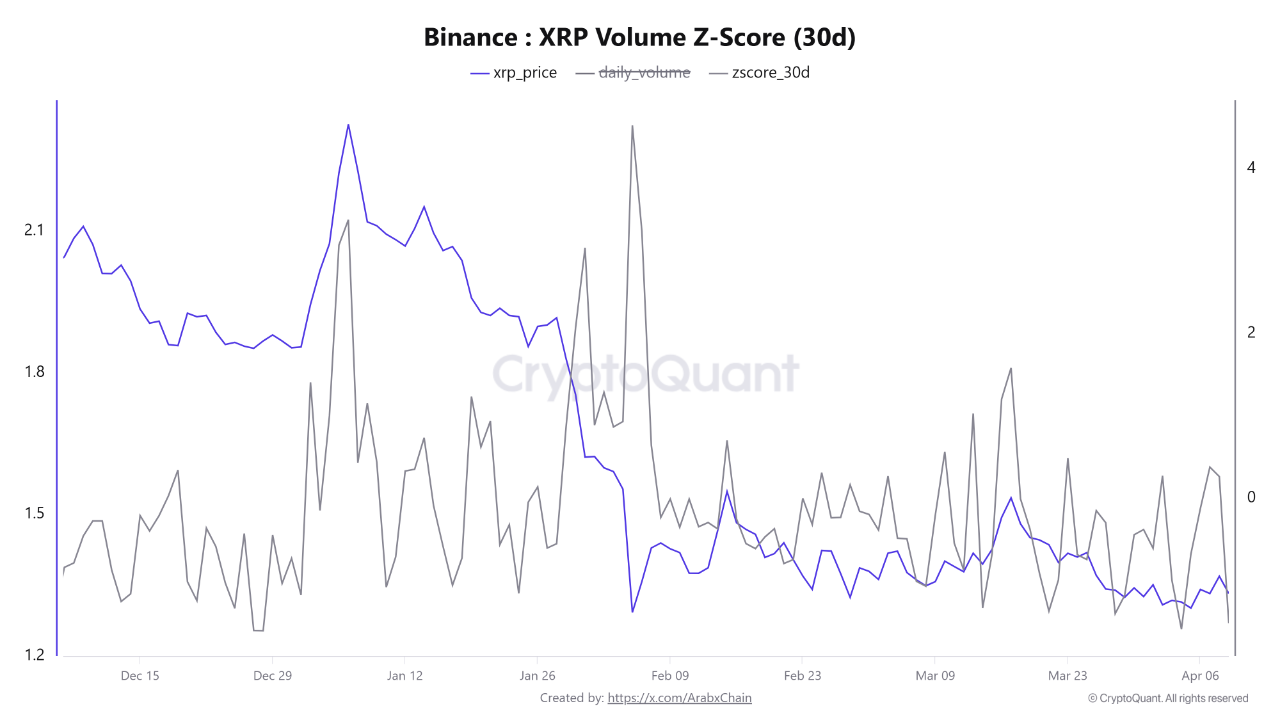
XRP is still trying to recover from a long downtrend that has dragged its price down by 53% since October 2025. Amid the downturn, Arab Chain, a verified analyst on CryptoQuant, calls attention to a drop in XRP’s Volume Z-Score on Binance. The metric has now fallen to its lowest level since late 2025.

Key Points

  • Amid the ongoing downtrend, the XRP Volume Z-Score on Binance has dropped to its lowest level since late 2025.
  • The Volume Z-Score (30d) fell below -1, indicating trading volume has crashed below its monthly average.
  • This decline indicates lower participation, especially from short-term traders, as well as reduced volatility.
  • The last similar figure in late December 2025 saw XRP rise from $1.85 to $2.41 by January 2026.

Market Implications of the XRP Volume Z-Score

Arab Chain explained that the drop in the Volume Z-Score indicates weaker momentum and reduced interest from short-term traders. This suggests that many traders who usually follow quick market moves have stepped back for now.

According to him, the 30-day Volume Z-Score measures how current trading volume compares to its average over the past month. 

When the value turns negative, it means the current trading activity has fallen below normal levels. Recent data shows the indicator has dropped below -1, one of its lowest points since 2025, confirming a clear slowdown in XRP trading on Binance.

XRP Volume Z-Score on Binance CryptoQuant
XRP Volume Z-Score on Binance | CryptoQuant

At the same time, XRP’s price has followed a similar downward path. After reaching a high of $3.6 in July 2025, the price has continued to fall into lower ranges. 

From this peak, XRP has lost nearly 63% of its value. Although investors expected better performance in 2026 after a 11.54% decline in 2025, the asset has already dropped another 26.81% in 2026, adding to the negative trend.

What Happened the Last Time XRP Reached Similar Levels

Arab Chain pointed out that when volume falls like this, it often means investors are waiting for clearer signals before making new moves. Most of them prefer to stay on the sidelines until they see a more defined trend. As a result, the lower volume may also indicate reduced volatility.

Speaking further, he stressed that a falling Z-Score shows lower participation, especially from short-term investors who depend on strong volume and momentum. When market activity drops to this level, the market often enters a range-bound phase. This phase usually comes before a stronger move, either downward or upward, depending on what happens next.

Looking at past data helps put the current situation into context. The last time XRP’s Volume Z-Score on Binance dropped to similar levels was in late December 2025, when the price stood around $1.85. At that time, market activity had also slowed down in a similar way.

As the Z-Score began to rise again, XRP’s price saw a strong rebound. The price climbed to $2.41 on Jan. 6, 2026, while the Volume Z-Score surged toward 2.1. This showed how quickly the price can react once trading activity picks up again. However, the rally did not last. After reaching $2.41, XRP hit resistance and started to pull back.

XRP Validator Says ‘Delusional’ XRP Price Dreamers Will Win in the End

The discussion around XRP long-term price potential is heating up again, particularly around popular aggressive targets within the community.

XRP Ledger validator Vet has suggested that the very investors often labeled “delusional” could ultimately come out on top.

In a tweet, Vet stated that despite skepticism around extreme price predictions, “the delusional people will win at the end,” adding that “being a dreamer is just too powerful.”

Key Points

  • XRP validator Vet says so-called “delusional” price dreamers could ultimately win as long-term conviction grows.
  • Despite trading near $1.30, XRP holders still project bold targets from $100 to $10,000.
  • Analysts warn that a $1,000 XRP would imply a massive $50T–$100T market cap, fueling debate.
  • Past comments from David Schwartz suggest XRP’s future price depends on adoption and imagination.

XRP Holders and Big Dreams

At the time of writing, XRP is trading around $1.30 and is still struggling to regain momentum after nine months in a bear market. Yet, that hasn’t stopped the community from projecting massive upside targets ranging from $100 to $1,000 and even $10,000.

For instance, Dom Kwok and Phillip Kwok, in a podcast on Thursday, argue XRP could reach $1,000 within four to five years.

They point to Bitcoin, which has repeatedly exceeded expectations and valuation frameworks. According to them, crypto valuations are driven as much by narrative and adoption as they are by fundamentals.

However, such a projection would imply a market capitalization between $50 trillion and $100 trillion.

While critics highlight valuation limits and market cap constraints, XRP bulls continue to disagree. They often argue that “market cap does not matter.”

Community Reactions

Responses to Vet’s statement expressed similar sentiment. Community figure X Finance Bull remarked that, numbers aside, “strong conviction can carry people further.”

This view suggests that conviction, no matter how unrealistic it may appear, often separates early believers from the crowd. Others pointed out that what looks irrational today can become obvious in hindsight.

One user noted that there is only a “thin line between being delusional and being early,” stressing that patience, discipline, and timing ultimately determine whether bold predictions pay off.

Throwback to David Schwartz’s “Dream Big” Theory

Adding historical context, community members resurfaced an old discussion involving Ripple’s Emeritus CTO, David Schwartz, regarding XRP’s price outlook.

Back in 2016–2017, when XRP traded around $0.005, one holder asked what the highest possible price XRP could reach “mathematically,” given its large supply and extremely low price.

In response, Schwartz said, “It all depends on how big you want to dream.” He explained that the asset’s future price depends largely on the scale of its adoption and imagination. At the time, he outlined several scenarios:

  • Matching Bitcoin’s market share could push XRP to around $2
  • Capturing global high-friction payments could justify $20
  • Expanding use cases and economic growth could drive it toward $120 and beyond

At the time, even $1 seemed ambitious. Today, XRP has already surpassed that level multiple times, reinforcing the idea that market expectations can shift dramatically over time.

David Schwartz's reddit comment
David Schwartz’s Reddit comment

The Future Decides

Ultimately, while XRP continues to trade below key breakout levels in the short term, the long-term conversation is increasingly shaped by conviction, adoption potential, and historical precedent.

Whether the so-called “dreamers” are early visionaries or simply overly optimistic, the future will tell. But as past cycles have shown, crypto markets have a way of surprising both sides.

XRP ETFs Flash Green as Prices Rise Despite Quiet Trading Volume

0

Multiple XRP ETFs recorded upward price movements during yesterday’s trading session, signaling positive short-term momentum across these investment products.

XRP ETFs tied to major asset managers, including Bitwise Asset Management, Canary Capital, Franklin Templeton, Teucrium, and Volatility Shares, all posted intraday gains on their respective charts. 

As a result, the synchronized price increases point to growing investor interest in gaining exposure to XRP through regulated investment vehicles.

Key Points

  • XRP ETFs from major asset managers, including Bitwise, Canary Capital, Franklin Templeton, Teucrium, and Volatility Shares, recorded modest intraday gains.
  • These products posted gains ranging from 0.45% to 1.29% during the session.
  • Despite the upward movement, trading activity remained subdued, with daily volumes across spot XRP ETFs staying below $10 million.
  • Analysts note that the combination of rising prices and low volume may signal a quiet accumulation phase among investors.

All XRP ETFs Post Intraday Gains 

According to data from SoSoValue, the Bitwise XRP ETF (XRP), currently ranked as the largest spot XRP ETF, rose 0.46% during the session, pushing its price to $15.25. Meanwhile, the Canary XRP ETF (XRPC), the second-largest spot XRP ETF, rose 0.62% to $14.50.

Similarly, other spot XRP funds also recorded modest gains. The Franklin XRP ETF (EZRP) advanced 0.47% to $14.81, while the 21Shares XRP ETF (TOXR) increased 0.45% to $13.28. At the same time, the Grayscale XRP Trust (GXRP) rose 0.69%, closing the session at $26.44. 

XRP ETFs Performances
XRP ETFs Performance

In addition, the REX-Osprey XRP ETF (XRPR) recorded a stronger move, climbing 0.71% to $11.17. Leveraged XRP ETFs also joined the rally. The Teucrium 2x Long Daily XRP ETF (XXRP) surged 1.29% to $3.92, while the Volatility Shares Trust XRP ETF (XRPI) rose 0.50% to $7.69. 

Spot XRP ETF Trading Volume Stays Below $10M

Despite the widespread gains, trading activity remained relatively subdued. Data from Coinglass shows that all spot XRP ETFs recorded daily trading volumes of less than $10 million. Specifically, these spot XRP ETFs pulled in a combined daily volume of $7.65 million. In comparison, the iShares Bitcoin Trust (IBIT) from BlackRock alone posted $34.80 million in daily trading volume during the same period. 

XRP ETF volume
XRP ETF volume

Nonetheless, analysts often view the combination of rising prices and low trading volume as a potential accumulation phase. During such periods, larger investors may quietly build positions without triggering major price spikes or attracting widespread market attention.

If this trend continues, the current pattern could indicate early positioning ahead of broader demand for XRP-linked investment products. Meanwhile, the development aligns with a modest uptick in XRP. The asset has gained 0.41% over the past 24 hours, extending its 7-day increase to 2.81%. At press time, XRP trades at $1.34 with a daily trading volume of $1.87 billion. 

XRP Ledger Stablecoin Volume Surges to $1,770,000,000

The latest data from the XRP Ledger shows a rise in stablecoin activity, with 30-day transfer volume jumping to $1.77 billion. 

This figure represents an impressive 91% increase from the previous reading and comes alongside a 7.51% in stablecoin market cap on the XRPL, as well as a milder 2.23% rise in represented real-world asset (RWA) value to $1.53 billion.

Key Points

  • The XRP Ledger recorded $1.77 billion in stablecoin transfer volume over 30 days, marking a 91.90% increase.
  • Other stablecoin metrics also improved, with market cap at $432.26 million (+7.51%) and 56,830 holders (+7.99%).
  • RLUSD dominates the market with about 84–85% share and $336.8 million value.
  • Several stablecoins, including XSGD, EURØP, and USDC, launched on XRPL in 2025.
  • The XRPL has also recorded a 2.23% increase in represented RWA in the past 30 days to $1.53 billion.

Stablecoin Volume Hits $1.7B on XRP Ledger

This is according to the latest data provided by RWA.xyz for the XRP Ledger. Specifically, the network processed $1.77 billion in stablecoin transfers over 30 days, representing a 91.90% increase.

Interestingly, other major figures also moved higher. Specifically, the stablecoin market cap reached $432.26 million, up 7.51%, while the number of users grew to 56,830 holders, a 7.99% increase. 

XRP Ledger Stablecoin and RWA Growth

RLUSD Leads Stablecoin Activity 

Most of this growth comes from RLUSD, the dollar-backed stablecoin issued by Ripple. RLUSD holds about 78% of the market, with a valuation of $336.8 million amid a 6.93% rise over 30 days. This large share shows how central RLUSD has become to activity on XRPL.

RLUSD is fully backed 1:1 with U.S. dollars and cash equivalents, with checks provided by Deloitte. This has helped build trust, especially among institutions that need reliable and transparent settlement tools.

The stablecoin has recorded impressive growth since launching in December 2024 on the XRPL and Ethereum. It reached $500 million in quarterly volume by Q2 2025. 

By November 2025, RLUSD crossed a $1 billion market cap, showing a 1,278% increase since the start of that year, and closed 2025 at about $1.33 billion. In January 2026, it was listed on Binance, first on Ethereum and later on XRPL.

XRPL has also added several other stablecoins, helping build a broader payment system. Notably, XSGD launched on May 19, 2025. Around the same time in May 2025, EURØP and USDB entered the network. BBRL had already launched earlier in 2025, and USDC joined around June 12, 2025.

XRP RWA Data Confirms Broader Growth

While stablecoins are growing fast, real-world assets on XRPL show a more stable trend. Further data from RWA.xyz shows $410.10 million in distributed asset value, down 3.44% over 30 days, while represented asset value stands at $1.53 billion, up 2.23%.

The number of RWA holders has reached 25, a 4.17% increase, with a total of 289 assets on the network. However, 30-day transfer volume fell to $111.78 million, a 25.41% drop, confirming that the overall RWA market saw slower movement compared to stablecoins.

Main contributors to RWA value include RLUSD, Ondo, CRX Digital Assets, Braza Crypto, and Zeconomy. These cover assets like U.S. Treasuries, credit products, commodities, and cash-based instruments.