Home Blog Page 165

Experts Say XRP Faces Far Lower Quantum Risk Than Bitcoin, With Just 0.03% of XRP Supply Exposed vs. 35% of BTC

0

Amid growing concerns about the impact of quantum computing on blockchain security, experts now argue that XRP may be structurally less exposed to future quantum attacks than Bitcoin.

Quantum computing has increasingly emerged as a long-term challenge for blockchain networks. This concern intensified after Google indicated that sufficiently powerful quantum machines might require less computational power than previously estimated to exploit existing cryptographic systems. 

Consequently, researchers and industry experts have begun reassessing how major blockchains could withstand such threats. In this context, experts highlight that the account-based architecture of the XRP Ledger (XRPL) offers several structural advantages over Bitcoin’s design. 

Recent analyses suggest that only about 0.03% of XRP’s supply appears vulnerable under current conditions. Meanwhile, an estimated 35% of Bitcoin’s circulating supply could theoretically face exposure. 

Key Points

  • Experts suggest XRP may be structurally less exposed to potential quantum attacks than Bitcoin due to differences in blockchain architecture. 
  • Current estimates indicate that only about 0.03% of XRP’s circulating supply appears vulnerable to theoretical quantum attacks.
  • Google suggests that around 35% of Bitcoin’s circulating supply could be exposed under similar assumptions. 
  • Developers in the XRP and Bitcoin ecosystems are actively exploring quantum-resistant cryptographic upgrades.  

Only 0.03% of XRP Supply Faces Quantum Attack Risk 

Earlier this week, prominent XRPL dUNL validator Vet conducted a quick review of the ledger for quantum vulnerabilities. He found that roughly 300,000 XRP accounts holding about 2.4 billion XRP have never sent transactions. Since these accounts have only received funds, their public keys have never been exposed on-chain. As a result, they remain quantum-safe by default.

However, the analysis identified two dormant accounts that had previously transacted, thereby exposing their public keys. Together, these accounts hold 21 million XRP, which represents roughly 0.03% of the circulating supply.

Even so, Vet explained that these accounts could still mitigate risk by using XRPL’s key-rotation feature. This function allows users to update the signing key associated with an account without moving the funds, effectively replacing a compromised key while keeping the assets in place.

In addition, Mayukha Vadari, a software engineer at Ripple’s development arm RippleX, pointed to XRPL’s escrow functionality as another protective mechanism. He explained that escrow locks funds using time-based logic rather than cryptography alone. 

Therefore, the system prevents withdrawals until a predefined time has passed. Although escrow does not eliminate account-level risk, it reduces attackers’ incentives to access the funds, as they cannot access them immediately. 

Bitcoin Faces Severe Quantum Risks 

While these experts suggest that XRPL may offer stronger structural resistance to quantum threats, Vet emphasized that the situation appears more challenging for Bitcoin.

Specifically, he mentioned that early Bitcoin transaction formats, particularly Pay-to-Public-Key (P2PK) outputs, revealed public keys directly in transaction data. Many of these coins, including those widely attributed to Satoshi Nakamoto, have remained unmoved for years, leaving their keys permanently exposed.

According to estimates cited by Google, nearly 7 million BTC, or about 35% of Bitcoin’s supply, could theoretically become vulnerable if quantum computers become powerful enough to exploit these exposed keys.

Moreover, Bitcoin currently lacks a native key-rotation mechanism. As a result, users must transfer funds to a new address to secure them. However, during this transfer, the transaction temporarily exposes the public key while it waits in the network’s mempool. In theory, a powerful quantum computer could exploit that brief window.

Despite these concerns, the threat remains largely theoretical for now. Developers in the Bitcoin ecosystem have already begun researching and proposing upgrades to introduce quantum-resistant cryptographic schemes.

Meanwhile, researchers have also acknowledged that XRPL has taken early steps toward quantum resilience. These efforts include testing post-quantum ML-DSA signatures and creating experimental environments designed to evaluate quantum-resistant cryptographic algorithms. 
SBI Group CEO Confirms Completion of This New Platform on XRPL 

0

SBI Group CEO Yoshitaka Kitao has confirmed that its subsidiary, SBI Ripple Asia, has completed the development of a new token issuance infrastructure built on the XRP Ledger (XRPL).

Through this initiative, SBI Ripple Asia seeks to accelerate the real-world implementation of blockchain technology in regulated financial services. Moreover, the company plans to explore new business models through partnerships with enterprises and regional communities.

Key Points

  • SBI CEO Yoshitaka Kitao confirmed in a recent tweet that SBI Ripple Asia has finalized a token issuance platform built on the XRP Ledger (XRPL).
  • The subsidiary has also secured regulatory approval to operate as a third-party prepaid payment instrument issuer in Japan.
  • Through these initiatives, the company can legally issue tokenized prepaid payment instruments under the country’s regulatory framework.
  • This milestone reflects not only technical progress but also regulatory readiness for blockchain-based financial services.

XRPL-Based Token Issuance Platform Designed for Seamless Integration

In a recent tweet, Yoshitaka Kitao confirmed that SBI Ripple Asia has completed its XRPL-based tokenization platform and secured regulatory approval to operate as a third-party prepaid payment issuer in Japan.

Notably, SBI had disclosed plans for the platform’s development. Now that the system is complete, businesses can issue and manage tokens directly on the XRP Ledger while connecting their existing services through API integrations.

Consequently, companies can introduce blockchain-based features, such as prepaid credits, digital incentives, or tokenized rewards, without disrupting their current applications or customer interfaces.

Moreover, the system combines XRPL’s fast and low-cost transaction capabilities with proprietary wallet management technology developed by SBI Ripple Asia. This integration ensures compliance with regulatory requirements governing prepaid financial instruments. 

SBI Ripple Asia Achieves New Regulatory Milestone

Alongside the platform’s completion, SBI Ripple Asia also secured a major regulatory milestone. On March 26, the firm successfully registered as a third-party issuer of prepaid payment instruments, allowing it to legally issue tokenized prepaid value under Japan’s Payment Services Act.

This approval further strengthens the company’s commitment to operating in accordance with regulatory frameworks in Japan and globally. 

In the future, SBI Ripple Asia plans to deploy the platform across specific economic ecosystems, particularly those that link consumer behavior to digital incentives. For instance, tourism regions and local economic zones could adopt tokenized prepaid instruments to reward spending, offer discounts, or facilitate localized payment networks.

Meanwhile, Kitao’s confirmation highlights SBI Holdings’ broader strategy to bridge traditional finance with blockchain under strict regulatory oversight. With official registration now secured, SBI Ripple Asia can legally deploy these tokenized instruments, positioning the firm at the forefront of regulated digital payment innovation in Japan. 

Market Updates: TAO Plummets 19% after Covenant AI Exit, U.S. Senators Probe Trump Memecoin, Aethir Contains Bridge Exploit Under $90K

0

Latest Market Updates: As of 10th April 2026.

TAO Falls After Covenant AI Exit

The crypto market came under renewed pressure on April 10, 2026. Leading the downturn, TAO, the native token of Bittensor, recorded double-digit losses. It dropped over 19%, sliding from roughly $337 to near $263.

The decline followed Covenant AI’s exit from the Bittensor ecosystem. The firm cited governance concerns, arguing that decision-making power appears concentrated among a small group of participants.

In a post on X, the team also alleged that Jacob Steeves holds disproportionate influence over key operations.

Given these concerns, Covenant AI confirmed it will no longer build on the network and will instead continue its research independently. The group had previously developed a large-scale decentralized AI model, Covenant-72B, using distributed contributors.

U.S. Senators Scrutinize Trump-Linked Memecoin Event

At the same time, regulatory pressure intensified elsewhere in the market. According to a Politico report, U.S. Senators Elizabeth Warren, Adam Schiff, and Richard Blumenthal have raised concerns about a memecoin project linked to Donald Trump.

The lawmakers sent a letter to Bill Zanker questioning whether access to Trump is being used to promote the “Official Trump” memecoin. They warned that such messaging could mislead participants, particularly if it implies exclusive access in exchange for token purchases or generates transaction-related revenue.

Concerns are further complicated by scheduling conflicts. The memecoin-linked event is set for April 25 at Mar-a-Lago, the same date as the White House Correspondents’ Association Dinner in Washington, D.C., which Trump had previously indicated he would attend.

This overlap has prompted questions about whether promotional materials accurately reflect his availability.

Aethir Contains Bridge Attack, Losses Stay Below $90K

Meanwhile, security risks remain a persistent issue across the sector. Aethir, a decentralized GPU cloud platform for AI, confirmed it had contained a recent exploit targeting bridge contracts connected to Ethereum.

The team behind the project said it detected the breach early and responded quickly by disconnecting affected contracts and coordinating with exchanges to block suspicious wallets. Consequently, total losses were kept below $90,000.

Aethir emphasized that its primary token supply on Ethereum remains secure. It plans to release a compensation plan next week, along with a detailed post-incident report and wallet data.

Anchorpoint Plans HKD Stablecoin Launch in Q2 2026

Amid these developments, Anchorpoint Financial announced plans to launch a Hong Kong dollar-pegged stablecoin, HKDAP, in partnership with Animoca Brands, Standard Chartered, and HKT.

The rollout is expected to begin in phases in Q2 2026. Anchorpoint intends to use a business-to-business-to-consumer (B2B2C) model, leveraging established distribution networks to expand access.

The firm also plans to introduce incentives for early partners, aiming to drive real-world use cases and broader adoption.

From $169 to $5.2B: Analytics Platform Revisits Shiba Inu Early Altseason Explosion

0

Blockchain analytics platform Reflection has spotlighted how a $169 investment in Shiba Inu briefly ballooned into more than $5 billion within days. 

The commentary has reignited debate about the explosive gains that characterized early cryptocurrency bull cycles. Moreover, it highlights one of the most extreme examples of speculative profit during the rise of Shiba Inu.

Key Points

  • Blockchain analytics platform Reflection highlighted a viral chart showing how a $169 investment in Shiba Inu briefly grew into more than $5 billion.
  • It cited the event as an example of a “real altseason,” when smaller cryptocurrencies significantly outperform major assets.
  • Shiba Inu’s major rally did not occur until 2021, when several exchanges listed it, and the Ethereum co-founder burned 41% of SHIB’s supply.
  • That rally created multiple life-changing profit stories among early investors, including a truck driver whose $650 investment turned into $1.7 million.

$169 SHIB Investment Spikes to $5.2B?

A viral chart shared by analytics platform Reflection illustrates one of the most dramatic wealth-creation stories in cryptocurrency history. According to the post, a trader who invested just $169 in the early days of Shiba Inu saw their position reach a staggering $5.2 billion in valuation within days.

Specifically, the accompanying chart shows that the unknown investor purchased $169.94 worth of SHIB on August 9, 2020, only a few days after the token launched. The data suggests that this modest investment surged to about $5.27 billion roughly 10 days later.

ImageReflection uses the example to describe what it calls a “real altseason”—a period when smaller cryptocurrencies dramatically outperform established assets. During such cycles, social media frenzy can drive extraordinary returns within a very short time.

Not Entirely True

Notably, Reflection’s claim that an investor turned a $169 SHIB purchase into $5.2 billion is inaccurate. In fact, Shiba Inu did not record any major rally or reach its all-time high until more than a year after its launch, ultimately peaking in October 2021.

Moreover, the referenced trade has been widely documented, including by the fifth edition of Shib Magazine. However, contrary to Reflection’s assertion, the publication reported that the investor initially committed $8,000 and later realized approximately $5.7 billion in profit, describing it as one of the most successful trades in history.

How Shiba Inu Delivered Life-Changing Gains to Early Investors

Indeed, early SHIB buyers accumulated enormous amounts of the token when it launched in August 2020 at fractions of a cent. However, the asset did not record a significant rally until 2021. At that point, multiple cryptocurrency exchanges listed the token, and Ethereum co-founder Vitalik Buterin burned about 41% of the total supply.

As speculative demand intensified throughout 2021, SHIB’s price surged by millions of percent, eventually reaching an all-time high of $0.00008845 in October. Consequently, several early investors turned relatively small bets into life-changing fortunes.

For example, a truck driver reportedly secured a profit of $1.7 million from a small Shiba Inu investment of $650. In another case, two brothers who initially invested $7,900 in SHIB reportedly generated about $9 million in profit.

Current Market Context

Despite its historic rally during the 2020–2021 cycle, Shiba Inu has since struggled to regain similar momentum. The token has declined about 93.34% from its all-time high and currently trades around $0.000005895.

Meanwhile, broader market indicators suggest that the cryptocurrency sector has yet to enter a full altcoin season. Data from the CoinMarketCap Altcoin Season Index shows that most altcoins still lag behind Bitcoin in market performance.

Nonetheless, supporters believe SHIB could still deliver significant gains if another altcoin cycle emerges. Critics, however, argue that the token’s large market valuation and declining community enthusiasm may limit the likelihood of another explosive rally.

Bitcoin Sees -$582M in Exchange Netflow as Funding Rate Flips Negative: Short Squeeze Incoming?

0

Bitcoin is seeing large exchange outflows, as funding rate flips negative, increasing the chances of a potential short squeeze.

Bitcoin (BTC) has shown a strong recovery over the past week, climbing from $66,900 on April 3 to around $73,000 after reclaiming $70,000 two days ago. This rebound comes as on-chain data confirms reduced selling pressure.

Analysis from Ruga Research on CryptoQuant reveals that while BTC continues to leave exchanges, funding rates have turned negative, showing rising short positions. This creates a situation where one side of the market may be forced to unwind, increasing the chances of a short squeeze.

Key Points

  • Bitcoin exchange netflow flipped from +2,109 BTC inflow to -2,533 BTC outflow on April 9.
  • Outflows have accelerated further to -5,441 BTC on April 10, bringing total withdrawals since April 9 to 7,974 BTC worth $582 million.
  • Exchange reserves have dropped from 2.8 million BTC on Feb. 15 to 2.701 million BTC, indicating a decline of 100,000 BTC valued at $7.3 billion.
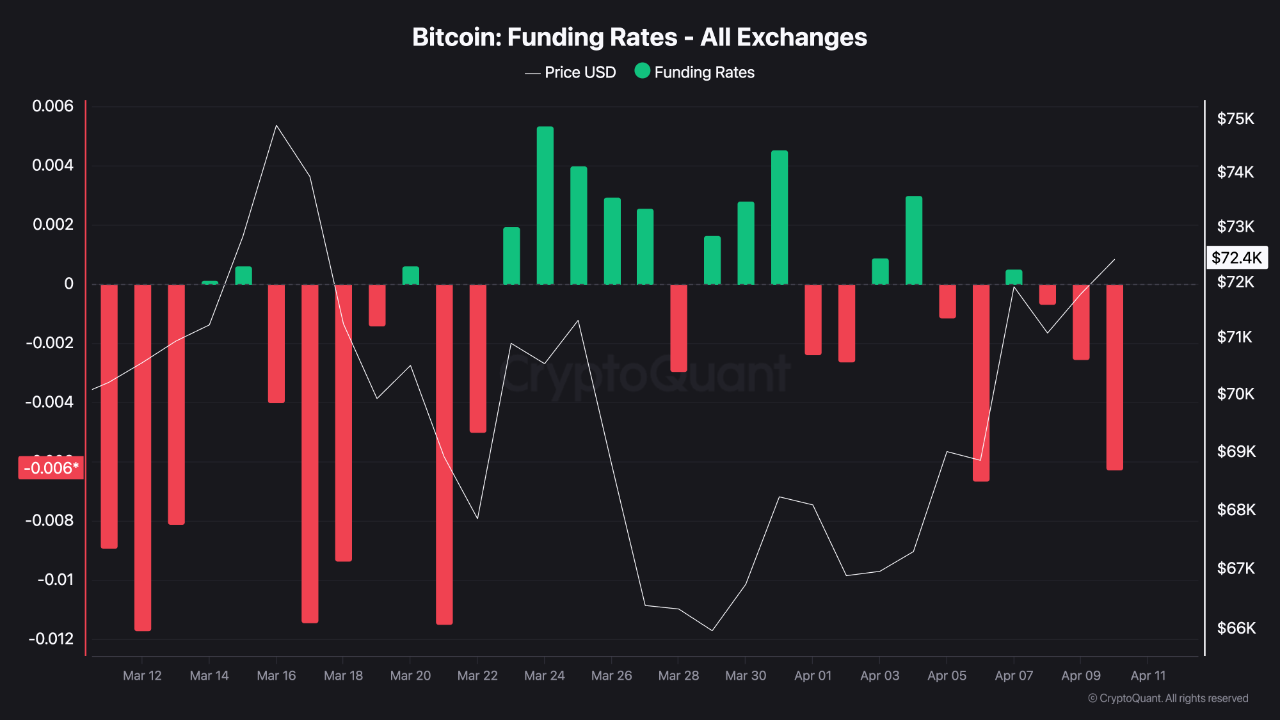
  • Funding rates fell to -0.253% on April 9, indicating dominance of shorts.
  • This situation raises the chances of a potential short squeeze setup.

Exchange Flows Reverse as Outflows Accelerate

According to Ruga Research, Bitcoin netflow turned negative at -2,533 BTC on April 9, right after showing an inflow of +2,109 BTC the day before. This quick reversal shows incoming coins are not staying in exchanges for long.

The trend has continued into today, April 10, where netflow has dropped further to -5,441 BTC, on track to mark the largest negative netflow seen this month and in the past two weeks. Altogether, since April 9, about 7,974 BTC, worth roughly $582 million at current prices, has moved off exchanges.

Bitcoin Exchange Netflow CryptoQuant
Bitcoin Exchange Netflow | CryptoQuant

Ruga Research confirmed that this back-and-forth pattern has been happening for weeks. Coins come in, get absorbed, and then leave again. He noted that the important point is not the daily changes but the overall direction. This direction shows that exchanges keep losing Bitcoin over time.

Bitcoin Exchange Reserves Decline

Notably, data from exchange reserves confirm this claim. Specifically, since mid-February, the total amount of Bitcoin held on exchanges has been falling. After reaching 2.8 million BTC on Feb. 15, reserves have dropped to about 2.701 million BTC today.

Bitcoin Exchange Reserve CryptoQuant
Bitcoin Exchange Reserve | CryptoQuant

This means exchanges have lost around 100,000 BTC, worth about $7.3 billion at current prices, over the last two months. This steady drop shows that fewer coins are available for immediate selling.

When Bitcoin leaves exchanges, it reduces the supply that traders can easily sell. Ruga Research stressed that while this does not guarantee prices will rise, it removes one of the main factors needed for prices to keep falling, which can ease selling pressure.

Bitcoin Funding Rates Show Growing Short Pressure

On the derivatives side, funding rates remain bearish. Ruga Research pointed out that funding rates fell to -0.253% on April 9, meaning short traders are paying long traders. This shows that more traders are betting against the market with strong conviction.

Bitcoin Funding Rates CryptoQuant
Bitcoin Funding Rates | CryptoQuant

In the past, similar situations, where funding rates turn deeply negative while coins leave exchanges, have often come before short squeezes. It does not happen every time, but the setup is clear enough to watch closely.

Ruga Research stressed that this is not a direct signal to buy, as it only shows how traders are positioned. Coins are leaving exchanges, and more short positions are building up at the same time, creating tension in the Bitcoin market.

Ethereum Leads Capital Rotation as It Outperforms Bitcoin

0

Bitcoin is slacking behind Ethereum in several metrics, as the crypto market appears to be making a clear capital rotation.

While Bitcoin (BTC), the largest cryptocurrency by market cap, has seen its fair share of bullish traction, it has failed to match its closest rival, Ethereum. Recent on-chain analysis from XWIN Research shows that Ethereum outperformed BTC in the previous month and suggests what may have driven this market rotation.

Key Points

  • An analysis highlighted, in March 2026, Ethereum pulled ahead of Bitcoin in both price performance and underlying metrics.
  • While Bitcoin posted a modest 1.83% increase during the period, Ethereum climbed 7.12%.
  • Ethereum recorded realized volatility of 62.8%, compared to Bitcoin’s 49.8%, suggesting ETH is reacting more sharply to shifts in liquidity and sentiment.
  • Ethereum has seen continued outflows from exchanges, indicating reduced immediate sell pressure. 
  • In addition, network activity continues to expand, with active addresses trending higher.

Ethereum Outperformed Bitcoin in March

The late Thursday analysis highlighted that a clear shift took shape in March 2026, with Ethereum pulling ahead of Bitcoin in both price performance and underlying metrics. 

For context, while Bitcoin posted a modest 1.83% increase during the period, Ethereum climbed 7.12%, signaling that market participants are leaning toward assets with stronger short-term momentum. At the same time, Bitcoin’s market cap slipped slightly by 0.43%, whereas Ethereum’s expanded by 2.97%, reinforcing the view that capital is gradually rotating.

Interestingly, this divergence appears to be very intentional. It reflects a deeper repositioning in the market, with attention shifting from store-of-value plays toward assets that respond more dynamically to liquidity conditions. With Ether showing more strength during short upward bursts, investors reallocated to it to make higher returns.

Volatility and Supply Dynamics Signal Clear Ether Preferences

Furthermore, volatility data highlights a notable difference in behavior between the two assets. Ethereum recorded realized volatility of 62.8%, compared to Bitcoin’s 49.8%, suggesting ETH is reacting more sharply to shifts in liquidity and sentiment. 

Despite maintaining a strong correlation of around 0.94, Ethereum’s price movements have been more pronounced, positioning it as a higher-leverage beta asset in the current market environment compared to Bitcoin.

Meanwhile, on-chain signals are beginning to align with this capital shift. Ethereum has seen continued outflows from exchanges, indicating reduced immediate sell pressure and a tilt toward longer holding behavior. 

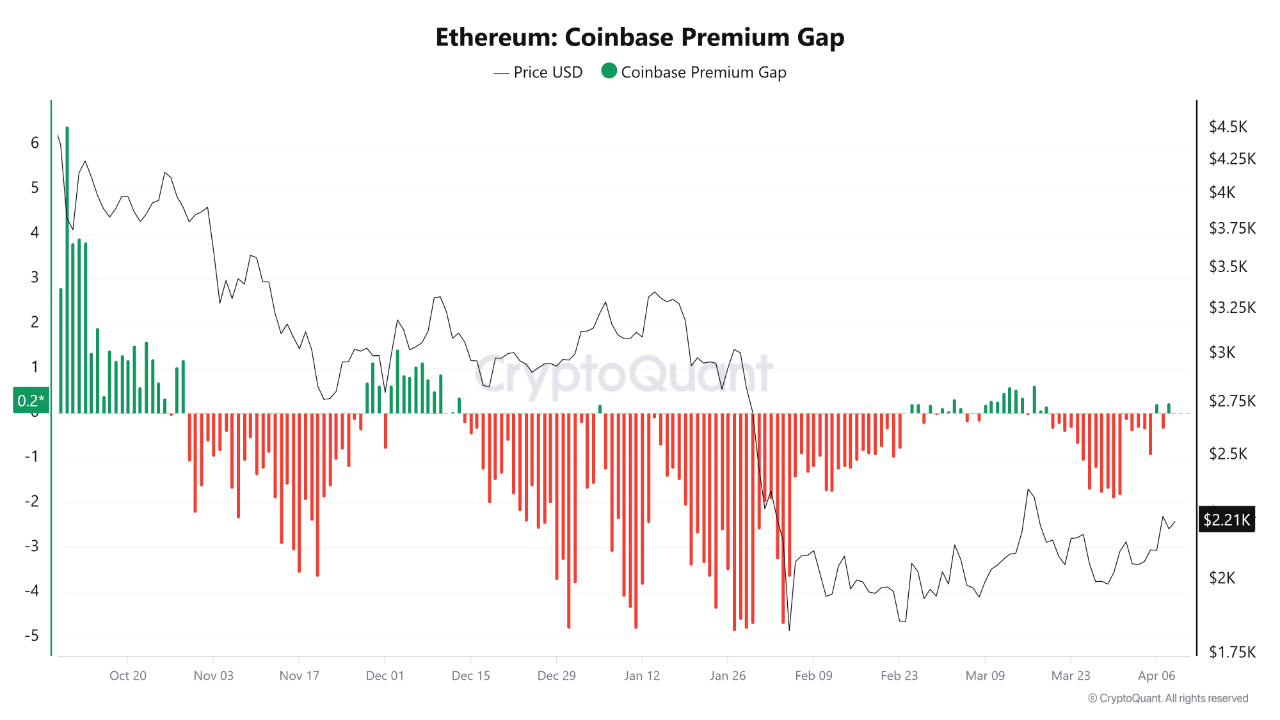
Notably, the Coinbase Premium Gap, although still negative, has shown signs of recovery, hinting at a gradual return of U.S.-based demand.

Ethereum Coinbase Premium/CryptoQuant

Ecosystem Boost Adds Further Momentum

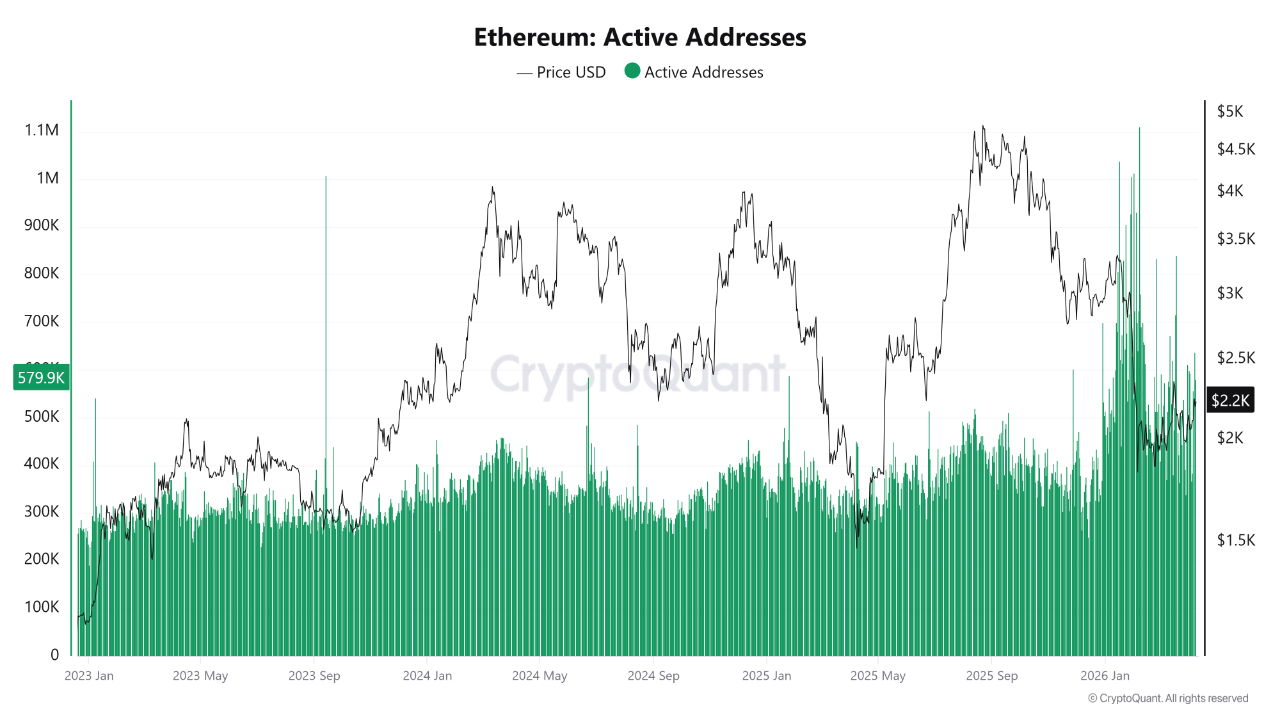
In addition, network activity continues to expand, with active addresses trending higher. This suggests that usage across Ethereum’s ecosystem is increasing.

Ethereum Active Addresses/CryptoQuant

While broader participation has not fully returned, stablecoins, DeFi, and RWA tokenization have received substantial boosts, reinforcing Ethereum’s role as a financial infrastructure layer. At the moment, this is drawing more attention than Bitcoin’s store-of-value narrative.

The analysis concluded that Ethereum is currently benefiting from a series of ecosystem and on-chain boosts, placing it in a better position than Bitcoin. As market conditions improve, it suggests that Ether could further outperform the crypto leader.

Japan Approves Landmark Bill to Classify Crypto as Financial Instruments

Japan has moved to reshape its crypto industry by approving a bill that treats crypto assets as financial products instead of just payment tools. 

If parliament passes it, the new rules could take effect by 2027.

Key Points

  • Japan approves bill to classify crypto as financial instruments, shifting focus from payments to investments.
  • If passed by parliament, the new crypto rules could come into force by 2027.
  • The proposal adds stricter rules, including disclosures and an insider trading ban.
  • Tougher penalties aim to curb fraud as Japan pushes for a more mature, investor-friendly crypto market.

Cabinet Backs New Crypto Classification

Today, Japan’s cabinet has approved changes to its financial laws that would treat cryptocurrencies more like traditional investments such as stocks and bonds.

The proposal, created by the Financial Services Agency, adds stricter rules to protect investors and improve transparency. It will now go to parliament for debate and approval.

The goal is to modernize the financial system and create a more structured crypto market that can attract investment.

Shift From Payment Use to Investment Focus

Until now, crypto in Japan has been regulated under the Payment Services Act, largely treating crypto assets as a means of payment. That approach dates back to reforms introduced after the Mt. Gox collapse.

However, with growing adoption, the role of crypto has changed significantly. Japan now has over 13 million crypto accounts, and most users treat digital assets as investments rather than payment tools. The new law reflects this shift, placing crypto firmly under securities-style regulation.

Key Rules: Insider Trading Ban and Mandatory Disclosures

The new law brings several key changes to Japan’s crypto market. For instance, it will ban insider trading that relies on non-public information, and crypto issuers must share yearly reports to improve transparency.

It also updates industry terms, renaming “crypto asset exchange operators” to “crypto asset trading operators” to better match traditional finance.

Meanwhile, Japan is tightening crypto rules with much tougher penalties. Specifically, unlicensed operators could face up to 10 years in prison (up from three), and fines will rise from ¥3 million to ¥10 million.

The stricter measures highlight the government’s intent to clamp down on fraud and misconduct. This comes as regulators reportedly receive hundreds of crypto complaints each month, underlining the need for stronger protections.

Overall, the changes mark a major shift. By treating crypto as a traditional financial asset, Japan is building a more mature market that could attract major investors. At the same time, stricter rules may push out smaller players, leaving larger firms to dominate.

‘Ripple Replaces SWIFT’ Era Was a Great Entry Point, but It’s Time for XRP Thesis Upgrade: EasyA Founder

The long-standing narrative that Ripple could replace SWIFT may have helped early adoption, but according to Dom Kwok, the market is now moving beyond that idea.

Speaking on The Rollup Podcast, the EasyA co-founder argued that focusing solely on SWIFT as a benchmark is no longer enough to understand where XRP and the ecosystem are heading.

Key Points

  • Dom Kwok says XRP’s growth is moving beyond the SWIFT replacement narrative to new use cases.
  • He argues XRPL’s strength lies in enabling broad financial apps, not just improving cross-border payments.
  • Institutional adoption and RLUSD growth are driving real-world use and boosting ecosystem activity.
  • Kwok believes XRP’s future is bringing global finance on-chain, not competing with SWIFT alone.

Moving Beyond the SWIFT Narrative

Kwok explained that while SWIFT once served as a useful reference point, it is no longer the “limiting factor” for growth. Instead, the focus has shifted toward more ambitious use cases.

According to him, the XRP Ledger is gaining traction not because it replaces a single system, but because it enables a wide range of financial applications that go far beyond traditional payment rails.

A key part of this “thesis upgrade” is the growing emphasis on institutional use cases. Kwok pointed out that XRPL stands out in its ability to attract real financial applications and enterprise-level adoption.

Hidden Road and GTreasury are examples of traditional finance firms that have been brought into the ecosystem through acquisitions.

The strategy is to acquire and integrate companies with existing customer bases, then gradually move their operations onto blockchain infrastructure. Even shifting a small portion of these transactions on-chain could unlock massive activity levels.

RLUSD and Developer Growth Fuel Momentum

Beyond institutional deals, Kwok pointed to the rise of RLUSD as another major driver of ecosystem growth. He described the stablecoin as one of the more successful recent launches, helping to expand real-world use cases on XRPL.

At the same time, developer activity is increasing. Through hackathons and educational initiatives across cities like Hong Kong and Singapore, more builders are entering the ecosystem and securing funding for XRPL-based projects.

This combination of developer momentum and financial infrastructure is helping to renew investor interest in XRP.

Kwok’s core argument is that the future of XRP is not about replacing SWIFT, but about something much larger, which is bringing the entire financial world onto blockchain rails.

He emphasized that the industry is heading toward a multi-chain future, where different blockchains serve different roles. However, he remains particularly bullish on XRP and Ripple due to their growing footprint in traditional finance.

XRP Doesn’t Need SWIFT

Earlier this month, XRP Ledger validator Vet argued that XRP does not need collaboration with SWIFT to function. He noted that blockchain systems replace legacy rails by combining messaging and settlement into a single process.

Unlike SWIFT, which only handles communication while funds move separately, XRP enables both instantly within a single transaction.

Ripple executive Eric van Miltenburg reinforced the stance, saying the company aims to replace, not partner with, SWIFT.

In sum, the original “SWIFT replacement” narrative may have opened the door. But the next phase is about scaling real-world financial systems on-chain.

Market Updates: XRP Seen Far Less Quantum-Risky than Bitcoin, Hong Kong Grants First Stablecoin Licenses, ETH Staking Hits ATH

0

Latest Market Updates: As of 10th April 2026.

XRP Seen as Less Vulnerable to Quantum Risks

Recent analysis suggests that XRP may be significantly less exposed to future quantum computing threats than Bitcoin. Specifically, experts estimate that only 0.03% of XRP’s total supply is currently at risk, compared to roughly 35% of Bitcoin’s supply.

This disparity stems largely from how each network handles public key exposure. In particular, analysts note that XRP minimizes exposure more effectively, which could translate into stronger long-term security.

Additionally, XRP incorporates built-in safeguards such as key rotation systems and escrow time-lock mechanisms. Together, these features enhance its resilience against advanced threats. In contrast, Bitcoin does not provide these protections natively.

Hong Kong Issues First Stablecoin Licenses

Meanwhile, in Hong Kong, authorities have taken a significant step toward formalizing the stablecoin market.

The Hong Kong Monetary Authority (HKMA) has granted stablecoin issuer licenses to Standard Chartered and HSBC under the newly implemented Stablecoins Ordinance, with approvals taking immediate effect.

Both institutions are expected to roll out stablecoins in the second half of 2026, targeting use cases such as cross-border payments, domestic transactions, and digital asset trading.

HKMA Chief Executive Eddie Yue described the move as a key milestone, emphasizing the importance of balancing innovation with user protection and risk management. Deputy Chief Executive Daryl Ho added that future licenses will be issued cautiously and in limited numbers.

Ethereum Staking Reaches Record Highs

As regulatory clarity improves in some regions, institutional participation in crypto markets continues to accelerate, particularly within the Ethereum ecosystem.

Data from Onchain Lens shows that Grayscale’s Ethereum Mini Trust recently staked 83,200 ETH, valued at around $184 million. Notably, this move builds on the firm’s growing presence in Ethereum-based investment products.

Grayscale’s Ethereum ETFs are also reportedly leading in staking rewards, having generated nearly $8 million in yield so far. This sustained activity has contributed to a broader network trend.

Consequently, Ethereum staking has reached an all-time high. Data from Token Terminal shows that around $85 billion worth of ETH is now locked, highlighting both increased network security and growing adoption.

Japan Reclassifies Crypto as Financial Instruments

At the same time, Japan has redefined its classification of crypto assets.

Under amendments to the Financial Instruments and Exchange Act, crypto assets are now officially categorized as financial instruments, according to Nikkei. This shift brings stricter oversight and aligns digital assets more closely with traditional financial markets.

The updated rules introduce new restrictions, including a ban on insider trading based on undisclosed information. In addition, crypto issuers will also be required to provide annual disclosures to enhance transparency.

Previously, digital assets were regulated under the Payment and Settlement Act. However, the new classification reflects increasing institutional investment and ultimately signals Japan’s intent to integrate crypto into its broader financial system.

Binance Relocates UAE Staff to Asia Amid US-Iran War

Finally, geopolitical developments are also beginning to impact crypto operations, particularly in the Middle East.

Amid the ongoing US-Iran conflict, Binance is reportedly relocating staff from the UAE to key Asian hubs, including Hong Kong, Tokyo, Kuala Lumpur, and Bangkok, according to Wu Blockchain.

The UAE has been a major operational base for Binance, hosting over 1,000 employees and serving as a strategic hub following the exchange’s global licensing in Abu Dhabi in 2026.

Nevertheless, recent missile and drone incidents in Dubai have raised security concerns. Consequently, several crypto firms are reducing their presence in the area. Additionally, the 2049 Summit, originally scheduled in Dubai, has also been postponed by one year.

XRP Price if the XRP Market Cap Hits $1 Trillion

The XRP price could skyrocket to a double-digit range if XRP’s market cap crossed the $1 trillion milestone.

While XRP continues to navigate the ongoing market-wide turbulence, down more than 27% this year, market watchers believe an imminent recovery push could take prices to new heights.

In previous reports, some market commentators have even predicted a possible run to a $1 trillion market cap for XRP. Considering the current circulating supply, the XRP price would soar to $16 if the crypto asset ever reached that milestone.

Key Points

  • Despite XRP recording a 27% crash this year, analysts maintain a long-term bullish outlook.
  • Previous market expositions have projected a possible XRP rally to a $1 trillion market cap.
  • This would make XRP the second crypto asset to hit the $1 trillion market cap milestone, only behind Bitcoin.
  • With the current circulating supply of 61.4 billion tokens, the XRP price would soar to $16 at a $1 trillion market cap.

Long-Term Optimism Amid Current XRP Price Struggles 

Notably, after an 11.58% decline last year, 2025, XRP began this year on a positive note, soaring to $2.41 in early January. However, this relief bounce soon met resistance, leading to a pullback. XRP has since continued to decline, recording lower highs, having collapsed 27.42% this year.

Despite the ongoing downturn, most market commentators insist that XRP still has a bullish long-term outlook. While some, like Chart Nerd and Casi, believe the asset could record steeper declines below $1 before finding its bottom, they suggest that a recovery from the bottom could lead to higher prices, like the $21 mark. 

XRP Price if It Hits The $1 Trillion Market Cap Milestone

The current bullish outlook builds on earlier sentiments held by market analysts regarding XRP’s future. One such analyst is EGRAG Crypto, who suggested in February 2025 that XRP has the potential to reach the $1 trillion market cap level, citing historical data. According to EGRAG, this run is “super doable.”

At press time, XRP boasts a market valuation of $82.2 billion, making it the fourth-largest crypto asset in the market (including stablecoins). XRP still sits miles below Tether (USDT), which holds a valuation of $184.1 billion. With a circulating supply of 61.4 billion, the XRP price would need to breach $3 to overtake USDT again.

XRP Currently Fourth Largest Asset CMC
XRP Currently Fourth Largest Asset | CMC

Notably, this higher circulating supply, which has increased by 3.13 billion tokens over the past year alone, would mean lower prices for XRP at the ambitious $1 trillion market cap. Considering 61.4 billion tokens in circulation, the XRP price would sit at exactly $16.28 if XRP hits a $1 trillion valuation. This would represent a 1,114% increase from current prices. 

How Feasible is a $1 Trillion Market Cap?

However, reaching a $1 trillion valuation would represent no small feat for XRP. At press time, Bitcoin (BTC) is the only crypto asset that has crossed this milestone. Specifically, BTC first claimed the $1 trillion valuation mark in February 2021, when prices hit a new ATH of $58,000 at the time. This was 12 years after its launch.

The closest any other crypto asset has gotten to reaching the $1 trillion market cap was when Ethereum (ETH) hit its all-time high valuation of $598 billion in August 2025. At the time, ETH needed a mere 67% increase to claim $1 trillion.

Meanwhile, XRP’s ATH valuation was $216.69 billion, attained when its price rose to $3.6 in July 2025. From this top, XRP needed an additional 361% increase to reach $1 trillion. The XRP market cap has continued to slide since the $216 billion high, entering a falling channel pattern on the 1-month chart. At the current valuation, XRP needs a 1,114% rise to reach a $1 trillion market cap.

XRP Market Cap
XRP Market Cap