Home Blog Page 1683

Analyst Believes XRP is Still on Track to $1.4

0

XRP recently crashed to a low of $0.60 amid the market-wide correction, but prominent market analyst EGRAG believes the $1.4 price target is still achievable.

In an analysis on X, EGRAG spoke on the recent market-wide collapse that saw Bitcoin (BTC) plummet by 5.79%, Ethereum by 5.41%, and XRP by 6.50%. Highlighting XRP’s collapse, the analyst stressed that the unfortunate event erased long positions held by market participants.

As The Crypto Basic revealed yesterday, investors witnessed $320 million in long liquidations within 12 hours amid the market decline. Data from Coinglass confirms that XRP alone recorded $7.05 million in long liquidations, making up 97% of the total liquidations the crypto asset saw yesterday.

Interestingly, several market watchers hold the opinion that these correction-induced liquidations were necessary to sieve out weak hands. XRP has still not recovered from the collapse yesterday, and it is currently down 0.50% over the past 24 hours. EGRAG noted that the drop underscores the unpredictability of the crypto market.

He reiterated that riding on market trends and entering positions on the market could lead to substantial losses for investors, as evidenced by the latest chain of events. However, the market analyst emphasized that his earlier projection of an XRP rally to $1.4 is still on track.

XRP Still on Track to $1.4

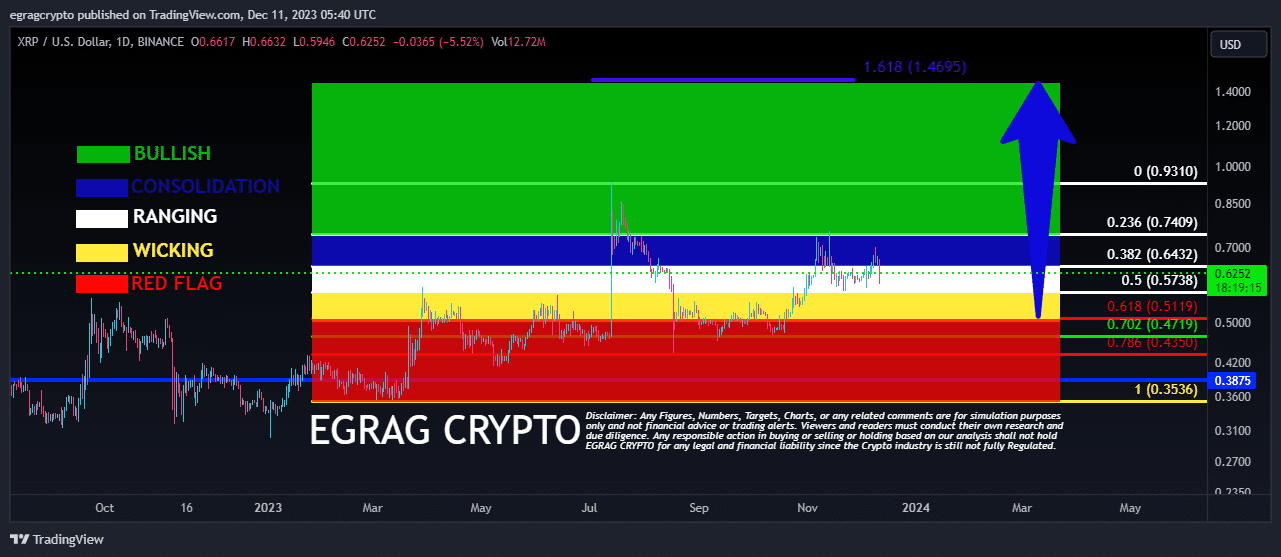
Notably, on Sept. 21, EGRAG unveiled the “Color Code” analysis, suggesting that XRP’s path to $1.4 features multiple price territories, each identified with a unique code, that could serve as pivotal regions for the cryptocurrency to overcome.

EGRAG has since updated the positions of the color codes based on changing market realities. Currently, the first region, in red, represents the Red Flag zone. This is a bearish territory between $0.3536 and $0.5119. Fortunately, XRP has towered above the region.
XRP Color Code to $14 EGRAG Crypto
XRP Color Code | EGRAG Crypto

The second territory, in yellow, is the Wicking zone, currently between $0.5119 and $0.5738. The third area is a white position representing the Ranging zone, currently within the price range of $0.5728 and $0.6432. The next region is the Consolidation area, represented in blue, ranging from $0.6432 to $0.7409.

The last territory is a green area called the Bullish zone, the most extensive region. This area spans $0.7409 through the ultimate price target of $1.4. Trading for $0.6230 at the reporting time XRP currently sits within the Ranging zone. 

To claim the $1.4 price target, XRP would need to break through to the Consolidation zone and from the Consolidation zone to the Bullish region. The digital asset would still face some pivotal resistance points within the Bullish zone before it hits the $1.4 target. 

Coinbase Now Lets Users Send USDC For Free, But On BASE

0

Crypto users can now transfer USDC for free using Coinbase’s new layer-2 network, Base. 

In an apparent move to drive the adoption of its new layer-2 network, Coinbase has enabled a new functionality that allows users to transfer USDC for free. The functionality is available on the Coinbase Wallet app under Simple Mode. 

The Simple Mode feature aims to simplify the onboarding and user experience for newcomers, with Coinbase’s newly launched interface focusing mainly on buying, selling, and transferring crypto assets. Advanced functionalities such as staking and DeFi are unavailable to users in the simple mode. 

According to Coinbase CEO Brian Armstrong, the Simple Mode interface, which supports free USDC transfers on the Base network, will automatically become the default option for users in “frontier markets.” 

Hence, first-time users will not contend with the high fees of transferring USDC on Ethereum, the default option on the native Coinbase Wallet app. Given the current block demand, users may pay as much as $1.31 to transfer USDC but will have the option to do so for free and instantly on Base. 

Coinbase Boost Base Adoption

Beyond its stated desire to simplify the user experience, Coinbase’s latest features tie into its broader mission to drive the adoption of its Base network. Coinbase (the exchange) boasts over 100 million verified users, with the Coinbase Wallet being one of the most widely used Web3 wallets.

Coinbase has publicly revealed its intent to leverage its wide audience to make Base Network one of the most used blockchains globally. Interestingly, the layer-2 network built on Ethereum has achieved early success with Coinbase’s backing. 

Base is currently the 10th largest chain by DeFi TVL, with over $365 million locked across protocols on the network. Earlier this week, Coinbase listed the first Base-based token, Seam, as part of an effort to attract more users to its ecosystem.

Evernode Airdrop Completes, with 38K+ Addresses Holding 432M XRP Registered

0

The registration for the Evernode (EVERS) airdrop is complete and a total of 38,478 XRP addresses expressed interest in the giveaway.

According to the update shared by the XRP Ledger (XRPL) based layer-2 scaling protocol, the 38,478 qualifying addresses hold approximately 432 million XRP that are eligible to receive the airdrop.

Evernode said the airdrop process has garnered support from 2 top exchanges including Bitrue and Uphold. The protocol also confirmed that the XRP held by the participating exchanges totaled 2.039 billion.

Evernode Airdrop: What Comes Next

The Evernode airdrop is a multi-step process that has been the ultimate buzz in the XRP ecosystem for the past few weeks with over 10,000 addresses showing interest within 24 hours.

Now that the registration phase is complete, Evernode said it will be cross-referencing the registered r-addresses on the XRPL to know how much XRP that a particular wallet is entitled to at the snapshot date.

With the registration closed, Evernode now has less than a week to its mainnet launch date. In this period, it plans to collate “all the addresses, tally all the balances, calculate the Evers/Qualifying XRP Held, and then program and test the Airdrop Hook.”

While airdrops are free, failure to plan out the campaign well can bring about intense backlash that may impact the project as it launches. Evernode is doing all it can to ensure this is not the case.

Notably, before now, some community members raised complaints about the registration process, doubting its legitimacy based on the nature of address collation. Evernode quickly cleared the air on its approach and detailed what to expect as the process swung along.

More Engagements Required from Participants

According to Evernode, participating users will have to import their r-address onto Xahau while designating a trustline for the EVERS issuing address. With 5,160,960 up for grabs, Evernode will deposit these tokens into the Address Hook upon launch.

From the Address Hook, qualifying users can send a claim transaction to the Address Hook from the registered r-address on Xahau.

While it promises more information soon, Evernode said beneficiaries will also need to take note and comply with the different tax demands within regions in their respective locations.

While no one is particularly sure what the price of EVERS will be at launch, learning from previous airdrops including that from Flare Networks, the gifted tokens might turn out to be very valuable in the long run.

Law Professor Says Ripple Ruling Could Serve As a Roadmap for Crypto Companies

0

The summary judgment decision in the SEC v. Ripple lawsuit has been stirring reactions from top legal experts even though the ruling was issued five months ago.

In an interesting development, J.W. Verret, an associate professor of law at George Mason University, has become the latest legal expert to comment on the landmark ruling in the SEC v. Ripple lawsuit.

A Roadmap for Crypto Companies

In a recent op-ed piece, Verret emphasized that the Ripple ruling could serve as a roadmap for other crypto companies.


According to the legal expert, Judge Analisa Torres, the ruling judge of the lawsuit, carefully highlighted the significance of facts and circumstances in crypto sales under existing securities law.

He stated that the verdict recognized the uniqueness of digital asset trading while effectively applying existing securities law, especially the Howey case.

For clarity, the Howey case of 1946 established a legal test determining the transaction that constitutes a security.

SEC Failed Attempt to Bypass Howey

Per Verret, the Securities and Exchange Commission attempted to bypass the application of the Howey test in the Ripple case by establishing an alternative fact without citing any legal precedent to support its argument.

Notably, the SEC claimed that XRP in itself is a digital asset security in its very nature. In addition, the commission argued that all XRP sales satisfy the various prongs of Howey, thus making these transactions investment contracts in Ripple.

Contrary to the SEC’s claim, Judge Torres reaffirmed that facts and circumstances are relevant in specific offers and sales in Howey’s analysis, irrespective of the asset’s underlying technology.

Recall that the SEC initially claimed that Ripple’s institutional XRP sales, programmatic XRP sales on digital exchanges, and other distributions are investment contracts.

While the Judge affirmed that Ripple violated the law via its XRP sales to institutional investors, she ruled that programmatic sales are executed on digital exchanges via blind bid/ask transactions between unknown parties.

The judge backed her decision by citing 3K affidavits submitted by XRP holders who claimed they knew nothing about Ripple’s existence when they purchased the coin on digital exchanges. Hence, she concluded that programmatic sales of XRP are not securities, as alleged by the SEC.

SEC Can’t Make Up Non-Existing Facts

While SEC chair Gary Gensler claims that Congress gave the commission a broad brush to apply the Howey test, Verret said the Ripple ruling clarifies that the brush is not too wide to allow the regulator to make up non-existing facts and circumstances to justify its arguments.

He asserted that the Ripple decision could serve as “a template for rules that adapt to the unique needs of crypto asset owners” like the SEC established multiple rules in the past.

Chainlink Opens LINK v0.2 Staking To Public, But Almost No One Can Get In

0

Chainlink has enabled general access with certain limitations to its v0.2 community pool. 

Blockchain-based oracle service Chainlink announced Monday that it has now enabled general access to its community staking pool for v0.2 staking. Launched in late November, the community pool allows users to lock LINK for a variable rate reward of 4.3%.

However, opening general access does not mean LINK holders who missed the Early Access phase can now automatically stake the token.

Instead, as Chainlink noted in its announcement, new users can only “stake LINK whenever an existing stake completes a withdrawal and pool space becomes available.”

The Chainlink v0.2 community pool was immediately filled within hours after launch. The 40,875,000 LINK allocation for the pool was met by users who instantly migrated from v0.1 to the new pool. Additionally, other LINK holders who met certain criteria and had Early Access staked in the pool to complete the allocation.

Hence, users must now wait for early stakers to unstake LINK for an opportunity. Even in the event that an existing staker wants to exist their position, the LINK v0.2 contract enforces a 28-day unbonding period and an additional seven-day period for users to completely claim their locked access.

With Chainlink Early Access opening on December 7, users must wait until at least January 11 for a chance to join the LINK community staking pool. The above also assumes that a staker enabled withdrawal on the same day they originally staked, underlining the difficulty for new community members seeking access to the LINK pool.

LINK Attempts Recovery After Broader Market Correction

The LINK staking program aims to provide more favorable economics for the asset, with roughly 8% of the overall supply now locked by stakers. With a lower circulating supply, LINK potentially has a better chance of delivering better returns across various market conditions.

Over the past 24 hours, the token has rebounded alongside the rest of the crypto market after a slight correction. LINK dropped from $16.15 to $14.35 following the move but has since recovered to around $14.96 at the time of writing.

Ripple Ally SBI Group and Saudi Aramco to Explore Joint Digital Asset Investment

0

Ripple Labs’ ally, SBI Group, and state-owned energy giant Saudi Aramco have entered into a strategic partnership to explore a joint digital asset investment initiative.

The news has reverberated into the financial world, triggering positive trends for the crypto ecosystem. The partnership could benefit the crypto and blockchain scene.

As a major Ripple partner, SBI Group has a sizable interest in many of the big movers in the crypto world. With the recent partnership, Saudi Aramco might leverage the firm to deepen its foothold in the industry.

Details of the SBI Group – Aramco Link-Up

The deal between the duo will focus on jointly investing in each others’ interests as it concerns digital assets and semiconductors.

SBI Group and Saudi Aramco will also jointly boost Japanese startups with plans to expand their reach into Saudi Arabia. A new outlet, “SBI Middle East,” will go live soon to achieve this goal.

As a company big on tokenization, speculation abounds that the partnership may revolve around SBI helping Saudi Aramco diversify in this regard.

One emphatic move SBI Group has made in its tokenization push is the planned launch of START, a brokerage platform for tokenized investment contracts projected to start operations on December 25. START will be launched by Osaka Digital Exchange, a firm in which SBI Group holds a majority stake.

On the crypto and blockchain front, Saudi Aramco currently has little-known stakes. It, however, invests indirectly in the crypto world through Tiger Global, Andreessen Horowitz (a16z), and Blockchain Capital, amongst others.

SBI Holdings: a Good Ally for Crypto

With the evolution of the crypto ecosystem thus far, companies like SBI Holdings are helping to integrate crypto solutions to reach more people. 

As reported earlier by The Crypto Basic, SBI Holdings partnered with Circle to drive USDC integration in Japan. This move complements the launch of a 100 billion Yen Fund designated to power startups operating at the intersection of Web 3.0 and Artificial Intelligence (AI).

FED Money Printing Could Trigger XRP Price Surge: Forbes

0

Forbes senior contributor has suggested that the U.S. Federal Reserve’s money printing efforts could trigger a significant surge in cryptocurrencies, with XRP benefiting alongside Bitcoin.

In a recent report, Forbes’ Billy Bambrough highlighted that Bitcoin has soared nearly 200% since the previous year. He argued that the surge has been crucial in propelling the combined market cap of XRP and other cryptocurrencies to surpass $1.5 trillion —a milestone not seen since early 2022.

Additionally, Bambrough attributed the crypto market growth to expectations that Wall Street eyes potential opportunities within the digital asset space.

Crypto Rising Amid FED Money Printer

Amid these developments, the Forbes contributor noted that analysts foresee a turbo-charged crypto market rally in 2024. They believed the astronomic surge would surface when the FED restarts money printing, potentially undermining the U.S. dollar.

Furthermore, Billy Bambrough highlighted that concerns about the collapse of the U.S. dollar have escalated due to extensive government spending and relentless money printing since the 2008 financial crisis. He quoted Jefferies’ analysts predicting a Fed restart of the money printer in 2024.

Per the disclosure, the move could trigger a U.S. dollar collapse and fuel a substantial Bitcoin price surge comparable to the market’s response to gold.

Besides, Bambrough cited Zach Pandl, a former managing director at Goldman Sachs, concerning the outlook where the U.S. dollar suffers. Pandl noted that Bitcoin is the “obvious competitor currency” should the U.S. dollar face devaluation.

Bitcoin, XRP Profiting from Interest Rate Cut

Moreover, the Forbes writer stated that many anticipate the Federal Reserve will commence a series of interest rate reductions next year, marking a shift from its tightening trend. According to him, this adjustment is a response to a deceleration in the inflation rate.

In parallel, Bambrough cited Luke Nolan, a researcher at CoinShares, commenting on the positive impact of potential rate cuts. Nolan suggested that the factors could support a sustained Bitcoin rally, with a conservative estimate of reaching $70,000 by the end of 2024.

Where Bitcoin grows over 65% to $70k, crypto like XRP is expected to follow a similar trajectory.

XRP Outperforms 60% Of Top 100 Coins But Massively Down On Long-Term Scale

0

XRP has delivered significant returns this year but has largely underperformed the major crypto assets BTC and ETH in a longer time frame.

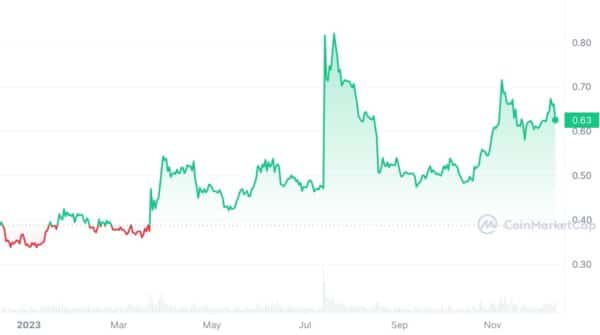
The price of XRP has gained over 65% since the start of January, making it one of the best-performing cryptocurrency assets among the top 100 coins.

A significant chunk of the gains came in July after a U.S. Supreme Court ruled in favor of Ripple in a long-standing lawsuit with the Securities and Exchange Commission (SEC).

However, XRP investors have seen most of the unrealized gains in the aftermath of the court victory wiped out despite the broader crypto market being in an uptrend for most of the year.

While XRP reached as high as $0.93 following the ruling, the crypto asset eventually dropped to $0.44. XRP eventually managed a long-term rebound that has taken it above $0.62 at the time of writing.

XRP 1Y graph coinmarketcap
XRP Chart | CoinMarketCap

The less-than-impressive performance of XRP has raised concerns among investors on whether it is still ideal to hold the cryptocurrency, especially with Ripple’s legal woes still not wholly resolved. A closer comparison with other top assets like Bitcoin (BTC) and Ether (ETH) further exposes XRP’s lukewarm performance.

XRP Struggles Against BTC and ETH

XRP’s performance over the past three years has been largely shaped by Ripple’s regulatory hurdles, which began in late 2020. As evidenced in July, the company’s partial victory led to a surge in price.

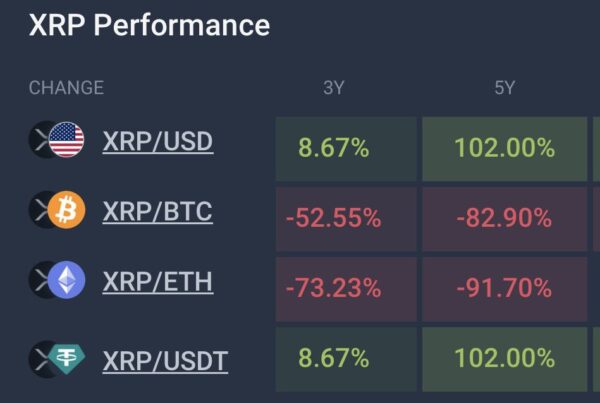
The uncertainties facing XRP mean it barely stands a chance compared to BTC and ETH. In the past five years, XRP’s value is up 102% against the dollar, but down 82% compared with BTC and a further 91% against the second largest crypto, ETH. XRP has also struggled with the three-year time frame, losing 52% and 73% against BTC and ETH, respectively.

XRP performance
XRP performance (Bill Morgan on X)

Evidently, Ripple’s legal woes have largely impacted XRP’s price, especially with the company’s institutional and corporate strides impeded by regulatory uncertainties.

Yet, XRP holders remain hopeful that the tide will soon turn and the years of patience will eventually pay off, even though nothing is guaranteed.

Top Wallet With Over 37M Verified Users Adds XRP

0

Blockchain.com, which boasts over 37 million verified users, has relisted XRP after a federal court ruled that the coin is not a security as alleged by the SEC.

Blockchain.com, one of the oldest crypto exchanges and wallet providers, has relisted XRP, adding the fifth-largest cryptocurrency to its roster of supported digital currencies.

In a tweet yesterday, the leading crypto startup emphasized that the Blockchain.com wallet now supports XRP.

Blockchain.Com Relists XRP Months After Court Verdict

The announcement comes several months after a New York federal court declared that XRP in itself is not a security. Recall that Blockchain.com was among the top crypto startups that delisted XRP shortly after the U.S. SEC charged Ripple with offering XRP as an unregistered security.

With a federal court finding XRP to be a non-security, several crypto startups, including Blockchain.Com, Coinbase, and Binance.US, have made a U-turn to relist the top crypto asset.

The relisting of XRP by Blockchain.com is seen as a strategic move for the crypto asset, given the company’s dominance in the industry.

It bears mentioning that Blockchain.com is one of the early pioneers of the crypto space. Launched in 2011, Blockchain.com functions as a crypto exchange and a wallet provider.

The company has succeeded in onboarding tens of millions of users from various parts of the world. As of October 2022, Blockchain.com claims it has over 37 million verified users, with 80 million wallets created so far.

Since its inception, the leading crypto startup has processed over $1 trillion worth of crypto transactions, according to CoinMarketCap.

At press time, Blockchain.com supports 31 crypto assets, including BTC, ETH, XLM, LTC, XRP, and SOL, with a total of 60 trading pairs. The trading platform has a 24-hour volume of $374,395. Notably, USDT/USD ranked as the most active trading pair, with a volume of $134,540.

Since XRP was relisted on Blockchain.com yesterday, the CoinMarketCap data did not indicate XRP trading volume on the platform.

In the meantime, XRP was down 0.3% in 24 hours to $0.62. XRP has been hovering around the $0.6 level in the past month, with many investors expressing frustrations over the development.

However, Google Bard recently put smiles on the faces of many XRP investors following its bullish prediction for the coin. As reported today, Google Bard forecasted that XRP could surge to $38.5 if Bitcoin reaches the $100K post-halving projected price.

FAssets to Allow XRP Holders Earn dApp Yield or Bridge XRP Through LayerCake

0

Flare Labs has disclosed that FAssets could bring a new purpose for XRP by helping holders earn yield or bridge their tokens to other EVM networks through LayerCake.

Flare Labs, the research team behind the Flare Network, is currently developing the FAssets protocol. The central vision for the project is to introduce smart contract capabilities for assets that do not support smart contracts on their native networks, including XRP and Bitcoin (BTC).

The Crypto Basic reported on Dec. 1 that the development team had launched private beta testing for the project on the Coston testnet. The beta testing phase would emulate all real case scenarios for the project, allowing the testers to mint tokens such as XRP and BTC on Flare as FAssets.

These tokens, now FAssets, can then be leveraged for various purposes that are only possible with the use of smart contracts. Shortly after launching the beta testing phase, Flare Labs teased that the project could help unlock up to $800 billion in XRP and other crypto assets.

A New Purpose for XRP

Now, their latest teaser aims to highlight a few areas of interest for market participants, including yield generation and the ability to bridge their tokens to other EVM networks. It bears mentioning that Flare in itself is an EVM blockchain.

Flare boasts multiple dApps, with numerous projects currently building on the network. Last December, a curated list of all the projects on the blockchain was released, with their number totaling 42. In an impressive rise, these projects have increased to 280, marking a 566% surge in a year.

Some of these projects allow users to earn yield through staking and other DeFi activities. Now, market participants can leverage these protocols for yield generation when they mint their XRP and BTC tokens as FAssets on the Flare Network.

However, there is an alternative route for users who seek to use the dApps on other EVM blockchains such as Polygon, Ethereum, Avalanche, and Cosmos. According to Flare Labs, users can also bridge their FAssets from Flare Network to these blockchains. The list also includes Cardano, Solana, and Binance Smart Chain.

Users can bridge their FAssets by leveraging Flare’s upcoming LayerCake bridge protocol. Like the FAssets project, LayerCake is currently being developed. The development team stresses that the bridge protocol would solve the problems of centralization, security, and lack of liquidity plaguing mainstream bridges.