Home Blog Page 1738

Bitcoin Network Fails to Produce Block for More Than an Hour

0

A lengthy interval between the production of multiple Bitcoin blocks has sparked community interest.

The Bitcoin network failed to produce a new block over a 69-minute period on November 7. On-chain data reveals that it took approximately an hour and nine minutes between the production of Bitcoin blocks 815,689 and 815,690.

The delayed block time lasted between 16:47 and 17:56 (UTC+8) and preceded an earlier block (815,689), which also took 43 minutes to mine. As the below data from BTC.com shows, the Bitcoin mining firms Foundry and Antpool mined the delayed blocks. 

Bitcoin BlockTime
Bitcoin BlockTime

The delayed production time between the blocks within the window catches the eye, given Bitcoin’s average ten-minute block time. 

Additionally, Bitcoin’s memory pool (mempool), from which miners pick transactions to confirm, has been relatively congested, with over 100,000 transactions pending confirmation at the time. The number of Bitcoin users has surged significantly with the BTC market rebound, thus creating additional demand.

Delayed Block Time Not New

Although the recently delayed block time may catch first-timers’ attention, it is not a new phenomenon. While Bitcoin has a target average time of ten minutes between blocks, some blocks are mined faster or take significantly longer. 

For instance, block 815,691, which followed the delayed blocks, was mined in under one minute. Hence, the tendency for lengthy block times becomes evident. In April 2021, block 679,786 took 122 minutes to mine. However, the longest time taken to mine a block was 144 minutes in October 2011 during the mining of block 149,097.

According to Lightning Network founder Tadge Dryja, such delayed blocks happen every 85 days, barring any adjustment to the Bitcoin mining difficulty algorithm. Therefore, the latest development is not a concern for Bitcoin investors.

Meanwhile, the price of BTC continues to maintain its stability within the $34,500 to $35,400 region. The leading cryptocurrency was trading at $34,850 at the time of writing, up 110% on the year-to-date chart.

The price increase has been largely buoyed by improved macroeconomics and the potential for a spot Bitcoin ETF in the United States.

Chainlink Outperforms Bitcoin in This Metric, Will LINK Touch $27?

0

Chainlink (LINK) has outperformed Bitcoin (BTC) and the general market in terms of year-to-date (YTD) gains, with hopes of extending its valuation for the year.

Top market analyst hitesh.eth recently compared Chainlink and Bitcoin per their Year-to-Date (YTD) gains. While Chainlink has soared by 128% to date, Bitcoin’s YTD growth comes in at 110%.


Despite the bullish similarities between them, as pointed out by the analyst, Chainlink is still lagging in some areas.

Where Chainlink Needs to “Rev the Throttle”

Chainlink’s growth YTD has outperformed those of its peers in literal terms. However, when placed side by side with Bitcoin, this growth does not necessarily translate to wallet profitability. 

According to the accompanying IntoTheBlock chart posted by hitesh.eth, the percentage of Bitcoin holders in profit is 79%, dwarfing the 54.96% of Chainlink.

Address profitability in this regard refers to wallets whose combined portfolio valuation is higher than the purchase price of the tokens. Riding on these dynamics, approximately 366,490 LINK addresses are “In the Money,” with the break-even price pegged at the $12.41 to $13.60 price range.

Chainlink LINK Profitability IntoTheBlock
Chainlink Profitability | IntoTheBlock

Chainlink already crossed this price point as LINK, benefiting from the intense whale action. This price uptick has been bolstered by sustained adoption, with 27,152 wallets now holding at least 1000 LINK, as reported earlier by The Crypto Basic. 

However, amid the favorable price movements, hitesh.eth believes LINK will face a major supply block in the $16 to $27 range, a level he predicts will also form a major resistance for the token.

Currently, LINK’s trading volume is up 20.21% to $839,855,513, with its price rising 2.73% to $12.89. Should this buying momentum remain and LINK soar toward the upper end of the resistance zone at $27, the analyst is optimistic its profitability ratio will surpass 80%.

Sound Fundamentals Backing LINK

Besides what the technicals show about Chainlink’s potential, the decentralized oracle service provider has rich fundamentals to back its resilience and growth in the long term.

Part of these fundamentals is anticipating the release of the Staking v0.2 upgrade, slated to go live later this year. With plans to introduce “Unbonding Mechanism” and “Liquid Rewards,” among other innovations, Chainlink is setting LINK up for a massive accumulation.

The novel Cross-Chain Interoperability Protocol (CCIP) protocol also marks another ammunition in Chainlink’s arsenal to drive new users and cement its growth projections.

Shiba Inu Team Lauds Shib Dream 550M Token Burn on Shibarium

0

The Shiba Inu team has recognized the effort of a Shiba Inu-themed project in burning a significant amount of SHIB tokens via the ecosystem’s blockchain Shibarium.

Shiba Inu Team Recognizes 550M SHIB Burn Effort

In a recent tweet, Shiba Inu content marketer Lucie expressed admiration for Shib Dream’s recent action. This project disclosed that it has incinerated 550,000,000 (550 million) SHIB tokens over the past 14 days. The team noted that the tokens were destroyed on Shibarium from their nonfungible token collections.

In response to this update, the Shiba Inu representative shared a heart emoticon, expressing approval for the move from the project team.

This heartfelt acknowledgment from the Shiba Inu team is significant as it could boost the morale of Shibarium projects in contributing more to SHIB token burns, thereby supporting Shiba Inu’s market value.

Notably, the update from Shib Dream followed a notification from the Shiba Inu community–driven burn tracker, Shibburn. Shibburn revealed that 100,000,000 SHIB had been dispatched to a non-recoverable wallet, effectively burning the tokens.

Meanwhile, in recent tweets, Shibburn documented that Shiba Inu’s burn rate has increased by over 19,000% in the past 24 hours. Cumulatively, Shibburn recorded 173,214,139 are out of circulation since the past day.

Interestingly, this figure accounts for more than 50% of the total amount of SHIB tokens sent to dead wallets since October 31. Specifically, 319,318,279 SHIB have been wiped out of circulation in the past seven days.

Whales Move 15.7 Trillion Shiba Inu

Notably, the 24-hour surge in Shiba Inu’s burn rate follows shocking massive movements of Shiba Inu to unknown addresses. In a Tuesday notification, renowned influential investor tracker Whale Alert broadcasted that a whale moved 4,397,530,677,374 (over 4.397 trillion) SHIB from an unknown wallet to another. The transaction has a market value of $35,914,633.

Meanwhile, on Monday, Whale Alert documented three similar trillion units of SHIB moved to unknown wallets. Over 2.481 trillion Shiba Inu left the Turkish crypto exchange Paribu to an untagged address.

On the same day, the Bitvavo exchange transferred 4.407 trillion SHIB to an unidentified wallet. Similarly, 4.419 trillion Shiba moved in and out of unknown wallets. 

Shiba Inu Wallet
Shiba Inu Whale Movements | Whale Alert

Cumulatively, whales have moved 15,705,994,054,262 (15.705 trillion) SHIB to unknown addresses within the past 48 hours. These significant movements have had little impact on Shiba Inu. In particular, Shiba Inu saw barely 1% negative growth in the past day.

Veteran Analyst Identifies Cardano Sell Signal on TD Sequential

0

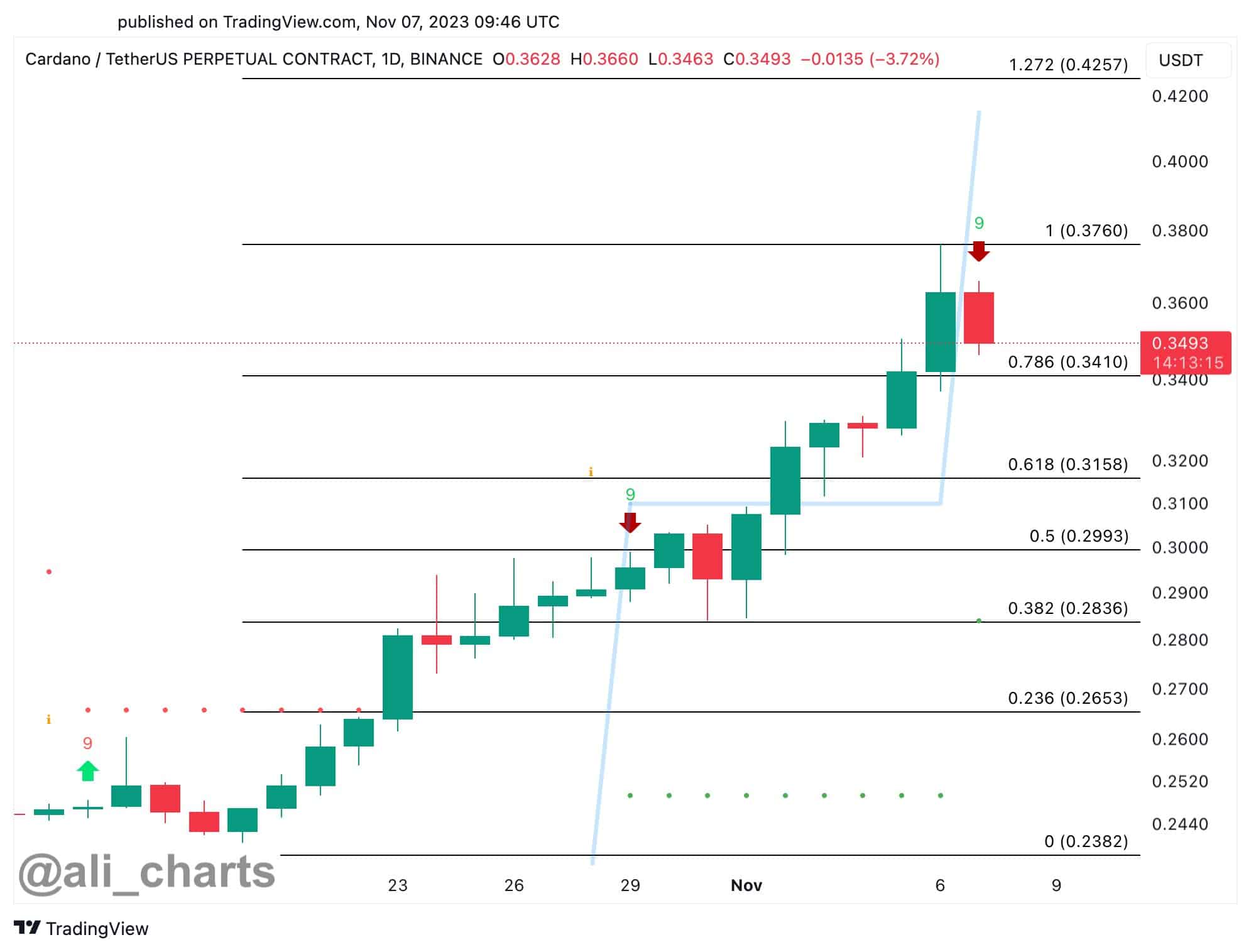
Cardano (ADA) might be on the verge of a price slump, as prominent market analyst Ali Martinez projects a retest of $0.30 upon the confirmation of a sell signal from the TD Sequential indicator.

The TD Sequential indicator is a tool for identifying potential trend reversals or trend continuation in asset prices. It leverages a sequence of price bars and provides signals upon certain conditions, helping market participants make decisions about buying or selling the asset.

ADA’s Rollercoaster Ride

In his most recent analysis, Ali emphasized that the TD Sequential indicator has presented a sell signal on the Cardano daily chart. Notably, this sell signal came up today amid the recent roadblock to ADA‘s uptrend which has caused a discouraging 5.26% intraday decline.

Cardano ADA 1D Chart Ali Martinez
ADA 1D Chart | Ali Martinez

It bears mentioning that the asset is on an impressive run which began on Oct. 19. ADA had dropped to a low of $0.2420 on Oct. 18 before staging this massive comeback. However, since Oct. 18, Cardano has appreciated by 42.5%, recouping all the losses from July to late October. TVL has also seen an uptick, recently overtaking Bitcoin.

Amid the run, the TD Sequential presented a sell signal on Oct. 31. The asset eventually tumbled 3.33% that day but recorded a rebound that kept it afloat till today. Now that the indicator has flashed another sell signal, Ali believes a correction of some of these gains it accumulated would occur.

At the time of Ali’s disclosure, ADA changed hands at $0.3493, with a 3.72% drop. The asset has continued to slump since then, currently trading for $0.3438. Ali revealed that he expects Cardano to witness a correction from the current price position. 

ADA to Retest $0.30 Amid Accumulation Trend

According to the analyst, this correction would take ADA to the $0.30 support level. Data from the chart confirms that the bulls have a major stronghold at $0.3410. However, a breach of this level would bring $0.3158 into play, the last line of defense above $0.30.

Notably, such a drop would not mark a complete correction to the Oct. 18 low. Rather, it would drop Cardano to the $0.3017 levels it traded at in August. It bears mentioning that Ali noted that this slump would mark a retest, suggesting that a possible rebound could be in the works.

The expectations of a retest follows a massive accumulation trend observed in the market last month. IntoTheBlock disclosed today that whale addresses amassed 1.89 billion ADA last month, worth $600 million at current prices.

Data confirms that most of these purchases occurred at a price range of $0.249 and $0.271. At ADA’s current price of $0.3438, these whales are in profit despite the intraday decline. Notably, market activity remains high, with a 24-hour volume of $453 million, up 38%.

Coinbase to Delist Bitcoin SV, Advises Users on Next Step

0

America’s largest cryptocurrency exchange Coinbase Global Inc. has revealed its plans to delist Bitcoin SV (BSV), highlighting the next step for affected users.

According to a screenshot shared by Alex Gladstein, the Chief Strategy Officer of the Human Rights Foundation, the delisting will come into effect on January 9, 2024. The market has started pricing in this news as Bitcoin SV’s price has dropped 1.45% to $48.74 at press time.


Coinbase Advises Next Step

Coinbase made this announcement about 2 months before the proposed delisting time to give its users with BSV assets ample time to convert their funds. Coinbase said its BSV holders can start making withdrawals from this time until 12 p.m. ET on January 9. 

Users who refused to convert their BSV by that time will have to face automatic liquidation. The trading platform said it will convert the remaining BSV assets into another supported cryptocurrency and deposit it into the user’s wallet. However, the credited amount will be less due to the fees incurred. 

Coinbase also warned its users that failure to withdraw the asset by its stipulated January 9 deadline may attract “unanticipated tax consequences.” As it stands, the exchange confirmed it has halted deposit support for BSV, and attempts to send the coin to its platform may result in a loss of funds.

The Bitcoin SV and Coinbase spat dated way back to August 2021 when Coinbase suspended the asset after recording a 51% attack. This attack comes into play when a group of bad actors gain control of at least 50% of the network’s node infrastructure. This allowed them to confirm transactions to their benefit.

It is worth noting that while the Bitcoin SV delisting appears targeted, this move is not uncommon among exchanges. From Binance to Bitget, delisting non-functional trading pairs comes as a standard practice for these trading venues to maintain the integrity of their platforms.

Coinbase Delisting: Damage to BSV?

BSV has garnered a strong community of like minds to drive a robust ecosystem around the blockchain network. Its performance hit a climax on October 22 when the coin soared to its highest price for the year.

Per earlier reports, BSV soared to a high of $55.5, setting a new pace for other altcoins like Ethereum Classic (ETC) and Polkadot (DOT) to follow. 

As a fork of Bitcoin Cash, BSV occupies a pivotal role in the evolution of digital currencies with its mission to restore Satoshi’s original vision. Bitcoin SV’s market capitalization is $937,037,488, with a trading volume $54,880,280, up 35%.

Bitrue Refunds Users Locked XRP: Details

0

Prominent crypto exchange Bitrue has refunded its customers’ XRP tokens previously locked for the minting of Xahau token (XAH) following the end of the event.

Notably, the refund of customers’ tokens, announced by Bitrue yesterday on X, indicates that the mint event was not successful amid prevalent concerns regarding the major difference in price between XAH, the native token of the new Xahau sidechain, and XRP.

The Burn2Mint Approach

Recall that Xahau, an XRPL-based sidechain seeking to give users an early opportunity to leverage Hooks, recently launched. Per its documentation, market participants can get XAH, the chain’s token, by burning XRP tokens.

The process, dubbed Burn2Mint, is a one-way flight. This means that any market participant that burns their XRP for XAH cannot get back the XRP tokens. In addition, the Xahau team confirmed that the burn to mint ratio will be a 1:1 proportion, suggesting that users get 1 XAH for every 1 XRP they burn.

Concerns emerged regarding the Burn2Mint protocol, as some XRP investors expressed reservations about burning their XRP tokens. Amid these concerns, Ripple CTO David Schwartz endorsed the process, noting that it could drive demand for XRP. Also, Bitrue opened up an avenue to allow its customers to burn XRP for XAH.

Emerging Concerns

The exchange launched a campaign on Oct. 30, prompting users to lock up their XRP tokens and mint XAH. However, more concerns emerged when XAH began trading but had a much lower value than XRP. This would mean that users would be burning XRP to mint a token of less value.

Nonetheless, it is important to note that the Burn2Mint ratio of 1:1 remains intact, as users will always get 1 XAH for 1 XRP. However, while XRP now trades at $0.68 due to its recent uptrend, XAH currently changes hands at $0.21 over three times less than the value of XRP.

The emerging concerns stem from the fact that some market participants might want to convert back their XAH to XRP when XAH trades on exchanges. However, should this occur, the resulting value would be much less than what they initially had.

Customers took to social media to lay complaints. Amid the comments and the reality of the situation, Bitrue decided to suspend the mint event and refund its customers their XRP tokens. Individuals such as Schwartz have noted that they would rather wait and trade XRP for Xahau on exchanges instead of burning.

SushiSwap May Get a New Tokenomics Model, Will SUSHI Outrank UNI?

0

Decentralized exchange SushiSwap might get a new tokenomics if the comprehensive proposal from the team gains the right community support.

The proposal was re-introduced by the exchange’s CEO, Jared Grey, who pointed out the need to get a new system, as the current tokenomics model, Kanpai, will fade out by December. The proposal highlights key aspects for consideration, including the benefits, stakeholder consideration, and challenges.

The SushiSwap Rejuvenation

As one of the oldest DEXs in the DeFi world, SushiSwap strives to achieve more pronounced sustainability as it concerns its economic models. The new tokenomics proposal aims to help the protocol achieve this ultimate goal.

Among the challenges, the proposal aims to proffer a solution on “liquidity subsidization.” With new tokenomics in place, SushiSwap will pursue efficiency in this regard and help in reducing the annual cost of SUSHI emissions. Additionally, the incentives designated for Liquidity Providers (LP) demand recalibration to keep it competitive.

Besides these challenges, the new SUSHI tokenomics will also seek to enhance the protocol’s Staking mechanism and xSushi distributions. To achieve its ultimate goals, SushiSwap projects its revenue will come from multiple sources, including fees collected from traders, stakers, and aggregation routing.

One crucial aftermath of this new tokenomics is its potential impact on the market valuation of SushiSwap. With the plans to stay competitive also a part of the future goals, the question remains whether SUSHI is finally ready to take on Uniswap’s native token, UNI. 

Catching Up With UNI’s Bullish Momentum

Presently, SushiSwap’s market valuation comes in at $0.9909 after printing 42.30% Week-to-Date (WTD). Despite this performance, SUSHI has a gloomy outlook in the trailing 24-hour period, a time frame that top market analyst Ali Martinez confirmed Uniswap’s exhibition of bullish momentum.


Riding on backing from the technicals he shared, the analyst projects UNI might retest the $6 price level, a move that will mark a 21.95% surge from its current price of $4.95. With the target locked in, time will show whether the tokenomics proposal can stir a buying frenzy that will make SUSHI outrun UNI in the short term.

This SUSHI proposal lies in the hands of the community, which has a tendency to rebel against core team members. However, Jared confirmed cooperation since the introduction of the first draft earlier in the year, spelling a good omen ahead. So far, all votes are in favor of the proposal.

Ripple Sparks New Selloff Intrigue After Moving 60M XRP

0

A whale address associated with American blockchain payments firm Ripple Labs Inc. has moved $60,000,000 ($60 million) XRP, sparking selloff concerns.

As reported by Whale Alert, the massive XRP transfer has a valuation of $42,831,410. This implies the firm moved the asset at an average price of $0.7138, a figure that coincides with the top end of XRP’s latest rally. The assets moved to another Ripple address.


Ripple’s XRP Transfer Now a Pattern

Ripple’s activities as an operational fintech firm with responsibilities to XRP are predictable. At the start of each month, the firm releases about 1 billion XRP into the market from escrow. This monthly transfer marks Ripple’s way of managing the circulation of XRP and, as such, bolsters a healthy market with liquidity.

Besides these initial transfers, it is not uncommon for Ripple to initiate other monthly transfers with little or no explanations. This latest 60 million XRP transfer is one of these transactions, which has triggered speculation of selloffs despite moving to another Ripple-affiliated address.

As reported earlier, the unexplained Ripple transfers formed a crucial subject of discussion in October as the company transferred millions of XRP to Bitstamp Exchange. One of Ripple’s addresses on Bitstamp received at least three tranches of XRP transfers from October 2 to October 11.

The first transfer featured 47,500,000 XRP transferred to Bitstamp on October 2. This was followed by another 42,500,000 XRP on October 9 and 23,000,000 XRP on October 11.

It is worth noting that Bitstamp does not enjoy a monopoly in receiving Ripple’s XRP transfers, as other exchanges, especially Bitvavo, also have a history of welcoming transfers from the company. The company also moves some XRP tokens across its addresses, like the latest transaction.

Why Selloff is Logical

While the latest transfer to its own address could invalidate concerns of selloffs, the thesis that Ripple is selling XRP with previous transfers sounds quite logical, as the company might be looking to cover operational expenses. 

In addition, the funds could move from the recipient’s address to an exchange. However, this has not happened as of press time. If selloff is the basis for this transfer, it will also be logical as XRP soared to a weekly high of $0.7285, marking a key profit-taking level. 

At press time, XRP’s market value is $0.699, up 2.96%. The coin has a trading volume of $3,390,635,568, which has soared 35.21%, while its market capitalization currently sits at $37,480,623,694.

Ripple Gains Big Media Coverage from Arabic Journals in MENA

0

Renowned San Francisco-based blockchain firm Ripple is now garnering significant coverage from the Middle East and North Africa (MENA) region. 

On Monday, two leading Arabic daily publications based in Kuwait wrote reports about the payment market in the country, spotlighting RippleNet. Specifically, the publishing firms are Kuwait Al-Seyassah and Al Qabas. The two Arabic newspapers wrote concerning the Ripple and Kuwait Finance House (KFH) partnership for cross-border payment services.

Crypto Eri, a prominent influencer in the XRP community, took to X to spotlight the development.

Kuwait Al-Seyassah Reports on RippleNet

In her tweet, Crypto Eri revealed that the Kuwait Al-Seyassah Daily Paper’s article underscored the transformative impact of fintech in Kuwait, with KFH now making it its core business focus.

Notably, KFH’s collaboration with Ripple for cross-border transfers through the RippleNet network was a central point of discussion. Citing Tareq Al-Ajeel, KFH’s executive manager of digital transformation, Al-Seyassah noted that the Ripple partnership has empowered KFH to explore new opportunities for collaboration with emerging technology companies. 

Furthermore, the article underscored that in the financial landscape, infrastructure investment is no longer merely an option but a necessity. It stressed that banks and financial institutions need to embrace and adopt such innovative programs to remain competitive and meet the changing demands of the market.

More Coverage for Ripple in Kuwait

Meanwhile, in another conversation, Crypto Eri highlighted Al Qabas’ Monday publication touching RippleNet amid the Ripple-KFH alliance. Similarly, an English-based Kuwait journal featured KFH’s executive manager in an October report where he described Ripple as a “Word-class Company.”


With Ripple featured in three Kuwait publications within four weeks, the XRP influencer expressed that the coverage for Ripple in the MENA region would further intensify. The foundation of this view is the Ripple Swell unfolding in Dubai starting tomorrow, November 8.

Shiba Inu Shiboshi NFTs Appear On a Billboard in New York

0

Shiba Inu community members are excited as the cryptocurrency’s non-fungible token (NFT), Shiboshis, appears on a billboard in New York.

The development was shared on the X platform today by Shiba Inu marketing specialist Lucie. Notably, the video footage showcased various Shiboshis being displayed on a gigantic billboard in the heart of New York City (NYC). Lucie captioned the footage using a “heart hands” emoji.

It bears mentioning that the development was first shared by ElSende, a Shiba Inu community member committed to expanding Shiboshis reach to a wider audience.

Shiba Inu Community Members React

As expected, the update stirred reactions among Shiba Inu enthusiasts, with many users reacting with rocket emojis.

Many enthusiasts saw the ads as an interesting move to draw attention to the Shiba Inu NFT project. The Shiboshi digital collectibles have enjoyed less attention than other Shiba Inu-related projects, including Shibarium and its ecosystem tokens.

Shiboshi NFTS Sell Out in 34 Minutes

Launched on October 14, 2021, Shiboshis recorded a major milestone as all 10,000 units of the digital collectibles were sold out in 34 minutes.

The 10K NFTS were sold in three different categories. Each unit of the first 3K Shiboshis sold for 0.1 ETH. The second batch, consisting of 5K Shiboshis, was minted at 0.2 ETH apiece. The last 2K units of Shiboshis were minted at the price of 0.3 ETH.

During the minting phase, several users encountered challenges, especially paying hefty gas fees for the transaction. Some users complained about not receiving any Shiboshi despite spending up to $1,500 in gas fees.

The challenges experienced during the minting of Shiboshis prompted the Shiba Inu team to intensify efforts towards releasing its Layer-2 scaling solution, Shibarium.

Shiboshi Transaction Volume Surpass $30M

At the time of writing, the floor price for the SHIBOSHI collection is 0.23 ETH, worth $433.78.

Since its launch, Shiboshis has recorded an impressive transaction volume, which currently stands at 15,971 ETH. It is worth noting that Shiboshi’s transaction volume equates to a whopping $30,121,306 ($30.12 million).