Home Blog Page 1744

Cardano Price History Hints at Potential 43.5% Surge in November

0

Judging by the historical price data of Cardano (ADA), expectations abound that the coin may welcome a 43.5% growth in November.

CryptoRank data already pegs the accumulated growth rate this month at 9.05%. This growth ends a period of 2 successive yearly drops in Cardano’s price falls for November.

Cardano’s Bullish Prospects

According to CryptoRank data, November has always showcased mixed growth patterns. In November 2017, the asset recorded a massive 311.6% growth. This appreciation at the time drew on massive hype that trailed the launch of the protocol. 

After the performance in November 2017, ADA nosedived 44.1% in November 2018 and by 2.39% in November 2019. Cardano reversed the trend the next year as its price in November 2020 jumped 84%. However, the bearish trend continued in 2021 and 2022 with 20.7% and 21% slumps respectively.

Following this historical order, Cardano has one natural course for this month and by the current outlook, the asset appears to be on track to follow this bullish trajectory. CryptoRank’s data puts an average price jump of 43.5% in November.

With ADA’s price pegged at $0.3171, up 2.48% overnight, it has extended its gains this November to 7.77%. With the November 2020 growth less than half of that recorded in 2017, a projection of a 40% growth by the end of this month seems logical. 

Cardano metrics are pointing towards a potential rally, as reported earlier by The Crypto Basic. The Cardano whale address count and daily active addresses have soared to their highest level in the past 2 weeks. A sustained trend in these metrics will showcase growing demand for ADA and might boost price growth moving forward.

Cardano Fundamentals to Bolster Growth

Cardano started this year on a bullish note with innovative product launches to serve its community. With Mithril going live on the mainnet earlier in the year alongside the Cardano Lace Wallet, ADA has solid fundamentals to hinge its growth on.

Input Output Global, Cardano’s parent company has teased plans for a new stablecoin venture. For this, the startup has appointed Sean Ford and David Markley as CEO and COO with innovations expected from the team soon. 
Cardano TVL in ADA Surges to ATH as DJED Stablecoin Hits 390% Collateralization

0

Cardano’s DeFi ecosystem is seeing significant growth, with the total value of locked assets recently hitting a new all-time high (ATH) in ADA. 

As the crypto market continues its recovery, the Cardano ecosystem has emerged as one of the biggest beneficiaries. On-chain metrics show that DeFi protocols built on the Cardano network have attracted more capital, with the total value of locked (TVL) assets steadily growing. 

According to data from DeFiLlama, the Cardano network has a TVL of $216 million. This amount represents a new all-time high in ADA, meaning there are now nearly 700 million ADA tokens across Cardano-based DeFi protocols.

ADA TVL
ADA TVL | DeFiLlama

The new Cardano TVL all-time high builds on an impressive third quarter that saw the network become the 15th largest blockchain in DeFi activity. At the end of the third quarter, Cardano had a TVL of $150.6 million, meaning that over $60 million has been added since the start of October.

As previously reported by The Crypto Basic, Cardano’s surge in TVL is partially a result of increased usage of stablecoins on the network. It is unsurprising then that leading Cardano stablecoin DJED also marked a new milestone on the eve of the network’s TVL surging to a new all-time high.

DJED Stablecoin Now Over 390 % Collateralized

Launched in February, DJED stablecoin has become a popular choice in the growing Cardano DeFi ecosystem. The token has a circulating market cap of $3.3 million and has maintained relative stability over time, trading at around $1.01.

On Wednesday, COTI Network, the team that partnered with Cardano’s Input Output Global (IOG) to issue DJED, announced a new milestone. The stablecoin now had a collateralization ratio above 400%, although the ratio has dropped to 390% at press time.

The increased reserve ratio means users can safely mint and redeem DJED on the Cardano chain. Additionally, it shows that COTI maintains a sufficient reserve of SHEN tokens, which serves as the reserve token for DJED. With such high collateralization, users can confidently use DJED, further bolstering an already thriving Cardano ecosystem.

MicroStrategy Stock Outperforms Legacy Assets Since Bitcoin Adoption

0

From August 10, 2020, when MicroStrategy began accumulating Bitcoin (BTC), its stock has soared 242%, outperforming traditional assets at a remarkable rate.

Dan Tapiero, the Founder and CEO of growth equity firm 1RT Partners, recently highlighted the growth trend, noting that MicroStrategy’s Bitcoin bet will go down as the “greatest directional macro trades of all-time.” In his words, the “old school macro investment process leads to giant conviction and giant trade.”

Judging from MicroStrategy’s success, the veteran believes the misconception of Bitcoin’s riskiness encourages people to embrace its volatility

MicroStrategy vs Indices and Tech Stocks

Per the chart shared by Dan, MSTR has outperformed Bitcoin, which has managed 192% growth since it became the company’s favorite reserve asset. The performance of other indices, including the S&P 500, which has grown 25%, and the Nasdaq Composite, with a 17% surge pales, compared to MicroStrategy.

MicroStrategy Performance Since Adopting Bitcoin FactSet
MicroStrategy Performance Since Adopting Bitcoin | FactSet

Gold, the consensus asset employed as a hedge against inflation, slipped by 1% within the same period as Silver fell 18% and Bonds plummeted by 24%. 

Though 4 of the six profiled large tech stocks in the United States have maintained an uptrend since MicroStrategy adopted its Bitcoin strategy, MSTR’s growth rates dwarf those of these firms. Alphabet Inc’s GOOGL is up 68%, Microsoft’s MSFT has printed a gain of 62%, with Apple’s AAPL recording a 51% jump. 

Meta Platforms Inc (META) has printed a comparatively low gain of 15% but remains in the green when compared to Netflix (NFLX) and Amazon (AMZN), both of which dropped by 15% to date. 

Despite the backlash MicroStrategy has faced in its Bitcoin accumulation journey, it has outperformed stocks within its niche as a business intelligence and software provider.

Oracle (ORCL) takes the second spot in this area with 88% growth, IBM follows with a 19% surge, and Salesforce (CRM) is up 2%. In the enterprise sector, SAP has printed a 16% loss compared to MicroStrategy’s 242% gain.

Unrelenting Bitcoin Accumulation

One underlying factor in MicroStrategy’s Bitcoin accumulation strategy is the firm’s consistency. Though the firm adopted the policy when its founder, Michael Saylor, occupied the CEO position, his successor, Phong Le, has not slowed down the tempo.

In the firm’s Q3 earnings report, it confirmed the acquisition of an additional 155 Bitcoin in October, a figure that places the total bought to 6,607 for the quarter.

At the moment, MicroStrategy now holds a total of 158,400 BTC acquired for $4.69 billion, or $29,586 per bitcoin. These assets are currently worth $5.43 billion at Bitcoin’s current price, leaving the firm with a profit of $740 million.

Polygon (MATIC) Sees More Active Addresses and NFT Volume in Stellar Quarter

0

The Polygon network saw sustained growth in the third quarter, maintaining its place in a highly competitive market for dApp-compatible blockchains.

During the third quarter of the year, the Polygon network improved on several key metrics. There was a notable increase in the number of active addresses on the network, with an even more impressive surge in NFT trading volume.

Polygon is an Ethereum-based layer-2 solution that allows users to enjoy low fees and faster transactions. Its native currency MATIC ranks as the 12th largest crypto asset by market capitalization. In the third quarter, Polygon announced and implemented a range of upgrades to enhance the project’s tokenomics and make the network more robust.

Amid these major upgrades, a recent report from Messari shows that the Polygon ecosystem maintained relative stability and even saw an uptick in other areas.

For instance, the number of daily active addresses increased by 1.6%, growing from 359,000 addresses by the end of Q2 to 364,000 at the end of the third quarter.

Polygon Network Analysis Messari
Polygon Network Analysis | Messari

The network also experienced a higher retention rate compared to the previous quarter. The average daily number of returning addresses increased by 4.8%, jumping from 273,400 to over 286,000 addresses.

Another notable metric in the third quarter is the increased supply of MATIC coins staked. The data reveals that 36.3% of the total supply of MATIC is staked, a mild 0.9% increase from the past quarter. The percentage of staked supply has increased by over 10% compared to last year’s third quarter, when only 32.6% of MATIC’s supply was staked.

NFT and DeFi Volume Remains Steady 

The NFT and DeFi sector constitutes major components of a thriving blockchain ecosystem, and Polygon is not left behind. In fact, the network saw an increase in NFT trading volume, according to Messari’s data.

Daily NFT sales volume increased by over 50%, from $2 million to $3 million, largely buoyed by the launch of the DraftKings Reignmaker NFT collection. In turn, weekly volume rose as high as $20 million, representing a 131% rise compared to the same quarter last year.

Polygon PoS Ecosystem Overview Messari
Polygon Ecosystem Overview | Messari

Meanwhile, although the total value locked across Polygon-based DeFi protocols dropped by $200 million within the quarter, the blockchain’s ecosystem remained firmly capitalized. Over $900 million in assets are still locked on Polygon DeFi apps, with the sector responsible for 57% of daily active addresses on the network.

Top Trader Says His Shiba Inu 90,000% Gain Was “Best Play of His Life”

0

A prominent trader in the crypto community has recently beamed the spotlights on his early Shiba Inu involvement that saw him gain 90,000%.

In a tweet on Thursday, Blackbeard resurfaced a 2021 post concerning a Shiba Inu trade he had executed earlier on. In the tweet, he disclosed that while he merely played a risk game by investing in Shiba Inu, his investment saw a staggering 64,000% gain from his entry point.

Meanwhile, Blackbeard noted in the Thursday tweet that his Shiba Inu portfolio even grew more significantly at some point, reaching 90,000%. As a result, he proclaimed that his early Shiba Inu involvement represents his most worthwhile endeavor in the realm of sensational cryptocurrencies.

In his words: “I don’t care if you hate memes, but this was the best play of my life. SHIB.”

Notably, Blackbeard did not disclose whether he currently holds Shiba Inu or his percentage gains to date. In the initial post, Shiba Inu had just four leading zeros, marking one of its peak moments. However, since then, Shiba Inu has shed two more leading zeros, with its price now at $0.000007729.

Regardless, his post garnered the interest of Shiba Inu enthusiasts, leaving them intrigued about his early discovery and investment in the digital asset. Some expressed curiosity about how he discovered Shiba Inu around its early days of launch.

In response to the incessant inquiries, Blackbeard has authored an extensive thread elaborating on the methods to identify crypto narratives and trends in their early stages.

Meanwhile, some other crypto enthusiasts expressed regret for not joining the Shiba Inu market despite becoming aware of it earlier. 

Other Lucky Shiba Inu Investors

Notably,  Blackbeard stands among the select group of esteemed investors whom Shiba Inu has rewarded for their loyalty. The Crypto Basic recently disclosed the case of an investor who made an unprecedented $5.7 billion from Shiba Inu. 

In parallel, the unfortunate case of an individual who forfeited a potential multi-million dollar fortune by divesting their Shiba Inu holdings much earlier is also documented.

Shiba Inu Team Debunks Claims of Binance Delisting SHIB

0

Shiba Inu marketing specialist Lucie has debunked recent reports regarding Binance’s decision to delist a SHIB trading pair later this month.

Lucie, the marketing specialist of canine-themed token Shiba Inu, has reacted to a recent report regarding the delisting of a SHIB trading pair on Binance.

Binance to Delist SHIB Margin Pairs

Yesterday, the world’s largest crypto exchange by 24-hour trading volume announced plans to delist 23 cross-margin and isolated-margin trading pairs, including SHIB/BUSD and ADA/BUSD. Binance said the trading pairs will be delisted on November 9, 2023, at 06:00 (UTC).

In what appeared to be a stunt to attract clicks, several media outlets published the news using the headline “Binance Delists SHIB.”

Lucie Debunks Negative SHIB Report

Reacting to the development, Lucie characterized the headline as misleading. She pointed out that the upcoming removal of margin trading pairs on Binance did not affect only SHIB.

She provided a complete list of crypto assets Binance will be delisting from its cross-margin and isolated-margin pairs against BUSD. The list includes crypto assets like DOGE, PEPE, LUNA, LINK, MATIC, APE, AVAX, BAKE, OP, RUNE, YGG, XLM, USTC, GALA, FIL, DOT, TRB, LTC, BCH, and DOT.

The recent report about Binance delisting a Shiba Inu trading pair caused panic among community members. As a result of the “misleading” headline, some Shiba Inu enthusiasts initially believed the decision only affected Shiba Inu. However, the complete report painted a different picture.

Binance Gradually Removing BUSD-Related Pairs

Notably, the crypto assets that are about to be delisted are pairs of the exchange’s stablecoin BUSD. Binance has been delisting various BUSD-related trading pairs on its platform in recent times.

In an August statement, Binance announced that BUSD issuer Paxos had halted the minting of new stablecoins. Consequently, the exchange stated it would “gradually remove support for the stablecoin” on its platform.

Since the announcement, Binance has aggressively delisted various BUSD-related pairs on its platform. As reported last month, the leading exchange announced the delisting of 17 crypto assets, including SHIB, from the Binance Liquid Swap.

Cardano MarketCap Up 36% As 2 Key Metrics Hit 3-Month Highs

0

Cardano (ADA) price has maintained its positive rally, soaring 30% in 14 days as its address activity and whale transactions hit record highs.

Per data from the crypto analytics platform Santiment, ADA address activity and whale transactions have reached their highest level in more than three months. The impressive on-chain metrics bolster the formation of support at $0.32.

Cardano’s Growth Backed by On-Chain Trends

Per data from the accompanying Santiment chart, daily active addresses and whale transactions worth at least $100,000 have recorded erratic movements since late July. 

Cardano ADA Metrics Santiment
Cardano Metrics | Santiment

From July to date, the active addresses count on Cardano touched the lowest level between September 10 and September 18. In addition, whale activities hit their lowest level on October 12, a trend that lasted until October 19. 

However, both metrics are now back on track, with Santiment confirming a more than 23% surge in address activity in the past three weeks and a 32% surge in whale transactions within the same period.

The positive outlook on Cardano per this metric stems from notable strides recorded by DApps residents on the protocol. Indigo, a Cardano-based Collateral Debt Position (CDP) platform, now ranks among the top 15 protocols in this niche, further driving the sentiment across the board.

Analysts Bullish on Cardano

While Cardano remains down 18.5% from this time last year, the latest developments have ignited some optimistic projections about the protocol’s future.

At the time of writing, Cardano is trading at $0.3235, up 5.2% over 24 hours. The growth has remained consistent for the better part of the week, as it recorded a 9% surge on Thursday. The improving stats have pushed Cardano’s market cap up 5.2% to $11,399,009,966 amid a 39.42% surge in trading volume to $487,392,180.

Notably, top market analyst Tim Warren believes ADA could record a 40x surge to print a new high of $10 shortly. Warren’s projections hinge on the historical trends of Cardano, which provide the perfect set-up to record such a growth push.

On its part, Input Output Global (IOG) keeps pushing new milestones to sustain dApp activities on the blockchain. One of its latest moves is the appointment of Sean Ford and David Markley as the CEO and COO of its new stablecoin venture.

Analyst Explains Why XRP Should Be Standard for Cross-Border Remittances

0

Renowned crypto author Panos Mekras highlights the appeal of XRP in cross-border settlements.

Mekras took to X to react to a recent article published by Ripple’s partner Tranglo, which addressed five misconceptions about remittances and cross-border settlements.

Tranglo Addresses Misconceptions About Remittance

In the article, Tranglo addressed the misconception that places banks as the cheapest method for cross-border remittance. Dispelling this misconception, Tranglo cited a March 2023 World Bank report highlighting banks as the most expensive service provider.

According to Tranglo, the World Bank, in the report, stated that online remittances via banks cost an average of 12.1% per transaction, while the global average was around 6.24%.

To verify this claim, Tranglo’s research team conducted an internal study authenticating the World Bank’s data. Per Tranglo’s findings, the global average transaction fee for traditional banks and payment gateways ranges from 3% to 7%.

Interestingly, Tranglo claims that its users pay an average transaction fee of less than 0.5% for cross-border remittance.

Crypto Author Says XRP-Powered Low Fees Should Be the Standard

Tranglo’s claim attracted the attention of the renowned crypto author Mekras. The industry analyst pointed out that Tranglo’s low transaction fee is possible due to XRP and blockchain.

Furthermore, he said Tranglo’s low fee should be implemented as the standard for cross-border settlements and remittances.

Ripple and Tranglo Partnership

It bears mentioning that Ripple has been a major Tranglo partner since March 2021. At the time, Ripple acquired 40% of the company’s stake to expand the reach of On-Demand Liquidity (ODL) to clients in the Asia Pacific (APAC) region.

Ripple made the strategic move based on the growing demand for ODL, a solution that leverages XRP as a bridge currency for cross-border settlements.

Following the partnership, Tranglo integrated Ripple’s ODL solution into its more than 20 payment corridors, helping businesses to process seamless, cost-effective, and fast transactions.

In May 2023, Tranglo disclosed that it had processed over $1 billion worth of transactions through Ripple’s ODL. Tranglo’s partnership with Ripple has helped the company expand its presence in the United Arab Emirates (UAE).

As reported earlier, Tranglo deepened its presence in the UAE by collaborating with Al Ansari Exchange, the country’s largest outward personal remittance.

FTX’s Sam Bankman-Fried Convicted, Potentially Faces 115 Years in Prison

0

Sam Bankman-Fried has now been convicted nearly one year on from the infamous collapse of his FTX empire.

After a month-long trial, former FTX CEO Sam Bankman-Fried (SBF) faces the prospect of spending decades in prison. A federal jury on Thursday convicted the once influential crypto personality on all counts brought against him by the United States Department of Justice (DOJ) in connection with FTX’s demise.

Recall that throughout the trial, SBF had pleaded not guilty to the five counts of conspiracy and two counts of fraud. SBF and his legal defense team had tried to convince the jury he did not deliberately defraud customers and that the $8 billion shortfall was a mistake. 

SBF also said he believed it was legal for FTX to use customer funds to make investments through its sister company, Alameda Research. He also apportioned blame for the collapse to legal advice he received while running the company and claimed to be unaware of certain liberties granted to Alameda while trading on FTX.

However, the jury, after hearing testimony from the former FTX CEO and reviewing available evidence, concluded that SBF had intentionally defrauded customers. The ruling came after a four-hour deliberation process in which the jury unanimously concluded that Sam Bankman-Fried was guilty on all seven counts.

The conviction means that SBF may face a sentence of up to 115 years in prison. U.S. District Judge Lewis Kaplan will announce SBF’s exact verdict on March 28, 2024. The convict is also expected to appear in court in March to face a different set of charges alleging his involvement in bank fraud conspiracy and foreign bribery.

SBF Legal Defense to Appeal Verdict

Following the guilty verdict, Sam Bankman-Fried’s legal defense, led by Attorney Mark Cohen, indicated they would appeal the ruling. While admitting respect for the jury’s decision, Cohen reportedly said, “Mr. Bankman-Fried maintains his innocence and will continue to fight the charges against him vigorously.”

It is noteworthy that the chances of overturning such a unanimous jury decision through an appeal are relatively slim. Additionally, several legal experts have affirmed that SBF’s decision to testify during his trial lowers the chances of an appeal bearing fruit.

XRP Now Available in 72 Countries With Combined GDP of over $8 Trillion

0

XRP may now be available in up to 72 countries within the MEASA (Middle East, Africa, and South Asia) region following its recent regulatory approval by Dubai within the DIFC.

The Crypto Basic recently disclosed that the Dubai Financial Services Authority (DFSA), the independent financial services regulatory body in the Dubai International Financial Center (DIFC), approved XRP under its digital asset regime.

The approval would give licensed crypto-focused companies operating within the DIFC the liberty to offer all forms of crypto-related services for XRP, including trading, lending, and others. 

According to the announcement, XRP became the first crypto asset the regulatory agency granted legal and regulatory approval from an external application under its crypto asset regime within the DIFC. XRP joins other digital assets such as Bitcoin (BTC), Ethereum (ETH), and Litecoin (LTC), but these did not get approved through an external application.

Significance of the Development 

Interestingly, recent discoveries confirmed that the development is more pivotal than most enthusiasts initially believed. The DIFC’s role as a leading financial center is not limited to Dubai or the UAE but extends its influence across a vast area, reaching the entire MEASA region.

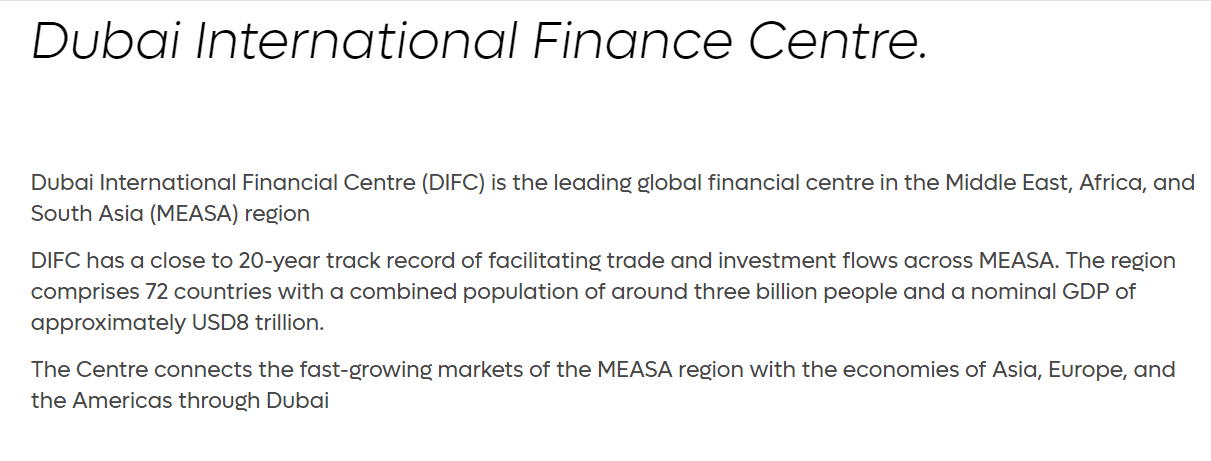
Information from its official platform suggests that the DIFC has served as a central point for various financial activities, making it one of the primary destinations for businesses, investors, and financial institutions in the MEASA region for over two decades.

For context, the Middle East, Africa, and South Asia (MEASA) region encompasses up to 72 countries, including major players like India, Saudi Arabia, UAE, Israel, Turkey, Egypt, and Qatar. The MEASA region boasts a combined nominal GDP of over $8 Trillion, per recent estimates.

Dubai DFIC
Dubai DFIC

The DIFC has been instrumental in facilitating trade and investment within the MEASA region. It plays a vital role in linking investors and businesses from MEASA to the rest of the world. As a result, XRP’s regulatory clarity in the financial hub opens the doors for multiple opportunities in the 72 countries within MEASA.

Three years back, Ripple established its MENA (Middle East and North Africa) headquarters within the DIFC upon recognizing the potential opportunities that could come from operating within the hub. XRP’s entrance further solidifies its footing in the center.

Notably, XRP already secures regulatory clarity in some countries within the MEASA region with favorable crypto rules. Nonetheless, the recent approval from the DIFC could help bolster its prominence in the region, exposing it to several MEASA companies domiciled in the DIFC.