Home Blog Page 1745

Top US Exchange Uphold Launches 50,000 XRP Giveaway

0

Pro-XRP exchange Uphold offers a 150% increase in XRP prize to 50,000 XRP in its November “XRP Sweepstakes” giveaway.

The prominent American exchange with unyielding support for XRP has just announced a more grand XRP prize offer in the ongoing “XRP Sweepstakes” campaign that began in October.

In a recent tweet, Uphold disclosed increasing the XRP bounty for the promotion by 150%. In particular, the exchange proclaimed that 50,000 XRP is now up for grabs in its “XRP Sweepstakes” promo. 

Notably, this increase comes amid the conclusion of the first round of the XRP prize bounty. In the October offer, Uphold offered 20,000 XRP to one fortunate trader on its platform. This implies the exchange has more than doubled the reward for the November edition.

“We’ve got 50,000 XRP up for grabs in November. Our XRP sweepstakes are back and better than ever,” the pro-XRP exchange proclaimed in the recent notification.

How to Win Uphold’s 50,000 XRP Giveaway

It is worth mentioning that the rules for winning the 50k XRP are similar to the just concluded October offer. To recap, Uphold is offering the XRP prize to a lucky trader who emerged victorious in the draw that will be conducted from qualified entries. 

Besides, eligible participants are crypto enthusiasts based in the United States. Per the terms and conditions of the game, each intending participant must first register their interest in the promotion by “opting-in.” According to Uphold, only transactions a participant conducted after the opt-in would count toward the qualified entries for the draw.

Notably, a transaction is deemed qualified if worth $20 and above. Also, Uphold stated, “There’s no limit on the amount of entries you can get. So the more you trade, the better your chances.”

It is worth noting that invalid entries include transaction actions like fiat deposits into the same fiat currency, withdrawals, and crypto movement between Uphold users.

Here Are Top Signs that Ripple is Preparing to Go Public with an IPO

0

Ripple’s silent IPO preparations have become evident from its recent M&A moves, hiring trends, and finance roles targeting international tax directors.

In a recent video, prominent XRP influencer Lewis Jackson discussed compelling evidence pointing towards Ripple’s intentions to go public. Jackson argued that Ripple may have been hinting at its IPO preparation plans on its website while many people are yet to take cognizance of it.

In the video, Jackson highlighted several key factors that support this hypothesis.

Ripple’s Subtle IPO Preparation Plans

Jackson underlined that a company’s journey to an IPO often involves specific stages, including a phase of mergers and acquisitions (M&A). He pointed out that Ripple has been actively involved in M&A activities. He cited Ripple’s acquisition of Metaco, which happened five months ago. Alongside, Jackson noted the failed acquisition bid in the case of Fortress Trust. 

According to the XRP influencer, while these activities alone do not guarantee an IPO, they typically precede it.

Furthermore, Jackson argued for Ripple’s silent IPO preparation plans based on the company’s hiring trends. He particularly noted roles related to corporate development, engineering, finance, and shareholder communication. 

According to Ripple’s career page, the technology firm currently seeks a Director of Corporate Development and Managers of Corporate Development. 

One of the critical responsibilities of the incoming directors and managers is to “Establish strong relationships externally with the crypto and blockchain community of entrepreneurs and investors.”

Recall that The Crypto Basic recently disclosed that Ripple seeks a “Shareholder Communications Senior Manager.”

Therefore, Jackson explained that the hiring of a director and manager of corporate development indicates Ripple’s commitment to strategic growth, including M&A and partnerships. 

Besides, he noted Ripple’s recruitment of engineers suggests its dedication to strengthening its technical infrastructure. Meanwhile, the analyst remarked:

 “[Hiring of engineers] doesn’t necessarily reflect on the prospect of an IPO.  But certainly, it seems like Ripple is building and building to be able to show anyone looking in how robust they are and how they are growing and expanding, making things better. These are all just good signs, anyway.

Hiring for International Tax and Financial Risk

Furthermore, Jackson sees IPO preparation signs in Ripple’s openings for various finance roles. It includes a Director of International Tax and a Financial Risk Director.

According to Jackson, these finance roles are crucial for auditing financial data and preparing for public disclosure. In his words:

“When you go public, then everyone can see all the numbers. So, you need to make sure that you’re abiding by international taxes because they’re a global company.”

Location of the Openings

Notably, Ripple mostly wants the directors and managers to be from San Francisco, its headquarters, as well as from New York City and London.

While Jackson did not draw a direct connection between the job postings and the location of Ripple’s potential IPO, he noted that more than 10% of the positions were in the United States.

Furthermore, he speculated that the New York Stock Exchange (NYSE) could be Ripple’s primary goal for going public. However, he also mentioned that London or Dubai might be secondary options.

Regulatory Triumph

It is worth mentioning that Ripple’s protracted legal case with the U.S. regulator is gradually ending with successive victories against the SEC, such as the recent dismissal of the charges against Ripple’s executives. Therefore, the hindrances to Ripple going public via an initial public offering soon have lowered.

Out of 9 Companies, Georgia Selects Ripple for its National Digital Currency

0

The National Bank of Georgia affirms Ripple’s expertise in CBDC development by selecting the company as its technology partner for the digital Lari pilot.

The National Bank of Georgia (NBG) has selected San Francisco-based company Ripple Labs as its technology partner for the digital Lari (GEL) pilot project.


According to a blog post yesterday, the pilot program will be planned and executed using Ripple’s central bank digital currency (CBDC) platform.

Notably, the partnership will explore the potential use cases and benefits of Ripple’s CBDC platform in the public and business sectors.

Ripple Selected Out of Nine Candidates 

Per the announcement, the Bank of Georgia selected Ripple for its CBDC pilot program after conducting an intense selection process, leading to the assessment of nine shortlisted candidates.

Interestingly, the Bank of Georgia chose Ripple due to the company’s knowledge of the project’s use cases and its experience undertaking similar initiatives.

Furthermore, Ripple’s CBDC platform also played a pivotal role in the selection process. The platform, which launched in May, allows governments and financial institutions to “mint, manage, transact and redeem CBDCs.”

Commenting on the development, Natia Turnava, the Acting Governor of NBG, confirmed that the bank selected Ripple based on its technical excellence.

Ripple’s VP of Central Bank Engagements, James Wallis, also commented on the development. Wallis stated that the partnership demonstrates Ripple’s commitment to empowering both public and private entities to achieve their set goals.

Launched in May 2023, Ripple’s CBDC platform was designed to help governments, financial institutions, and central banks navigate the complexities of CBDC management. Powered by the XRP Ledger (XRPL), the platform is an enhanced version of Ripple’s private ledger, a solution introduced in 2021 for the issuance of CBDC. 

Ripple Selected in Multiple CBDC Projects 

Top financial institutions have continued recognizing Ripple’s technological prowess and expertise in CBDC development.

The company has been selected for different CBDC pilot projects in various nations, including Bhutan, Montenegro, Hong Kong, Montenegro, and Colombia. According to Ripple, the company is in talks with governments and central banks of over 20 countries for digital currency programs.

Interestingly, the Central Bank of Colombia and the Hong Kong Monetary Authority (HKMA) specifically utilize Ripple’s CBDC platform for these pilot ventures.

As reported earlier, Ripple’s CBDC Platform is currently being used to create the hypothetical e-HKD, the digital version of the Hong Kong dollar.

Why Abandon XRP? XRP at $2 Would Yield Ripple a $100 Billion, as Experts Evaluate Ripple IPO

0

In a recent statement, prominent pro-XRP attorney John Deaton emphasized that the Ripple pre-IPO valuation is a considerable bargain compared to the potential $100 billion windfall if XRP’s value reaches $2. 

Deaton said this while responding to a recent report from Ripple detailing an XRP milestone in Dubai. As The Crypto Basic recently reported, Dubai’s financial authorities recently approved XRP as a legal and regulated crypto asset under its digital asset regime, allowing licensed firms to incorporate it.

The report garnered significant attention from the XRP community, given its pivotal nature. It also demonstrates Ripple’s readiness to push for legal and regulatory clarity for XRP at a time when most XRP community members are concerned that the company is pivoting away from the asset.

Notably, most of Ripple’s recent offerings have sent a message that the company is trying to shift its focus from XRP. The firm’s Liquidity Hub product does not feature XRP despite the asset’s regulatory clarity. These cases have raised concerns that Ripple might be abandoning XRP.

The Ties Between Ripple and XRP

Deaton attempted to debunk these claims. His comments on the matter first highlighted Ripple’s journey from its early Series A valuation of $128 million in 2015 to its latest Series C Buyback valuation of $15 billion in 2022.


The lawyer stressed that Ripple’s decision to repurchase its Series C shares at a 50% premium during the cryptocurrency bear market and before Judge Analisa Torres’ ruling in the SEC case indicates strong confidence in itself.

He noted that the company’s pre-IPO shares currently trade below the $15 billion that Ripple paid to buy back its Series C stock. This further demonstrates Ripple’s assurance of its future. Deaton believes the company’s future success is intricately tied to XRP.

According to the attorney, due to the intricate ties, Ripple has a fiduciary duty not to abandon XRP. Notably, the firm holds a substantial 46.5 billion XRP, according to its latest market report. Deaton thinks this massive holding could become a crucial factor of success for Ripple if XRP succeeds.

If XRP achieves a major price milestone, it will translate into a significant boost for Ripple’s balance sheet. Should XRP hit $2, Ripple will be sitting on $100 billion. If the asset reaches $3, the company will hold $139.5 billion. This provides a clear illustration of the mutually beneficial relationship between Ripple and XRP.

Report Shows How FTX Founder SBF Recklessly Lost 20 Million XRP

0

A report shows that disgraced FTX founder Sam Bankman-Fried (SBF) once misplaced 20 million XRP ($4 million) for several weeks while trading out of the Alameda Research account.

It’s been nearly one year since FTX’s infamous collapse, from being one of the world’s largest crypto ecosystems to a bankrupt entity struggling to repay creditors. A large portion of the blame has been laid on how the exchange mishandled customer funds, a reasoning that continues to be bolstered as new evidence emerges.

In one such newly disclosed evidence, a Wall Street Journal report shows that FTX’s former CEO recklessly managed funds while handling the trading account for the company’s sister firm, Alameda Research.

SBF, through his company, had borrowed $170 million from other individuals who shared his idea of making money with the sole purpose of giving all of it away (so-called altruists), only to lose all of it to poor trading.

In another reckless development, the FTX CEO lost 20 million XRP (worth $4 million at the time). The money “just vanished from Alameda’s accounts,” with SBF unable to account for its movement. 

When confronted by employees, the former FTX CEO downplayed the significance of the lost amount, nonchalantly noting that the money may have been moved from a US-based exchange that Alameda uses to another one in South Korea used by the platform.

He claimed that the South Korean exchange was merely delaying credit of the amount, even though he did not know which platform.

FTX employees reportedly had to force the former CEO to quit trading for two weeks to enable proper tracing of the missing funds, a condition SBF grudgingly accepted. Notably, SBF sought to convince employees to lie that the company still had 80% of the XRP assets, even when its whereabouts were clearly unknown.

“Missing Ripple Was the Final Straw”

According to the WSJ report, the missing XRP tokens were the final straw for employees who had grown weary of Sam’s reckless approach to managing Alameda accounts. Even during the period when the funds were missing, the company was still making over 250,000 trades per day, and the system could not account for most of them.

It is noteworthy that after several months, Alameda found the missing XRP. Hey had been transferred from Kraken to the South Korean-based crypto exchange Bithumb.

Bithumb received the 20 million XRP coins without any hint from the sender on who they belonged to. Yet, Alameda Research did not get in touch to retrieve the funds until after a lengthy period.

Upon discovering where the funds had gone, Bankman-Fried called Bithumb. A Bithumb employee asked Bankman-Fried over a call, “Are you the f—er who sent us like 20 million Ripple tokens? How the f— are you only calling us now?”

Following the Ripple incident, the WSJ report noted that the already-odd company had become even more odd. 

The case involving the missing XRP is just one of the many shocking revelations about the former FTX CEO in recent times.

In the past week, it was disclosed that the CEO used profits from its Alameda Research to buy Solana (SOL) at $0.20 per coin. SBF also believed it was legal for the company to use FTX customer funds to invest in a sister company, Alameda Research.

Dubai Approves XRP for Usage in Dubai International Financial Centre

0

Ripple gains DFSA approval for XRP in DIFC, enabling licensed virtual asset firms to offer XRP.


Main Points

  • Ripple has received approval from the Dubai Financial Services Authority (DFSA) to use the digital asset XRP within the Dubai International Financial Centre (DIFC).
  • This makes XRP the first virtual asset to be approved by the DFSA since it opened up external applications.
  • XRP joins BTC, ETH, and LTC as approved assets under the DFSA’s virtual assets regime.
  • Ripple’s CEO, Brad Garlinghouse, commended Dubai’s regulatory leadership and the DFSA’s support for digital assets, highlighting their commitment to fostering innovation.
  • Dubai’s listing of XRP can potentially unlock new regional payment and virtual asset use cases on the XRP Ledger.
  • Ripple established its MENA headquarters in the DIFC in 2020 due to Dubai’s forward-thinking regulations and global financial center status.
  • The announcement coincides with Ripple Swell, a significant event in Dubai, bringing together industry experts, regulatory voices, and thought leaders.
  • The event will feature speakers from the DIFC, VARA, and other global influencers in fintech, finance, and crypto.

FTX and Alameda Move Additional $46M in SOL, ETH, Others to Kraken, Binance and Coinbase

0

FTX and Alameda Research addresses have transferred an additional $46 million worth of Solana (SOL), Ethereum (ETH), Polygon (MATIC), and other crypto assets to Kraken, Binance, and Coinbase.

The latest batch of movements began yesterday at 18:56 (UTC) when an Alameda Research-labeled address moved $2.1 million worth of SushiSwap (SUSHI). Following the SUSHI transfer, the Alameda address, alongside FTX wallets, continued to move more tokens.

According to the blockchain surveillance system Spot on Chain, the largest transfers in this batch included movements of 500,000 SOL valued at $21.6 million, 14 million MATIC worth $9.3 million, and 2,784 ETH tokens pegged at $5.15 million at the time of the movement.

Other tokens featured in the latest tranche of transfers include Mask Network (MASK), Basic Attention Token (BAT), Gala (GALA), Lido DAO (LDO), and Coin98 (C98). The combined value of these five tokens amounted to $7.61 million, bringing the value of all the moved assets to $46 million.

The FTX and Alameda addresses have transferred these assets to American exchanges Coinbase and Kraken, as well as Binance, the world’s largest exchange. In all, FTX and Alameda have shifted 30 crypto assets valued at $170 million since they started moving funds on Oct. 26. 

FTX and Alameda Transfers Since Oct 26 SpotOnChain
FTX and Alameda Transfers Since Oct 26 | SpotOnChain

FTX and Alameda Holdings and Recent Txns

Following the most recent transactions, FTX addresses currently hold $444 million, according to Spot on Chain. In addition, Alameda addresses boast $236 million. FTT is the largest FTX holding ($319 million), while STG represents Alameda’s largest holding ($47.2 million).

Amid this series of movements, Solana takes a special spot due to the sheer amount of tokens the FTX ecosystem holds. The estate has continued to move out more SOL tokens, sending $61.7 million worth of the asset to exchanges over the past week as it looks to reduce its bag.

The ecosystem still holds 1,137,681 Solana tokens valued at $46.3 million in cold wallets. As observed with previous batches of transactions, the latest movements have again triggered fears of selloffs, with Solana the most potentially impacted.

However, as detailed in previous reports, these fears cooled when the FTX estate decided to stake some of the tokens. In 7 days, FTX staked $169.5 million worth of assets, including 5.5 million SOL valued at $122 million at the time and $38.1 million worth of ETH.

Additionally, when the FTX estate wishes to sell off its crypto holdings, the court has set up measures to minimize the impact on the market. Notably, the court permits FTX to sell off a maximum of $50 million for the first week, with the limit increasing to $100 million in subsequent weeks.

Worldcoin Native Wallet Reaches 4M Downloads and 22M Transactions 

0

The development team behind Worldcoin, a blockchain-based iris-scanning project, has highlighted the growing adoption of its mobile wallet, World App. 

According to a blog post yesterday, the team claimed that World App has reached a milestone of 4 million downloads. It is worth noting that the figure accounts for both Android and iOS downloads. 

For context, the World App is the first Worldcoin wallet introduced on May 8, 2023, to offer global finance to everyone, especially the unbanked and underbanked. 

World App Achieves Other Major Milestones 

Besides World App reaching 4 million downloads in six months, the hot wallet boasts over 1 million active users. 

Furthermore, the team also claimed that the app has over 100K daily active users and more than 500K weekly active users. In addition, the app has also processed over 22 million transactions since its inception. 

The development team also took to X (formerly Twitter) to celebrate the milestone. 

Is World App the Sixth Most Downloaded Wallet? 

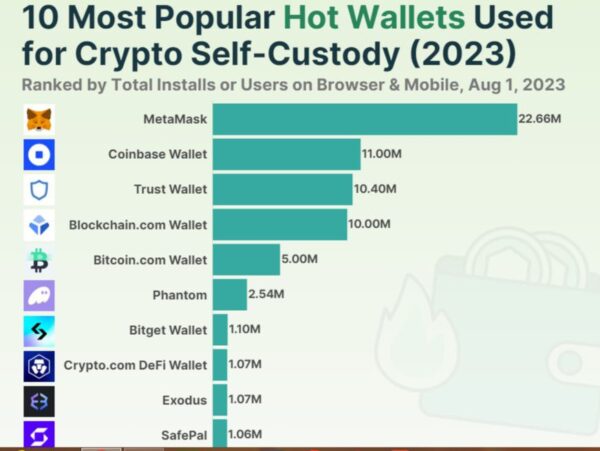
It bears mentioning that the stats provided by Worldcoin have yet to be officially verified by top crypto aggregate platforms. As of August 2023, CoinGecko published a list of the top 10 hot wallets used for crypto custody. 

Most downloaded hot wallets
Most downloaded hot wallets | CoinGecko

The top five wallets such as Metamask, Coinbase Wallet, Trust Wallet, Blockchain.com Wallet, and Bitcoin.com Wallet, boast 22.66M, 11M, 10.4M, 10M, and 5M downloads, respectively. However, the World App was not listed among the top 10 hot wallets with the most downloads, even though the last app on the list, SafePal, had about 1.06M downloads. 

If CoinGecko verifies Worldcoin’s claim, the World App could sit in the sixth position on the list of most downloaded hot wallets. 

World App Features 

For context, the World App is the native wallet of Worldcoin, developed and managed by Tools for Humanity. According to the team, World App on Android and iOS is significantly smaller in size, 18MB, compared to the industry’s average hot wallet. 

Interestingly, the app supports multiple languages and devices, as the wallet was designed to be used by everyone. In September, the wallet was significantly upgraded to make transactions more scalable and cost-efficient. This, according to Worldcoin, boosted the number of transactions on the app. 

Worldcoin is an ambitious project allowing users to prove they are humans by scanning the iris. The user is given a “World ID” after the system has confirmed their proof of humanity. Early users who completed the verification received 25 WLD, Worldcoin’s native token. 

At the time of writing, WLD was changing hands at $1.81, down 4% over the past 24 hours. Since its introduction, WLD has been listed across top crypto exchanges, including Binance, KuCoin, and Gate.io. 

SafeMoon Crashes 77% to $0.00004327 as SEC Charges Team for $200M Fraud

0

SafeMoon plummeted over 77% after the SEC charged the project’s team with fraud, alleging they rugged and misappropriated $200 million.

The crypto market has sustained the green trend that commenced last week, with many assets recording surprising price gains. However, the SafeMoon token is seeing an equally shocking price performance amid the market bull rally. 

In particular, CoinMarketCap data shows SafeMoon’s price has experienced a dramatic 77.80% decrease within the past 24 hours. This bearish performance is particularly concerning, considering that SafeMoon had been on a bullish trajectory in the past 30 days.

Safemoon
SafeMoon Chart | CoinMaketCap

U.S. Regulator Charges SafeMoon Team for Fraud

The cause of the steep decline in SafeMoon’s value remains glaring. On November 1, the U.S. SEC took legal action against the parent company, SafeMoon LLC. The regulator also charged the company’s executive team. It included SafeMoon’s founder, Kyle Nagy; Chief Executive Officer, John Karony; and Chief Technology Officer, Thomas Smith.

According to the official report, the SEC asserted that the individuals orchestrated “a massive fraudulent scheme” via SafeMoon token. The SEC claimed SafeMoon was a security its founder and executives failed to register.

Furthermore, the U.S. regulator alleged that the defendants had promised SafeMoon investors significant profits under the guise of taking the token “Safely to the moon.” However, instead of delivering on this promise, they allegedly rugged the project, causing substantial market losses.

Specifically, the SEC mentioned the SafeMoon team withdrew over $200 million in crypto assets from the project and misappropriated investor funds for personal use. The SEC alleged that the executives used users’ funds to finance extravagant purchases, such as McLaren cars and luxury homes.

Moreover, the SEC’s complaint stated that SafeMoon founder Nagy assured investors their funds were secure and locked in SafeMoon’s liquidity pool. In contrast, significant portions of the liquidity pool were never locked. 

David Hirsch, Chief of the SEC Enforcement Division, highlighted concerns about the DeFi sector, citing its susceptibility to fraudulent activities. Hirsch emphasized that unregistered offerings in decentralized finance lack the necessary disclosures and accountability required by the law, making them attractive to individuals like Kyle Nagy, who exploit these vulnerabilities to profit while harming others.

SafeMoon Suffers Impact

Expectedly, this development has pushed the token’s price into the abyss with a 100% crash in sight. The coin now trades at $0.00004536, from 0.0001832 yesterday.


Screenshot 2023 11 02 153349
SafeMoon nears 100% price crash in 24 hours.

Interestingly, amid the sustained drop, SafeMoon witnessed a massive spike in trade volume. The asset’s volume has surged 125% to $2.9 million over the last 24 hours. This indicates that market participants have trooped to the scene to sell off their holdings.

How To Establish Business With Cryptocurrency: Exchange & Wallet

0

Cryptocurrency offers innovative solutions and opportunities for those willing to venture into the digital frontier. In this guide, we’ll explore how to establish a business with cryptocurrency. You will learn the fundamentals of starting a cryptocurrency business.

Foundations of Cryptocurrency Business

To begin, it’s essential to understand the core concepts of cryptocurrency, crypto exchanges, and crypto wallets. These will be the building blocks.

Essential Definitions

  • A cryptocurrency is a digital currency based on cryptographic technologies for security.
  • A cryptocurrency exchange is a platform for trading digital assets.
  • A cryptocurrency wallet is an instrument for storing, sending and receiving cryptocurrencies.

If you’re interested in ready-made solutions for your crypto business, check out crypto exchange software and a white label crypto wallet.

Business Plan

A clear and comprehensive business plan is the bedrock of any successful venture, and the world of cryptocurrency is no exception. Here’s why the business plan matters:

  • Strategic Direction: A well-structured business plan outlines your company’s mission, vision, and strategic goals;
  • Investor Confidence: If you’re seeking investment or funding, a well-documented business plan demonstrates your commitment and seriousness to potential investors;
  • Resource Allocation: Your plan details the resources required for your cryptocurrency project, such as technology, personnel, and capital;.
  • Risk Assessment: Through careful analysis, a business plan helps you identify potential risks and challenges, then develop strategies to mitigate these risks;
  • Market Analysis: Analyzing the market, you get insights about your target audience, market trends, and competitors;
  • Legal and Regulatory Compliance: An elaborated business plan gives an understanding of the legal framework.

Legal and Regulatory Considerations

  • AML and KYC: Introduce Anti-Money Laundering (AML) and Know Your Customer (KYC) regulations are innate for identifying and preventing illicit activities;
  • Licensing and Registration: Register your business to operate legally. Seek legal counsel if necessary;
  • Taxation: Understand the tax implications of your jurisdiction and comply with tax laws;
  • Data Protection: Implement stringent data protection measures to safeguard user information and be compliant with data protection laws such as GDPR (General Data Protection Regulation);
  • Security Regulations: Ensure your platform’s security measures align with security requirements to protect users’ assets;
  • Consumer Protection: Adhere to consumer protection laws and regulations, which may include mechanisms for dispute resolution and compensation in case of losses;
  • Financial Regulations: Depending on your region, you might need to comply with financial regulations. This may include capital requirements, financial reporting, and audit procedures;
  • International Compliance: If you operate internationally, understand and adhere to the regulatory requirements of each country where you offer your services.

Starting Cryptocurrency Business

The following guide is a versatile roadmap suitable for any type of business within the cryptocurrency domain, including a crypto exchange and a crypto wallet.

Choose Type

One of the first decisions you’ll make is selecting the type of exchange or wallet to establish. Your choices will significantly impact the nature and scope of your crypto enterprise.

Types of crypto exchanges

  • Centralized exchanges (CEX) are traditional exchanges where a central authority manages the order book, trading, and security. CEXs are highly liquid and user-friendly but require more regulatory compliance. Examples: Binance, Coinbase.
  • Decentralized exchanges (DEX) function using blockchain technology, without a central authority. Instead, users engage in direct trading with each other through smart contracts. DEXs feature enhanced privacy and control but have lower liquidity. Examples: Uniswap, SushiSwap.
  • Hybrid exchanges combine elements of centralized and decentralized exchanges. They aim to provide the benefits of both models. Examples: BitShares, CryptoBridge.

Types of crypto wallets

  • Software wallets are software programs installed on computers or mobile devices. Examples: Electrum, Trust Wallet.
  • Hardware wallets are physical devices for offline storage of cryptocurrencies. Examples: Ledger Nano S, Trezor.
  • Paper wallets are physical documents with a public address and a private key.
  • Mobile wallets are apps for mobile devices.
  • Web wallets are programs for web browsers.

Research Market

As you choose the type that best aligns with your business objectives, remember that your decision should factor in aspects like your target audience, geographic reach, and the specific cryptocurrencies you plan to support.

Adjust Technical Requirements

It’s imperative to adjust your technical requirements comprehensively. Your success hinges on having the right infrastructure, technology, and security measures in place.

  • Your exchange must be hosted on reliable servers with sufficient bandwidth to handle high trading volumes. Consider load balancing to ensure consistent performance during peak trading hours. Scalability is crucial, as your platform should seamlessly accommodate a growing user base without disruptions.
  • Selecting the appropriate trading engine, matching algorithms, and order book architecture is pivotal. The technology stack should be robust, capable of handling rapid order execution, and supporting a variety of order types.
  • Security Measures: Stringent security protocols include cold storage for digital assets, two-factor authentication (2FA) for user accounts, regular security audits to identify vulnerabilities.

Manage Liquidity

In the realm of cryptocurrency exchanges, liquidity is the lifeblood that keeps the trading engine running smoothly. Liquidity means how easily assets can be bought or sold without causing substantial price fluctuations.

To manage liquidity effectively, incentivize market makers, encourage trading pairs with higher trading volumes, provide liquidity through trading competitions or other mechanisms.

Provide Security

Cryptocurrency businesses are prime targets for malicious actors. Thus, a multi-layered security approach is essential to fortify your defense.

Fundamental security measures include:

  • Advanced encryption techniques,
  • 2FA for user accounts,
  • Cold storage,
  • Regular security audits,
  • Penetration testing,
  • Compliance with industry standards.

Meet Regulations

It is not enough to merely understand the current regulatory environment; you must stay informed about and satisfy the continuously changing rules.

Educate Users

Ensuring that your users are well-informed about the best practices for platform usage and security is vital.

User education should encompass:

  • Safeguarding private keys,
  • Using secure and trusted platforms,
  • Recognizing potential scams and phishing attempts.

Encourage users to enable 2FA to add an extra layer of protection to their accounts and provide resources on how to manage and recover lost or compromised assets.

Promoting Cryptocurrency Business

Building a successful cryptocurrency business also involves effective marketing and promotion:

  • Branding: Build up a strong brand identity to give prominence to your project;
  • User Attraction and Retention: Concentrate on acquiring and retaining users;
  • Customer Support: Offer top-notch customer support to build trust and credibility;
  • Social Media and Partnerships: Leverage social media and partnerships for effective promotion;
  • Competitive Landscape: Understand the competitive landscape of the crypto industry and carve out your niche.

Challenges of Cryptocurrency Business

Starting a cryptocurrency business comes with challenges that require careful consideration and strategic planning. Here’s a brief overview of hurdles:

  • Regulatory Uncertainty: The crypto regulatory landscape is still maturing, thus compliance can be complex and varied;
  • Security Threats: Cryptocurrency businesses are prime targets for cyberattacks and hacking due to the potential for significant financial gains;
  • Liquidity and Market Competition: Attracting users to a new exchange can be burdensome, especially with established competitors;
  • Technical Challenges: Building and maintaining a cryptocurrency exchange or wallet requires a deep understanding of blockchain technology and scalability;
  • Market Volatility: Cryptocurrency markets are volatile, which can be both an opportunity and a risk.

Opportunities of Cryptocurrency Business

While the challenges are daunting, crypto businesses also present opportunities for innovation and growth:

  • Financial Inclusivity: Cryptocurrency extends financial services to underbanked and unbanked populations worldwide;
  • Innovation and Technology: As an operator, you can tap into innovation, creating unique services and products that solve real-world problems;
  • Global Reach: The decentralized nature of cryptocurrencies allows your business to operate on a global scale, reaching a vast and diverse audience;
  • High Growth Potential: You can benefit from the potential for high returns on investments and business growth;
  • Diversification: Cryptocurrency businesses can diversify their income streams by offering various services, such as trading, lending, staking, or wallet services;
  • Disrupting Traditional Finance: Cryptocurrencies challenge traditional financial systems. Operators can play a role in reshaping the finance industry;
  • Partnerships and Collaboration: Operators can build partnerships with other projects, potentially expanding their reach and offering a broader range of services to users;
  • Ecosystem Development: By contributing to the crypto ecosystem, operators can help shape its future.

The challenges are indeed substantial, but even more so are the opportunities for those with the vision and determination to venture into this dynamic landscape.

Establishing a business with cryptocurrency is a promising endeavor. With a well-defined plan, adherence to regulatory requirements, and a strong focus on security, you can navigate the crypto landscape successfully.